
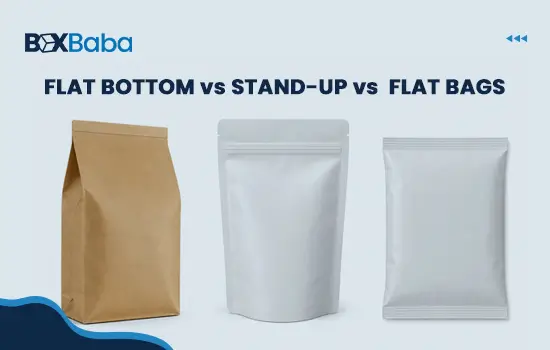
Flat-bottom pouches, stand-up pouches, and flat bags package coffee, snacks, supplements, powders, pet treats, samples, and dry goods for USA retail and ecommerce brands. The wrong format can raise unit cost, weaken shelf presence, waste storage space, or fail the product’s barrier needs.
The right format protects the product, fits the sales channel, supports the fill weight, and looks correct on the shelf or in the customer’s hand.
This guide compares the three most common custom Mylar bag formats side by side. It explains where each format wins, where each format struggles, how film structure affects protection, what changes pricing and MOQ, and what details to send BoxBaba before requesting a custom pouch quote.
What Are Flat-Bottom Pouches, Stand-Up Pouches, and Flat Bags?
Flat-bottom pouches, stand-up pouches, and flat bags are flexible Mylar pouch formats used for coffee, snacks, supplements, powders, pet food, samples, and other dry goods.
A flat-bottom pouch, also called a box pouch or quad-seal pouch, stands upright on a square sealed base and usually offers five printable panels.
A stand-up pouch, also called a doypack, stands on a curved bottom gusset and gives brands front, back, and gusset print zones.
A flat bag, also called a lay-flat bag or 3-side seal pouch, lies flat and does not stand on its own.
Each format can work well, but the best choice depends on product weight, shelf display needs, barrier requirements, shipping method, MOQ, and budget.
Flat-bottom pouches give the strongest retail shelf presence. They are a strong fit for premium coffee, granola, pet treats, larger supplement fills, and products that need a box-like pouch shape.
Stand-up pouches are the most flexible all-rounder. They fit snacks, powders, supplements, gummies, coffee, and DTC products that need a balance of shelf display, cost control, and resealable convenience.
Flat bags usually carry the lowest unit cost and ship most efficiently. They fit sample packs, single-serve products, lightweight dry goods, refill packs, and ecommerce products that do not need upright shelf stability.
Film structure matters as much as pouch format. A foil-laminated flat bag can protect better than a weak-barrier flat-bottom pouch if the product needs stronger oxygen, moisture, light, or aroma protection.
Quick Decision
A flat-bottom pouch wins on shelf presence, a stand-up pouch wins on versatility, and a flat bag wins on compact cost-efficient packaging.
| Decision Factor | Flat-Bottom Pouch | Stand-Up Pouch | Flat Bag |
|---|---|---|---|
| Shelf presence | Strongest | Strong | Weak |
| Ecommerce shipping | Good | Good | Strongest |
| Typical structure | Five-panel box-style pouch | Front, back, and bottom gusset | Two-panel lay-flat pouch |
| Print area | Front, back, side gussets, bottom | Front, back, gusset | Front and back |
| Best for | Premium coffee, granola, pet treats, retail shelf products | Snacks, supplements, powders, gummies, DTC products | Samples, single-serve packs, refills, lightweight goods |
| Unit cost tendency | Highest of the three | Mid-range | Lowest of the three |
| Resealable zipper fit | Common | Very common | Possible, but less common |
| Degassing valve fit | Common for coffee | Common for coffee | Less common |
| Hang hole fit | Possible | Possible | Common |
| Best buyer profile | Retail-focused brand | Multi-channel DTC or retail brand | Sample, ecommerce, or cost-sensitive brand |
What Each Pouch Format Actually Is
Each format is a flexible Mylar pouch, but the dieline, panel count, base structure, and seal layout change how the pouch behaves on the shelf, in a shipping box, and during customer use.
Flat-Bottom Pouch: Box Pouch or Quad-Seal Pouch
A flat-bottom pouch uses a square base, front panel, back panel, and side gussets to stand like a soft box.
This structure gives the pouch strong shelf stability and more printable surface area than standard pouch formats. Coffee roasters, premium snack brands, pet treat companies, and specialty food brands often choose flat-bottom pouches when retail presentation matters.
Flat-bottom pouches can support resealable zippers, tear notches, degassing valves, hang holes, matte finishes, gloss finishes, foil accents, and other custom features depending on the pouch design and material structure.
For products that need a structured retail pouch, compare BoxBaba flat-bottom box pouches.
Stand-Up Pouch: Doypack
A stand-up pouch uses a front panel, back panel, and bottom gusset that expands when filled.
The format is popular because it works across many product types and sales channels. Snack brands, supplement companies, coffee brands, powder brands, and DTC businesses often use stand-up pouches because they balance shelf appeal, cost, and practical handling.
Stand-up pouches can support zippers, tear notches, hang holes, windows, valves, and custom printing. They are often the safest starting point when a brand needs one pouch format for retail, ecommerce, and wholesale.
Flat Bag: Lay-Flat or 3-Side Seal Pouch
A flat bag is a two-panel pouch sealed on three sides. It lies flat and does not stand upright.
Flat bags work best when shelf display is not the main goal. They are useful for product samples, single-serve portions, refill packs, promotional inserts, spice samples, tea samples, supplement sachets, and lightweight ecommerce items.
Because they store flat and use less structure, flat bags can reduce cube space and shipping bulk. For lay-flat packaging needs, review BoxBaba flat Mylar bags.
When a Flat-Bottom Pouch Is the Right Fit
Choose a flat-bottom pouch when the product needs premium shelf presence, stronger standing stability, and more printable panels.
Flat-bottom pouches are ideal for products that compete visually in retail. The box-like shape creates a clean shelf block, and the side panels give brands more space for ingredients, flavor systems, nutrition details, certifications, QR codes, and product storytelling.
Use a flat-bottom pouch when:
- The product sells in specialty retail, grocery, coffee shops, pet stores, or supplement stores.
Shelf presence influences the purchase decision. - The product has enough fill weight to support the pouch structure.
- The brand needs front, back, and side-panel artwork.
- Premium presentation justifies a higher unit cost.
- The product needs zipper, valve, tear notch, or hang-hole options.
Specialty coffee roasters often compare flat-bottom pouches with custom coffee bags when whole-bean shelf presence, aroma protection, and degassing valve placement matter.
Limitation: Flat-bottom pouches usually cost more than stand-up pouches or flat bags because they use a more complex structure. Confirm the current MOQ, dieline, film structure, and finishing compatibility before final artwork approval.
When a Stand-Up Pouch Is the Right Fit
Choose a stand-up pouch when the product needs a flexible all-purpose format for retail, ecommerce, wholesale, or DTC sales.
Stand-up pouches work well for snacks, powders, supplements, gummies, granola, pet treats, dried fruit, coffee, and many dry goods. The format gives buyers strong branding space without the extra structure of a flat-bottom pouch.
Use a stand-up pouch when:
- The product sells through both ecommerce and retail.
- The brand needs a resealable zipper.
- The pouch needs strong front-panel branding.
- The order may include multiple flavors or SKUs.
- The buyer wants a practical balance between cost and shelf appeal.
- The product does not need the box-like structure of a flat-bottom pouch.
Stand-up pouches are often the best choice for early-stage brands because they support product testing, SKU expansion, and channel flexibility.
Limitation: Stand-up pouches do not look as structured as flat-bottom pouches in premium retail displays. Heavier fills may also need stronger material, a different gusset structure, or a flat-bottom format.
When a Flat Bag Is the Right Fit
Choose a flat bag when the product is lightweight, sample-size, single-serve, or ecommerce-focused.
Flat bags are simple, compact, and efficient. They store easily, ship efficiently, and usually require less structure than standing pouches. They are useful when the buyer does not need a pouch that stands upright.
Use a flat bag when:
- The product is a sample, trial pack, or single-serve portion.
- Lower unit cost is more important than shelf blocking.
- The product ships through ecommerce, subscription boxes, or promotional kits.
- A hang hole or euro-slot fits the retail display method.
- The product is lightweight and does not need strong standing support.
- The brand needs a compact refill or insert-style package.
Flat bags are also useful for small SKU tests because they keep packaging simple.
Limitation: Flat bags do not stand on shelves. They also offer less display impact than flat-bottom or stand-up pouches. Resealable zippers may be possible, but zipper availability depends on pouch size, format, and production requirements.
Mylar Film Structure Matters More Than Format Alone
Pouch format controls shape, but film structure controls much of the product protection.
A flat-bottom pouch, stand-up pouch, and flat bag can all perform differently depending on the film stack. Two pouches with the same shape can have very different oxygen, moisture, aroma, light, and puncture resistance if they use different materials.
Common Mylar pouch film structures include:
| Film Structure | Typical Use | Buyer Note |
|---|---|---|
| PET / AL / PE | Coffee, oxygen-sensitive supplements, high-fat snacks, aroma-sensitive products | Foil-laminated structures can provide stronger barrier protection, but confirm suitability for the product. |
| PET / MET-PET / PE | Snacks, granola, pet treats, dry foods | Metallized PET can offer a practical balance between barrier and cost. |
| PET / PE | Clear or window pouches, lower-barrier applications | Useful when product visibility matters, but barrier needs must be reviewed. |
| Kraft outer with foil or PE liner | Coffee, natural-positioned foods, premium dry goods | Gives a kraft appearance while using an inner liner for protection. |
A flat bag with the right barrier film may protect a single-serve product better than a flat-bottom pouch with the wrong film. Choose format and film together.
For food, coffee, supplement, CBD/hemp where legally applicable, or regulated-product packaging, ask BoxBaba to confirm material suitability, closure requirements, labeling needs, documentation, and any state-specific or retailer-specific requirements before production.
Printing, Finishes, and Shelf Appeal by Format
Print area changes by pouch format. Flat-bottom pouches give the most printable space, stand-up pouches give strong front and back branding, and flat bags give the simplest print layout.
Flat-bottom pouches can carry front, back, side gusset, and bottom-panel branding. This helps brands that need ingredient details, flavor systems, certifications, usage instructions, QR codes, or premium retail storytelling.
Stand-up pouches work well for bold front-facing branding, product claims, supplement panels, snack flavors, and DTC product systems.
Flat bags work best for simpler artwork, sample packs, refill packaging, promotional goods, and lightweight products.
Common printing and finish options may include:
- Digital printing for short runs, samples, test launches, and multi-SKU orders.
- Flexographic printing for larger repeat orders.
- Rotogravure printing for high-volume consistent runs.
- CMYK printing for full-color artwork.
- PMS or Pantone matching for brand color accuracy.
- Matte lamination for a soft, premium finish.
- Gloss lamination for shine and stronger color pop.
- Soft-touch coating for tactile brand feel.
- Spot UV for logo or design emphasis.
- Foil stamping, embossing, or debossing when compatible with the pouch material and design.
Limitation: Premium finishes can raise cost and increase proofing or setup complexity. Foil stamping, embossing, debossing, and spot UV should be confirmed against the exact film structure before production.
Cost Factors That Change Custom Pouch Pricing
Pouch pricing depends on multiple inputs working together, not pouch format alone.
A small flat bag with complex print, premium finish, and PMS matching may cost more than a simple stand-up pouch. A flat-bottom pouch may cost more because of structure, but it may also create stronger shelf value for premium products.
Main cost factors include:
| Cost Factor | How It Affects the Quote |
|---|---|
| Pouch format | Flat-bottom pouches usually require more structure than stand-up pouches or flat bags. |
| Film structure | Foil-laminated, metallized, kraft, and clear-window films can change cost and protection. |
| Size and fill weight | Larger pouches use more material and can affect carton packing. |
| Print method | Digital, flexographic, and rotogravure printing fit different order sizes. |
| Print coverage | Full-coverage artwork can cost more than simple logo placement. |
| Color matching | PMS / Pantone matching may require additional proofing. |
| Finish | Matte, gloss, soft-touch, spot UV, foil, embossing, and debossing can change cost. |
| Add-ons | Zippers, valves, tear notches, hang holes, and child-resistant closures can affect pricing. |
| Quantity | Higher quantities may reduce unit cost, but require more inventory planning. |
| Proofing | Digital proofs and physical samples can affect timeline and budget. |
| Shipping | Destination, carton size, and freight method affect landed cost. |
The safest quote request includes format, size, material, quantity, print, finish, add-ons, artwork status, and shipping destination.
MOQ and Quantity Planning by Print Method
MOQ is shaped by print method, pouch format, material, finish, and production setup.
Digital printing usually supports lower-volume custom pouch orders because it avoids plate setup. Flexographic printing often fits medium-to-large repeat orders. Rotogravure printing usually fits high-volume production where setup cost can be spread across a larger run.
The ranges below are planning-level industry ranges. They are not guaranteed BoxBaba MOQs. Ask BoxBaba to confirm the current MOQ for your exact pouch format, material, size, print method, and finish.
| Print Method | Planning-Level MOQ Range | Best Use Case |
|---|---|---|
| Digital printing | Often used for lower-volume runs | Test launches, seasonal SKUs, multi-SKU orders, startup campaigns |
| Flexographic printing | Often used for medium-to-large runs | Established products, growing DTC brands, wholesale orders |
| Rotogravure printing | Often used for large-volume runs | National retail, long repeat runs, consistent high-volume artwork |
Why MOQs Change
Plate and cylinder costs affect MOQ. Flexographic and rotogravure printing require setup that becomes more cost-effective across larger quantities.
Setup time affects waste. Press alignment can create material waste before approved units are produced.
Material compatibility affects method choice. Some films, finishes, and pouch structures work better with certain print methods.
SKU count affects quantity planning. Ten flavors at low volume can be harder to produce cost-effectively than one or two core SKUs.
Practical Quantity Planning Formula
Use this simple model before requesting a quote:
- Estimate monthly unit sales per SKU.
- Decide how many months of inventory you want between reorders.
- Multiply monthly sales by the reorder window.
- Compare that number with the MOQ for the pouch format and print method.
- Reduce SKU count, simplify the dieline, or choose digital printing if MOQ exceeds practical demand.
Lower MOQs can reduce inventory risk, but they may increase unit cost. Larger runs can improve unit economics, but they require cash flow, storage space, and stronger demand forecasting.
Production Timeline, Samples, and Proofing
Production timing depends on artwork approval, order confirmation, payment status, pouch format, material availability, print method, finish, proofing needs, and shipping destination.
Do not plan only around production days. A realistic launch schedule should include artwork preparation, dieline review, proof approval, production, freight transit, and a small buffer for changes.
Proofing Options
| Proofing Option | Best Use | Buyer Benefit |
|---|---|---|
| Digital proof | Checking layout, copy, logo placement, dieline alignment, and panel flow | Catches artwork issues before production. |
| 3D mockup | Reviewing pouch shape, shelf appearance, and visual presentation | Helps visualize the finished package. |
| Blank sample | Testing size, fill weight, product fit, zipper position, and pouch structure | Helps confirm physical fit before printing. |
| Printed sample | Checking color, finish, material feel, zipper function, valve placement, and shelf presentation | Reduces risk before bulk production. |
Sampling and proofing catch dieline, color, material, and closure issues before they become a bulk-order problem. A pouch can look correct on screen but fail in real use if the fill weight, seal area, zipper location, valve placement, or product dimensions are wrong.
Ask BoxBaba to confirm available proofing options, current production timing, and rush availability during the quote stage.
Tradeoffs Coffee, Snack, and Supplement Brands Should Expect
Good pouch decisions come from tradeoffs, not isolated features.
| Tradeoff | What It Means |
|---|---|
| Shelf appeal vs unit cost | Flat-bottom pouches look stronger on retail shelves, but usually cost more than simpler pouch formats. |
| Versatility vs premium structure | Stand-up pouches fit many products, but may not look as premium as flat-bottom pouches. |
| Shipping efficiency vs shelf stability | Flat bags ship efficiently, but do not stand upright. |
| Small quantity vs better unit pricing | Lower-volume runs reduce inventory risk, while larger runs may lower unit cost. |
| Premium finish vs production simplicity | Foil, spot UV, soft-touch, embossing, and debossing can improve presentation but add complexity. |
| Sustainability preference vs barrier performance | Recyclable or compostable claims must be verified against the exact film structure and end-of-life pathway. |
| One pouch format vs channel-specific packaging | One format can simplify ordering, but separate retail and sample formats may fit better. |
Brands should choose the format that matches the product’s real selling environment, not the format that looks best in isolation.
Retail vs Ecommerce: Format Fit by Sales Channel
Sales channel often decides pouch format faster than product type.
| Sales Channel | Best-Fit Format | Why It Fits |
|---|---|---|
| Specialty retail | Flat-bottom pouch | Strong shelf presence and more print panels for brand story. |
| Grocery or supplement retail | Flat-bottom pouch or stand-up pouch | Depends on fill weight, shelf set, and brand positioning. |
| DTC ecommerce | Stand-up pouch | Balanced branding, protection, and fulfillment efficiency. |
| Subscription boxes | Flat bag or small stand-up pouch | Compact packaging fits inside mailers or kits. |
| Sample campaigns | Flat bag | Lightweight and cost-efficient. |
| Peg-hook retail | Flat bag with hang hole or stand-up pouch with hang hole | Display depends on weight and pouch structure. |
| Wholesale / multi-channel | Stand-up pouch | Flexible across multiple sales channels. |
For ecommerce shipments, pouches may still need secondary protection. DTC brands can compare BoxBaba shipping boxes when pouch shipments need outer protection, carton branding, or a stronger unboxing experience.
When None of These Pouches Are the Right Fit
Flat-bottom pouches, stand-up pouches, and flat bags do not fit every product.
Consider another packaging option when:
- The product is fragile and needs stronger crush protection.
- The product is liquid or semi-liquid and needs a spouted pouch, bottle, or jar.
- The product is bulky, dense, or too heavy for standard flexible pouch handling.
- The product needs inserts, trays, or rigid support.
- The brand wants a premium gift presentation.
- The product requires verified child-resistant packaging or retailer-specific compliance documentation.
If the product needs luxury presentation, stronger structure, or inserts, rigid boxes may fit better than flexible Mylar pouches.
Compliance Cautions for USA Food, Coffee, and Supplement Brands
Compliance requirements vary by product type, state, claim, ingredient, and distribution channel. Treat this section as a packaging planning checklist, not legal advice.
Food-contact suitability: Food, coffee, snack, and supplement brands should ask BoxBaba to confirm the exact film structure, ink system, and documentation required for the product and sales channel.
Supplement labeling: Supplement pouches may need accurate Supplement Facts panels, ingredient statements, manufacturer information, net quantity, warnings, and claim review. Review labels before approving artwork.
Child-resistant claims: Do not market a pouch as child-resistant unless the closure or packaging system has the required certification for the intended use.
Sustainability claims: Recyclable, compostable, biodegradable, and eco-friendly claims depend on material structure and applicable rules. Confirm any claim before printing it on the pouch.
State-specific rules: Requirements such as California Proposition 65 may apply depending on ingredients, claims, and distribution.
A compliant-looking pouch is not the same as a compliant package. Confirm requirements before production.
How to Move From Comparison to a BoxBaba Quote
The fastest path to a useful quote is to send the format, dimensions, fill weight, film, finish, add-ons, quantity, artwork, timeline, and shipping destination in one message.
BoxBaba can then help compare whether a flat-bottom pouch, stand-up pouch, or flat bag fits the product, channel, and budget. The team may also recommend another option if the product needs shipping boxes, rigid boxes, stronger barrier film, a different pouch structure, or additional compliance review.
Before final approval, confirm:
- Final pouch dimensions
- Material and barrier structure
- Closure and add-on placement
- Artwork and dieline accuracy
- Finish compatibility
- MOQ and unit price
- Proofing option
- Production timeline
- Shipping timeline
- Compliance-sensitive requirements
Start with BoxBaba custom Mylar bags page or visit BoxBaba to request a custom pouch quote.
Final Takeaway
The right pouch decision is rarely which format looks best. It is a mix of fill weight, sales channel, shelf-presence priority, unit-cost target, film structure, MOQ, timeline, and quote readiness.
Flat-bottom pouches win retail shelf presence. Stand-up pouches fit the widest range of products. Flat bags win ecommerce shipping efficiency and sample-pack cost control.
None of those advantages matter if the film structure is wrong for the product’s barrier needs. Choose the pouch format and material together before locking artwork.
Ready to choose the right pouch format? Send BoxBaba your format, dimensions, fill weight, film preference, finish, add-ons, quantity, artwork, timeline, and shipping destination. Clear inputs help BoxBaba confirm the best format, price, MOQ, and production path for your custom pouch order.
FAQs
Q: What is the best pouch format for specialty coffee?
A: Flat-bottom pouches often fit specialty coffee because they stand firmly and support premium shelf presentation. Stand-up pouches with degassing valves can also work for smaller DTC runs. Confirm valve placement, film structure, and seal strength before production.
Q: Are flat-bottom pouches more expensive than stand-up pouches?
A: Flat-bottom pouches usually cost more because they use a more structured dieline and more complex construction. Final pricing depends on size, material, print method, finish, quantity, and add-ons.
Q: What is the typical MOQ for custom Mylar pouches?
A: MOQ depends on pouch format, print method, material, finish, size, and quantity. Digital printing often supports lower-volume runs, while flexographic and rotogravure printing usually fit larger production volumes. Ask BoxBaba to confirm MOQ for your exact pouch.
Q: How long does it take to produce custom pouches?
A: Production timing depends on artwork approval, order confirmation, payment, material availability, proofing, print method, finish, and shipping destination. Confirm the current standard or rush timeline during the quote stage.
Q: Can flat bags have a resealable zipper?
A: Sometimes. Resealable zippers are more common on stand-up and flat-bottom pouches, but some flat bag designs can support zipper closures. Confirm zipper availability based on pouch size and dieline.
Q: Are degassing valves available for coffee pouches?
A: Degassing valves may be available for coffee pouch formats such as flat-bottom and stand-up pouches. Confirm valve type, placement, seal area, and film structure before approving production.
Q: Which pouch format is best for ecommerce shipping?
A: Flat bags usually ship most efficiently because they lie flat and reduce package bulk. Stand-up pouches also work well for ecommerce, while flat-bottom pouches take more space but improve retail presentation.
Q: Are Mylar pouches suitable for food packaging?
A: Food packaging suitability depends on the exact film, ink system, product type, and intended use. Ask BoxBaba to confirm material suitability and documentation before producing food, coffee, or supplement packaging.
Q: Should I order a digital proof or a physical sample?
A: Order a digital proof when artwork layout is the main concern. Order a physical or printed sample when size, fill weight, seal strength, zipper function, valve placement, finish, or color accuracy matters.
Q: Can I print recyclable or compostable claims on Mylar pouches?
A: Only print recyclable, compostable, biodegradable, or eco-friendly claims after verification. These claims depend on material structure, end-of-life pathway, and applicable rules.
Q: What is the best pouch for supplement powders?
A: Stand-up pouches are often a practical choice for supplement powders because they support zippers, tear notches, strong front branding, and back-panel label space. Larger fills may need flat-bottom pouches.