
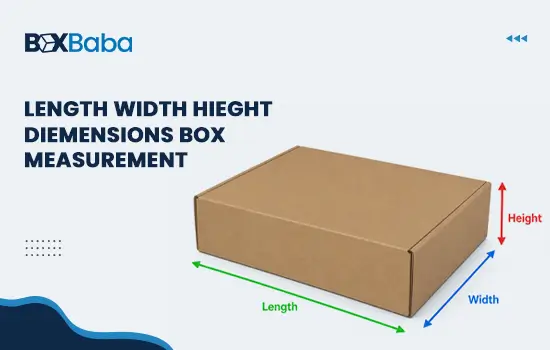
Length width height dimensions define the usable space, product fit, and shipping size of a custom box. For ecommerce brands, small businesses, packaging managers, and product-based companies, accurate box measurements help prevent loose products, crushed corners, oversized cartons, artwork errors, and quote delays.
Box dimensions also affect material choice, inserts, dimensional weight, storage space, retail presentation, and shipping cost. A box that fits the product well can reduce void fill and improve protection, while a poorly sized box can increase damage risk or create unnecessary shipping volume.
BoxBaba offers fully customized printed boxes in required material, size, and style, so accurate dimensions help the packaging team understand the buyer’s exact custom packaging request before quoting or production planning.
Length Width Height Dimensions
Length width height dimensions describe a box in three measurements: length × width × height. Length is usually the longest side, width is the shorter side across the opening, and height is the vertical depth of the box.
Box dimensions are usually written as length × width × height. Use internal dimensions for product fit and external dimensions for shipping, storage, and carrier entry. Before requesting a custom box quote, measure the product, add clearance, account for inserts, confirm the finished outside size, and send complete quote details.
BoxBaba Sizing Framework
Start with the product, not the box. Measure the product’s length, width, height, and weight first. Then choose the internal box size, add clearance for inserts or cushioning, confirm the external shipping size, and submit those details with your quote request.
Product dimensions → internal box size → clearance and inserts → material thickness → external box dimensions → quote request
This framework helps buyers avoid one of the most common custom packaging mistakes: ordering a box based only on the outside size without checking the usable inside space.
What Do Length, Width, and Height Dimensions Mean for a Box?
Length, width, and height define the shape and usable space of a box. These measurements help buyers choose the right custom box size for product fit, shipping efficiency, and packaging quotes.
| Dimension | What It Usually Means | Why It Matters |
|---|---|---|
| Length | The longest side of the box opening | Sets the main product direction |
| Width | The shorter side across the box opening | Controls side-to-side product fit |
| Height | The vertical depth of the box | Affects stacking, closure, inserts, and clearance |
For shipping, carriers often define length as the longest side of the package. UPS instructs shippers to measure the longest side first as length, then measure the next longest side as width, then measure the remaining side as height. UPS also says to round package dimensions up to the nearest whole number.
For custom packaging production, buyers should send accurate product dimensions, desired internal box dimensions, and intended shipping or retail use. A box that looks correct by outside size may still be wrong if the product, insert, or closure needs more usable internal space.
How to Measure Box Dimensions in the Correct Order
Measure a box by recording length first, width second, and height third. Keep the box square, measure from edge to edge, and use inches for most USA custom packaging and shipping conversations.
| Step | What to Do | Buyer Tip |
|---|---|---|
| 1 | Place the box on a flat surface | Avoid measuring a crushed or warped box |
| 2 | Measure the longest side | Record this as length |
| 3 | Measure the shorter opening side | Record this as width |
| 4 | Measure the vertical side | Record this as height |
| 5 | Confirm the unit | Use inches unless the supplier requests another unit |
| 6 | Separate production and shipping needs | Exact size helps production; rounded size may be needed for carrier entry |
For carrier shipping, dimensions may need to be rounded up. UPS says measurements from 1.01 to 1.99 inches should round up to 2 inches when entering package dimensions.
For custom box quoting, do not only send the outside size of an existing box. Send the product size, product weight, box style, desired fit, insert needs, artwork status, and shipping destination so the supplier can understand the full packaging requirement.
Internal vs External Dimensions: Which One Should You Use?
Use internal dimensions for product fit and external dimensions for shipping. Internal dimensions show the usable space inside the box, while external dimensions show the finished outside size after material thickness and structure are included.
| Dimension Type | Best Used For | Example |
|---|---|---|
| Product dimensions | Starting the box design | Measuring a candle jar, folded shirt, serum bottle, or jewelry tray |
| Internal dimensions | Product fit and inserts | Confirming the product fits inside the box |
| External dimensions | Shipping, storage, and shelf space | Entering parcel size or planning warehouse space |
| Dieline dimensions | Artwork and production layout | Placing logo, panels, folds, bleed, and cut lines |
This distinction matters because material thickness changes the final size. A rigid board box, corrugated shipping box, or folding carton may have different wall thickness and structural allowances.
Use this order before ordering custom packaging:
Product dimensions → internal box dimensions → clearance and inserts → material thickness → external dimensions
If the package includes foam inserts, paperboard inserts, molded pulp, dividers, or product trays, those inserts reduce usable space. A box can have the correct outside size and still fail if the inside space is too small.
Example: Measuring a Product for a Custom Box
A product’s dimensions are the starting point, not the final custom box dimensions. Buyers should add space for clearance, inserts, material thickness, and the intended packing method.
Example: a skincare jar measures 3 inches long, 3 inches wide, and 4 inches tall. If the brand wants a paperboard insert and a small clearance gap, the internal box dimensions may need to be larger than the product itself.
| Measurement Step | Example |
|---|---|
| Product size | 3″ × 3″ × 4″ |
| Clearance | Add space for easy packing and removal |
| Insert space | Add room for paperboard or foam structure |
| Internal box target | Example: 3.25″ × 3.25″ × 4.25″, depending on insert design |
| External box size | Final size depends on board thickness and structure |
Buyer takeaway: Measure the product first, then build the custom box size around the real packing method.
For skincare, makeup, and personal care products, custom cosmetic boxes can help buyers plan bottle fit, cap clearance, label protection, finish placement, and retail shelf presentation.
How Box Dimensions Affect Product Fit and Protection
Box dimensions affect how securely the product sits inside the package. A good custom box leaves enough space for the product, insert, and closure without creating unnecessary empty space.
A box that is too tight can scuff labels, crush corners, bend flaps, or make unboxing difficult. A box that is too large can let the product move, increase void fill, raise shipping cost, and weaken presentation.
| Fit Factor | Why It Matters |
|---|---|
| Product size | The box must fit the longest, widest, and tallest product points |
| Product shape | Irregular products need more careful clearance planning |
| Product weight | Heavy products may need stronger corrugated board or structural support |
| Insert type | Inserts reduce usable internal dimensions |
| Closure style | Tuck flaps, mailer locks, sleeves, and lids need working room |
| Retail presentation | Empty space can make the product look undersized |
| Ecommerce shipping | Movement inside the box can increase damage risk |
Fragile products usually need more controlled internal space than soft goods. Glass jars, candles, cosmetics, electronics, and gift sets may need inserts, dividers, or cushioning. Apparel, textiles, and lightweight accessories may need less rigid protection but still require the right fold size and presentation space.
Limitation: A smaller box may reduce empty space, but reducing size too aggressively can remove the cushioning or insert space needed for safe shipping.
How Shipping Box Dimensions Affect Cost and DIM Weight
Shipping box dimensions affect cost because carriers may price packages by space, not only by actual weight. Larger boxes can increase dimensional weight, storage space, and oversized handling risk.
Basic box volume is calculated as:
Length × Width × Height = cubic inches
UPS defines dimensional weight as the amount of space a package occupies compared with its actual weight and gives the formula as L × W × H ÷ divisor. UPS also notes that dimensional weight may apply to domestic and international package services.
For ecommerce sellers, right-sized packaging can reduce excess cubic volume, improve packing efficiency, and limit unnecessary DIM weight exposure. If the box must survive transit, buyers should compare custom shipping boxes before finalizing external dimensions.
USPS also uses parcel size standards. Postal Explorer states that most mailpieces may not exceed 108 inches in combined length and girth, with some very large USPS Retail Ground or Parcel Select packages over 108 inches but not more than 130 inches charged oversized pricing.
USPS has also published a final rule expanding the requirement to include accurate parcel dimensions in manifests, with an effective date of July 12, 2026.
Limitation: Shipping rules, divisors, fees, and service limits can change by carrier, service, account type, and date. Buyers should confirm current shipping requirements with their carrier, fulfillment provider, or shipping software before finalizing box dimensions.
Choosing the Right Custom Box Size by Product Type and Sales Channel
The right custom box size depends on the product’s shape, weight, fragility, sales channel, and presentation goal. Different products need different clearance, insert, and material decisions.
| Product Type | Sizing Priority | Packaging Notes |
|---|---|---|
| Apparel | Folded garment size | Mailer boxes or folding cartons may work depending on presentation and shipping needs |
| Cosmetics | Bottle, jar, cap, pump, and label protection | Measure the widest point, not only the container body |
| Jewelry | Centered presentation and insert fit | Rigid boxes or small cartons may need foam or paperboard inserts |
| Food or bakery items | Product shape and contact sensitivity | Confirm material suitability and labeling requirements before production |
| Subscription boxes | Full kit arrangement | Measure the packed layout, not only individual products |
| Electronics | Protection and movement control | Inserts, dividers, or corrugated structures may be needed |
| Fragile items | Cushioning and structural support | Allow room for protective material |
| Retail products | Shelf footprint and front-panel branding | Balance presentation with efficient sizing |
For lightweight retail cartons, buyers can review custom cardboard boxes before choosing final length, width, and height. BoxBaba cardboard box category explains that these boxes can be made in custom sizes with printing, inserts, partitions, die-cut options, and E/B/C flute options for different strength needs.
For subscription boxes, apparel, and DTC orders, custom mailer boxes may offer a practical balance of branding, protection, and ecommerce packing. For jewelry, candles, watches, and premium kits, custom rigid boxes may be better when presentation and insert fit matter more than low shipping volume.
For edible products, review custom food boxes and confirm material suitability, labeling needs, and product-specific requirements before production. Compliance requirements can vary by product type, claim, ingredient, state, and distribution channel.
Choose the Box Category Before Finalizing Dimensions
The best box dimensions depend on the packaging category, not only the product size. A product may fit inside several box styles, but each style changes protection, presentation, shipping cost, and quote requirements.
| Buyer Situation | Better Box Path | Why It Helps |
|---|---|---|
| Lightweight retail product | Custom cardboard boxes | Supports shelf packaging, print panels, and carton-style branding |
| Ecommerce product shipping directly to customers | Custom shipping boxes | Helps balance transit protection, external size, and DIM weight |
| Subscription, apparel, or DTC product | Custom mailer boxes | Supports branded unboxing with practical ecommerce packing |
| Jewelry, candles, watches, or premium gifts | Custom rigid boxes | Supports inserts, presentation, and higher perceived value |
| Bakery or food product | Custom food boxes | Requires extra caution around material suitability and labeling |
| Skincare, makeup, or personal care item | Custom cosmetic boxes | Helps plan bottle fit, cap clearance, finish, and retail display |
Buyer takeaway: Choose the packaging category first, then finalize length, width, height, material, inserts, printing, and shipping requirements.
Material, Insert, and Finish Factors That Can Change Box Size
Material and inserts can change usable and external box dimensions, while finishes can affect production setup, panel planning, and proofing.
| Packaging Factor | How It Can Affect Dimensions |
|---|---|
| Corrugated board | Flute thickness can increase outside dimensions |
| Rigid board | Thick board can reduce internal space if not planned correctly |
| SBS paperboard | Works for lighter folding cartons but may not suit heavy shipping needs |
| Kraft stock | Useful for natural-looking packaging, but strength depends on grade and structure |
| Foam inserts | Reduce internal space and require precise product cavities |
| Paperboard inserts | Need fold, lock, and tab allowances |
| Molded pulp | Can support protection goals but needs dimensional planning |
| Matte or gloss lamination | Usually affects finish more than size, but should be considered in production planning |
| Foil stamping or embossing | Can improve presentation but may add setup complexity |
E-flute is often selected for lighter printed packaging when a cleaner surface is needed, but the best flute depends on product weight, shipping method, and protection requirements. B-flute or stronger corrugated structures may be better for heavier or transit-sensitive products.
Printing choices such as CMYK, PMS/Pantone matching, digital printing, and offset printing should be confirmed after the dieline is approved because panel size, fold position, and print coverage depend on the final box dimensions.
Premium finishes such as matte lamination, gloss lamination, soft-touch coating, foil stamping, embossing, debossing, and spot UV can improve shelf appeal. However, they may also increase production complexity, proofing needs, or unit cost.
Limitation: Finish selection should not compensate for poor sizing. A premium finish cannot fix a box that is too loose, too tight, or structurally weak for the product.
Cost, MOQ, and Production Tradeoffs When Box Size Changes
Changing box dimensions can change material use, printing area, insert needs, tooling, shipping cost, and storage efficiency. Even a small size change can affect the final custom packaging quote.
Cost Factors
| Cost Driver | How Box Size Affects It |
|---|---|
| Packaging size | Larger boxes usually use more board, paperboard, or corrugated material |
| Material type | Corrugated board, rigid board, SBS paperboard, and kraft stock have different cost profiles |
| Board thickness or flute | Stronger structures can increase material use |
| Print coverage | More surface area can increase printing requirements |
| Color needs | PMS/Pantone matching may add production control requirements |
| Finish selection | Foil, embossing, debossing, spot UV, and soft-touch coating may increase complexity |
| Inserts | Foam, paperboard, molded pulp, or dividers add material and planning |
| Quantity / MOQ | MOQ can vary by box style, material, and order details; confirm before ordering |
| Sampling or proofing | Custom sizing may require dieline review or sample approval |
| Shipping destination | Larger external dimensions can increase freight or parcel costs |
| Deadline | Rush needs may affect production and shipping options; exact timing must be confirmed |
Buyer Tradeoffs
| Tradeoff | Practical Meaning |
|---|---|
| Stronger material vs lower unit cost | Heavier board may protect better but can cost more |
| Smaller box vs better protection | Reducing dimensions can lower volume but may reduce cushioning space |
| Premium finish vs production simplicity | Foil stamping or embossing can improve presentation but increase complexity |
| Retail shelf appeal vs ecommerce shipping efficiency | A larger display-friendly box may cost more to ship |
| Custom insert vs simpler packing | Inserts improve fit but require more accurate measurements |
| Small quantity vs bulk planning | Smaller runs may help testing; larger orders may improve unit economics, but MOQ must be confirmed |
Bad-Fit Cases
This box size may not be the right choice when:
| Bad-Fit Case | Why It Matters |
|---|---|
| The product touches every wall tightly | No room remains for inserts, cushioning, or easy removal |
| The product moves freely inside | Damage risk and poor unboxing may increase |
| The box is oversized for lightweight ecommerce shipping | DIM weight may increase shipping cost |
| The material is too weak for the product | A correct size still fails if the structure is underbuilt |
| The product is regulated | Material, labeling, and state-specific requirements may need review |
| The buyer needs verified certifications | Certifications must be confirmed before production |
Production Timeline Factors That Can Affect Custom Box Orders
Production timing can change when box dimensions require a new dieline, custom insert, specialty finish, sample approval, or revised artwork. Buyers should confirm timelines before ordering because production speed depends on structure, quantity, proofing, finishing, and shipping destination.
| Timeline Factor | Why It Matters |
|---|---|
| Dieline approval | Incorrect dimensions can delay artwork setup |
| Sample or proof request | Physical review can add time before production |
| Insert complexity | Foam, paperboard, or molded pulp inserts need extra planning |
| Finish selection | Foil stamping, embossing, and spot UV can add production steps |
| Quantity | Larger orders may need more production scheduling |
| Shipping destination | Delivery time depends on location and freight method |
| Artwork readiness | Missing or incorrect files can delay proofing |
| Size revisions | Changing L × W × H after proofing can require dieline updates |
Buyer takeaway: Finalize product dimensions, insert needs, material, and artwork before requesting production timing.
Common Box Measurement Mistakes to Avoid
Most box measurement mistakes happen when buyers measure only one side, confuse internal and external dimensions, or forget inserts, closures, and carrier rules.
| Mistake | Better Approach |
|---|---|
| Measuring only the product length | Measure length, width, height, and weight |
| Using outside dimensions for product fit | Use internal dimensions for usable box space |
| Ignoring material thickness | Account for corrugated, paperboard, or rigid board thickness |
| Forgetting inserts | Measure product plus insert structure |
| Measuring a damaged sample box | Use a flat, square, undamaged reference |
| Choosing oversized packaging for a premium feel | Balance presentation with shipping cost |
| Not rounding shipping dimensions | Follow carrier entry rules when creating labels |
| Not sharing the sales channel | Tell the supplier whether the box is for retail, ecommerce, gifting, or wholesale |
A buyer should send product photos, product dimensions, weight, box style, insert needs, artwork status, and shipping destination before requesting a quote. That helps the packaging supplier identify fit risks before production.
Quote-Ready Checklist for Box Dimensions
A quote-ready box request includes product size, desired box style, dimensions, quantity, material preference, printing needs, inserts, shipping destination, and deadline.
| Quote Input | What to Provide |
|---|---|
| Product type | Apparel, cosmetics, bakery item, jewelry, electronics, subscription kit, etc. |
| Product dimensions | Longest length, widest width, tallest height |
| Product weight | Needed for structure and shipping planning |
| Box style | Mailer box, folding carton, rigid box, corrugated shipping box, sleeve box, etc. |
| Internal dimensions | Desired usable space inside the box |
| External dimensions | Required shipping, storage, or shelf size if known |
| Quantity | Estimated order volume; confirm MOQ for the exact box style and material |
| Material preference | Corrugated board, SBS paperboard, kraft stock, rigid board, etc. |
| Printing | Logo, CMYK artwork, PMS/Pantone color needs, inside printing |
| Finish | Matte, gloss, soft-touch, spot UV, foil stamping, embossing, debossing |
| Insert requirement | Foam, paperboard insert, divider, molded pulp, or none |
| Artwork status | Dieline ready, logo only, or design help needed |
| Shipping destination | City/state or fulfillment location |
| Deadline | Desired in-hand date; exact production and delivery timing must be confirmed |
| Compliance sensitivity | Food, cosmetics, CBD/hemp, supplements, vape, or regulated claims |
| Reorder expectations | One-time order, seasonal packaging, or recurring wholesale packaging |
BoxBaba custom cardboard boxes page includes quote form fields for material, length, width, height, dimension units, quantity, printing side, message, and design upload, which matches the quote-readiness information buyers should prepare before submitting a request.
For sensitive categories such as food, cosmetics, CBD/hemp, supplements, vape, or medical-style products, confirm material suitability, labeling requirements, and state-specific rules before production. Compliance requirements vary by product type, claim, ingredient, state, and distribution channel.
Final Box Size Decision Summary
The right box size protects the product, controls internal movement, reduces excess cubic volume, and gives BoxBaba the information needed to quote the correct custom packaging structure.
Use this packaging size when:
- The product fits with enough clearance for packing and removal.
- The internal dimensions account for inserts, dividers, or cushioning.
- The external dimensions support shipping, storage, and shelf needs.
- The material fits the product weight and sales channel.
- The quote request includes dimensions, quantity, artwork, material, and shipping destination.
Consider another packaging option when:
- The product is fragile and needs more insert or cushioning space.
- The box creates excessive dimensional weight for ecommerce shipping.
- The product is too heavy for the selected board or carton style.
- The package needs verified food-contact, cosmetic, CBD/hemp, supplement, or child-resistant requirements.
- The buyer needs certifications or claims that have not been confirmed.
Final Takeaway
Length width height dimensions help buyers choose custom boxes that fit the product, protect the item, control empty space, and support more accurate shipping and quote planning. The safest approach is to measure the product first, decide the needed internal box space, add clearance or inserts, and then confirm the finished external dimensions before ordering.
FAQs About Length Width Height Dimensions
What does length width height mean for a box?
Length width height describes a box as L × W × H. Length is usually the longest side, width is the shorter side across the opening, and height is the vertical depth.
What order are box dimensions written in?
Box dimensions are usually written as length × width × height. Use the same order consistently when requesting a custom packaging quote.
Should I measure the inside or outside of a box?
Measure inside dimensions for product fit and outside dimensions for shipping. Internal size controls usable space, while external size affects parcel entry, storage, and freight.
How do I measure a box for shipping?
Measure the longest side as length, the next longest side as width, and the remaining side as height. Carriers may require dimensions to be rounded up.
Why do box dimensions affect shipping cost?
Box dimensions affect shipping cost because carriers may use dimensional weight. A large lightweight box can cost more than a smaller box with the same actual weight.
How much clearance should a custom box have?
Clearance depends on product shape, material, inserts, and shipping risk. Fragile products usually need more planned space than soft goods or compact retail items.
What dimensions should I send for a custom box quote?
Send product length, width, height, weight, desired box style, quantity, material preference, printing needs, insert needs, shipping destination, and deadline.
Can BoxBaba help choose the right custom box size?
BoxBaba offers fully customized printed boxes in required material, size, and style. Buyers should send complete product and quote details so the packaging request can be reviewed accurately.