
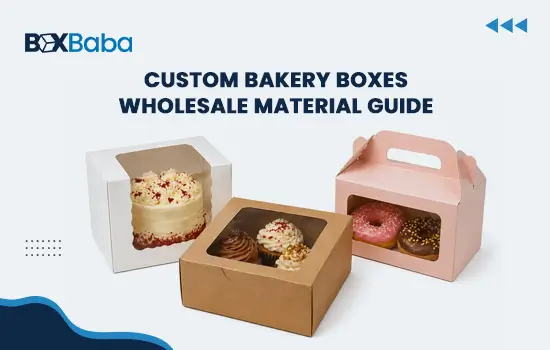
Wholesale bakery boxes must match the product’s weight, height, grease exposure, display need, and delivery method. A cake box, cupcake box, cookie box, pastry box, or dessert box should protect the product, fit the tray or cake board, present the brand, and give the packaging supplier enough details to quote accurately.
Before requesting a quote for custom bakery boxes, choose the material based on product risk. A lightweight cookie box may only need SBS paperboard or kraft stock. A tall decorated cake may need stronger board, extra height, and better base support. A cupcake box may need inserts to keep frosting from touching the lid or sides.
This guide helps bakeries, home bakers, cake decorators, dessert shops, event planners, and wholesale bakery buyers compare materials, styles, finishes, inserts, cost factors, and quote requirements before ordering custom bakery boxes wholesale.
What Are Custom Bakery Boxes Wholesale?
Custom bakery boxes wholesale are made-to-order packaging boxes for cakes, cupcakes, cookies, pastries, macarons, donuts, pies, brownies, and dessert assortments.
They can be customized by size, material, box style, printing, finish, window, insert, divider, and order quantity. Wholesale ordering is useful when bakeries need repeat packaging in consistent sizes and branded designs.
Custom bakery boxes can support several packaging goals at once:
- Product protection
- Retail display
- Pickup packaging
- Local delivery
- Dessert gifting
- Seasonal promotions
- Branded unboxing
- Wholesale bakery supply
- Event and catering packaging
The right bakery box should not be chosen by appearance alone. It should fit the product, support the product weight, reduce movement, handle grease or moisture when needed, and match the way the baked goods will be sold or delivered.
Best Bakery Box Material by Use Case
Choose SBS paperboard for clean printed retail boxes, kraft paper for natural bakery branding, corrugated board for heavier delivery orders, and rigid board for premium bakery gift packaging.
Here is the simple decision path:
Use SBS paperboard when print quality, clean color, and retail presentation matter.
Use kraft paper when the bakery wants a natural, rustic, or minimal look.
Use corrugated board when weight, stacking, delivery, or handling creates damage risk.
Use rigid board when the packaging must feel premium enough for gifting, weddings, corporate events, or luxury desserts.
Use inserts or dividers when cupcakes, macarons, truffles, cake jars, or dessert assortments need movement control.
Use window bakery boxes when product visibility matters for retail display, gift appeal, or impulse purchases.
How to Choose the Right Bakery Box Material
The safest bakery box is the one that matches the product’s damage risk: weight, frosting height, grease exposure, movement, stacking, and delivery distance.
A dry cookie does not need the same structure as a tall cake. A cupcake box needs movement control. A pastry box may need grease-resistant material or a liner. A premium macaron box may need dividers and a stronger presentation structure.
Use this buyer logic before choosing material:
For cookies and brownies:
SBS paperboard or kraft paper usually works when the product is lightweight and does not need heavy stacking strength. Add dividers or sleeves if the product is fragile or sold as a gift set.
For cupcakes:
Paperboard, kraft, or corrugated board can work, but inserts matter most. Cupcake inserts reduce movement and help protect frosting during pickup or delivery.
For decorated cakes:
The box needs enough height, base support, and side-wall strength. Measure the cake board, not only the cake diameter. Heavy cakes may need stronger paperboard or corrugated board.
For pastries:
Grease and moisture matter. Coated paperboard, grease-resistant stock, or liners may be needed depending on the pastry type and whether the product touches the box directly.
For macarons and dessert gifts:
Presentation and separation matter. Rigid board, sleeve boxes, drawer boxes, windows, and dividers can improve protection and gift value.
For local delivery and catering:
Stacking, closure security, and transport movement matter. Corrugated board, auto-lock bottoms, reinforced structures, and inserts can reduce handling risk.
When Custom Bakery Boxes Make Sense
Custom bakery boxes make sense when a bakery needs consistent sizing, branded presentation, repeat ordering, or packaging that fits a specific product better than stock boxes.
Custom packaging is usually worth considering when:
- You sell the same bakery products repeatedly.
- You need logo printing or branded colors.
- Your products need exact box dimensions.
- Your cakes, cupcakes, or desserts need inserts.
- You sell premium bakery gifts.
- You package seasonal collections.
- You deliver bakery items locally.
- You need retail-ready shelf presentation.
- You want packaging that matches your bakery’s price level.
Custom bakery boxes are especially useful for bakeries that already know their best-selling product sizes. A bakery that sells daily 6-inch cakes, 12-count cupcake packs, or macaron gift boxes can benefit from repeat packaging specifications.
When Stock Bakery Boxes May Be Better
Stock bakery boxes may be better when the buyer needs packaging urgently, only needs a small one-time quantity, or has not finalized product dimensions.
Stock boxes can work for:
- Emergency bakery packaging
- Product testing
- One-time events
- Very low quantities
- Temporary seasonal items
- Early-stage home bakers still changing product sizes
Custom bakery boxes are better when the bakery needs consistent branding, exact sizing, windows, inserts, printed logos, finish options, or wholesale repeat orders.
A practical approach is to use stock boxes during product testing and move into custom wholesale bakery boxes once your product sizes, order volume, and branding are stable.
Best Materials for Custom Bakery Boxes
Bakery box materials affect print quality, strength, grease resistance, shelf appeal, delivery performance, and cost. The right material depends on what the box must protect and how the box will be used.
SBS Paperboard
SBS paperboard supports clean full-color printing for retail bakery boxes.
It is a strong choice for bakeries that want bright artwork, sharp logo printing, smooth panels, and a clean white packaging surface. SBS paperboard works well for cookie boxes, cupcake boxes, pastry boxes, cake boxes, and dessert boxes that need branded presentation.
Use SBS paperboard when print quality matters more than heavy stacking strength.
SBS can work well for:
- Retail bakery boxes
- Printed cake boxes
- Cookie boxes
- Cupcake boxes
- Pastry boxes
- Window bakery boxes
- Branded dessert
- packaging
SBS may not be enough for heavy cakes, stacked delivery, or rough handling unless the board thickness and structure support the packed product.
Kraft Paper
Kraft paper creates a natural bakery packaging look with a more muted print result.
It fits bakeries that want rustic, organic-style, artisan, or minimal packaging. Kraft bakery boxes can work for cookies, pastries, donuts, brownies, cupcakes, and farmers market bakery products.
Use kraft when natural presentation matters and exact bright color is not the main priority.
Kraft works well for:
- Rustic bakery branding
- Home baker packaging
- Farmers market products
- Cookies and brownies
- Artisan pastries
- Minimal logo designs
- Natural-looking gift packaging
Kraft stock can make printed colors look darker or softer than they appear on white paperboard. If brand color accuracy matters, ask about PMS or Pantone color matching and review a proof before approving a larger run.
Corrugated Board
Corrugated board improves stacking strength for heavier bakery delivery orders.
It is useful when the product is heavy, tall, fragile, or likely to be transported, stacked, or handled by delivery staff. Corrugated bakery boxes may be suitable for cake boxes, catering orders, dessert shipping, and wholesale bakery distribution.
Use corrugated board when delivery, weight, or stacking creates damage risk.
Corrugated board can support:
- Tall cakes
- Heavy cake boards
- Multi-item dessert packs
- Local delivery orders
- Catering packaging
- Wholesale bakery transport
- Stacked bakery storage
E-flute can provide a thinner and cleaner structure for compact protective packaging. B-flute can add more cushioning and stacking strength, but it may feel bulkier. The best flute depends on product weight, print expectations, and handling conditions.
Rigid Board
Rigid board creates premium presentation for bakery gift packaging.
It is best for higher-value bakery products where the box is part of the gift experience. Rigid bakery boxes can work for macarons, luxury dessert sets, wedding favors, corporate gifting, premium cake accessories, and holiday bakery collections.
Use rigid board when gift value and unboxing justify a higher packaging cost.
Rigid board can support:
- Premium dessert gifts
- Macaron gift boxes
- Wedding bakery packaging
- Corporate gifting boxes
- Luxury pastry assortments
- Drawer-style dessert boxes
- Sleeve-style bakery gift boxes
Rigid boxes usually cost more than folding cartons or simple paperboard boxes. They may not be necessary for everyday bakery counter sales unless the product margin supports the packaging cost.
Grease-Resistant or Coated Stock
Grease-resistant or coated stock can help when bakery products contain butter, oil, glaze, filling, or moisture.
This material direction may be important for pastries, cream-filled desserts, glazed items, brownies, and buttery cookies. A liner can also help when the bakery product touches the inside panel directly.
Ask BoxBaba to confirm material suitability before production if the product is greasy, moist, warm, or in direct contact with the packaging.
Best Material by Bakery Product
Different bakery products need different packaging support. A box that works for cookies may fail for a tall decorated cake.
Cake Boxes
Cake boxes need base strength, height clearance, and side-wall support.
The box should fit the cake board, not only the cake. If the cake has tall decorations, the lid needs extra clearance. If the cake is heavy, the box may need stronger board, a reinforced base, or corrugated structure.
Before requesting a cake box quote, prepare:
- Cake diameter or length and width
- Cake height
- Cake board size
- Approximate packed weight
- Pickup or delivery use
- Decoration height
- Window preference
- Quantity
A common cake packaging mistake is choosing a box that fits the cake but not the board. Cake board size controls the correct cake box footprint.
Cupcake Boxes
Cupcake boxes need movement control.
The material matters, but the insert often matters more. A cupcake insert holds each cupcake in place and helps reduce tipping, sliding, and frosting damage.
Cupcake packaging may include:
- 2-pack inserts
- 4-pack inserts
- 6-pack inserts
- 12-pack inserts
- Window lids
- Printed logo panels
- Locking closures
- Corrugated options for delivery
A cupcake box should match the number of cupcakes per pack. A 4-pack and 12-pack box need different insert layouts and different movement-control planning.
Cookie Boxes
Cookie boxes usually need light protection, attractive presentation, and good branding space.
SBS paperboard, kraft paper, or printed paperboard can work well for cookies. Fragile cookies may need dividers, sleeves, or trays. Greasy or buttery cookies may need liners or material review.
Cookie packaging may include:
- Window panels
- Sleeves
- Paperboard dividers
- Printed labels
- Matte or gloss finish
- Foil stamped logos
- Seasonal artwork
For gift cookies, presentation may matter as much as protection. For shipped or delivered cookies, internal movement and breakage risk become more important.
Pastry Boxes
Pastry boxes need material that can handle delicate shapes, grease, and moisture.
Butter-heavy pastries, cream-filled items, glazed desserts, and warm bakery products may require coated stock, liners, or material confirmation. Ventilation may also matter for warm bakery products because trapped steam can affect texture and box performance.
Before ordering pastry boxes, confirm:
- Whether the pastry touches the box directly
- Whether oil or moisture can transfer
- Whether the item will be warm when packed
- Whether a window is needed
- Whether the box will be used for display or delivery
Macaron and Dessert Boxes
Macaron and dessert boxes need presentation, spacing, and separation.
Macarons, truffles, dessert bites, cake jars, and assorted sweets can shift inside the box. Dividers, trays, sleeves, drawer boxes, and rigid structures can improve both protection and gift value.
These products often benefit from:
- Paperboard dividers
- Custom inserts
- Clear windows
- Sleeve boxes
- Drawer boxes
- Foil stamping
- Soft-touch coating
- Rigid board
For premium dessert sets, the box should protect the product and support the unboxing experience.
Retail, Pickup, Delivery, and Catering Packaging
Retail bakery boxes prioritize appearance and visibility. Delivery and catering boxes prioritize strength, closure security, stacking support, and movement control.
For bakery counter sales, SBS paperboard, kraft boxes, and window bakery boxes can work well because customers see the product and carry it directly.
For retail shelf display, clean printing, window placement, logo visibility, and finish choice matter. A window can help customers see the product before purchase, while a closed printed box can provide more branding space.
For local delivery, structure becomes more important. Corrugated board, secure closures, inserts, and reinforced bases can help reduce movement and handling damage.
For catering orders, stacking strength matters. Boxes may be carried in larger quantities, loaded into vehicles, or stored before service.
For premium gifting, rigid board, sleeve boxes, drawer boxes, foil stamping, embossing, and soft-touch finishes can help the packaging match the product price.
Bakery Box Style Options
Bakery box style controls assembly, closure, display, and protection. Material gives the box strength, but structure decides how the box performs in real use.
Common bakery box styles include:
- Straight tuck end boxes
- Reverse tuck end boxes
- Auto-lock bottom boxes
- One-piece cake boxes
- Two-piece lid and base boxes
- Window bakery boxes
- Gable boxes with handles
- Sleeve boxes
- Drawer boxes
- Rigid gift boxes
- Corrugated delivery boxes
Straight Tuck and Reverse Tuck Boxes
Straight tuck and reverse tuck boxes work well for lightweight bakery products, cookies, small pastries, and retail dessert packaging.
They are common folding carton styles. They can be cost-efficient and easy to store flat, but they may not be the best choice for heavy cakes or delivery-heavy packaging.
Auto-Lock Bottom Boxes
Auto-lock bottom boxes improve assembly speed and bottom support.
They can help bakeries that package many items each day. They are useful when staff need faster box setup and better base stability than a basic tuck carton.
Lid and Base Boxes
Lid and base boxes work well for cakes, pastries, and gift bakery packaging.
They allow easier product placement because the base and lid separate. This can help when the product is delicate, decorated, or difficult to slide into a tuck-style box.
Gable Boxes
Gable boxes add a handle for carrying.
They can work for bakery gifts, event favors, party desserts, and small catering orders. The handle improves convenience, but the material and base still need to match product weight.
Sleeve and Drawer Boxes
Sleeve and drawer boxes create a more premium unboxing experience.
They can work for macarons, dessert assortments, cookies, and gift packaging. They usually cost more than simple folding cartons, so they fit higher-value bakery products better.
Windows, Inserts, Dividers, and Closures
Windows, inserts, dividers, and closures change how bakery boxes display and protect the product.
A window bakery box improves product visibility. It can help customers see cakes, cookies, cupcakes, and pastries before purchase. It works well for retail counters, gift packaging, and display shelves.
However, window material may affect cost, structure, and recyclability. If sustainability or direct-food-contact concerns matter, confirm the window material before ordering.
Inserts and dividers reduce movement inside the box. They are especially useful for cupcakes, macarons, truffles, dessert jars, and assorted sweets.
Closure type affects delivery safety. A loose tuck lid may work for counter pickup, while an auto-lock bottom or secure lid-and-base structure may perform better for transport.
Printing Options for Custom Bakery Boxes
Printing turns bakery boxes into branded packaging. CMYK printing supports full-color artwork, while PMS or Pantone matching helps with stricter brand color control.
Common printing options include:
- CMYK printing
- PMS or Pantone color matching
- Digital printing
- Offset printing
- Flexographic printing where suitable
- Inside printing
- Outside printing
- Logo printing
- Pattern printing
- Seasonal artwork
Material affects print results. White SBS paperboard usually supports brighter colors. Kraft paper creates a more muted and natural print result. Corrugated board may need simpler artwork or different print planning depending on the surface.
If your bakery relies on a specific brand color, request proofing before approving a wholesale order.
Finish Options for Bakery Boxes
Finishes change how bakery boxes look, feel, resist handling, and signal price level on a counter, shelf, or gift table.
Common finish options include:
- Matte lamination
- Gloss lamination
- Soft-touch coating
- Aqueous coating
- Spot UV
- Foil stamping
- Embossing
- Debossing
Matte or gloss lamination can work for everyday bakery boxes when the goal is clean presentation and handling resistance.
Foil stamping, embossing, debossing, spot UV, and soft-touch coating can help premium bakery gifts feel more valuable.
Premium finishes can increase cost and production complexity. If budget matters, use finishes selectively on the logo, lid, sleeve, or front panel.
Size and Dimension Planning
Bakery box dimensions should be based on the product, tray, cake board, insert, decoration height, and handling clearance.
A box that is too tight can damage frosting, toppings, decorations, or glaze. A box that is too large can allow the product to shift during pickup or delivery.
Before requesting a quote, measure:
- Product length
- Product width
- Product height
- Cake board or tray size
- Decoration height
- Insert height
- Number of items per box
Approximate packed weight
Space needed for safe handling
For cakes, measure the cake board. For cupcakes, measure the cupcake diameter and frosting height. For macarons, measure the product diameter and divider spacing.
The best bakery box size protects the product without wasting space.
MOQ and Wholesale Quantity Planning
MOQ planning helps bakery buyers balance unit cost, storage space, cash flow, and reorder frequency.
Higher quantities often improve unit economics, but they also require more storage and better demand planning. Home bakers may want fewer sizes at first. Established bakeries may benefit from ordering larger quantities of their most-used box sizes.
Ask BoxBaba to confirm the current MOQ for your exact:
- Box style
- Material
- Size
- Print method
- Finish
- Window requirement
- Insert requirement
- Delivery deadline
A simple reorder model can help. List your top three bakery products, identify the box size for each product, estimate monthly usage, decide whether seasonal designs are needed, and ask for price breaks by quantity.
Save your approved dieline, artwork file, material choice, finish, and order quantity from the first order. These details help reduce confusion when reordering everyday or seasonal bakery boxes.
Cost Factors for Custom Bakery Boxes Wholesale
Custom bakery box cost depends on size, material, board thickness, structure, print coverage, finish, quantity, inserts, shipping, and deadline.
Common cost drivers include:
- Larger box dimensions
- Thicker paperboard
- Corrugated or rigid board
- Full-color printing
- PMS color matching
- Inside printing
- Window patching
- Inserts or dividers
- Foil stamping
- Embossing or debossing
- Spot UV
- Rush production
- Split shipments
- Shipping destination
Exact pricing is unclear until the buyer provides specifications. A simple kraft cookie box and a rigid foil-stamped macaron gift box should not be priced the same way.
For a more useful quote, provide your size, quantity, material preference, print requirements, finish preference, window needs, insert needs, shipping destination, and deadline.
Production, Proofing, and Timeline Factors
Production timing depends on artwork approval, proofing, material availability, finish complexity, order quantity, and shipping method.
Artwork approval affects production timing. Material availability, window patching, foil stamping, embossing, debossing, order volume, and shipping distance can also affect the final delivery schedule.
Important proofing steps may include:
- Dieline setup
- Artwork placement
- 3D mockup review
- Printed sample review
- Color proofing
- Final production approval
A dieline helps confirm where the logo, window, folds, cuts, and panels will appear. A 3D mockup helps buyers visualize the finished box before production.
For seasonal bakery packaging, start early. Valentine’s Day, Easter, Mother’s Day, wedding season, Halloween, Thanksgiving, and Christmas can increase packaging demand.
Shipping and Storage Considerations
Bakery box shipping depends on carton size, order quantity, destination, and whether boxes ship flat or assembled.
Flat-shipped boxes usually save storage and freight space. Rigid boxes and certain assembled styles may require more storage. Corrugated bakery boxes may protect better but increase carton volume.
Dimensional weight can affect shipping cost when packaging cartons take up more space. This matters for bulky bakery boxes, rigid gift boxes, and large cake boxes.
Before ordering, ask:
- Will the boxes ship flat or assembled?
- How many boxes fit in one shipping carton?
- What is the estimated carton size?
- How much storage space will the order require?
- Will boxes be stored in a bakery, home kitchen, retail backroom, or warehouse?
- Will the packaging support local delivery or only counter pickup?
Storage planning matters for home bakers and small bakeries because wholesale packaging can take up more room than expected.
Sustainability Considerations
Sustainability depends on material, coating, ink, window film, lamination, local recycling rules, and proof of claims.
Do not assume every paper-based bakery box is recyclable, compostable, biodegradable, or eco-friendly. Coatings, laminations, inks, adhesives, grease exposure, and window materials can affect disposal options.
Before printing environmental claims, ask:
- Is the material recyclable in the target market?
- Does the window film affect recyclability?
- Does lamination affect disposal?
- Are recycled-content options available?
- Are compostable or biodegradable claims documented?
- Can the environmental claim be supported?
Use cautious wording on packaging and marketing materials. Claims such as eco-friendly, biodegradable, compostable, and recyclable should be supported before they appear on printed bakery boxes.
Food-Contact and Compliance Cautions
Bakery packaging may require product-specific material review. Direct food contact, grease exposure, moisture, labeling, ingredients, and distribution channel can affect requirements.
Before production, confirm:
- Whether the food touches the box directly
- Whether the product is greasy or moist
- Whether the product is warm when packed
- Whether liners or inserts are needed
- Whether the box needs food-contact suitability review
- Whether labeling requirements apply
- Whether the product will be sold across state lines
- Whether retail, delivery, wholesale, or ecommerce distribution changes requirements
BoxBaba can help discuss packaging specifications, but buyers should confirm food-contact, labeling, and state-specific requirements before production.
This article does not provide legal advice. Compliance requirements vary by product type, ingredient, claim, state, and distribution channel.
How to Evaluate a Bakery Box Supplier
A bakery box supplier should ask about product size, product weight, food-contact exposure, grease risk, delivery method, artwork, quantity, and deadline before recommending a material.
If a supplier quotes only from a product name, the quote may miss important packaging risks.
Ask these questions before choosing a supplier:
- Can you recommend material by product weight and use case?
- Can you help with a dieline or 3D mockup before production?
- Can you explain how windows, inserts, and finishes affect cost?
- Can you support repeat orders with consistent size and print specs?
- Can you explain proofing steps before production?
- Can you discuss material suitability for direct-contact bakery products?
- Can you help compare pickup, retail, delivery, and gifting packaging needs?
A useful supplier conversation should make your packaging decision clearer, not more confusing.
Quote-Readiness Checklist for Custom Bakery Boxes
A bakery box quote is more accurate when the buyer provides product, size, material, artwork, finish, quantity, and delivery details upfront.
Send BoxBaba these details:
- Product type
- Box style
- Product dimensions
- Tray or cake board dimensions
- Approximate packed weight
- Order quantity
- Material preference
- Printing requirement
- Logo or artwork files
- Finish requirement
- Window requirement
- Insert or divider requirement
- Assembly preference
- Storage limits
- Food-contact sensitivity
- Shipping destination
- Deadline
- Reorder expectations
- Artwork versions for holidays, events, or corporate gifting
- Retail, pickup, delivery, or catering use
If you are unsure about material, send product photos, dimensions, weight, and use case details. Clear specifications help BoxBaba recommend a suitable material, box structure, finish, and quote direction.
Why Choose BoxBaba for Custom Bakery Boxes?
BoxBaba is a fit for bakery buyers who want custom box sizing, material guidance, logo printing, finish options, windows, inserts, and wholesale quote support in one packaging request.
BoxBaba can support quote conversations around:
- Custom bakery box sizes
- Cake, cupcake, cookie, pastry, and dessert packaging
- SBS, kraft, corrugated, and rigid board options
- Logo printing and branded artwork
Window bakery boxes - Inserts and dividers
- Matte, gloss, foil, embossing, debossing, and spot UV finishes
- Wholesale quantity planning
- Packaging quote preparation
The best way to request a quote is to share your product type, dimensions, quantity, material preference, artwork, finish needs, window or insert requirements, shipping destination, and deadline.
Final Takeaway
The right custom bakery box starts with risk-based material fit: weight, grease exposure, frosting height, movement, display needs, and delivery method.
Use SBS paperboard for clean printed retail packaging. Use kraft paper for natural bakery branding. Use corrugated board for stronger delivery support. Use rigid board for premium dessert gifts. Add windows when visibility matters. Add inserts when movement can damage the product.
Before requesting a wholesale quote from BoxBaba, prepare your product dimensions, quantity, material preference, print needs, finish options, window or insert requirements, shipping destination, deadline, and food-contact concerns.
Need custom bakery boxes for cakes, cupcakes, cookies, pastries, or dessert gifts?
Send BoxBaba your product size, quantity, artwork, material preference, and deadline to request a custom bakery packaging quote.
Frequently Asked Questions Custom Bakery Boxes?
What is the best material for custom bakery boxes?
The best material depends on the bakery product. SBS paperboard suits clean printed retail boxes, kraft suits natural branding, corrugated board supports heavier delivery orders, and rigid board fits premium bakery gifts.
Are kraft bakery boxes good for cakes?
Kraft bakery boxes can work for lighter cakes and rustic branding. Heavy, tall, or decorated cakes may need stronger board, extra height, or corrugated structure.
What material is best for cupcake boxes?
SBS paperboard, kraft paperboard, or corrugated board can work for cupcake boxes. Inserts are often more important than material alone because they help keep cupcakes upright.
Should bakery boxes have windows?
Window bakery boxes are useful for retail display and gift presentation. They show the product before purchase, but the window material may affect cost, structure, and recyclability.
Are custom bakery boxes food-safe?
Food-contact suitability depends on material, coating, ink, liner, and how the bakery product contacts the box. Ask BoxBaba to confirm suitability for direct-contact, greasy, moist, or regulated products before production.
What affects the cost of custom bakery boxes wholesale?
Cost depends on size, material, board thickness, structure, quantity, print coverage, finish, window, inserts, shipping destination, and deadline.
What information do I need for a bakery box quote?
Send product type, dimensions, quantity, material preference, printing needs, finish preference, window or insert requirements, shipping destination, deadline, and artwork if available.
Are rigid bakery boxes worth it?
Rigid bakery boxes are worth considering for premium desserts, macarons, corporate gifting, wedding favors, and luxury bakery sets. They usually cost more than folding cartons, so they fit higher-margin products better.
Can home bakers order custom bakery boxes wholesale?
Home bakers can consider custom bakery boxes when they have repeat orders, stable sizes, and enough demand to justify custom packaging. MOQ and pricing should be confirmed before ordering.
What is the difference between retail bakery boxes and delivery bakery boxes?
Retail bakery boxes focus on appearance and visibility. Delivery bakery boxes focus on strength, closure security, stacking support, and reducing product movement.