
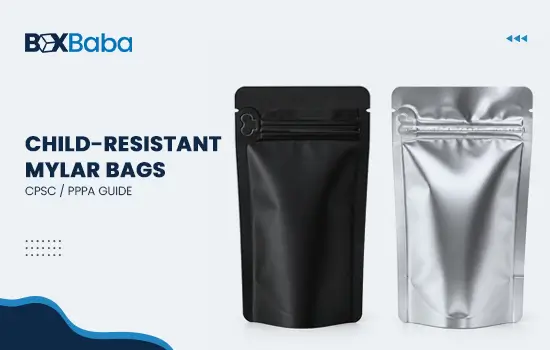
Child-resistant Mylar bags help cannabis, CBD, hemp, and supplement brands package sensitive products in flexible barrier pouches that are difficult for young children to open while still usable by adults.
The buying decision is not only about bag size, artwork, or finish. Buyers also need to verify the closure system, documentation, material structure, tamper-evident setup, label space, product-specific requirements, and quote details before production.
For USA buyers, the most important distinction is this: CPSC does not approve, certify, or endorse specific child-resistant packages or packaging suppliers. Buyers should avoid asking for CPSC-approved Mylar bags and instead ask for relevant child-resistant packaging documentation, package configuration details, and product-specific compliance support.
Brands ready to compare pouch options can review BoxBaba child-resistant Mylar bags before preparing a quote request.
This guide uses a CR Documentation + Product Fit Framework so buyers can verify the closure, pouch structure, label space, documentation, product format, and quote inputs before approving production.
Child-resistant Mylar bags are flexible barrier pouches designed with a child-resistant closure, such as a CR zipper, plus laminated film structures that may help protect products from moisture, oxygen, light, odor transfer, or handling damage.
Child-resistant packaging does not mean child-proof packaging. CPSC defines special packaging as packaging that is significantly difficult for children under 5 to open but relatively easy for adults to open.
Child-resistant Mylar bags can be a strong fit for cannabis, CBD, hemp, and supplement products that need flexible barrier packaging plus restricted access.
Do not rely on CPSC-approved wording. CPSC does not approve specific packages, and the finished product manufacturer or filler is responsible for selecting suitable packaging and ensuring compliance when special packaging rules apply.
Before requesting a quote, buyers should confirm:
- CR closure type
- available
- documentation
- material structure
- heat-seal setup
- resealability needs
- label panel space
- product-specific compliance concerns
- MOQ
- proofing process
- production timing
- shipping destination
What Are Child-Resistant Mylar Bags?
Child-resistant Mylar bags are flexible pouches made with barrier film and a CR closure to help restrict child access while supporting retail, ecommerce, and wholesale packaging.
These bags are commonly considered by cannabis brands, CBD brands, hemp companies, supplement brands, nutraceutical sellers, and regulated-product startups that need a custom printed pouch instead of a bottle, jar, carton, or rigid box.
A CR Mylar bag usually combines several packaging elements:
| Packaging element | Buyer value | Important limitation |
|---|---|---|
| CR zipper | Helps restrict access after opening | The closure needs documentation tied to the package format |
| Heat-sealable top | Supports tamper evidence before first opening | Tamper evidence is not the same as child resistance |
| Barrier film | Helps protect against moisture, oxygen, light, or odor transfer | Barrier needs depend on product form and storage conditions |
| Printed exterior | Supports brand presentation and label communication | Regulated products may restrict graphics, claims, and child appeal |
| Resealable format | Supports multi-serving products | Resealability requirements vary by product and state |
| Custom sizing | Improves product fit and fill efficiency | Custom dimensions may require extra proofing or sampling |
BoxBaba child-resistant Mylar bag page describes CR zipper systems, PET/VMPET or foil laminates, heat-sealable tamper-evident closures, custom sizing, premium print production, matte, gloss, soft-touch, and foil finishes. Buyers should confirm current specifications, documentation, MOQ, lead time, and shipping terms during the quote process.
If your product does not need a CR closure, compare broader custom Mylar bags
first so the pouch style, barrier level, and order quantity match the use case.
What CPSC / PPPA Child-Resistant Packaging Rules Mean When They Apply
When PPPA special-packaging rules apply, CPSC / PPPA requirements focus on package performance, not supplier marketing phrases or generic “child-proof” claims.
The buyer question should not be:
Is this bag CPSC-approved?
The better question is:
What child-resistant testing, closure documentation, certificate, and package configuration support this bag for my product?
The Poison Prevention Packaging Act requires certain substances to be in special packaging. CPSC defines special packaging as packaging designed or constructed to be significantly difficult for children under 5 to open within a reasonable time and not difficult for adults to use properly.
CPSC also states that it does not approve, certify, or endorse any specific special packaging, package manufacturer, testing firm, package consultant, or related service.
Key CPSC / PPPA Points for Packaging Buyers
| Topic | Buyer takeaway |
|---|---|
| “CPSC-approved” wording | Avoid it. CPSC does not approve or endorse specific packages or manufacturers. |
| Special packaging | PPPA requires certain substances to be in special packaging. |
| Testing procedure | CPSC’s FAQ points to 16 CFR § 1700.20 for child and adult testing protocols. |
| Child test performance | CPSC’s FAQ states that at least 85% of tested children must not open the package in the first 5 minutes, and at least 80% must not open it during the full 10-minute test. |
| Adult usability | CPSC’s FAQ states that at least 90% of adults must be able to open a package within 5 minutes and, when applicable, resecure a second package within 1 minute. |
| Documentation | Buyers should ask whether available documentation matches the selected closure, pouch format, and product use. |
CPSC’s FAQ states that the PPPA requirements are codified at 16 CFR part 1700, and the testing protocol for determining whether a package is special packaging is outlined in 16 CFR § 1700.20.
Buyer takeaway: A child-resistant Mylar bag should be evaluated as a complete package system: film, closure, seal, product format, label layout, documentation, and compliance responsibility must work together.
Child-Resistant vs Tamper-Evident vs Resealable Packaging
Child-resistant, tamper-evident, and resealable features solve different packaging problems. Buyers should not treat them as interchangeable.
| Feature | What it helps support | What it does not prove |
|---|---|---|
| Child-resistant closure | The package is designed to restrict child access under applicable CR standards | It does not prove the product is compliant in every state or sales channel |
| Tamper-evident heat seal | The package shows signs of first opening | It does not prove child resistance |
| Resealable zipper | The pouch can be opened and closed repeatedly | It does not automatically mean the zipper is child-resistant |
| Opaque film | The product is not visible through the pouch | It does not automatically satisfy every cannabis opacity rule |
| High-barrier film | The pouch may help protect against moisture, oxygen, light, or odor transfer | It does not replace product-specific shelf-life or compliance review |
A heat-sealable top can support tamper evidence before first opening, but child resistance depends on the closure mechanism, package configuration, testing support, and use case.
Cannabis and Supplement Packaging Risks to Check Before Ordering
Cannabis and supplement brands face risk when they treat CR packaging as a generic pouch feature instead of a product-specific compliance decision.
Cannabis packaging rules vary by state. California’s Department of Cannabis Control says manufactured cannabis products have packaging requirements that include child-resistant, tamper-evident, and resealable features.
Supplement packaging risk depends on product composition, dosage, claims, and applicable federal requirements. CPSC recall activity for iron-containing dietary supplements shows that child-resistant packaging can be a serious issue when PPPA requirements apply.
Product-Specific Risk
| Product type | CR packaging concern | Buyer action |
|---|---|---|
| Cannabis flower | State rules may require CR, tamper-evident, resealable, opaque, or labeled packaging | Confirm target-state packaging rules before printing |
| Cannabis edibles | Multi-serving access, resealability, opacity, and child-appeal restrictions may apply | Confirm label layout and resealable CR closure needs |
| CBD / hemp products | Requirements can vary by state, product type, claim, and sales channel | Confirm state and retailer packaging expectations |
| Iron-containing supplements | Some formulas may trigger child-resistant packaging requirements | Confirm formula, dosage, and certificate responsibility |
| Functional gummies | Child appeal, serving count, and label claims may increase review needs | Confirm artwork and warning-panel requirements before production |
| Powders or capsules | Moisture protection and label accuracy may matter as much as closure type | Confirm barrier structure and supplement label panel size |
For eighth-size cannabis, hemp, or herbal formats, 3.5g Mylar bags can help
buyers compare small-format pouch dimensions, closures, and label-space needs.
Compliance caution: A packaging supplier can help with specifications, but the brand, filler, importer, or domestic party may still be responsible for product-specific compliance decisions. Ask qualified legal or regulatory support before placing regulated products into production packaging.
How to Evaluate Child-Resistant Mylar Bags Before Production
Evaluate child-resistant Mylar bags by checking the closure, documentation, resealability, heat seal, material structure, label space, and product fit.
A CR pouch should not be approved only because it looks professional or uses thick film. The opening system, package format, product type, and supporting records matter.
CR Documentation + Product Fit Framework
| Verification step | What to ask BoxBaba or your supplier | Why it matters |
|---|---|---|
| Closure type | Is the bag using a CR zipper, slider, press-to-close closure, or another CR mechanism? | Child resistance depends heavily on opening motion |
| Documentation | What CR test documentation or certificate is available for this closure or package format? | Buyers may need records for compliance files |
| Package configuration | Does documentation match this pouch size, structure, closure, and use case? | A different pouch setup may not support the same claim |
| Product form | Is the product flower, edible, gummy, capsule, powder, concentrate, or another format? | Product form affects access risk and filling needs |
| Resealability | Does the package need to remain child-resistant after first opening? | Multi-serving products may need ongoing CR function |
| Tamper evidence | Will the bag be heat sealed before retail sale? | Tamper evidence and child resistance are different functions |
| Label area | Is there enough printable space for warnings, ingredients, supplement facts, cannabinoid data, batch information, and symbols? | Compliance problems often appear on artwork, not only structure |
| Filling process | Will the filler heat seal, hand fill, automate fill, or use secondary packaging? | Production method can affect seal quality |
| Shipping environment | Will bags ship through ecommerce, wholesale cartons, or retail distribution? | Compression, heat, and handling can affect performance |
CR zippers can improve restricted access for multi-use pouches, but the zipper must be suitable for the product, pouch structure, and intended compliance use. Do not assume every resealable zipper is child-resistant.
Supplier Verification Questions Before You Approve a CR Mylar Bag
A supplier should help buyers verify the pouch format, closure, documentation, artwork, proofing, and order details before production.
| Question | Why it matters |
|---|---|
| What CR closure system is used? | The opening mechanism drives child-resistant performance. |
| Does available documentation match this pouch format? | Documentation should support the selected size, closure, and structure. |
| Is the pouch heat-sealable after filling? | Heat sealing supports tamper evidence before first opening. |
| Can the label panel fit required warnings and product data? | Regulated products often fail at artwork review, not only structure. |
| What material structure is recommended for this product? | Barrier needs differ for flower, gummies, powders, capsules, and concentrates. |
| What MOQ, proofing, production, and shipping terms apply? | Quote terms can change by size, quantity, print coverage, and finish. |
| Can the supplier support reorder consistency? | Repeat runs need stable dimensions, color, closure, and seal specifications. |
This supplier verification step is especially important because CPSC does not pre-approve packaging suppliers. Buyers should collect package-specific documentation and confirm whether it applies to their chosen pouch format and product use.
Materials, Closures, Printing, and Finishes
Material, closure, printing, and finish choices should support product protection, adult usability, compliance review, and brand presentation.
For CR Mylar bags, material selection usually starts with the product’s sensitivity. Cannabis flower may need odor control and moisture protection. Gummies may need seal integrity and label space. Supplements may need moisture resistance and clear dosage communication.
Material Options
| Material / structure | Best-fit use | Caution |
|---|---|---|
| PET / PE laminate | General printed flexible pouch structure | Confirm barrier performance for sensitive products |
| PET / VMPET / PE | Stronger light and barrier support | Metallized layers may affect window options |
| PET / foil / PE | Higher odor, light, and moisture barrier needs | May increase cost and reduce recyclability options |
| Kraft exterior laminate | Natural shelf appearance | Kraft look does not automatically mean recyclable or compostable |
| Opaque film | Cannabis and sensitive product presentation | State rules may define opacity differently |
| Clear window | Product visibility | May conflict with cannabis rules or barrier needs |
BoxBaba child-resistant Mylar bag page describes high-barrier PET/VMPET or foil laminates and heat-sealable tamper-evident closures. Buyers should confirm thickness, laminate structure, and product suitability for the exact SKU.
For aroma-sensitive cannabis, CBD, coffee, or herbal products, smell proof Mylar bags may be a related option when odor control is the main buyer concern.
Closure and Seal Options
| Closure feature | What it does | Buyer caution |
|---|---|---|
| CR zipper | Adds child-resistant opening action | Request documentation for the actual closure |
| Resealable zipper | Allows repeated opening and closing | Resealable does not automatically mean child-resistant |
| Heat-seal top | Creates tamper-evident first opening | Heat seal alone is not child resistance |
| Tear notch | Helps adults start opening the pouch | Poor placement can weaken protection goals |
| Hang hole | Supports peg display | Confirm it does not interfere with seal area |
| Rounded corners | Improves handling and shelf feel | May affect dieline and unit cost |
Printing and Finish Options
Custom child-resistant Mylar bags can use CMYK printing, PMS / Pantone color matching, matte finish, gloss finish, soft-touch coating, spot UV, foil accents, metallic effects, or holographic-style finishes.
| Finish | Buyer value | Limitation |
|---|---|---|
| Matte finish | Clean, modern retail presentation | May show scuffs more visibly than gloss |
| Gloss finish | Brighter shelf appearance | Can create glare under retail lighting |
| Soft-touch coating | Premium tactile feel | May increase cost and handling sensitivity |
| Spot UV | Highlights logo or product name | Requires precise artwork setup |
| Foil stamping | Adds premium shelf appeal | Can increase proofing and production complexity |
For cannabis, CBD, hemp, and supplement products, artwork should leave room for required warnings and avoid claims or design elements your compliance reviewer has not approved.
CR Mylar Bag Style Options
The best CR Mylar bag style depends on fill weight, shelf presentation, storage method, shipping channel, and label space.
| Bag style | Best fit | Buyer caution |
|---|---|---|
| Stand-up pouch | Retail shelves, gummies, supplements, CBD products, edibles | Needs enough bottom gusset stability for product weight |
| Flat pouch | Small cannabis, sample, or lightweight product formats | May have less shelf presence than stand-up pouches |
| Gusseted pouch | Larger fill volumes or bulk product formats | Gusset dimensions affect fill accuracy and shelf stability |
| 3.5g pouch | Eighth-size cannabis, hemp, or herbal products | Label space can become tight on small formats |
| Opaque pouch | Cannabis and sensitive product presentation | Confirm opacity rules by state and product type |
| Window pouch | Product visibility for non-restricted categories | May reduce barrier performance or conflict with cannabis packaging rules |
Choose the pouch style before finalizing artwork. A dieline for a flat pouch will not transfer cleanly to a stand-up pouch, gusseted pouch, or CR zipper format without layout changes.
Retail vs Ecommerce Use
Retail packaging needs shelf clarity, label compliance, and shopper-facing presentation. Ecommerce packaging needs seal strength, carton fit, and protection through handling.
| Use case | Packaging priority | Buyer decision |
|---|---|---|
| Retail dispensary | Shelf visibility, label readability, CR closure, tamper evidence | Use clean artwork and leave space for required warnings |
| Ecommerce shipping | Seal strength, compression resistance, carton packing, odor control | Confirm pouch thickness, case pack, and shipping method |
| Wholesale distribution | Reorder consistency, carton count, SKU separation | Lock specifications after proof approval |
| Subscription products | Unboxing experience, repeat presentation, batch labeling | Consider outer mailer or carton protection if needed |
If you are shipping pouches directly to customers, avoid treating the pouch as the only protective layer. A Mylar bag protects the product inside the pouch, but ecommerce shipping may still require a mailer, carton, or case-pack plan.
Cost Factors, MOQ, Timeline, and Tradeoffs
Child-resistant Mylar bag cost depends on pouch size, film structure, closure type, print coverage, finish, quantity, proofing, and delivery needs.
Exact prices should be quoted, not guessed. CR packaging usually has more variables than standard Mylar packaging because the closure system, documentation, and regulated-market requirements can change the order.
Main Cost Factors
| Cost factor | Why it affects quote |
|---|---|
| Bag dimensions | Larger pouches use more material and affect carton size |
| Film structure | Foil and high-barrier laminates can cost more than simpler films |
| CR closure | Child-resistant mechanisms add complexity |
| Print coverage | Full-print designs need more print control |
| PMS matching | Brand-color accuracy can add setup requirements |
| Finish selection | Foil, spot UV, and soft-touch finishes can increase cost |
| Quantity | Higher quantities may reduce unit cost but increase upfront spend |
| SKU count | Multiple designs can split quantity and affect setup |
| Sampling / proofing | Samples reduce risk but adds time |
| Shipping destination | Freight and delivery method affect landed cost |
| Deadline | Rush needs may limit material and finish options |
BoxBaba’s child-resistant Mylar bag page states that MOQ starts at 100 units and production is 5–9 business days. Buyers should confirm current MOQ, proof approval timing, rush availability, shipping terms, and product-specific details during the quote process.
Buyer Tradeoffs
| Tradeoff | Practical meaning |
|---|---|
| Stronger barrier vs lower unit cost | Higher-barrier film can improve product protection but may raise cost |
| Premium finish vs production simplicity | Foil, spot UV, and soft-touch effects can improve shelf appeal but add proofing complexity |
| Custom size vs faster ordering | Custom dimensions improve fit but may require extra setup |
| Small MOQ vs bulk efficiency | Smaller orders help startups test demand, while larger orders may improve unit economics |
| Resealable CR closure vs simpler pouch | Resealable CR function can support multi-serving products but adds closure complexity |
| Compliance caution vs fast launch | Regulated products need review before print approval, even when deadlines are tight |
A fast production claim should not replace artwork, label, and compliance review. Buyers should approve the dieline and printed proof only after confirming product-specific requirements.
When CR Mylar Bags Are a Good Fit—and When They Are Not
CR Mylar bags fit products that need flexible barrier packaging, custom branding, restricted access, and quote-ready documentation review.
Use This Packaging When:
- Your cannabis, CBD, hemp, or supplement product needs a flexible pouch.
- Your product benefits from barrier film against moisture, oxygen, light, or odor transfer.
- Your product may require restricted child access.
- Your product is multi-serving and may need resealability.
- Your brand needs custom printing with enough space for warnings, ingredients, supplement facts, batch data, or cannabis symbols.
- Your team can review documentation and product-specific compliance before ordering.
Consider Another Packaging Option When:
- Your product is fragile and needs rigid crush protection.
- Your product is heavy, sharp, oily, or wet enough to challenge flexible film.
- Your compliance team requires a package format already validated for a very specific SKU.
- Your product needs verified certifications that are not available for the selected pouch.
- Your state or sales channel requires packaging features that a pouch cannot support.
- Your brand needs legal advice before determining whether CR packaging is required.
| Use CR Mylar bags when | Consider another option when |
|---|---|
| You need flexible barrier packaging | You need rigid protection |
| You need a CR closure with custom branding | You need a bottle, jar, carton, or rigid box format |
| You need retail or ecommerce pouch packaging | Your product can puncture or leak through flexible film |
| You can verify documentation before production | Required certificates or state-specific support are unclear |
Choose CR Mylar bags when flexible barrier packaging and restricted access are both important. Choose another format when product protection, certification, filling process, or state rules cannot be confirmed.
Why Choose BoxBaba for Child-Resistant Mylar Bags?
BoxBaba is a relevant supplier option when buyers need custom child-resistant Mylar bags with configurable pouch size, CR zipper selection, barrier material options, custom printing, finish choices, proofing, and USA shipping support.
BoxBaba’s child-resistant Mylar bag page describes CR zipper systems, PET/VMPET or foil laminates, heat-sealable tamper-evident closures, custom sizing, premium print production, matte, gloss, soft-touch, and foil finishes. Buyers should confirm current specifications, documentation, MOQ, lead time, and shipping terms during the quote process.
Use BoxBaba when:
- you need custom child-resistant Mylar bags with logo printing
- your product needs a CR zipper and heat-sealable pouch format
- you need help aligning pouch size, material, print, finish, and quantity
- you want a quote based on product type, dimensions, artwork, and shipping destination
Ask BoxBaba to confirm:
- CR closure type
available documentation
material structure
heat-seal setup
MOQ
proofing process
production timing
shipping terms
product-specific suitability
Start with BoxBaba when you know your product type, fill amount, bag size, quantity, artwork status, and compliance concerns.
Final Takeaway
Child-resistant Mylar bags are a practical option when cannabis, CBD, hemp, or supplement products need flexible barrier packaging plus restricted access.
The safest buying process avoids vague claims such as CPSC-approved and instead verifies documentation, closure design, package configuration, product-specific requirements, artwork, material structure, proofing, and quote details before production.
BoxBaba can help buyers configure custom child-resistant Mylar bags around pouch size, CR zipper needs, barrier structure, custom printing, finish choices, MOQ, proofing, and shipping destination. To request a stronger quote, prepare your product type, fill amount, dimensions, quantity, artwork status, closure requirement, material preference, compliance concerns, and delivery deadline before contacting BoxBaba.
FAQs About Child-resistant Mylar Bags
Are child-resistant Mylar bags child-proof?
No. Child-resistant means the package is designed to be difficult for young children to open while remaining usable by adults. It does not mean impossible for a child to open.
Does CPSC approve child-resistant Mylar bags?
No. CPSC states that it does not approve, certify, or endorse specific special packaging, package manufacturers, testing firms, or consultants. Ask for documentation instead of CPSC-approved wording.
What standard applies to child-resistant packaging testing?
CPSC’s FAQ points to 16 CFR § 1700.20 for special packaging test protocols. Buyers should ask whether available documentation matches the selected package format, closure, and product use.
Do cannabis products need child-resistant packaging?
Many state cannabis programs require child-resistant packaging, but rules vary by state and product type. California guidance says manufactured cannabis products have child-resistant, tamper-evident, and resealable packaging requirements.
Do supplement brands need child-resistant packaging?
Some supplement products may need child-resistant packaging depending on ingredients, dosage, and applicable rules. Brands should confirm requirements for the exact formula, product format, and sales channel before ordering.
Is a tamper-evident heat seal the same as child resistance?
No. A heat seal can show whether a pouch was opened before sale, but child resistance depends on the package’s ability to restrict child access under applicable standards.
Can child-resistant Mylar bags be custom printed?
Yes. CR Mylar bags can be custom printed with brand artwork, product information, warnings, and required label panels. Regulated-product artwork should be reviewed before production.
What should I ask BoxBaba before ordering?
Ask about closure type, CR documentation, material structure, heat-seal setup, sizing, MOQ, proofing, finish options, lead time, shipping, and product-specific suitability.
What is the best child-resistant Mylar bag for cannabis edibles?
A resealable CR stand-up pouch with suitable barrier film and enough label space often works well for cannabis edibles. Confirm state rules, serving format, warnings, opacity, and child-appeal restrictions before production.
Can one CR Mylar bag design work in every state?
Not safely without review. Cannabis packaging rules vary by state, and supplement requirements can vary by product composition. Review each target market before printing bulk inventory.