
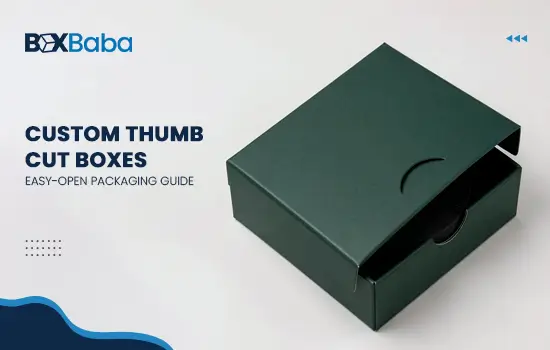
Custom thumb cut boxes help customers open packaging without tearing flaps, bending panels, or struggling to grip the product. The thumb cut notch is a small die-cut opening, but it can make a box easier to use, easier to present, and easier to brand.
For USA retail brands, ecommerce businesses, product manufacturers, and wholesale packaging buyers, the key question is not only, Can I add a thumb cut? The better question is, Will this notch improve access without weakening the box, confusing the artwork, or raising cost unnecessarily?
If you are comparing thumb cut packaging with broader branded packaging options, review BoxBaba custom packaging boxes wholesale options before requesting a quote. If you already know your product size, quantity, and preferred box style, use this guide to prepare a cleaner packaging quote request.
What Are Custom Thumb Cut Boxes?
Custom thumb cut boxes are boxes with a die-cut notch that gives the customer a clean grip point for opening, lifting, sliding, or pulling part of the package.
The notch may appear on a tuck flap, sleeve edge, drawer tray, lid, or front panel. Thumb cut packaging is commonly used for retail products, cosmetics, accessories, jewelry, stationery, apparel items, electronics accessories, promotional kits, and ecommerce product packaging.
A thumb cut is a die-cut opening feature that can be added to several box structures. It can help customers lift a flap, pull a tray, slide a sleeve, or remove a product without damaging the box.
| Function | What the Thumb Cut Helps the User Do |
|---|---|
| Lift | Open a tuck flap or lid |
| Pull | Slide a tray out of a sleeve |
| Grip | Remove a product or insert |
| Reveal | Create a cleaner premium opening |
| Reopen | Make repeated access easier |
A small notch can improve the unboxing experience, but it should not cut into important artwork, weaken a flap, or interfere with closure security.
When Thumb Cut Boxes Make Sense
Custom thumb cut boxes are best when a product needs easy opening, clean presentation, and branded die-cut packaging. They work well for lightweight retail boxes, sleeve boxes, drawer boxes, rigid gift boxes, and some ecommerce packaging.
Use thumb cut boxes when:
- the customer needs easy access;
- the package should stay clean after opening;
- the product benefits from a premium reveal;
- the box style can support a notch;
- the brand needs custom printed packaging with logo.
Review carefully when:
- the product is heavy or fragile;
- the box needs tamper evidence;
- the product is food, cosmetic, CBD/hemp, supplement, or child-related;
- the notch may reduce closure strength;
- verified certifications or compliance claims are required.
Use this simple framework before ordering:
Opening access + box structure + product weight + sales channel + quote readiness.
Who Should Use Thumb Cut Boxes?
Thumb cut boxes are useful for brands that want easier opening and a cleaner product presentation. They are especially helpful when customers may open the package more than once.
This packaging style can fit:
- retail brands selling small or medium-weight products;
- ecommerce brands that want better unboxing;
- product manufacturers selling packaged components;
- jewelry and accessory brands;
- cosmetic and skincare brands;
- stationery and card brands;
- apparel accessory brands;
- promotional kit buyers;
- wholesale packaging buyers comparing custom box styles.
A thumb cut is most valuable when it solves a handling problem. If the package already opens easily, the notch may be unnecessary. If the product needs stronger security, tamper evidence, or heavy-duty shipping protection, a different structure may be better.
Use the Thumb Cut Fit Framework before choosing a structure: check whether the notch improves opening access, whether the box style can support the cutout, whether the material fits product weight, whether the package will sell through retail or ecommerce, and whether you can provide quote-ready details.
Best Product Uses for Thumb Cut Packaging
Thumb cut packaging works best for products that need clean access, shelf presentation, or a controlled reveal. The product should be light enough for the selected box structure.
| Product Type | Why Thumb Cut Boxes Can Fit |
|---|---|
| Cosmetics | Easy opening supports premium retail presentation |
| Skincare products | A clean notch can improve repeated access |
| Jewelry | Drawer or rigid boxes can create a gift-ready reveal |
| Stationery | Cards, notepads, and flat items are easier to remove |
| Apparel accessories | Socks, ties, belts, and small accessories can fit sleeve or carton styles |
| Electronics accessories | Small components can be organized with inserts |
| Promotional kits | Thumb cuts help users open inner boxes or trays |
| Subscription products | Inner thumb cut boxes can organize grouped items |
| Retail samples | Compact packaging can stay neat after handling |
Cosmetic and skincare brands should compare thumb cut cartons with BoxBaba custom cosmetic boxes , especially when product labeling, finish selection, and shelf presentation affect the buying decision.
Jewelry brands should compare thumb cut drawer or rigid styles with BoxBaba custom jewelry boxes when inserts, velvet lining, foam, or premium reveal matter.
For food, bakery, cosmetic, CBD/hemp, supplement, or regulated products, the box structure is only one part of the decision. Material suitability, labeling, coating, migration risk, state rules, and sales-channel requirements should be confirmed before production.
Common Thumb Cut Box Styles
The best thumb cut box style depends on how the customer should open the package. A tuck flap, sleeve, drawer, or rigid lid can each use the notch differently.
| Box Style | Thumb Cut Location | Best Fit | Limitation |
|---|---|---|---|
| Straight tuck end box | Top or front tuck flap | Lightweight retail products | Repeated opening may weaken thin board |
| Reverse tuck end box | Opposite tuck flaps | Small cartons and compact products | Not ideal for heavy products |
| Folding carton | Flap or access edge | Cosmetics, stationery, accessories | May need insert for fragile items |
| Sleeve box | Sleeve edge or tray edge | Apparel, cosmetics, gift items | Tray friction must be tested |
| Drawer box | Front tray panel | Jewelry, premium kits, accessories | More complex structure can increase cost |
| Rigid box | Lid edge, tray front, or drawer panel | Luxury gifting and premium products | Higher material and production complexity |
| Corrugated box | Front flap or access panel | Ecommerce kits or heavier goods | Notch placement must avoid strength loss |
A thumb cut should follow the opening motion. If the buyer pulls a tray, the notch belongs on the tray face or sleeve edge. If the buyer lifts a flap, the notch belongs on the flap edge. If the buyer removes a lid, the notch should help lift the lid without making it loose.
For premium products, a thumb notch can work especially well on drawer, lid-and-base, and setup structures. Compare these options with BoxBaba custom rigid boxes when the product needs a stronger gift-ready presentation.
Thumb Cut Notch Options
Thumb cut notches can be semicircular, crescent-shaped, shallow, deep, centered, or side-positioned. The best notch shape depends on how the customer opens the box and how much board strength the structure needs.
| Notch Option | Best Use | Buyer Caution |
|---|---|---|
| Semicircle notch | Standard tuck boxes and folding cartons | Keep it away from required text or barcode space |
| Crescent notch | Sleeve boxes and drawer boxes | Test grip depth before production |
| Wide thumb notch | Larger trays or rigid lids | Can weaken thin panels if oversized |
| Small thumb notch | Compact retail cartons | May not provide enough grip for repeated use |
| Side-positioned notch | Drawer boxes, sleeves, and trays | Confirm the opening direction before finalizing the dieline |
| Custom-shaped notch | Branded or premium packaging | Needs careful dieline review |
The thumb cut can support the visual design when the dieline keeps the notch away from logos, claims, barcodes, warnings, and required product information.
A thumb cut is usually a cutout. A thumb tab may refer to a pull tab, locking tab, or structural flap depending on the box style.
Materials for Custom Thumb Cut Boxes
Material choice controls strength, print quality, appearance, and cost. Most thumb cut boxes use paperboard, kraft board, corrugated board, or rigid board.
| Material | Best Use | Buyer Benefit | Watch-Out |
|---|---|---|---|
| SBS paperboard | Retail cartons and printed product boxes | Smooth surface for detailed branding | Not ideal for heavy shipping alone |
| Kraft paperboard | Natural-look retail packaging | Simple, earthy presentation | Printed colors may appear more muted |
| Corrugated board | Ecommerce and heavier products | Better structure and cushioning | Less sleek than smooth paperboard |
| E-flute corrugated | Retail-shipping hybrid boxes | Slim corrugated profile | Still needs testing for fragile products |
| B-flute corrugated | Stronger shipping or storage boxes | More stacking strength | Bulkier appearance |
| Rigid board / chipboard | Premium gift, drawer, or jewelry boxes | Strong presentation and luxury feel | Higher cost and less flat-pack efficiency |
SBS paperboard can work well for printed retail cartons. Kraft paperboard can support a natural brand look. Corrugated board can improve shipping strength. Rigid board can create a more premium reveal.
A thumb cut notch changes how stress moves through the flap, sleeve edge, tray panel, or lid. A thin flap with a large thumb cut may bend more easily. A heavier product may require thicker board, a reinforced structure, or an insert.
If your product needs a printable paperboard or corrugated structure, compare the selected thumb cut format with BoxBaba custom cardboard boxes before finalizing material, thickness, and finish.
Printing, Finishes, and Branding Options
Custom thumb cut boxes with logo need artwork that works around the notch. The die-cut area should support the design instead of cutting through brand marks, claims, or product information.
Common printing and branding options include:
| Option | Use Case | Limitation |
|---|---|---|
| CMYK printing | Full-color artwork and product graphics | Color may vary by stock and print method |
| PMS / Pantone matching | Brand color control | May add production review requirements |
| Digital printing | Smaller or simpler runs | May not fit every finish or material |
| Offset printing | Larger runs with refined print detail | Setup may be more involved |
| Inside printing | Premium unboxing experience | Adds print area and cost |
| Logo-only printing | Clean branded packaging | May feel too plain for retail display |
Finishing options can improve shelf appeal:
| Finish | What It Adds | Tradeoff |
|---|---|---|
| Matte lamination | Smooth, refined surface | May show scuffs in handling |
| Gloss lamination | Shine and stronger color pop | Can reflect retail lighting |
| Soft-touch coating | Premium tactile feel | Can increase cost |
| Spot UV | Highlighted logo or pattern | Works best when used selectively |
| Foil stamping | Metallic brand detail | Adds setup and production complexity |
| Embossing | Raised texture | Needs suitable board and artwork |
| Debossing | Pressed-in texture | Best for simple brand elements |
The thumb cut can become part of the design system. A clean semicircle feels simple and functional. A larger crescent can improve grip. A custom-shaped notch may look more branded, but it should still be easy to use.
Inserts, Protection, and Damage Risks
Thumb cut boxes improve access, but they do not automatically improve protection. Fragile, loose, or premium products may still need inserts, dividers, or stronger board.
Common insert options include:
| Insert Type | Best Fit | Buyer Benefit |
|---|---|---|
| Paperboard insert | Cosmetics, small retail products, kits | Holds items in place with lower bulk |
| Corrugated divider | Multipacks or ecommerce kits | Adds separation and structure |
| EVA foam insert | Jewelry, electronics, premium products | Adds cushioning and presentation |
| Molded pulp insert | Shaped protection needs | Can support protective organization |
| Custom tray | Drawer or sleeve boxes | Improves reveal and product control |
A thumb cut can make opening easier, but the product still needs protection from compression, vibration, scuffing, and movement. For ecommerce shipments, a retail thumb cut carton may need an outer corrugated shipper.
Do not rely on the notch to solve damage risk. Use board thickness, inserts, dividers, outer cartons, and testing to control product movement.
Retail vs Ecommerce Use
Retail thumb cut boxes prioritize shelf appeal and customer handling. Ecommerce thumb cut boxes must also account for shipping stress, dimensional weight, and outer-carton protection.
| Use Case | What Matters Most | Recommended Review |
|---|---|---|
| Retail shelf | Print quality, front-panel design, clean opening | Confirm notch does not interrupt artwork |
| Ecommerce shipping | Compression, scuffing, movement, delivery handling | Consider corrugated board or outer shipper |
| Subscription boxes | Organized reveal and repeated opening | Review inserts and product grouping |
| Gift packaging | Premium reveal and tactile finish | Review rigid board, drawer box, or sleeve box |
| Wholesale distribution | Carton efficiency and reorder consistency | Confirm pack-out, carton count, and quantity planning |
Retail buyers should prioritize front-panel artwork, shelf handling, opening access, and scuff resistance. Ecommerce buyers should focus on product movement, board strength, outer protection, and delivery handling.
If your package must ship directly to customers, compare a thumb cut retail carton with BoxBaba custom mailer boxes. A mailer may be better when shipping strength, outer protection, and unboxing durability matter more than a small retail carton.
Cost Factors and MOQ Planning
Custom thumb cut box cost depends on structure, size, material, print coverage, finish, inserts, quantity, proofing, and shipping destination. Exact pricing should be confirmed through a quote because size, material, structure, print coverage, finish, inserts, quantity, and shipping destination affect cost.
Key cost drivers include:
| Cost Factor | Why It Affects Pricing |
|---|---|
| Box size | Larger boxes use more material |
| Structure | Drawer, sleeve, and rigid boxes are usually more complex than simple cartons |
| Material | SBS, kraft, corrugated, and rigid board have different cost profiles |
| Board thickness or flute | Stronger material can increase cost but improve protection |
| Print coverage | Full-coverage artwork can cost more than simple printing |
| PMS matching | Brand color control may add review requirements |
| Finishes | Foil, embossing, debossing, spot UV, and soft-touch coatings add complexity |
| Inserts | Inserts add material, design, and assembly considerations |
| Quantity | Higher quantities may improve unit economics; smaller runs may cost more per box |
| Sampling and proofing | Samples and mockups can reduce risk but may affect timeline |
| Shipping destination | Freight, carton count, and dimensional weight affect landed cost |
| Deadline | Rush needs can affect production and shipping planning |
For wholesale thumb cut boxes, quantity planning should connect to launch needs, retail rollout, storage capacity, reorder timing, and expected sales volume.
Unclear: BoxBaba exact MOQ, exact unit pricing, and exact turnaround time for custom thumb cut boxes. Ask BoxBaba to confirm these details for the specific style, material, and quantity.
Tradeoffs and Bad-Fit Cases
Thumb cut boxes improve opening access, but the notch can create tradeoffs in strength, cost, artwork layout, and closure behavior. The best choice depends on the product and sales channel.
| Tradeoff | Buyer Meaning |
|---|---|
| Easy opening vs closure security | A notch improves access but does not replace tamper evidence |
| Premium finish vs lower cost | Foil, embossing, and soft-touch finishes improve presentation but add complexity |
| Paperboard vs corrugated board | Paperboard looks cleaner for retail; corrugated board can improve shipping strength |
| Custom notch shape vs production simplicity | Unique shapes can support branding but need careful dieline review |
| Small run vs bulk order | Small runs reduce inventory risk; larger runs may improve unit cost |
| Retail presentation vs ecommerce durability | A shelf-ready carton may still need an outer shipper |
Bad-Fit Cases
Custom thumb cut boxes may not be the right choice when:
- the product is very heavy for the selected board;
- the product is fragile and has no insert or divider;
- the package needs verified tamper evidence;
- the product is wet, oily, or moisture-sensitive;
- the product is food-contact, cosmetic, CBD/hemp, supplement, or child-related and has not been reviewed;
- the buyer needs verified FSC, recyclable, compostable, food-safe, or child-resistant claims that are not confirmed;
- the notch would cut through required labeling, warnings, or barcode space;
- the package must survive rough ecommerce shipping without an outer carton.
Buyer Decision Summary
Use custom thumb cut boxes when:
- your product needs cleaner opening;
- your packaging should support retail, ecommerce, gifting, or repeated handling;
- the notch improves access without weakening the structure;
- your artwork can work around the cutout;
- you want branded die-cut packaging with practical user value.
Consider another packaging option when:
- the product is heavy, fragile, regulated, wet, oily, or compliance-sensitive;
- the box needs tamper evidence or child-resistant performance;
- a simple tuck box, mailer box, rigid box, or corrugated shipper would solve the buyer problem better.
Production Timeline Factors
Production timing depends on structure, artwork readiness, dieline review, proofing, material selection, finishing, quantity, and shipping method. Exact timing should be confirmed before ordering.
Timeline factors may include:
| Factor | Why It Matters |
|---|---|
| Dieline creation | The notch must be placed accurately |
| Artwork readiness | Missing artwork can delay proofing |
| Structural complexity | Drawer, sleeve, and rigid boxes may need more review |
| Finish selection | Foil, embossing, and spot UV can add production steps |
| Sample request | Physical samples may add time but reduce risk |
| Quantity | Larger runs may require more production planning |
| Shipping destination | Distance and freight method affect delivery timing |
A simple thumb cut folding carton may be easier to plan than a rigid drawer box with foil stamping and a custom insert. Buyers with launch dates should share deadlines early.
Sustainability Questions to Ask Before Ordering Thumb Cut Boxes
Sustainability depends on material, coating, ink, finish, insert, disposal path, and certification status. Do not assume a thumb cut box is recyclable, compostable, FSC-certified, or eco-friendly unless BoxBaba confirms the material and documentation.
Buyer questions to ask:
| Question | Why It Matters |
|---|---|
| What board stock is being used? | Material controls disposal options |
| Is the coating recyclable in my market? | Local recycling acceptance varies |
| Are inserts made from the same material? | Mixed materials may complicate disposal |
| Are certifications available? | Claims require documentation |
| Will a premium finish affect recyclability? | Some coatings and foils may complicate claims |
A kraft look does not automatically prove sustainability. A recyclable claim should be supported by material details and local recycling context.
Compliance Cautions
Compliance requirements vary by product type, state, claim, ingredient, and distribution channel. Thumb cut packaging should not be treated as compliant by default.
Use extra review for:
- food packaging;
- bakery packaging;
- cosmetic and skincare packaging;
- CBD/hemp packaging where legally applicable;
supplements; - children’s products;
- medical-style or pharmaceutical-style packaging;
- products requiring warnings or regulated labels.
Ask BoxBaba to confirm material suitability for your product. Also confirm labeling, food-contact, warning, barcode, and state-specific requirements before production.
This packaging guidance does not replace legal, labeling, food-contact, or state-specific compliance review.
Why Choose BoxBaba for Custom Thumb Cut Packaging?
Choose BoxBaba when you need a custom packaging quote that accounts for box size, notch placement, material, printing, finish, inserts, quantity, and shipping destination.
A thumb cut box is not just a box with a notch. The packaging team should review how the notch affects the dieline, flap strength, artwork placement, product access, and shipping use. That review helps buyers avoid weak structures, misaligned artwork, and quote delays.
Before ordering, ask BoxBaba to confirm the MOQ, production timeline, proofing options, material suitability, certification availability, and shipping details for your specific thumb cut box project.
Share your product dimensions, product weight, quantity, artwork files, preferred box style, finish needs, insert requirements, shipping destination, and deadline so BoxBaba can prepare a more accurate custom packaging quote.
Final Takeaway
Custom thumb cut boxes are a smart choice when the package needs easier opening, cleaner handling, and stronger branded presentation. A thumb cut notch affects flap strength, artwork placement, board choice, opening access, and dieline review.
Use the Thumb Cut Fit Framework before ordering:
Opening access + box structure + product weight + sales channel + quote readiness.
If the notch improves access without weakening the package, thumb cut packaging may be a strong fit. If the product is heavy, fragile, regulated, moisture-sensitive, or shipping-intensive, review material, insert, and compliance needs before production.
Request a Custom Thumb Cut Box Quote from BoxBaba by sending your product dimensions, product weight, quantity, preferred box style, notch placement, material preference, artwork files, finish requirements, insert needs, shipping destination, and deadline. The more complete your details are, the easier it is to review structure, print, protection, and cost factors before production.
FAQs About Custom Thumb Cut Boxes
What are custom thumb cut boxes?
Custom thumb cut boxes are boxes with a die-cut notch that helps customers grip, open, lift, or slide part of the package more easily.
Are thumb cut boxes the same as die-cut boxes?
Thumb cut boxes are a type or feature of die-cut packaging. A thumb cut is usually a notch, while die-cut boxes can include many custom shapes, windows, and structural cuts.
What products are best for thumb cut boxes?
Thumb cut boxes work well for cosmetics, jewelry, stationery, accessories, apparel items, electronics accessories, promotional kits, samples, and premium retail products.
Can thumb cut boxes be printed with a logo?
Yes, custom thumb cut boxes with logo can use CMYK printing, PMS color matching, foil stamping, embossing, debossing, spot UV, matte lamination, or gloss lamination.
Are thumb cut boxes good for ecommerce?
They can be, but ecommerce packaging may need corrugated board, inserts, or an outer shipper. A lightweight retail carton may not protect fragile products during delivery.
What material is best for thumb cut boxes?
SBS paperboard works well for printed retail cartons, kraft paperboard supports a natural look, corrugated board adds strength, and rigid board supports premium presentation.
Do thumb cut boxes cost more?
They may cost more if the structure, notch placement, material, finish, insert, or artwork requires extra production work. Exact pricing requires a custom quote.
What is the difference between a thumb cut and a thumb tab?
A thumb cut is usually a die-cut notch that improves grip and opening. A thumb tab may refer to a pull tab, locking tab, or structural flap depending on the box style.
Are thumb cut boxes food-safe?
Do not assume food-contact suitability. Ask BoxBaba to confirm material, coating, and labeling suitability before producing food, bakery, or other regulated packaging.
What should I send for a thumb cut box quote?
Send product size, product weight, box style, quantity, material preference, artwork, finish needs, insert needs, shipping destination, deadline, and compliance concerns.