
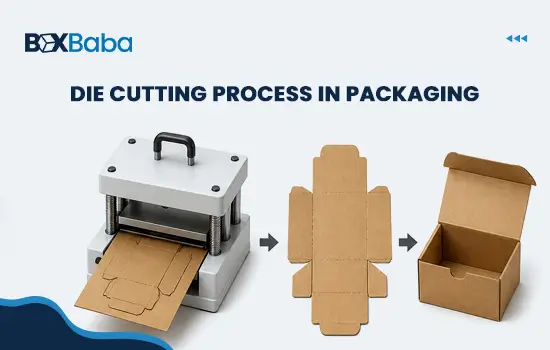
The die cutting process in packaging is the manufacturing step that turns a flat printed sheet of paperboard, corrugated board, kraft stock, foam, or label stock into the exact box, insert, tag, or label your brand needs. It gives a folding carton its tuck-end closure, a mailer box its self-locking flaps, a bakery box its window cutout, and a perfume insert its foam recess.
For USA brands buying custom packaging, understanding die cutting helps you choose better box styles, avoid tooling surprises, brief your supplier accurately, and prepare a quote request that gets a clearer answer. The most important commercial idea is simple: die cutting often includes a one-time tooling cost that becomes cheaper per unit as quantity rises.
That means your run size, not just your design, often decides whether die-cut custom packaging is the right call.
This guide explains what die cutting is, how the process runs from dieline to finished piece, which materials and packaging formats rely on it, what affects cost, and when die-cut custom packaging may not be the right fit for your product.
A manufacturing process that uses a custom-shaped cutting die to cut, score, crease, perforate, or shape flat sheets of paperboard, corrugated board, kraft stock, foam, or label stock into a finished packaging component such as a folding carton, mailer box, sleeve, insert, hang tag, label, or window cutout.
A dieline file controls every cut, fold, crease, glue tab, and perforation on the sheet.
- Die cutting turns flat printed sheets into exact packaging shapes using a custom cutting die.
- It produces folding cartons, mailer boxes, sleeves, window boxes, inserts, hang tags, and labels.
- A dieline file controls every cut, score, crease, and perforation.
- Common methods include flatbed, rotary, digital, and laser die cutting.
- Tooling is often a one-time cost, so per-unit cost can drop as quantity rises.
- Die cutting fits brands that need custom structure, branded unboxing, product visibility, or repeatable box dimensions.
- It may not be the cheapest option for plain stock shipping boxes at very low quantities.
What Is the Die Cutting Process in Packaging?
The die cutting process in packaging uses a custom-shaped blade or cutting system to turn flat packaging material into a specific box, insert, label, or display shape.
A cutting die works like a precision cookie cutter. Wherever the blade is positioned, the material is cut, scored, creased, or perforated.
In a typical custom packaging workflow, sheets are printed first through offset, digital, or flexographic printing. They then move to the die-cutting station, where the die shapes them into blanks. Finally, the blanks fold along scored creases and glue at their seams to become a finished box.
A single die can perform several actions on one sheet:
| Die-Cutting Action | What It Does | Packaging Example |
|---|---|---|
| Through cut | Fully cuts through the material | Box outline, window cutout, hang tag shape |
| Score / crease | Indents the material so it folds cleanly | Folding carton panels, mailer box flaps |
| Perforation | Creates small cuts for controlled tearing | Easy-open mailers, tear-away strips |
| Kiss cut | Cuts the top layer without cutting the backing liner | Labels, stickers, decals |
This is why a printed paperboard sheet can become a folded, glued, perforated, window-cut box in a small number of production passes.
How the Die Cutting Process Works, Step by Step
Die-cut packaging moves from dieline creation to printing, tooling, press setup, cutting, stripping, folding, gluing, inspection, and packing.
Knowing the steps helps packaging buyers understand where cost, lead time, proofing, and approval decisions enter the project.
Step 1: Dieline creation
A packaging designer builds a dieline file in vector software. The dieline shows every cut line, fold line, perforation, glue tab, bleed area, and safe zone.
A small structural error in the dieline can multiply through every later step. That is why dieline approval is one of the most important risk-control points in die-cut packaging.
Step 2: Print production
Flat sheets are printed before die cutting in many packaging workflows. Printing may use CMYK process colors, PMS / Pantone spot colors, specialty inks, or brand color matching.
Coatings, foil stamping, embossing, debossing, or lamination may be applied before or after die cutting depending on the finish sequence.
Step 3: Cutting die fabrication
A steel rule die may be built to match the dieline. Sharp steel blades cut the sheet, while rounded steel rules create creases and folds.
This is often the one-time tooling step. Once a die is made, changing the structure can require new tooling, which adds cost and time.
Step 4: Die cutting press setup
The die is loaded into a flatbed or rotary die-cutting machine. The press is registered to the printed sheet so cuts land where the artwork expects them.
Good registration keeps logos, borders, windows, and fold lines aligned with the final structure.
Step 5: Cutting and creasing
Sheets feed through the press. The die presses down or rolls across the sheet, cutting and creasing each blank.
A typical press pass can produce multiple finished blanks from one parent sheet.
Step 6: Stripping and separation
Excess waste material around each blank is removed. This step is called stripping.
Clean stripping matters when the design includes windows, handles, tabs, hang holes, or intricate edges.
Step 7: Folding and gluing
Many folding cartons and mailer boxes move to a folder-gluer machine after die cutting. The blank folds along scored creases and glues at its seams.
Some packaging styles ship flat to reduce storage space and dimensional weight.
Step 8 Inspection and packing
Finished boxes are checked for cut accuracy, crease quality, print registration, glue alignment, and visual defects before packing.
Proofing a digital flat, 3D mockup, or physical sample before tooling is one of the strongest ways to reduce production risk.
Types of Die Cutting Used in Packaging
Flatbed, rotary, digital, and laser die cutting serve different packaging materials, run sizes, and design requirements.
The method is usually chosen by the packaging supplier, but buyers should understand the tradeoffs before approving a quote.
| Method | Best For | Material Fit | Tooling Required | Run Size Fit | Buyer Caution |
|---|---|---|---|---|---|
| Flatbed die cutting | Folding cartons, corrugated mailers, rigid box panels, inserts, window boxes | Paperboard, E-flute, B-flute, chipboard, foam | Steel rule die | Small to large | Tooling should be approved carefully before production |
| Rotary die cutting | High-volume corrugated packaging and repeatable shapes | Corrugated board, depending on flute and machine setup | Cylindrical rotary die | Large | Setup may not fit every short-run or complex project |
| Digital die cutting | Prototypes, samples, short runs, test orders | Paperboard, light corrugated, label stock | No physical die in many setups | Very small to small | Unit cost may stay higher on larger runs |
| Laser die cutting | Fine details, intricate decorative cuts, complex windows | Paperboard, kraft, thin board | No steel die | Small to medium | May be slower or less suitable for some materials and high-volume runs |
Digital die cutting can help with sampling before a steel rule die is made. That can reduce the risk of committing to tooling before the structure is confirmed.
Whether BoxBaba uses any specific die-cutting method in-house is Unclear. Ask BoxBaba to confirm which production method fits your material, quantity, and structure during the quote stage.
Common Packaging Products Made With Die Cutting
Die cutting produces folding cartons, mailer boxes, sleeves, window boxes, inserts, hang tags, labels, and shaped retail packaging components.
Many custom packaging formats depend on die cutting because the process creates structural features that stock boxes cannot provide.
Common die-cut packaging formats include:
- Folding cartons with straight tuck end, reverse tuck end, or auto-lock bottom closures for cosmetics, supplements, retail goods, and bakery products.
- Custom mailer boxes with roll-end tuck or roll-end front tuck styles for ecommerce, subscription boxes, and branded unboxing. Ecommerce brands can compare die-cut cartons with custom mailer boxes when shipping durability and presentation both matter.
- Sleeve boxes that wrap around trays, rigid boxes, or retail products.
- Window boxes where a die-cut opening displays the product through the front panel. If product visibility is the main goal, review boxes with window before choosing a custom window structure.
- Inserts and dividers in paperboard, corrugated board, EVA foam, or molded pulp-style formats to hold products in place.
- Hang tags and swing tags with custom shapes, rounded corners, string holes, and branded layouts. If the product does not need a custom box shape, custom hang tags may support pricing, care instructions, QR codes, and brand messaging without changing the main packaging structure.
- Labels and stickers where kiss cuts separate the label from the backing liner.
- Retail display boxes with custom cutouts, handles, dispenser openings, or branded silhouettes.
One clarification matters: rigid boxes often use die-cut wrap sheets and die-cut chipboard panels, but rigid setup boxes are usually constructed differently from folding cartons. Luxury products may fit rigid boxes better when the buyer needs a premium setup box instead of a foldable die-cut carton.
For beauty and skincare products, buyers can also compare die-cut carton structures with custom cosmetic boxes when product size, labeling space, and shelf presentation matter.
What a Dieline Is and Why It Matters
A dieline is the technical artwork file that controls every cut, fold, crease, perforation, glue tab, and print-safe area on packaging.
Without an accurate dieline, a box may not fold correctly, glue tabs may not align, windows may cut into artwork, and the cutting die may need to be remade.
A correct dieline usually includes:
| Dieline Element | Purpose |
|---|---|
| Cut lines | Show where the material will be cut through |
| Fold / crease lines | Show where the material will bend |
| Perforation lines | Show tear-away or easy-open areas |
| Glue tabs | Show where panels attach |
| Bleed area | Extends artwork beyond the cut edge |
| Safe zone | Keeps logos, text, and claims away from folds or cuts |
| Window or insert outlines | Show special die-cut features |
| Registration marks | Help align print and cutting |
Buyers usually have two paths:
- Provide a print-ready dieline from their own designer.
- Ask the packaging supplier to build a dieline from product dimensions and box style.
A 3D mockup, digital flat proof, or physical sample should be reviewed before the cutting die is fabricated. Once a steel rule die is made, structural changes are not cheap to edit.
Materials That Work Well With Die Cutting
Most flat packaging substrates can be die cut, but material thickness, fiber direction, flute type, and coating affect cut quality.
Material choice influences print clarity, fold accuracy, edge cleanliness, durability, cost, and shipping performance.
| Material | Common Use | Die-Cutting Notes |
|---|---|---|
| SBS paperboard | Cosmetic boxes, folding cartons, food-style cartons, retail packaging | Cuts and creases cleanly; smooth surface supports detailed printing |
| Kraft paper / kraft board | Natural-look cartons, mailer boxes, hang tags | Cuts cleanly; visible fibers may show on cut edges |
| Corrugated board | Cardboard boxes, shipping boxes, mailers, trays | E-flute supports cleaner retail printing; B-flute and heavier flutes may need stronger tooling |
| Chipboard / rigid board | Rigid box panels, drawer boxes, premium packaging | Often cut as panels and wrapped; not usually folded like a carton |
| EVA foam | Custom inserts and product recesses | Die-cuts into shaped cavities for fragile or premium products |
| Molded pulp | Protective inserts | Usually molded, but may be trimmed or shaped depending on project |
| Label stock | Stickers, labels, seals | Kiss cuts separate the printed label from the liner |
Buyers who need a general-purpose packaging structure can compare custom die-cut options with cardboard boxes when board strength, print surface, and shipping use matter.
Heavier flutes and thicker boards can require stronger tooling and slower production settings. Coated or laminated stocks may also affect cutting, creasing, and blade wear.
For food-contact, cosmetic, CBD/hemp, supplement, vape, child-resistant, or regulated packaging, ask BoxBaba to confirm material suitability before production. Compliance requirements vary by product type, state, claim, ingredient, and distribution channel.
Cost Factors in Die-Cut Custom Packaging
Die-cut custom packaging cost depends on tooling, material, sheet size, print coverage, finish, quantity, proofing, shipping, and production complexity.
A buyer should not estimate cost from box size alone. Two boxes with similar dimensions can price differently if one includes a window, insert, foil stamping, PMS color matching, or complex dieline.
| Cost Factor | Why It Matters |
|---|---|
| Cutting die fabrication | A simple carton die usually costs less than a complex die with windows, curves, tabs, and perforations |
| Material and substrate | SBS, kraft, corrugated, foam, and rigid board carry different cost and performance profiles |
| Board thickness or flute type | Heavier material can improve strength but may increase cost and shipping weight |
| Sheet size and yield | Larger boxes use more material; yield affects how many units fit on one parent sheet |
| Print coverage and color count | Full-bleed CMYK usually costs more than simple one-color printing |
| PMS / Pantone matching | Spot color matching can add setup and proofing requirements |
| Finishes | Matte lamination, gloss lamination, soft-touch coating, spot UV, foil stamping, embossing, and debossing add production steps |
| Die complexity | Windows, handles, curves, tear strips, and inserts increase tooling complexity |
| Quantity | Tooling cost spreads across the run, so larger runs may reduce per-unit cost |
| Proofing and sampling | Samples and 3D mockups can add cost and time but reduce tooling risk |
| Production lead time | Rush needs may affect scheduling and cost |
| Shipping destination | Freight method, carton size, flat-pack format, and destination affect landed cost |
Tooling can feel expensive on a first order, but it is often paid once for the same dieline. Reorders of the same structure may skip new die fabrication, while changes to dimensions or features may require new tooling.
Exact pricing is Unclear without project specifications. Request a quote with size, material, print, finish, quantity, and shipping details for a verified number.
Tradeoffs Buyers Should Weigh Before Choosing Die Cutting
Die cutting improves custom structure, but every packaging decision creates a tradeoff between cost, speed, protection, and brand presentation.
Use these tradeoffs to decide whether die-cut packaging is worth the added setup.
| Tradeoff | Buyer Meaning |
|---|---|
| Custom shape vs unit cost | A unique silhouette improves shelf appeal, but it can increase tooling cost and reduce sheet yield |
| Tooling investment vs reorder savings | The first order carries tooling cost; reorders of the same dieline can spread that investment |
| Design complexity vs production speed | Intricate cutouts, perforations, and windows can slow proofing and setup |
| Premium finish vs production sequence | Foil stamping, embossing, spot UV, and lamination can improve presentation but add steps |
| Short run vs steel rule die | Digital cutting may fit prototypes; steel rule dies may fit larger repeat orders |
| Retail display vs ecommerce durability | A window improves visibility, while closed corrugated structures may protect better in shipping |
| Sustainability preference vs structural performance | Lightweight or recycled-look stocks may support brand positioning, but product protection still comes first |
Confirm any recyclability, compostability, FSC, food-contact, or sustainability claim with BoxBaba before printing it on packaging.
When Die-Cut Packaging May Not Be the Right Fit
Die-cut custom packaging may not fit very small one-time runs, plain stock shipping needs, unverified compliance requirements, or heavy-duty rigid packaging projects.
Die cutting is widely used, but it is not always the most economical or practical option.
Consider another packaging option when:
- You need a plain rectangular shipping box at low quantity.
- A stock corrugated mailer is cheaper and faster than a new custom die.
- You are testing only a very small run and tooling cost will not amortize.
- Digital cutting, stock boxes, or custom labels may solve the need with lower setup.
- Your product is heavy, sharp, oily, wet, or fragile and needs a specialty barrier, coating, insert, or molded structure.
- You need verified food-contact, child-resistant, pharmaceutical-style, or regulated packaging compliance before selecting material.
- Your product needs a premium rigid setup box rather than a foldable carton.
- Your timeline is too tight for dieline approval, tooling fabrication, proofing, printing, finishing, and shipping.
Bakery boxes can use die-cut windows for product visibility, but food-contact material, coating, labeling, and state-specific requirements should be confirmed before production.
When Die-Cut Custom Packaging Is the Right Fit
Use die-cut custom packaging when your product needs a custom shape, specific dimensions, branded structure, display feature, or repeatable production format.
Die cutting is strongest when the box structure itself supports the product experience.
Use die-cut packaging when:
- You need a custom structural box style that a stock box cannot match.
- You want a window cutout, custom insert, perforated easy-open feature, or shaped tag.
- You plan to reorder the same dieline over time.
- You want a branded unboxing experience for ecommerce, retail, or subscription fulfillment.
- You need folding cartons, mailers, sleeves, displays, or inserts at quantities where tooling makes sense.
- Your product needs a specific feature such as an auto-lock bottom, tuck-end closure, shaped recess, or hang hole.
- Your retail packaging needs stronger shelf impact than a plain rectangular carton.
If your product only needs a standard structure, compare die-cut packaging with BoxBaba’s custom packaging boxes before choosing a more complex dieline.
Quote-Readiness Checklist for Die-Cut Packaging Projects
A complete quote request helps BoxBaba review structure, material, quantity, artwork, finish, protection, and shipping details more accurately.
Before requesting a quote, prepare the following information.
| Quote Input | Why It Matters |
|---|---|
| Product type | Helps define the right packaging format |
| Product weight | Affects material, flute, insert, and protection needs |
| Box style | Determines whether the project needs a carton, mailer, sleeve, insert, tag, or display |
| Internal dimensions | Drives dieline sizing and product fit |
| Quantity | Affects unit cost, tooling amortization, and production planning |
| Expected reorders | Helps evaluate whether tooling investment makes sense |
| Material preference | SBS, kraft, corrugated, rigid board, foam, or supplier recommendation |
| Board thickness / flute | Affects strength, print quality, and shipping weight |
| Print requirements | CMYK, PMS / Pantone, full bleed, inside printing, or outside-only printing |
| Finish requirements | Matte, gloss, soft-touch, foil, embossing, debossing, or spot UV |
| Window, insert, or special cutout | Affects dieline complexity and die fabrication |
| Existing dieline | Determines whether design setup is ready or still needed |
| Artwork files | Helps align print, bleed, safe zones, and brand colors |
| Shipping destination in the USA | Affects freight and landed cost |
| Deadline | Determines whether rush production may be needed |
| Compliance sensitivity | Food, cosmetic, CBD/hemp, supplement, vape, or child-resistant concerns require review |
| Sample or 3D mockup need | Adds approval control before production |
The clearer your inputs, the closer your first quote can be to the final project scope.
Exact MOQ, exact production lead time, and exact project pricing are Unclear without specifications. Confirm those details with BoxBaba during the quote stage.
What to Ask a Custom Packaging Supplier Before Die Cutting
A supplier should confirm structure, material, print setup, proofing, finishing, quantity, and shipping details before die-cut packaging moves into production.
Ask these questions before approving a dieline:
- Can this structure support my product weight and sales channel?
- Should this package be a folding carton, mailer box, sleeve, rigid box, display box, insert, label, or hang tag?
- Which material fits my product: SBS paperboard, kraft stock, corrugated board, rigid board, foam, or label stock?
- Does the design need a die-cut window, insert, divider, hang hole, handle, sleeve, or locking tab?
- Will the artwork need CMYK printing, PMS color matching, inside printing, or both-side printing?
- Which finish adds value without unnecessary production complexity?
- Can I review a dieline, 3D mockup, or physical sample before production?
- Will the packaging ship flat or assembled?
- What quote details are required before pricing can be verified?
This supplier-check step helps buyers avoid unclear quotes, weak material choices, and preventable dieline revisions.
Why Brands Choose BoxBaba for Die-Cut Custom Packaging
BoxBaba supports USA brands looking for custom packaging structures such as folding cartons, mailer boxes, sleeves, window boxes, inserts, hang tags, labels, and specialty packaging.
Buyers can share an existing dieline or provide product dimensions, box style, material preference, quantity, artwork, and feature requirements. BoxBaba can then review the project details and confirm which structure, material, finish, and production approach fits the packaging goal.
Specific BoxBaba production details, including in-house equipment, MOQ, exact lead time, verified certifications, and per-project pricing, are Unclear without project specifications. Confirm these details during the quote stage.
For a smoother quote, send:
- Product dimensions
- Quantity
- Material preference
- Box style
- Artwork or logo files
- Dieline if available
- Window, insert, tag, or special cutout needs
- Printing and finishing preferences
- Shipping destination
- Deadline
- Compliance sensitivity
Final Takeaway
The die cutting process in packaging turns a printed flat sheet into a finished, foldable, branded package. For many USA brands, the key question is not simply whether die cutting works. The real question is whether your run size, product structure, design complexity, and budget justify a custom dieline and cutting die over a stock alternative.
Use this guide as a fit framework: review the cost factors, weigh the tradeoffs, check the bad-fit cases, and prepare the quote checklist before moving forward.
When you are ready to start, share your dimensions, quantity, material preference, artwork, box style, and any custom cutout or finish needs with BoxBaba. Clearer inputs help the team review the project more accurately and move your die-cut custom packaging project from dieline to delivery with fewer avoidable revisions.
FAQs About the Die Cutting Process in Packaging
Q: What is the die cutting process in packaging?
A: Die cutting in packaging uses a custom-shaped die to cut, score, crease, or perforate flat sheets into packaging components. It helps create folding cartons, mailer boxes, inserts, hang tags, labels, and window boxes.
Q: What is a dieline in packaging?
A: A dieline is a flat vector template that shows every cut, fold, crease, perforation, glue tab, bleed area, and safe zone. Printers and die cutters use it to turn artwork into a manufacturable package.
Q: What is the difference between flatbed and rotary die cutting?
A: Flatbed die cutting presses a flat die into sheets, often fitting cartons, inserts, and mailers. Rotary die cutting uses a cylindrical die and is often used for higher-volume repeatable packaging shapes.
Q: Do I need a new cutting die for every order?
A: Not always. If the dimensions, structure, and dieline stay the same, the same die may be reused. Changing box size, window shape, insert layout, or structure can require a new die.
Q: Is die cutting suitable for low-MOQ custom boxes?
A: It can be, depending on the production method and project specs. Digital cutting may support short runs or prototypes, while steel rule dies usually make more sense when quantity justifies tooling.
Q: Can die cutting create windows in packaging?
A: Yes. Die cutting can create window openings in packaging panels. Buyers should confirm window size, panel strength, and whether a film patch is needed for the product and sales channel.
Q: Does die cutting work with corrugated shipping boxes?
A: Yes. Many custom mailer boxes and corrugated retail boxes use die cutting. Plain rectangular shipping boxes may use simpler converting methods when no custom shape or tuck closure is needed.
Q: How long does die-cut custom packaging take to produce?
A: Production time depends on dieline approval, tooling, printing, finishing, die cutting, gluing, inspection, and shipping. Exact BoxBaba lead time is Unclear without project specifications.
Q: Is die cutting the same as laser cutting?
A: No. Die cutting uses a physical die or cutting system to shape material. Laser cutting uses a focused beam guided by software and may fit intricate details or prototype work.
Q: What should I send for a die-cut packaging quote?
A: Send product dimensions, box style, quantity, material preference, print needs, finish options, artwork, dieline if available, shipping destination, deadline, and any compliance concerns.