
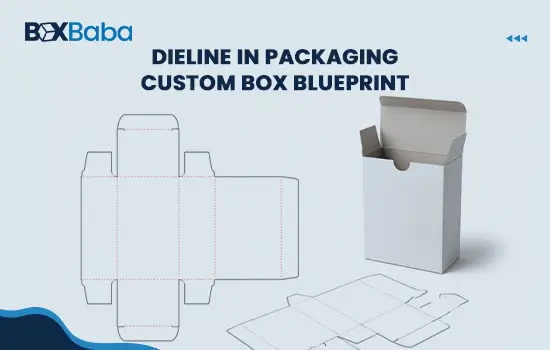
A dieline in packaging is the flat, scaled blueprint of a custom box. It maps where the box is cut, folded, glued, and assembled. Treating the dieline as a quote-readiness tool, not just a designer file, helps USA brands move through quoting and production review with fewer avoidable revisions.
For ecommerce brands, startups, and product brands ordering custom packaging, understanding dielines early can reduce reprint risk, improve quote clarity, and reduce back-and-forth during proofing. This guide explains what a dieline is, the parts it contains, the box styles it supports, the mistakes that delay production, and the inputs you should prepare before requesting a quote from BoxBaba.
A flat, scaled vector template that maps the cut lines, fold lines, bleed area, safe zones, glue tabs, and perforations of a packaging structure. Designers use dielines to position artwork, and manufacturers use them to die-cut, score, fold, and assemble the final box.
- A dieline is the flat blueprint of a custom box, mailer, carton, rigid package, sleeve, insert, or display.
- It defines cut lines, fold lines, bleed, safe zones, glue tabs, and perforations.
- Artwork sits on top of the dieline so printing aligns with the folded structure.
- Different packaging styles — folding cartons, mailers, rigid boxes, sleeves, displays — require different dielines.
- A correct dieline can reduce reprints, delays, artwork misalignment, and assembly errors.
- Brands typically need product dimensions, box style, quantity, material, and artwork direction before a dieline is finalized.
- BoxBaba advertises design support, dielines, and 3D mockups; buyers should confirm the exact dieline process for their selected box style before production.
What Is a Dieline in Packaging?
A dieline is a flat vector template that shows how a packaging structure is cut and folded into its final 3D form. It is the foundation of every custom printed box, mailer, folding carton, rigid package, sleeve, insert, and display box.
A packaging dieline contains:
- the cut path, where the die physically cuts the board, paper, or film
- the crease path, where the material folds to form the box
- the bleed area, where artwork extends beyond the cut line
- the safe zone, where logos, text, and barcodes should stay
- the glue tabs, where panels bond together during assembly
- the perforation lines, where tear-away or opening features may appear
Designers place artwork on a separate layer above the dieline. The printer uses the dieline to align the cutting die, and the assembler uses the same template to fold the box correctly.
A dieline is not artwork it is the rulebook artwork must follow.
Why Dielines Matter Before Custom Packaging Production
Dielines determine whether a custom box prints, folds, closes, and assembles correctly. Custom packaging is printed flat and assembled later, so an inaccurate dieline can produce misaligned artwork, broken folds, weak glue areas, or boxes that do not fit the product.
For most custom box projects, the dieline determines:
- whether logos and text appear on the correct panel after folding
- whether the box closes, locks, or seals properly
- whether the product fits inside the packaging
- whether print bleeds correctly to the edge
- whether the supplier can review production requirements without unnecessary delays
A clean, approved dieline can reduce avoidable production risk when dimensions, material, artwork, and proofing are also correct. A rushed or unverified dieline can lead to reprints, file corrections, and extra proofing rounds.
That said, even a well-built dieline cannot fully prevent problems if the underlying product dimensions, material specs, or artwork files are inaccurate. Verification across the full file is essential before approval.
The Anatomy of a Packaging Dieline
A packaging dieline is built from clearly marked lines, and each line represents a different production action. Understanding these lines helps brands review files before approving production.
Cut Lines
Cut lines tell the die-cutting machine where to physically cut the material. Anything outside the cut line is removed. Cut lines define the box’s outer shape, windows, handle holes, tear openings, and decorative cutouts.
Fold or Crease Lines
Fold lines mark where the board is scored so it can fold cleanly. On corrugated and paperboard packaging, scoring is important because unscored material can crack, resist folding, or distort the printed design.
Bleed Area
The bleed area is artwork extended beyond the cut line. Bleed is often around 0.125 inches, but exact requirements should be confirmed with the packaging supplier before final artwork approval.
Bleed prevents thin white edges from appearing if the cutting die shifts slightly during production. Without bleed, small trimming variation can create visible white slivers along the edges.
Safe Zone
The safe zone is the inner margin where logos, text, barcodes, QR codes, and essential artwork should stay. Anything placed too close to a fold, cut, or seam risks being trimmed, distorted, or hidden when the box is assembled.
Glue Tabs and Assembly Points
Glue tabs are the flaps that bond panels together. Designers usually keep important artwork off glue tabs because adhesives may not bond well to printed or heavily coated surfaces.
Perforation Lines
Perforation lines mark tear-away zones, often used in mailer boxes with tear strips, subscription packaging, retail cartons, or one-time-use opening features.
Although these dieline elements may look simple, they require accurate product measurement, board-thickness planning, and assembly review. Even small fold-line errors can affect how some boxes close, especially when material thickness and assembly method are not considered.
Common Dieline Types for Custom Boxes and Packaging
Each packaging style has its own dieline because the cut, fold, and glue patterns differ. Folding cartons, mailers, rigid boxes, sleeves, displays, and shipping boxes cannot share the same template.
| Packaging Style | Typical Dieline Structure | Common Use |
|---|---|---|
| Straight Tuck End carton | Tuck flaps on top and bottom in the same direction | Cosmetics, retail cartons |
| Reverse Tuck End carton | Tuck flaps facing opposite directions | Skincare, supplements, light retail |
| Auto-Lock Bottom carton | Pre-glued locking base | Heavier retail products needing faster assembly |
| Mailer Box | One-piece corrugated dieline with side wings and locking tabs | Ecommerce, subscription, DTC shipping |
| Shipping / RSC Box | Regular slotted container layout | Bulk shipping, wholesale, fulfillment |
| Rigid Setup Box | Chipboard structure plus wrap dieline | Luxury, jewelry, premium gifting |
| Sleeve Box | Outer sleeve plus inner tray | Subscription and premium retail |
| Pillow Box | Curved cut and crease pattern | Gift items and small accessories |
| Display Box / PDQ | Open-top dieline with front cutout | Retail counter and shelf display |
Many ecommerce brands start with custom mailer boxes for DTC shipping , while retail and gifting brands often compare custom rigid boxes for premium presentation.
Brands should confirm the dieline type early because the structure affects material choice, print method, finish compatibility, assembly process, and unit cost. A mailer dieline cannot be printed and finished the same way as a rigid box wrap, and switching structures mid-project usually means revising or rebuilding the dieline.
How Dielines Connect to Printing, Finishing, and Die-Cutting
A dieline is the bridge between artwork and the physical box. It directly affects how the package is printed, finished, cut, folded, and assembled.
Printing Alignment
Whether the box is produced with offset, digital, or flexographic printing, the press uses the dieline to position the print sheet. CMYK process colors and Pantone/PMS spot colors sit in the artwork layer, and the press registers them against the dieline’s reference marks.
Brand-critical colors should be discussed before production because color output can change by material, coating, ink system, print method, and proofing process.
Finishing Placement
Finishes like matte lamination, gloss lamination, soft-touch coating, spot UV, foil stamping, embossing, and debossing should align with the dieline.
Spot UV and foil often require their own layers within the production file so the finishing tool aligns precisely. A small misalignment can leave foil or UV in the wrong position and may require correction before production continues.
Adding more finish layers can improve shelf appeal, but it also adds production complexity. Brands should weigh visual impact against schedule, budget, and unit cost.
Die-Cutting and Scoring
After printing and finishing, sheets pass through a die-cutting machine. The physical die is built from the dieline. If the dieline is wrong, the die may also be wrong.
Once tooling is created, dieline changes may add time, cost, or revision steps. This is why brands should review dimensions, fold direction, bleed, safe zones, and panel orientation before final approval.
Proofing and 3D Mockups
A proof helps brands review artwork before production. A flat proof shows the dieline and artwork layout, while a 3D mockup helps visualize how the folded packaging may look.
BoxBaba advertises design support, dielines, and 3D mockups. Buyers should confirm whether dieline preparation, dieline review, or 3D mockup support applies to their specific box style, quantity, material, artwork status, and production requirements.
A 3D mockup is still a visualization. Final color, texture, coating, and finish may look different on actual material, especially with kraft stock, rigid chipboard, uncoated paperboard, or specialty finishes.
Common Dieline Mistakes That Delay Production
Dieline errors wrong dimensions, missing bleed, artwork on glue tabs can delay custom packaging production. Most are preventable with a structured pre-production review.
Frequent issues include:
Wrong Product Dimensions
Confusing internal product-fit dimensions with external box dimensions can produce a box that is too tight or too loose. Material thickness also affects internal space, especially with corrugated board and rigid packaging.
Missing Bleed
Artwork that ends exactly at the cut line may show white edges after die-cutting. A missing bleed may require artwork correction and proof review before production continues.
Important Elements Outside the Safe Zone
Logos, product names, barcodes, QR codes, and required text placed too close to folds, seams, or cut lines may be hidden, distorted, or trimmed.
Artwork on Glue Tabs
Print, coating, or ink on glue tabs can interfere with adhesive performance. Important artwork should usually stay away from glue tabs unless the supplier confirms the placement is acceptable.
Incorrect Fold Direction
Reversing a fold direction changes how artwork appears on the assembled box. This can be especially risky on mailer lids, sleeves, and retail-facing panels.
Low-Resolution Artwork
Dielines are vector files, but placed raster artwork still needs suitable print resolution. Low-resolution images can print blurry on physical packaging.
Unconverted Fonts or Unflattened Effects
Fonts, transparency effects, and linked assets may shift across software versions. Final production artwork should be packaged, outlined, embedded, or exported according to supplier requirements.
Mixed Color Modes
RGB files often shift when converted for print. CMYK and PMS/Pantone requirements should be confirmed before approval, especially for brand-critical colors.
Each issue may extend production review, especially if proofing or tooling has already started.
Dieline-Related Cost Factors for Custom Packaging
A dieline itself is usually part of the broader custom packaging quote, but several dieline-related decisions affect total project cost.
Cost is typically influenced by:
- Box style complexity: A standard tuck-end carton uses a simpler die than a custom-shaped retail display.
- Custom structural work: Brand-new structures may require new die tooling or engineering review, especially for unusual shapes.
- Material and board thickness: Heavier corrugated board and rigid chipboard require different cutting and scoring setups than lightweight folding cartons.
- Print coverage and color count: Full-bleed CMYK with multiple Pantone colors usually costs more than simple one-color printing.
- Finishes applied to the dieline: Spot UV, foil stamping, embossing, and debossing may require additional setup or tooling layers.
- Inserts and add-ons: EVA foam, molded pulp, paperboard inserts, windows, and dividers may need their own dielines.
- Quantity and MOQ: Higher volumes may reduce unit cost but increase total project spend.
- Shipping destination and dimensional weight: Compact packaging may reduce dimensional weight, while oversized boxes may increase shipping cost.
- Deadline: Rush needs can affect production planning and available options.
Heavier products often require custom shipping boxes with stronger corrugated structures instead of lightweight folding cartons. If you are still deciding between paperboard and corrugated formats, custom cardboard boxes can be a useful internal comparison point.
Exact pricing depends on these variables together not on the dieline alone. BoxBaba can provide quote details after reviewing structure, material, finish, quantity, artwork status, and shipping requirements.
Tradeoffs Brands Should Consider
Dieline-related decisions often involve practical tradeoffs.
| Tradeoff | Buyer Meaning |
|---|---|
| Custom structural dieline vs faster production | A unique structure can stand out, but it may add tooling and review time. |
| Premium finish placement vs unit cost | Foil and spot UV improve presentation but add cost and production complexity. |
| Tight product fit vs easy assembly | A snug fit protects the product, but it can make fulfillment harder. |
| Smaller dimensions vs better protection | Compact boxes reduce dimensional weight but may need stronger material or inserts. |
| Sustainable material vs structural strength | Kraft or recycled stocks may support brand values, but material suitability should be confirmed for the product. |
| Standard style vs custom-engineered structure | Standard dielines are easier to review, while custom structures may improve fit or shelf impact. |
Confirm material suitability before committing to a structure, especially if the product is fragile, heavy, oily, wet, temperature-sensitive, or compliance-sensitive.
Bad-Fit Cases for a Standard Dieline Approach
A standard dieline workflow may not be the right fit when the product or sales channel requires more than a normal template.
A project may need custom structural design or additional review when:
- the product has unusual weight or fragility
- the package needs a custom retail display structure
- the product is food, cosmetic, supplement, CBD/hemp, or otherwise regulated
- the brand needs child-resistant features
- the buyer requires verified certifications such as FSC, food-contact suitability, recyclability, or compostability
- the product needs impact testing, special inserts, or performance validation
- the deadline does not allow enough time for dieline creation, proofing, and tooling
For regulated products, confirm labeling, food-contact, and state-specific requirements before production. Compliance varies by product type, ingredient, claim, distribution channel, and state.
A dieline can support artwork placement and structure, but it does not confirm legal compliance by itself.
Production and Shipping Policy Notes
A clean dieline can support faster review, but production timing still depends on artwork readiness, structure complexity, proof approval, material availability, finishing, quantity, and shipping destination.
BoxBaba’s shipping policy lists standard processing at 5–9 business days after digital proof approval, with expedited processing options available for faster orders. Buyers should still confirm timing for their specific project because production and delivery can be affected by proof approval, order complexity, shipping address accuracy, courier operations, weather, political events, customs or government actions, and other external delays.
Before approving production, buyers should review BoxBaba current shipping, refund, and return policies so they understand processing timelines, address responsibilities, reshipping costs, and order-change limitations.
What to Prepare Before Requesting a Custom Packaging
A quote for custom packaging becomes more accurate when the dieline can be created or reviewed early. Brands do not always need a finished dieline to request a quote, but having the right inputs ready can reduce back-and-forth.
Prepare these details before contacting BoxBaba:
- product dimensions, including length, width, and height
- product weight, especially for shipping boxes and mailers
- packaging style, such as mailer, folding carton, rigid box, sleeve, display box, or shipping box
- material preference, such as SBS paperboard, kraft stock, corrugated E-flute or B-flute, or rigid chipboard
- quantity range
- print method or print expectation, such as CMYK, Pantone/PMS, full-color, one-color, or kraft printing
- finish preferences, such as matte lamination, gloss lamination, soft-touch, spot UV, foil, embossing, or debossing
- add-ons, such as window cutouts, inserts, EVA foam, paperboard inserts, or molded pulp
- artwork files in vector format when available
- shipping destination within the USA
- delivery deadline, including retail launch or seasonal dates
- compliance-sensitive label requirements if relevant
If artwork is not ready, ask BoxBaba whether a blank dieline or template can be provided for your selected box style. Compliance-sensitive products food, bakery, cosmetic, supplement, CBD/hemp, or medical-style packaging should also confirm label placement and material suitability before production.
When You May Not Need to Create a Dieline Yourself
Many brands assume they must hire a designer to draft a dieline before contacting a packaging supplier. That is not always necessary.
Custom packaging suppliers may work with dielines in three ways:
Supplier-Provided Dielines
For standard box styles, the supplier may prepare or provide a dieline based on product dimensions and the selected structure.
BoxBaba advertises design support, dielines, and 3D mockups, but buyers should confirm the exact process for their project before assuming a dieline will be prepared.
Brand-Supplied Dielines
Brands with in-house designers or existing artwork can submit their own dielines for review. The supplier may still need to check size, material, line types, bleed, safe zones, fold direction, and production compatibility.
Custom-Engineered Dielines
For unusual shapes, retail displays, specialty closures, or structural innovations, the project may require custom structural design work. This can add review time and may affect cost.
For many ecommerce brands, startups, and small businesses, the simplest path is to share product dimensions and desired box style first. Then BoxBaba can confirm whether dieline preparation, review, or design support is available for that packaging project.
Final Takeaway
A dieline in packaging is the production blueprint that determines whether your custom box prints correctly, folds cleanly, and fits your product. Brands that approach the dieline as a quote-readiness tool confirming dimensions, structure, material, finish, artwork, proofing needs, and shipping details early can reduce avoidable production revisions.
If you are preparing to order custom mailer boxes, folding cartons, custom rigid boxes, custom shipping boxes, or custom cardboard boxes, gather your product dimensions, preferred box style, quantity range, material preference, and artwork direction first.
From there, BoxBaba can review your quote inputs, discuss dieline needs, and confirm the next step for your specific packaging project.
FAQs
What is a dieline in packaging in simple terms?
A dieline is the flat blueprint of a packaging structure. It shows where the box is cut, folded, and glued. Designers place artwork on top of the dieline so printing aligns correctly with the finished box.
Do I need to create my own dieline before contacting a packaging supplier?
Not always. BoxBaba advertises design support, dielines, and 3D mockups, but buyers should confirm whether dieline preparation or review applies to their selected box style, quantity, material, and artwork status.
What file format should a packaging dieline be in?
Dielines are typically vector files. Common formats include Adobe Illustrator, PDF, and EPS. Vector formats keep cut and fold lines precise at any scale, which is important for accurate die-cutting.
What is the difference between a dieline and a 3D mockup?
A dieline is the flat production template with cut, fold, bleed, and safe-zone markings. A 3D mockup is a visualization showing how the package may look once folded. Dielines guide production; mockups support visual review.
How much bleed should a packaging dieline have?
Bleed is often around 0.125 inches beyond the cut line, but exact requirements depend on the supplier, print method, and box style. Confirm bleed and safe-zone specifications before finalizing artwork.
Can the same dieline be used for different box sizes?
No. Each size needs its own dieline because cut paths, fold positions, panel dimensions, and material allowances change with size. A new dieline is required when box dimensions change.
Do dielines affect the cost of custom packaging?
Yes, indirectly. The dieline reflects box style, material, structure, inserts, and finish complexity, which can affect tooling, production setup, material use, and unit cost.
Can I request a quote without a finished dieline?
Yes. You can request a quote with product dimensions, box style, quantity, material preference, artwork status, and shipping destination. The dieline can be prepared or reviewed during the quoting process if available for your project.