
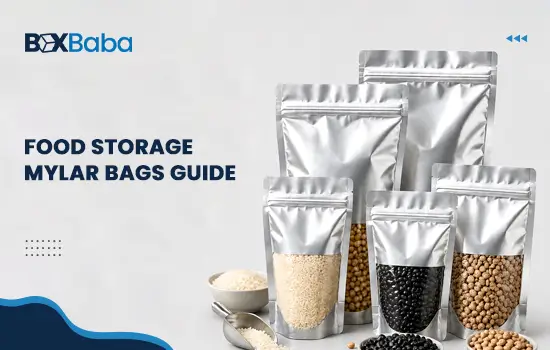
Food storage Mylar bags help food brands protect dry and low-moisture products from oxygen, moisture, light, odor transfer, and handling exposure. They are commonly used for spices, grains, powders, coffee, tea, snacks, candy, cookies, and ecommerce-ready food products.
The best Mylar bag is not simply the most attractive pouch. The right pouch depends on your food’s moisture level, aroma sensitivity, fill weight, puncture risk, closure needs, shelf display goals, and shipping method.
For most food brands, Mylar bags make the most sense when the product needs barrier protection and custom branding in one flexible package. They are not a default choice for every liquid, sauce, paste, hot-filled product, or compliance-sensitive food item without material and seal review.
If you are comparing pouch options for your brand, BoxBaba custom Mylar bags is a useful starting point for branded Mylar packaging styles, sizes, and customization options.
What Are Food Storage Mylar Bags?
Food storage Mylar bags are flexible barrier pouches used to package food products that need protection from oxygen, moisture, light, odor, and external handling. Food brands customize them by size, material structure, closure, printing, finish, and order quantity.
In commercial food packaging, Mylar packaging usually describes a flexible pouch structure built for barrier performance. A food storage Mylar bag may use PET, foil or metallized film, and a PE seal layer depending on the product, storage condition, and packaging goal.
Food brands use Mylar bags in several pouch formats:
- stand-up pouches for retail shelves
- flat pouches for samples or lightweight food items
- gusseted pouches for larger fill weights
- resealable zipper pouches for repeat access
- heat-sealed pouches for freshness protection before opening
- vacuum-compatible pouches where product suitability is confirmed
- printed branded pouches for retail and ecommerce sale
For dry foods, snacks, grains, coffee, and powdered products, BoxBaba food Mylar bags is the closest product fit.
Are Mylar Bags Good for Food Storage?
Yes. Mylar bags are good for many dry and low-moisture foods because they can protect against oxygen, moisture, light, odor, and handling exposure better than basic plastic bags.
They work especially well for food products that need freshness protection, resealable convenience, custom printing, and shelf-ready presentation. They are most commonly used for spices, grains, coffee, tea, snacks, candy, dry mixes, powders, cookies, and dehydrated foods.
They need extra review when the product is liquid, oily, acidic, high-moisture, hot-filled, refrigerated, frozen, or sold through channels with strict documentation requirements.
TL;DR for Food Brands
Mylar bags work best for dry or low-moisture food products that need barrier protection and branded presentation.
A zipper helps customers reseal the pouch, but a heat seal protects the product before first opening.
A clear window improves product visibility, but it can reduce light protection in that part of the pouch.
BoxBaba custom food Mylar bags start at a 1,000-piece MOQ.
Standard production takes 5 to 9 business days after order details and artwork are confirmed.
Free samples are available. Customers only pay sample shipping charges, which are reimbursed with the first bulk order.
BoxBaba makes food Mylar bags according to industry-standard packaging practices, but does not claim to provide FDA certificates, test reports, material declarations, or third-party compliance certificates.
Match the Mylar Bag to the Food’s Main Packaging Risk
The right Mylar bag depends on the food’s main packaging risk: oxygen exposure, moisture absorption, aroma loss, puncture, seal failure, shelf-display weakness, or ecommerce handling damage.
Before choosing a pouch style or finish, match the bag to the product risk.
| Food product | Main packaging risk | Better Mylar direction |
|---|---|---|
| Spices and seasonings | Aroma loss, moisture, light exposure | High-barrier pouch, zipper closure, strong print panel |
| Grains, rice, and beans | Fill weight, long storage, puncture risk | Thicker structure, gusseted or flat bulk pouch, heat seal |
| Powders and dry mixes | Moisture, clumping, seal contamination | Moisture-barrier film, clean seal area, zipper if repeat-use |
| Coffee and tea | Aroma loss, oxygen exposure, degassing | Barrier pouch, zipper, valve if needed |
| Snacks and candy | Freshness, shelf appeal, repeat access | Stand-up pouch, zipper, tear notch, matte or gloss finish |
| Cookies and bakery items | Breakage, freshness, shelf presentation | Proper pouch size, seal strength, optional window, secondary protection if needed |
| Nuts and oily snacks | Oil staining, oxygen exposure, aroma transfer | Material compatibility review, barrier film, durable seal |
| Sauces and pastes | Moisture, leakage, product compatibility | Material, seal, closure, and filling review before production |
| Ecommerce food products | Compression, puncture, seal failure | Durable film, right pouch size, secondary shipping protection |
Use this matrix before choosing material, closure, print finish, or quantity. A spice brand, coffee roaster, grain seller, snack company, and cookie brand should not use the same pouch specification without review.
Best Food Products for Mylar Bags
Food storage Mylar bags work best for products that benefit from barrier protection, flexible pouch sizing, resealable access, and printed branding.
Spices and Seasonings
Spices need aroma protection, moisture control, and strong shelf branding. A resealable stand-up Mylar pouch helps customers reopen the package while keeping the front panel available for the logo, flavor name, net weight, and product details.
Spice brands should also think about odor transfer. Strong aromas can affect nearby products when the pouch structure is weak or poorly sealed.
Grains, Rice, Beans, and Dry Staples
Grains and dry staples need packaging that supports weight and storage. A gusseted Mylar bag can improve volume capacity and shelf stability. A flat pouch may work better for smaller portions, samples, or lightweight ecommerce items.
Heavy dry foods need attention to seal strength, pouch thickness, puncture resistance, and carton packing.
Powders and Dry Mixes
Powders need moisture protection and clean sealing. Powder can enter the seal area during filling, which may weaken closure performance if the process is not controlled.
Brands selling protein powder, seasoning blends, drink mixes, flour, or powdered ingredients should plan pouch size, zipper placement, headspace, and fill method before ordering.
Coffee and Tea
Coffee and tea need aroma protection and strong barrier performance. Coffee may also need a degassing valve depending on roast date, filling process, storage method, and distribution plan.
Coffee brands can compare pouch direction with BoxBaba custom coffee bags
when aroma retention, valve options, resealable access, and shelf presentation matter.
Snacks and Candy
Snacks and candy need freshness, shelf appeal, and easy opening. Stand-up pouches, zipper closures, tear notches, clear windows, matte finishes, and gloss finishes can all support retail presentation.
A snack pouch should not only look good. It also needs enough strength for filling, packing, shipping, and customer handling.
Cookies and Bakery Products
Cookie brands need freshness protection, portion control, and breakage awareness. A Mylar pouch may work for cookies, biscuits, and baked snacks, but fragile products may need a carton, tray, insert, or careful shipping protection.
Bakery and cookie brands can review BoxBaba custom cookie bags when they need printed pouch packaging for sweet goods, snacks, or bakery-style products.
Sauces and Pastes
Sauces and pastes need material review because moisture level, acidity, oil content, filling temperature, and seal strength can affect pouch performance.
Do not assume a pouch that works for dry spices will work for sauces, pastes, or moist foods. Confirm the material structure, seal layer, closure type, filling method, and storage condition before production.
https://boxbaba.com/product/custom-cookie-bags/
Mylar bags do not automatically fit every food product. They need extra review when the food creates moisture, leakage, temperature, oil, acid, or compliance concerns.
Use caution when the product is:
- liquid or semi-liquid
- sauce, paste, or puree
- oily or greasy
- acidic
- hot-filled
- refrigerated or frozen
- sharp-edged
- very heavy
- highly aromatic
- sold through strict retail channels
- tied to specific labeling or material documentation requirements
Flexible pouches also do not replace structural shipping protection. A Mylar bag may protect against oxygen and moisture, but fragile food products may still need cartons, dividers, trays, inserts, padding, or shipping boxes.
Choose the Right Mylar Bag Style
The best Mylar bag style depends on fill weight, shelf display, opening experience, resealability, and shipping method.
Stand-up pouches work well for retail because they create a stable shelf presence and provide a large front panel for branding. Flat pouches work better for samples, single-serve products, or lightweight items. Gusseted pouches support larger volumes and heavier dry foods.
Products that customers reopen after purchase may fit resealable Mylar bags. A resealable zipper helps customers close the pouch after first opening, which is useful for spices, coffee, tea, candy, snacks, and powders.
Products that need air removal or tighter storage control may require vacuum-sealed Mylar bags
after product suitability is reviewed. Vacuum-compatible packaging is not automatically right for every food, so confirm the food type, structure, and sealing process before ordering.
Brands that want a natural shelf look can consider kraft Mylar bags. Kraft Mylar can support a natural or organic-style presentation, but the inner barrier structure still matters more than the outer appearance.
Material and Barrier Structure
Food storage Mylar bags usually use layered materials to control barrier performance, print quality, and seal strength.
Common material layers may include PET, BoPET, foil, metallized film, kraft-laminated structures, and PE seal layers. Each layer has a role.
PET or BoPET can support durability, print surface quality, and dimensional stability. Foil or metallized layers can improve oxygen, moisture, light, and odor barrier performance. PE seal layers can support heat sealing and product-contact functionality.
A food brand should choose Mylar material by product risk first and appearance second.
For example:
- Aromatic spices need odor and moisture control.
- Coffee needs aroma and oxygen protection.
- Powders need moisture protection and a clean seal area.
- Grains need stronger structure for weight and storage.
- Snacks need freshness, puncture resistance, and shelf appeal.
- Clear-window pouches need visibility, but the window area may reduce light protection.
If you are unsure which material structure fits your product, send BoxBaba the food type, fill weight, storage condition, closure preference, and sales channel before requesting production.
Closure Options for Food Mylar Bags
Closure choice affects freshness, opening experience, repeat use, and cost.
A heat seal protects the product before first opening. A zipper lets the customer reseal the pouch after opening. A tear notch makes the pouch easier to open. A valve may help coffee packaging release gas when needed. A hang hole supports peg display in retail environments. A spout may fit some liquid or paste products after material and seal review.
Many food brands use both a heat seal and a zipper. The heat seal protects the product before first opening, and the zipper supports customer reuse after the seal is removed.
Do not treat the zipper as a replacement for the initial seal. The first seal still matters for storage, handling, and customer confidence.
Printing and Finish Options
Custom printed Mylar bags help food brands show flavor, ingredients, nutrition facts, barcode, weight, storage instructions, and brand identity.
A printed pouch should support both shelf appeal and required product information. A strong design leaves enough room for the seal area, zipper placement, gussets, nutrition panel, ingredient list, barcode, lot code, and warning statements where required.
Common print and finish decisions include:
- full-color brand artwork
- SKU and flavor variations
- matte finish
- gloss finish
- soft-touch finish
- spot UV
- foil stamping
- clear product window
- rounded corners
- hang hole
- barcode placement
- nutrition panel space
- ingredient and allergen statement space
A printed Mylar pouch can fail at retail if the barcode scans poorly, the nutrition panel is too small, or the artwork crosses the seal area. Design should support both branding and packaging function.
Size, Fill Weight, and Dimension Planning
Food Mylar bag dimensions should match fill weight, product volume, headspace, closure type, shelf display, and shipping method.
A pouch that is too large can look underfilled. A pouch that is too small can stress the seal, crowd the zipper, or distort the artwork.
Before choosing dimensions, define:
- product fill weight
- product volume
- product shape
- bulk density
- required headspace
- zipper location
- heat seal area
- gusset depth
- front-panel design space
- carton packing method
- retail display method
- ecommerce shipping method
A 4 oz spice pouch, 12 oz coffee pouch, 1 lb grain pouch, and 2 oz candy pouch may need different dimensions even if they use similar material.
The safest workflow is to request a sample, test the fill, check the pouch shape, review the seal area, and approve shelf appearance before bulk production. BoxBaba can provide samples, and sample charges are reimbursed on the first bulk order.
BoxBaba MOQ, Samples, Production, and Shipping
BoxBaba’s custom food Mylar bags start at a 1,000-piece MOQ. This helps food brands plan launch runs, retail tests, wholesale orders, and reorder quantities.
Standard production takes 5 to 9 business days after order details and artwork are confirmed. Artwork changes, sample approval, material selection, order quantity, finishing requirements, and shipping details can affect the full schedule.
Samples can be provided. Sample charges are reimbursed on the first bulk order, which helps brands test pouch size, structure, print direction, and product fit before committing to larger production.
BoxBaba provides free shipping across the USA and supports DDP doorstep delivery. That means buyers can receive custom packaging at their delivery address without managing separate freight steps.
Before ordering, confirm your product details, artwork status, quantity, delivery destination, and deadline so the quote reflects the actual packaging need.
Cost Factors for Food Storage Mylar Bags
Food storage Mylar bag pricing depends on size, film structure, thickness, closure, printing, finish, quantity, sample needs, and delivery requirements.
Larger pouches use more material. Higher-barrier structures may cost more than simple film structures. Zippers, valves, windows, spouts, hang holes, special finishes, and multiple SKU designs can also affect price.
Exact pricing requires a custom quote because food brands rarely need the same pouch. A spice pouch, coffee pouch, cookie pouch, candy pouch, and bulk grain pouch can all require different materials, dimensions, closures, and print layouts.
To get a more accurate quote, prepare your product type, fill weight, pouch size, quantity, closure preference, artwork, finish choice, shipping destination, and deadline.
Food-Contact, Documentation, and Sustainability Cautions
Food packaging may require product-specific material review. Buyers should confirm material suitability, food-contact expectations, labeling requirements, storage conditions, and sales-channel requirements before production.
BoxBaba makes food Mylar bags according to industry-standard packaging practices, but BoxBaba does not claim to provide FDA certificates, test reports, material declarations, or third-party compliance certificates.
This means buyers should not use unsupported claims such as:
- FDA-approved packaging
- certified food-safe packaging
- certified recyclable packaging
- certified compostable packaging
- certified biodegradable packaging
- verified test-report-backed packaging
unless they have separate documentation that supports those claims.
BoxBaba can use recyclable, compostable, and biodegradable material options, but certificates are not provided for those claims. If your retailer, distributor, procurement team, or compliance department requires certificates, confirm those requirements before ordering.
This article does not provide legal advice. Packaging requirements can vary by product type, ingredient, moisture level, oil content, claim, label, storage condition, state, and sales channel.
Retail vs Ecommerce Food Packaging
Retail food packaging needs shelf visibility, clear product information, and strong presentation. Ecommerce food packaging needs seal strength, puncture resistance, carton protection, and delivery reliability.
A pouch may look good on a retail shelf but still fail during shipping if the film is too thin, the seal is weak, or the product is fragile. A pouch may also ship safely but fail on shelf if it does not stand well, display clearly, or communicate the product quickly.
For retail, prioritize:
- stand-up structure
- strong front-panel branding
- readable flavor and weight
- barcode placement
- nutrition panel space
- shelf stability
- finish choice
- product visibility where useful
For ecommerce, prioritize:
- seal strength
- pouch durability
- puncture resistance
- right fill size
- carton fit
- compression
- protection
- scuff resistance
- secondary shipping protection
Many food brands need both. If your pouch will sit on a shelf and ship directly to customers, choose a structure that supports both presentation and delivery.
Quote-Readiness Checklist
A quote-ready Mylar bag request helps BoxBaba understand your product, packaging risk, design needs, and delivery requirements.
Send these details before requesting a quote:
| Quote detail | What to provide |
|---|---|
| Product type | Spice, grain, snack, candy, powder, coffee, cookie, sauce, paste, etc. |
| Product condition | Dry, oily, aromatic, moist, powdered, sharp-edged, fragile |
| Fill weight | Ounces, grams, pounds, serving size, or bulk weight |
| Bag style | Stand-up, flat, gusseted, resealable, vacuum-compatible, kraft, window |
| Dimensions | Width, height, gusset, or target fill size |
| Material direction | Foil, metallized, kraft, clear, recyclable, compostable, biodegradable, or unsure |
| Closure | Heat seal, zipper, tear notch, valve, spout, hang hole |
| Printing | Logo, full-color artwork, nutrition panel, barcode, SKU versions |
| Finish | Matte, gloss, soft-touch, spot UV, foil, window |
| Quantity | Minimum 1,000 pieces, first order quantity, and expected reorder quantity |
| Artwork status | Ready file, needs dieline, needs design help, or needs proof |
| Sample need | Whether you need a sample before bulk production |
| Shipping destination | City, state, and delivery address type |
| Deadline | Launch date, retail date, event date, or reorder date |
| Compliance sensitivity | Food-contact, labeling, retailer, state, or documentation requirements |
Better quote inputs reduce confusion, prevent wrong specifications, and help the supplier recommend a better pouch direction.
What to Ask Before Ordering Food Storage Mylar Bags
Ask supplier questions before ordering so the pouch fits the food, sales channel, and production plan.
Use these questions before approving a bulk order:
- Does this pouch structure fit my product type?
- Does my food need oxygen, moisture, light, odor, or puncture protection?
- Is my product dry, oily, acidic, moist, powdered, or sharp-edged?
- Does the pouch need a zipper, heat seal, tear notch, valve, window, or hang hole?
- Will the package be used for retail, ecommerce, wholesale, or all three?
- Is a sample available before bulk production?
- Are sample charges reimbursed on the first bulk order?
- What is the MOQ?
What is the production timeline after artwork approval? - Is shipping included across the USA?
- Is DDP doorstep delivery available?
- Are certificates, test reports, or material declarations required by my retailer or compliance team?
- Is my artwork ready for the dieline, seal area, gusset, zipper, and barcode placement?
These questions help buyers avoid packaging that looks good in a mockup but fails during filling, shipping, retail display, or compliance review.
Why Choose BoxBaba for Food Storage Mylar Bags?
BoxBaba helps food brands order custom Mylar bags with the right pouch style, material direction, closure, print setup, quantity, and delivery plan.
Food brands can use BoxBaba for custom Mylar packaging when they need branded pouches for dry foods, snacks, coffee, cookies, grains, powders, candy, and other food products that require barrier protection and shelf-ready presentation.
BoxBaba food Mylar bag program includes:
- 1,000-piece MOQ
- 5 to 9 business day standard production
- sample availability
- sample charge reimbursement on the first bulk order
- free shipping across the USA
- DDP doorstep delivery
- custom size, print, closure, and finish planning
BoxBaba does not claim to provide FDA certificates, test reports, material declarations, or third-party sustainability certificates. Buyers who need documentation for retail, compliance, procurement, or regulated distribution should confirm those requirements before ordering.
Final Takeaway
Food storage Mylar bags can be a strong packaging choice when a food product needs barrier protection, custom branding, resealable access, and retail or ecommerce presentation.
Start with the food’s protection risk. Then choose the Mylar structure, pouch style, closure, size, print finish, and quantity around that risk.
If you are preparing a custom packaging order, send BoxBaba your product type, fill weight, pouch size, closure preference, artwork, quantity, delivery location, and deadline. BoxBaba can help you prepare a custom food Mylar bag quote with the right packaging direction for your product.
Frequently Asked Questions Mylar Bags
Are Mylar bags good for food storage?
Yes. Mylar bags are good for many dry and low-moisture foods that need oxygen, moisture, light, odor, or handling protection. Suitability depends on the food type, material structure, seal quality, and storage condition.
What foods can go in Mylar bags?
Common food uses include spices, grains, rice, beans, coffee, tea, powders, snacks, candy, cookies, nuts, dry mixes, and dehydrated foods. Moist, oily, acidic, or liquid foods need additional material review.
Are Mylar bags food safe?
Food-contact suitability must be confirmed for the exact food product, material structure, storage condition, and intended use. BoxBaba makes food Mylar bags according to industry-standard packaging practices but does not claim FDA certificates.
What is BoxBaba MOQ for food Mylar bags?
BoxBaba custom food Mylar bags start at a 1,000-piece MOQ. Final order planning should consider SKU count, pouch size, material, print setup, finish, closure, and reorder needs.
How long does production take?
BoxBaba standard production time is 5 to 9 business days after artwork and order details are confirmed. Artwork changes, sample approval, finishing, quantity, and shipping details can affect the full schedule.
Can BoxBaba provide samples?
Yes. Free samples are available upon request. Customers pay sample shipping charges, which are reimbursed with the first bulk order. Custom-printed samples are quoted separately.
Does BoxBaba offer free shipping in the USA?
Yes. BoxBaba provides free shipping across the USA and supports DDP doorstep delivery, so buyers can receive packaging at their delivery address.
Can Mylar bags be resealed?
Yes. Mylar bags can include zipper closures. Many food brands use both a heat seal for first-opening protection and a zipper for customer resealing after opening.
Can Mylar bags have a clear window?
Yes. Some Mylar bags can include a clear window. A window improves product visibility, but it may reduce light protection in that area.
Do Mylar bags need oxygen absorbers?
Some dry storage applications use oxygen absorbers. Food brands should confirm whether oxygen absorbers fit the product, pouch structure, filling process, labeling, and storage expectations.
What affects the cost of custom food Mylar bags?
Cost depends on pouch size, material structure, thickness, closure, printing, finish, quantity, sample needs, and delivery requirements. Exact pricing requires a custom quote.
Does BoxBaba provide FDA certificates or material declarations?
No. BoxBaba does not claim to provide FDA certificates, test reports, material declarations, or third-party compliance certificates. Buyers should confirm documentation requirements before ordering.
Can BoxBaba use recyclable, compostable, or biodegradable materials?
Yes. BoxBaba can use recyclable, compostable, and biodegradable material options, but certificates are not provided for these claims. Buyers needing documented sustainability proof should confirm requirements before ordering.