
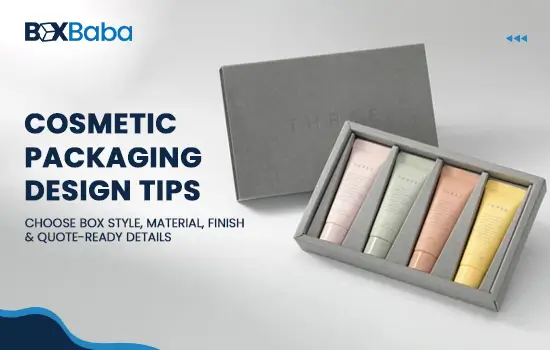
Cosmetic packaging design tips help beauty brands choose the right box style, material, color, finish, insert, and protection features before production. A lipstick carton, serum box, skincare mailer, or rigid cosmetic box should fit the product’s size, weight, sales channel, and brand tier.
For USA beauty brands, packaging design is not only about making a box look attractive. It must also support product fit, readable branding, retail display, ecommerce shipping, required label space, finish compatibility, and quote preparation.
This guide uses BoxBaba’s Cosmetic Packaging Design Fit Framework to help skincare startups, makeup brands, private-label beauty businesses, ecommerce sellers, and beauty product manufacturers prepare better custom cosmetic boxes before they request a packaging quote. BoxBaba cosmetic boxes positions the category for beauty brands, skincare companies, makeup lines, and personal care businesses across the USA.
What Makes Good Cosmetic Packaging Design?
Good cosmetic packaging design matches the product’s size, weight, fragility, sales channel, brand tier, material, printing method, finish, labeling space, and quote requirements. A cosmetic box should protect the product, present the brand, and prepare the buyer for production.
What Is Cosmetic Packaging Design?
Cosmetic packaging design is the process of selecting the box structure, material, artwork layout, printing method, surface finish, insert, window, and protection features for beauty products. It helps cosmetic brands present products, protect containers, support retail or ecommerce use, and prepare custom cosmetic boxes for quote review.
Cosmetic Packaging Design Tips
Use this order before designing your cosmetic box:
- Match the product to the box style.
- Match the box style to the material.
- Match the material to printing and color needs.
- Match the brand tier to the finish.
- Match the sales channel to protection needs.
- Match the artwork layout to labeling space.
- Match sustainability claims to verified documentation.
- Match the quote request to exact packaging inputs.
Use BoxBaba Cosmetic Packaging Design Fit Framework
BoxBaba design framework helps beauty brands connect product needs to packaging structure, material, finish, channel, and quote inputs.
| Fit Layer | Buyer Question | Packaging Decision |
|---|---|---|
| Product fit | What are you packaging? | Lipstick, serum, jar, palette, bottle, kit |
| Structure fit | What box style supports the item? | Folding carton, rigid box, mailer box, sleeve box |
| Material fit | What board supports print and protection? | SBS paperboard, kraft paper, corrugated board, rigid chipboard |
| Finish fit | What surface treatment matches brand tier? | Matte, gloss, soft-touch, foil, embossing, spot UV |
| Channel fit | Where will the box be sold or shipped? | Retail, ecommerce, subscription, wholesale, gifting |
| Quote fit | What details are needed for pricing? | Dimensions, quantity, artwork, finish, inserts, destination |
This framework keeps the design process practical. It prevents a brand from choosing a finish before confirming the material, or completing artwork before confirming the dieline.
What Are Cosmetic Packaging Design Tips for Beauty Brands?
Cosmetic packaging design tips help beauty brands choose box structure, material, color, finish, insert, and channel protection that fit the product before production.
A cosmetic box must do four jobs:
- Hold the product
- Present the brand
- Protect the container
- Support the buying channel
A serum bottle needs different packaging than a lipstick tube. A retail mascara carton needs different design choices than an ecommerce skincare mailer. A premium fragrance set may need a rigid box, while a lightweight eyeliner may only need a printed folding carton.
| Design Area | Packaging Decision | Buyer Question |
|---|---|---|
| Product type | Lipstick, serum, palette, jar, bottle, kit | What box style fits the item? |
| Structure | Folding carton, rigid box, mailer, sleeve, drawer | What format supports the product? |
| Material | SBS, kraft, corrugated, rigid board | What material supports print and protection? |
| Printing | CMYK, PMS / Pantone, offset, digital | How should artwork and brand colors print? |
| Finish | Matte, gloss, foil, embossing, spot UV | Which finish supports brand tier? |
| Channel | Retail, ecommerce, wholesale, gifting | How much protection does the box need? |
| Quote inputs | Dimensions, quantity, artwork, destination | What details does BoxBaba need? |
Cosmetic packaging design should start with product fit, not decoration. Decoration improves visual impact only after structure, size, and protection are correct.
Choose the Right Cosmetic Box Style First
Choose the Right Cosmetic Box Style First
| Cosmetic Box Style | Best Fit | Design Strength | Buyer Caution |
|---|---|---|---|
| Straight tuck end box | Lipstick, mascara, eyeliner, small skincare bottles | Clean front display panel | Weak fit for heavy glass without support |
| Reverse tuck end box | Lightweight skincare or makeup cartons | Efficient folding carton style | Front or bottom edge may affect presentation |
| Auto-lock bottom box | Heavier jars, bottles, or kits | Stronger base support | More complex than basic tuck cartons |
| Sleeve box | Soap, skincare sets, palettes | Clean sliding reveal | Poor fit for fragile items without inserts |
| Drawer box | Luxury cosmetics, PR kits, gift sets | Premium unboxing experience | Requires separate sleeve and tray planning |
| Rigid setup box | Fragrance sets, high-end skincare, influencer kits | Strong premium presentation | Higher material, storage, and shipping impact |
| Mailer box | Ecommerce cosmetics, subscription boxes | Shipping-friendly structure | Needs correct flute and insert planning |
| Window box | Products where visibility helps purchase | Shows shade, jar, tube, or bottle | Reduces printable area |
Folding cartons work well for many lightweight retail cosmetics because they provide printable panels and can ship flat. Rigid setup boxes support premium presentation, but they may increase storage space, shipping weight, and unit cost.
For premium launches, compare custom rigid boxes when the product needs a stronger presentation structure. For ecommerce beauty shipments, compare custom mailer boxes when shipping protection and unboxing are more important than slim shelf display.
Match Material to Product Weight, Print Quality, and Brand Position
The best cosmetic box material depends on product weight, container fragility, print detail, finish choice, and sales channel.
| Material | Strong Fit | Packaging Use | Caution |
|---|---|---|---|
| SBS paperboard | Color-rich cosmetic cartons | Lipstick boxes, mascara boxes, skincare cartons | May need inserts for heavy glass |
| Kraft paper | Natural-looking cosmetic packaging | Minimal skincare, soap, wellness brands | Colors can look muted on brown stock |
| Corrugated board / E-flute | Ecommerce cosmetic mailers | DTC shipping and subscription boxes | Oversizing can increase dimensional weight |
| Rigid board / chipboard | Luxury cosmetic boxes | Gift sets, PR kits, premium collections | Higher structure can raise freight and storage needs |
| Paperboard inserts | Lightweight product organization | Lipsticks, jars, bottles, samples | Must match exact product dimensions |
| Molded pulp or foam inserts | Fragile product support | Glass bottles, droppers, palettes | Material and sustainability claims need review |
SBS paperboard supports clean print detail and bright cosmetic brand colors. Kraft paper supports a natural appearance, but it can reduce color vibrancy. Corrugated board supports ecommerce protection. Rigid board supports premium presentation.
A heavy glass serum bottle may not be a good fit for a basic folding carton unless the structure and insert are designed correctly. A lightweight lipstick box may not need a rigid structure if shelf display and cost control matter more than luxury unboxing.
Design for Print, Logo Placement, and Color Accuracy
Printing decisions affect how cosmetic packaging colors, logos, typography, and product information appear after production.
CMYK printing supports full-color artwork, gradients, illustrations, and product-family graphics. PMS or Pantone matching helps when a beauty brand needs specific color consistency across cosmetic boxes, labels, inserts, mailers, and retail displays.
| Printing / Design Element | Best Use | Buyer Caution |
|---|---|---|
| CMYK printing | Full-color cosmetic artwork | Screen colors may shift in print |
| PMS / Pantone matching | Signature brand colors | May add setup complexity |
| Offset printing | Larger production runs | Requires setup and proofing |
| Digital printing | Shorter runs or samples | Color may vary from offset output |
| Logo placement | Brand recognition | Must not crowd required label text |
| Typography | Product clarity | Small or thin fonts may lose readability |
| Front-panel hierarchy | Retail shelf visibility | Avoid cluttered claims and badges |
Logo placement should match the buying channel. Retail cartons need strong front-panel recognition. Ecommerce mailers can use the top panel and inside lid for unboxing impact. Gift boxes may use foil stamping, embossing, or debossing on the lid.
Cosmetic boxes with logo should still leave space for product name, shade, net quantity, ingredient information, barcode, batch code, and required warnings where applicable.
For branded artwork, logo placement, and inside/outside printing, review printed boxes with inserts before finalizing the dieline and artwork setup. BoxBaba printed boxes with inserts highlights inserts for protection and presentation, including use cases such as premium cosmetics.
Select Finishes That Match Brand Tier and Budget
Cosmetic packaging finishes can improve shelf appeal, but each finish should support the brand tier, artwork, material, and budget.
| Finish | Best Use | Design Effect | Caution |
|---|---|---|---|
| Matte lamination | Minimal skincare, premium clean beauty | Smooth low-shine appearance | May show scuffs during handling |
| Gloss lamination | Colorful makeup cartons | High-shine color intensity | Can create glare under retail lighting |
| Soft-touch coating | Premium skincare or luxury cartons | Velvet-like tactile feel | May increase production complexity |
| Foil stamping | Logos, icons, limited editions | Metallic shelf emphasis | Adds setup and cost complexity |
| Embossing | Brand marks or seals | Raised texture | Works best with simple artwork areas |
| Debossing | Minimal luxury packaging | Pressed-in detail | Fine details need testing |
| Spot UV | Logo or pattern highlights | Gloss contrast on matte areas | Registration needs design review |
| Aqueous coating | General paperboard protection | Light surface protection | Less premium than specialty finishes |
Foil stamping improves shelf appeal, but it can increase cost and production complexity. Matte lamination creates a premium look, but it may show scuffs more visibly than gloss in some handling conditions. Spot UV works best when used selectively, not across every design element.
Use one or two finish effects with purpose. Overusing foil, embossing, spot UV, and heavy color together can make cosmetic packaging look crowded and harder to produce.
Plan Inserts, Windows, and Protection Features
Inserts, dividers, windows, and inner supports help cosmetic boxes protect products and improve presentation.
| Feature | Best Fit | Packaging Benefit | Caution |
|---|---|---|---|
| Paperboard insert | Tubes, jars, bottles, samples | Holds products in place | Needs exact dimensions |
| Divider | Multi-product kits | Separates items | Can waste space if poorly planned |
| EVA foam insert | Fragile glass or premium kits | Strong cushioning | May conflict with sustainability goals |
| Molded pulp insert | Plastic-reduction goals | Structured product hold | Claims need verification |
| Die-cut window | Shade or product visibility | Shows product without opening | Reduces printable area |
| Sleeve or tray | Premium reveal | Improves unboxing sequence | Requires multiple dielines |
| Hang tab | Peg retail display | Helps in-store placement | Must support product weight |
A die-cut window can help shoppers see product color or container shape, but it reduces branding space. Inserts can reduce movement inside the box, but they require accurate product measurements before production.
If your serum bottles, jars, palettes, or sample kits need internal product hold, compare printed boxes with inserts before choosing a basic carton.
Design for Retail, Ecommerce, Subscription, or Gift Use
Retail cosmetic packaging and ecommerce cosmetic packaging need different structural and visual decisions.
| Channel | Design Priority | Packaging Tip |
|---|---|---|
| Retail shelf | Front-panel clarity and shelf visibility | Keep brand, product type, shade, and claim hierarchy readable |
| Ecommerce shipping | Protection and arrival condition | Use mailer boxes, inserts, or stronger board where needed |
| Subscription box | Organized multi-item presentation | Use dividers, inserts, and inside-lid branding |
| Wholesale | Efficient packing and repeat orders | Keep structure consistent across SKUs |
| Gift set | Premium opening experience | Consider rigid boxes, drawer boxes, sleeves, or specialty finishes |
| Influencer / PR kit | Visual reveal and shareability | Use structured inserts and branded interior panels |
Retail packaging must stand upright, stack cleanly, and communicate quickly. Ecommerce packaging must survive handling, reduce movement, and avoid unnecessary dimensional weight.
A beautiful folding carton may work well on a retail shelf but may crush if shipped alone without an outer mailer. A large mailer may protect the product but increase shipping cost if the dimensions are not planned around the product and insert.
Use Sustainability Claims Carefully
Sustainability-oriented cosmetic packaging design requires material, coating, ink, certification, and claim verification.
Beauty brands often ask for kraft paper, reduced lamination, recycled content, recyclable materials, compostable packaging, or plastic-free packaging. These can be valid goals, but the final claim must match verified material specifications and the market where the package is sold.
The FTC Green Guides are designed to help marketers avoid environmental claims that mislead consumers, so broad claims such as eco-friendly, green, recyclable, or compostable should not be printed unless they are properly substantiated.
| Sustainability Direction | Packaging Impact | Caution |
|---|---|---|
| Kraft paper | Natural look | Color output may be muted |
| Reduced lamination | Less coating complexity | May reduce scuff or moisture resistance |
| Recycled content | Sustainability positioning | Requires verified content documentation |
| Recyclable claim | Buyer trust signal | Depends on material and local systems |
| Compostable claim | Strong environmental claim | Requires specific certification and conditions |
| Minimal packaging | Less material use | Must still protect the product |
Do not add FSC, recyclable, compostable, biodegradable, plastic-free, or eco-friendly claims to artwork unless BoxBaba and your compliance advisor confirm the claim can be supported.
Plan Cosmetic Labeling Space Before Artwork Approval
Cosmetic labeling requirements affect panel layout, font size, net quantity placement, ingredient space, warning areas, and contact information.
FDA’s cosmetic labeling resources provide an overview of labeling requirements that affect cosmetics, and FDA’s Cosmetics Labeling Guide gives step-by-step help with cosmetic labeling under U.S. laws and related regulations.
MoCRA also added modern requirements for the cosmetics industry, including safety substantiation, registration and listing, adverse event reporting, and fragrance allergen labeling requirements.
This section provides packaging-design guidance only. Confirm final label content, claims, warning statements, ingredient naming, net quantity, contact information, and state or channel requirements with your regulatory advisor before production.
| Labeling Area | Design Impact |
|---|---|
| Product identity | Needs clear front-panel placement |
| Net quantity | Needs compliant panel placement |
| Ingredient list | Can require significant back or side panel space |
| Distributor / business details | Needs readable information panel space |
| Warnings or directions | May require extra panel area |
| Barcode and batch code | Need clear, scannable placement |
| Claims | Need review before printing |
Small boxes create the biggest design challenge. A lipstick carton, travel-size serum, or mini skincare box may not have enough panel space for long ingredient lists or claims. In these cases, the structure, panel layout, or secondary packaging may need adjustment before artwork is approved.
Understand Cosmetic Packaging Cost and MOQ Factors
Cosmetic packaging cost depends on size, structure, material, print coverage, finishes, inserts, quantity, proofing, production complexity, shipping destination, and deadline.
Exact pricing and MOQ should be confirmed through BoxBaba quote process because they depend on structure, material, quantity, finish, inserts, and shipping details. BoxBaba quote form asks for key production details such as material, length, width, height, quantity, printing side, message, and design upload.
| Cost Factor | How It Affects the Quote |
|---|---|
| Box size | Larger boxes use more material and may increase shipping cost |
| Structure | Rigid boxes and drawer boxes are more complex than folding cartons |
| Material | SBS, kraft, corrugated, and rigid board affect cost differently |
| Board thickness | Heavier board can increase material cost |
| Print coverage | Full-color or heavy ink coverage may increase complexity |
| PMS / Pantone matching | Adds color-control requirements |
| Finish selection | Foil, embossing, soft-touch, and spot UV can add setup |
| Inserts | Paperboard, molded pulp, or foam inserts add material and dielines |
| Quantity / MOQ | Higher quantities may improve unit economics but require more inventory |
| Proofing | Samples, dielines, and mockups affect planning time |
| Shipping destination | Freight and dimensional weight can affect total landed cost |
| Deadline | Rush needs may limit production options |
Buyer Tradeoffs to Review
| Tradeoff | Buyer Decision |
|---|---|
| Stronger material vs lower unit cost | Choose stronger material when protection or premium feel matters |
| Premium finish vs production simplicity | Use specialty finishes only where they improve perceived value |
| Retail shelf appeal vs ecommerce durability | Retail boxes need visibility; ecommerce boxes need protection |
| Sustainability preference vs product protection | Material choice must still protect the product |
| Small order vs bulk efficiency | Lower quantity reduces inventory risk; larger quantity may improve unit economics |
| Custom inserts vs faster production | Inserts improve fit but require extra dieline planning |
When Cosmetic Packaging Design Makes Sense and When It Does Not
Custom cosmetic packaging design makes sense when the product, brand tier, sales channel, and quote inputs are clear.
Use Custom Cosmetic Box Design When
- You are launching a skincare, makeup, fragrance, or beauty product line.
- You need consistent branding across multiple cosmetic SKUs.
- Your product needs retail shelf presence or premium unboxing.
- Your product needs inserts, dividers, or structured protection.
- You have product dimensions, quantity, artwork direction, and sales channel details ready.
Consider a Simpler Packaging Option When
- The product dimensions are not finalized.
- The budget cannot support specialty finishes or rigid structures.
- The product is fragile but no insert or shipper has been planned.
- The artwork includes unverified sustainability, certification, or compliance claims.
- The brand needs verified certifications that have not been confirmed.
Bad-Fit Cases
A standard folding carton may be a bad fit for a heavy glass bottle shipped directly to consumers without an outer mailer. A rigid box may be a bad fit for a low-margin product where the packaging cost does not support the retail price. Kraft packaging may be a bad fit for artwork that depends on bright pastel colors or exact color matching.
How to Choose a Cosmetic Packaging Supplier
Choose a cosmetic packaging supplier by checking whether they ask about product dimensions, material, printing, finish, inserts, sales channel, quantity, and shipping destination before quoting.
| Supplier Check | Good Sign | Risk Sign |
|---|---|---|
| Box style guidance | Explains product fit | Recommends one box for every product |
| Material guidance | Compares SBS, kraft, corrugated, and rigid board | Uses vague “premium material” claims |
| Printing support | Discusses CMYK and PMS / Pantone | Ignores color accuracy |
| Finish guidance | Explains foil, matte, spot UV, and embossing tradeoffs | Pushes finishes without cost caution |
| Insert planning | Reviews product movement and fragility | Skips protection review |
| Compliance caution | Tells you to verify labels and claims | Promises compliance without details |
| Quote clarity | Requests dimensions, quantity, artwork, and destination | Gives vague pricing without specs |
Use this scorecard when comparing suppliers or preparing your BoxBaba quote request. The uploaded research also recommends supplier evaluation around structure guidance, material options, print support, proofing, quote clarity, and compliance caution.
What to Prepare Before Requesting a Cosmetic Packaging Quote
Prepare product details, box style, dimensions, quantity, material, printing, finish, insert needs, artwork, shipping destination, deadline, and compliance sensitivity before requesting a cosmetic packaging quote.
A complete quote request reduces back-and-forth. It also helps the supplier evaluate material fit, print setup, finish complexity, and shipping impact.
| Quote Input | What to Provide | Example |
|---|---|---|
| Product type | Cosmetic item category | Lipstick, serum bottle, cream jar, palette |
| Packaging style | Preferred structure | Folding carton, rigid box, mailer box |
| Dimensions | Product and box size | Length × width × height |
| Quantity | Order volume and reorder plan | First run and expected reorder |
| Material preference | Board or paper type | SBS paperboard, kraft, corrugated, rigid board |
| Printing | Artwork and color needs | CMYK, PMS / Pantone matching |
| Finish | Surface treatment | Matte lamination, foil stamping, spot UV |
| Inserts | Product support | Paperboard insert, EVA foam, molded pulp |
| Artwork files | Design status | Dieline, logo, print-ready PDF, 3D mockup request |
| Channel | Use case | Retail, ecommerce, wholesale, gifting |
| Shipping destination | Delivery location | City, state, ZIP code |
| Deadline | Needed arrival date | Launch date or reorder date |
| Compliance sensitivity | Label or claim risk | SPF, acne, anti-aging, CBD, state-specific claims |
| Protection concerns | Risk factors | Glass, pump, cap, palette pan, mirror |
Ask BoxBaba to confirm material suitability, production options, timeline, MOQ, and shipping details before approval.
How BoxBaba Helps You Move From Cosmetic Box Design to Quote
BoxBaba supports USA beauty brands by connecting cosmetic box planning with quote-ready packaging details. Use the custom cosmetic boxes page when you are comparing beauty packaging options, the custom rigid boxes page when you need premium presentation, and the custom mailer boxes page when ecommerce shipping and unboxing are priorities.
Before submitting a quote request, prepare your product dimensions, quantity, material preference, print side, artwork files, finish goals, insert needs, shipping destination, and deadline. BoxBaba’s quote page collects key production inputs such as material, length, width, height, quantity, printing side, message, and design upload.
Confirm MOQ, production timeline, certification, sustainability, and shipping details during the quote process before approving final artwork.
Final Takeaway
Cosmetic packaging design works best when you choose structure before decoration. Start with product fit, then choose material, printing, finish, insert, channel protection, labeling space, and quote inputs.
BoxBaba Cosmetic Packaging Design Fit Framework helps beauty brands request custom cosmetic boxes with clearer specifications and fewer production assumptions.
Ready to move from design to production? Send BoxBaba your product type, dimensions, quantity, artwork status, material preference, finish goals, insert needs, shipping destination, deadline, and compliance concerns to request a cosmetic packaging quote.
FAQs About Cosmetic Packaging Design Tips
What are the most important cosmetic packaging design tips?
The most important cosmetic packaging design tips are to match box style, material, color, finish, insert, and channel to the product. A beauty brand should design for product fit before choosing decoration.
What material is best for cosmetic boxes?
SBS paperboard often fits printed retail cosmetic boxes, while corrugated board fits ecommerce mailers and rigid board fits premium kits. The best material depends on product weight, fragility, artwork, and sales channel.
Are rigid boxes good for cosmetic packaging?
Rigid boxes work well for premium cosmetic kits, gift sets, fragrance sets, and PR packages. They may cost more and weigh more than folding cartons, so use them when presentation value supports the choice.
What finish is best for luxury cosmetic packaging?
Foil stamping, embossing, debossing, spot UV, matte lamination, and soft-touch coating can support luxury cosmetic packaging. Use one or two finish effects to keep artwork clean and production manageable.
Can cosmetic packaging be eco-friendly?
Cosmetic packaging can support eco-conscious goals when materials and claims are verified. Confirm recyclable, compostable, biodegradable, FSC, recycled-content, or plastic-free claims before printing them on boxes.
What affects custom cosmetic packaging cost?
Box size, material, board thickness, print coverage, PMS matching, finish, inserts, quantity, proofing, production complexity, shipping destination, and deadline affect cosmetic packaging cost. Exact pricing requires reviewed specifications.
What should I send for a cosmetic packaging quote?
Send product type, box style, dimensions, quantity, material preference, printing needs, finish choice, insert needs, artwork files, shipping destination, deadline, and compliance sensitivity. These details help create a cleaner quote.