
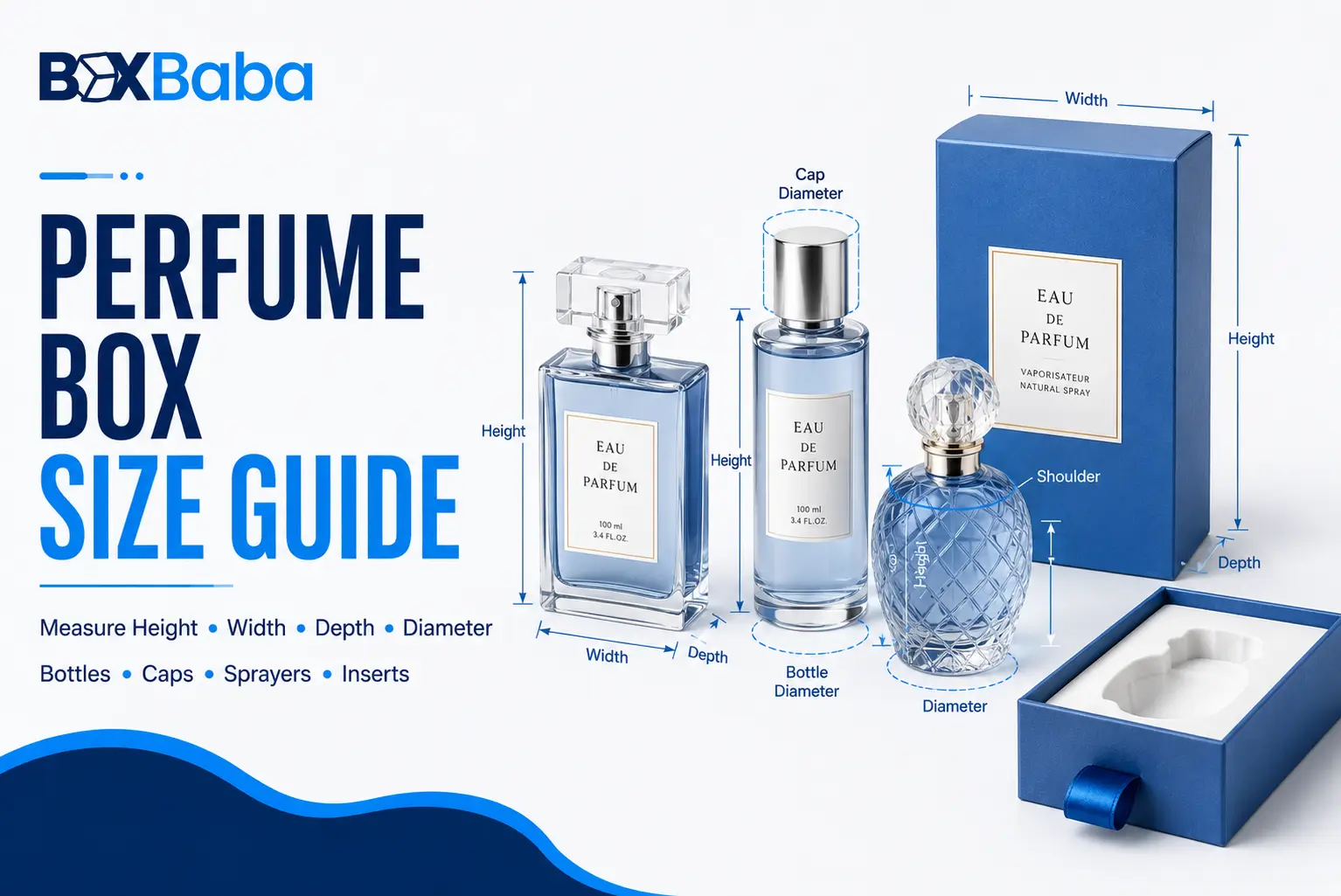
There is no universal perfume box size. A 30 ml, 50 ml or 100 ml capacity does not determine carton dimensions because perfume bottles can have different bodies, shoulders, caps and sprayers. Measure the complete assembled bottle at its maximum width, depth and closed height, then account for the insert, clearance, material and box structure.
For custom packaging, use the perfume bottle in its complete assembled, closed and sale-ready condition, including the glass body, shoulders, neck, atomizer, collar, installed cap and permanent decorative features.
A practical sizing sequence is:
Complete Assembled Perfume Bottle → Maximum Product Envelope → Insert / Clearance Requirements → Internal Box Dimensions → Material + Structure → External Box Dimensions
Brands preparing a custom project can explore Custom Perfume Boxes. For broader cosmetic measurement principles, review the Cosmetic Box Size Guide.
Primary Perfume Bottle vs Secondary Perfume Box
For measurement purposes, distinguish the primary fragrance container from the secondary package.
Primary Perfume Package: the assembled bottle that directly contains the fragrance, including its closure and permanent exterior components.
Secondary Perfume Box: the carton or presentation box developed around the finished bottle and any required internal support.
The relationship is:
Fragrance → Primary Perfume Bottle → Secondary Perfume Box
Fragrance capacity describes how much product is inside the bottle. It does not describe the exterior dimensions required for the box.
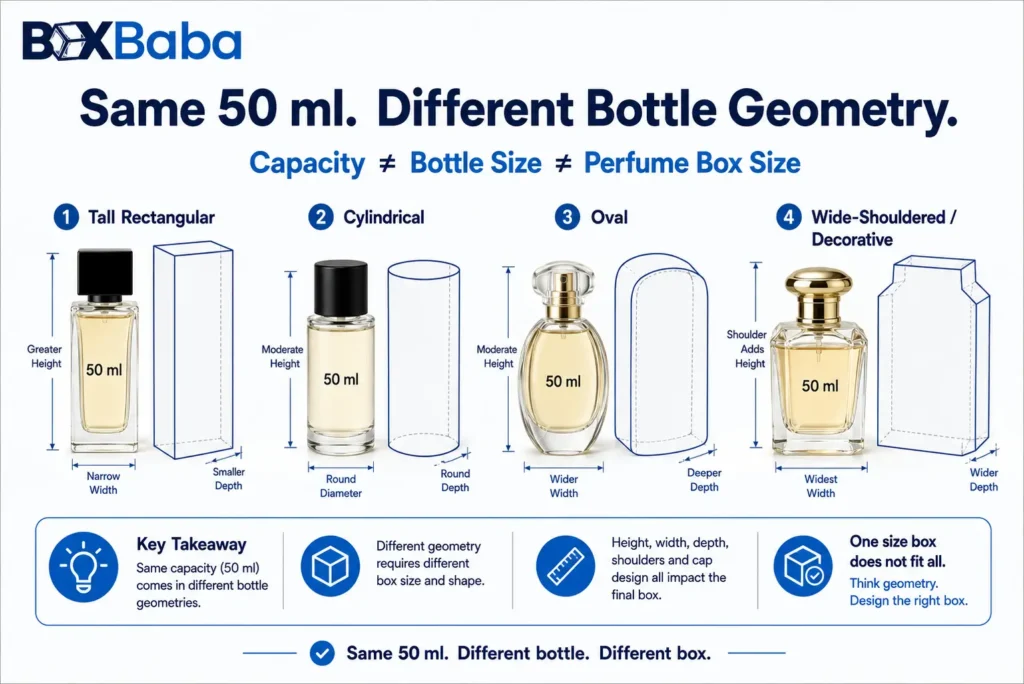
Is There a Standard Perfume Box Size?
There is no single production-ready box size for every 30 ml, 50 ml or 100 ml perfume.
Two 50 ml perfumes might use:
- a tall rectangular bottle;
- a short square bottle;
- a cylindrical bottle;
- a wide-shouldered design;
- an oval bottle;
- a thick-glass bottle;
- an irregular or sculpted container.
Each can require different carton dimensions.
The important distinction is:
Perfume Capacity / Net Volume ≠ Finished Bottle Dimensions ≠ Perfume Box Dimensions
Published 30 ml, 50 ml and 100 ml size charts can be useful for early reference, but they should not replace measurements from the actual finished bottle.
Perfume Bottle Measurement-to-Box Size Matrix
| Measurement | What to Measure | Why It Matters |
| Complete closed height | Base to highest installed cap or decorative point | Establishes starting carton height |
| Maximum body width | Widest bottle-body point | Defines part of the horizontal envelope |
| Maximum shoulder width | Widest shoulder profile | Shoulders may exceed body or base width |
| Maximum depth | Maximum front-to-back dimension | Required for non-round bottles |
| Maximum diameter | Widest exterior point of cylindrical bottle | Establishes round-bottle footprint |
| Base footprint | Actual standing width × depth or diameter | Provides orientation and support input |
| Cap width / depth | Widest installed cap profile | Cap may control carton footprint |
| Cap height | Height contributed by installed cap | Can control complete closed height |
| Atomizer / collar profile | Installed spray assembly and surrounding collar | Relevant to clearance and insert contact |
| Decorative projection | Raised emblem, band, sculpted cap or permanent feature | May become the controlling dimension |
| Filled weight | Complete sale-ready bottle | Provides structural and support context |
| Center of gravity | Bottom-heavy, balanced or top-heavy | May influence orientation and support |
| Sensitive decorated surface | Printed, frosted, coated, labeled or embellished area | Helps plan insert-contact areas |
| Insert cavity | Bottle contact areas and cavity geometry | Uses internal space |
| Removal direction | Lift, side pull, ribbon pull or other method | Influences access and insert clearance |
| Bottle photographs / technical drawing | Front, side, top and irregular-profile details | Helps communicate geometry basic dimensions may miss |
| Orientation | Upright, horizontal or another approved position | Changes dimension-to-carton mapping |
These are finished-bottle measurements and packaging inputs, not completed production-box dimensions.
What Measurements Do You Need From a Perfume Bottle?
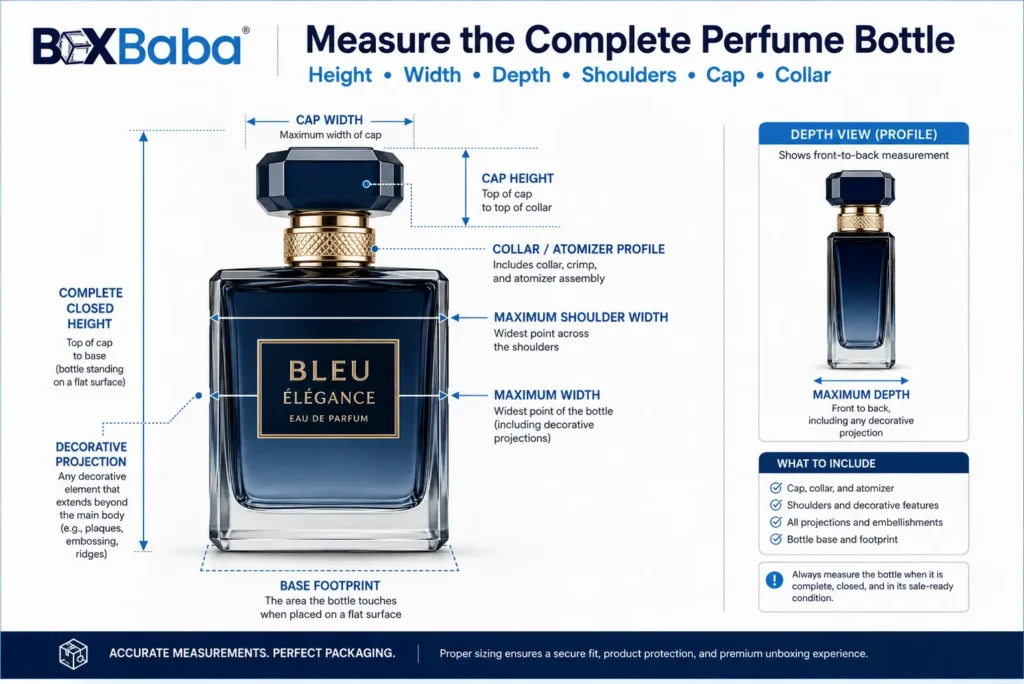
The correct measurement entity is the complete assembled perfume bottle.
Do not measure only the central glass body if the shoulders, cap, atomizer, collar or decorative features extend beyond it.
Complete Closed Height
Measure from the lowest point of the bottle base to the highest point of the installed cap or permanent decorative top.
Include the final:
- glass bottle body;
- neck;
- atomizer;
- collar;
- installed cap;
- decorative top.
The glass-body height alone may understate the finished product height.
Maximum Width and Depth
For a rectangular or irregular bottle, record:
Maximum Width × Maximum Depth × Complete Closed Height
Inspect the full bottle.
The maximum width may occur at the:
- base;
- body;
- shoulders;
- cap;
- decorative feature.
Do not assume the front label panel or bottle base represents the widest point.
Maximum Shoulder Width
Perfume shoulders deserve separate measurement because they can project beyond the lower bottle body.
For example:
Base Width: 2.10 in
Maximum Shoulder Width: 2.38 in
Therefore:
Maximum Finished Bottle Width: 2.38 in
In this case, the shoulder profile rather than the base controls the starting carton width.
Cap, Sprayer and Collar Profile
Measure the installed closure system as part of the finished bottle.
Record:
- cap width;
- cap depth;
- cap height;
- asymmetry;
- atomizer profile;
- collar profile;
- decorative projections.
An oversized or sculpted cap may become the widest or tallest part of the bottle.
Even when the cap covers the atomizer during retail presentation, the spray assembly can still matter where the insert contacts the neck or closure area.
Base Footprint
Record the actual standing surface.
For a rectangular bottle:
Base Width × Base Depth
For a cylindrical bottle:
Base Diameter
The base footprint can be smaller than the maximum shoulder or cap dimensions.
Decorative Projections and Irregular Shapes
Measure permanent exterior features such as:
- raised logos;
- metal bands;
- sculpted shoulders;
- attached ornaments;
- decorative collars;
- asymmetric caps.
For sculpted or asymmetric bottles, inspect the product from the front, side, top and base.
Photographs or a technical drawing can help communicate geometry that one width × depth × height measurement may not fully describe.
Filled Weight and Center of Gravity
Record the complete sale-ready bottle weight where available.
A thick glass base may make the bottle bottom-heavy, while a large decorative cap can shift weight upward.
Filled weight does not directly establish carton dimensions, but it may influence support, orientation and structure.
How to Measure a Perfume Bottle Step by Step
Step 1 — Use the Finished Sale-Ready Bottle
Whenever possible, measure the filled bottle or an approved production sample.
Install the final atomizer, collar, cap and permanent decorative components.
Step 2 — Close the Bottle Completely
Measure the perfume exactly as it will be packed and sold.
Do not size the box from an uncapped bottle when the final product includes a cap.
Step 3 — Confirm Orientation
Determine whether the bottle will be packed:
- upright;
- horizontally;
- inside a fitted insert;
- within a presentation box;
- as part of a fragrance set.
Step 4 — Measure Complete Closed Height
Measure from the bottle base to the highest point of the installed cap or permanent decorative feature.
Step 5 — Find Maximum Width and Depth
Inspect the entire bottle profile.
For rectangular or irregular bottles, record maximum width and depth.
For cylindrical bottles, record maximum exterior diameter.
Check the shoulders, cap and decorative features rather than measuring only the central body.
Step 6 — Measure Base, Shoulders and Closure
Record:
- base footprint;
- maximum shoulder width;
- cap dimensions;
- atomizer/collar profile.
These measurements identify which part of the finished bottle controls each dimension.
Step 7 — Document Decorative and Sensitive Surfaces
Identify permanent projections and surfaces that may affect insert-contact planning.
Examples include:
- frosted glass;
- printed glass;
- metallic coatings;
- labels;
- raised logos;
- decorative bands.
Step 8 — Record Filled Weight and Balance
Use the complete sale-ready bottle where possible.
Note whether the product is substantially bottom-heavy, balanced or top-heavy.
Step 9 — Confirm Insert and Removal Requirements
If an insert is planned, identify:
- intended support points;
- approved contact areas;
- surfaces where avoidable rubbing should be limited;
- removal direction;
- finger access;
- ribbon or pull requirements, if applicable.
The support system should be evaluated around appropriate bottle-contact areas rather than assuming the cap or atomizer should carry the filled bottle’s load.
Perfume Box Sizing by Bottle Format
| Perfume Bottle Format | Dimensions to Record | Extra Feature to Check | Main Sizing Risk |
| Rectangular bottle | Maximum W × D × complete closed H | Shoulders and cap | Front panel may not be widest |
| Square bottle | Maximum W × D × H | Cap overhang | Body and closure may not align |
| Cylindrical bottle | Maximum diameter × complete closed H | Cap diameter | Closure may exceed bottle diameter |
| Oval / curved bottle | Major width × minor depth × H | Curved shoulders | Front width can understate depth |
| Wide-shouldered bottle | Maximum shoulder W + D + H | Base vs shoulder profile | Base does not define maximum width |
| Heavy glass bottle | Maximum W × D × H + filled weight | Base and center of gravity | Weight can change support decisions |
| Decorative / irregular bottle | Maximum finished W × D × H | Sculpted exterior | Basic dimensions may miss projections |
| Miniature perfume bottle | Actual finished dimensions | Cap-to-body proportion | Should not be scaled from full-size packaging |
| Travel spray | Maximum diameter/W/D + complete H | Cap / sprayer | Slim body may have wider closure |
| Discovery set | Every product + completed arrangement | Insert cavities / removal access | One bottle does not define the set |
Miniature Perfume Bottles and Travel Sprays
Miniature bottles and travel sprays should be measured independently.
Do not reduce a full-size perfume carton by a fixed percentage.
A miniature bottle can have:
- a proportionally wider cap;
- different shoulders;
- a thicker base relative to its size;
- a different sprayer-to-body ratio.
Use the actual finished mini product as the measurement entity.
Worked Example: Measuring a Rectangular 50 ml Perfume Bottle
Consider a hypothetical rectangular 50 ml perfume bottle with these finished measurements:
Bottle body width: 2.05 in
Maximum shoulder width: 2.26 in
Maximum depth: 1.72 in
Complete closed height: 4.38 in
The bottle body width should not be used as the final maximum width because the shoulders extend farther.
Therefore:
Maximum Finished Bottle Envelope: 2.26 W × 1.72 D × 4.38 H
These are still finished-bottle dimensions, not final box dimensions.
Clearance, insert configuration, material and structure still need to be established before internal and external box dimensions are finalized.
This hypothetical example should not be treated as a standard size for every 50 ml perfume bottle.
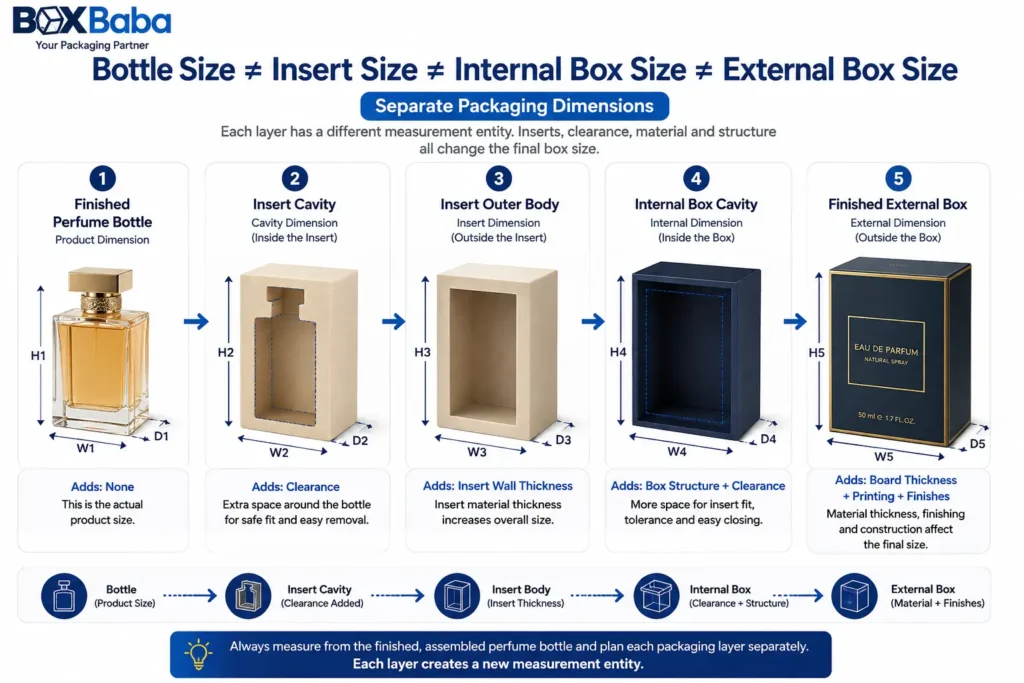
Product Dimensions vs Insert vs Internal vs External Box Dimensions
Perfume packaging can involve several separate dimensional entities.
Finished Bottle Dimensions
These describe the complete assembled fragrance product.
For a rectangular bottle:
Maximum Width × Maximum Depth × Complete Closed Height
For a cylindrical bottle:
Maximum Diameter × Complete Closed Height
Insert Cavity Dimensions
If an insert is used, its cavity should be developed around the finished bottle geometry and intended contact areas.
It may need to account for:
- base shape;
- shoulders;
- neck;
- cap clearance;
- decorated surfaces;
- finger access;
- removal direction.
The cavity should not automatically equal the exact bottle dimensions.
Insert Outer Dimensions
The support component has its own width, depth and height or thickness.
It can also include:
- supporting walls;
- platforms;
- partitions;
- surrounding material.
Internal Box Dimensions
Internal dimensions describe usable space inside the perfume box.
Where an insert is used, the box must accommodate the completed insert configuration, not only the bottle.
External Box Dimensions
External dimensions describe the finished outside package.
They may be affected by:
- internal dimensions;
- material thickness;
- folding-carton construction;
- rigid-board construction;
- wrapped edges;
- closures.
The finished bottle, insert cavity, insert body, internal box and external box should therefore be treated as separate dimensional entities.
How Inserts Change Perfume Box Dimensions
Perfume inserts should be considered before final internal box dimensions are approved.
A fitted insert can use significant internal space depending on its cavity geometry, surrounding material and support method.
Bottle Cavity
Develop the cavity around the actual bottle geometry.
Consider:
- base profile;
- shoulders;
- curvature;
- neck position;
- cap clearance;
- filled weight.
Sensitive Decorated Surfaces
If the bottle has printed, frosted, coated, labeled or embellished surfaces, identify where the insert is intended to make contact.
This does not mean all contact will damage a bottle. It means contact areas should be considered deliberately rather than left undefined.
Removal Access
A bottle can fit within an insert and still be inconvenient to remove.
Confirm whether the user should:
- lift directly upward;
- grip the shoulders;
- use finger notches;
- pull a ribbon;
- remove the bottle from another direction.
Dimensional fit and usable removal access should be evaluated together.
Heavy Glass Perfume Bottles and Weight Distribution
Two perfume bottles with similar exterior dimensions can require different support decisions because their weight distribution differs.
Review:
- complete dimensions;
- base footprint;
- filled weight;
- center of gravity;
- cap weight;
- intended orientation.
A heavy glass bottle does not automatically require a rigid box, foam insert or another specific structure.
The complete packaging configuration should be evaluated before support is selected.
Perfume Discovery Sets and Multi-Bottle Packaging
A discovery set should be sized from the completed arrangement, not by multiplying one bottle dimension by the number of products.
A set may include:
- sample vials;
- miniature bottles;
- travel sprays;
- several full-size fragrances;
- bottles with different cap profiles.
Measure every product independently.
Consider:
- each product’s width or diameter;
- depth;
- complete closed height;
- cap profile;
- orientation;
- spacing;
- insert cavity layout;
- removal access;
- completed loaded weight.
Five 0.60-inch-wide fragrance vials do not automatically require exactly 3.00 inches of internal width because insert walls, spacing and removal access can increase the completed arrangement.

Can Multiple Fragrances Use the Same Box Size?
Yes, when multiple fragrances use the same physical bottle and structural configuration.
A fragrance brand may use one bottle for:
- different scents;
- eau de parfum variants;
- eau de toilette variants;
- seasonal artwork;
- regional artwork.
If the bottle dimensions, shoulders, cap, atomizer, orientation, insert and structure remain unchanged, one physical packaging configuration may support multiple artwork versions.
The dieline should be reviewed if another SKU changes the:
- bottle dimensions;
- shoulders;
- base;
- cap;
- atomizer;
- decorative profile;
- filled-weight range;
- orientation;
- insert;
- box structure.
Different fragrance names do not automatically require different structural dielines.
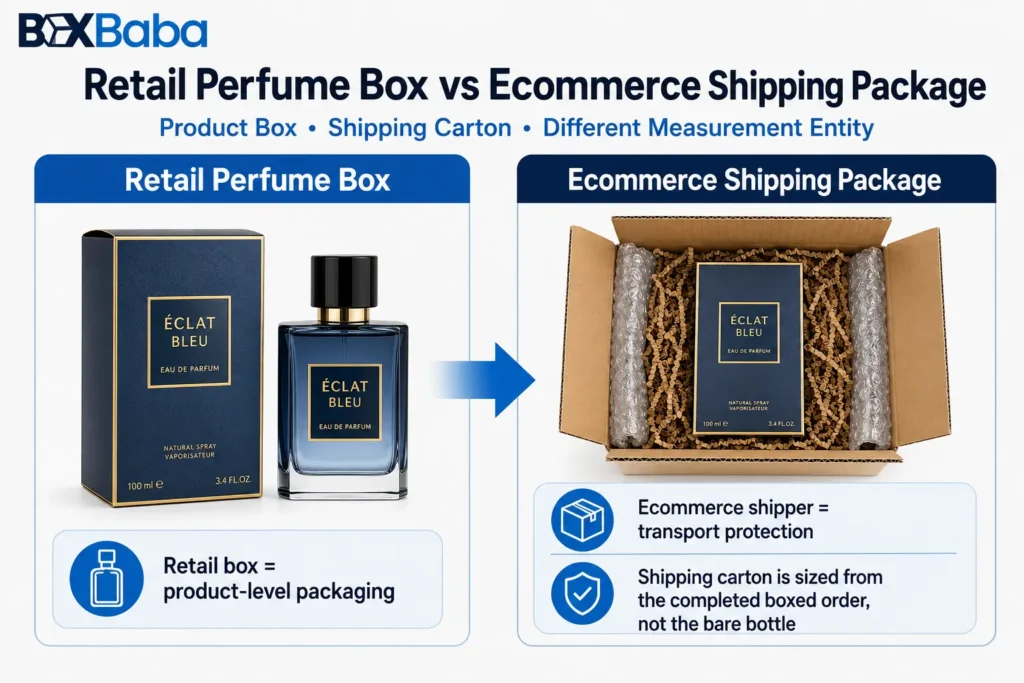
Retail Perfume Box vs Ecommerce Shipping Package
The individual perfume package and the ecommerce shipping carton are separate sizing tasks.
For retail:
Finished Perfume Bottle + Approved Support → Individual Perfume Box
For ecommerce:
Completed Boxed Order → Mailer / Shipping Carton
Do not use the bare perfume-bottle dimensions to determine the outer shipping package.
Likewise, do not enlarge the individual perfume carton merely because it will later move through ecommerce fulfillment.
When several completed perfume boxes are arranged in a retail display, their external dimensions become inputs for the display layout.
Common Perfume Box Sizing Mistakes
| Sizing Mistake | Better Approach |
| Treating 30 ml, 50 ml or 100 ml as the final box size | Measure the actual finished bottle |
| Measuring only the central glass body | Include shoulders, cap, atomizer and permanent decoration |
| Measuring only base width | Inspect the full bottle for maximum width |
| Ignoring wide shoulders | Use the maximum shoulder profile where applicable |
| Ignoring cap height | Measure complete closed height |
| Ignoring asymmetric caps | Record maximum width and depth |
| Ignoring decorative projections | Measure the complete sale-ready exterior |
| Using one front-view measurement for a sculpted bottle | Inspect front, side, top and base |
| Ignoring filled weight | Record complete sale-ready weight |
| Assuming every glass bottle requires rigid packaging | Evaluate the complete structure/support requirement |
| Applying one universal clearance value | Confirm through the selected structure and proofing |
| Designing the box before the insert | Develop support and internal dimensions together |
| Making the cavity equal to bottle dimensions automatically | Include contact and removal requirements |
| Ignoring sensitive decorated surfaces | Identify intended contact areas |
| Ignoring removal direction | Plan usable product access |
| Scaling a mini bottle from full-size packaging | Measure the miniature independently |
| Using one bottle to size a discovery set | Measure every product and completed arrangement |
| Assuming equal volume means equal bottle size | Compare actual exterior geometry |
| Assuming every fragrance needs a new dieline | Compare the physical bottle configuration |
| Using retail-box dimensions for ecommerce shipping | Measure the completed boxed order |
Perfume Bottle Measurement and Quote Checklist
Bottle Measurements
| Field | Value / Options |
| Fragrance Capacity / Net Volume | ____________________ |
| Bottle Format | Rectangular / Square / Cylindrical / Oval / Decorative / Miniature / Travel Spray / Other |
| Complete Closed Height | ____________________ |
| Maximum Width | ____________________ |
| Maximum Depth | ____________________ |
| Maximum Diameter, if round | ____________________ |
| Maximum Shoulder Width | ____________________ |
| Base Width / Diameter | ____________________ |
| Base Depth | ____________________ |
| Cap Width | ____________________ |
| Cap Depth | ____________________ |
| Cap Height | ____________________ |
| Atomizer / Collar Profile | ____________________ |
| Decorative Projections | ____________________ |
| Filled Weight | ____________________ |
| Center of Gravity | Bottom-Heavy / Balanced / Top-Heavy / Unsure |
Product Reference
| Field | Value / Options |
| Bottle Photographs Available | Yes / No |
| Technical Drawing Available | Yes / No |
| Important Irregular / Sculpted Features | ____________________ |
Surface and Insert Information
| Field | Value / Options |
| Sensitive / Decorated Surfaces | ____________________ |
| Approved Insert Contact Areas | ____________________ |
| Insert Required | Yes / No / Unsure |
| Removal Direction | Lift Up / Side Removal / Ribbon Pull / Other / Unsure |
| Finger Access Required | Yes / No / Unsure |
Packaging Configuration
| Field | Value / Options |
| Bottle Orientation | Upright / Horizontal / Other / Unsure |
| Products Per Box | ____________________ |
| Additional Products / Accessories | ____________________ |
| Preferred Box Structure | ____________________ |
| Intended Use | Retail / Presentation / Ecommerce / Gift Set / Other |
SKU and Quote Information
| Field | Value / Options |
| Number of Fragrances / SKUs | ____________________ |
| Same Physical Bottle Across SKUs | Yes / No / Unsure |
| Quantity Per SKU | ____________________ |
| Artwork Status | Ready / In Progress / Not Started |
| Delivery Destination | ____________________ |
Instead of:
Need 500 boxes for a 50 ml perfume.
provide:
The finished rectangular 50 ml perfume bottle measures 2.26 in at its maximum shoulder width, 1.72 in deep and 4.38 in complete closed height. The bottle will be packed upright, weighs approximately [filled weight], and a fitted insert is being considered. Product photographs are available.
This describes the physical product the packaging supplier needs to evaluate.
From Perfume Measurements to the Final Dieline
Perfume-bottle measurements are starting inputs, not final production-dieline dimensions.
A practical sequence is:
Finished Bottle Measurements → Insert / Support Configuration → Internal Box Dimensions → Material + Structure → Dieline → Proof / Approval
A completed dieline may contain:
- structural panels;
- folds;
- flaps;
- glue areas;
- wrapped edges;
- closure components;
- insert cavities;
- finger-access features.
Do not create a perfume-box dieline by simply adding an arbitrary amount to a 30 ml, 50 ml or 100 ml reference size.
For broader decisions about structures, materials, inserts and finishes, review the Perfume Packaging Guide after the physical bottle specification has been confirmed.
Request Custom Perfume Box Pricing
A reliable perfume-box specification starts with the complete assembled and sale-ready fragrance bottle, not a generic 30 ml, 50 ml or 100 ml reference size.
BoxBaba supplies Custom Perfume Boxes for custom fragrance-packaging projects.
BoxBaba’s MOQ for custom cosmetic boxes starts from 100 boxes.
When requesting pricing, provide the fragrance capacity, complete closed bottle dimensions, maximum shoulder width, cap dimensions, atomizer/collar profile, decorative projections, filled weight, intended orientation, insert requirements, sensitive decorated surfaces, removal requirements, bottle photographs or technical drawing where available, quantity per SKU and artwork status.
If the final box dimensions are not yet known, provide the finished perfume-bottle measurements rather than estimating an external carton size.
Proofing or sample routes are confirmed during quotation. Production timing is project-specific after dimensions, structure, material, inserts, artwork, quantities, finishes and proofing requirements are approved. Shipping methods, charges and estimated transit times are confirmed according to the completed order, packing format, destination and selected service.
Measure the complete assembled perfume bottle—including the widest shoulders, installed cap, sprayer profile and permanent decorative features—before developing the box around it.
FAQs About Perfume Box Sizes and Dimensions
What is the standard perfume box size?
There is no universal production-ready perfume box size. A 30 ml, 50 ml or 100 ml perfume can use bottles with different widths, depths, shoulder profiles, caps and sprayers, so the carton should be developed from the actual finished bottle.
Does perfume bottle capacity determine box size?
No. Capacity identifies how much fragrance the bottle contains, not its exterior geometry. Two 50 ml bottles can have different widths, depths, shoulders, caps and heights, so each finished bottle should be measured independently.
How do I measure a perfume bottle for a custom box?
Measure the bottle in its complete assembled and closed condition. For rectangular bottles, record maximum width, maximum depth and complete closed height. For cylindrical bottles, record maximum diameter and complete closed height.
What dimension controls perfume-box width?
The widest point of the complete assembled bottle establishes the starting horizontal envelope. Depending on the design, this may be the body, shoulders, base, cap or a decorative projection.
Does the perfume sprayer count when measuring the bottle?
Yes. The atomizer and collar are parts of the assembled primary package. Measure the product in its final closed condition and document the spray assembly where it affects insert contact or clearance.
How much clearance should be added around a perfume bottle?
There is no universal clearance value. Required space depends on bottle geometry, closure profile, insert design, material thickness, orientation, intended contact areas, packing method and removal direction.
Are perfume-bottle dimensions the same as perfume-box dimensions?
No. Bottle dimensions describe the assembled fragrance product, insert dimensions describe the internal support where used, internal box dimensions describe usable packaging space, and external dimensions describe the completed outside package.
Can multiple fragrances use the same box?
Yes, when they use the same physical bottle and structural configuration. Different fragrance names or artwork versions do not automatically require a different structural dieline.