
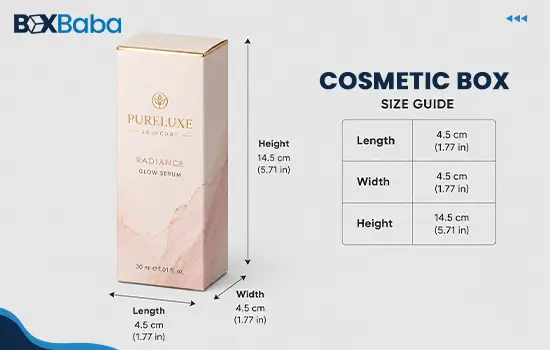
To measure a cosmetic product for a custom box, measure the finished, assembled and retail-ready product exactly as it will be packed. Include the bottle, jar, tube, compact or palette together with its cap, pump, dropper, wand, lid, overcap, collar and any fixed decorative components that change the external profile.
Record the product’s maximum physical dimensions, filled weight and intended orientation before the box, insert or dieline is developed.
A reliable measurement sequence is:
Finished Cosmetic Product → Maximum External Profile → Closure → Filled Weight → Orientation → Internal Packaging Requirement → Dieline → Fit Confirmation
Do not use fill capacity alone to determine box size. Two 30 mL serum bottles, 50 mL perfume bottles or 100 mL lotion bottles can have different heights, widths, closures and packed weights.
This cosmetic box size guide explains how to measure bottles, jars, tubes, wand products, compacts, palettes and multi-product beauty sets before requesting Custom Cosmetic Boxes.
How Do You Measure a Cosmetic Product for a Custom Box?
Start with the finished product, not the empty container and not an estimated box size.
For most non-round products, record:
Height × Maximum Width × Maximum Depth
For a finished product that is truly circular at its widest point, record:
Total Height + Maximum Diameter
The important word is maximum. A lid may be wider than the jar body. A pump may project farther than the bottle wall. A perfume cap may be wider than the glass bottle. The dimension used for packaging should represent the furthest external point of the complete product.
Also record the filled weight and intended packing orientation.
The core relationship is:
Finished Product Dimensions → Starting Internal Space Requirement
The product measurements are not automatically the final internal or external box dimensions. Clearance, inserts, material construction and box style still need to be considered during structural development.
Measure the Retail-Ready Product
Measure the product in the condition in which it will actually enter the box.
For example:
Serum Bottle + Dropper = Finished Serum Product
Cream Jar + Closed Lid = Finished Jar Product
Perfume Bottle + Sprayer + Decorative Cap = Finished Perfume Product
Mascara Tube + Closed Wand Cap = Finished Mascara Product
Labels, sleeves, collars, overcaps and other fixed components should also be included when they change the external profile.
Record Filled Weight
Dimensions explain how much space the product occupies. Filled weight explains the load placed on the box, base and any internal support.
Filled weight is especially useful for:
- Glass serum bottles
- Cream jars
- Foundation bottles
- Perfume bottles
- Nail polish bottles
- Multi-product cosmetic sets
A heavier product may require a different structural or material evaluation, but higher weight does not automatically mean a rigid box is required.
Confirm Product Orientation
The same product can create different packaging dimensions depending on whether it sits upright, horizontally or flat.
For example:
Perfume Bottle Upright → Height-Driven Carton
Perfume Bottle Horizontal → Wider Presentation Layout
Orientation can also affect insert geometry, window position and product removal.
It should therefore be confirmed before the final structural dieline is approved.
What You Need Before Measuring
Accurate cosmetic-product measurement does not require complicated equipment. What matters most is that the finished product is measured consistently.
What You Need | Why It Matters |
|---|---|
Finished retail-ready product | Captures the real packed profile |
Ruler or measuring tape | Suitable for larger dimensions |
Digital calipers | Useful for small bottles, tubes and closures |
Digital scale | Records the actual filled weight |
Flat surface | Provides a consistent measuring reference |
One measurement unit | Reduces conversion errors |
Use one unit system throughout the specification where possible.
For example:
Height: 4.72 in
Width: 1.38 in
Depth: 1.38 in
is clearer than mixing inches and millimeters in the same dimension set.
For small cosmetic containers, millimeters can also be useful because they allow detailed measurements without long decimal conversions.
Measure from the furthest external point on one side of the finished product to the furthest external point on the opposite side.
The goal is not unnecessary precision. The goal is a clear and repeatable description of the product that will enter the box.
Cosmetic Product Measurement Worksheet
The following worksheet gives cosmetic brands and packaging buyers a practical way to record the most important information before requesting a quote.
| Product Format | Measure | Include | Also Record | Commonly Missed |
|---|---|---|---|---|
| Serum / Dropper Bottle | H + diameter or W × D | Dropper or pump | Filled weight | Closure width |
| Pump / Lotion Bottle | H × W × D | Pump or overcap | Filled weight | Pump projection |
| Cream Jar | H + max diameter | Closed lid | Filled weight | Lid overhang |
| Lipstick | H + diameter or W × D | Closed cap | Orientation | Wider cap/base |
| Lip Gloss | Closed H + max cross-section | Wand cap | Filled weight | Applicator closure |
| Mascara | Closed length + max cross-section | Wand cap | Orientation | Wider cap |
| Foundation | H × W × D or diameter | Pump/dropper/cap | Filled weight | Closure projection |
| Perfume | H × W × D or diameter | Cap and collar | Filled weight | Decorative projection |
| Nail Polish | H + max footprint | Brush cap | Filled weight | Cap width |
| Compact | L × W × closed thickness | Hinge/latch | Orientation | Raised lid |
| Makeup Palette | L × W × closed thickness | Hinge/closure | Weight | Thickest point |
| Multi-Product Set | Every product + arrangement | Insert/dividers | Combined weight | Removal access |
Product Information Checklist
| Information | Details |
|---|---|
| Product Name | __________________________ |
| Container Type | __________________________ |
| Closure Type | __________________________ |
| Measurement Unit | __________________________ |
| Maximum Height | __________________________ |
| Maximum Width | __________________________ |
| Maximum Depth / Diameter | __________________________ |
| Filled Weight | __________________________ |
| Orientation | __________________________ |
| Products per Box | __________________________ |
| Insert Needed | Yes / No / Unsure |
| Window Needed | Yes / No / Unsure |
| Intended Use | Retail / Ecommerce / Gift / Display / Other |
I need a box for a 30 mL serum.
The Measurements That Define a Cosmetic Product
Instead of treating every cosmetic product as a completely different measurement problem, it is more useful to group products according to their finished geometry.
The same underlying method can then be applied to serum, lotion, lipstick, mascara, foundation, perfume and other beauty products.
Round Bottles and Jars
For a truly circular finished bottle or jar, measure:
Total Height + Maximum Diameter
This method may apply to:
- Serum bottles
- Fragrance-oil bottles
- Round cream jars
- Selected nail polish bottles
- Cylindrical lipstick tubes
- Selected mascara tubes
The widest component determines the diameter.
For a cream jar, measure both the jar body and lid. If the lid extends beyond the body, the lid becomes the maximum diameter.
For example:
Jar Body: 2.35 in
Lid: 2.55 in
Use 2.55 in as the maximum finished diameter for packaging measurement.
A similar principle applies to serum bottles. If the dropper cap is wider than the glass bottle, the closure becomes the maximum width.
Brands developing jar packaging can also review Custom Cream Boxes.
Pump, Dropper and Spray Bottles
Pump, dropper and sprayer closures deserve additional attention because they can change both height and footprint.
This group includes:
- Serum bottles
- Lotion bottles
- Foundation bottles
- Perfume bottles
- Treatment products
Measure the product in its actual retail packing configuration.
If a pump will be locked down inside the box, measure it locked down. If the bottle will be packed with an overcap, include the overcap.
The correct relationship is:
Retail Packing Configuration → Measurement Configuration
Measure total assembled height first. Then check whether the closure projects beyond the bottle body.
For a serum bottle with a round glass body but asymmetric pump, record:
Total Height + Maximum Width + Maximum Depth
rather than relying only on the bottle diameter.
Two 30 mL serum bottles can therefore require different boxes even when the fill capacity is identical.
Use:
Finished Serum Bottle + Closure → Packaging Measurement
not:
30 mL → Standard Serum Box
For product-specific packaging, buyers can review Custom Serum Boxes and Custom Lotion Boxes.
Tubes, Sticks and Wand Products
Lipstick, lip gloss, mascara, eyeliner and flexible cosmetic tubes are usually measured in their fully closed condition.
For a round lipstick tube:
Total Closed Height + Maximum Diameter
For a square or shaped lipstick:
Height + Maximum Width + Maximum Depth
Do not measure the exposed lipstick bullet.
For mascara or lip gloss, measure the complete closed product with the wand cap fully seated. The wand itself does not need to be measured separately when it is enclosed inside the finished retail container.
For a flexible foundation or skincare tube, measure:
- Total closed height
- Maximum width
- Maximum filled depth
- Cap profile
An empty flexible tube can be flatter than the filled retail product, so the filled profile is more useful for packaging development.
Brands can also review Custom Lipstick Boxes and Custom Mascara Boxes for product-specific packaging.
Compacts and Palettes
Compacts and palettes should normally be measured closed.
Record:
Length × Width × Maximum Closed Thickness
Also check whether the following components extend beyond the main shell:
- Hinge
- Latch
- Raised lid
- Mirror housing
- Decorative panel
- Magnetic closure feature
A makeup compact should be measured from its outer shell, not from the cosmetic pan inside it.
A palette may also require a removal-access consideration if it will be packed inside a sleeve or fitted tray.
Use:
Closed Palette Dimensions + Removal Direction → Packaging Requirement
Irregular and Decorative Bottles
Irregular perfume and fragrance bottles often need more than a simple width, depth and nominal volume.
Measure:
- Total height with cap attached
- Maximum width
- Maximum depth
- Decorative cap
- Sprayer / collar
- Raised base
- Shoulder projections
- Filled weight
- Orientation
The decorative cap may control more of the box footprint than the glass bottle itself.
Use:
Finished Perfume Bottle + Cap + Collar + Filled Weight → Packaging Specification
Glass construction does not automatically require rigid packaging. The finished weight, geometry, intended structure and support requirements still need to be evaluated.
For product-specific packaging, buyers can review Perfume Boxes.
How to Measure Multi-Product Cosmetic Sets
A multi-product set is a different measurement task from a single product.
Do not measure only the largest item and assume the outer box can be developed from it.
Use:
Individual Products → Arrangement → Internal Support → Removal Access → Internal Box Requirement
Measure Every Product First
Record the finished dimensions and filled weight of every component.
For example, a skincare set may contain:
Serum Bottle
Height: ______
Diameter / W × D: ______
Filled weight: ______
Cream Jar
Height: ______
Maximum diameter: ______
Filled weight: ______
Eye Treatment
Height: ______
Width: ______
Depth: ______
Filled weight: ______
A three-product lipstick set and a three-product skincare set both contain three units, but the required box dimensions may be completely different.
Product count alone does not determine set size.
Plan the Arrangement
Possible layouts include:
- Side-by-side
- Horizontal rows
- Vertical rows
- Tiered layout
- Separate compartments
- Fitted cavities
The same products arranged differently can produce different internal dimensions.
This makes the following sequence important:
Measure → Arrange → Determine Internal Footprint
not:
Choose Outer Box → Force Products Into It
Inserts and Dividers
Not every multi-product set needs a fully fitted insert.
A simple divider may be enough when products only need separation.
A fitted insert may be more appropriate when the products need defined positions.
Use:
Need for Separation → Divider May Be Enough
Need for Fixed Positioning → Fitted Insert May Be Considered
Removal Access and Combined Weight
A set can be dimensionally correct but still be difficult to use if the products are too deeply recessed or difficult to grip.
Check:
- Finger access
- Grip area
- Insert depth
- Removal direction
- Product height above the insert
Also record the combined filled weight of the complete set.
A package containing several lightweight lip products creates a different structural requirement from one containing multiple glass bottles.
How Product Measurements Become Box Dimensions
One of the most common packaging misunderstandings is treating product dimensions, internal box dimensions and external box dimensions as if they are the same measurement set.
They are related, but they serve different purposes.
Product Dimensions vs Internal Box Dimensions
Product dimensions describe the finished cosmetic product.
Internal box dimensions describe the usable space inside the finished package.
Internal dimensions may need to account for:
- Product dimensions
- Structural clearance
- Insert or divider
- Product orientation
- Removal access
Therefore:
Product Dimensions ≠ Internal Box Dimensions
The most useful starting information for a new custom-box project is normally the actual finished-product measurement.
How Inserts Change Internal Space
An insert occupies physical space inside the package.
It may include:
- Folded paperboard walls
- Product cavities
- Divider thickness
- Raised platforms
- Supporting panels
Therefore:
Product Arrangement Dimensions ≠ Final Internal Box Dimensions
when an insert is involved.
The insert should normally be developed around the finished product before the outer dimensions are locked.
Why Clearance Is Not One Fixed Number
Avoid silently adding a universal amount to every product measurement.
Required packing clearance can depend on:
- Product geometry
- Closure
- Box structure
- Material
- Insert
- Packing method
- Removal requirements
- Production tolerances
Instead, send the actual finished dimensions and identify them clearly as product dimensions.
Then:
Actual Product Dimensions → Structural Clearance → Internal Box Space
can be developed during the packaging-engineering stage.
Internal vs External Box Dimensions
Internal dimensions describe the usable space inside the box.
External dimensions describe the outside footprint of the finished package.
The difference can be influenced by:
- Board thickness
- Corrugated fluting
- Rigid-board construction
- Folded panels
- Lid-and-base structures
Use:
Internal Space + Material / Construction → External Dimensions
Material Thickness
Material occupies physical space.
A folding carton, corrugated mailer and rigid presentation box can have different external dimensions even if they are developed around a similar internal product requirement.
Do not add material thickness to product measurements by guesswork.
The better sequence is:
Product → Required Internal Space → Structure + Material → External Dimensions
Product Measurements vs Dieline Dimensions
A dieline is the flat production layout used to cut, crease and assemble the packaging.
Product dimensions are an input to the dieline. They are not the dieline itself.
Use:
Product Measurements → Structural Specification → Dieline
The structural development process may account for:
- Panel dimensions
- Tuck flaps
- Glue flaps
- Bottom construction
- Locking tabs
- Insert slots
- Windows
- Cut lines
- Crease lines
The buyer normally does not need to convert product dimensions directly into panel dimensions.
The more useful buyer task is to provide an accurate finished-product specification.
Insert Contact Areas and Product Removal
The widest point of a cosmetic product is not always the same area an insert should use to hold it.
For example, a perfume bottle may be widest at the shoulder while the practical insert contact point is around the body or base.
This means two different measurement ideas may matter:
Maximum Product Envelope
→ determines the space the product occupies.
Insert Contact Area
→ determines where the internal support interacts with the product.
This distinction can be particularly useful for:
- Decorative perfume bottles
- Glass serum bottles
- Cream jars
- Cosmetic compacts
- Products with sensitive decorated surfaces
The insert should support the intended product position while still allowing practical removal.
Use:
Product Geometry + Insert Contact Area + Removal Direction → Insert Design
not:
Tightest Possible Fit → Best Insert
Retail Box Measurement vs Ecommerce Shipping Measurement
A retail carton and an ecommerce mailer should not be measured from the same starting object.
For the individual retail box:
Finished Cosmetic Product → Retail Carton
For ecommerce packaging:
Finished Retail Carton / Complete Packed Order → Ecommerce Mailer
For example:
Serum Bottle → Serum Retail Carton → Ecommerce Mailer
The serum bottle dimensions help develop the retail carton.
Once that retail carton exists, its external dimensions become an input for the outer shipping package.
For a multi-product ecommerce order, measure or plan:
- External dimensions of the finished retail boxes
- Number of products
- Order arrangement
- Total packed weight
- Internal separation where needed
This prevents product-level measurements from being incorrectly used to size the distribution package.
Common Cosmetic Product Measurement Errors
Most cosmetic measurement problems come from measuring the wrong version of the product or confusing product dimensions with packaging dimensions.
| Mistake | Why It Creates a Poor Specification | Better Method |
|---|---|---|
| Measuring an empty container | Final profile or weight may differ | Measure the finished, retail-ready product |
| Ignoring cap, pump, or dropper | Maximum size may be understated | Include the complete closure |
| Using mL or oz as box size | Capacity does not define external dimensions | Measure the physical product |
| Measuring only the main body | Wider lid or cap may be missed | Find the maximum external profile |
| Assuming a round body means a round finished product | Pump or cap may project | Use W × D when needed |
| Measuring an empty flexible tube | Finished depth may be understated | Measure the filled tube |
| Ignoring filled weight | Structural input is incomplete | Record the finished weight |
| Adding arbitrary clearance | Product and box dimensions become confused | Send actual product dimensions |
| Using one universal clearance | Different structures require different allowances | Let structural development determine clearance |
| Mixing units | Creates conversion risk | Use one unit system |
| Forgetting orientation | Internal footprint may change | State the intended orientation |
| Measuring only the largest set item | Set arrangement becomes inaccurate | Measure every component |
| Ignoring removal access | Insert may be difficult to use | Confirm grip/removal direction |
| Using retail carton dimensions as product dimensions | Wrong measurement object | Label each measurement set |
| Using product dimensions for an ecommerce mailer | Wrong packaging layer | Measure the packed retail order |
A reliable workflow is:
Finished Product → Maximum Envelope → Filled Weight → Orientation → Arrangement / Insert → Internal Space → Dieline → Fit Review
Cosmetic Product Measurement Template for a Quote
Here is the inquiry format converted into a clean, professional table:
Custom Cosmetic Box Inquiry Form
Information | Details / Selection |
Product Name | ______________________________ |
Product Type | Bottle / Jar / Tube / Compact / Palette / Vial / Other |
Container Material | ______________________________ |
Closure Type | Cap / Pump / Dropper / Wand / Lid / Sprayer / Overcap / Other |
Measurement Unit | Inches / Millimeters |
Maximum Finished Height | ______________________________ |
Maximum Width | ______________________________ |
Maximum Depth | ______________________________ |
Maximum Diameter, if Circular | ______________________________ |
Widest Projection | ______________________________ |
Filled Product Weight | ______________________________ |
Orientation | Upright / Horizontal / Flat / Unsure |
Products Per Box | ______________________________ |
Insert / Divider Required | Yes / No / Unsure |
Window Required | Yes / No / Unsure |
Intended Use | Retail / Ecommerce / Gift Set / PR Kit / Display / Other |
Preferred Box Structure, if Known | ______________________________ |
Order Quantity | ______________________________ |
Artwork Status | Ready / In Progress / Not Started |
Example: Serum Bottle Specification
Specification | Details |
Product | Facial serum |
Container | Glass dropper bottle |
Closure | Dropper |
Maximum Height with Dropper | __________________ |
Maximum Diameter / W × D | __________________ |
Filled Weight | __________________ |
Orientation | Upright |
Products per Box | 1 |
Insert | Unsure / To be evaluated |
Window | No |
Use | Individual retail packaging |
Quantity | __________________ |
Product Volume | 30 mL — for identification only |
Important: The 30 mL volume can be included to identify the product, but it should not replace the physical dimensions required for accurate box sizing.
What If the Final Product Is Not Available Yet?
If the final retail-ready product has not yet been produced, clearly identify any measurements as preliminary.
Possible starting references may include:
- Approved container drawing
- Manufacturer specification
- Production-equivalent sample
- Confirmed closure dimensions
Do not present provisional dimensions as final production measurements.
Use:
Preliminary Specification → Final Product Confirmation → Packaging Approval
Where component variation may affect fit, checking more than one production-equivalent unit can also be useful.
Rather than averaging meaningful variation away, record the observed dimensional range and flag it during structural development.
This can be particularly useful for:
- Flexible tubes
- Multi-part assembled components
- Decorated containers
- Products supplied from multiple container batches
Request Custom Cosmetic Box Pricing
A useful custom-box inquiry begins with the finished cosmetic product, not an estimated box size.
When requesting pricing, provide:
- Finished product dimensions
- Filled weight
- Container and closure type
- Product orientation
- Number of products per box
- Insert or divider requirements
- Window requirements
- Intended retail, ecommerce, gifting or display use
- Order quantity
- Artwork status
For multi-product cosmetic sets, also provide the dimensions and intended arrangement of every component.
BoxBaba can use these details as the starting point for evaluating the box structure, internal layout, material and dieline requirements.
MOQ for custom cosmetic boxes starts from 100 boxes. Proofing or sample routes are confirmed during quotation. Production timing and shipping requirements are confirmed according to the completed project specification.
Explore Custom Cosmetic Boxes or submit your finished product measurements to request project-specific pricing.
Finished Product → Accurate Measurements → Structural Specification → Dieline → Proofing → Custom Box Quote
FAQs About Measuring Cosmetic Products
How do I measure a cosmetic product for a custom box?
Measure the finished retail-ready product with its cap, pump, dropper, lid or other closure attached. Record maximum height, width and depth, or height plus maximum diameter for a truly circular product. Also provide filled weight and intended orientation.
Should I include the cap, pump or dropper?
Yes. Measure the product in the configuration in which it will actually enter the box. Closures can determine the maximum height, width or depth.
How do I measure a round cosmetic bottle?
If the complete assembled product is circular, record total height and maximum diameter. If the closure projects beyond the round body, record maximum width and depth separately.
Does 30 mL determine the box size?
No. Fill capacity does not determine external container dimensions. Two 30 mL bottles can use different heights, diameters, shoulders, pumps or droppers.
Should I add clearance to the product dimensions myself?
Normally, provide the actual finished-product dimensions and label them clearly. Required structural clearance depends on the product, box structure, material, insert and packing method and can be determined during packaging development.
Do inserts change the required box dimensions?
Yes. Inserts occupy internal space and can change product position, internal width, depth and height. The product and intended insert arrangement should therefore be considered before final box dimensions are approved.
What is the difference between product dimensions and internal box dimensions?
Product dimensions describe the physical cosmetic item. Internal box dimensions describe the usable space inside the completed packaging. They are related but are not the same measurement.
How do I measure several products for one cosmetic set?
Measure every finished product separately first. Then determine the arrangement, divider or insert requirement, removal access and combined loaded weight before developing the outer box.
What measurements should I send for a custom cosmetic box quote?
Provide the finished product dimensions, closure type, filled weight, orientation, number of products, insert or window requirements, intended use, quantity and artwork status.
How is final fit confirmed?
Accurate product measurements provide the starting specification. Final packaging fit should then be reviewed through the appropriate dieline, proofing, mockup or sample route for the specific project.