
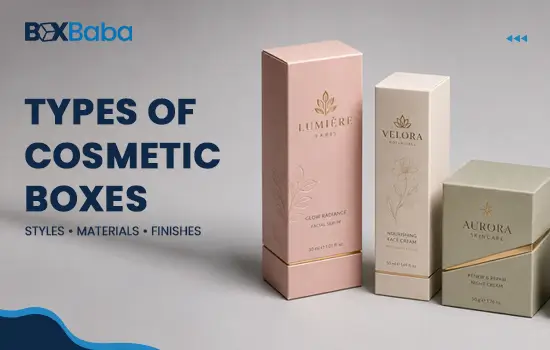
Cosmetic boxes come in different structures because a lipstick tube, serum bottle, cream jar, perfume bottle and makeup set do not create the same packaging requirements. Common types include folding cartons, sleeve boxes, two-piece boxes, rigid presentation boxes, drawer boxes, window boxes, boxes with inserts, cosmetic display boxes and ecommerce mailers.
The right starting structure depends on more than appearance. Buyers should consider the finished product dimensions, filled weight, container shape, closure, number of products being packed and where the package will be used.
Finished Cosmetic Product → Dimensions and Filled Weight → Product Count → Sales Channel → Suitable Box Structure
This guide explains the main cosmetic box types, which makeup, skincare, fragrance and beauty products they may suit, where each structure can become a poor fit, and what to confirm before requesting custom packaging.
Brands ready to develop packaging around an actual product can also explore Custom Cosmetic Boxes.
What Are Cosmetic Boxes?
Cosmetic boxes are secondary packaging structures used around finished makeup, skincare, fragrance and other beauty products.
Serum Bottle → Folding Carton → Ecommerce Mailer
Each layer performs a different packaging role.
Primary Packaging vs Secondary Cosmetic Boxes
Understanding the packaging layers helps prevent the wrong structure from being selected.
Primary Packaging
Primary packaging is the container that directly holds the cosmetic formulation.
- Lipstick tubes
- Lip gloss tubes
- Mascara tubes
- Serum bottles
- Foundation bottles
- Cream jars
- Lotion bottles
- Perfume bottles
- Nail polish bottles
The product container and closure should normally be finalized before the secondary cosmetic box is developed.
Secondary Cosmetic Packaging
Secondary packaging is the box placed around the finished primary container or product.
- Folding cartons
- Sleeve boxes
- Two-piece boxes
- Rigid presentation boxes
- Window cartons
- Boxes with inserts
Secondary packaging can organize the finished product, provide printable panel space and support its intended retail presentation.
Display Packaging
A cosmetic display box normally organizes several finished retail units rather than packaging only one product.
- Countertop displays
- Open display trays
- Compartment displays
- Tiered cosmetic displays
Display dimensions depend on the finished retail units, SKU count, product quantity and available retail footprint.
Ecommerce and Shipping Packaging
A printed cosmetic retail carton should not automatically be treated as the complete parcel-shipping package.
Primary Container → Secondary Cosmetic Box → Outer Mailer or Shipping Carton
The outer distribution package should be developed around the complete packed order.
What Are the Main Types of Cosmetic Boxes?
- Folding cartons
- Sleeve boxes
- Two-piece boxes
- Rigid presentation boxes
- Drawer-style boxes
- Window cartons
- Cosmetic boxes with inserts
- Cosmetic display boxes
- Ecommerce mailers and shipping cartons
These categories can overlap. A folding carton can include a window; a rigid box can contain a fitted insert; a sleeve can fit over an inner tray or another carton; a display can be made from paperboard or corrugated board; and an ecommerce mailer can carry several individually boxed cosmetic products.
- Folding, sleeve, two-piece, drawer and rigid = structural directions
- Window = visibility feature
- Insert = internal-support configuration
- Display = merchandising function
- Mailer / shipping carton = distribution function
Finished Cosmetic Product → Packaging Function → Structural Requirements → Suitable Box Type
Cosmetic Product-to-Box Fit Matrix
Finished Product / Situation | Starting Box Direction | Why It May Fit | Poor-Fit Signal | Confirm Before Choosing |
Lipstick | Folding carton | Compact single retail product | Excess internal movement | Finished tube and cap dimensions |
Lip gloss | Folding carton | Narrow tube format | Applicator cap lacks clearance | Complete tube and closure |
Mascara | Folding carton | Long narrow product | Carton much wider than tube | Total length and maximum width |
Eyeliner | Folding carton | Suitable for many pen/tube formats | Product format differs from assumed carton | Pencil, pen, liquid or jar format |
Foundation | Folding carton + optional support | Common bottle or tube format | Pump or bottle moves excessively | Filled weight and closure |
Serum | Folding carton + optional insert | Suitable for single retail bottle | Bottle moves or closure contacts carton | Bottle, dropper/pump and weight |
Cream jar | Folding or presentation box | Depends on jar weight and presentation | Excess headspace or weak base | Jar + lid dimensions and weight |
Lotion | Folding carton | Often suitable for one bottle/tube | Pump clearance is insufficient | Complete closure profile |
Eye shadow | Folding carton or sleeve | Compact or flat product | Excessive box depth | Finished compact profile |
Makeup palette | Sleeve or presentation structure | Flat product format | Difficult product removal | Palette dimensions and opening |
Perfume | Folding + insert or presentation box | Bottle-dependent | Bottle movement or excessive loaded weight | Bottle, cap, weight and insert |
Fragrance oil | Compact folding carton | Small bottle format | Narrow bottle moves excessively | Closure and bottle profile |
Nail polish | Folding carton | Compact bottle | Glass bottle needs separation in sets | Bottle, cap and filled weight |
Lash product | Folding or window carton | Tray-based presentation | Window misaligns with product | Finished tray dimensions |
Single gift product | Two-piece or presentation box | Presentation requirement | Structure is excessive for product | Product weight and opening method |
Multi-product skincare set | Compartmented presentation box | Multiple shapes need organization | Products difficult to remove | Arrangement and individual dimensions |
Makeup kit | Tray / drawer / presentation box | Several products need defined positions | Outer box chosen before layout | Complete product arrangement |
Checkout assortment | Cosmetic display box | Multi-unit merchandising | Footprint too large | Unit count, SKU count and footprint |
Ecommerce order | Retail carton + outer mailer | Separates retail and shipping roles | Retail carton treated as shipper | Complete order dimensions and weight |
These are starting structural directions rather than fixed rules. Products in the same cosmetic category can require different boxes because their finished dimensions, filled weights, closures, orientation, container materials and sales channels differ.
Product Category Alone Does Not Determine Box Type
Finished Product Specification + Intended Use → Box Structure
Folding Cartons for Makeup, Skincare and Beauty Products
Folding cartons are secondary packaging structures commonly made from paperboard. They begin as a flat printed and die-cut sheet before being folded into the finished carton.
They may be suitable for lipstick, lip gloss, mascara, eyeliner, foundation, serum, small skincare tubes, cream jars, lotion, eye shadow, nail polish and selected fragrance products.
They are often a practical starting direction for a single retail product with defined finished dimensions and a manageable loaded weight.
Finished Product Dimensions + Filled Weight + Orientation + Closure Profile → Folding Carton Specification
Straight Tuck-End Cartons
Straight tuck-end cartons use top and bottom tuck flaps that close in the same general direction. They may suit many cosmetic tubes, serum bottles, lip products, foundation products and small skincare products. Their panels can provide space for branding and required product information.
Serum Bottle + Dropper → Finished Height → Required Carton Clearance
Do not assume carton size from serum fill volume alone.
Reverse Tuck-End Cartons
Reverse tuck-end cartons position the main top and bottom tuck flaps in opposite directions. They can be used for many of the same cosmetic products as straight tuck-end cartons. The choice should follow dieline configuration, packing method, artwork placement, opening direction, product orientation and production requirements.
Auto-Lock and Snap-Lock Bottom Cartons
Auto-lock or snap-lock bottom structures may be considered when the base needs to manage a greater loaded weight than a basic tuck-bottom configuration. Possible applications include heavier jars, larger skincare bottles and selected glass products. They should not automatically be described as stronger or better for every cosmetic product; the requirement depends on the complete loaded package.
When Is a Folding Carton a Good Starting Choice?
- One finished product is packed per box
- Dimensions are predictable
- Loaded weight is suitable
- Adequate printed panel area is available
- Product positioning does not need a complex system
- Flat storage before assembly is useful
- A rigid presentation structure is unnecessary
Compact Single Product → Moderate Structural Requirement → Folding Carton
When Can a Folding Carton Become a Poor Fit?
- The product is unusually heavy
- A glass bottle moves excessively
- Several products need organized positions
- The closure requires significant clearance
- A structured presentation is essential
- A large window removes too much usable panel area
- Product removal becomes difficult
- Ecommerce distribution requires another outer layer
Possible responses include adjusting dimensions, reviewing board specification, adding a paperboard insert, using a locking-bottom structure, changing product orientation, considering a sleeve or two-piece format, or separating the retail carton from the shipping package.
Folding Cartons for Glass Cosmetic Containers
Glass does not automatically mean rigid packaging is required.
Bottle Dimensions + Filled Weight + Closure + Movement + Removal Direction → Carton and Insert Decision
An insert should be used only where it solves a positioning, support or presentation problem.
Folding Cartons With Inserts
An insert may help position dropper bottles, pump bottles, perfume bottles, nail polish bottles, cream jars and multi-component sets.
Finished Product → Insert Geometry → Required Internal Carton Space
Develop the insert around the finished product first rather than forcing an insert into a preselected outer box. Product removal also needs to remain practical.
Folding Cartons With Windows
Windows can reveal bottles, jars, tubes, compacts, labels or selected product components.
Product Orientation → Visible Area → Window Position → Remaining Structural and Printed Panel Area
A window can become a poor choice when it removes too much information space or weakens a critical carton area.
Folding Cartons for Retail vs Ecommerce
A folding cosmetic carton is normally secondary product packaging. Ecommerce may require another layer.
Cosmetic Container → Folding Carton → Outer Mailer or Shipping Carton
Sleeve Boxes and Two-Piece Cosmetic Boxes
Sleeve boxes and two-piece boxes are useful when a cosmetic product needs a different presentation format from a standard tuck carton but does not necessarily require rigid construction.
Sleeve Box → Outer Sleeve + Inner Tray, Carton or Product-Holding Component
Two-Piece Box → Separate Lid + Base
Sleeve Boxes for Cosmetic Products
A sleeve box uses an outer printed sleeve that slides over an inner component. It may be considered for makeup palettes, skincare sets, cream jars, serum collections, lip-care sets, promotional packs, limited-edition products and gift packaging.
Inner Component Dimensions → Sleeve Clearance → Sliding Fit
When Is a Sleeve Box a Good Fit?
- The product already has a stable inner tray or carton
- A sliding opening is desired
- Several products need to remain organized
- Additional exterior branding space is useful
- A removable outer component is part of the presentation
When Can a Sleeve Become a Poor Fit?
- The inner component lacks stability
- Loaded weight makes sliding difficult
- Clearance is too tight
- Clearance is too loose
- The product projects beyond the tray
- Labels, closures or accessories interfere with movement
Inner Tray / Carton First → Sleeve Fit Second
Sleeve Boxes for Cosmetic Sets
Serum + Cream + Eye Treatment → Inner Product Tray → Printed Sleeve
Product Set → Arrangement → Inner Tray → Sleeve
Two-Piece Cosmetic Boxes
A two-piece box uses a separate lid and base. Possible applications include cream jars, skincare sets, makeup kits, perfume products, PR kits, gift sets, product launches and multi-product presentations. A two-piece box is not automatically a rigid box: two-piece describes the structural format, while rigid describes a construction direction.
When Is a Two-Piece Box a Good Fit?
- A lid-and-base opening is desired
- Several products need arrangement
- A jar or bottle benefits from a deeper base
- A fitted tray is required
- A removable lid suits the intended presentation
When Can a Two-Piece Box Become a Poor Fit?
- The product is a simple lightweight SKU
- Faster packing favors a folding carton
- The lid is too tight or too loose
- Excess depth creates empty space
- Extra construction does not solve a real need
Lid-and-Base Fit Matters
- Base dimensions
- Lid dimensions
- Material thickness
- Required clearance
- Product weight
- Insert thickness
- Desired lid resistance
The lid and base should be developed as one system.
Two-Piece Boxes With Inserts
Possible applications include perfume bottle positioning, serum and cream combinations, makeup sets, jar-and-applicator kits and skincare collections.
Finished Products → Arrangement → Insert Geometry → Box Base Dimensions
Rigid Cosmetic Boxes and Drawer-Style Cosmetic Boxes
Rigid cosmetic boxes and drawer-style boxes may suit heavier products, gift sets, PR kits and multi-product beauty collections. They should not be selected only because a product is positioned as premium.
Finished Product + Loaded Weight + Product Arrangement + Opening Experience → Presentation Structure
Rigid Cosmetic Boxes
Rigid cosmetic boxes use a more substantial board construction than typical folding cartons. They may be considered for perfume bottles, skincare jars, serum sets, makeup collections, gift sets, PR kits, product launches and multi-product cosmetic sets. They may also use fitted trays, dividers or other internal-support components.
When Is a Rigid Box a Good Starting Choice?
- Several products need defined positions
- The combined load is greater
- A fitted tray is central to the presentation
- Gifting or PR presentation is important
- A deeper structured base is useful
- The opening experience is part of the project requirement
When Can a Rigid Box Become a Poor Fit?
- The product is a simple lightweight SKU
- A folding carton already provides suitable fit
- The package becomes much larger than the product
- The insert serves no meaningful function
- Flat storage or simpler packing is important
- The only justification is a luxury appearance
Premium appearance does not automatically require rigid packaging.
For a deeper comparison, see the Rigid vs Folding Carton Cosmetic Packaging guide.
Rigid Boxes for Perfume and Skincare Sets
Finished Bottle + Cap + Decorative Components + Filled Weight + Insert → Final Box Structure
Product Set → Arrangement → Removal Sequence → Insert → Outer Box
Do not choose the outer dimensions first and force the products into the remaining space.
Product Removal Matters
- Finger access
- Pull tabs where appropriate
- Product orientation
- Insert depth
- Grip area
- Removal direction
Product Retention + Customer Access → Insert Design
Drawer-Style Cosmetic Boxes
Outer Sleeve → Sliding Inner Tray
Possible applications include makeup sets, skincare gift sets, lip-product collections, fragrance sets, PR kits and product-launch packaging.
When Is a Drawer Box a Good Fit?
- Products need to remain arranged in a tray
- A sliding opening is desired
- Several components are included
- Horizontal presentation is useful
- A fitted insert is required
Finished Products → Tray Layout → Drawer Dimensions → Outer Sleeve
When Can a Drawer Box Become a Poor Fit?
- The product is a simple single SKU
- The loaded tray is too heavy to slide comfortably
- Sleeve fit is too tight
- Excess clearance makes it loose
- Product removal is awkward
- Added construction has no clear purpose
Check tray width, depth and height, sleeve dimensions, board thickness, loaded weight and pull direction.
Window Cosmetic Boxes and Cosmetic Boxes With Inserts
Window boxes and boxes with inserts describe different packaging functions. A window changes what the customer can see; an insert changes how the product is held or organized.
Outer Box Structure + Optional Window Feature + Optional Internal Insert
Window Cosmetic Boxes
A window is an opening in a compatible box panel that reveals part of the finished primary package or internal arrangement. Windows may be considered for lash products, makeup palettes, lip products, serum bottles, cream jars, nail products and gift sets.
Product Orientation → Visible Product Area → Window Position → Remaining Panel Area
When Is a Window Box a Good Fit?
- The visible primary package supports identification
- Product orientation is predictable
- Adequate printed panel area remains
- The opening does not interfere with folds or closures
- The product remains aligned with the opening
When Can a Window Become a Poor Fit?
- Important information loses panel space
- The product does not align with the opening
- The product shifts inside the box
- Too much structural material is removed
- An insert or fold interferes with the opening
A larger window is not automatically better.
Window Film
Some window applications may use transparent film, while others may use an open die-cut design depending on project requirements. Do not automatically describe window packaging as plastic-free, recyclable, biodegradable or environmentally preferable unless the exact construction and materials support the claim.
Cosmetic Boxes With Inserts
An insert can hold, separate, position or present one or more finished cosmetic products. Possible applications include serum bottles, perfume bottles, foundation bottles, cream jars, nail polish bottles, makeup sets, skincare collections, PR kits and gift sets.
Finished Product → Movement / Positioning Requirement → Insert Decision
Do All Cosmetic Boxes Need Inserts?
No. An insert becomes more relevant when products move excessively, several products need separation, a bottle needs fixed orientation, glass containers require controlled positioning, or product presentation depends on a defined arrangement. An unnecessary insert can increase material, complexity, package size and packing steps.
Die-Cut Paperboard Inserts
They may be developed around serum bottles, foundation bottles, perfume bottles, nail polish, cosmetic jars and small beauty accessories.
Bottle Body + Shoulder + Cap / Dropper Profile → Insert Opening
Fitted Trays, Dividers and Compartments
Fitted trays may support skincare sets, makeup kits, perfume sets and PR packages. Simple dividers can separate products where fully fitted individual cavities are unnecessary.
Need for Separation ≠ Need for Fully Fitted Insert
Insert Depth and Product Removal
- Finger access
- Grip area
- Product height above insert
- Insert depth
- Removal direction
Product Retention + Removal Access → Insert Depth
Window Boxes With Inserts
Product Position → Insert → Visible Area → Window Location
Designing the window before fixing product position can create misalignment.
Cosmetic Display Boxes and Ecommerce Shipping Packaging
Cosmetic display boxes and ecommerce shipping boxes perform different functions from individual retail cartons.
Individual Cosmetic Box → Packages One Finished Retail Product
Cosmetic Display Box → Organizes Multiple Finished Products
Ecommerce Mailer / Shipping Carton → Carries the Packed Order Through Distribution
Cosmetic Display Boxes for Retail Merchandising
Display packaging may be used for lip balm, lip gloss, lipstick, mascara, eyeliner, small skincare products, lash products, nail products and cosmetic samples. Common directions include countertop trays, open-front displays, PDQ displays, tiered displays, compartmented displays and header-card displays.
Finished Retail Unit → SKU Count → Unit Capacity → Product Orientation → Display Footprint → Display Structure
For dedicated merchandising packaging, see Cosmetic Display Boxes.
Display Capacity Should Follow the Finished Units
Do not specify only 12-unit display or 24-piece display. Also confirm unit width or diameter, unit height, unit depth, unit weight, product orientation, SKU count and retail footprint.
3 SKUs × 2 Facings × 2 Units Deep = 12 Units
Capacity alone does not determine the final dimensions.
Single-SKU vs Multi-SKU Displays
Single-SKU displays can simplify slot size, spacing and replenishment. Multi-SKU displays may require separate rows, slots, compartments, tiered levels or SKU identifiers.
SKU Count → Facing Arrangement → Display Width and Capacity
Partial-Load Stability
Displays should be considered both fully loaded and partially loaded. Review full load, half load, uneven SKU levels, front-heavy condition, rear-heavy condition and customer removal. A display should not depend entirely on merchandise weight to remain stable.
Ecommerce Mailer Boxes for Cosmetic Orders
Ecommerce packaging addresses distribution rather than only individual retail presentation.
Primary Cosmetic Container → Secondary Retail Carton → Ecommerce Mailer / Shipping Carton
A mailer may be considered for direct-to-consumer orders, multiple retail cartons, subscription beauty products, PR kits and branded ecommerce presentations. The outer package should be developed around total product count, complete packed dimensions, total packed weight, product arrangement, internal support where needed and distribution requirements.
Retail Carton vs Ecommerce Mailer
Packaging Layer | Main Function | Example |
Primary Container | Directly contains product | Serum bottle |
Secondary Retail Box | Packages one finished SKU | Folding serum carton |
Display Packaging | Organizes multiple units | Counter display |
Ecommerce Mailer | Carries DTC order | Corrugated mailer |
Shipping Carton | Larger distribution load | Corrugated shipping case |
One structure should not automatically be expected to perform every function.
Which Cosmetic Box Types Fit Makeup Products?
Makeup products vary widely in shape, closure style, weight and presentation.
Finished Makeup Product → Container Shape → Closure Profile → Filled Weight → Product Orientation → Starting Box Structure
Lipstick Boxes
A compact folding carton may be a practical starting direction for a single lipstick tube. Confirm tube width, total height with cap, base profile, product orientation and internal clearance. An unusually shaped or gift-set lipstick product may require another structure.
Lip Gloss Boxes
Measure the complete product including tube body, cap, wand closure, decorative shoulders or collars and filled weight.
Finished Lip Gloss Tube + Applicator Cap → Carton Dimensions
Multi-shade or gift sets may use sleeves, trays or presentation boxes.
Mascara Boxes
Mascara often suits a narrow folding carton. Check maximum tube width, total finished length, cap profile and decorative projections. Avoid excessive unused width.
Eyeliner Boxes
Eyeliner may be supplied as a pencil, pen, liquid tube or gel jar.
Eyeliner Format → Primary Container → Finished Dimensions → Box Direction
Not every eyeliner product requires the same narrow carton.
Foundation Boxes
Foundation can use glass bottles, plastic bottles, pump bottles, dropper bottles, tubes or compacts.
Bottle Body + Shoulder + Pump + Overcap → Required Carton Clearance
An insert may be considered if positioning requires it.
Eye Shadow and Makeup Palettes
Small compacts may suit folding cartons, while larger palettes may use sleeves, folding presentation cartons, two-piece boxes or other presentation structures.
Finished Palette Profile → Box Depth and Opening Style
Avoid unnecessarily deep packaging for flat products.
Makeup Kits
Lipstick + Mascara + Eye Shadow + Accessories → Arrangement → Compartments / Insert → Presentation Structure
Possible options include two-piece presentation boxes, rigid boxes, drawer boxes, compartmented trays and sleeved sets.
Which Cosmetic Box Types Fit Skincare Products?
Skincare products may use bottles, jars, tubes, sachets, trays and treatment sets.
Finished Skincare Product → Primary Container → Closure Profile → Filled Weight → Product Count → Starting Box Structure
Serum Boxes
A folding carton is often a practical starting direction for one serum bottle. Measure the bottle body, shoulder, dropper or pump, cap, decorative collar and filled weight.
Finished Serum Bottle + Closure → Internal Carton Dimensions
Two 30 mL bottles can require different cartons.
Cream Jar Boxes
Possible starting structures include folding cartons, two-piece boxes, sleeves and rigid presentation boxes for selected applications. Measure maximum jar diameter, lid diameter, total height and filled weight.
Maximum Finished Jar Profile → Required Internal Box Space
Lotion Boxes
Lotion products may use pump bottles, flip-cap bottles, squeeze tubes or travel containers.
Bottle Body + Shoulder + Pump + Overcap → Maximum External Dimensions
Do not size the box from the bottle body alone.
Skincare Tubes
Compact folding cartons may suit tubes when dimensions are stable, one product is packed, cap clearance is sufficient and an insert is unnecessary. The actual filled retail-ready product should guide the carton.
Eye Treatment and Eye Mask Packaging
Under-eye treatments may use sachets, hydrogel patch jars, lidded trays or multi-sachet sets.
Finished Primary Pack → Secondary Box
Filled Sachet → Sachet Stack → Folding Carton
Eye Patch Jar + Lid + Applicator → Insert Layout → Secondary Box
For product-specific packaging, see Eye Mask Packaging.
Skincare Sets
A skincare set may contain serum, cream, lotion, eye treatment, cleanser, applicator and printed literature.
Products → Arrangement → Removal Sequence → Compartments / Insert → Outer Presentation Structure
Do not determine outer dimensions before the internal layout.
Glass vs Plastic Skincare Containers
Container material can influence structural requirements but should not determine the box alone.
Container Material + Geometry + Filled Weight + Movement → Structural Requirement
Avoid shortcuts such as glass means rigid or plastic means folding cartons.
Which Cosmetic Box Types Fit Fragrance Products?
Fragrance packaging often requires close attention to bottle geometry, caps, sprayers and filled weight.
Finished Fragrance Bottle → Bottle Shape → Cap / Sprayer Profile → Filled Weight → Orientation → Insert Requirement → Starting Box Structure
Perfume Boxes
Possible structures include folding cartons, folding cartons with inserts, two-piece presentation boxes, rigid boxes, sleeve-and-tray structures and gift-set packaging.
Finished Perfume Bottle + Cap + Decorative Components + Filled Weight → Structural Direction
Do not assume a standard box size from 50 mL or 100 mL fragrance volume.
Perfume Bottle Measurements
- Maximum width
- Maximum depth
- Total height
- Cap width and height
- Sprayer or collar dimensions
- Decorative components
- Filled weight
- Orientation
The cap may determine the box dimensions rather than the bottle body.
Folding vs Rigid Perfume Packaging
A folding carton may work when loaded weight is suitable, bottle clearance is appropriate, product positioning is controlled and a complex gift presentation is unnecessary. Rigid packaging may be considered for gift products, PR kits, heavier bottles, multi-product fragrance sets or presentation-focused projects. Premium positioning alone does not require rigid packaging.
Perfume Inserts
Possible internal support includes die-cut paperboard inserts, fitted trays, compartments and selected foam inserts.
Bottle Body + Shoulder + Cap / Collar → Insert Opening
Also check removal access.
Fragrance Oils and Samples
Small fragrance oil bottles may suit compact folding cartons. Sample packaging may use small cartons, multi-vial sleeves, compartmented sets or presentation trays.
Vial Count + Arrangement + Separation → Internal Layout
For broader fragrance packaging, buyers can review Fragrance Packaging.
Fragrance Gift Sets
A set may include a perfume bottle, travel spray, sample vial, lotion, cream or fragrance oil.
Multiple Components → Arrangement → Compartments / Insert → Presentation Structure
Which Cosmetic Box Types Fit Nail and Beauty Products?
Nail products and beauty accessories range from small glass bottles to lash trays, brushes and applicator sets.
Finished Product → Container or Tray Format → Product Count → Filled Weight → Orientation → Starting Box Structure
Nail Polish Boxes
A folding carton may suit one finished nail polish bottle. Confirm bottle width, depth, total height with cap, cap profile, filled weight and orientation.
Finished Nail Polish Bottle + Cap + Filled Weight → Carton Specification
Glass does not automatically mean an insert is necessary. For several bottles, plan the arrangement and separation before the outer box.
Eyelash Packaging
Lashes commonly use a tray, case or holder before entering the outer box. Possible secondary structures include folding cartons, window cartons, sleeve-and-tray structures, drawer boxes and multi-pair presentation boxes.
Finished Lash Tray / Case → Secondary Box Dimensions
Window Boxes for Lashes
Tray Position → Visible Lash Area → Window Location
If the tray moves, the window may stop aligning correctly.
Beauty Tools and Cosmetic Applicators
Products may include cosmetic brushes, sponges, applicators, lash tools and small beauty accessories. Possible structures include folding cartons, sleeves, window boxes, presentation boxes and compartmented sets.
Accessory Shape + Product Count + Orientation → Box Structure
Brush and Beauty Accessory Sets
For a brush set, confirm number of brushes, total lengths, handle widths, brush-head widths, product arrangement and removal direction.
Accessory Set → Product Arrangement → Compartments / Tray → Presentation Structure
How the Finished Cosmetic Product Changes the Box Type
The product category can suggest a starting direction, but the final structure should follow the finished retail-ready product. Two products in the same category can differ in dimensions, closures, filled weight, orientation and presentation requirements.
Product Category → Starting Direction
Finished Product Specification → Final Packaging Decision
Finished Dimensions Matter More Than Fill Volume
A 30 mL serum, 50 mL perfume or 100 mL lotion can use containers with very different external dimensions. Measure the container body, base, shoulder, cap, pump, dropper, wand, applicator, overcap, decorative collar and filled weight.
Maximum Finished Product Dimensions → Starting Internal Box Dimensions
For detailed measurement guidance, see the Cosmetic Box Size Guide.
Closure Type Can Change Required Clearance
Closures such as pumps, droppers and perfume caps can determine final carton dimensions.
Container + Closure → Maximum Finished Profile → Required Clearance
Filled Weight Can Change the Structural Direction
Filled weight may influence board selection, bottom construction, insert requirement, base support, presentation structure and shipping configuration.
Filled Weight + Product Geometry + Box Size + Intended Use → Structural Requirement
Higher weight does not automatically mean a rigid box.
Product Orientation Changes the Box
Products may be packed upright, flat, horizontally or in a fitted tray. Changing orientation can change width, depth, height, insert design, window position and opening direction.
Product Removal Should Be Considered Early
- Finger access
- Grip area
- Removal direction
- Insert depth
- Drawer access
- Sleeve clearance
- Lid opening
Product Retention + Customer Access → Final Internal Layout
Single Cosmetic Products vs Multi-Product Sets
Single Product → Product-to-Carton Fit
Multi-Product Set → Product Arrangement + Separation + Access + Outer Structure
Packaging a Single Cosmetic Product
Main considerations include maximum dimensions, filled weight, closure, orientation, internal clearance, insert necessity and sales channel. A single product should not automatically use a complex structure.
Packaging Multiple Cosmetic Products Together
- Number of products
- Individual dimensions
- Tallest component
- Heaviest component
- Orientation
- Separation needs
- Removal sequence
- Accessories
Finished Products → Product Count → Arrangement → Separation → Removal Sequence → Insert / Tray → Outer Box
Different Product Heights
Where one product is substantially taller than the others, options may include raised insert platforms, separate compartments, tiered trays or different orientations. Avoid excessive empty space simply to accommodate one component.
Separating Glass Containers
Possible approaches include paperboard dividers, compartments, fitted inserts and product trays. Do not claim that an insert guarantees protection against breakage.
Glass Products + Close Proximity + Movement → Separation Requirement May Increase
Retail vs Ecommerce vs Display Packaging
The same cosmetic product may need different packaging depending on how it reaches the customer.
Finished Cosmetic Product → Sales Channel → Packaging Function → Structure
Retail Cosmetic Packaging
Retail packaging usually focuses on one finished product. A typical sequence is primary cosmetic container followed by a secondary retail carton. Retail packaging should consider product fit, front-panel presentation, product information, barcode or QR area, shelf orientation, customer access and window placement.
Ecommerce Cosmetic Packaging
Primary Container → Secondary Cosmetic Box → Outer Mailer / Shipping Carton
The outer package should consider complete order dimensions, total packed weight, number of products, product arrangement, internal restraint and distribution requirements.
Cosmetic Display Packaging
Finished Retail Unit → SKU Count → Unit Capacity → Arrangement → Retail Footprint → Display Structure
Retail vs Ecommerce vs Display Comparison
Sales Situation | Main Function | Starting Direction | Main Check |
Individual retail | Package one SKU | Folding carton, sleeve or presentation box | Fit and panel space |
Gifting / presentation | Presentation | Two-piece, drawer or rigid | Arrangement and opening |
Ecommerce | Distribution | Retail carton + mailer | Complete packed order |
Counter merchandising | Multi-unit presentation | Cosmetic display | Unit count and footprint |
Multi-SKU display | Organize variants | Compartmented or tiered display | SKU layout |
Subscription order | Organize multiple products | Mailer + internal arrangement | Product mix and packed weight |
The primary use should be defined before the structure.
Printing and Finishes Come After the Box Structure
Printing and decorative finishes can change appearance, but they do not correct an unsuitable structure.
Finished Product → Box Structure → Material → Artwork → Finish
A beautifully finished box can still be a poor fit if product dimensions are wrong, closure clearance is missing, insert removal is difficult, window alignment is poor or the structure is unsuitable for loaded weight.
Cosmetic Box Printing
- Digital printing
- Offset printing
- CMYK printing
- Spot-color printing where applicable
- Outside printing
- Selected inside printing on compatible structures
Cosmetic Packaging Finishes
- Matte lamination
- Gloss lamination
- Soft-touch lamination
- Foil stamping
- Embossing
- Debossing
- Spot UV
For deeper guidance, see the Cosmetic Packaging Finishes Guide.
Finishes Should Respect Functional Areas
Coordinate finishes with score lines, glue areas, locking tabs, windows, insert openings, folding panels and opening areas.
Functional Dieline Areas → Artwork → Decorative Finish Placement
Premium appearance does not automatically require a rigid box.
Common Mistakes When Choosing a Cosmetic Box Type
Choosing a cosmetic box only by appearance can create fit, usability and efficiency problems.
Product Specification → Packaging Function → Structure → Material → Artwork and Finish
1. Choosing the Box Before Measuring the Finished Product
This can create excess space, insufficient clearance, product movement, difficult closing, poor insert fit or misaligned windows.
Finished Product → Maximum External Dimensions → Box Development
2. Using Fill Volume as the Box Size
Capacity does not equal external dimensions.
Container Geometry + Closure + Filled Weight
3. Ignoring Caps, Pumps, Droppers or Applicators
Closures can determine carton dimensions. Measure the complete assembled product.
4. Assuming Every Product Needs an Insert
Unnecessary inserts can increase material, complexity, package size, packing steps and cost.
Movement / Separation / Presentation Problem → Insert
5. Assuming Every Glass Bottle Needs a Rigid Box
Glass may increase structural demand but should not dictate the structure by itself.
Glass Container + Filled Weight + Geometry + Movement + Intended Use → Structural Requirement
6. Choosing Rigid Packaging Only for Appearance
A folding carton may also use premium artwork and finishes.
Product Requirement → Structure → Visual Treatment
7. Making the Box Much Larger Than the Product
Oversized packaging can increase empty space, movement, insert size, material use and shipping volume.
Product Dimensions + Required Clearance + Functional Components → Appropriate Box Size
8. Designing the Outer Box Before the Insert
For products requiring internal support, establish the insert geometry before finalizing the outer box.
Finished Products → Arrangement → Insert Geometry → Outer Box
9. Designing the Window Before Product Position
The product position should determine the visible area and window location.
Product Position → Visible Area → Window Location
10. Making the Window Too Large
Balance visibility with structural area and printed information.
Product Visibility + Structural Area + Printed Information
11. Ignoring Product Removal
A secure product can still be frustrating if it is difficult to access.
Product Retention + Removal Access → Internal Design
12. Treating All Products in One Category the Same
A 30 mL serum in a tall dropper bottle and a 30 mL serum in a short airless pump may need different cartons.
13. Designing a Multi-Product Set Like One Large Product
Plan each component and its relationship to the others.
Individual Products → Arrangement → Compartments → Outer Structure
14. Ignoring Filled Weight
Filled weight may affect board, bottom construction, insert support, presentation structure and shipping packaging.
15. Confusing Box Type With Material
Structure and material are related but separate decisions.
Structure First → Compatible Material Second
16. Choosing Finishes Before Confirming the Dieline
Artwork and finish placement should follow the confirmed structure.
Structure → Dieline → Artwork → Finish Placement
17. Treating Retail Packaging as Complete Ecommerce Packaging
A typical ecommerce system can require a separate distribution layer.
Primary Container → Retail Carton → Outer Mailer
18. Using a Display Box as an Individual Carton
An individual box packages one finished product; a display organizes multiple finished units.
19. Ignoring the Sales Channel
The packaging role changes across retail, ecommerce, display, gifting and distribution.
Product + Sales Channel → Packaging Role → Box Type
20. Ordering Before Confirming Product Specifications
Confirm the product and structure before production.
Confirm Product → Confirm Structure → Confirm Proofing → Production
For a full step-by-step selection process, see How to Choose Cosmetic Packaging Boxes.
What to Prepare Before Requesting a Custom Cosmetic Box Quote
A more accurate quote starts with complete product information. Instead of requesting a price for a general term such as serum box or perfume box,provide the specifications of the finished product.
Finished Product → Dimensions → Filled Weight → Box Structure → Material → Printing / Finish → Quantity
1. Finished Product Dimensions
Provide width, depth, height, diameter where applicable, widest point, closure dimensions and decorative projections. Measure the complete assembled product. For example: Serum Bottle + Dropper = Finished Product; Perfume Bottle + Cap = Finished Product; Cream Jar + Lid = Finished Product.
2. Filled Product Weight
Filled weight is especially useful for glass serum bottles, cream jars, foundation bottles, perfume bottles, skincare sets and cosmetic gift sets.
3. Primary Container and Closure Type
Identify the primary package (glass bottle, plastic bottle, jar, tube, compact, tray, sachet or vial) and the closure (dropper, pump, screw cap, flip cap, applicator wand, perfume sprayer, decorative cap or overcap).
4. Number of Products Per Box
Confirm whether the package contains one product, multiple identical products, several different products, a product plus accessory, or a product plus printed literature.
5. Preferred Product Orientation
Possible orientations include upright, flat, horizontal, side-by-side, in rows or in a fitted tray.
6. Preferred Box Structure
If known, specify folding carton, sleeve, two-piece box, drawer box, rigid presentation box, window carton, display box or ecommerce mailer. If unsure, provide the product specification first.
7. Insert or Divider Requirements
Possible needs include no insert, paperboard insert, fitted tray, dividers, compartments, bottle holder, jar holder or multi-product insert. Explain what problem the insert is intended to solve.
8. Window Requirements
Identify the product area to remain visible, product orientation, approximate window location and whether the primary label needs to remain visible.
9. Intended Use
State whether the box is for retail, checkout display, ecommerce, subscription, gift set, PR kit, product launch or wholesale distribution.
10. Material Preference
Possible directions may include SBS paperboard, white cardstock, kraft paperboard, corrugated board or rigid-board construction. Final suitability depends on the complete specification.
11. Printing and Artwork
Provide available artwork or identify outside printing, selected inside printing, logo, product name, variant information, barcode, QR code, required product information and color requirements.
12. Finishing Preferences
Possible compatible finishes include matte lamination, gloss lamination, soft-touch lamination, foil stamping, embossing, debossing and Spot UV.
13. Order Quantity
BoxBaba’s MOQ for custom cosmetic boxes starts from 100 units.
14. Sample or Proofing Requirement
State whether you need a proofing or sample route to review the dieline, artwork placement, structural fit, product positioning, insert arrangement or window placement. Available proofing and sample options should be confirmed for the specific project during quotation.
Cosmetic Packaging Quote Checklist
- Finished product name
- Finished dimensions
- Filled weight
- Primary-container type
- Closure type
- Product count
- Orientation
- Preferred box structure
- Insert requirements
- Window requirements
- Intended use
- Material preference
- Printing requirements
- Finishing preferences
- Artwork status
- Order quantity
- Proofing or sample requirement
Request Custom Cosmetic Box Pricing
The right cosmetic box starts with the finished product, not with a generic box style.
When requesting pricing, share:
- Finished product dimensions
- Filled weight
- Primary-container and closure type
- Number of products per box
- Preferred product orientation
- Box structure, if already selected
- Insert or divider requirements
- Window requirements
- Material preference
- Printing and finishing requirements
- Intended retail, display, gifting or ecommerce use
- Order quantity
- Artwork status
For multi-product cosmetic sets, also provide the dimensions and intended arrangement of each component.
BoxBaba can use these specifications to evaluate a suitable structural direction, material, internal layout and printing configuration for the project.
MOQ for custom cosmetic boxes starts from 100 units. Proofing, sample options, production timing and shipping requirements should be confirmed for the specific project during quotation.
Explore Custom Cosmetic Boxes or submit your finished product specifications to request project-specific pricing.
Finished Cosmetic Product → Accurate Measurements → Suitable Box Structure → Material → Artwork → Finishing → Quote
FAQs About Types of Cosmetic Boxes
What are the main types of cosmetic boxes?
Common cosmetic box types include folding cartons, sleeve boxes, two-piece boxes, rigid presentation boxes, drawer boxes, window cartons, boxes with inserts, cosmetic display boxes and ecommerce mailers. The most suitable structure depends on the finished product, dimensions, filled weight, product count, opening method and sales channel.
Which cosmetic box type is best for a single product?
A folding carton is often a practical starting point for a single lipstick, mascara, serum bottle, foundation bottle, skincare tube or other compact retail product. The final decision should follow the finished product dimensions, filled weight, closure and orientation.
Are folding cartons suitable for cosmetic packaging?
Yes. Folding cartons may suit many individual makeup, skincare and fragrance products when the finished product fits correctly and the loaded weight is suitable for the selected structure and board.
Should I choose a folding carton or rigid cosmetic box?
A folding carton may suit a lightweight or moderate-weight individual retail product. A rigid presentation structure may be considered for multi-product sets, gift packaging, PR kits, heavier products or projects requiring fitted presentation trays.
See the deeper comparison in Rigid vs Folding Carton Cosmetic Packaging.
Do glass cosmetic bottles require rigid boxes?
Not automatically. A glass bottle may still work in a properly specified folding carton. Evaluate bottle geometry, filled weight, movement and intended use before choosing the structure.
Do cosmetic boxes need inserts?
No. An insert may be useful for product positioning, separation or presentation, but a correctly sized product may fit securely without one.
Which box type is suitable for serum bottles?
A folding carton is often a useful starting direction for an individual serum bottle. Measure the complete bottle including its dropper, pump or cap rather than selecting the carton from fill capacity.
What type of box works for perfume bottles?
Perfume packaging may use folding cartons, cartons with inserts, two-piece boxes, rigid presentation boxes, sleeve-and-tray structures or gift-set packaging. The appropriate direction depends on the bottle, cap, filled weight and presentation requirement.
Which box type is suitable for cream jars?
A cream jar may use a folding carton, two-piece box or presentation structure depending on the jar dimensions, lid profile, filled weight and intended use.
What type of cosmetic box is best for makeup sets?
Multi-product makeup sets may use two-piece boxes, sleeve-and-tray structures, drawer boxes, rigid presentation boxes or compartmented cartons. Plan the internal arrangement first.
What is the difference between a sleeve box and a drawer box?
A sleeve box uses an outer sleeve around an inner component. A drawer box specifically uses a sliding inner tray that moves out from the sleeve.
What is the difference between a two-piece box and a rigid box?
A two-piece box describes a lid-and-base structure. Rigid describes a construction direction. Therefore, not every two-piece box is automatically a rigid box.
Are window boxes a separate cosmetic box structure?
A window is usually a feature added to a compatible structure such as a folding carton rather than a completely separate structural family.
Can cosmetic boxes have both a window and an insert?
Yes. Where both are needed, establish the product position and insert first, then determine the visible area and window location.
How do I choose the right cosmetic box size?
Measure the complete finished product including closures and decorative projections. For multi-product sets, measure every component and establish the arrangement first.
For detailed measurement guidance, see the Cosmetic Box Size Guide.
Does cosmetic product capacity determine box size?
No. Products with the same capacity can use different container shapes and closures. Finished external dimensions should determine the starting box size.
Which cosmetic box type is best for ecommerce?
Ecommerce packaging should be considered separately from the retail carton. A typical system is primary cosmetic container, secondary cosmetic box, then ecommerce mailer or shipping carton.
What type of box is used for cosmetic retail displays?
Cosmetic display boxes organize multiple finished units for merchandising. Possible structures include countertop displays, open-front trays, PDQ displays, tiered displays and compartmented displays.
Can the same cosmetic box be used for retail and ecommerce?
The same retail carton may sometimes be used in both channels, but ecommerce can still require an additional outer mailer or shipping carton.
What materials are commonly used for cosmetic boxes?
Depending on the structure and project, possible material directions include SBS paperboard, white cardstock, kraft paperboard, corrugated board and rigid-board construction. Material should be selected according to structure, loaded weight, printing and intended use.
Can cosmetic boxes use foil, embossing or Spot UV?
Compatible cosmetic packaging structures may use foil stamping, embossing, debossing, Spot UV, matte lamination, gloss lamination or soft-touch lamination. The dieline and artwork should be confirmed before finish placement is finalized.
See the Cosmetic Packaging Finishes Guide for finish selection.
What information should I provide for a custom cosmetic box quote?
Useful information includes finished product dimensions, filled weight, primary-container type, closure, product count, orientation, preferred structure, insert requirements, window requirements, intended use, material preference, printing and finishing, artwork status and quantity.
What is the minimum order quantity for custom cosmetic boxes?
BoxBaba’s MOQ for custom cosmetic boxes starts from 100 units. The final specification should be confirmed according to the product dimensions, structure, material, printing and other project requirements.
How do I choose between different cosmetic box types?
Start with the finished product rather than the appearance of the box. Review dimensions and filled weight, closure, product count, sales channel and structural requirement; then choose material, artwork and finishes.
For the full step-by-step process, see How to Choose Cosmetic Packaging Boxes.