
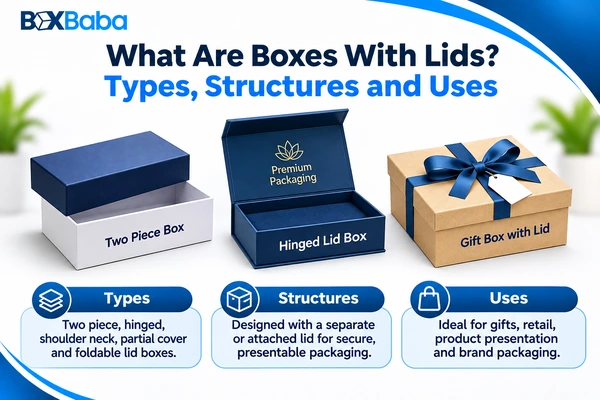
A box with a lid is packaging in which a top component covers or closes the box base or body. The lid may lift away completely, remain attached on a hinge, cover all or part of the base, fold into position, or provide product visibility through a clear top.
That means Boxes With Lids are a packaging family, not one single box construction.
A two-piece rigid lid-and-base box is one type of lidded packaging. So are hinged structures, partial-cover boxes, foldable lid-and-base formats, corrugated lid-and-base boxes and clear-lid packaging.
The easiest way to compare them is not by marketing name. Start with how the lid relates to the base, then evaluate coverage, construction, material, visibility and product fit.
Brands already evaluating made-to-size packaging can compare the commercial options under Custom Boxes With Lids.
Boxes With Lids at a Glance
| Decision Layer | Common Directions | What It Changes |
| Lid relationship | Separate/removable or attached/hinged | How the package opens |
| Lid coverage | Full-cover, partial-cover, shallow/deeper lid | How much of the base remains visible |
| Structure | Two-piece, shoulder-neck, foldable, hinged | How lid and base are constructed |
| Material/construction family | Rigid board, folding paperboard, Kraft paperboard, corrugated board | Form, weight, storage, printing and handling |
| Visibility | Opaque or clear/transparent lid | Whether the product is visible before opening |
| Shape | Rectangular, square, round, heart or another approved geometry | Product fit, tooling, inserts and artwork |
| Application | Gift, presentation, footwear, retail, seasonal, ecommerce | Which buyer problem the box must solve |
These dimensions overlap.
A box can be both rigid and two-piece, Kraft and removable-lid, or heart-shaped and gift-focused.
The terms describe different attributes of the same package.
The First Question: Is the Lid Removable or Attached?
The clearest starting point is the relationship between lid and base.
Separate or Removable Lids
A separate lid lifts completely away from the lower base.
This family includes many structures described as:
- lid-and-base boxes;
- two-piece boxes;
- lift-off lid boxes;
- detachable-lid boxes;
- telescope boxes.
These terms can overlap, but they are not automatically identical in every context.
The basic relationship is:
lid → separates from → base
A removable top gives broad access to the product once opened and creates a clear closed-state/open-state transition.
Where rigid construction itself is important, Two Piece Rigid Boxes provide the more specific commercial structure.
Attached or Hinged Lids
A hinged lid remains connected to the main box body or base while opening.
The relationship becomes:
lid → remains attached to → box
This changes the opening experience because the customer does not remove and set aside a separate top.
A hinged package can also provide a large inside-lid surface for messaging or artwork.
An attached lid should not be called a detachable lid merely because both structures open from the top.

What Is a Two-Piece Lid-and-Base Box?
A two-piece box uses two main components:
- a lower base or tray;
- a separate lid that fits over or onto that base.
In rigid packaging, this is one of the most familiar removable-lid structures.
However:
two-piece lid-and-base box ≠ every box with a lid
A broad Boxes With Lids family can also contain attached, foldable, clear-top and other lid relationships.
This distinction is important because many packaging guides use lid-and-base box, two-piece rigid box and box with lid almost interchangeably even though their scope is not always the same.
Full-Cover vs Partial-Cover Lids
| Method | Best For | Material Fit | Tooling Required | Run Size Fit | Buyer Caution |
|---|---|---|---|---|---|
| Flatbed die cutting | Folding cartons, corrugated mailers, rigid box panels, inserts, window boxes | Paperboard, E-flute, B-flute, chipboard, foam | Steel rule die | Small to large | Tooling should be approved carefully before production |
| Rotary die cutting | High-volume corrugated packaging and repeatable shapes | Corrugated board, depending on flute and machine setup | Cylindrical rotary die | Large | Setup may not fit every short-run or complex project |
| Digital die cutting | Prototypes, samples, short runs, test orders | Paperboard, light corrugated, label stock | No physical die in many setups | Very small to small | Unit cost may stay higher on larger runs |
| Laser die cutting | Fine details, intricate decorative cuts, complex windows | Paperboard, kraft, thin board | No steel die | Small to medium | May be slower or less suitable for some materials and high-volume runs |
Digital die cutting can help with sampling before a steel rule die is made. That can reduce the risk of committing to tooling before the structure is confirmed.
Whether BoxBaba uses any specific die-cutting method in-house is Unclear. Ask BoxBaba to confirm which production method fits your material, quantity, and structure during the quote stage.

Common Packaging Products Made With Die Cutting
Once a separate lid has been selected, the next question is how much of the base it covers.
Full-Cover Lid
A deeper lid extends over most or all of the visible base sidewall when the package is closed.
This creates a more visually covered exterior.
Partial-Cover Lid
A shallower lid covers only the upper part of the base, leaving some lower sidewall visible.
The exposed base can become part of the visual design—for example, by using a contrasting color or printed treatment.
Neither arrangement is universally better.
The right depth depends on:
- structure;
- product;
- desired proportions;
- opening behavior;
- artwork;
- exposed base area.
There is no universal lid-depth percentage that should be applied to every custom box.
What Is a Shoulder-Neck Box?
A shoulder-neck box introduces an additional inner component between the outer base and lid.
The raised inner section—often called the neck or shoulder—creates a ledge and a more layered opening presentation.
Conceptually:
lid + internal neck/shoulder + base
This makes it structurally different from a simple two-component lid-and-base package.
Shoulder-neck construction is therefore better treated as its own structural decision rather than merely another decorative name for a standard removable lid.

What Are Foldable Lid-and-Base Boxes?
Not every lid-and-base package must remain permanently assembled.
A foldable lid-and-base structure is developed so components can be collapsed or supplied flat before final assembly, depending on the approved construction.
This creates a different operational question from a conventional setup box:
Does the buyer prioritize a permanently formed presentation structure, or reduced storage volume before assembly?
The answer depends on the exact package, packing process and material system.
Foldable therefore describes a structural/operational attribute, not merely the way the lid opens.
What Is a Clear-Lid Box?
A clear-lid box lets the product remain visible through part or most of the top while the package is closed.
That changes the buyer problem from:
conceal → open → reveal
to:
display → contain → open
Visibility affects several decisions:
- product orientation;
- internal presentation;
- insert position;
- loaded height;
- interior color;
- artwork placement.
A transparent lid should not automatically be described as PET, PVC, acetate or another particular material unless the exact project specification confirms it.
If product visibility before opening is central to the decision, compare Presentation Boxes With Clear Lid.

Material and Lid Type Are Different Decisions
One of the most common packaging-taxonomy mistakes is mixing materials and lid styles in the same list.
For example:
- hinged;
- rigid;
- Kraft;
- clear;
- gift
are not five equivalent box structures.
They describe five different kinds of attributes.
Rigid Board Boxes With Lids
Rigid packaging uses a firm setup construction that generally retains its finished form rather than behaving like a conventional lightweight folding carton.
Rigid construction can be combined with several opening styles.
For example, the wider Custom Rigid Boxes family can include:
- two-piece lid-and-base boxes;
- magnetic closures;
- drawer structures;
- shoulder-neck boxes;
- other approved rigid formats.
So:
rigid = construction family
not:
rigid = one lid type
Paperboard or Cardboard Boxes With Lids
Folding paperboard/cardboard structures are generally developed from lighter board that is cut, creased and formed into packaging.
They may be appropriate when a project needs a lighter carton format rather than a formed rigid setup box.
The exact structure should follow:
- product dimensions;
- loaded weight;
- opening requirement;
- packing process;
- printing;
- distribution role.
Cardboard box with lid is therefore still too broad to identify one precise construction.
Kraft Boxes With Lids
Kraft describes a material/surface direction rather than one universal lid structure.
A Kraft package may use a removable, folding or other compatible lid design.
The natural brown appearance is also not proof by itself that a finished package is recycled, recyclable, biodegradable or compostable.
Those attributes depend on the complete material, coating, adhesive and finishing system.
Corrugated Boxes With Lids
Corrugated board contains a fluted layer and is commonly used where handling, distribution, larger formats or shipping-oriented requirements become more important.
A corrugated lid-and-base box can still use a separate upper lid and lower tray.
But it should not be treated as structurally identical to a rigid gift box simply because both have removable tops.
When transportation becomes the dominant task, compare the broader Ecommerce Packaging Boxes or corrugated packaging route rather than assuming a presentation box is automatically a parcel shipper.
Choose the Lid Before the Decorative Finish
Foil, Spot UV, embossing and gloss effects may attract attention early in a packaging project, but they do not answer the first structural questions.
A more useful order is:
product → opening method → lid/base relationship → internal fit → material/construction → artwork → printing → finishing
This avoids designing an attractive surface around the wrong package.
Printing, Color and Finishing Are Different Layers
Packaging terminology becomes confusing when these are blended together.
Printing Methods
Depending on the approved substrate and production setup, printing methods may include:
- offset printing;
- digital printing;
- suitable flexographic printing.
Color Systems
CMYK and Pantone/PMS are color-management approaches.
They are not box structures or finishing methods.
Physical color can also change with substrate, ink, coating, lamination and finish, so a digital reference should not be treated as an absolute guarantee of identical physical appearance.
Finishing
Finishing treatments may include, where compatible:
- matte;
- gloss;
- soft-touch;
- foil stamping;
- embossing;
- debossing;
- Spot UV.
These treatments come after the structural decision.
Spot UV does not create a new box type. Neither does gold foil or a particular color.
How Should a Product Be Measured for a Box With a Lid?
Start with the finished item in the condition in which it will actually be packed.
Record:
- maximum length;
- maximum width;
- maximum height;
- widest or highest projections;
- packed weight where relevant;
- intended orientation;
- accessories/components.
Then include any:
- tissue;
- insert;
- divider;
- platform;
- additional product;
- presentation component
before final internal packaging dimensions are approved.
A useful sequence is:
finished product → packed orientation → insert/support → required interior → loaded height → lid/base configuration
Do not treat the product dimensions as finished external box dimensions.
Internal and External Dimensions Are Not the Same
Internal dimensions describe usable space inside the package.
External dimensions describe the overall finished package.
They differ because packaging materials and structural components occupy space.
This becomes particularly important when:
- an insert is used;
- the lid overlaps the base;
- the product has projections;
- several items share one package;
- shipping cube matters.
A custom quote should therefore start from the product and pack-out rather than an assumed outside box size.

When Does a Box With a Lid Need an Insert?
Not every lidded box needs one.
An insert becomes useful when it solves a real problem, such as:
- controlling product movement;
- holding a fixed orientation;
- separating several components;
- elevating or recessing a product;
- organizing a gift set;
- improving product removal.
The insert and outer package should be designed together because the insert consumes internal space and can change loaded height.
For projects requiring fitted foam cavities, Custom Foam Inserts provide the deeper commercial route.
Common Uses for Boxes With Lids
The same broad packaging family appears across very different buyer tasks.
Gift Packaging
Gift applications often use a removable lid when concealment and the opening reveal matter.
For gifting-specific planning, Gift Boxes With Lids focus on the recipient experience, gift-set fit, lid depth and internal arrangement.
Product Presentation
Presentation packaging focuses more on how the product appears after opening.
A Presentation Boxes With Lid may prioritize product positioning, interior framing and the transition from closed branding to open display.
Product Visibility
Clear-top packaging is useful when seeing the product before opening is part of the presentation.
Footwear
Shoe Boxes With Lids add another fit problem because the packaged unit is normally the complete footwear pair rather than one shoe in isolation.
Shaped Packaging
A shape can change the physical packaging problem.
For example, Heart Shaped Boxes With Lids require a different usable footprint from a rectangular lid-and-base package.
Seasonal Packaging
Christmas and other seasonal campaigns may use lidded gift packaging, but seasonality is an application layer rather than a lid mechanism.
How Do You Choose the Right Box With a Lid?
Use the packaging decision in this order.
1. Decide How the Lid Should Behave
Ask:
Should the lid lift away, or remain attached?
That separates removable and hinged directions immediately.
2. Decide How Much of the Base the Lid Should Cover
For removable lids, consider whether the base should be:
- mostly covered;
- partly visible;
- framed by another component.
3. Define the Complete Product Pack-Out
Confirm the actual product, orientation, accessories and insert requirements.
4. Choose the Construction and Material
Then decide whether the project is better suited to:
- rigid setup construction;
- folding paperboard;
- Kraft paperboard;
- corrugated board;
- another verified structure.
5. Decide Whether Product Visibility Matters
If the product must be seen while closed, investigate a verified clear-lid route.
6. Separate Presentation From Shipping
Ask whether the lidded box is:
- retail packaging;
- gift packaging;
- presentation packaging;
- inner ecommerce packaging;
- an outer shipping carton.
One box should not automatically be assumed to perform all of these roles.
7. Add Printing and Finishing Last
Once structure, fit and material are approved, develop the artwork and compatible decorative finish.
Start with the finished item in the condition in which it will actually be packed.
Record:
- maximum length;
- maximum width;
- maximum height;
- widest or highest projections;
- packed weight where relevant;
- intended orientation;
- accessories/components.
Then include any:
- tissue;
- insert;
- divider;
- platform;
- additional product;
- presentation component
before final internal packaging dimensions are approved.
A useful sequence is:
finished product → packed orientation → insert/support → required interior → loaded height → lid/base configuration
Do not treat the product dimensions as finished external box dimensions.

Common Mistakes When Choosing Boxes With Lids
Mistake 1: Treating Box With Lid as One Exact Structure
It is an umbrella concept.
First identify whether the lid is removable, attached, full-cover, partial-cover or part of another structure.
Mistake 2: Choosing Rigid Before Choosing the Opening Method
Rigid describes construction.
It does not tell you whether the package should use a separate lid, hinge, drawer or another opening system.
Mistake 3: Selecting a Finish Before Solving Fit
Foil and Spot UV cannot correct a box that does not fit the product.
Mistake 4: Guessing Universal Lid Clearance
Fit depends on the exact construction and production specification.
Avoid applying an arbitrary universal tolerance.
Mistake 5: Treating the Retail Box as the Shipping Carton
A presentation package can require a separate outer shipping layer.
Mistake 6: Assuming Every Clear Lid Uses the Same Material
Confirm the exact transparent material for the project.
Quick Selection Guide
If Your Main Requirement Is… | Start With… |
Separate rigid lift-off lid | |
General removable-lid gifting | |
Opaque presentation after opening | |
Product visibility while closed | |
Footwear-specific lid packaging | |
Heart-shaped geometry | |
Shipping-first ecommerce packaging | |
Still comparing lid structures |
Final Takeaway
Boxes With Lids describes a broad packaging family, not one exact box.
The clearest way to choose between them is to work through the decision in layers:
lid relationship → lid coverage → product fit → construction/material → visibility → application → printing and finishing
That approach keeps terms such as two-piece, hinged, rigid, Kraft, clear-lid and gift packaging in their correct roles instead of treating them as interchangeable box types.
If you already know your product needs a lid but are still comparing structures, materials or applications, explore Custom Boxes With Lids to move from the informational taxonomy in this guide to the appropriate commercial packaging route.
Frequently Asked Questions About Boxes With Lids
Is a box with a lid the same as a two-piece box?
No. A two-piece box with a separate lid and base is one type of box with a lid. The broader category can also include hinged, foldable and other lidded structures.
What is the difference between a removable lid and a hinged lid?
A removable lid separates completely from the base. A hinged lid remains attached to the box body while opening.
What is a full-cover lid?
A full-cover lid extends over most or all of the visible base sidewall when closed. A partial-cover lid leaves more of the base exposed.
Are lid-and-base boxes always rigid?
No. Rigid lid-and-base packaging is common, but separate lid/base concepts can also be developed in other suitable material and structural systems.
Is Kraft a box style?
No. Kraft describes a material or surface direction. The package still needs a defined opening and structural format.
Is a clear lid always PET or acetate?
No. The exact transparent material should be confirmed for the specific packaging project rather than assumed from appearance alone.
Does every box with a lid need an insert?
No. Inserts are useful when the product needs positioning, separation, movement control or a specific presentation arrangement.
Can a box with a lid be used for shipping?
Some structures may be designed for distribution, but a retail or presentation box should not automatically be treated as the outer parcel shipper. Shipping requirements should be evaluated separately.