
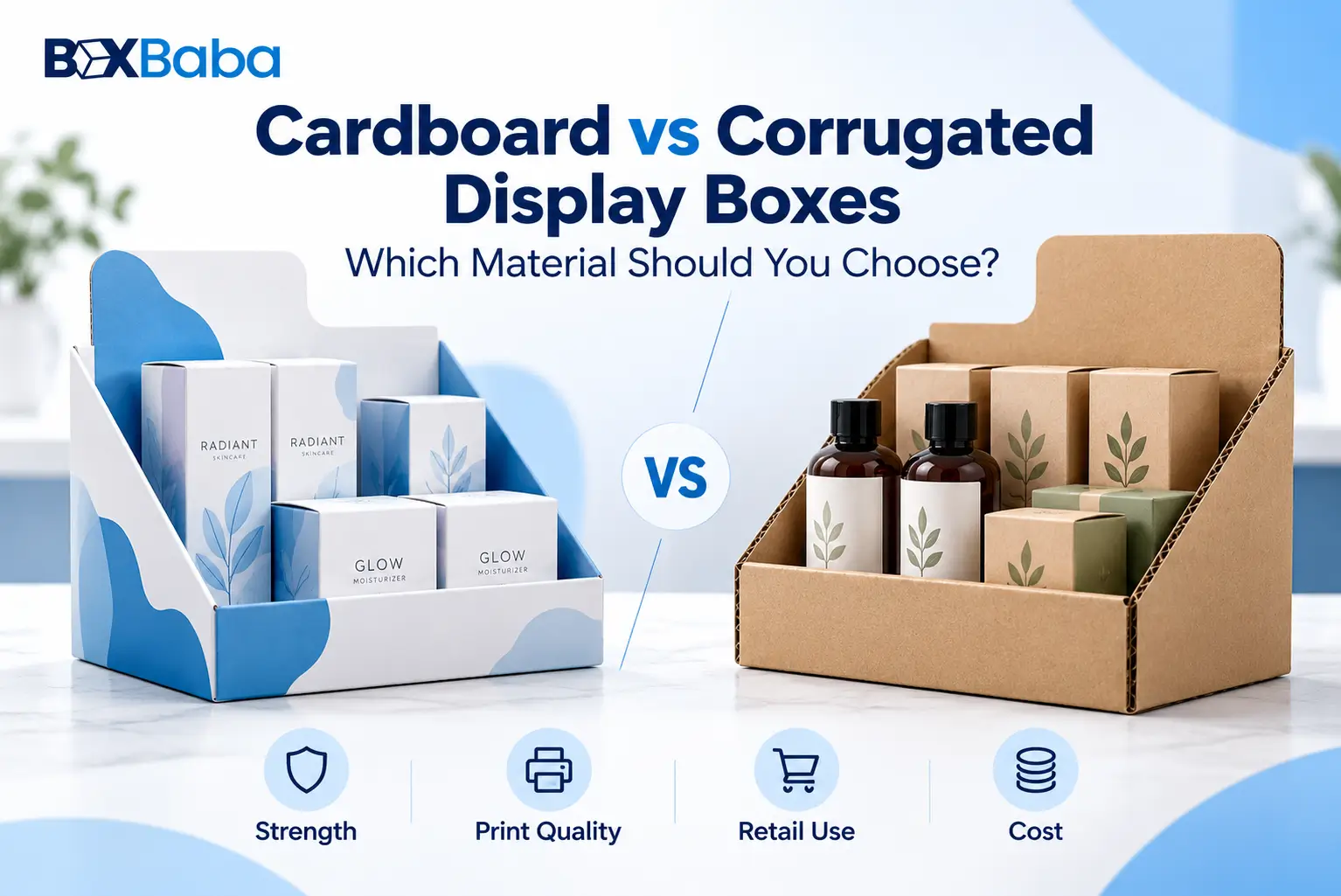
Choose a solid paperboard display when the merchandise, quantity and retail footprint can be supported by a compact solid-board structure and print presentation is an important part of the brief.
Evaluate a corrugated display when the loaded arrangement, larger footprint, longer unsupported sections or distribution role creates greater structural demand from the board system.
Neither material should be chosen from the product category alone.
A better decision sequence is:
Finished Products → Unit Weight → Quantity → Arrangement → Loaded Configuration → Retail Footprint → Structural Requirement → Print Requirement → Material Direction
For this article, cardboard means the solid paperboard or cardstock direction used for retail displays. Corrugated means fluted board made with liner sheets around a corrugated medium.
That distinction is important because cardboard is often used casually for several different paper-based materials.
For commercial material-specific options, compare BoxBaba Cardboard Display Boxes with Corrugated Display Boxes.
Cardboard vs Corrugated Display Boxes at a Glance
Decision Factor | Solid Paperboard / Cardboard | Corrugated |
Board construction | Solid, non-fluted paperboard | Fluted medium with liner sheets |
Strongest starting context | Compact display where the approved paperboard structure meets the load requirement | Display with greater structural demand from load, footprint, span or distribution role |
Retail footprint | Can suit compact structures | Often worth evaluating as footprint and unsupported sections become more demanding |
Print presentation | Smooth board surface can support detailed retail artwork | Can also be custom printed; result depends on liner, flute and print route |
Fine folding geometry | Well suited to many compact folding-display structures | Geometry must account for the deeper fluted board construction |
Loaded distribution role | Requires project-specific review | Often worth evaluating where merchandise travels loaded in the display system |
Dividers / holders | Possible | Possible |
Automatically cheaper? | No | No |
Automatically stronger? | No universal rule | Fluting changes structural capability, but final performance still depends on the complete board and design |
This table identifies a material direction, not a manufacturing specification.
What Does Cardboard Mean in This Comparison?
Packaging buyers often use the word cardboard for almost any paper-based package.
Here, the term is narrower:
Cardboard Display Box → Solid Paperboard / Cardstock Display Structure
This is different from corrugated board because the paperboard is a solid sheet rather than a fluted construction.
A useful relationship is:
Compatible Loaded Arrangement → Solid Paperboard Structure → Retail Display
Paperboard can be appropriate where the approved structure can support the merchandise without requiring the structural depth of a fluted board system.
The final decision still depends on the loaded display—not on the word cardboard by itself.
How Corrugated Display Board Is Different
Corrugated board uses a fluted paper medium combined with liner sheets.
That creates a deeper structural cross-section than solid paperboard.
For display packaging, think of the relationship as:
Loaded Display Requirement → Fluted Board Structure → Retail Display
Corrugated becomes particularly relevant to evaluate where the project introduces more demanding combinations of:
- loaded merchandise;
- wider or deeper footprint;
- longer unsupported sections;
- more substantial structural walls;
- distribution while the display is loaded.
That does not mean every heavy product automatically needs corrugated.
The complete structure still needs to be reviewed.

Start With the Loaded Display, Not the Empty Sample
An empty display can give a misleading impression of material suitability.
The useful condition is the display after the actual merchandise is arranged inside it.
Start with:
Finished Unit Weight × Quantity → Complete Loaded Configuration
Then consider where that load sits.
The same total weight may create a different structural condition when products are concentrated in a small area compared with being distributed across the base.
For DB-07, loaded configuration is a material-selection input.
The deeper engineering relationship between loaded weight and structural design belongs to the later How Loaded Weight Affects Display Box Structure guide.

Footprint and Unsupported Span Can Change the Decision
Total weight is only one variable.
Imagine two displays carrying a similar product load.
One is compact.
The other is much wider.
The wider display may introduce longer base panels, larger walls or greater unsupported spans even though the merchandise itself has not become heavier.
Therefore:
Same Product Load + Different Footprint → Different Structural Requirement
This is why material should not be chosen from unit weight alone.
A compact solid-paperboard structure may be suitable where its approved geometry supports the loaded arrangement.
As the structural span becomes more demanding, corrugated becomes more relevant to evaluate.

Product Arrangement Also Changes Structural Demand
The way products are positioned influences how the load enters the display.
Merchandise may be:
- spread across an open base;
- arranged several rows deep;
- divided into lanes;
- positioned in individual holders;
- placed across more than one level.
The useful relationship is:
Unit Weight + Quantity + Product Position → Loaded Display Condition
rather than:
Product Weight Alone → Material
For DB-07, this is enough to establish the material decision.
The deeper relationship between arrangement and finished display size belongs to the separate SKU-arrangement engineering guide.
When Solid Paperboard Is the Stronger Starting Direction
Solid paperboard is worth evaluating first when the project combines:
Compact Retail Footprint + Compatible Loaded Arrangement + Detailed Presentation Requirement + Suitable Folding Geometry
That can apply to compact counter and product-display structures where the approved paperboard construction provides the required retention and stability.
For example, a Counter Display Boxes may use solid paperboard where the finished products, quantity and available countertop footprint support that construction.
The important point is not that Counter Displays must be paperboard.
It is that a compact display does not automatically need corrugated simply because multiple products are present.
When Corrugated Is the Stronger Starting Direction
Corrugated becomes more relevant to evaluate when the project combines:
Greater Loaded Structural Demand + Larger Footprint / Span + Fluted-Board Structure + Possible Loaded Distribution Role
The flute changes the board structural section and gives the designer another way to develop rigidity into the display.
However:
Corrugated ≠ Universal Heavy-Duty Solution
Final performance still depends on the board construction, structure, folds, product arrangement and project conditions.
Do not assign one universal product-weight threshold or one flute recommendation to every retail display.
Material Depth Can Affect the Finished Geometry
This distinction should remain explicit throughout the project.
A design proof may show:
The approved warning appears on the back panel.
That does not prove:
The wording satisfies every applicable federal, state, product-category or retailer requirement.
Use:
Product / Regulatory Review → Approved Copy
↓
Approved Copy → Packaging Artwork
Packaging production should not be used as a substitute for appropriate product and labeling review.
Treat CBD Claims as Controlled Production Content
A corrugated board has a deeper cross-section than a solid paperboard.
That can influence:
- folded edges;
- slots and tabs;
- internal usable space;
- holder openings;
- retaining walls;
- external dimensions.
This does not make corrugated automatically too bulky for retail use.
It means the dieline and internal geometry need to be developed for the selected board rather than copied directly from another material.
The correct relationship is:
Change Material → Recheck Structure → Review Dieline
If you need the general production fundamentals behind cut lines, folds, glue areas and artwork placement, BoxBaba packaging dieline guide covers that topic in more detail.
Print Presentation Is Part of the Material Decision
Solid paperboard commonly provides a smooth, uniform surface for detailed retail artwork.
Corrugated displays can also be fully branded and printed.
The final appearance depends on variables such as:
- liner selection;
- flute profile;
- print process;
- artwork;
- finishing route.
Do not reduce the comparison to:
Paperboard = Good Printing
Corrugated = Poor Printing
A better question is:
What combination of structural requirements and print presentation does this display need?
If highly detailed artwork or a particular finishing effect is central to the project, confirm its compatibility with the selected board and production route before final approval.

Compact Folding Geometry May Favor Paperboard
Some display concepts rely on closely spaced folds, small tabs, detailed locks or compact die-cut geometry.
Solid paperboard can suit many of these folding-carton-style structures where the board and geometry are compatible.
Corrugated can also be die cut, folded and converted, but the fluted board behaves differently.
That means:
Same Visual Concept ≠ Same Dieline Across Materials
Changing from paperboard to corrugated—or back—should trigger structural review.

Dividers and Holders Do Not Decide the Outer Material by Themselves
Both material directions can use internal product support where the approved structure allows it.
A project may need:
- dividers;
- product lanes;
- individual holders;
- retaining walls;
- custom-cut openings.
Those features answer:
How should the merchandise be positioned or separated?
They do not answer:
What must the outer display material be?
Where product geometry is the dominant problem rather than material, BoxBaba Product Display Boxes provides the more relevant commercial starting point.
A Loaded Distribution Role Can Change the Material Brief
A display used only after it reaches the store has a different requirement from one that carries merchandise through part of the distribution process.
If products travel loaded in the display system, the material review also needs to consider:
Distribution State
and:
Retail Display State
This can make corrugated worth evaluating because the project now has an additional structural role.
It is not an automatic rule.
The complete packed configuration and applicable retailer requirements still need to be reviewed.
The broader distribution-to-retail workflow belongs to the Retail-Ready Display Packaging guide once that article is live.
Cardboard Does Not Mean Light Products Only
Avoid replacing one oversimplification with another.
A solid-paperboard display can support a multi-unit retail arrangement when its:
- footprint;
- board specification;
- folds;
- walls;
- support geometry;
- loaded configuration
work together appropriately.
The correct question is not:
Is this product light?
It is:
Can the approved paperboard display structure support the complete merchandising configuration?
Likewise, several units do not automatically require corrugated.
Corrugated Does Not Mean Shipping Only
Corrugated is strongly associated with distribution packaging, but it also has a legitimate retail-display role.
BoxBaba maintains Corrugated Display Boxes as a dedicated display category because fluted board can be developed for retail merchandising as well as other packaging functions.
Therefore:
Cardboard ≠ automatically retail
and:
Corrugated ≠ automatically shipping
Material follows the complete structural requirement.
Cost Depends on the Complete Display Specification
Do not assume paperboard is always cheaper or corrugated is always more expensive.
Project cost can change with:
- material specification;
- finished display size;
- order quantity;
- board utilization;
- print route;
- structural complexity;
- dividers or holders;
- finishing;
- assembly;
- sampling;
- fulfillment requirements.
The right question is:
Which material meets the required structural and presentation brief without unnecessary complexity?
Cost should then be quoted from that approved specification.
Sustainability Claims Require the Actual Material Specification
Do not select either material solely from a generic claim such as:
Cardboard is always eco-friendly.
or:
Corrugated is always recyclable.
The environmental profile of a finished package can be affected by:
- fiber source;
- recycled content;
- coatings;
- laminations;
- adhesives;
- inks;
- windows;
- other components;
- local recycling conditions.
Where recyclability, certified sourcing, recycled content or another environmental requirement matters, include it in the project brief and verify it against the final specification.
Cardboard vs Corrugated Decision Framework
Project Requirement | Material Direction to Evaluate First | Why |
Compact display with a compatible loaded arrangement | Solid Paperboard / Cardboard | A compact solid-board structure may meet the requirement |
Detailed print presentation is a leading priority | Solid Paperboard / Cardboard | Smooth paperboard can support detailed retail graphics |
Wider or deeper footprint creates longer structural spans | Corrugated | Fluted construction becomes more relevant to structural review |
Loaded arrangement creates greater structural demand | Evaluate Corrugated | The deeper board section may better suit the structural requirement |
Display travels loaded as part of a retail-ready system | Evaluate Corrugated | Distribution introduces another structural state |
Small footprint with concentrated product load | Engineering Review | Small does not automatically mean paperboard |
Large display with comparatively light merchandise | Engineering Review | Footprint and span still affect structural demand |
Display requires holders or dividers | Either | Support geometry alone does not determine the outer material |
Retailer specifies the board or construction | Follow the Requirement | Project-specific specification takes priority |
Use this as a decision framework, not as a production specification.

Common Cardboard vs Corrugated Selection Mistakes
Choosing Material From the Product Category
Cosmetics, supplements, bottles or snack products do not automatically belong to one display material.
Better approach: evaluate the entire loaded display.
Looking Only at an Empty Display
An unloaded structure does not represent the real merchandising condition.
Better approach: consider the intended products, quantity and arrangement.
Assuming Paperboard Is Always Too Weak
Material name alone does not determine structural performance.
Better approach: evaluate the complete paperboard structure.
Assuming Corrugated Is Always Better
More structural depth can add unnecessary material or geometry to a compact project.
Better approach: use the material needed by the actual brief.
Selecting Material Before Finalizing Arrangement
Rows, lanes, product positions and footprint can change structural demand.
Better approach: establish the merchandise configuration first.
Reusing the Same Dieline After Changing Material
Paperboard and corrugated do not have identical folding geometry.
Better approach: review the structure and dieline whenever the board system changes.
Choosing From Print Appearance Alone
Graphics matter, but the display still has to support the merchandise.
Better approach: balance presentation with structural requirement.
Making Generic Environmental Claims
Material category alone does not prove a specific sustainability attribute.
Better approach: verify the finished specification.
What Information Should You Prepare Before Choosing the Material?
Before choosing paperboard or corrugated, prepare:
- finished product dimensions;
- complete finished unit weight;
- quantity per display;
- number of SKUs;
- intended product arrangement;
- available retail footprint;
- whether products travel loaded in the display;
- known holder or divider requirement;
- header or tier requirement where applicable;
- print and presentation expectations;
- retailer-specific material requirements where applicable.
These inputs allow the material to follow the actual retail display rather than a generic preference.
Choosing Display Materials With BoxBaba
If the project points toward a compact solid-paperboard structure, explore BoxBaba Cardboard Display Boxes.
If the loaded configuration, footprint, structural span or distribution role makes fluted-board construction worth evaluating, explore Corrugated Display Boxes.
If the correct material is not yet clear, start with Custom Display Boxes and provide the finished product dimensions, unit weight, quantity, arrangement, retail footprint and intended use.
BoxBaba offers an MOQ starting from 100 units on eligible custom packaging projects, along with artwork assistance, dieline support and digital 3D mockups. Production timing should be confirmed for the specific structure, material, quantity and approval status.
Free shipping is available across the USA according to BoxBaba current shipping terms.
Frequently Asked Questions
What is the main difference between cardboard and corrugated display boxes?
In this guide, cardboard means solid paperboard or cardstock display construction. Corrugated uses a fluted medium with liner sheets, creating a different and deeper structural board system.
Is corrugated always stronger than cardboard?
Corrugated fluted construction can provide greater structural capability, but final display performance depends on the specific board, structure, footprint and loaded merchandise. Material name alone does not determine the result.
Are cardboard display boxes only for lightweight products?
No. Solid paperboard suitability depends on the complete display structure, quantity, footprint and loaded arrangement rather than one universal product-weight limit.
Should I automatically use corrugated for a large display?
No. A larger footprint makes structural span more important and can make corrugated worth evaluating, but the final material still depends on the merchandise, structure and retail requirements.
Which material is better for printing?
Solid paperboard commonly offers a smooth presentation surface, while corrugated can also be custom printed. The better choice depends on the selected board, artwork, print process and structural requirement.
Can both materials use product dividers or holders?
Yes, where the approved structure supports them. Divider or holder requirements do not automatically determine the outer display material.
Should I choose corrugated when the display travels loaded?
Corrugated is worth evaluating when the display has a loaded distribution role, but it is not an automatic requirement. The packed configuration, handling requirements and final retail structure still need review.
What should I send BoxBaba before choosing the display material?
Send finished product dimensions and unit weight, quantity, SKU arrangement, retail footprint, intended support method, whether merchandise travels loaded in the display and the required print or presentation direction.