
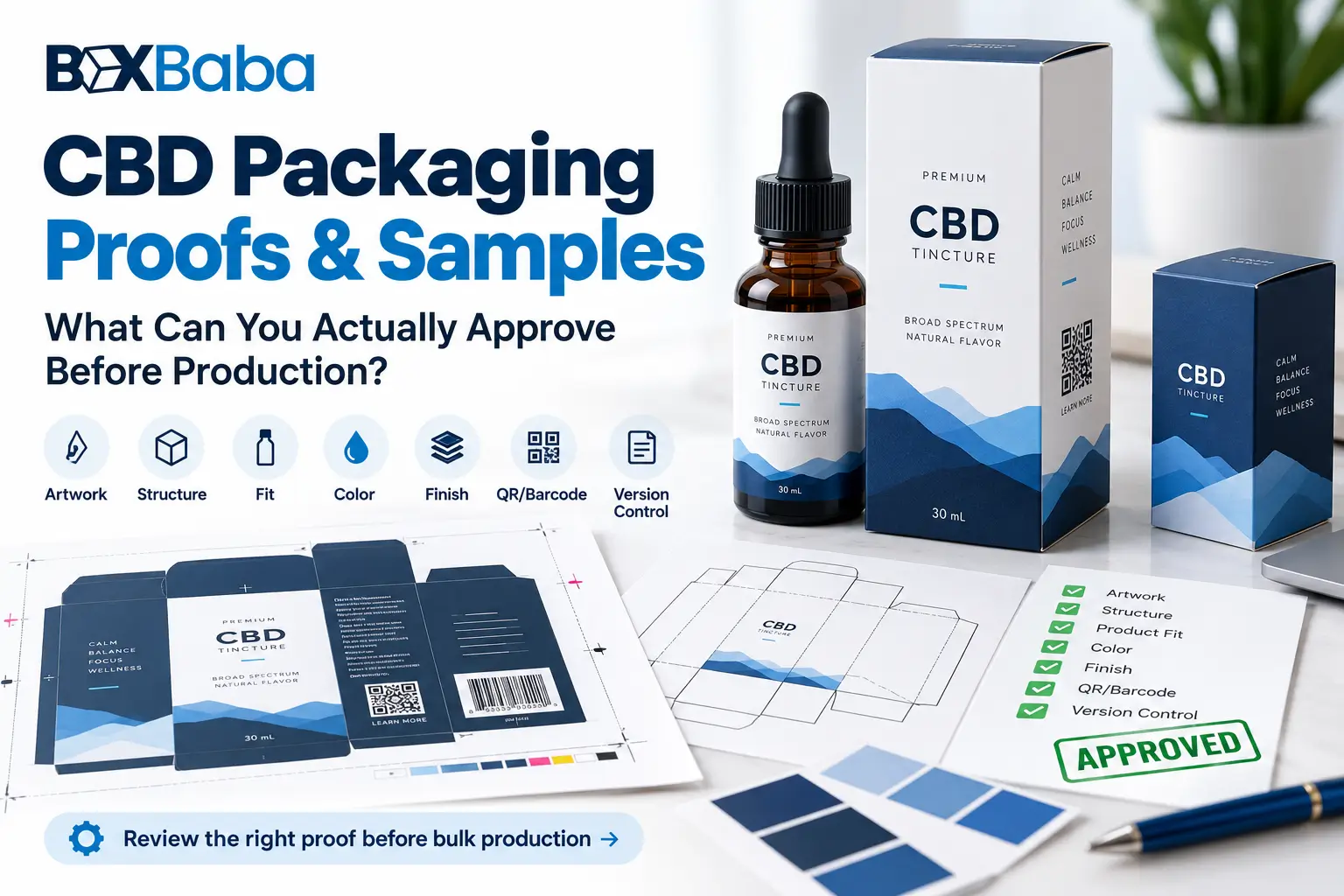
A CBD packaging sample should answer a defined production question.
It should not be approved simply because:
The box looks good.
A digital artwork proof can help confirm whether the correct CBD SKU, product name, strength, barcode, QR code and finishing locations appear on the correct panels.
A blank structural sample answers different questions:
Does the finished bottle fit?
Does the carton close correctly?
Does the insert retain the product without making removal difficult?
A printed sample can help review physical artwork, substrate interaction and selected finishes.
A more production-representative sample may provide a closer physical reference when its material and production methods more closely match the intended bulk run.
The useful sequence is:
Unresolved Risk → Appropriate Proof → Defined Approval Criteria → Review → Correction → Version-Controlled Approval → Production
The key rule is:
Proof Type Determines What You Can Approve
Brands still defining the underlying secondary package can start with Custom CBD Boxes.
CBD Packaging Proof Types at a Glance
Review Route | What It Can Help Approve | What It Does Not Automatically Prove |
3D digital mockup | General assembled appearance and panel relationships | Physical fit, actual material, actual print or transit performance |
Digital artwork proof | SKU data, text, barcode/QR placement, panel orientation and finish locations | Bottle fit, material feel or physical finish |
Stock/reference sample | General structure, material or finish direction | Your exact dimensions, artwork or custom product fit |
Blank structural sample | Dimensions, folds, closure, product fit, insert fit, loading and removal | Final print color or decorative finish |
Printed sample/prototype | Physical artwork, scale, color direction and selected finishing | Exact bulk result unless relevant production conditions genuinely match |
Product-fit review | Product-to-insert-to-box relationship | Products or conditions not actually reviewed |
Production-representative sample | Higher-fidelity physical reference where production-like processes are used | Absolute uniformity across every bulk-production unit |
Supplier terminology varies.
A prototype, white sample, printed sample, press sample, approval sample or pre-production sample can mean different things.
Before approving one, ask:
How was it produced?
What specification does it represent?
What exactly am I approving from it?

Start With the Risk, Not the Sample Name
A request such as:
Please send us a sample.
does not explain what the project still needs to validate.
First identify the unresolved risk.
Artwork Risk
Is the correct CBD strength printed on the correct SKU?
Structural Risk
Does the finished glass bottle fit without forcing the carton or closure?
Insert Risk
Does the insert retain the bottle while still allowing practical removal?
Window Risk
Does the intended part of the bottle remain visible through the opening?
Color Risk
Does the approved color direction work on the selected substrate?
Finish Risk
Is the foil, Spot UV or embossing positioned and reproduced acceptably?
Coding Risk
Will the intended batch/lot/date coding area work on the selected finished surface?
Then choose the review route.
Question → Appropriate Proof
is stronger than:
Sample Name → Assume Everything Is Approved

CBD Packaging Has More Than One Approval Object
A complex CBD package can contain several things that need separate approval.
Structural Approval
Confirms the package geometry.
Product-Fit Approval
Confirms the physical relationship between the finished product and packaging.
Artwork Approval
Confirms the printed content and production placement.
SKU/Data Approval
Confirms the exact product version, strength, barcode, QR and quantity.
Color/Finish Approval
Confirms the agreed physical reference level for color or decorative treatment.
Production-Reference Approval
Links a specific physical sample or reference to a written specification.
This matters because one approval does not automatically cover another.
Structure Approved ≠ Artwork Approved
Artwork Approved ≠ Product Fit Approved
Printed Sample Approved ≠ Shipping Performance Approved
CBD SKU Control Makes Proofing Especially Important
CBD product families frequently use packaging that looks almost identical across several versions.
For example:
CBD Oil – Variant A
CBD Oil – Variant B
CBD Oil – Variant C
They may share:
- bottle;
- closure;
- carton dimensions;
- material;
- dieline.
But printed information can differ in:
- product name;
- strength;
- flavor;
- formula;
- barcode;
- QR destination;
- approved warnings;
- quantity.
This creates two separate approval paths:
Shared Physical Structure
and:
Individual Printed Version
Shared Dieline Does Not Mean Shared Artwork Approval
Suppose three CBD oil SKUs use exactly the same physical bottle and carton.
One approved structural sample may be enough to validate the shared physical geometry when the products are genuinely identical in shape and weight.
The printed versions still need individual checking.
SKU | Dieline | Variant | Barcode | QR Destination | Artwork Approval |
SKU A | DL-01 | Variant A | Code A | Link A | Required |
SKU B | DL-01 | Variant B | Code B | Link B | Required |
SKU C | DL-01 | Variant C | Code C | Link C | Required |
The rule is:
Shared Dieline ≠ Shared Artwork Approval

3D Mockup vs Digital Artwork Proof
These are related but not identical review tools.
3D Mockup
A 3D visualization can help review:
- approximate assembled appearance;
- front/side relationships;
- overall branding direction;
- opening presentation;
- approximate product-facing hierarchy.
It does not physically validate:
- actual carton dimensions;
- product clearance;
- insert retention;
- substrate feel;
- real foil reflection;
- real printed color.
Digital Artwork Proof
A production-oriented digital proof should receive more detailed scrutiny.
For each CBD SKU, check:
- product name;
- strength or variant;
- approved copy;
- front/back/side assignment;
- top and bottom orientation;
- barcode;
- QR code;
- variable-data area;
- window position;
- foil/Spot UV/emboss locations;
- production quantity.
A useful distinction is:
3D Mockup → Visualize
Artwork Proof → Verify Production Placement
Neither replaces a physical fit review.
Review Digital Proofs as Data, Not Only Design
The biggest CBD proofing problem may not be:
The logo is 2 mm too far left.
It may be:
- wrong strength;
- wrong barcode;
- QR linked to another SKU;
- outdated warning copy;
- wrong artwork quantity.
Before approving each version, ask:
Is this the correct product?
Is this the approved artwork version?
Is this the correct strength/variant?
Is this the correct barcode?
Does the QR open the correct destination?
Is this the final approved copy?
Is the production quantity correct?
That turns proofing into a production-control process.
Artwork Approval Is Not Regulatory Approval
A proof can confirm:
The approved statement appears on the intended side panel.
It cannot independently establish:
The statement itself satisfies every applicable product or market requirement.
Use:
Product / Regulatory Review → Approved Copy
then:
Approved Copy → Artwork Proof
The packaging supplier can help position the supplied information within the production file.
The brand should approve the underlying product-specific wording and claims.
Verify the Barcode & QR for Every Printed Version
Do not approve codes visually.
For every applicable CBD SKU:
- confirm barcode assignment;
- confirm the correct product identifier;
- scan the QR;
- verify its destination;
- inspect placement;
- confirm folds/cuts do not interfere;
- check that decorative finishing does not compromise the code area.
If the QR leads to laboratory or COA information, verify more than scanability.
Ask:
Does this exact SKU open the correct approved destination?
A QR that scans perfectly but opens information for another product is still wrong.
Blank Structural Samples Validate Physical Relationships
A blank structural sample is useful because it removes decorative printing from the decision.
It can help review:
- package dimensions;
- folds;
- tuck/lock closures;
- drawer movement;
- lid/base fit;
- insert geometry;
- window position;
- product loading;
- product removal.
Its purpose is structural.
Do not reject an otherwise useful structural sample simply because it lacks finished artwork.
Test the Finished or Representative CBD Container
Physical fit should be reviewed using the product that will actually enter the packaging whenever practical.
For a CBD dropper bottle, that means accounting for the complete closed unit:
- bottle body;
- shoulder;
- closure;
- dropper/bulb;
- representative packed weight where relevant.
Do not validate the package against:
- fill capacity alone;
- an uncapped bottle;
- an unrelated bottle that merely has the same volume.
For product-specific secondary packaging, see CBD Dropper Bottle Boxes.
Finished Container → Product-Fit Review
is more meaningful than:
30 ml → Standard Sample
What to Check on a Structural Sample
Loading
Can the product be inserted consistently without forcing the carton?
Clearance
Is there enough working room without creating unnecessary movement?
Closure
Can all flaps, lids or sleeves close without bulging or distortion?
Closure Contact
Does the carton or insert apply unintended pressure to a:
- bulb;
- pump;
- cap;
- lid;
- operational closure?
Removal
Can the user remove the product without excessive force?
Orientation
Does the product remain in the intended direction?
Window Alignment
Does the intended product area appear consistently through the opening?
Insert Interaction
Does the product fit the insert, and does the completed insert fit the outer box?
A package can pass one of these checks and fail another.
Product, Insert & Outer Box Should Be Reviewed Together
For insert-supported CBD packaging, the physical system is:
Finished Product
↓
Insert Cavity
↓
Completed Insert
↓
Outer Box
↓
Window / Opening Where Applicable
Possible problems include:
- cavity too tight;
- excessive movement;
- product rotation;
- poor removal access;
- insert movement inside the carton;
- closure interference;
- window misalignment.
Where a fitted internal holder is needed, explore Printed Boxes with Inserts.

A Blank Structural Sample Does Not Approve Printing
An unprinted sample may answer:
Does the physical structure work?
It does not approve:
- final print appearance;
- brand color;
- foil;
- Spot UV;
- lamination;
- embossing;
- inside printing.
This distinction prevents:
Structure Approved → Entire Package Approved
Each unresolved production attribute needs the review method capable of evaluating it.
Printed Samples Add Physical Artwork Review
A printed prototype can help review:
- actual artwork scale;
- typography;
- front-panel hierarchy;
- small-copy readability;
- panel transitions;
- inside printing;
- barcode/QR location;
- window-to-artwork relationship;
- general color direction;
- selected finish placement.
The important phrase is:
depending on how the sample is produced.
Its production method determines what can reasonably be approved from it.
Printed Prototype Does Not Automatically Equal Bulk Production
A prototype can differ from the final run in:
- print process;
- substrate;
- ink/toner system;
- coating;
- lamination;
- tooling;
- foil process;
- assembly.
Before approving physical appearance, ask:
What does this sample match from production?
and:
What remains representative or approximate?
A sample can be extremely useful without being described as an exact duplicate of every bulk-production unit.
Define the Color Reference Being Approved
The statement:
We approved the green.
is incomplete unless the reference is identified.
Possible approval references include:
Screen / PDF Proof
Useful mainly for layout and digital color indication.
Pantone / Spot-Color Reference
Useful for communicating a target spot color where applicable.
Material / Printed Sample
Adds the interaction between ink and the actual or representative substrate.
Production-Representative Sample
Can provide a closer physical reference where materials and production processes more closely match the intended run.
These references answer different questions.
Do not treat a monitor as the final physical color standard.
Material Changes Can Reopen Color Approval
Identical artwork can reproduce differently on:
White Paperboard
and:
Natural Kraft
It can also change after switching:
- coating;
- lamination;
- wrap;
- substrate.
Therefore:
Material / Finish Change → Review Physical Appearance Again Where Relevant
Do not assume:
Same Artwork File → Same Printed Appearance
Physical Finish Samples Validate What Screens Cannot
A screen can simulate a decorative treatment.
It cannot reproduce real:
- tactile feel;
- surface texture;
- reflection;
- relief.
Finish | Useful Physical Review |
Matte | Surface appearance and text/graphic contrast |
Gloss | Reflection and glare |
Soft-touch | Tactile character |
Foil | Reflection, placement and registration |
Spot UV | Selective contrast and registration |
Emboss/deboss | Physical position, relief and interaction with the structure |
Approve the sample only for the specific finish attribute it actually represents.

Foil Has a Digital & Physical Approval Level
A digital proof can establish:
which artwork area receives foil.
A physical reference can help evaluate:
how the foil actually appears on the package.
That creates:
Digital Proof → Finish Position
and:
Physical Sample → Finish Appearance
Do not collapse both approvals into one.
Child-Resistant Instructions Can Be Proofed—CR Performance Cannot
If an applicable CBD packaging system contains approved opening instructions, a proof can help confirm:
- wording;
- arrows;
- press/push indicators;
- placement;
- orientation;
- readability.
That does not establish the child-resistant performance of the package.
Use:
Proof → Printed Instruction
not:
Proof → CR Qualification
The underlying packaging system requires its own appropriate basis.
Tamper Features Can Affect Artwork Approval
A tamper-evident component may affect:
- printable area;
- tear path;
- seal location;
- label position;
- opening instructions.
If one is part of the packaging design, review whether:
- critical copy remains readable;
- the opening action damages unintended graphics;
- the feature occupies the correct panel area.
This approval concerns the relationship between artwork and the physical feature.
It does not automatically establish any broader regulatory conclusion.
Variable Coding Areas May Need Physical Validation
A CBD carton may reserve an area for later:
- lot code;
- batch code;
- date coding where applicable;
- another production identifier.
A digital proof can approve the position.
But if the unresolved question is whether the coding process works on the finished surface, a physical review may also be useful.
The interaction can depend on:
- lamination;
- coating;
- ink coverage;
- foil;
- coding technology.
Plan this area before the packaging is fully decorated.
Retail & Ecommerce Proofing Answer Different Questions
An individual retail carton and the ecommerce order package are different packaging entities.
Retail Unit Review
May check:
- product fit;
- SKU identity;
- barcode/QR;
- small copy;
- window;
- shelf-facing orientation.
Retail Display Review
May check:
- completed unit arrangement;
- loading;
- visibility;
- display footprint.
Ecommerce Pack-Out Review
May check:
- arrangement of completed saleable units;
- internal movement;
- divider placement;
- void areas;
- order-level closure.
Approving the retail carton does not automatically validate the ecommerce outer package.
A Sample Review Is Not Distribution Testing
A structural prototype can answer:
Does this product fit and assemble correctly?
It does not automatically answer:
- parcel-drop performance;
- vibration;
- compression;
- wider distribution hazards.
These are different evaluation scopes.
Use:
Structural/Product-Fit Sample → Geometry & Pack-Out
and:
Distribution Evaluation → Complete Packaged Shipping System
where distribution testing is required.
What Is a Production-Representative Sample?
Some suppliers can provide a sample made using materials and processes closer to the intended bulk production.
It may be called:
- pre-production sample;
- press sample;
- approval sample;
- production sample;
- production-representative sample.
The label itself is not enough.
Ask whether it uses the same:
- board;
- printing route;
- ink system;
- lamination;
- coating;
- foil;
- tooling;
- assembly method.
The more of the final specification it actually shares, the stronger it can be as a production reference.
It still should not be treated as a guarantee that every bulk-production unit will be physically identical.
Link Every Approved Sample to a Written Specification
A loose sample in a cabinet becomes ambiguous over time.
A useful production reference should identify:
- CBD product/SKU;
- artwork version;
- dieline revision;
- substrate;
- print specification;
- spot/Pantone reference where applicable;
- coating/lamination;
- selective finish;
- insert;
- sample type;
- approval date;
- accepted observations or limitations.
Use:
Physical Reference + Written Specification + Version ID
rather than:
Use the old sample.
Approval Belongs to a Version
A package is not approved forever merely because the first order passed review.
Approval belongs to a defined combination of:
Product
Structure
Artwork
Material
Finish
When something changes, identify the affected relationship.
Then revalidate that relationship.
What Changes Require Re-Proofing?
Change | What Usually Needs Review |
Copy/text | Artwork proof |
Strength/variant | SKU/artwork proof |
Barcode | Artwork + barcode verification |
QR destination | Artwork + QR verification |
Artwork placement | Artwork proof |
Box dimensions | Structural review + revised dieline |
Bottle/jar/closure | Product-fit review |
Insert geometry | Structural/product-fit review |
Window position | Structure + artwork relationship |
Material/substrate | Structural/print/color review as relevant |
White board → kraft | Color/artwork review |
Matte → gloss | Finish/color review |
Foil/Spot UV position | Artwork + finish review |
Opening instruction | Artwork proof; functional qualification remains separate |
Coding method | Coding-area/material review where relevant |
The core rule is:
Change → Identify Affected Approval → Revalidate That Approval
Do not unnecessarily restart every review.
But do not assume an old approval covers a changed specification.

New CBD Strength Can Require Proofing Without a New Structural Sample
Suppose a brand launches another strength using:
- the same bottle;
- same closure;
- same filled physical configuration;
- same carton;
- same material.
No new structural sample may be necessary solely because the strength changed.
The new printed version can still require review for:
- product name;
- strength;
- barcode;
- QR;
- approved copy;
- quantity.
Again:
Physical Structure Approval ≠ Artwork/SKU Approval
Create an Approval Record for Future Reorders
Before bulk production, record the approved:
Dieline
Artwork Version
Substrate
Print Specification
Finish
Insert
Physical Reference Where Available
Then a future reorder can begin with:
What changed since the previous approved specification?
This makes proofing part of production control rather than a one-time pre-launch activity.
CBD Packaging Approval Matrix
Approval Area | Digital Proof | Structural Sample | Printed Sample | Production-Representative Sample |
Correct SKU / strength | ✓ | — | ✓ | ✓ |
Barcode / QR placement | ✓ | — | ✓ | ✓ |
Panel orientation | ✓ | — | ✓ | ✓ |
Physical dimensions | — | ✓ | ✓ | ✓ |
Bottle/jar fit | — | ✓ | ✓ | ✓ |
Insert interaction | — | ✓ | ✓ | ✓ |
Window alignment | Visual estimate | ✓ | ✓ | ✓ |
Material feel | — | Depends on sample material | ✓ | ✓ |
Color direction | Screen indication only | — | ✓ | ✓ |
Foil / Spot UV appearance | Simulated placement only | — | Where physically included | Where physically included |
Loading / removal | — | ✓ | ✓ | ✓ |
Transit performance | — | — | — | Not automatically |
This is a decision framework, not a promise that every supplier uses identical sample-production methods.
Common CBD Packaging Proofing Mistakes
Approving a 3D Mockup as Product-Fit Evidence
Better: Use a physical structural/product-fit review when fit is unresolved.
Approving Only the Hero Panel
Better: Review every panel, flap, code and SKU.
Checking Whether the QR Scans but Not Where It Goes
Better: Verify scanability and destination for that exact SKU.
Assuming One Artwork Approval Covers Every Strength
Better: Review every distinct printed version.
Approving Physical Color From a Screen
Better: Define the physical reference where color fidelity matters.
Treating a Prototype as an Exact Bulk Guarantee
Better: Document what materials/processes the prototype actually represents.
Changing the Container After Structural Approval
Better: Recheck physical fit and the dieline.
Changing Substrate Without Reviewing Artwork
Better: Review color/contrast where the substrate affects appearance.
Calling a Sample CR Approved
Better: Keep sample/print approval separate from CR qualification.
Keeping an Unlabelled Old Sample
Better: Link every retained physical reference to a written specification/version.
Treating Fit Review as Shipping Validation
Better: Evaluate distribution separately where required.
CBD Packaging Proofing Workflow
Confirm the Exact CBD SKU
Product, variant, container and closure.Confirm the Current Packaging Specification
Structure, dieline, material, insert, window and finish.Identify the Unresolved Risk
Artwork, fit, color, finish, coding, product position or another defined question.Choose the Simplest Proof That Can Answer It
Do not request an elaborate sample when a digital proof can reliably resolve the issue.Define the Approval Criteria
State exactly what counts as acceptable.Review the Correct Product & Version
Do not mix samples or files across SKUs.Record Corrections
Do not approve while unresolved edits remain.Reissue the Proof Where Necessary
The approval should reference the corrected version.Verify Functional Product Data
Barcode, QR destination and variable-data areas where applicable.Identify the Scope Being Approved
Artwork, structure, fit, color and finish should remain distinguishable.Record the Approved Specification
Dieline, artwork, material, finish, insert and physical reference.Release Only the Controlled Version to Production
What Should You Send When Requesting a CBD Packaging Sample?
Do not send only:
We need a sample.
Provide the information relevant to the unresolved approval.
Product
- CBD product/SKU;
- finished container;
- dimensions;
- closure;
- representative packed weight where relevant.
Packaging
- proposed structure;
- dieline status;
- material;
- insert;
- window;
- product orientation.
Artwork
- artwork version;
- barcode;
- QR;
- color/finish requirements.
Project
- number of SKUs;
- production quantity;
- sales channel;
- delivery destination.
Most importantly, state:
What decision must this sample help us make?
For example:
We need to confirm that the finished glass dropper bottle fits the paperboard insert, stays centered behind the window and can be removed without excessive force. This sample is for structural approval only; we are not approving final print color from it.
That is a useful sampling brief.
CBD Packaging Samples & Proofing With BoxBaba
The correct sample route depends on what is still unresolved.
A digital artwork proof may be appropriate for:
- SKU information;
- panels;
- barcode/QR placement;
- finishing positions.
A structural sample may be more relevant for:
- bottle or jar fit;
- closure;
- insert geometry;
- loading;
- removal;
- window alignment.
A printed physical sample may add review of:
- physical artwork;
- substrate interaction;
- color direction;
- decorative finishing;
depending on how that sample is produced.
For broader packaging development, explore Custom CBD Boxes.
For structural file terminology, use BoxBaba Dieline in Packaging guide.
Where fitted product positioning is required, explore Printed Boxes with Inserts.
When requesting a sample, share the exact CBD SKU, finished container, packaging specification, artwork version and—most importantly—the unresolved question that the sample must answer.
The goal is not to obtain the most elaborate sample available.
It is to use the right proof for the right approval decision.
Frequently Asked Questions
What is a CBD packaging proof?
It is a pre-production review used to validate a defined part of a CBD packaging specification, such as artwork, SKU data, dimensions, product fit, color direction or finish.
What is the difference between a digital proof and physical sample?
A digital proof primarily reviews printed content and production placement. A physical sample can additionally review physical relationships such as fit, closure, insert behavior and material/finish characteristics depending on how it was produced.
Can a PDF proof prove that my CBD bottle fits the box?
No. Product fit is a physical relationship and should be reviewed with an appropriate structural/product-fit sample when fit remains unresolved.
Does every CBD SKU need a physical sample?
Not necessarily. If several SKUs share an identical approved physical product and structure, one structural approval may support that geometry. Every distinct printed artwork version should still be verified.
Should every CBD strength receive an artwork proof?
Each distinct printed version should be checked for the correct product name, strength/variant, barcode, QR destination, approved copy and production quantity.
Can a printed CBD packaging sample exactly predict bulk production?
Do not assume so. Ask which materials, print methods, finishes and tooling match the intended production run and which attributes remain representative.
Can I approve CBD package color from a screen proof?
A screen proof can indicate color digitally but cannot fully reproduce the physical interaction between ink, substrate and finish. Use an agreed physical reference where exact physical appearance matters.
Should the QR be tested during proofing?
Yes. Confirm that the final code scans and that it opens the correct destination for the exact SKU being approved.
Does a packaging sample prove child resistance?
No. A sample can review structure or printed instructions, but child-resistant qualification is a separate performance/compliance matter.
Does a structural sample prove ecommerce shipping performance?
No. Structural fit review and distribution testing of a complete packaged product are different validation processes.
When should packaging be re-proofed?
Revalidate the affected relationship when the product, structure, artwork, barcode, QR, material, insert, window, finish or another approved specification changes.
What should be retained after sample approval?
Keep the relevant artwork version, dieline revision, material/print/finish specification, insert details, approval date and physical sample/reference identifier where applicable.