
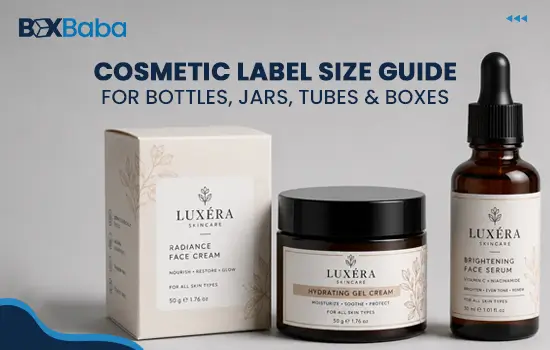
Cosmetic labels must do more than decorate a bottle, jar, tube or box. A good label helps customers identify the product, read important information, understand the brand, compare options on the shelf and trust the product before purchase. Before ordering labels, beauty brands need a clear plan for labeling cosmetic jars, bottles, tubes and boxes.
This BoxBaba cosmetic label planning guide for bottles, jars, tubes and boxes is written for beauty brand founders, product managers, packaging buyers and ecommerce teams that need practical guidance before ordering custom labels or cosmetic packaging. It covers label size, container fit, materials, adhesive choice, packaging structure, inserts, windows, print finishes, retail display, ecommerce protection and quote preparation.
Cosmetic labeling should be reviewed carefully before production. FDA explains that cosmetics marketed in the United States must comply with labeling requirements under the FD&C Act, the Fair Packaging and Labeling Act and FDA regulations.
What Is Cosmetic Label Planning?
Private label cosmetic packaging is branded packaging used to sell skincare or
Cosmetic label planning is the process of choosing the label size, shape, material, finish, adhesive, copy placement and packaging structure before printing labels for cosmetic products.
A complete cosmetic label plan should answer:
- What container is being labeled?
- Is the product packed in a bottle, jar, tube or carton?
- What is the labelable surface area?
- Should the product use a wrap label, roll label, sheet label, lid label or front/back label?
- What information belongs on the front panel?
- What information belongs on the back or side panel?
- What label material works with the formula and surface?
- Does the product need a carton, insert, window or divider?
- Will the product be sold in retail, ecommerce or both?
- Is the artwork ready for quoting and printing?
The goal is simple: the label should fit the product, stay readable, support the brand and reduce production mistakes.
keup products made by a third-party manufacturer under your own brand name. It includes custom cosmetic boxes, labels, inserts, materials, finishes, and retail or ecommerce packaging structures.
Cosmetic labels should be planned around the container first. Bottles need front/back labels, wrap labels or clear labels. Jars often need lid labels, side labels or cartons for extra copy space. Tubes need flexible label planning because they bend and squeeze. Cartons need panel-based artwork, insert planning and retail-ready structure.
Before requesting a quote, measure the container, prepare artwork, choose label material, decide the finish, confirm required copy, review claims and share quantity, dimensions and shipping needs with BoxBaba.
What cosmetic labels packaging must solve
Cosmetic label packaging must solve product identification, container fit, readability, adhesion, shelf appeal, ecommerce handling, movement control and quote accuracy.
A cosmetic label is not just a sticker. It is part of the complete packaging system. The label must work with the container shape, product formula, carton structure, insert style, retail shelf position and shipping method.
For cosmetic brands, label planning must solve:
- Product name visibility
- Brand recognition
- Product identity
- Net contents placement
- Ingredient and warning space
- Barcode or QR code placement
- Label adhesion on glass, plastic, tubes or cartons
- Moisture, oil and handling exposure
Main Container Formats: Bottles, Jars, Tubes and Cartons
Cosmetic labels should be planned around the container because bottles, jars, tubes and cartons have different surfaces, shapes and handling conditions.
Container format | Common products | Suitable label approaches | Main planning risk |
Bottles | Serum, toner, lotion, shampoo, cleanser and body oil | Front/back, partial-wrap, full-wrap or clear labels | Curves, shoulders and low-energy plastics can cause distortion or edge lifting |
Jars | Cream, balm, mask, scrub, body butter and powder | Lid, side, bottom or wrap labels | Short sidewalls may not provide enough readable space |
Tubes | Face wash, hand cream, lip gloss and cosmetic gels | Flexible front/back or custom tapered labels | Squeezing, tapering, seams and crimps can cause wrinkling |
Cartons | Skincare, makeup, fragrance and beauty sets | Printed carton panels, seals and supporting labels | Poor panel planning may hide important information |
Compacts | Powder, blush, eyeshadow and solid cosmetics | Top, bottom or custom-shaped labels | Hinges, curves and small surfaces restrict copy space |
Small containers | Samples, lip balms, mini jars and travel products | Small wrap, lid or bottom labels | Limited space may require an outer carton or display card |
Bottles
Bottles are commonly used for liquid and semi-liquid cosmetic products. They may be round, oval, square, cylindrical, frosted, clear, colored, glass or plastic. The label must match the bottle’s diameter, shoulder shape, body height, cap area and product visibility to ensure proper fit, readability and clean presentation.
Best options for bottles include:
- Front label for brand and product name
- Back label for directions, ingredients and barcode
- Wrap label for larger copy area
- Clear label for a clean no-label look
Jars
Jars are used for creams, masks, balms, scrubs, body butter, cosmetic powders and hair masks. Jars often require label planning across the lid, sidewall and bottom.
Best options for jars include:
- Lid label for brand name and product identity
- Side label for product name, quantity and short claims
- Bottom label for batch, barcode or extra details
- Wrap label for wider brand storytelling
Jar labels must also be planned around oil, moisture and frequent hand contact. If the formula is greasy, wet or often handled, choose a suitable label material, adhesive and finish to reduce smudging, peeling or edge lifting. When the jar surface is too small for readable information, brands can use a matching carton or secondary packaging to create more space for ingredients, directions and required label details.
Tubes
Tubes are flexible containers, so label planning must consider squeezing, bending and repeated handling. A tube label should not be too rigid, too close to the crimp area or too close to the cap edge.
Best options for tubes include:
- Flexible film labels
- Front/back label layout
- Tube-compatible artwork
- Squeeze-compatible finish
- Strong adhesive for curved surfaces
Tube labels should be tested at actual size because copy near the edges can curve, distort or disappear into the tube seam.
Cartons
Cartons give cosmetic brands more space for retail presentation, product education and label information. A carton may be used around a bottle, jar or tube to improve shelf presence and protect the product.
Cartons are useful when:
- The container is too small for complete copy
- The product needs premium retail packaging
- The brand wants more space for ingredients or directions
- The product is part of a gift set or skincare routine
- The item needs a barcode, QR code or seal label
- The label needs better readability than the container allows
- The product needs insert support for shipping or display
For carton-based packaging, connect your label plan with custom cosmetic boxes so the container label and outer box work together.
Cosmetic Label Size Formula by Container Type
Correct label size starts with the real container, not the design file.
For round bottles and jars, measure the circumference with flexible tape or calculate it with this formula:
Circumference = diameter × 3.14
Then subtract a safe gap from the label width to reduce overlap, edge lift and flagging. For wrap labels, a small gap between label edges is usually safer than forcing the label to meet edge-to-edge.
If a 30ml round serum bottle has a 28mm diameter, its circumference is about 88mm. A wrap label should leave a safe gap instead of wrapping edge-to-edge. The printable height should exclude the shoulder, base curve and cap area.
Container Type | Measurement Formula | Planning Note |
Round bottle | Diameter × 3.14 = circumference | Subtract a safe gap for wrap labels |
Round jar | Diameter × 3.14 = circumference | Use flat sidewall height, not total jar height |
Tube | Width or diameter × 3.14 if round | Avoid full wrap unless material is tested |
Square bottle | Front panel width × printable height | Usually better with front/back labels |
Oval bottle | Flat front width × printable height | Wrap labels may distort on curved sides |
Carton | Finished panel width × height | Use panel dimensions, not flat sheet size |
Need help choosing the right label size? Share your bottle, jar, tube or carton dimensions with BoxBaba before finalizing artwork.
Typical Cosmetic Label Size Reference
These are planning examples, not fixed requirements. Always measure your exact container before approving artwork.
Product | Common Container | Label Planning Direction | Best Structure |
15ml serum | Small dropper bottle | Small front/back label or partial wrap | Clear or white BOPP label |
30ml serum | Glass bottle | Front/back label or wrap label | Carton with insert for retail |
100ml toner | Tall bottle | Taller front/back label | Moisture-resistant label |
30ml cream | Small jar | Lid label + side label | Carton if copy is long |
60ml face cream | Wide jar | Side label or wrap label | Lid label for branding |
Lip balm | Small tube | Wrap or tube label | Counter display boxes if retail |
Face wash | Squeeze tube | Flexible front/back label | Carton for retail shelf |
Fragrance | Glass bottle | Clear, metallic or front label | Premium carton with insert |
Cosmetic set | Multi-product kit | Product label for each item | Box, tray or divider insert |
How To Measure The Product
Measure the actual container before designing the label because wrong measurements create poor fit, edge lifting, distorted text and production delays.
A cosmetic labels size guide should begin with the physical product. Measure the surface where the label will sit, not the full height or full circumference of the container.
Bottle Measurement Checklist
For bottles, measure:
- Total bottle height
- Printable body height
- Diameter or width
- Circumference for wrap labels
- Base curve
- Gap needed between label edges
- Any embossed, frosted or textured surface
The printable body height excludes the shoulder curve, base curve and areas where adhesion may be unreliable. This is especially important for serum bottles, lotion bottles, oil bottles and pump bottles.
Jar Measurement checklist
For jars, measure:
- Jar diameter and height
- Lid diameter
- Labelable side area
- Bottom-label diameter
- Lid texture or ridges
- Curved or tapered areas
Short jars often need a simple side label and a stronger carton plan because the jar itself may not provide enough readable label space.
Tube Measurement Checklist
For tubes, measure:
- Tube height and width
- Front and back label area
- Cap direction
- Crimp area
- Shoulder curve
- Flexible squeeze zone
- Safe margin from edges
- Seam or sealing area
Do not place essential copy too close to the crimp, seam or cap. These areas can distort during filling, sealing, display or customer use.
Carton Measurement Checklist
For cartons, measure:
- Product length, width and depth
- Carton internal dimensions
- Front panel size
- Back panel size
- Side panel width
- Top and bottom flap area
- Window position, if used
A carton should fit the product without excessive movement. If the bottle, jar or tube shifts inside, add an insert or divider instead of making the carton overly tight.
FDA Label Space Planning for Cosmetic Packaging
Cosmetic labels need enough space for product identity, net contents, ingredient declaration, warnings where applicable, business information and directions for safe use.
FDA explains that required information should be prominent and conspicuous, with attention to panel display, panel size, letter style, letter size, background contrast and avoidance of designs that obscure required information.
Label Element | Best Placement | Why It Matters |
Product name | Front label / PDP | Helps buyers identify the product quickly |
Product identity | Front label / PDP | Explains what the product is |
Net contents | Front label / PDP | Helps customers compare quantity |
Directions | Back, side or carton panel | Supports correct product use |
Warnings | Information panel or required area | Adds caution where needed |
Ingredients | Information panel | Needs clear, readable space |
Business information | Information panel | Identifies the manufacturer, packer or distributor |
Barcode | Back, bottom or side panel | Supports retail checkout and inventory |
QR code | Back, side or insert card | Supports product education, reorder path or digital details |
Compliance note: This guide is for packaging planning only and is not legal advice. Cosmetic brands should review product claims, ingredient declarations, warnings, net contents, business information and state-specific requirements before printing labels.
Cosmetic Label Formats: Roll, Sheet, Wrap and Front/Back Labels
The best cosmetic labels packaging structure depends on container shape, product quantity, application method, retail needs and production setup.
Structure | Best For | Why It Works |
Roll labels | Medium to large label runs, machine application, repeated SKUs | Efficient for consistent application and reorder planning |
Sheet labels | Small batches, samples, short runs, manual application | Useful for startup testing and limited product launches |
Wrap labels | Round bottles, jars and larger copy needs | Provides more surface area for branding and instructions |
Front/back labels | Bottles, tubes and retail products | Keeps the front clean and moves details to the back |
Lid labels | Jars, balms and round containers | Improves top-view branding and shelf recognition |
Carton labels | Boxed cosmetics, kits and specialty packaging | Supports barcode, QR code, retail messaging and premium presentation |
Security or seal labels | Cartons, jars and caps | Helps show closure integrity, but suitability depends on product and package |
Cosmetic Labels Packaging Structure by Product Type
Choose the label and package structure based on product size, formula type, handling conditions and sales channel.
Product Type | Recommended Label Structure | Supporting Packaging |
Serum bottle | Front/back label or clear label | Folding carton with insert for premium retail |
Cream jar | Lid label + side label | Carton if ingredient copy is too long |
Face wash tube | Flexible tube label | Carton for retail shelf presence |
Lip balm | Wrap label or tube label | Display box for retail counters |
Body oil | Moisture/oil-resistant label | Inserted carton to reduce bottle movement |
Cosmetic set | Product labels for each item | Rigid box, mailer box or retail carton with inserts |
Sample pack | Sheet labels or small roll labels | Sleeve, small carton or pouch card |
Fragrance bottle | Clear, metallic or front label | Premium carton with insert or window |
This structure-based approach helps brands avoid the common mistake of choosing labels only by appearance.
Materials and Board Strength
Cosmetic labels materials should match the product surface, formula exposure, handling environment and brand presentation.
Common cosmetic label materials include White BOPP, Clear BOPP, paper, metallic, textured, removable and moisture-resistant labels. White BOPP works well for bottles, jars, tubes and moisture-exposed products, while Clear BOPP is suitable for transparent bottles and premium cosmetic labels that need a clean no-label look. Paper labels fit natural, kraft and handmade beauty products, but they may need coating for oils, moisture or frequent handling. For bathroom-use products, brands should test moisture-resistant label material, adhesive and finish before production.
BoxBaba can help you choose label material, adhesive and finish based on your product container and packaging use.
Common Cosmetic Box Materials
Box Material | Best Use | Strength and Presentation |
SBS paperboard | Premium cosmetic cartons | Smooth surface for detailed printing |
Kraft paperboard | Natural or organic-style beauty packaging | Earthy appearance, but eco claims still need support |
Corrugated board | Ecommerce cosmetic shipping and kits | Stronger protection for transit |
Rigid board | Luxury skincare, fragrance and gift sets | Premium structure and high perceived value |
Cardstock | Lightweight retail boxes and sleeves | Good for smaller products and short-run presentation |
Adhesive and Surface Compatibility for Cosmetic Labels
Adhesive choice affects whether the label stays clean, flat and readable during storage, retail handling, shipping and use.
Container / Use Case | Label Risk | Better Planning Choice |
Glass serum bottle | Curved surface | Clear or White BOPP with tested adhesive |
HDPE / PP bottle | Adhesion difficulty | Use high-tack or tested film label |
Shower product | Moisture exposure | Choose moisture-resistant material and adhesive |
Oil-based product | Smudging or edge lift | Use film label with protective finish |
Tapered tube | Wrinkling or puckering | Use a custom tapered label shape |
Label Material and Adhesive Compatibility
Choose the label material and adhesive according to the container surface. Glass usually supports clear or white film labels, while PET, HDPE and PP may require tested adhesives for reliable bonding. Squeeze tubes need flexible labels that can bend without wrinkling or peeling. For oily jars, use oil-resistant film labels with a protective finish to reduce smudging and edge lifting. Always test the label on the actual filled container before production.
Manual vs Machine Label Application
Choose the label application method before final production because roll direction, spacing, shape and material can affect how smoothly labels are applied.
- Manual application: Best for startups, samples and small batches. Use simple label shapes and clear alignment marks.
- Semi-automatic application: Best for growing DTC brands. Keep label size consistent across SKUs for easier application.
- Machine application: Best for larger runs and repeat orders. Confirm roll direction, core size and unwind direction before printing.
- Hand-applied sheet labels: Best for local launches and short runs. Avoid complex shapes that are difficult to align by hand.
- Wrap label application: Best for round bottles and jars. Leave a safe gap to reduce overlap, edge lift and label lifting.
Inserts, Windows and Movement Control
The strongest cosmetic packaging plans connect the label, carton and insert before artwork approval.
Packaging Part | Main Role | Planning Question |
Product label | Identify product and brand | Is the label readable on the container? |
Carton | Add space, shelf appeal and protection | Does the box carry information the container cannot fit? |
Insert | Control movement | Does the product shift, rub or rotate inside the box? |
Window | Show product visibility | Does the window improve trust without weakening the box? |
Seal label | Support closure presentation | Does the seal fit the cap, lid or carton flap? |
QR insert card | Add product education | Does the QR code reduce label crowding? |
For a complete packaging system, connect cosmetic labels with custom cosmetic boxes so the product label and outer carton work together.
Printing and Finish Compatibility
Printing and finish choices should match the label material, container use and cosmetic brand positioning.
Cosmetic label printing is not only about color. It affects readability, shelf appeal, durability, color consistency and premium perception.
Printing Options
Common printing options include:
- Digital printing for short runs and multiple SKUs
- Offset printing for high-quality carton artwork
- Flexographic printing for roll labels and larger label runs
- CMYK printing for full-color designs
- PMS / Pantone matching for brand color consistency
Finish Options
Common cosmetic label and box finishes include:
- Matte or Gloss lamination
- Soft-touch coating
- Spot UV
- Foil stamping
- Embossing and Debossing
- Aqueous coating
Retail vs Ecommerce Requirements
Retail cosmetic labels must be easy to read on shelves, while ecommerce labels must stay clear and protected during shipping. For retail, focus on product identity, front-panel clarity, barcode placement and shelf appeal. For ecommerce, plan moisture resistance, label durability, product photography, unboxing presentation and movement control inside the box. Brands selling online can also connect labels with protective cartons, inserts or custom cosmetic boxes for a better delivery experience.
Common Risks: Poor Adhesion; Unreadable Text; Wrong Label Size
Most cosmetic label problems happen because the label was designed before the container, material and use environment were understood.
Poor Adhesion
Poor adhesion can happen when the label material, adhesive or container surface is not properly matched. Oil residue, moisture, curved surfaces, frosted glass, squeeze tubes or low-surface-energy plastics can cause peeling, edge lifting or weak label hold.
Unreadable Text
Unreadable text reduces buyer trust and can make important product information difficult to understand. Avoid thin fonts, low contrast, crowded ingredients, glossy glare and placing required details over busy artwork or curved label areas.
Wrong label Size
Wrong label size can cause edge lifting, distorted copy, poor placement and wasted printed labels. Measure the actual labelable area, allow safe margins, avoid shoulder and crimp areas and confirm the dieline before printing.
What Affects Cosmetic Label Cost?
Cosmetic label pricing depends on size, material, finish, print method, structure and quantity.
Major cost factors include:
- Label dimensions and shape
- Roll labels vs sheet labels
- Material type
- Adhesive requirement
- Print coverage
- Number of colors
- White ink for clear labels
- PMS / Pantone matching
- Deadline or rush requirements
Request a custom cosmetic labels quote with dimensions, quantity and artwork so BoxBaba can guide the label size, material, finish and packaging structure more accurately.
For product-specific label support, visit cosmetic labels. For broader packaging education, read the cosmetic packaging guide.
Quote-Readiness Checklist
Before requesting a cosmetic label quote, prepare the key details your packaging supplier needs to guide the right label solution. Share your product type, container format, bottle or jar size, tube or carton dimensions, label size, material preference, finish option, barcode or QR code needs, retail or ecommerce use and shipping destination.
These details help BoxBaba recommend the right label size, material, adhesive, finish and packaging structure for your cosmetic bottles, jars, tubes or boxes.
Request a custom cosmetic labels quote with dimensions, quantity, artwork and material preference.
Why BoxBaba for Cosmetic Labels and Packaging Planning?
BoxBaba helps beauty brands plan custom cosmetic labels around the real product, not just the design idea. The goal is to make the label fit the bottle, jar, tube or carton while supporting readability, retail presentation, ecommerce handling and quote accuracy.
- Custom cosmetic labels
- Cosmetic bottle labels
- Cosmetic jar labels
- Cosmetic tube labels
- Cosmetic carton labels
- Roll labels and sheet labels
- Wrap labels and front/back labels
- Cosmetic boxes
- Inserts and dividers
Final Takeaway
Cosmetic labels must be planned around the product container, not only the brand design. Bottles, jars, tubes and cartons each need a different label size, material, structure and panel strategy. A strong cosmetic label plan improves readability, adhesion, retail presentation, ecommerce performance and production accuracy.
Use this cosmetic label planning guide for bottles, jars, tubes and boxes to prepare your dimensions, quantity, artwork and packaging needs before requesting a quote. The better your label plan, the easier it becomes to choose the right material, finish, insert, carton and structure for your cosmetic product.
FAQs
What is a cosmetic label planning guide for bottles, jars, tubes and boxes?
A cosmetic label planning guide helps beauty brands choose label size, material, structure, panel layout, finish and packaging support for different container formats. It helps prevent poor fit, unreadable text, weak adhesion and unclear quote requests.
How do I choose the right cosmetic label size?
Measure the actual labelable area of the container, not the full container size. Check height, width, diameter, curves, crimp areas, cap space and safe margins before designing the label.
What is the best label size for a cosmetic bottle?
The best label size depends on bottle diameter, labelable height, shoulder curve and copy needs. For round bottles, measure the circumference and leave a safe gap between label edges to reduce lifting.
What label works best for cosmetic bottles?
Front/back labels, wrap labels and clear labels commonly work well for cosmetic bottles. The best option depends on bottle shape, labelable surface, product visibility, formula exposure and how much information must appear on the package.
What label works best for cosmetic jars?
Jar labels often use lid labels, side labels or bottom labels. If the jar is too small for readable ingredients or directions, use a carton with more panel space.
Should cosmetic jars use side labels or lid labels?
Cosmetic jars often use both. Lid labels improve top-view branding, while side labels support product identity and quantity. If the sidewall is too short, use a carton for ingredients and directions.
Are wrap labels good for cosmetic tubes?
Wrap labels can be difficult on squeeze tubes because tube movement may wrinkle or crack the label. A flexible front/back label or tube-compatible material is usually safer.
What are roll labels and sheet labels?
Roll labels are supplied on rolls and are useful for larger runs or repeated application. Sheet labels are supplied on sheets and may work for small batches, samples or manual application.
What materials are used for cosmetic labels?
Common cosmetic label materials include white BOPP, clear BOPP, paper labels, metallic labels, textured labels and moisture-resistant label materials. The right choice depends on the container, formula, handling and brand style.
What label material is best for shower products?
Moisture-resistant film labels are usually better than paper labels for products used in bathrooms or showers. Brands should test the label material, adhesive and finish with the actual container.
What is the biggest mistake in cosmetic label planning?
The biggest mistake is designing the label before measuring the container and planning the information hierarchy. This often leads to wrong label size, unreadable text, poor adhesion and costly artwork changes.
Do cosmetic labels need FDA approval before printing?
Cosmetic labels generally do not need FDA pre-approval before printing, but they must follow applicable labeling requirements. Brands should review claims, ingredients, warnings, net contents and business information before production.