
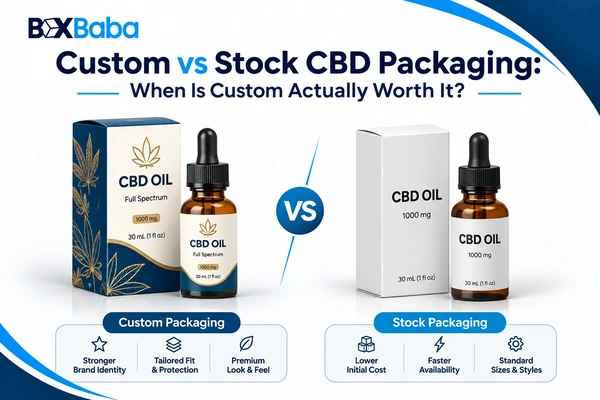
Custom CBD packaging is not automatically better than stock packaging.
The better choice is the simplest packaging system that meets the actual product, information, functional and production requirements without creating unnecessary compromises.
A stock carton can be completely appropriate when the finished CBD product fits correctly, the panels support the approved product information and the structure works for packing and sale.
Custom secondary packaging becomes more useful when the available stock option creates a specific problem such as:
- poor product fit;
- inadequate closure clearance;
- insufficient panel space;
- insert or window limitations;
- SKU/version-control problems;
- repeat-production inefficiency.
For many CBD brands, the practical answer is neither completely stock nor completely custom.
It is:
Stock Primary Container → Custom Secondary Carton
Brands ready to develop a made-to-size outer package can explore Custom CBD Boxes.
Stock, Hybrid or Custom?
Packaging Route | Best Starting Point When |
Stock primary + stock secondary | An available combination already passes the product, information and operational requirements |
Stock primary + custom secondary | An existing bottle/jar works, but the outer carton needs a better fit, artwork system, insert or presentation |
Custom primary + stock secondary | A stock outer package genuinely accommodates the proprietary primary container |
Custom primary + custom secondary | Both packaging layers require dedicated development |
For many BoxBaba secondary-packaging projects, the most relevant comparison is:
Existing Primary Container
vs:
Stock or Custom Outer Carton
You do not need a custom bottle mold simply because you need a custom CBD box.
First Identify the Packaging Layer
CBD packaging can refer to different parts of the packaging system.
Packaging Layer | Examples | Main Role |
Primary | Bottle, jar, tube, pouch, closure | Directly contains or dispenses the product |
Secondary | Folding carton, sleeve, rigid box, box with insert | Surrounds the finished primary package |
Ecommerce / distribution | Mailer, shipping carton, master case | Packs completed products for fulfillment or transport |
This article focuses mainly on secondary CBD packaging.
That means the question is usually:
Should this finished CBD bottle, jar, tube or pouch use an available stock outer package or a made-to-size custom carton?

What Is Stock Secondary CBD Packaging?
Stock secondary packaging uses an existing:
- carton size;
- box structure;
- mailer;
- sleeve;
- gift box;
instead of developing the physical dimensions specifically around one finished CBD product.
The product must work within the package that already exists.
Stock does not mean:
- poor quality;
- temporary-looking;
- unbranded.
An appropriate stock structure can potentially be:
- labelled;
- sleeved;
- printed or decorated where the supplier supports it;
- used across several compatible SKUs.
The important question is whether the stock format genuinely works.
What Is Custom Secondary CBD Packaging?
Custom secondary packaging is developed around a defined packaging specification.
Depending on the project, that can include:
- made-to-size dimensions;
- selected structure;
- dieline;
- insert;
- window;
- product orientation;
- printed artwork;
- finishing.
The relationship is:
Finished CBD Product → Required Packaging Relationship → Custom Secondary Carton
Custom does not automatically mean:
- custom glass bottle;
- proprietary jar mold;
- child-resistant;
- more protective;
- more sustainable.
It means the secondary package provides greater control over its specification.
Use the Five-Gate Test Before Choosing Custom
A stock box should pass more than:
The product fits inside.
Evaluate five gates.
Gate 1 — Product Stability
Is the actual product configuration stable?
Confirm the current:
- primary container;
- closure;
- dimensions;
- filled weight;
- orientation.
If the brand may still change the bottle, lid or pump, final made-to-size packaging can become obsolete.
Gate 2 — Physical Fit
Does the stock package provide appropriate:
- loading;
- closure clearance;
- product position;
- removal;
- internal movement?
Gate 3 — Information & Data Fit
Does the usable artwork area support the correct:
- product identity;
- CBD strength or variant;
- barcode;
- QR;
- approved product copy;
- variable coding area where required?
Gate 4 — Packaging-Function Fit
Does the project need:
- fitted insert;
- window alignment;
- product separation;
- specific opening/tamper feature;
- another functional relationship?
Gate 5 — Production Fit
Does the stock package work across the expected:
- quantities;
- SKUs;
- packing workflow;
- timeline;
- repeat orders?
If the stock option passes all five, a new custom structure may add little value.
If it fails an important gate, customization becomes easier to justify.

Physical Fit Is More Than The Product Goes Inside
Suppose a CBD bottle fits inside a stock carton.
That still does not answer whether the packaging works.
Check:
Loading
Can the product enter the carton consistently?
Closure Clearance
Is there enough space around the:
- dropper;
- bulb;
- lid;
- pump;
- cap?
Internal Movement
Does the product move excessively because the box is substantially oversized?
Removal
Can the customer remove the product without forcing it?
Presentation
Does the product remain in the intended orientation?
This gives:
Product Fits Inside ≠ Packaging Fits the Product
Custom Becomes Useful When the Stock Box Is Clearly Oversized
Inspect the complete product from multiple directions.
The widest compon
Suppose a finished dropper bottle is substantially narrower and shorter than the available stock carton.
The immediate solution may appear to be:
Add Filler
But first compare whether the stock carton itself is creating the problem.
An oversized carton can introduce:
- movement;
- excess material;
- additional internal components;
- poor window alignment;
- larger retail footprint.
A made-to-size secondary carton may provide a cleaner solution.
For bottle-specific packaging, explore CBD Dropper Bottle Boxes.
ent may be:
- glass body;
- shoulder;
- cap;
- collar;
- bulb.
For example:
Bottle Body Width = A
Bulb Width = B
If:
B > A
then B is the relevant maximum clearance input on that axis.
But that still does not mean the insert should grip the bulb.
The clearance and retention questions remain separate.

Closure Geometry Can Make a Stock Carton Unsuitable
CBD primary packages often use closures that project beyond the main container body.
Examples include:
- dropper bulbs;
- jar lids;
- pumps;
- dispensing caps.
A stock carton can appear suitable when judged from the bottle body while still creating poor clearance around the complete finished closure.
Use:
Finished Product Body + Closure → Stock Compatibility
not:
Nominal Fill Capacity → Stock Box
Information Fit Can Fail Even When Physical Fit Passes
This is particularly important for CBD products.
A stock box may physically fit perfectly while creating poor panel space for the approved printed information.
Depending on the product and project, the artwork may need controlled areas for:
- product identity;
- strength or variant;
- barcode;
- QR;
- instructions;
- approved warnings or other product information;
- later variable coding.
This creates:
Physical Fit ≠ Information Fit
Custom panel proportions become useful when the stock package forces essential information into poor:
- panel positions;
- folds;
- very limited spaces.
The brand should still supply and approve the underlying product-specific copy.
Customization controls the production space, not the legal sufficiency of the wording.
CBD Data Fit Is a Separate Decision
For CBD product families, the stock-vs-custom question can also involve production-data control.
Suppose three tincture strengths use the same bottle and stock carton.
They may still require:
- Artwork A;
- Artwork B;
- Artwork C;
- separate barcodes;
- separate QR destinations.
The stock structure might remain perfectly suitable.
Therefore:
Multiple CBD SKUs ≠ Automatically Need Custom Structure
The relevant question is:
Can the chosen stock package support the controlled artwork/data system for all compatible SKUs?
If yes, stock may remain suitable.

QR Placement & QR Destination Are Different Questions
A stock carton can provide a perfectly suitable QR area.
That does not mean all SKUs should use the same QR.
For each applicable printed version, confirm:
SKU → QR → Correct Destination
Custom packaging becomes useful when the existing panel architecture cannot provide a reliable code area.
It is not required merely because the CBD product uses a QR.
Inserts Can Be a Strong Trigger for Custom Secondary Packaging
An insert creates a three-part relationship:
Finished Product
↓
Insert
↓
Outer Box
A stock carton may have enough overall volume while still providing a poor platform for:
- fitted retention;
- product orientation;
- removal access;
- window alignment.
Where the internal holder is important, developing the product, insert and outer structure together can be more effective.
For fitted internal packaging, explore Printed Boxes with Inserts.

But an Insert Does Not Automatically Mean Custom Is Necessary
Do not reverse the logic.
If:
- an existing box works;
- an available insert works;
- the completed package meets the project requirements;
there may be no reason to replace the stock system.
The decision should remain:
Does Custom Solve an Existing Problem?
not:
Insert Used → Custom Required
Window Alignment Can Justify Custom Packaging
A product window depends on physical positioning.
The relationship is:
Product Position → Intended Visible Area → Window → Artwork
A stock window can fail when:
- it is too high;
- it is too low;
- it reveals the wrong area;
- the product rotates inside the box.
A custom structure becomes more useful where the product and window need a controlled relationship.
Packaging Function Must Be Evaluated Separately
Some products or markets can involve:
- specific opening mechanisms;
- tamper-related features;
- access-control configurations;
- associated user instructions.
These should be identified independently from the stock-vs-custom decision.
A stock package is not unsuitable merely because it is stock.
A custom package is not compliant merely because it is custom.
Use:
Applicable Product Requirement → Required Packaging Function → Suitable Package Configuration
not:
Custom = Safety / Compliance
Where child-resistant functionality is applicable, the appropriate package configuration and supporting basis need separate verification.
Custom Outer Carton Does Not Automatically Create Child Resistance
This distinction is important.
If a project requires a different:
- primary closure;
- tested package configuration;
- opening mechanism;
a standard secondary folding carton does not become child-resistant simply because it has been made to custom dimensions.
Likewise:
Child-Resistant ≠ Tamper-Evident
Custom secondary packaging provides development flexibility.
It does not automatically establish either function.
Stock Primary + Custom Secondary Is Often the Most Practical Hybrid
Many CBD brands do not need proprietary primary-container tooling.
A practical route is:
Existing Dropper Bottle
↓
Custom Printed Folding Carton
or:
Existing Cream Jar
↓
Custom Secondary Skincare Box
This preserves the established bottle or jar while allowing the outer packaging to be developed around:
- finished dimensions;
- artwork;
- SKU system;
- insert;
- presentation.
For CBD skincare formats, explore Custom CBD Cosmetic Boxes.
CBD Product Scenarios
CBD Product Scenario | Stock Can Be Suitable When | Custom Becomes More Useful When |
Dropper bottle | Available carton fits complete bottle and closure | Bulb/closure geometry, insert or window needs a defined fit |
Gummy jar | Jar/lid fits and artwork panels are sufficient | Jar profile, presentation, SKU system or multipack needs more control |
Cream/balm jar | Stock carton fits finished jar and lid | Lid overhang, insert, artwork or presentation creates a specific requirement |
Capsule bottle | Existing carton fits cap/bottle and information | Multiple bottle sizes, inserts or coordinated SKUs need structural control |
Multi-product set | Existing gift box fits the completed arrangement | Compartments, orientation or presentation order is product-specific |
The product format does not automatically determine custom or stock.
The completed packaging relationship does.
Multi-SKU Does Not Automatically Mean Custom
Suppose five CBD gummy flavors use:
- the same jar;
- same lid;
- same orientation;
- the same suitable stock carton.
The stock structure may work for all five.
The project might need:
One Stock Structure
Five Printed / Label Versions
That can be completely valid.
Custom structure becomes more useful when the brand needs something the stock package cannot provide, such as:
- better fit;
- coordinated dieline;
- window;
- insert;
- improved information-panel architecture.
Custom Does Not Mean Every SKU Needs Its Own Box
Likewise, once a custom secondary structure is developed, physically compatible SKUs may share it.
For example:
Three CBD Oil Strengths
↓
One Bottle
↓
One Custom Dieline
↓
Three Artwork Versions
This can be a strong reason to invest in custom packaging because the structural system becomes repeatable across the product family.
But that is a compatibility decision—not an automatic benefit of customization.
Product Stability Should Come Before Custom Structure
Custom packaging can become wasteful if it is finalized too early.
Do not lock the final carton while the team is still changing:
- bottle supplier;
- closure;
- jar;
- lid;
- product arrangement.
A dimensional change can affect:
- carton size;
- insert;
- window;
- dieline;
- artwork.
Use:
Stable Finished Product → Final Custom Structure
where possible.
Stock or temporary packaging may be more practical while the physical product is still being tested.
When Stock Packaging Makes More Sense
Stock can be the stronger choice when:
The Existing Package Passes All Five Gates
There is no need to customize for the sake of customization.
The Physical Product Is Still Changing
Avoid final structural commitment too early.
The Packaging Need Is Temporary
Examples can include:
- pilot launch;
- temporary bundle;
- short promotion;
- internal sample.
The Custom Feature Has No Defined Job
Do not add:
- insert;
- rigid structure;
- window;
- complex opening;
only because it appears more premium.
Custom should solve a packaging requirement.
When Custom Packaging Becomes Easier to Justify
Custom secondary packaging becomes more valuable when the stock option repeatedly fails one or more gates.
Typical triggers include:
- poor product fit;
- closure interference;
- excessive void;
- inadequate information space;
- fitted insert requirement;
- exact product/window relationship;
- coordinated multi-SKU structure;
- repeatable retail presentation.
The rule is:
Stock Creates Meaningful Constraint → Evaluate Custom
not:
Brand Is Growing → Automatically Go Custom
Custom Packaging Is Not Automatically More Protective
Customization gives greater control over:
- dimensions;
- structure;
- internal layout.
That does not guarantee performance.
A poor custom package can still have:
- excessive space;
- weak retention;
- poor structural design.
A suitable stock package can work very well for its intended role.
Use:
Completed Packaging Configuration → Performance
not:
Custom Label → Better Protection
Custom Packaging Is Not Automatically More Sustainable
A made-to-size package may reduce avoidable void space in some projects.
But sustainability depends on the actual:
- dimensions;
- material;
- coatings;
- laminates;
- insert;
- window;
- sourcing;
- end-of-life conditions.
A simple stock carton can potentially use less material than an elaborate custom presentation package.
Evaluate the actual specification rather than the custom/stock label.
Compare the Complete Packaging System, Not Only Unit Price
A stock carton and a custom carton may create different additional requirements.
Stock System May Need
- filler;
- added sleeve/label;
- extra packing steps;
- larger outer shipping packaging.
Custom System May Need
- structural development;
- dieline;
- artwork setup;
- insert;
- sampling;
- finishing.
Therefore:
Stock Carton Price ≠ Total Stock-System Cost
and:
Custom Carton Price ≠ Total Custom-System Cost
The proper comparison is:
Equivalent Completed Packaging Systems
Detailed CBD pricing factors should be evaluated separately from this sourcing decision.

Quantity Matters—but Does Not Decide the Answer Alone
Stock is often useful for:
- testing;
- short-term needs;
- uncertain product formats.
A controlled custom structure can become more practical when there are:
- repeat orders;
- stable products;
- several compatible SKUs;
- ongoing retail requirements.
But quantity alone does not determine the decision.
A large-volume product can remain suitable for stock packaging.
A smaller premium product set can still require custom structural development.
Use:
Requirements + Quantity + Repeatability
rather than:
High Quantity = Custom
MOQ Does Not Tell You Whether Custom Is Worth It
MOQ answers:
Can the supplier manufacture this project at the requested quantity?
It does not answer:
Does the project need custom packaging?
BoxBaba current custom CBD packaging starts from 100 units for many projects.
That means custom development can be available at relatively modest quantities.
The actual decision should still follow the packaging need.
Timeline Can Favor Stock—If the Correct Stock Package Exists
Stock can reduce development steps when the required package is:
- genuinely available;
- physically suitable;
- operationally suitable.
A made-to-size custom carton usually includes:
Product Specification
↓
Structural Development
↓
Dieline
↓
Artwork
↓
Approval
↓
Production
For general structural-file terminology, see the Dieline in Packaging guide.
A fixed launch date should therefore be considered before finalizing the sourcing route.
Retail & Ecommerce Can Use Different Stock/Custom Decisions
The packaging system does not need one stock/custom decision at every layer.
For example:
Custom Retail Carton
Stock Shipping Carton
can be appropriate.
Or:
Stock Retail Carton
Custom Ecommerce Mailer
can work.
Evaluate each packaging layer for its own job.
Do not overbuild the individual retail carton merely because some units will be sold online.
Stock vs Custom CBD Packaging Decision Matrix
Situation | Better Starting Direction | Why |
Early product test | Stock / hybrid | Reduces structural commitment |
Container still changing | Stock / delay final custom carton | Prevents obsolete dielines |
Stock box passes all five gates | Stock may be sufficient | Custom structure may solve no real problem |
Poor physical fit | Custom | Dimensions can follow the actual product |
Stock bottle already selected | Stock primary + custom secondary | Keeps the primary container while improving the outer package |
Strength variants share one bottle | Either | Structural need depends on stock compatibility, not SKU count alone |
Fitted insert required | Custom often becomes more useful | Product, holder and carton can be coordinated |
Exact window alignment | Custom often becomes more useful | Opening can follow the real product position |
Stock panels cannot support product data | Custom | Panel architecture can be developed around approved artwork |
Temporary promotional package | Stock may be sufficient | Lower need for repeatable structure |
Multi-product presentation set | Custom often becomes more useful | Internal arrangement is product-specific |
Retail carton + ecommerce outer packaging | Hybrid | Each layer can be sourced separately |
The Five Questions to Ask Before Paying for Custom Structure
1. Is the Finished Product Stable?
If not, do not rush to lock the dieline.
2. Does an Available Stock Package Pass the Physical-Fit Test?
If yes, continue to the next test.
3. Does It Pass the Information/Data Test?
Can every SKU use the available panels appropriately?
4. Does It Pass the Functional Test?
Can it handle the required insert, orientation, window or opening relationship?
5. Does It Make Sense Operationally?
Consider quantity, packing, timeline and repeat orders.
If the answer remains yes at every stage:
Use Stock if It Is the Better Operational Choice.
If an important answer becomes no:
Identify Exactly What Customization Needs to Solve.
Common Custom-vs-Stock CBD Packaging Mistakes
Assuming Custom Is Automatically Better
Better: Choose the simplest suitable system.
Assuming Stock Is Automatically Cheap or Low Quality
Better: Evaluate the actual specification and full system.
Finalizing a Custom Box Before the Primary Container
Better: Stabilize the finished product first.
Choosing Stock Packaging From ml or oz Capacity
Better: Compare actual external dimensions and closure geometry.
Keeping an Oversized Stock Carton & Automatically Adding Filler
Better: Determine whether the carton itself is the source of the excess space.
Assuming Every CBD SKU Requires a Different Custom Structure
Better: Standardize physically compatible products.
Assuming Multiple SKUs Automatically Require Custom Packaging
Better: A stock structure can still support controlled product versions.
Assuming Custom Makes a Package Child-Resistant
Better: Treat packaging-function qualification separately.
Comparing Stock & Custom Using Different Specifications
Better: Compare equivalent completed systems.
Ignoring the Launch Timeline
Better: Include structural development, artwork and approval stages.
Custom vs Stock CBD Packaging Workflow
- Confirm the finished product.
Container, closure, dimensions and weight. - Identify the packaging layer.
Primary, secondary or shipping. - Review available stock options.
- Test physical fit.
- Test CBD information/data fit.
- Identify functional needs.
Insert, window, opening or positioning. - Review compatible SKUs.
- Review quantity and timeline.
- Compare the complete stock and custom systems.
- Choose the least complicated suitable solution.
The target is not:
Maximum Customization
It is:
Appropriate Packaging Control
What Should You Send BoxBaba for a Stock-vs-Custom Review?
Prepare:
Finished Product
- CBD product type;
- primary-container type;
- maximum finished dimensions;
- closure;
- filled weight.
Packaging Requirement
- intended sales channel;
- product orientation;
- insert requirement;
- window requirement;
- units per package.
SKU & Data
- number of SKUs;
- quantity per SKU;
- whether containers are physically shared;
- barcode/QR requirements;
- artwork status.
Project
- total quantity;
- required timeline;
- delivery destination.
These inputs make it possible to answer:
Does this product actually need custom secondary packaging?
rather than simply assuming that every CBD brand should buy a custom carton.
Custom vs Stock CBD Packaging With BoxBaba
Custom CBD packaging is worth considering when it solves a defined problem that the available stock package cannot handle appropriately.
That problem might be:
- fit;
- closure clearance;
- information/data space;
- insert;
- window;
- multi-SKU structural control;
- presentation.
Stock packaging remains a valid option when an available package already satisfies the physical, information, functional and operational requirements.
A particularly practical route is:
Stock Primary Container
↓
Custom Secondary CBD Carton
For made-to-size outer packaging across tinctures, gummies, capsules, creams and other CBD formats, explore Custom CBD Boxes.
For presentation-led multi-product arrangements, see CBD Gift Boxes.
BoxBaba current custom CBD packaging program starts from 100 units, with custom sizing, artwork support and samples available. Standard production is generally 5–9 business days after artwork approval, and free shipping is available across the USA.
When requesting a project review, share the finished container, closure, maximum dimensions, filled weight, quantity by SKU, artwork status and any insert or window requirement.
The deciding question is not:
Is custom CBD packaging better?
It is:
Which requirement does the stock package fail—and will customization solve that failure?
Frequently Asked Questions
What is the difference between custom and stock CBD packaging?
Stock packaging uses an existing size or structure. Custom secondary packaging is developed around a defined product, structural and artwork specification.
Is custom CBD packaging always better?
No. If an available stock package already meets the product physical, information, functional and operational requirements, custom structural development may add little value.
When is custom CBD packaging worth it?
It becomes more useful when stock packaging creates a meaningful problem with fit, closure clearance, product information, inserts, windows, SKU coordination or presentation.
Can I use a stock CBD bottle with a custom box?
Yes. An existing primary bottle or jar can be paired with a made-to-size custom secondary carton.
Does a custom CBD box require a custom bottle?
No. Custom secondary cartons and custom primary containers are separate manufacturing decisions.
Can a stock box be used for several CBD strengths?
Yes, when the finished products are physically compatible and the stock packaging supports the required artwork and product-data versions.
Does having multiple CBD SKUs mean I need custom packaging?
No. SKU count alone does not determine the structure. Several SKUs can potentially use one suitable stock package with controlled printed versions.
Does custom packaging automatically make a CBD product child-resistant?
No. Custom dimensions or printing do not establish child-resistant performance. Applicable packaging-function requirements must be evaluated separately.
Is stock CBD packaging always cheaper?
No universal rule applies. Compare the complete stock and custom packaging systems, including any filler, inserts, additional labels, packing work and development requirements.
Is custom packaging automatically more sustainable?
No. Sustainability depends on the actual material, dimensions, coatings, inserts and end-of-life conditions—not simply whether the packaging is custom.
Should a CBD startup begin with stock packaging?
Stock or hybrid packaging can be practical when the product, container or demand is still being tested. A custom secondary carton can still make sense when the primary container is already stable and stock boxes create significant problems.
What should I provide for a custom CBD packaging quote?
Provide the finished product dimensions, closure profile, filled weight, quantity by SKU, structural or insert requirements, artwork status, sales channel and delivery destination.