
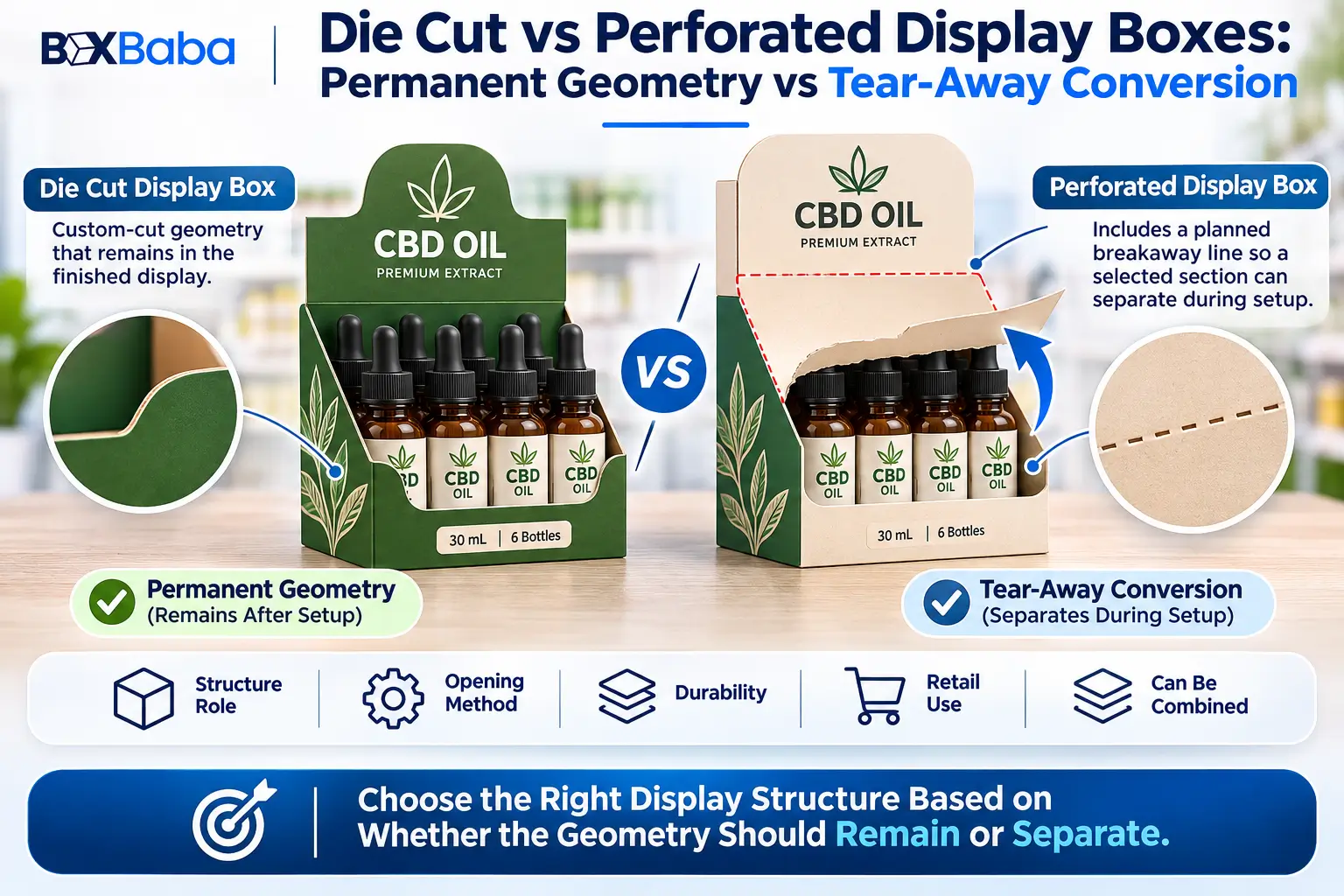
The main difference between die cut and perforated display boxes is what the custom geometry is supposed to do when the package reaches retail.
A Die Cut Display uses custom-cut geometry that remains part of the finished retail structure. Those cuts may create product positions, shaped fronts, access areas, headers or other permanent structural features.
A Perforated Display uses intentionally breakable geometry so a selected section can be torn away or opened during retail setup.
The simplest distinction is:
Die Cut Display → Geometry Remains
Perforated Display → Geometry Separates During Setup
The two are not opposites. One structure can use a perforated removable panel and permanent die-cut product openings at the same time.
Here, Die Cut Display refers to the buyer-facing structural category. It should not be confused with the broader manufacturing fact that custom packaging dielines can contain several different line types.
If you are still evaluating the wider retail-display structure rather than choosing between these two features, explore BoxBaba Custom Display Boxes.
Die Cut vs Perforated Display Boxes at a Glance
Decision Factor | Die Cut Display | Perforated Display |
Primary structural role | Creates custom geometry that remains in the finished display | Creates geometry intended to separate during setup |
Main question | What shape or opening should the final display keep? | What section needs to open or tear away? |
Typical use | Product positions, access cutouts, shaped fronts, headers, holder openings | Tear-away fronts, removable covers or conversion panels |
Does the feature remain? | Normally yes | The selected section is intended to separate or open |
Does it require a state change? | Not necessarily | Usually yes |
Can it support products? | Yes | Yes, through the structure that remains |
Can it be retail-ready? | Yes | Yes |
Can both exist together? | Yes | Yes |
The useful comparison is the function of the geometry, not simply whether cutting occurs during manufacturing.
What Is a Die Cut Display Box?
A Die Cut Display Box uses custom-cut geometry as a defining part of the finished retail structure.
That geometry might create:
- individual product positions;
- a shaped front opening;
- shopper-access areas;
- contoured side walls;
- a custom header;
- tabs or locking features;
- other project-specific cutouts.
Its core relationship is:
Retail Requirement → Custom-Cut Geometry → Finished Display
For example, a bottle display may use permanent openings that establish repeated product positions. An open tray may use a lowered front contour so the shopper can reach the first row more easily.
The important point is that the geometry continues to perform its function after setup.
Where permanent custom-cut geometry is the dominant structural requirement, explore BoxBaba Die Cut Display Boxes.

What Is a Perforated Display Box?
A Perforated Display uses a planned breakaway path so part of the structure can separate during setup.
Its relationship is:
Closed or More Enclosed State → Perforation → Controlled Separation → Open Retail State
The removable or opening section might be:
- a front panel;
- an upper section;
- a cover;
- part of a side or face panel;
- another project-specific area.
Perforation is therefore a conversion feature.
It becomes useful when the packaging needs one configuration before retail setup and another afterward.
BoxBaba dedicated Perforated Display Boxes commercial page should be linked here only after its final URL is live.

The Same Dieline Can Contain Permanent Cut and Perforation Paths
This distinction matters because die cut and perforated should not be treated as opposite manufacturing technologies.
A packaging dieline can identify different structural instructions, including:
continuous cut paths
crease or fold paths
and:
perforation paths
The continuous cuts define geometry that is cut during production. Perforation paths define areas intended to allow controlled separation later.
The exact converting method depends on the approved structure and production process.
For the deeper explanation of cut lines, fold lines, bleed, safe zones and perforation paths, see BoxBaba Dieline in Packaging Guide.
For this comparison, the buyer-level question is simpler:
Should this geometry remain in the final display, or should it separate during setup?

Permanent Geometry Shapes the Finished Display
A permanent cut should solve a requirement that continues after the display reaches its selling configuration.
For example:
Product Profile → Permanent Opening → Product Position
or:
Shopper Access Requirement → Permanent Front Cut → Access Area
Permanent geometry can influence:
- product positioning;
- product exposure;
- removal access;
- holder locations;
- front-wall profile;
- side profile;
- header geometry.
If the merchandise itself is the dominant structural problem, BoxBaba Product Display Box provides the broader product-led commercial context.
Custom cuts should solve a defined structural or merchandising requirement rather than being added simply because customization is possible.
Perforation Creates a Planned Change in State
Perforation becomes useful when a structural section needs to change between the pre-retail and retail configurations.
For example:
Closed Case
→ Tear Along Planned Path
→ Remove Upper / Front Section
→ Open Retail Tray
The tear-away feature therefore needs to be considered together with the structure that remains afterward.
The relevant relationship is:
Controlled Separation → Functional Remaining Display
A tear-away panel that opens easily but leaves poor product retention or poor shopper access has not solved the full display problem.
One Display Can Use Both
Consider an illustrative bottle display.
Before retail setup, an upper section helps create a more enclosed structure.
At the store, that section is removed along a perforated line.
The remaining display contains a platform with permanent custom-cut bottle openings.
The same package therefore uses:
Perforation
for conversion.
and:
Die-Cut Geometry
for the finished product positions.
The relationship becomes:
Perforated Conversion → Reveals → Permanent Die-Cut Display Geometry
This is why buyers should not treat the terms as mutually exclusive.

Product Access Can Be Permanent or Created During Setup
Both structures can improve access to merchandise, but they achieve it differently.
Permanent Access Geometry
A Die Cut Display may use a front contour or cutout that remains open for the life of the display.
The access area exists as part of the finished structure.
Tear-Away Access
A Perforated Display may initially cover more of the merchandise and expose it after the selected panel is removed.
Therefore:
Die Cut → Access Built Into Final Geometry
Perforation → Access Created Through Conversion
The right approach depends on whether the more open geometry should exist before retail setup or only after the package reaches its selling position.
Permanent Product Holders Usually Belong to the Final Geometry
These functions answer different questions.
Child-Resistant
When products need individual positions, the support feature normally remains in the display.
Examples can include:
- bottle openings;
- tube positions;
- repeated slots;
- shaped support platforms.
These are therefore commonly a permanent-geometry question.
Perforation can still appear elsewhere in the same packaging when a cover or external panel needs to separate.
Do not assume that Die Cut Display always means a product holder, however. Permanent cuts can also create shaped fronts, headers, access areas or other geometry.
Restricts child access under an applicable performance framework.
Tamper-Evident
Provides visible evidence that the package has been opened or interfered with.
Resealable
Allows the package to be closed again after opening.
One does not automatically prove another.
A tear strip can provide evidence of first opening without making the package child-resistant.
A child-resistant closure can potentially exist without a particular tamper-evident feature.
Define the required packaging functions separately.
A Perforated Panel Must Leave Enough Structure Behind
The opening is only one part of a tear-away design.
After conversion, evaluate the remaining:
- front wall;
- side walls;
- back panel;
- product support;
- shopper access;
- usable printed areas.
Removing more material is not automatically better.
Too little remaining structure may affect retention or support. Too much remaining structure may restrict product access or hide the merchandise.
There is no universal percentage of a panel that should be removed.
The final geometry should follow the actual products, arrangement and retail requirement.

Permanent Cutouts Also Change the Remaining Structure
A permanent opening removes material from the display panel.
That means windows, shaped fronts and holder openings should be considered as structural geometry rather than only as decoration.
A useful relationship is:
Larger / Different Opening → Different Amount and Location of Material Remaining
The actual consequence depends on the complete display design, board system, location of the cut and loaded configuration.
DB-09 should not prescribe universal cutout limits.
Those decisions belong to project-specific structural development.
Perforation Is One Retail-Ready Conversion Method
Perforation commonly appears where a grouped package needs to move from a more enclosed configuration into an open retail display.
However, retail-ready packaging does not automatically require perforation.
A project may instead use:
- a removable cover;
- an open tray;
- another approved setup method.
Where the project is driven by a quick retail-deployment arrangement, BoxBaba PDQ Trays and Boxes provide the related workflow-led commercial context.
The deeper distinction between PDQ workflow and perforated conversion belongs to the separate PDQ vs Perforated Display Boxes guide once that article is live.
Material Does Not Decide Whether a Display Is Die Cut or Perforated
Do not use the rule:
Die Cut = Cardboard
and:
Perforated = Corrugated
The classification describes geometry, not one universal board system.
A corrugated display can contain permanent custom-cut geometry.
A paperboard display can contain a perforated tear-away feature where the approved structure supports it.
Material is a separate decision based on the finished merchandise, loaded configuration, structural requirement and retail presentation.
The dedicated Cardboard vs Corrugated Display Boxes guide should own that deeper comparison once published.
Retail Placement Does Not Define the Difference
Neither classification tells you where the finished display must sit.
A Die Cut Display can be used on a counter or shelf.
A Perforated Display can also convert into a counter or shelf display.
Therefore:
Counter / Retail → Placement Context
Die Cut → Retained Geometry
Perforated → Breakaway Geometry
These terms can describe different attributes of the same structure.
The Dieline Must Show What Remains and What Separates
The structural file should make the distinction clear.
For a die-cut display, the dieline may define permanent:
- outer cut paths;
- product openings;
- access cutouts;
- tabs;
- header geometry.
For a perforated structure, the file also needs to identify the intended breakaway path.
Artwork should then be planned around the final retail state.
For example, important branding or required information should not accidentally depend on a panel that will be discarded during setup unless that placement is intentional.
The general mechanics of dielines belong to the Dieline in Packaging Guide; the display-specific requirement here is simply to distinguish retained geometry from removable geometry.
How to Choose Between Die Cut and Perforated Display Boxes
Use the required structural outcome as the starting point.
Main Requirement | Start With | Why |
Products need permanent custom-cut positions | Die Cut Display | Product-position geometry remains |
A shaped front or access cutout must remain in retail | Die Cut Display | Permanent opening is required |
A panel must tear away during setup | Perforated Display | Controlled separation leads |
One structure must change from enclosed to open | Perforated / Conversion Direction | State change is required |
Tear-away cover reveals permanent holders underneath | Both | Conversion and permanent geometry are both required |
Custom contour is central to the finished display | Die Cut Display | Final geometry leads |
Quick retail deployment is the main issue | Retail-Ready / PDQ Context | Workflow leads rather than geometry alone |
The labels narrow the structural direction.
They do not replace the actual project brief.
The structure should still be developed from:
Finished Product → Quantity → Orientation → Arrangement → Loaded Configuration → Retail Footprint → Structural Requirement

Common Die Cut vs Perforated Display Mistakes
Treating Every Custom Opening as Perforated
A cutout that remains in the finished display is not a tear-away feature.
Better approach: identify whether the geometry remains or separates.
Treating Die Cut and Perforation as Opposite Production Technologies
A structural dieline can contain both permanent cut paths and perforation paths.
Better approach: compare the function of the geometry.
Making the Tear-Away Area as Large as Possible
More opening is not automatically better.
Better approach: evaluate the structure that remains after removal.
Using Perforation When No State Change Is Needed
If an access area should remain open from the start, permanent geometry may be the more direct structural direction.
Better approach: use perforation when controlled separation solves an actual setup problem.
Adding Permanent Cutouts Without a Structural Purpose
A custom shape changes the geometry that remains.
Better approach: connect each opening to product positioning, access, visibility or another defined requirement.
Assuming Die Cut Means Product Holder
Product holders are only one use of permanent cut geometry.
Better approach: define the function of the specific cut.
Assuming Perforated Means PDQ
PDQ describes a retail-deployment workflow. Perforation describes a conversion feature.
Better approach: define workflow and geometry separately.
What Information Should You Prepare Before Choosing?
Before selecting Die Cut, Perforated or both, provide:
- finished product dimensions;
- finished unit weight;
- quantity per display;
- number of SKUs;
- intended product orientation;
- required shopper-facing panels;
- available retail footprint;
- permanent product openings where needed;
- whether the structure needs a more enclosed pre-retail state;
- which panel or section should open or be removed;
- holder or divider requirement where known;
- loaded configuration where applicable;
- retailer requirements where applicable;
- artwork status;
- total order quantity.
The key question is:
Which geometry must remain, and which geometry must separate?
That answer usually identifies the correct structural starting point.
Developing Die Cut and Perforated Display Packaging With BoxBaba
If permanent custom geometry is the dominant requirement, explore BoxBaba Die Cut Display Boxes.
If the project requires tear-away conversion, define the pre-retail state, intended breakaway panel and required remaining display before the structural file is finalized. The dedicated Perforated Display Boxes commercial page should be linked here after its final URL is live.
For projects combining several structural requirements, start with Custom Display Boxes and provide the finished product dimensions, quantity, SKU arrangement, loaded configuration and retail footprint.
BoxBaba MOQ starts from 100 units on most product lines. Artwork assistance, dieline support and digital 3D mockups are available during project development. Eligible standard projects may have production turnaround starting from 5–9 business days after specifications and artwork are approved, depending on structure, material, quantity, sampling, finishing and other project requirements.
Free USA shipping is available on eligible custom packaging orders.
Frequently Asked Questions
What is the main difference between die cut and perforated display boxes?
A Die Cut Display uses custom geometry that normally remains part of the finished retail structure. A Perforated Display uses a planned breakaway line so a selected section can separate or open during setup.
Can one display box be both die cut and perforated?
Yes. A structure can use a perforated removable cover or panel while retaining permanent die-cut openings, product holders or shaped fronts in the final display.
Is perforation the same as die cutting?
No. A dieline can contain both continuous cut paths and perforation paths. Continuous cuts define geometry cut during production, while perforation is intended to allow controlled separation later.
When should I choose a die cut display?
Use a die-cut-led direction when permanent product openings, shaped fronts, holder positions, headers or access geometry are central to the final display.
When should I choose a perforated display?
Use a perforated direction when part of a more enclosed structure needs to tear away or open during retail setup.
Is a perforated display the same as a PDQ?
No. Perforation describes a conversion mechanism. PDQ describes a retail-deployment context. The same structure may use both.
Does material determine whether a display is die cut or perforated?
No. These terms describe structural geometry. The material should be selected according to the finished merchandise, loaded configuration, structure and project requirements.