
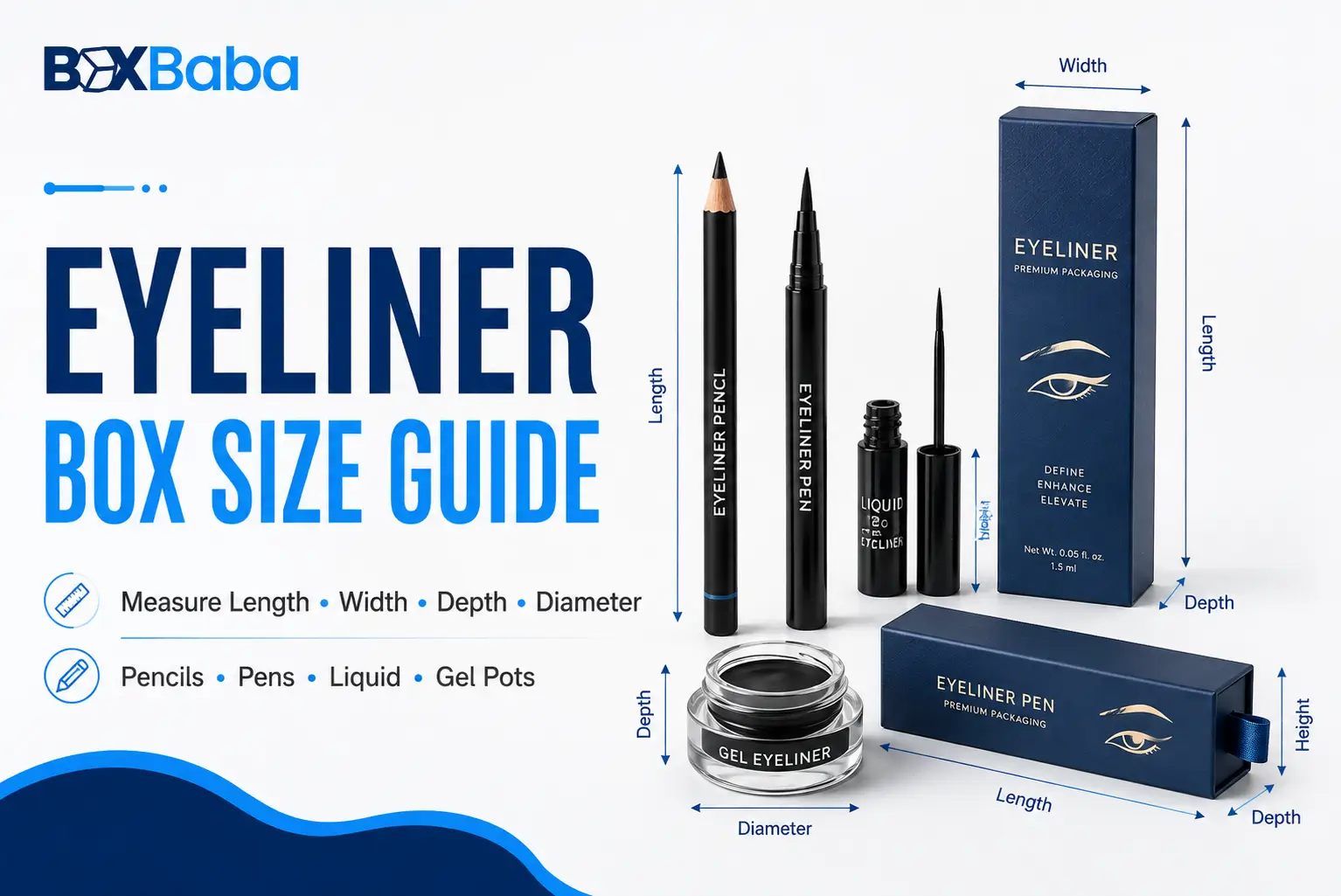
There is no universal eyeliner box size. Pencil, retractable, felt-tip, liquid-bottle, gel-pot, cake/pan and dual-ended eyeliners can have very different physical dimensions. Measure the complete closed and sale-ready product at its maximum length, width, depth or diameter—including the cap, clip, base, lid and packed accessories—before developing the carton around it.
The practical sizing relationship is:
Complete Eyeliner Product → Maximum Product Envelope → Clearance / Support → Internal Box Dimensions → Material + Structure → External Box Dimensions
Brands already preparing a packaging project can review Custom Eyeliner Boxes for commercial box options. If you need the broader measurement method used across lipstick, mascara, serum, cream and other cosmetics, use the Cosmetic Box Size Guide alongside this product-specific guide.
Why Eyeliner Box Size Depends on the Product Format
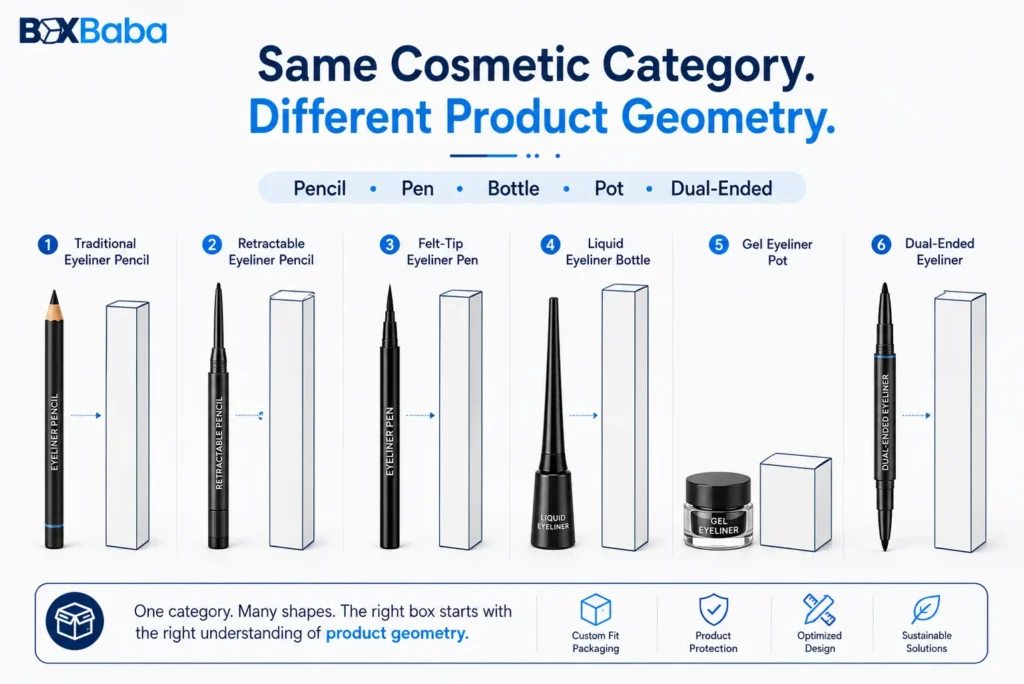
The word eyeliner describes a cosmetic category, not one physical container shape.
A traditional eyeliner pencil is usually long and narrow. A felt-tip liner may have a wider installed cap. A dip-style liquid eyeliner combines a bottle with a long applicator closure. Gel and cake eyeliners may use short, wide pots or compact-style containers. A dual-ended liner can have different profiles at each end.
Because those physical formats differ, one published standard eyeliner box size cannot be treated as a universal production specification.
The useful distinction is:
Eyeliner Category ≠ Finished Product Geometry ≠ Final Carton Dimensions
Reference dimensions such as 1 × 1 × 4 inches or 0.63 × 0.63 × 5.5 inches may describe individual packaging examples, but they should not replace measurements from the actual product being packed.
Primary Eyeliner Product vs Secondary Eyeliner Box
For sizing purposes, treat the eyeliner and its carton as separate measurement entities.
The primary eyeliner product is the complete sale-ready pencil, pen, bottle, pot or dual-ended product, including the closure and permanent exterior components.
The secondary eyeliner box is the carton developed around that finished product and, where required, any internal support or accessory.
This distinction prevents a common sizing error: using a cosmetic format name such as liquid eyeliner or pencil eyeliner as though it were already a dimensional specification.
Eyeliner Product Measurement-to-Box Size Matrix
| Measurement | What to Measure | Why It Matters |
| Complete closed length / height | Finished product from one outermost end to the other | Establishes the long carton axis |
| Maximum diameter | Widest point of a round barrel, cap, base or lid | Establishes the maximum cross-section |
| Maximum width | Widest exterior point of a non-round product | Helps determine internal carton width |
| Maximum depth | Maximum front-to-back profile | Required for rectangular or flattened formats |
| Barrel / body profile | Main product body | Helps compare the body with the closure or base |
| Cap / clip profile | Widest installed cap, closure or projecting clip | May control carton width or depth |
| Twist base | Maximum profile of retractable-liner base | May exceed the central barrel |
| End A profile | First end of a dual-ended liner | May control the maximum cross-section |
| End B profile | Opposite end | Can differ from End A |
| Liquid-liner bottle | Maximum bottle width/depth or diameter | Defines bottle footprint |
| Gel / cake container lid | Widest pot, compact or lid profile | May control a short, wide carton |
| Filled weight | Complete sale-ready product where relevant | Provides structural and support context |
| Accessory dimensions | Brush, sharpener, stamp or other packed item | Changes the completed arrangement |
| Orientation | Horizontal, upright or another approved position | Maps product dimensions to carton axes |
| Internal support | Insert, divider, rail or cavity where used | Consumes internal space |
| Removal direction | End removal, side removal or tray lift | Influences usable clearance |
| Product photograph / technical drawing | Finished geometry and irregular features | Helps communicate shape beyond basic dimensions |
These inputs describe the finished eyeliner product and its packaging requirements. They are not final production-box dimensions.
How to Measure the Complete Eyeliner Product
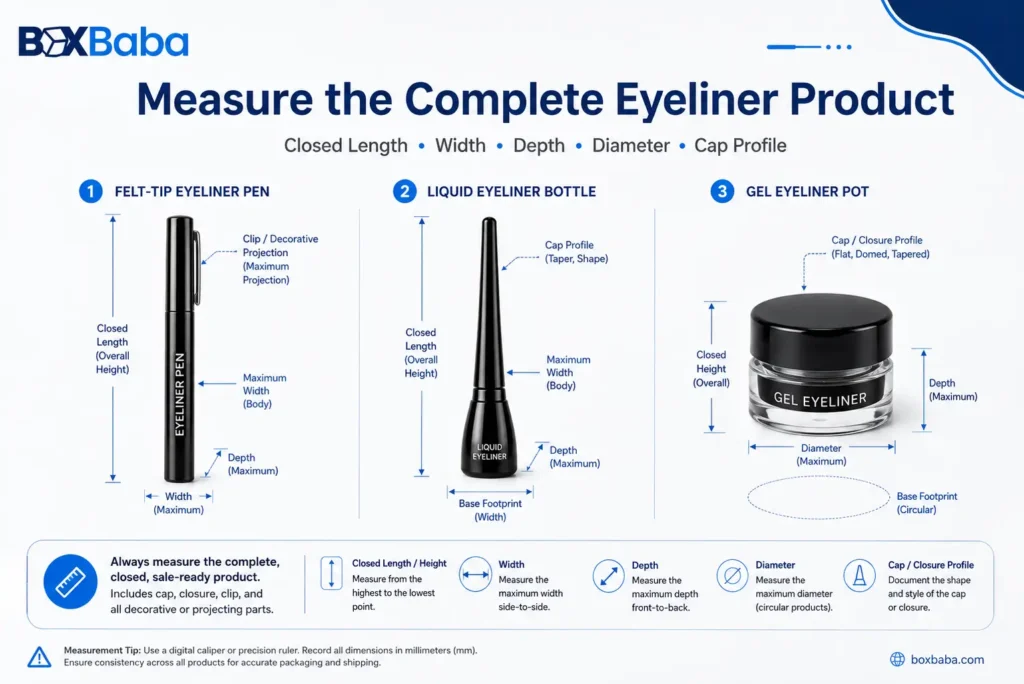
Start with the actual sale-ready product whenever possible. Install the final cap, closure, twist base, applicator assembly, lid and permanent exterior components before measuring.
For a cylindrical pencil or pen, the useful starting specification is:
Maximum Diameter × Complete Closed Length
For a flattened or non-round product, record:
Maximum Width × Maximum Depth × Complete Closed Length
For liquid bottles, gel pots and cake-style containers, use the maximum exterior footprint and complete closed height.
The important point is to measure the largest finished exterior profile, not just the most convenient part of the product.
Closed Length
A pencil, retractable liner or pen-style eyeliner should be measured from one finished end to the other.
If a cap covers a felt-tip or brush-tip applicator in the packed condition, measure the liner with that cap installed. Do not add the exposed applicator-tip length separately when the tip will sit inside the closure during packing.
For an uncapped wooden eyeliner pencil, measure the finished product to the tip and confirm suitable end clearance during carton development so the exposed tip is not treated as a structural contact point.
Barrel, Cap and Clip
The barrel is not always the widest part of an eyeliner.
Consider a felt-tip liner with:
Barrel Diameter: 0.42 in
Maximum Cap Diameter: 0.50 in
The relevant maximum diameter is 0.50 in, because the carton must accommodate the installed cap.
A projecting cap clip can create the same issue. If a pen-style eyeliner includes a clip or decorative closure feature, measure the complete closure profile rather than the cylindrical cap alone.
Twist Base and End Components
Retractable eyeliners can have a twist mechanism that projects beyond the main barrel.
Dual-ended eyeliners create another variation because one end may contain a liner while the other contains a smudger, stamp, second shade or alternate applicator.
Measure both ends independently.
The largest point across End A, the central body and End B becomes part of the maximum product envelope.
A Practical Eyeliner Measurement Workflow
Begin by identifying the physical format before deciding which dimensions matter. A traditional pencil, retractable liner, felt-tip pen, liquid bottle and gel pot should not be forced into the same measurement template.
Next, measure the finished product in the condition in which it will be packed. Confirm whether it will sit horizontally or upright, whether another accessory will share the carton and whether any insert, rail or divider is being considered.
Then record the largest exterior dimensions. Check the barrel, cap, clip, twist base, pot lid, bottle base and both ends of dual-ended products rather than assuming the central body controls every dimension.
Where useful, also record the completed product weight. This tends to matter more for bottles, pots and multi-product sets than for lightweight pencils.
Finally, record the dimensions consistently in either inches or millimeters. For non-round products, keep the measurement order clear as:
Width × Depth × Length / Height
This product specification becomes the starting point for carton development rather than the finished external box size.
Eyeliner Box Sizing by Product Format
| Eyeliner Format | Dimensions to Record | Extra Feature to Check | Main Sizing Risk |
| Traditional pencil | Complete length + maximum barrel profile | Cap/protector or exposed tip | Length alone may miss closure or tip requirements |
| Retractable pencil | Closed length + maximum diameter/W×D | Twist base + cap | Base or cap may be wider |
| Felt-tip liner | Closed length + maximum diameter/W×D | Installed cap / clip | Closure may control cross-section |
| Brush-tip pen | Closed length + maximum exterior profile | Cap / decorative ring | Central body may not be widest |
| Dip liquid liner | Maximum W×D or diameter + closed height | Long applicator cap | Closure may control total height |
| Gel eyeliner pot | Maximum diameter/W×D + closed height | Lid | Requires short, wide geometry |
| Cake / pan eyeliner | Maximum container W×D + closed height | Lid / compact profile | Should not be sized like a pencil |
| Gel pot + brush | Completed product arrangement | Brush position | Accessory changes footprint |
| Dual-ended liner | Complete length + both end profiles | End A vs End B | Ends may be asymmetric |
| Eyeliner multipack | Every product + completed arrangement | Divider / support | One liner does not define the set |
Different eyeliner formats require precise recording of their closed dimensions, unique closures, and accessory arrangements to ensure the secondary packaging fits securely without relying solely on generic product assumptions.
Measuring Liquid Eyeliner Bottles
Dip-style liquid eyeliner uses a different physical system from a pencil or felt-tip pen.
The packed product may consist of a bottle or reservoir combined with a long applicator cap. Measure the maximum bottle width/depth or diameter, base footprint, cap profile and complete closed height.
For example:
Bottle Body Height: 1.55 in
Complete Closed Height With Applicator Cap: 4.10 in
The relevant starting height is 4.10 inches, because the finished carton must accommodate the complete closed package rather than the reservoir alone.
Filled weight can also be useful when evaluating the final structure or support configuration.
Measuring Gel and Cake Eyeliner Containers
Gel eyeliner can use a short, wide pot rather than an elongated pencil or pen.
For a round pot, record:
Maximum Pot / Lid Diameter × Complete Closed Height
For a square or rectangular pot:
Maximum Width × Maximum Depth × Complete Closed Height
Check the lid independently because it may extend farther than the container body.
Cake or pan eyeliner can use a compact-style or shallow container and should be measured using the same principle: record the actual maximum finished footprint and closed height instead of assigning it a pencil-style carton.
This illustrates an important packaging relationship:
Same Cosmetic Category + Different Primary Container → Different Carton Geometry
If a gel eyeliner includes a separate brush, size the completed arrangement. A long, narrow brush placed beside a short, wide pot creates a different carton footprint from the same brush positioned above the pot or inside a separate channel.
Measuring Dual-Ended Eyeliner
A dual-ended eyeliner should be treated as one complete finished product but measured at several points.
Record the complete closed length, then compare the profile at End A, the central barrel and End B.
Do not assume that the two ends are symmetrical.
A liner + stamp combination, for example, may have a significantly wider stamp closure at one end. A liner + smudger may use another closure geometry.
Whichever part creates the largest exterior profile becomes part of the starting carton envelope.
Worked Example: Felt-Tip Eyeliner Pen
Consider a hypothetical felt-tip eyeliner with:
Barrel Diameter: 0.42 in
Maximum Cap Diameter: 0.50 in
Complete Closed Length: 5.10 in
The central barrel should not determine the product width because the installed cap extends farther.
Therefore:
Maximum Finished Eyeliner Envelope: 0.50 in diameter × 5.10 in complete closed length
This is still a product measurement, not a final carton size.
Clearance, support, material and box structure still need to be established before internal and external carton dimensions are finalized.
This example should not be treated as a universal size for all felt-tip eyeliners.
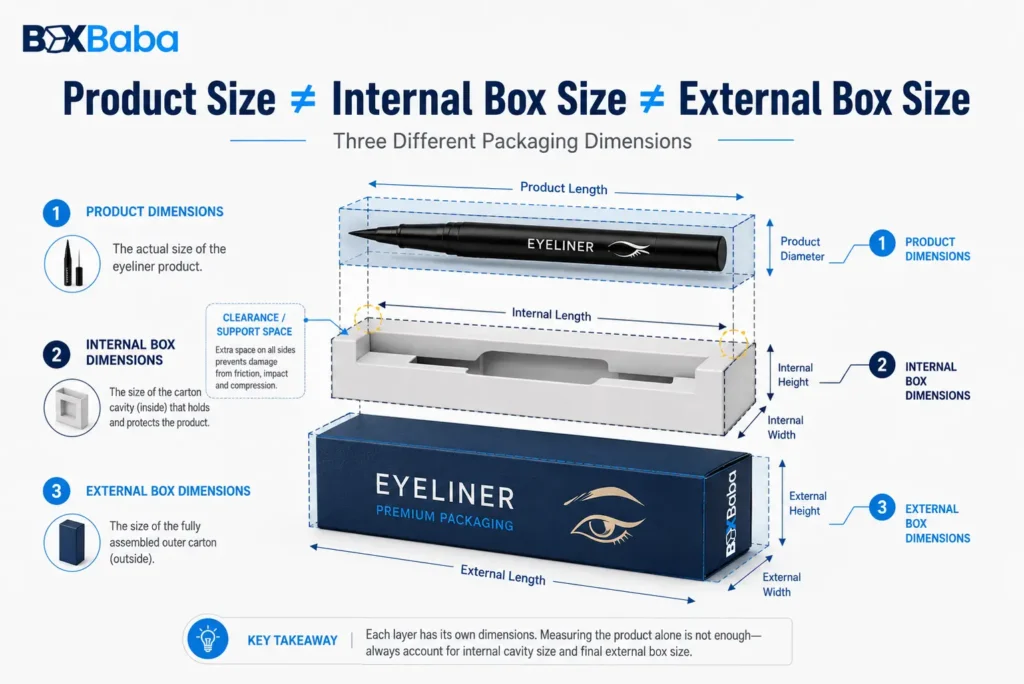
Product Dimensions, Internal Dimensions and External Dimensions
These three measurements describe different entities.
Product dimensions describe the complete closed eyeliner.
Internal box dimensions describe the usable space inside the assembled carton.
External dimensions describe the completed outside package.
If an eyeliner measures 0.50 inches at its widest point and 5.10 inches in closed length, the finished carton should not automatically be specified as 0.50 × 0.50 × 5.10 inches.
The internal package may need additional space for clearance, board folds, a support component, accessory placement or removal.
The external carton is then affected by the selected material and structure.
What Changes the Required Internal Box Space?
Clearance should not be treated as one universal number for every eyeliner format.
The required space can depend on the closure, twist base, board thickness, selected structure, internal support, packing method and removal direction.
Orientation also changes dimensional mapping. A 5.10-inch eyeliner can use that dimension as carton height in one structure and carton width in another.
Not every eyeliner box needs an insert. A straightforward pencil or pen may fit directly inside a suitably developed folding carton, while a liquid bottle, gel pot, accessory set or presentation arrangement may require more deliberate internal positioning.
If support is used, its dimensions must be considered before the internal carton is finalized.
Removal should also be considered. A product can fit mathematically yet still be difficult to pack or remove if the opening and clearance do not match the intended user interaction.
Hang-Tab and Peg-Display Dimensions
Retail hanging features introduce another dimensional layer.
A hang tab or header can increase the external display height of an eyeliner package without increasing the usable product cavity.
That means:
Product Cavity Height ≠ Total Hanging Package Height
When a hanging format is planned, confirm the finished carton dimensions, hanging direction, header or tab area and the packed product orientation together.
If a window is also used, its placement should be checked against the final product position rather than placed according to the unassembled dieline alone.
For broader commercial packaging choices such as structures, printing and presentation formats, the transactional Custom Eyeliner Boxes page should remain the main destination.
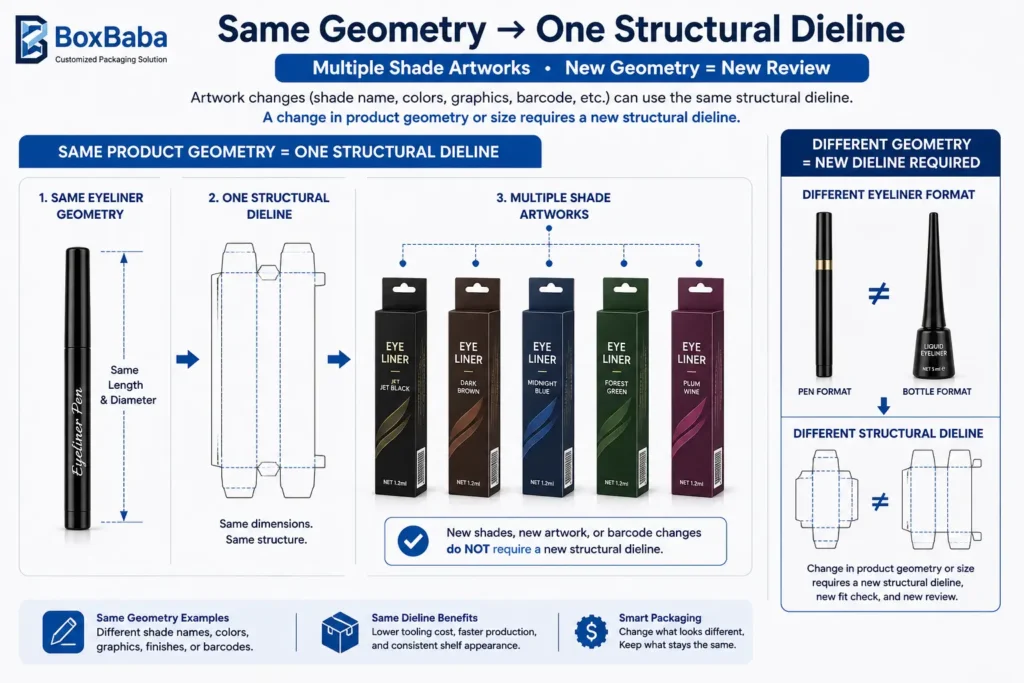
Can Multiple Eyeliner Shades Use the Same Dieline?
Yes, when multiple shades use the same physical eyeliner configuration.
A brand may sell black, brown, navy, white or colored eyeliner variants using the same pen, pencil or liquid-liner container.
If the dimensions, cap or closure, orientation, internal support and carton structure remain unchanged, the same structural dieline may support different artwork versions.
Review the dieline whenever another SKU changes the physical product.
A black felt-tip eyeliner and brown felt-tip eyeliner using the same physical pen may share one structural box.
A felt-tip pen and gel eyeliner pot require a new dimensional review because the container geometry changes.
Eyeliner Sets and Multi-Product Packaging
An eyeliner set should be developed from the completed arrangement, not by multiplying one product dimension by the number of items.
A set may combine several shades, a pencil and sharpener, a gel pot and brush, a liquid liner and pencil, or eyeliner with another eye-makeup product.
Measure every included item and confirm its orientation, spacing and support arrangement.
Three eyeliner pens that each measure 0.50 inches in diameter do not automatically require 1.50 inches of internal width. Divider thickness, spacing and product access can increase the completed footprint.
When eyeliner is being packaged as part of a broader eye-makeup assortment, the Makeup Boxes page is the more appropriate commercial destination for multi-product makeup packaging rather than treating every set as a single-eyeliner carton.
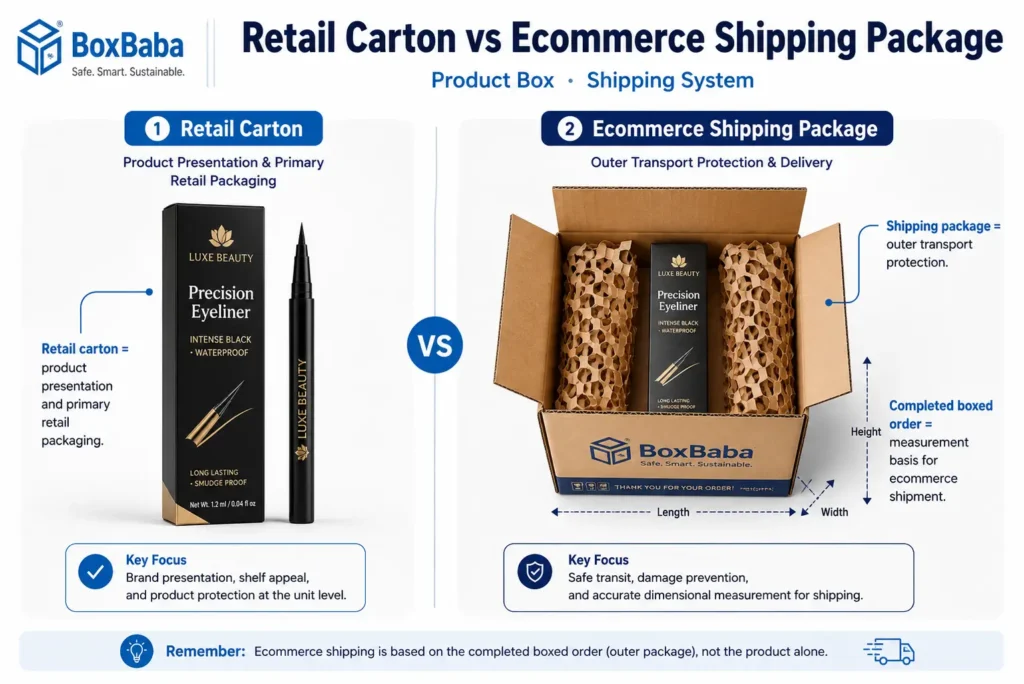
Retail Eyeliner Carton vs Ecommerce Shipping Package
The individual eyeliner box and the outer shipping carton perform different sizing jobs.
For retail:
Finished Eyeliner Product → Individual Eyeliner Carton
For ecommerce:
Completed Boxed Order → Mailer / Shipping Carton
Do not use the bare eyeliner dimensions as the basis for the ecommerce shipping package.
Likewise, the individual eyeliner carton does not need to be enlarged merely because it will later be placed inside an outer shipping package.
An ecommerce order may contain one eyeliner, several shades or a larger makeup assortment. The completed boxed order becomes the measurement entity for the outer shipping package.
Common Eyeliner Box Sizing Mistakes
| Sizing Mistake | Better Approach |
| Treating one published size as universal | Measure the actual finished eyeliner |
| Measuring only product length | Record maximum width, depth or diameter too |
| Measuring only the barrel | Include cap, clip, twist base and end profiles |
| Ignoring a wider cap | Use the maximum closed exterior profile |
| Measuring a felt-tip liner uncapped | Measure the complete closed product |
| Adding applicator-tip length separately | Use the packed sale-ready configuration |
| Treating every eyeliner as a pencil | Identify the physical format first |
| Measuring a gel or cake liner like a pen | Use its actual container footprint and closed height |
| Ignoring a long liquid-liner cap | Measure complete closed bottle height |
| Ignoring the twist base | Check the retractable-liner base profile |
| Assuming dual-ended products are symmetrical | Measure both ends independently |
| Forgetting a brush or sharpener | Size the completed packed arrangement |
| Applying one universal clearance | Confirm fit through the selected structure and proofing |
| Finalizing the carton before support | Include insert/divider dimensions first |
| Ignoring removal direction | Confirm practical packing and product access |
| Assuming every shade requires a new dieline | Compare the physical product configuration |
| Multiplying one product dimension for a set | Develop the completed arrangement |
| Using retail-carton dimensions for shipping | Measure the completed ecommerce order separately |
Avoiding these common sizing mistakes ensures your secondary packaging accurately accommodates your finished eyeliners, accounting for closures, unique formats, and accessories.
What specific eyeliner format or packaging specification would you like to explore or document next?
Eyeliner Measurement and Quote Checklist
Finished Product
| Field | Value / Options |
| Eyeliner Format | Traditional Pencil / Retractable Pencil / Felt-Tip / Brush-Tip / Liquid Bottle / Gel Pot / Cake-Pan / Dual-Ended / Other |
| Complete Closed Length / Height | ____________________ |
| Maximum Diameter | ____________________ |
| Maximum Width | ____________________ |
| Maximum Depth | ____________________ |
| Barrel / Body Profile | ____________________ |
| Cap / Clip Width or Diameter | ____________________ |
| Twist Base Profile | ____________________ |
| End A Profile, if dual-ended | ____________________ |
| End B Profile, if dual-ended | ____________________ |
| Bottle / Pot / Compact Base Footprint | ____________________ |
| Filled Weight, if relevant | ____________________ |
Accessories and Configuration
| Field | Value / Options |
| Accessory Included | None / Brush / Sharpener / Stamp / Other |
| Accessory Dimensions | ____________________ |
| Accessory Position | ____________________ |
| Product Orientation | Horizontal / Upright / Other / Unsure |
| Internal Support Required | Yes / No / Unsure |
| Removal Direction | End Removal / Side Removal / Tray Lift / Other / Unsure |
| Products Per Box | ____________________ |
| Product Photograph / Technical Drawing Available | Yes / No |
| Hang Tab / Peg Display Required | Yes / No / Unsure |
SKU and Quote Details
| Field | Value / Options |
| Number of Shades / SKUs | ____________________ |
| Same Physical Product Across SKUs | Yes / No / Unsure |
| Quantity Per SKU | ____________________ |
| Preferred Box Structure | ____________________ |
| Intended Use | Retail / Ecommerce / Set / PR / Other |
| Artwork Status | Ready / In Progress / Not Started |
| Delivery Destination | ____________________ |
Specification Best Practice:
Basic Inquiry: Need 500 eyeliner boxes.
Complete Specification Example: The finished felt-tip eyeliner measures 0.50 in at its maximum cap diameter and 5.10 in complete closed length. The cap is wider than the barrel, the product will be packed horizontally as one unit per carton, and no internal insert has yet been confirmed.
Providing detailed physical specifications gives the packaging supplier the actual physical information needed to evaluate and develop a precise production carton.
Would you like to review or prepare a specification template for another cosmetic product category next?
Finished Box Dimensions vs Flat Dieline Dimensions
A finished eyeliner box size and its flat dieline size are not the same measurement.
The finished box is normally described using assembled dimensions such as:
Width × Depth × Height
The flat dieline is larger because it contains the structural layout used to create that box.
Depending on the selected structure, the dieline may contain:
- front and back panels;
- side panels;
- top and bottom flaps;
- glue areas;
- closure panels;
- hang-tab or header sections;
- insert or divider features.
Therefore:
Finished Box Dimensions ≠ Flat Dieline Dimensions
Do not use the assembled box dimensions as the artwork canvas dimensions.
The development sequence should be:
Finished Product Measurements → Internal Carton Specification → Material + Structure → Finished Box Dimensions → Flat Dieline → Proof / Approval
Request Custom Eyeliner Box Pricing
A reliable eyeliner-box specification starts with the complete closed and sale-ready eyeliner product, not a generic reference size.
BoxBaba supplies Custom Eyeliner Boxes for product-specific cosmetic packaging projects. Buyers planning a wider beauty packaging range can also review Custom Cosmetic Boxes for the broader commercial category.
BoxBaba’s verified minimum order quantity for custom cosmetic boxes starts from 100 boxes.
When requesting pricing, provide the eyeliner format, complete closed dimensions, cap or closure profile, twist-base or end details, bottle/pot/compact measurements where applicable, accessory dimensions, orientation, internal-support requirements, quantity per SKU and artwork status.
If final carton dimensions are not yet known, provide the finished eyeliner-product measurements instead of estimating an external box size.
Proofing or sample routes are confirmed during quotation. Production timing is project-specific after dimensions, structure, material, inserts, artwork, quantities, finishes and proofing requirements are approved. Shipping methods, charges and estimated transit times are confirmed according to the completed order, packing format, destination and selected service.
Measure the complete closed eyeliner—including the widest cap, clip, base, lid or end profile—before developing the carton around it.
FAQs About Eyeliner Box Sizes and Dimensions
What is the standard eyeliner box size?
There is no universal production-ready eyeliner box size. Pencil, retractable, felt-tip, liquid-bottle, gel-pot and dual-ended eyeliners use different physical formats, so the carton should be developed around the actual finished product.
How do I measure eyeliner for a custom box?
Measure the eyeliner in its complete closed and sale-ready condition. For a round pencil or pen, record maximum diameter and complete closed length. For a non-round product, record maximum width, depth and length or height.
What dimension controls eyeliner box width?
The widest point of the complete closed eyeliner establishes the starting cross-section. Depending on the format, this may be the barrel, cap, cap clip, twist base, liquid-liner bottle, gel-pot lid or one end of a dual-ended product.
Does eyeliner length alone determine box size?
No. Two products can have the same length but different cap widths, barrel diameters, twist bases or end profiles. The complete maximum exterior profile should be measured.
Should I include the eyeliner cap when measuring?
Yes. If the eyeliner is packed and sold with the cap installed, measure the complete closed product. A cap or clip may extend beyond the central body and become the controlling dimension.
How do I measure liquid eyeliner packaging?
Measure the complete closed bottle with the applicator cap installed. Record maximum width/depth or diameter, complete closed height, cap profile and base footprint.
How do I measure a gel or cake eyeliner container?
For a round pot, record the maximum pot or lid diameter and complete closed height. For a non-round pot or compact, measure maximum width, depth and closed height. Include any separately packed brush in the completed arrangement.
How do I measure a dual-ended eyeliner?
Measure the complete closed length and compare both ends with the central body. Use the largest profile from End A, the barrel or End B when establishing the starting product envelope.
Are eyeliner product dimensions the same as box dimensions?
No. Product dimensions describe the finished eyeliner, internal box dimensions describe usable carton space and external dimensions describe the completed outside package.
Can several eyeliner shades use the same box?
Yes, when the same physical container, dimensions, closure, orientation and structural configuration are used. Artwork or shade changes alone do not automatically require a different structural dieline.