
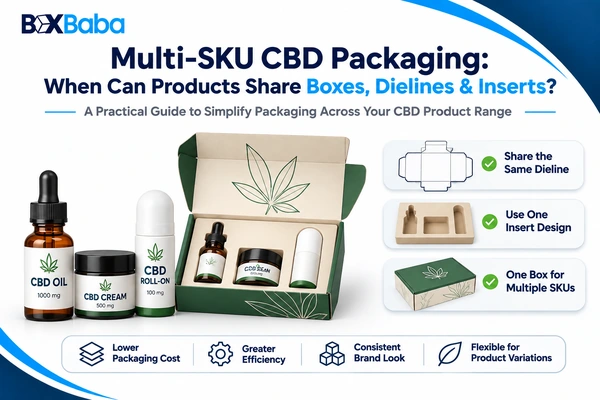
A CBD brand does not need a completely different packaging system for every strength, flavor or formula.
But standardization should follow physical compatibility, not simply the fact that the products belong to the same brand or contain the same amount of CBD.
Three tincture strengths using the exact same bottle and closure may be strong candidates for one box and one structural dieline.
A 30 ml tincture and a 30 ml airless skincare product are not automatically compatible just because both contain 30 ml.
The practical rule is:
Standardize the Physical Relationships That Are Truly Shared → Separate Product-Specific Data → Control Every Production Version
For a multi-SKU CBD range, evaluate:
Finished Product → Primary Container → Closure → Orientation → Filled Weight → Packaging Function → Box → Dieline → Insert → Artwork / Product Data
Brands planning packaging across oils, gummies, capsules, creams and other product families can start with Custom CBD Boxes.
What Does Multi-SKU CBD Packaging Standardization Mean?
Multi-SKU standardization means deliberately reusing compatible parts of a packaging system across several products.
It does not mean:
One CBD box for everything.
A product line might include:
- three tincture strengths;
- four gummy flavors;
- several cream formulas;
- capsule products;
- gift sets.
Some products may share the exact same primary container.
Others may have very different physical packages.
The objective is to identify:
what is genuinely identical enough to share
and:
what remains product-specific enough to require another version.
Four Versions Matter More Than Same Packaging
A useful CBD packaging system distinguishes four different version types.
Version Type | What It Identifies | Example |
Container version | Finished primary container + closure | CT-01 |
Structural version | Exact box/dieline | DL-01 |
Insert version | Internal holder/divider | IN-01 |
Artwork/data version | Printed SKU information | ART-A |
A multi-SKU project might therefore use:
Container CT-01
↓
Dieline DL-01
↓
Insert IN-01
↓
ART-A / ART-B / ART-C
That means three CBD SKUs can share one physical packaging system while retaining separate printed versions.
This is much more precise than describing all three as:
the same packaging.

Build the Product Schedule Before Standardizing the Boxes
Start by documenting every SKU as a physical package.
A useful schedule includes:
Field | Why It Matters |
SKU | Identifies the commercial product |
Primary-container reference | Shows whether the container is truly shared |
Closure reference | Captures cap, dropper, lid or pump differences |
Finished dimensions | Defines external product geometry |
Filled weight | Provides structural context |
Orientation | Affects box proportions and support |
Packaging function | Identifies product/market-specific functional differences |
Structural version | Identifies the box/dieline |
Insert version | Identifies internal support |
Artwork version | Identifies printed product data |
Barcode | Links the correct product identifier |
QR destination | Links the correct digital destination |
Quantity | Controls production by version |
The important conversion is:
Marketing SKU List → Physical Packaging Schedule
Can Different CBD SKUs Share the Same Box Size?
Yes, when their completed physical packages are compatible with the same internal box requirement.
Compare:
- maximum width/depth/diameter;
- complete closed height;
- closure profile;
- packed orientation;
- filled weight;
- insert/support;
- loading;
- removal.
Strong Standardization Candidate
Three CBD tincture strengths use the exact same:
- glass bottle;
- dropper;
- closure;
- dimensions;
- orientation.
Only the printed information changes.
One common box size may be appropriate.
Weak Standardization Candidate
Two products both contain 30 ml, but:
- one uses a dropper;
- one uses an airless pump.
Equal capacity does not establish physical compatibility.
Use:
Shared Physical Container → Potential Shared Box
not:
Shared Fill Capacity → Shared Box
For tincture-specific cartons developed around the finished bottle, explore CBD Dropper Bottle Boxes.

Same Box Size Does Not Necessarily Mean Same Dieline
A finished box size and a structural production file are not the same entity.
Two cartons could have similar finished dimensions while one has:
- straight tuck construction;
and another has:
- auto-lock bottom;
- window;
- hang tab;
- different opening feature.
The production geometry changes.
Therefore:
Same L × W × H ≠ Automatically Same Dieline
For broader structural-file terminology, see the Dieline in Packaging guide.

When Can Several CBD SKUs Share One Exact Dieline?
A shared dieline becomes realistic when the production-critical structural relationships stay the same.
Check:
- final box dimensions;
- structural style;
- bottom construction;
- opening;
- window;
- hang tab;
- insert relationship;
- orientation.
A useful relationship is:
Same Finished Product Geometry + Same Packed Orientation + Same Box Structure + Same Structural Features → Possible Shared Dieline
The artwork can still be different.
Shared Dieline Does Not Mean Shared Artwork
This is the most important multi-SKU distinction.
Three CBD oil strengths can use one physical carton while requiring different:
- strength;
- product name;
- barcode;
- QR code;
- approved product copy.
For example:
SKU | Dieline | Variant | Barcode | QR Destination | Artwork |
Oil A | DL-01 | Variant A | Code A | Link A | ART-A |
Oil B | DL-01 | Variant B | Code B | Link B | ART-B |
Oil C | DL-01 | Variant C | Code C | Link C | ART-C |
This gives:
One Structural Version
but:
Three Printed Versions
Production should control both.

Strength Changes Are Often Artwork Changes, Not Structural Changes
Suppose a CBD oil range has:
- Strength A;
- Strength B;
- Strength C.
If all three use the exact same:
- bottle;
- dropper;
- closure;
- finished dimensions;
- packed weight range compatible with the structure;
- orientation;
the strength change by itself may not require a new box.
It can instead require another artwork/data version.
Do not create a new dieline merely because the cannabinoid-strength statement changes.
Likewise, do not assume one artwork can serve all strengths just because the physical box is shared.
Same Strength Does Not Mean Same Packaging
The reverse is also important.
Two products can both state:
1000 mg CBD
while one is:
- tincture;
and another is:
- topical cream.
The physical products may use completely different:
- containers;
- closures;
- shapes;
- weights.
Standardization follows:
Physical Package Compatibility
not:
Matching Cannabinoid Number
CBD Gummy Flavors Can Sometimes Share One Structure
Consider:
- Strawberry Gummies;
- Citrus Gummies;
- Berry Gummies.
If they use the exact same:
- finished jar;
- lid;
- carton;
- orientation;
they may share one structural packaging version.
Their printed data may still differ in:
- flavor;
- barcode;
- QR;
- product copy;
- variant identification.
If one flavor later moves to another jar supplier, recheck the physical package before reusing the shared structure.
CBD Cream Formulas Can Share a Carton When the Jar Is Truly Shared
A CBD skincare range may contain:
- Recovery Cream;
- Night Cream;
- Cooling Balm.
If all three use the exact same finished jar and lid, a shared structural carton may be practical.
But:
50 ml Glass Jar
and:
50 ml Double-Wall Plastic Jar
are not automatically compatible.
The capacities can match while the:
- maximum width;
- lid profile;
- height;
- weight;
differ.
For CBD skincare product lines involving jars, pumps and other cosmetic formats, explore Custom CBD Cosmetic Boxes.
Container Supplier Changes Can Break a Shared Structure
The bottle maximum body diameter does not
A sourcing change can look insignificant in a purchasing spreadsheet but become important to packaging.
Suppose several tincture SKUs share:
Bottle CT-01
Later, one moves to another 30 ml bottle.
The replacement may have a different:
- body diameter;
- shoulder;
- base;
- closure height;
- bulb.
The product capacity has not changed.
The packaging input has.
Use:
Primary Container Change → Compatibility Review
before releasing the existing box specification.
always describe its actual standing surface.
A glass bottle can have:
- recessed base;
- rounded heel;
- thick glass;
- narrower effective contact area.
The base footprint is useful when evaluating:
- upright stability;
- bottom support;
- insert/base relationship.
It does not by itself determine the carton dimensions.
Closure Changes Also Matter
The bottle or jar body may remain unchanged while the closure changes.
Examples include:
- wider dropper bulb;
- different cap;
- taller pump;
- new jar lid;
- different access-control closure;
- added tamper component.
A closure change can affect:
- maximum width;
- complete height;
- support area;
- opening;
- printed instructions.
Therefore:
Same Bottle Body ≠ Same Finished Product
when the closure changes.
Packaging-Function Differences Can Break Standardization
Physical geometry is not the only compatibility test.
A product or market variation can require a different packaging function.
For example, a change in the applicable packaging system may introduce:
- different primary closure;
- different opening method;
- tamper-related feature;
- different user instruction.
Where child-resistant or other regulated packaging functionality is applicable, evaluate the supported package configuration rather than relying only on the shape or name of the outer carton.
Use:
Same Physical Container + Different Required Packaging Function → Recheck Compatibility
Do not collapse:
Child-Resistant
and:
Tamper-Evident
into one version field.
They solve different packaging questions.
Can Different CBD SKUs Share One Insert?
Sometimes, but the compatibility requirement is stricter.
The insert needs to work with the actual:
- product envelope;
- support/contact area;
- weight;
- orientation;
- removal path;
- closure clearance.
Two containers may fit the same outer box while needing different internal holders.
For example:
Product A
Wide body + narrow closure.
Product B
Narrow body + wide closure.
The shared outer carton may provide enough clearance for both.
A single fitted insert may not retain both correctly.
Use:
Compatible Product Geometry + Compatible Support Zone + Compatible Loading / Removal → Possible Shared Insert
Where fitted product holders are required, explore Printed Boxes with Inserts.
One Outer Box Can Use Different Insert Versions
A useful standardization system can sometimes use:
Shared Outer Box
with:
Insert IN-01
or:
Insert IN-02
depending on the SKU.
This can be appropriate when both configurations still work with the same:
- outer dimensions;
- opening;
- closure;
- loaded weight;
- product-removal path.
But do not call the complete packaging system identical.
The production record should show:
Outer Structure DL-01
Insert IN-01 or IN-02
Artwork ART-X

Shared Outer Box + Different Insert Creates a Packing-Control Issue
This is an operational consequence that is easy to miss.
If:
SKU A → Insert A
and:
SKU B → Insert B
use the same outer box, the packing team must reliably identify which insert belongs to each product.
The apparent reduction in box SKUs can therefore create additional:
- insert inventory;
- assembly instructions;
- pack-out controls.
Standardization is useful only when the whole system becomes manageable.
Windowed Boxes Require Stronger Compatibility
A shared window depends on the product appearing in the same intended location.
Window standardization can fail when one SKU has:
- different height;
- different label position;
- different lid;
- different insert;
- different orientation.
Use:
Product Position → Visible Area → Window Compatibility
not:
Shared Outer Size → Shared Window
If the window geometry changes, the structural dieline may also change.
Do Not Standardize by Creating Excessive Empty Space
Another strategy is to size every carton around the largest product in the range.
That can reduce the number of physical box sizes.
It can also create:
- unnecessary void space;
- product movement;
- larger retail footprint;
- additional insert complexity.
For example:
15 ml Bottle
and:
60 ml Bottle
might technically fit one large carton.
That does not make one shared carton an efficient solution.
Use:
Compatibility + Reasonable Packaging Efficiency
not:
If It Physically Fits, Standardize It
Group CBD SKUs by Physical Packaging Family
A practical hierarchy is:
Dropper Family
Same bottle/closure geometry.
Jar Family
Same jar/lid geometry.
Capsule Bottle Family
Same bottle/cap geometry.
Pouch Family
Same finished pouch format.
Tube / Pump Family
Same tube or dispenser geometry.
Gift / Set Family
Same completed multi-product arrangement.
Standardization usually works better within these physical families than across unrelated CBD product formats.
Shared Brand Identity Does Not Require Shared Box Dimensions
A coordinated range can still use:
- common logo hierarchy;
- typography;
- color rules;
- variant system;
- finish direction;
- panel hierarchy;
while different product families use different:
- dimensions;
- dielines;
- inserts.
Use:
Shared Visual System + Product-Specific Structures
to create consistency without forcing poor physical standardization.
Shared Artwork Template Is Not One Production Artwork
A CBD range can use a common artwork template defining:
- logo location;
- product-name hierarchy;
- strength position;
- barcode area;
- QR area;
- finish zone.
Each production SKU should still receive its correct data.
Use:
Shared Artwork System
but:
Controlled SKU-Specific Production Files
when printed information differs.
QR Placement Can Be Shared While QR Destinations Differ
This is a particularly useful CBD distinction.
Several SKUs can use the QR in the same:
- panel;
- position;
- size.
That does not prove the same encoded destination should be used.
For each artwork version verify:
SKU → QR → Correct Destination
If QR codes link to product information, COAs or another controlled resource, a code that scans to the wrong SKU is still an error.
Therefore:
Shared QR Position ≠ Shared QR Destination
Barcodes Require the Same SKU-Level Control
The structural carton does not determine the product identifier.
A shared dieline may contain:
Barcode A
on SKU A
and:
Barcode B
on SKU B.
Create:
SKU → Barcode → Artwork Version
as an explicit relationship.
Do not let structural standardization weaken product-data control.
Classify Changes Before Creating New Packaging
Change | Box Size | Dieline | Insert | Artwork/Data |
Strength / flavor only | Usually unchanged | Usually unchanged | Usually unchanged | Review |
Product name | Usually unchanged | Usually unchanged | Usually unchanged | Review |
Barcode | Unchanged | Unchanged | Unchanged | Review |
QR destination | Unchanged | Unchanged | Unchanged | Review |
Bottle supplier | Review | Review if geometry changes | Review | Possibly |
Closure | Review | Possibly | Review | Possibly |
Jar / lid | Review | Review if geometry changes | Review | Possibly |
Orientation | Review | Review | Review | Review panel logic |
Insert geometry | Possibly | Review relationship | Review | Usually unchanged |
Window | Review | Review | Possibly | Review |
Board/construction | Review | Review | Review | Review color/finish |
Packaging function | Review | Review | Review | Review instructions/data |
The table is a classification tool.
The exact project still needs its actual physical relationships checked.

Quantity Should Be Managed by Structural & Printed Version
A total project quantity does not tell the supplier enough.
Suppose the order is:
5,000 CBD Boxes
That might actually mean:
SKU | Dieline | Insert | Artwork | Quantity |
Oil A | DL-01 | None | ART-A | 1,000 |
Oil B | DL-01 | None | ART-B | 1,000 |
Oil C | DL-01 | None | ART-C | 1,000 |
Cream A | DL-02 | IN-01 | ART-D | 1,000 |
Cream B | DL-02 | IN-01 | ART-E | 1,000 |
That project contains:
5 printed artwork versions
but only:
2 structural dielines
and:
1 insert version.
This distinction improves:
- quotation;
- artwork control;
- inventory planning;
- repeat production.
Build a CBD Packaging Master Matrix
For a growing range, record:
- SKU;
- product name;
- container version;
- closure version;
- finished dimensions;
- filled weight;
- orientation;
- packaging-function requirement;
- structural/dieline version;
- insert version;
- window version;
- artwork version;
- barcode;
- QR destination;
- quantity;
- approval reference.
The knowledge relationship becomes:
SKU → Container → Structure → Insert → Artwork → Production Quantity
That is considerably safer than storing a folder of boxes named:
Final
Final2
Latest
Proof Shared Structures & Printed Versions Separately
If five CBD tincture strengths use one identical physical bottle and carton, one appropriate structural review may support the common geometry.
Each printed version should still be reviewed for the correct:
- product;
- strength;
- barcode;
- QR;
- approved copy;
- quantity.
Therefore:
Shared Structural Approval ≠ Approval of Every Printed SKU
The deeper sample/proof methodology belongs to the dedicated proofing guide.
The standardization point here is simply that physical and printed approval objects are separate.
Multi-Product Gift Sets Need Their Own Compatibility Test
A gift set containing:
CBD Oil + Cream + Gummies
is not simply three standardized unit cartons.
The set itself becomes another packaging entity.
A brand may standardize the same outer presentation box across several gift-set editions while using different insert configurations.
For presentation-led assortments, explore CBD Gift Boxes.
The shared outer box remains appropriate only when each completed pack-out still works for:
- fit;
- loading;
- retention;
- removal;
- closure;
- loaded weight.
When Does Standardization Become Over-Standardization?
Standardization Attempt | Why It Can Fail | Better Rule |
One box for all 30 ml CBD products | Capacity does not define geometry | Standardize by physical container |
One box for every tincture supplier | Bottle/closure profiles can differ | Approve specific container versions |
One insert for similar bottles | Support/removal can differ | Validate insert compatibility |
One window across different heights | Product visible area moves | Standardize product position first |
One carton for travel + full size | Creates excessive void | Share brand system instead |
One box for bottles + jars | Geometry differs | Group by physical family |
One artwork across strengths | Product data becomes incorrect | Separate printed versions |
One QR across products | Destination may be SKU-specific | Verify QR by SKU |
One total quantity | Hides version split | Provide quantity per version |
The guiding rule is:
Fewer Packaging SKUs Is Useful Only When the Shared Package Still Works Properly.
Multi-SKU CBD Packaging Decision Tree
1. Is the Finished Primary Container Identical?
Yes → Continue.
No → Compare actual geometry before standardizing.
2. Is the Closure Identical?
Yes → Continue.
No → Recheck maximum profile, support and opening.
3. Are Orientation & Loaded Structural Requirements Compatible?
Yes → Continue.
No → Separate structural review.
4. Is the Required Packaging Function Compatible?
Yes → Continue.
No → Separate functional/structural review.
5. Can the Products Use the Same Internal Fit?
Yes → Continue.
No → Consider separate inserts or structures.
6. Are Window & Other Structural Features Identical?
Yes → Shared dieline becomes more plausible.
No → Separate dieline may be required.
7. Is Only the Printed Information Different?
Yes → Shared physical packaging + separate controlled artwork versions may be appropriate.
This is the core standardization route:
Shared Physical Specification
Controlled Product-Specific Data
Example: Three CBD Oil Strengths
Three strengths use the same:
- bottle;
- closure;
- orientation;
- box;
- no insert.
Only:
- strength;
- barcode;
- QR;
- approved product copy;
changes.
Possible Packaging Model
CT-01
→ DL-01
→ ART-A / ART-B / ART-C
This is a strong standardization candidate.
Example: Same Capacity, Different Container
Two products contain 30 ml.
Product A
Glass dropper bottle.
Product B
Airless pump.
Result
Same Capacity
but:
Different External Geometry
→ Separate Structural Compatibility Review
They can share branding without sharing a physical carton.
Example: Three CBD Cream Formulas
Three formulas use the same:
- finished jar;
- lid;
- carton;
- insert.
Only printed product data changes.
Possible Model
CT-02
→ DL-02
→ IN-01
→ ART-D / ART-E / ART-F
If one formula changes jar supplier later, recheck the shared structure.
Example: Shared Outer Box With Two Inserts
A presentation box is used for:
Set A
Dropper + cream.
Set B
Dropper + gummies.
The same outer structure may be possible if both completed layouts remain compatible.
But the production specification becomes:
DL-03 + IN-A + ART-A
or:
DL-03 + IN-B + ART-B
The outer carton is standardized.
The complete packaging system is not.
Practical Multi-SKU CBD Packaging Workflow
List every SKU.
Include strength, flavor, formula and market version.
Assign the actual primary-container reference.
Do not group by capacity alone.
Record the finished container + closure.
Record dimensions, filled weight and orientation.
Identify packaging-function differences.
Group products into physical container families.
Compare box-size compatibility.
Confirm which products can share an exact structural dieline.
Compare insert compatibility separately.
Assign structural, insert and artwork version IDs.
Verify barcode + QR data for every printed SKU.
Record quantity per version.
Approve the physical structure and printed data at the appropriate level.
Store the final SKU-to-packaging relationship for repeat production.
What Should You Send BoxBaba for a Multi-SKU CBD Project?
Instead of:
We have 12 CBD products and want one packaging style.
prepare a structured schedule.
For Each SKU
- product name;
- strength/flavor/formula;
- primary-container type;
- container reference;
- closure reference;
- complete finished dimensions;
- filled weight;
- orientation.
Packaging
- intended structural family;
- insert requirement;
- window requirement;
- packaging-function requirements where applicable.
Printed Product Data
- artwork version;
- barcode;
- QR destination;
- approved product copy.
Production
- quantity per SKU;
- quantity per structural version;
- quantity per artwork version;
- proof/sample requirement;
- delivery destination.
This allows the packaging team to determine:
What Can Be Standardized
and:
What Must Remain a Separate Controlled Version
Multi-SKU CBD Packaging With BoxBaba
The goal of multi-SKU packaging is not to make every product physically identical.
It is to reduce unnecessary versions without sacrificing fit, function or product-data control.
Use:
SKU List
↓
Physical Container Families
↓
Shared / Separate Box Sizes
↓
Shared / Separate Dielines
↓
Shared / Separate Inserts
↓
Controlled Artwork / Barcode / QR Versions
↓
Quantity by Version
For broader packaging across CBD oils, gummies, capsules, creams and other product families, explore Custom CBD Boxes.
For CBD skincare product families using jars, pumps or dropper containers, explore Custom CBD Cosmetic Boxes.
Where different products require fitted holders or controlled internal layouts, use Printed Boxes with Inserts.
BoxBaba current CBD packaging program starts from 100 units, with custom sizing, artwork support, samples, standard production generally 5–9 business days after artwork approval, and free shipping across the USA.
When requesting a multi-SKU quote, provide quantity by SKU plus the actual physical-container specification for each product rather than only the total product-line quantity.
The best standardization question is:
Which physical, structural and data relationships are genuinely identical enough to share one controlled production specification?
Frequently Asked Questions
Can multiple CBD products use the same box size?
Yes, when their finished primary containers, closures, orientation and internal fit requirements are physically compatible.
Can several CBD strengths share one box?
Often, if they use the same finished container and packaging structure. Each strength may still require separate printed artwork and product data.
Can several CBD SKUs share one dieline?
Yes, when the exact structural geometry and production-critical features remain the same.
Does the same box size mean the same dieline?
No. Windows, bottom structures, hang tabs, openings and other structural differences can create separate dielines even when nominal dimensions match.
Can one dieline use several artwork files?
Yes. One physical carton can support several controlled printed versions.
Does a new CBD flavor require a new box?
Not necessarily. If only printed information changes and the physical product remains identical, it may be an artwork-only change.
Does a new CBD strength require a new dieline?
Not automatically. The physical product determines the structural compatibility.
Can two 30 ml CBD products share packaging?
Only after their actual finished containers are compared. Equal capacity does not establish compatibility.
Can several CBD SKUs share one insert?
Only when the product geometry, support zones, orientation, loading and removal requirements are compatible.
Can one outer CBD box use different inserts?
Potentially. The outer structure can remain shared while each product uses a controlled insert version.
Does changing the bottle supplier require a new box?
It requires compatibility review. Nominal capacity can remain the same while the external dimensions or closure change.
Does changing the closure affect standardization?
It can. A new cap, dropper, pump or lid can change height, width, support or packaging-function requirements.
Can all CBD SKUs use the same QR code?
Not automatically. Shared placement and shared destination are different decisions. Verify the correct QR destination for every product version.
Should every CBD SKU have a different barcode?
Barcode assignment is product-specific. The brand should supply and verify the appropriate identifier for each applicable SKU.
Can retail and ecommerce use the same CBD unit carton?
Often, when the saleable product remains identical. Ecommerce can use a separate order-level outer package around the completed unit.
How should a multi-SKU CBD packaging quote be prepared?
Provide the actual container specification and quantity for every SKU, plus dieline, insert and artwork differences. Do not provide only one combined quantity.
What is the biggest CBD packaging standardization mistake?
Over-standardizing products that are not physically or functionally compatible. Fewer packaging versions are useful only when the shared system still provides appropriate fit, function and production control.