
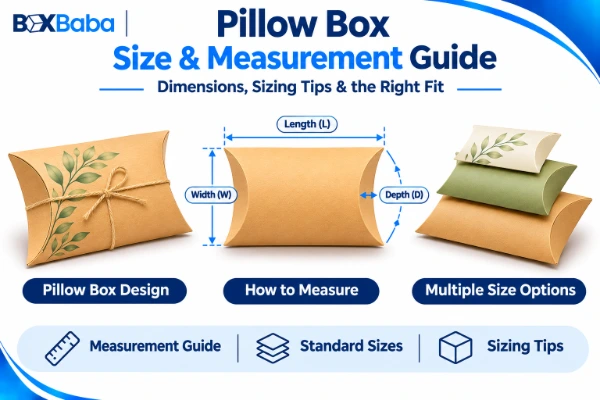
Accurate Pillow Box sizing starts with the finished product in the exact configuration in which it will be packed—not with a generic small, medium, or large box label.
Measure the product maximum packed length or height, width, depth or thickness, widest point, orientation, and any wrapper, card, pouch, tissue, insert, or other component that will enter the carton.
Those measurements are inputs, not final box dimensions.
Because a Pillow Box forms a curved body with inward-closing end areas, four dimensional concepts must remain separate:
Product Dimensions → Required Usable Fit → Assembled Box Dimensions → Flat Dieline Dimensions
Understanding those relationships is the foundation of accurate Pillow Box sizing.
Pillow Box Measurements at a Glance
Dimension State | What It Describes | Why It Matters |
Product Dimensions | Maximum geometry of the complete packed item | Establishes the starting measurement envelope |
Required Usable Fit | Space the packed product needs inside the formed Pillow Box | Determines whether the product and closures can coexist |
Assembled Box Dimensions | Outside geometry of the formed carton | Relevant to display, storage, secondary packaging, and fulfillment |
Flat Dieline Dimensions | Two-dimensional production layout before forming | Used to manufacture, print, cut, score, and assemble the carton |
The important rule is:
Product Dimensions ≠ Required Usable Fit ≠ Assembled Box Dimensions ≠ Flat Dieline Dimensions

Start with the Finished Packed Product
The first object to measure is the complete item that will actually enter the Pillow Box.
That could mean:
- a folded scarf rather than the garment label size;
- earrings attached to a presentation card rather than loose earrings;
- a wrapped soap bar rather than the bare bar;
- a product inside a pouch;
- a hair-extension bundle arranged around a card rather than the full strand length;
- a gift together with tissue and a card.
The buyer can provide perfectly accurate dimensions and still get the sizing brief wrong if those measurements describe the wrong object.
Use this sequence:
Product → Primary Wrap or Presentation Component → Complete Packed Arrangement → Measurement
Anything that remains inside the Pillow Box contributes to the packed geometry.
What Should You Measure for a Pillow Box?
Measure the maximum relevant geometry of the sale-ready arrangement.
Maximum Length or Height
Measure the longest span of the packed product in its intended orientation.
Do not stop at a nominal product dimension when something extends beyond it, such as:
- a clasp;
- cap;
- presentation card;
- folded edge;
- pouch seam;
- tag;
- bundled accessory.
Maximum Width
Measure the widest point of the complete arrangement.
The controlling width may occur away from the center of the product.
Maximum Depth or Thickness
Measure the thickest point after the product has been wrapped, folded, mounted, pouched, or combined with any other component.
Depth matters particularly in Pillow Box packaging because the usable internal profile changes as the body approaches the curved end closures.
Widest or Highest Protruding Point
Look for small features that extend beyond the main body, including:
- jewelry posts;
- bottle or tube closures;
- knots;
- seams;
- card edges;
- decorative hardware;
- irregular product features.
A small protrusion can become the controlling dimension when it reaches a restrictive area of the formed carton.
Intended Orientation
Record how the product should sit inside the Pillow Box.
Orientation is a sizing input.
The same physical product can produce a different structural requirement when rotated because a different dimension may become the required center depth or body span.
Quantity per Box
Measure the actual multi-item arrangement when more than one item will share the carton.
Do not automatically assume:
One-Item Thickness × Quantity = Final Packed Thickness
Items may overlap, flex, settle, nest, or create different high points once arranged together.

Include Every Component That Changes the Packed Envelope
A wrapper, pouch, card, support, or insert can control the final fit even when it is not the main product.
Include components such as:
- wrappers;
- sleeves;
- tissue;
- pouches;
- jewelry cards;
- instruction or greeting cards;
- presentation supports;
- inserts where known;
- additional accessories.
For example:
Jewelry → Presentation Card → Complete Jewelry Arrangement
not:
Jewelry → Box
Similarly:
Soap → Wrapper → Packed Soap
and:
Gift → Tissue + Card → Complete Gift Arrangement
If an insert is not yet designed, identify the retention requirement rather than inventing an insert size. The internal support and Pillow Box can then be developed together.
Flexible Products Need a Defined Packed State
Soft and flexible products can change dimensions according to the way they are handled.
Examples include:
- scarves;
- socks;
- textile accessories;
- hair extensions;
- soft pouches;
- flexible wrapped products.
Measure the product in its intended sale-ready condition.
Define whether it will be:
- folded;
- rolled;
- wrapped;
- held on a card;
- placed in a pouch;
- arranged with another item.
Do not compress a product arbitrarily just to obtain a smaller measurement.
If controlled compression is genuinely part of the production packing method, document and validate that packed state.
Why Curved Pillow Box Geometry Changes Fit
A Pillow Box does not create a constant rectangular internal cavity.
The formed body generally provides its greatest usable depth around the central portion, while internal space narrows toward the inward-curving end closures.
This creates two important structural areas.
Central Body Area
The central body normally provides the greatest depth.
A product thickest point is generally easier to accommodate here than directly beside a curved closure.
Curved Closure Areas
Usable space decreases as the closing ends curve inward.
A rigid product may therefore appear to fit within the outside dimensions of the box but still interfere with a closing area.
That can affect:
- closure formation;
- carton shape;
- product orientation;
- presentation.
For sizing purposes:
Assembled External Dimensions ≠ Usable Internal Fit
The outside profile tells you how large the formed carton is. It does not by itself prove how much product space is available at every point inside it.

Do Not Apply One Universal Clearance Formula
There is no responsible universal Pillow Box rule such as:
- always add a fixed number of millimeters;
- always add a particular fraction of an inch;
- always enlarge the product dimensions by one percentage.
Required clearance depends on the project.
Relevant variables can include:
- product geometry;
- rigidity or flexibility;
- orientation;
- Pillow Box proportions;
- material;
- closure geometry;
- wrapper or pouch;
- internal support;
- product variability;
- removal access.
A rigid rectangular item and a folded textile should not automatically use the same allowance simply because their nominal dimensions are similar.
Use this workflow instead:
Measure Actual Packed Product → Define Orientation → Develop Pillow Structure → Evaluate Usable Fit → Validate
The final structural dimensions should follow the product and package configuration rather than a universal clearance number.
Why L × W × H Labels Can Be Ambiguous for Pillow Boxes
Length × Width × Height is useful shorthand, but the letters alone are not always enough for a curved, non-rectangular package.
Different suppliers can assign the Pillow Box axes differently.
One may list the long body dimension first. Another may describe the opening span first or use depth for the maximum central rise.
For that reason, avoid sending only a line such as:
6 × 4 × 1.5 in
Instead identify what each measurement represents:
- maximum packed length or height: ___
- maximum packed width: ___
- maximum packed thickness/depth: ___
- intended orientation: ___
When referencing an existing Pillow Box, an annotated photo or sketch showing where each dimension was taken is even clearer.
For conventional rectangular-box terminology, BoxBaba guide to measuring box dimensions covers general L×W×H conventions separately.

Keep Four Dimensional States Separate
Product Dimensions
Product dimensions describe the complete item that will enter the carton.
These dimensions are measurement inputs.
They are not automatically the finished Pillow Box dimensions.
Required Usable Fit
Required usable fit is the actual three-dimensional space the packed product needs inside the formed structure.
Because the Pillow Box is curved, usable fit should not automatically be treated as a simple rectangular cavity.
Product orientation matters.
Assembled External Dimensions
Assembled dimensions describe the outside of the formed Pillow Box.
These can matter for:
- retail display;
- storage;
- master cartons;
- fulfillment planning.
External dimensions do not guarantee internal product fit.
Flat Dieline Dimensions
The dieline is the flat production geometry before the Pillow Box is formed.
It contains the structural panels, curved end geometry, cuts, scores, joining areas, and other production features.
Its flat width and height are therefore not the same thing as assembled usable product space.
For deeper dieline terminology, use BoxBaba Dieline in Packaging guide.
Why L × W × H Does Not Give Exact Usable Pillow Box Volume
Multiplying length × width × height describes a rectangular cuboid.
A Pillow Box does not have a constant rectangular cross-section.
Its body curves and the available depth changes toward the closing areas.
Therefore, multiplying three stated Pillow Box dimensions should not be treated as an exact calculation of usable product capacity.
For fit, the more useful question is:
Can the real product geometry occupy the usable curved space in the intended orientation while the end closures still form correctly?
A long rigid product can fail that test even when a basic volume calculation appears large enough.
Are Small, Medium, and Large Pillow Box Sizes Standard?
No universal small, medium, or large Pillow Box dimensions should be assumed.
A supplier may use those labels for its own stock range, but a supplier-specific medium is not an industry-wide standard.
For a custom project, start with:
Actual Packed Product → Maximum Geometry → Required Fit
rather than:
Product Category → Generic Size Label
When comparing stock Pillow Boxes, use the actual dimensional information supplied for those specific boxes.
How to Measure an Existing Pillow Box
If you already have a Pillow Box that you want to reproduce, resize, or use as a structural reference, measure the formed sample, not only the flattened blank.
Assemble the Box
Form and close the carton in the same condition in which it is normally used.
Label the Major External Axes
Record the outside spans of the assembled carton.
Use an annotated photo or drawing to show where each dimension was taken instead of relying only on L/W/H letters.
Measure the Maximum External Center Depth
Record the depth at the fullest central part of the formed carton.
Treat this as an external geometry measurement.
It should not be assumed to equal the available internal depth because carton material, curvature, and packed configuration still affect the usable space.
Identify the Product Usable Span
Observe where the curved end areas begin to reduce the internal envelope.
This is particularly important for long or rigid products.
Photograph the Sample with the Product
Where possible, provide images showing:
- the assembled Pillow Box;
- the product orientation;
- the package open;
- the product inside;
- a known reference dimension.
A reference sample can communicate structural relationships that three unlabeled measurements cannot.
Product Orientation Can Change the Required Size
Orientation is part of the sizing process.
Imagine a product with three principal dimensions:
A × B × C
In one orientation, C may become the required central depth.
Rotate the product, and B may become the depth requirement.
The product has not changed, but the Pillow Box requirement has.
Before final sizing, define:
- which product face should align with the main box panel;
- which axis should run along the carton body;
- where the thickest point will sit;
- how the product should be removed.
For apparel, the finished folded arrangement is more useful than garment size. Buyers working with that application can compare Apparel Pillow Boxes.
Hair extensions provide another useful example: the bundle width, fold, presentation card, and accessories can all alter the dimensional envelope. See Hair Extension Pillow Boxes for the application-specific commercial route.

How to Size Multiple SKUs
A brand may want one Pillow Box structure across several products.
Start by measuring each complete packed configuration separately.
SKU | Maximum Length | Maximum Width | Maximum Depth | Presentation Component | Orientation |
SKU A | Record actual | Record actual | Record actual | Card / pouch / none | Defined |
SKU B | Record actual | Record actual | Record actual | Card / pouch / none | Defined |
SKU C | Record actual | Record actual | Record actual | Card / pouch / none | Defined |
Do not automatically take the largest length from SKU A, the largest width from SKU B, and the largest depth from SKU C and treat that combination as the required box.
That may create a virtual product configuration that does not actually exist.
Instead compare each real packed arrangement.
A structural review can then determine whether:
- one Pillow Box configuration can serve the group;
- one structure can work with different presentation components;
- materially different products need another dieline.
Account for Real Product Variation
Some products naturally vary from unit to unit.
Examples include:
- handmade or hand-cut products;
- folded textiles;
- flexible packs;
- products with decorative projections;
- grouped assortments.
Do not size the package from one unusually small or ideal example if the production product can be larger.
Record the relevant variation or maximum sale-ready geometry that the Pillow Box is expected to accommodate.
This is not the same thing as inventing a manufacturing tolerance.
It simply tells the packaging designer that product variability exists.

Common Pillow Box Measurement Mistakes
Measuring the Bare Product Instead of the Packed Product
Cards, wrappers, pouches, tags, tissue, and supports can change the controlling dimensions.
Treating Product Dimensions as Box Dimensions
A product measuring X × Y × Z does not mean the final Pillow Box should also measure X × Y × Z.
Ignoring the Widest or Thickest Point
A clasp, cap, seam, folded edge, card, or decorative component may control the fit.
Ignoring Orientation
The same product can fit differently when rotated.
Treating the Dieline as an Internal-Space Diagram
A dieline describes production geometry, not a rectangular representation of usable three-dimensional space.
Applying One Fixed Clearance
Clearance depends on the product and structural configuration.
Trusting Small, Medium, or Large Labels
Use actual dimensions.
Sending Three Numbers Without Identifying the Axes
For a non-rectangular package, the axis labels can be interpreted differently.
Mixing Units
Use one measurement system consistently where possible.
If conversion is necessary, label the original and converted values clearly.
Rounding Too Early
Record the measured product geometry before rounding away differences that may matter structurally.
What Measurement Information Should You Send a Packaging Supplier?
A measurement brief should explain the product geometry without requiring you to design the Pillow Box yourself.
Provide:
- Product name or type.
- Maximum packed length or height.
- Maximum packed width.
- Maximum packed depth or thickness.
- Widest or highest point where relevant.
- Intended orientation.
- Quantity per Pillow Box.
- Any wrapper, card, pouch, tissue, or other packed component.
- Product variation or multiple SKU information.
- A product or reference-box photo where useful.
- Measurement units.
If an insert or retention system may be required, describe the problem it needs to solve rather than inventing an internal structure.
The packaging supplier can then translate these measurement inputs into a structural specification.
For custom production, explore BoxBaba Custom Pillow Boxes.
The Right Pillow Box Size Starts with the Right Measurement Entity
The most important sizing decision is not selecting a number from a generic Pillow Box size chart.
It is identifying exactly what will enter the carton and how that arrangement will sit inside the curved structure.
Measure the complete packed product at its maximum relevant dimensions. Record its orientation and every component that changes the dimensional envelope. Keep the product dimensions, usable fit, assembled external box, and flat dieline separate.
Use this sequence:
Finished Packed Product → Maximum Geometry → Orientation → Curved Usable Fit → Structural Validation → Finished Pillow Box
Once those measurement inputs are ready, BoxBaba Custom Pillow Boxes category is the commercial next step for developing the structure around the actual product.
Discuss Your Pillow Box Size and Fit
To discuss a custom Pillow Box project, prepare your packed product measurements, intended orientation, quantity per box, major SKU variations, presentation components, and delivery destination.
Phone: +1 305 574 4357
Email: sales@boxbaba.com
Request a Custom Packaging Quote
Frequently Asked Questions
Which Pillow Box dimension should be written first?
There is no safe assumption that every supplier uses the same axis order for a curved Pillow Box. When exchanging specifications, label each physical axis or provide an annotated drawing rather than relying only on L, W, H, or D abbreviations.
Can I reuse dimensions from a rectangular box for a Pillow Box?
You can use them as reference information, but they should not automatically become the Pillow Box specification. A rectangular carton and a Pillow Box distribute usable internal space differently because of the curved body and closing areas.
Should I send an actual product sample as well as dimensions?
A representative product or structural sample can be useful when the item is rigid, irregular, variable, multi-component, or close to the available curved space. Measurements remain important, but a physical sample can help validate orientation and closure behavior where applicable.
What if different production units have slightly different dimensions?
Record the real variation rather than supplying only one unusually small sample. The packaging designer needs to understand the sale-ready geometry the box is expected to accommodate. Do not invent a tolerance unless an actual product/manufacturing tolerance has been verified.
Should I measure the outside or inside of an existing Pillow Box?
Record the assembled outside dimensions when documenting the physical sample, but do not treat them as guaranteed usable internal dimensions. If the goal is to reproduce product fit, also document the product inside the box, its orientation, and where the curved closures reduce usable space.