
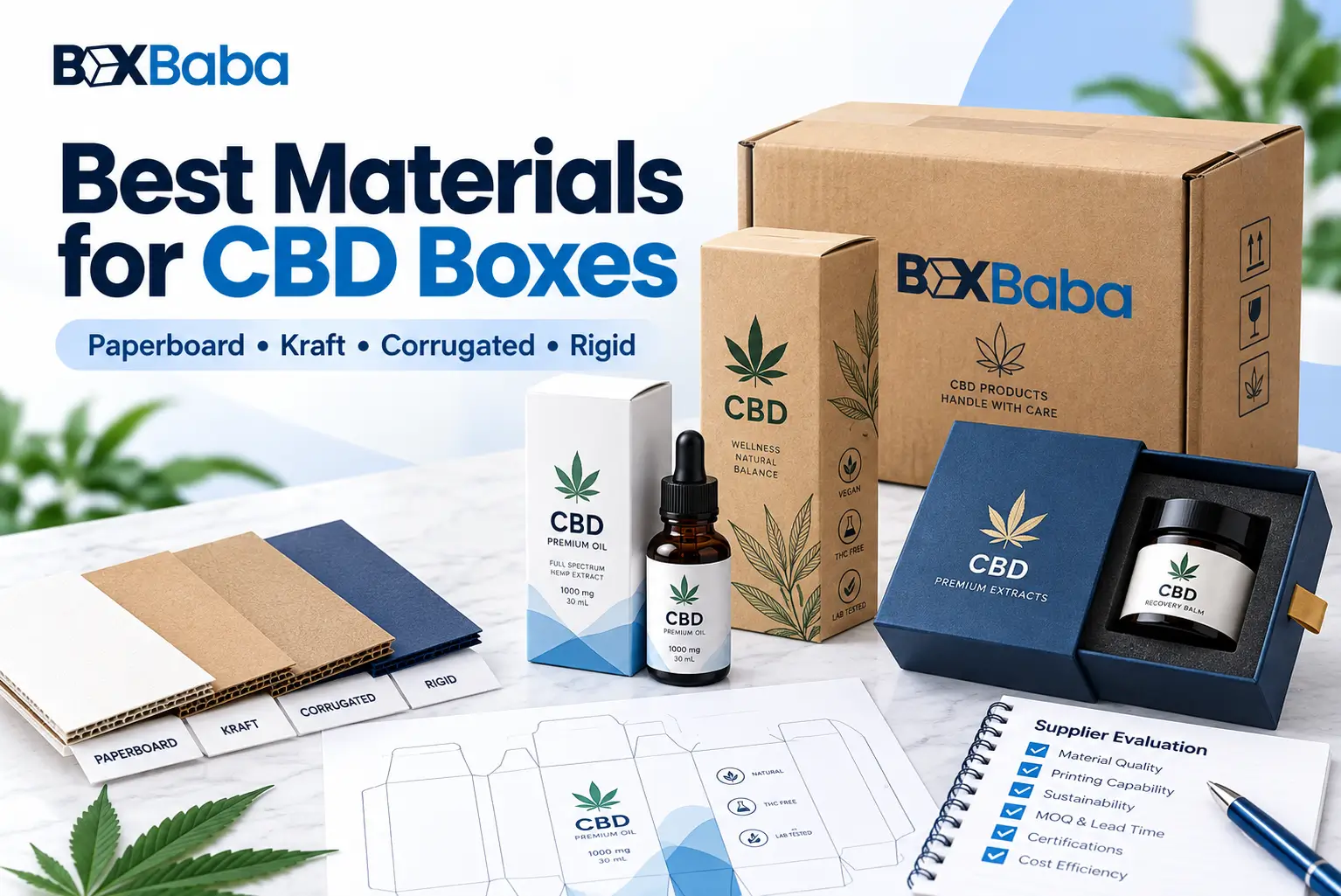
There is no single best material for every CBD box.
The appropriate material depends on what the finished package has to do.
A dropper bottle sold as an individual retail unit may use a folding paperboard carton. The same bottle shipped through ecommerce may sit inside that carton and then inside a corrugated mailer.
A natural kraft carton may use similar folding-carton construction to a white paperboard box but produce a very different print result.
A multi-product CBD presentation set may justify a wrapped rigid structure.
The material decision should therefore follow:
Finished CBD Product → Packaging Layer → Structure → Loaded Requirement → Material Direction → Printing / Finish
not:
CBD Product → Choose the Thickest or Most Premium Material
Brands planning the broader packaging system can first explore Custom CBD Boxes.
Quick Answer: Which Material Is Best for CBD Boxes?
Use the packaging role as the starting point.
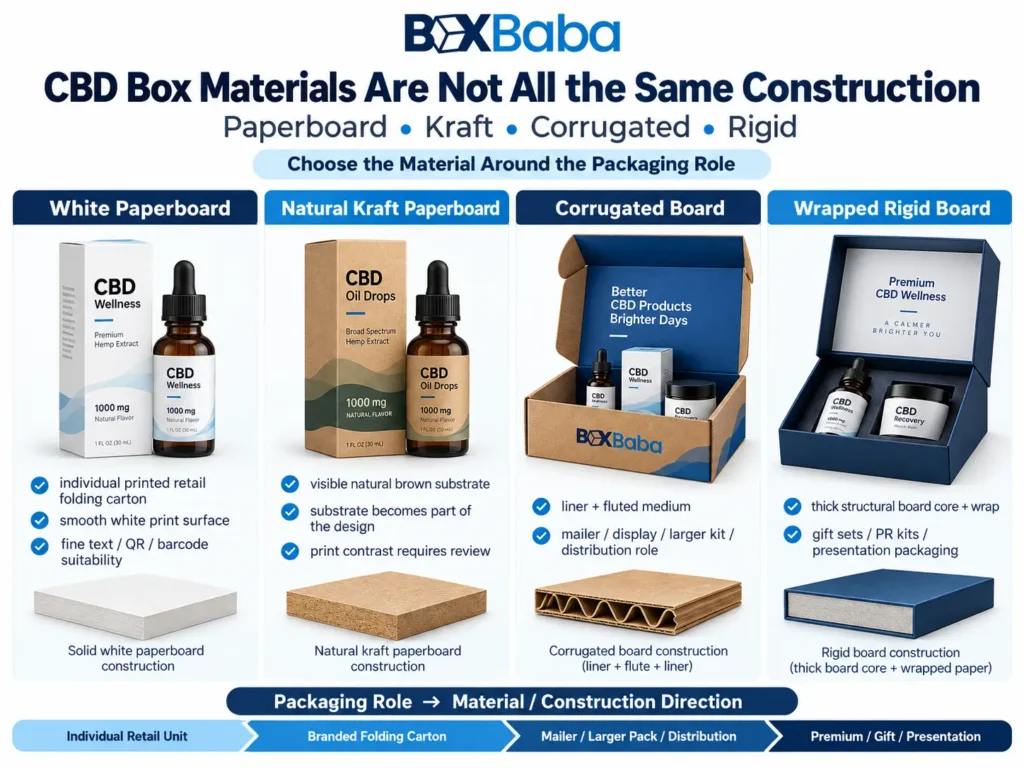
Material / Construction Direction | Strong Starting Application | Main Decision |
White paperboard | Standard printed retail folding cartons | Product load, board grade, structure, artwork |
Natural kraft paperboard | Folding cartons where the brown substrate is intentional | Print contrast, stock shade, finish |
Corrugated board | Mailers, displays, larger kits and outer ecommerce/distribution packaging | Loaded configuration, structure, liner/print requirement |
Wrapped rigid board | Gift sets, PR kits and presentation-led packaging | Presentation role, insert, storage and outer shipping needs |
These are not four completely equivalent stocks.
Natural kraft can itself be a paperboard substrate.
Corrugated is a layered construction using liners and a fluted medium.
Rigid/set-up packaging generally uses a thick structural board core with a separate paper or specialty wrap.
Understanding that distinction prevents a common sourcing problem: selecting a material name before deciding what kind of package is actually being built.
Cardboard Is Too Broad for a Final Material Specification
Buyers often use cardboard to describe almost any paper-based box.
Depending on the conversation, it might mean:
- folding paperboard;
- kraft board;
- corrugated board;
- greyboard/chipboard used in rigid packaging.
Those materials do not behave identically.
For a custom CBD packaging brief, use more precise terms such as:
White Paperboard
Natural Kraft Paperboard
Corrugated Board
Wrapped Rigid / Set-Up Construction
A more precise material description makes discussions about printing, structure, weight and finishing much clearer.
Choose the Packaging Layer Before the Material
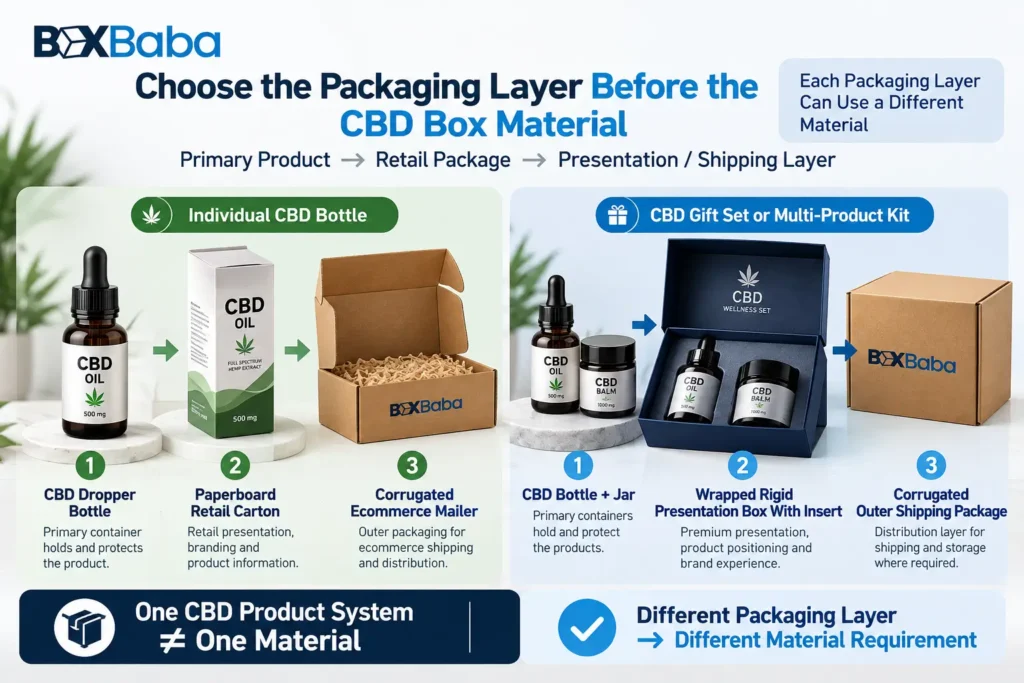
The same CBD product can use more than one material because each packaging layer has a different job.
Consider:
CBD Dropper Bottle
↓
Paperboard Retail Carton
↓
Corrugated Ecommerce Mailer
The paperboard carton provides the individual retail package.
The corrugated mailer handles a different outer-packaging role.
Another product might use:
CBD Bottle + Jar
↓
Wrapped Rigid Presentation Box With Insert
↓
Corrugated Outer Shipping Package
There is no reason every layer must use the same board family.
Material should follow the role of the package being specified.
White Paperboard for Individual CBD Retail Cartons
White paperboard is a practical starting direction for many individually boxed CBD products such as:
- dropper bottles;
- capped bottles;
- jars;
- tubes;
- lip-care products;
- cosmetic-style CBD products.
It can be converted into folding-carton structures while providing a relatively light-colored base for graphics and product information.
Where White Paperboard Has an Advantage
A light substrate can simplify artwork that depends on:
- fine typography;
- white space;
- light brand colors;
- detailed graphics;
- QR codes;
- barcodes;
- dense information panels.
That does not mean every white board produces the same print result.
The final result can still depend on:
- board grade;
- coating;
- print process;
- ink coverage;
- finish.
White cardstock should therefore be treated as a broad material direction rather than one fixed technical specification.
White Paperboard Is Not Automatically Suitable for Every Load
A standard folding carton should not automatically be selected for:
- a heavy glass jar;
- several bottles;
- a large kit;
- an outer parcel-shipping role.
A heavier product may require changes to:
- board specification;
- bottom structure;
- internal support;
- outer packaging.
It does not automatically require a rigid box.
Material and structure should be evaluated together.
Natural Kraft Paperboard: Same Carton Family, Different Substrate Direction
A useful comparison is often not:
Paperboard vs Kraft
but:
White Paperboard vs Natural Kraft Paperboard
Both can be used in folding-carton applications.
The major difference is that the natural brown substrate becomes a visible part of the finished design.
Brands specifically interested in kraft constructions can explore Custom Kraft Boxes.
When Natural Kraft Makes Sense for CBD Packaging
Natural kraft can suit packaging where the unbleached/brown appearance intentionally supports the visual direction.
Examples may include selected:
- CBD oils;
- balms;
- topical products;
- lip care;
- botanical-style product lines;
- minimalist wellness packaging.
The reason to choose kraft should be based on the desired material appearance and packaging specification, not on an assumption that every CBD or hemp product should look natural or rustic.
Printing on Kraft Is Different From Printing on White Board
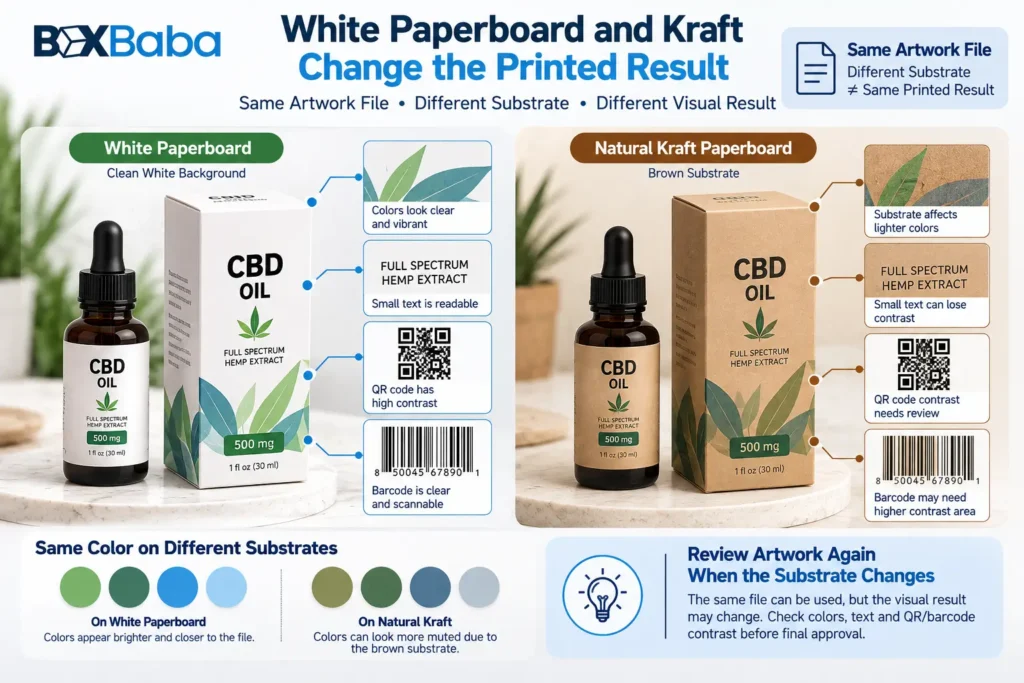
The color of the board becomes part of the artwork.
A design created for bright white stock can change when transferred to natural kraft.
Potential considerations include:
- reduced contrast for some colors;
- changes in apparent color;
- natural board showing through unprinted areas;
- readability of small text;
- barcode and QR-code contrast.
Therefore:
Same Artwork File + Different Substrate ≠ Guaranteed Same Printed Result
If a project switches from white board to natural kraft, review the artwork for the selected substrate rather than treating the change as purely structural.
Kraft Appearance Does Not Prove Sustainability
A brown paper surface can communicate a natural visual style.
It does not, by appearance alone, prove:
- recycled content;
- recyclability;
- biodegradability;
- compostability;
- FSC certification;
- plastic-free construction.
The completed package may also include:
- coatings;
- laminates;
- windows;
- adhesives;
- inserts;
- labels.
Those components can affect what environmental claims are appropriate.
Use:
Actual Material Specification + Supporting Documentation → Environmental Claim
not:
Brown Package → Eco-Friendly
If environmental positioning is important to the project, ask for the actual stock and documentation before approving marketing claims.
Jars are commonly shorter and broader than dropper bottles.
That geometry can make a single jar inherently more stable inside a close-fitting carton.
Direct Fit May Be Appropriate When
- the jar has a broad footprint;
- the outer carton is correctly sized;
- movement is limited;
- the package contains only one jar;
- no particular orientation is required.
Evaluate an Insert When
- the jar sits inside a larger presentation box;
- several products share the package;
- the jar is relatively heavy;
- an accessory needs its own position;
- presentation requires the jar to remain precisely centered.
Measure the complete closed jar rather than the body alone because the lid may create the maximum width.
For jar-specific packaging, explore Custom CBD Jars.
Corrugated Board for Mailers, Kits, Displays & Distribution Layers
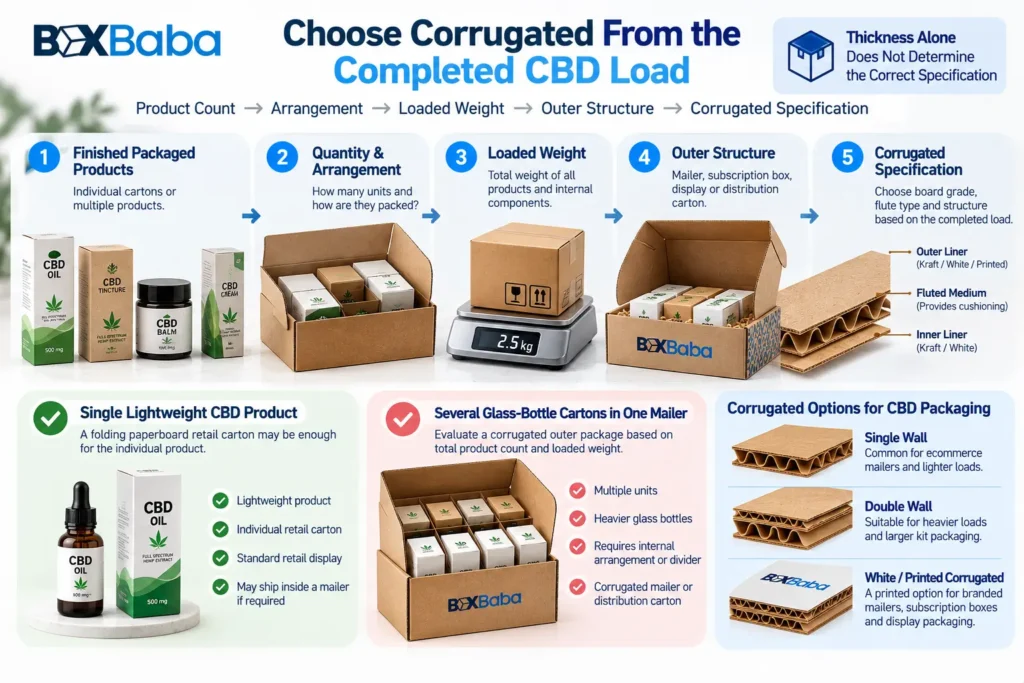
Corrugated board uses liner material combined with a fluted medium.
That gives it a different construction from an ordinary folding paperboard carton.
For CBD packaging, corrugated becomes particularly relevant when the project involves:
- ecommerce mailers;
- subscription packaging;
- larger multi-product kits;
- PR packages;
- point-of-sale displays;
- wholesale or distribution cartons.
For those applications, explore Custom Corrugated Boxes.
Corrugated Should Be Chosen From the Completed Load
Do not choose corrugated merely because it is physically thicker than folding paperboard.
Start with:
Finished Packaged Products
↓
Quantity / Arrangement
↓
Loaded Weight
↓
Outer Structure
↓
Corrugated Specification
A small individually boxed CBD lip balm may not require corrugated as its retail carton.
A mailer holding multiple glass-bottle cartons creates a different requirement.
The packaging layer changes the material decision.
Corrugated Is Not Only a Brown Shipping Carton
Corrugated board can be used in:
- printed ecommerce mailers;
- presentation kits;
- subscription boxes;
- displays;
- larger retail formats;
- distribution cartons.
Surface and printing expectations can vary considerably among those applications.
A plain distribution case and a full-color PR mailer can both use corrugated construction while requiring different:
- liner surfaces;
- printing approaches;
- artwork;
- finishing.
Do not assume one corrugated specification or flute direction works for every CBD project.
The correct construction depends on the completed package.
Corrugated & CBD Information Panels
CBD packaging can require substantial buyer-approved information, including:
- product identity;
- directions;
- warnings;
- barcode;
- QR code;
- SKU information.
If those elements appear directly on a corrugated structure, the liner and printing approach need to support the required readability and scanability.
This is particularly relevant to:
- subscription boxes;
- displays;
- multi-product kits;
where the corrugated package may also carry customer-facing artwork.
Wrapped Rigid Board for Presentation-Led CBD Packaging
Rigid or set-up boxes are a different construction from ordinary folding cartons.
They generally use:
Thick Structural Board Core
Printed / Colored / Textured / Specialty Wrap
The core creates the main form of the package.
The wrap creates much of the visible surface.
Rigid packaging can use structures such as:
- lid-and-base;
- drawer;
- magnetic closure;
- shoulder-neck;
- book-style;
- collapsible rigid formats.
For commercial options, explore Custom Rigid Boxes.
When Rigid Packaging Is Worth Considering
Rigid packaging makes more sense when the package has a strong presentation role, such as:
- CBD gift sets;
- PR kits;
- launch packaging;
- corporate sets;
- multi-product collections;
- selected high-value presentation formats.
For example:
Dropper Bottle + Jar + Applicator
may justify a rigid presentation structure when the products need an organized reveal and fitted interior.
By contrast, one lightweight bottle sold individually at retail may gain little structural value from a large rigid set-up box.
The presentation requirement should justify the construction.
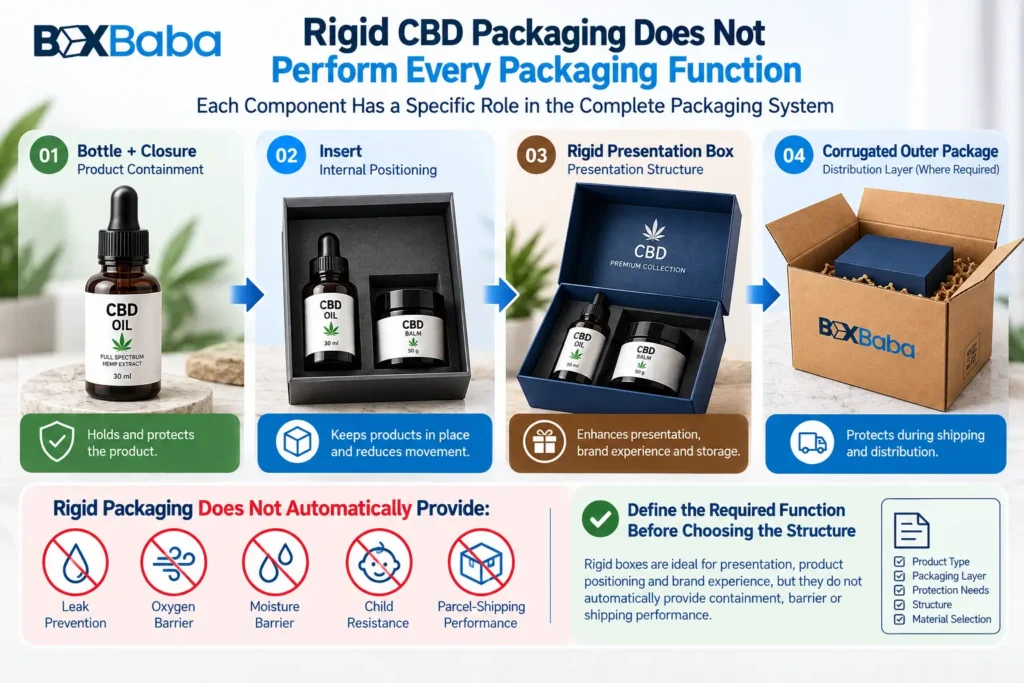
Rigid Does Not Automatically Mean More Protective
Rigid board can create a substantial, formed package.
That does not automatically establish:
- parcel-shipping performance;
- drop resistance;
- leak prevention;
- moisture barrier;
- oxygen barrier;
- child resistance.
Those functions can belong to different parts of the packaging system.
For example:
Bottle / Closure
→ product containment.
Insert
→ internal positioning.
Rigid Box
→ presentation structure.
Corrugated Outer Package
→ distribution layer where required.
Avoid using rigid as a substitute for defining the actual performance requirement.
Standard & Collapsible Rigid Formats Behave Differently
A conventional set-up rigid box normally retains its finished shape.
That can increase:
- storage volume;
- inbound shipping volume;
- warehouse space.
A collapsible rigid structure can behave differently.
Therefore, when considering rigid packaging, confirm whether the proposed construction is:
- standard set-up;
- collapsible;
- another assembly format.
The term rigid box alone does not describe the complete logistics requirement.
Paperboard vs Kraft vs Corrugated vs Rigid
Decision Factor | White Paperboard | Natural Kraft Paperboard | Corrugated | Wrapped Rigid |
Individual retail carton | Strong starting direction | Strong when brown substrate is intentional | Usually reserved for larger structural formats | Often unnecessary |
Fine product information | Good starting surface depending on stock/print | Requires careful contrast planning | Depends on liner and print process | Depends on selected wrap |
Brown natural substrate | No | Yes | Available with kraft-facing liners | Possible through selected wrap |
Ecommerce outer layer | Usually remains the inner retail carton | Usually remains the inner retail carton | Strong starting direction | Often requires separate distribution review |
Larger multi-product kit | Depends on load and structure | Depends on load and structure | Strong option | Strong presentation option |
Gift / PR presentation | Possible | Possible | Possible | Strong option |
Ships/stores flat | Common for folding cartons | Common for folding cartons | Common for many formats | Depends on construction |
Child-resistant by material alone | No | No | No | No |
Direct formulation barrier by material alone | No | No | No | No |
These are starting directions—not universal BoxBaba material specifications.
CBD Container Type Changes the Material Decision
Material should be selected around the finished container, not simply the CBD product name.
Dropper Bottle
A single lightweight bottle may use:
White Paperboard Retail Carton
or:
Natural Kraft Folding Carton
depending on the structure and artwork direction.
For bottle-specific cartons, see CBD Dropper Bottle Boxes.
If the same product ships through ecommerce, a corrugated outer layer may be evaluated separately.
Glass Jar
A broad plastic jar and a heavy glass jar create different loads even when their fill capacities are similar.
Review:
- finished jar dimensions;
- lid profile;
- filled weight;
- bottom structure;
- insert need.
A heavy jar does not automatically mean rigid packaging.
Tube or Lip-Care Product
Small tubes and sticks are often relatively lightweight and may be well suited to folding paperboard or natural kraft cartons.
A rigid box should have a clear presentation or structural purpose rather than being selected simply because the product is positioned as premium.
Gummies or Capsules in a Jar
For a jar sold with a secondary carton, material selection should follow the finished jar rather than the number of gummies or capsules.
The direct product-contact package and the secondary carton remain separate packaging layers.
Multi-Product CBD Set
A multi-product set creates a combined load.
Now compare:
- paperboard presentation structures;
- corrugated kits;
- rigid set-up boxes;
according to the complete arrangement.
This is where the product count, loaded weight and insert become more influential.
Outer Material & Insert Material Do Not Need to Match
A packaging system can use:
White Paperboard Carton + Folded Paperboard Holder
Rigid Box + Paperboard Insert
Corrugated Mailer + Divider System
The outer material and internal-support material solve different problems.
Use:
Outer Package → External Structure / Presentation
and:
Insert → Internal Positioning / Separation
as separate decisions.
If the project already requires a fitted holder, divider or cavity, explore Printed Boxes with Inserts.
Do not move to rigid construction simply because an internal fit problem exists that could be solved by a better carton or suitable insert.
Material Does Not Create Child Resistance
A packaging material does not become child-resistant simply because it is:
- thicker;
- rigid;
- corrugated;
- kraft.
Child resistance is a separate packaging-function question.
Therefore:
Rigid Board ≠ Child-Resistant
Corrugated Board ≠ Child-Resistant
Kraft Paperboard ≠ Child-Resistant
If a product needs child-resistant functionality, establish the applicable packaging system separately from material selection.
Secondary CBD Boxes Are Not Automatically Product Barriers
Most of the materials in this guide are being discussed as secondary or outer packaging.
They normally surround a finished:
- bottle;
- jar;
- tube;
- pouch.
The primary package and closure handle direct containment of the formulation.
Do not automatically describe an ordinary secondary carton as providing:
- liquid containment;
- oxygen barrier;
- moisture barrier;
- aroma barrier;
- formulation preservation;
- direct food-contact protection.
Use:
CBD Formulation → Primary Container
and:
Secondary Box → Presentation / Information / Structural Packaging
as distinct roles.
CBD Packaging Can Use Different Materials at Different Sales Stages
One CBD SKU can legitimately use several materials in one complete system.
For example:
Glass Dropper Bottle
↓
White Paperboard Retail Carton
↓
Corrugated Ecommerce Mailer
Another may use:
CBD Gift Set
↓
Rigid Presentation Box
↓
Corrugated Distribution Carton
That does not mean corrugated is better than rigid or paperboard.
Each material is solving a different packaging-layer problem.
Information-Panel Requirements Can Influence Material Selection
CBD packaging may need usable space for buyer-approved:
- ingredients;
- directions;
- warnings;
- net quantity;
- QR codes;
- barcodes;
- other product information.
Material selection affects how easily those elements can be presented.
For example:
Natural Kraft + Low-Contrast Small Copy
may be a poor artwork combination even when the brown substrate fits the branding direction.
Likewise, a reflective or highly textured surface may require additional review where:
- small text;
- QR codes;
- barcodes;
are important.
Material is therefore not only a structural choice.
It is also part of the information-delivery system.
Choose Material & Finish Together
Finishing options can include:
- matte;
- gloss;
- soft-touch;
- foil stamping;
- embossing;
- debossing;
- spot UV.
The exact appearance and compatibility can vary according to:
- material;
- surface;
- coating;
- print process;
- artwork;
- structure.
A finish approved conceptually on white board should not automatically be assumed to look identical on natural kraft or a specialty rigid-box wrap.
Establish the material direction before final appearance is approved.
Changing the Substrate Can Change the Printed Result
A screen proof can review:
- text;
- layout;
- artwork position.
It cannot fully reproduce every physical interaction among:
- stock color;
- ink;
- coating;
- texture;
- decorative finish.
This becomes especially relevant when moving:
White Paperboard → Natural Kraft
or:
Folding Carton → Specialty Rigid Wrap
Where the substrate itself materially affects appearance, review the appropriate physical reference before final production approval.
Fill Capacity Does Not Select the Material
Do not choose board from:
- ml;
- oz;
- gummy count;
- capsule count.
For example:
30 ml Plastic Bottle
and:
30 ml Heavy Glass Dropper Bottle
have equal nominal capacity but can create different:
- loaded weight;
- closure geometry;
- structural demands.
Use:
Finished Container + Filled Weight + Structure → Material
not:
30 ml → Standard Board
There Is No Universal CBD Box GSM, Pt or Flute
CBD does not create a universal paperboard thickness or corrugated flute requirement.
Final material specification can depend on:
- dimensions;
- filled weight;
- span;
- box structure;
- bottom design;
- insert;
- number of products;
- sales channel;
- production method.
Do not copy a competitor:
- pt range;
- GSM value;
- flute;
- rigid-board thickness;
and treat it as a universal CBD specification.
The board specification should be developed around the actual project.
Material Name Alone Does Not Determine Cost
Material affects cost, but a packaging quote can also change with:
- dimensions;
- box structure;
- order quantity;
- number of SKUs;
- print coverage;
- finishes;
- inserts;
- assembly;
- shipping format.
Therefore:
Kraft ≠ Automatically Cheapest
and:
Rigid ≠ Automatically Most Expensive in Every Possible Project
Use:
Complete Packaging Specification → Quote
rather than attempting to price the project from the material name alone.
Choosing Materials Across a Multi-SKU CBD Line
A CBD brand can maintain visual consistency without forcing every product and packaging layer onto one board construction.
For example:
Dropper Bottle
→ white paperboard carton.
Topical Gift Set
→ wrapped rigid presentation box.
Ecommerce Order
→ corrugated mailer.
The family can still remain visually connected through:
- typography;
- logo placement;
- color system;
- graphics;
- finish strategy.
Structural and material consistency are not the same thing as brand consistency.
Common CBD Material Selection Mistakes
Mistake | Better Decision |
Treating kraft and paperboard as opposite structural families | Recognize natural kraft as a paperboard substrate direction |
Choosing material before defining the packaging layer | Establish retail, presentation or distribution role first |
Selecting rigid simply because the product is premium | Use rigid when presentation/construction justifies it |
Assuming thicker always means better | Match specification to structure and load |
Using corrugated for every CBD package | Separate retail and distribution requirements |
Treating brown kraft as proof of sustainability | Verify the material and supporting claims |
Assuming rigid is shipping-tested | Evaluate complete distribution packaging separately |
Assuming material creates child resistance | Evaluate CR functionality separately |
Choosing material from ml or oz | Use finished container and filled weight |
Copying generic GSM/pt/flute values | Develop the project-specific specification |
Approving finish before substrate | Review material and finish together |
Ignoring insert requirements | Treat outer material and internal support as one packaging system |
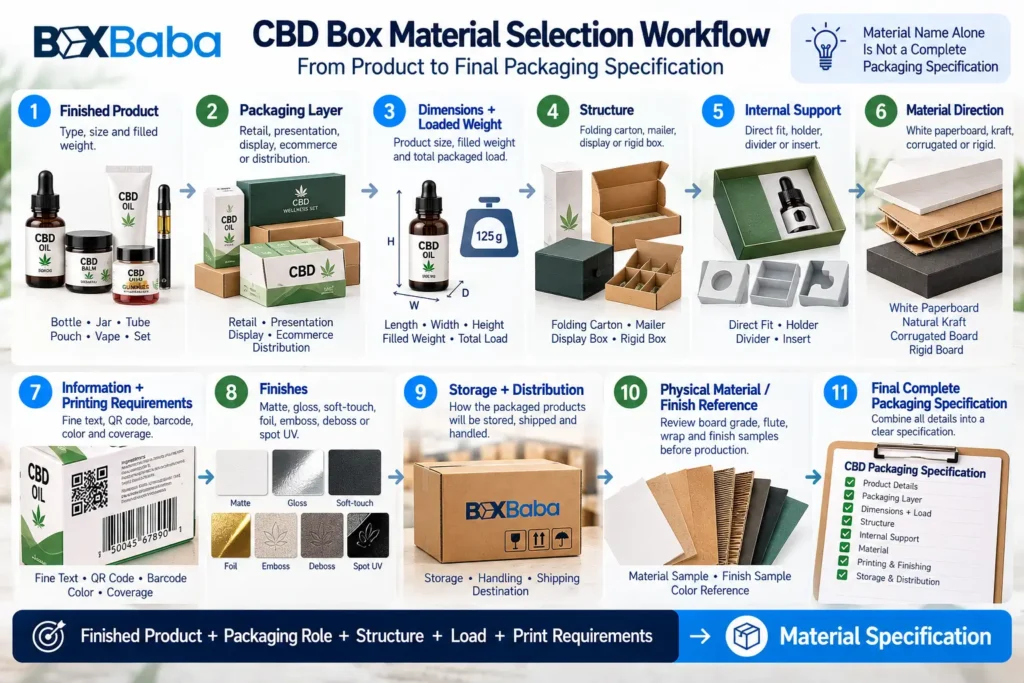
CBD Material Selection Workflow
Use this sequence:
- Confirm the Finished Product
Bottle, jar, tube, pouch or multi-product set. - Identify the Packaging Layer
Retail carton, presentation package, display, ecommerce mailer or distribution box. - Confirm Dimensions & Loaded Weight
Use the complete finished package. - Establish the Structure
Folding carton, mailer, display or rigid presentation structure. - Confirm Internal Support
Determine whether a holder, divider or fitted insert is required. - Choose the Material Direction
White paperboard, natural kraft paperboard, corrugated or rigid/set-up construction. - Review Information & Printing Requirements
Fine copy, color, QR codes, barcodes and other artwork. - Review Finishes
Evaluate their compatibility with the intended surface. - Consider Storage & Distribution
Especially for rigid and corrugated formats. - Review an Appropriate Physical Reference Where Needed
Particularly when substrate or finish materially affects appearance. - Finalize the Complete Packaging Specification
Material name alone is not a complete manufacturing specification.
What Should You Send BoxBaba for a Material Recommendation?
Prepare:
- CBD product type;
- finished primary-container type;
- maximum dimensions;
- filled weight;
- quantity;
- number of SKUs;
- packaging layer;
- sales channel;
- preferred structure if known;
- insert requirement;
- artwork status;
- information-panel requirements;
- printing requirements;
- desired finishes;
- delivery destination.
Instead of asking:
Which material is best for my CBD box?
send a brief such as:
We have one filled glass dropper bottle per retail carton. The dimensions and filled weight are final. We need detailed full-color artwork, a QR code and barcode, and the retail carton will later ship inside a separate ecommerce mailer.
That gives the packaging team enough context to compare materials for the actual packaging role.
Choosing CBD Box Materials From BoxBaba
The best material is the one that matches the finished product and packaging layer.
A practical starting framework is:
White Paperboard
→ individual printed retail folding cartons.
Natural Kraft Paperboard
→ folding cartons where the brown substrate is intentionally part of the design.
Corrugated
→ mailers, displays, larger kits and distribution-oriented packaging.
Wrapped Rigid
→ presentation-led gift sets, PR kits and selected multi-product packaging.
Explore the broader Custom CBD Boxes range once the product and packaging role are defined.
For kraft-specific formats, see Custom Kraft Boxes.
For larger fluted structures, explore Custom Corrugated Boxes.
For presentation-led set-up packaging, see Custom Rigid Boxes.
BoxBaba CBD packaging currently starts from 100 units, with artwork support and samples available. Standard production is generally 5–9 business days after artwork approval, with free shipping across the USA.
When requesting a quote, provide the product dimensions, filled weight, structure, quantity, required packaging layer, material direction, artwork and finishing requirements.
Choose the material because it performs the required packaging job—not because one name sounds more premium, natural or protective.
Frequently Asked Questions
What is the best material for CBD boxes?
There is no universal best material. White paperboard commonly suits individual retail folding cartons, natural kraft can suit brown-substrate designs, corrugated is useful for many mailer and distribution roles, and rigid construction is more appropriate for selected presentation packaging.
Is kraft different from paperboard?
Kraft is not automatically a separate structural family. Natural kraft paperboard can be used to produce folding cartons, just as white paperboard can.
Is kraft better than white paperboard for CBD boxes?
Neither is universally better. White paperboard provides a lighter printing base, while natural kraft makes the brown substrate part of the finished design.
Is kraft CBD packaging automatically eco-friendly?
No. Brown appearance does not establish recycled content, recyclability, biodegradability, compostability or certification. Environmental claims should follow the actual completed material specification and supporting evidence.
Is paperboard suitable for CBD dropper bottles?
It can be. The final selection depends on the finished bottle dimensions, closure, filled weight, structure and internal-support requirements.
Do heavy glass CBD bottles require rigid boxes?
No. Weight should trigger structural review, but a suitable folding-carton and insert configuration may work for some products.
Is corrugated packaging only for shipping?
No. Corrugated can also be used for printed mailers, displays, subscription boxes, presentation kits and other larger structural formats.
Is rigid packaging stronger than corrugated?
That comparison is too broad. Rigid/set-up packaging and corrugated construction perform different structural and presentation roles. The correct choice depends on the complete package.
Does rigid packaging protect CBD from oxygen or moisture?
Not automatically. Direct formulation containment and barrier functions normally belong to the primary container and closure.
Does thicker material always make a better CBD box?
No. Thickness is only one material attribute. Structure, product dimensions, loaded weight, inserts and packaging layer also matter.
Does rigid or kraft material make a CBD package child-resistant?
No. Child resistance is a separate packaging-function requirement and cannot be inferred from the material alone.
Can a CBD retail carton and ecommerce package use different materials?
Yes. A paperboard retail carton can sit inside a corrugated ecommerce mailer because the two packages perform different roles.
Is there a standard GSM or paperboard thickness for CBD boxes?
No. There is no universal CBD packaging GSM, pt value or corrugated flute. The specification should be developed around the actual product and structure.
Can the same artwork be moved from white paperboard to kraft unchanged?
The file can technically be reused, but the visual result may change because the natural substrate affects contrast and apparent color. Review the artwork for the selected material before approval.
Can multiple CBD SKUs use the same material?
Yes, when the material works with their individual structures and loads. They do not need identical box dimensions or structures merely to share the same material direction.
What should I provide BoxBaba for a material recommendation?
Provide the finished container type, dimensions, filled weight, packaging layer, structure, quantity, insert requirements, artwork, information-panel needs, finishes and delivery destination.