
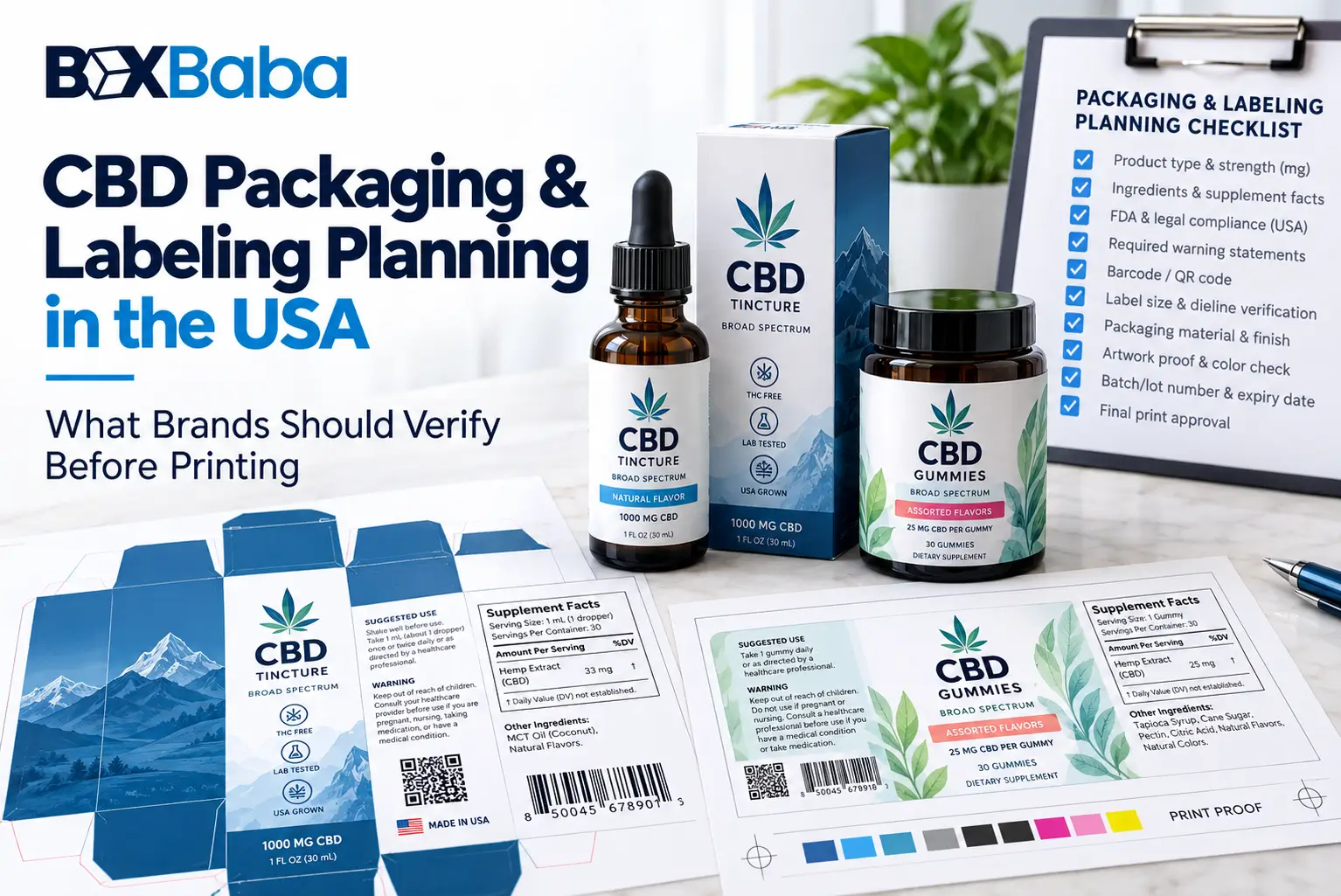
CBD packaging and labeling requirements in the USA cannot be reduced to one universal checklist for every CBD product.
A cosmetic cream, dropper oil, gummy product, topical, capsule product and other hemp-derived product can involve different regulatory questions even when every package carries the letters CBD.
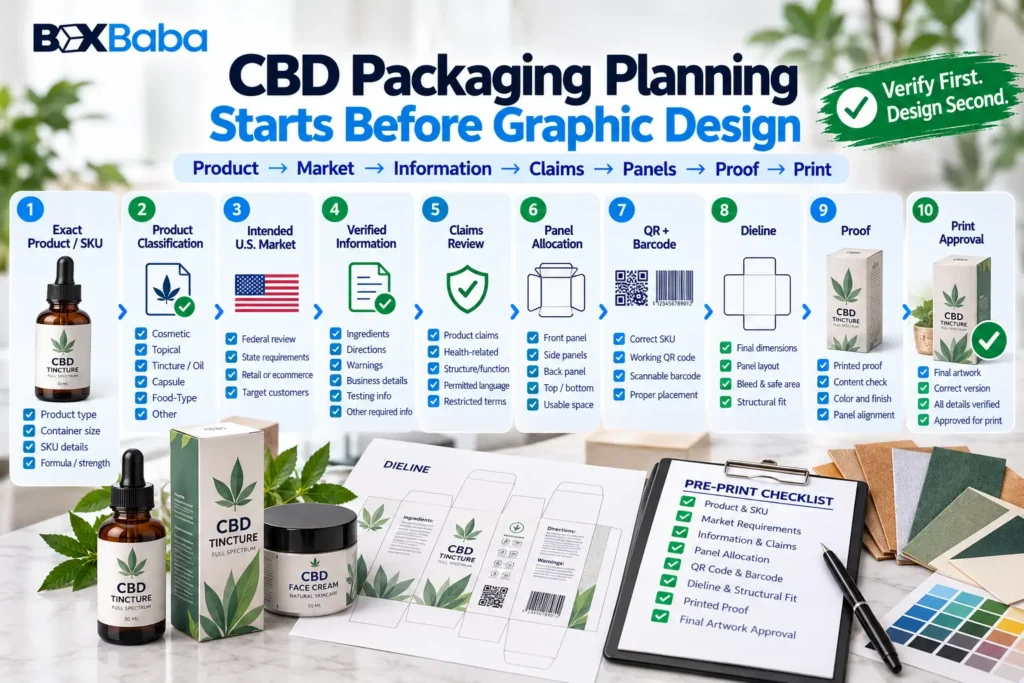
For packaging teams, the practical sequence is:
Product Classification → Intended Market → Verified Information → Claims Review → Panel Allocation → QR / Barcode Planning → Dieline → Proof → Print Approval
The purpose of this guide is not to determine whether a CBD product is legally marketable.
It explains what a brand should verify before approved information is converted into printed packaging.
That distinction matters because a carton can fit the product perfectly while the artwork is still unsuitable for production.
For brands that have already established their product and packaging direction, BoxBaba Custom CBD Boxes category provides commercial packaging routes for bottles, jars, cosmetics, displays and other CBD formats.
Important: This article provides packaging and pre-print planning information, not legal advice. Federal and state requirements can change and can depend on the finished product, ingredients, intended use, claims and destination market.
What Should a CBD Brand Verify Before Printing?
Before approving CBD packaging artwork, confirm:
- The exact finished product and SKU.
- How the product is being classified and marketed.
- Which federal, state and channel requirements apply.
- Which information belongs on the primary package, secondary carton or both.
- Whether ingredients, quantity, directions, warnings and business information are final where applicable.
- Whether all product and health-related claims have been reviewed.
- Whether cannabinoid, THC, testing, batch or other market-specific information needs a defined location.
- Whether the barcode belongs to the correct SKU.
- Whether the QR code scans and opens the correct destination.
- Whether child-resistant and tamper-evident requirements have been evaluated separately from printed labeling.
- Whether the final dieline provides enough usable panel space.
- Whether the exact approved artwork version matches the SKU and intended market.
The packaging manufacturer can print approved information accurately.
The brand remains responsible for determining which information and claims are appropriate for the finished product.
There Is No Universal U.S. CBD Label Template
A professionally designed package does not itself establish whether the product can lawfully be marketed.
FDA currently treats CBD differently according to the product category and intended use.
For example, FDA current published position is that CBD and THC products are excluded from the federal dietary-supplement definition under the agency existing interpretation.
FDA also maintains a separate federal position concerning CBD added to food.
Cosmetics follow a different framework, while therapeutic or disease-related intended uses can create drug-regulation issues.
The packaging takeaway is:
Label Format ≠ Product Classification
and:
Professional Packaging ≠ Product Authorization
Resolve the product question before releasing the packaging.
Important 2026 Federal Hemp Change: Check Long-Run Packaging Inventory
Brands printing packaging in September 2026 also need to consider an upcoming federal change.
A new federal statutory definition of hemp is scheduled to take effect on November 12, 2026.
The change may affect whether some hemp-derived cannabinoid products continue to fall within the federal hemp definition depending on their cannabinoid content and how particular cannabinoids are produced.
That creates a practical packaging question:
Will this packaging inventory still be used after November 12, 2026?
If yes, verify the product federal status under the new framework before committing to a long packaging run.
Do not assume that packaging approved under the current September 2026 framework will automatically remain appropriate for every product after the effective date.
This article should be reviewed again before that date.
Step 1: Confirm the Exact Product Before Building Artwork
Do not start the final carton artwork from a vague product category such as:
CBD Product
Start from the exact saleable SKU.
Confirm:
- product name;
- formulation type;
- intended use;
- primary container;
- variant;
- strength or other relevant product distinction;
- intended sales states;
- sales channel.
These inputs affect the information that may need to be verified before printing.
The same brand can therefore require different artwork-review processes for different CBD products.
CBD Cosmetics Need a Cosmetic-Specific Review
A CBD product intended for cleansing, beautifying, promoting attractiveness or altering appearance may fall within the cosmetic framework when its intended use supports that classification.
For cosmetics, the outer folding carton can be an important labeling surface.
Relevant information can include, where applicable:
- product identity;
- net quantity;
- ingredient declaration;
- name and place of business;
- directions;
- warnings;
- other required information.
FDA uses the concept of the principal display panel, or PDP, for the portion of the outer package most likely to be displayed or examined under customary retail conditions.
The other usable surfaces can function as information panels.
This makes carton planning directly relevant to labeling.
A small CBD cream jar may have very little printable area on the primary container, while its folding carton provides much more usable surface.
Brands developing CBD beauty products can explore Custom CBD Cosmetic Boxes after their product and information requirements are established.
Cosmetic Appearance Does Not Override Drug-Type Claims
A package can look like cosmetic packaging while the claims create a different regulatory question.
For example, statements about diagnosing, curing, treating, mitigating or preventing disease should not be treated as ordinary cosmetic copy merely because the product is sold in a beauty-style jar.
The artwork team should therefore avoid embedding unreviewed therapeutic claims into:
- headlines;
- badges;
- icons;
- foil callouts;
- embossed statements;
- side-panel copy.
Use:
Proposed Claim → Review → Approved Wording → Artwork
not:
Design → Print → Claim Review Later
CBD Food-Type & Ingestible Products Require Separate Product Review
A brand should not assume that using familiar food-label formatting resolves the federal CBD question.
The product legal and regulatory status must be considered separately from the physical label layout.
That distinction can be summarized as:
Correctly Formatted Label ≠ Automatically Lawful Product
For packaging planning, do not begin a large carton run for a gummy, edible or similar product merely because the designer has created a complete-looking ingredient or nutrition-style panel.
Confirm the product and market position first.
Dietary-Supplement-Style Artwork Does Not Determine Product Status
Similarly, adding a Supplement Facts-style panel does not itself determine whether the finished CBD product can lawfully be marketed as a dietary supplement.
Product classification should come before the artwork template.
Do not use:
Existing Supplement Template → CBD Artwork
as proof that the product belongs in that regulatory category.
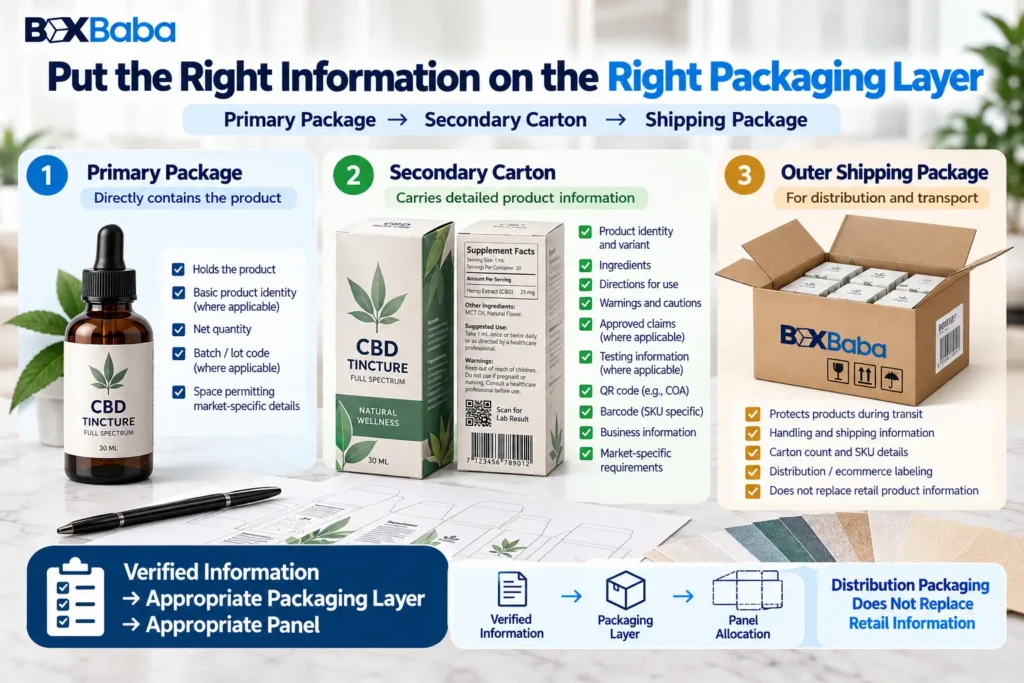
Step 2: Determine Which Packaging Layer Carries Each Information Block
A CBD product can use several packaging layers.
For example:
Primary Bottle → Secondary Folding Carton → Ecommerce Shipping Box
Each layer performs a different function.
Primary Package
The primary package directly contains or holds the product.
Examples include:
- bottle;
- jar;
- tube;
- pouch;
- stick container.
Secondary Carton
The folding carton surrounds the finished primary package.
It can provide usable space for approved:
- product information;
- directions;
- warnings;
- ingredients;
- barcode;
- QR code;
- business information;
- branding.
Outer Shipping Packaging
The shipping package primarily serves distribution.
Do not assume the shipping carton can replace information that belongs on the individual retail product package.
The useful planning relationship is:
Verified Information → Appropriate Packaging Layer → Appropriate Panel
Step 3: Create One Approved Information Inventory Per SKU
Before the designer starts placing content on panels, prepare one master information inventory for the exact SKU.
A useful pre-print inventory can include:
Information Type | What to Verify |
Product identity | Exact approved product name / description |
Net quantity | Final quantity declaration where applicable |
Ingredients | Final approved ingredient information where applicable |
Directions | Final approved use directions where applicable |
Warnings | Applicable approved warnings |
Business information | Correct responsible business information |
Product claims | Final approved marketing / cosmetic / other claims |
Cannabinoid information | Market-specific information where applicable |
THC information | Applicable disclosure requirements |
Barcode | Final barcode for the exact SKU |
QR code | Correct final destination |
Batch / lot | Whether variable information needs reserved space |
Dates | Best-by, expiry or other applicable variable information |
Testing / COA | Whether and how testing information will be referenced |
Market version | State, retailer or channel-specific artwork where needed |
This is a verification framework, not a declaration that every listed item is legally required on every CBD product.
The brand needs to determine what applies to the particular SKU.
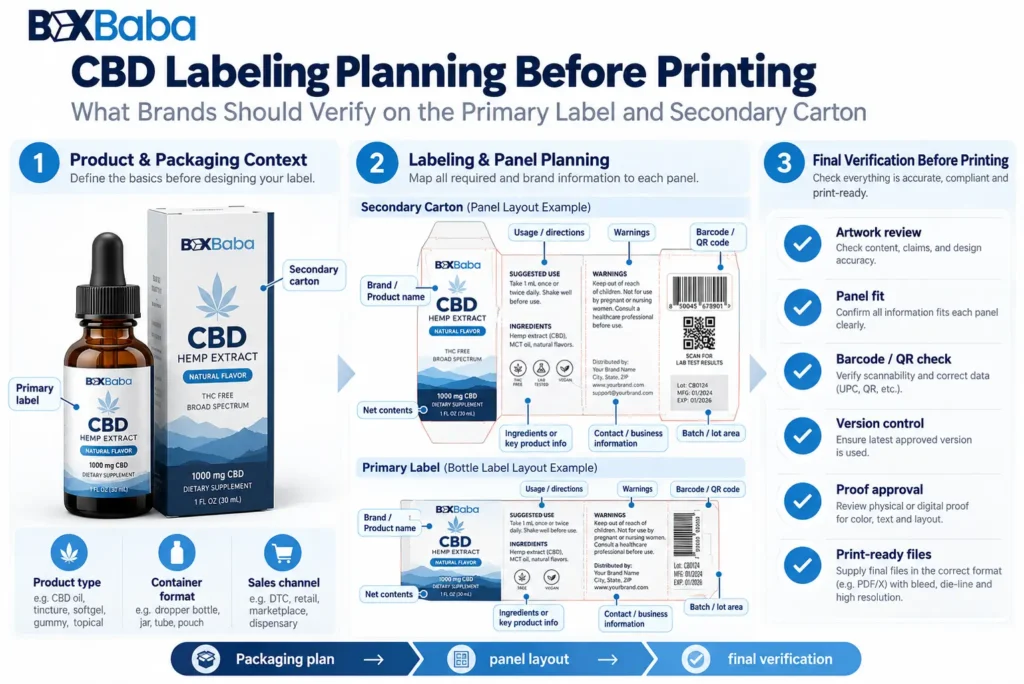
Step 4: Map Verified Information to the Carton Panels
Do not allow branding to consume the entire carton before functional information is allocated.
First determine:
- which panel faces the shopper;
- which panels provide the most readable area;
- whether a window removes useful space;
- where long information blocks can fit;
- where variable data will be applied;
- where scannable codes can remain flat.
For a folding carton, a practical starting map might look like this:
Panel | Possible Packaging Role |
Front | Product identity, variant and other approved front-facing information |
Side A | Ingredient / product information |
Side B | Directions / warnings |
Back | Extended information, business information, QR code |
Bottom | Barcode, SKU or variable-production area |
Top | Secondary brand / product identifier |
This is a packaging-planning example—not a universal legal placement rule.
Actual placement should follow the requirements applying to the finished product.
Physical Fit & Information Fit Are Two Different Requirements
A box can fit the container and still be wrong for the product.
Consider:
Physical Fit
Does the bottle, jar or tube fit properly?
and:
Information Fit
Can all approved product information be presented clearly on usable panels?
Both need to work.
This becomes particularly important for:
- small dropper bottles;
- narrow lip balm cartons;
- mini cosmetic jars;
- slim tubes.
Do not automatically solve a space problem by shrinking every line of text.
First review:
- carton structure;
- usable panel area;
- panel hierarchy;
- window size;
- decorative coverage.
Step 5: Review Claims Before They Become Part of the Design
Claims can appear in more places than ordinary body copy.
Review:
- product headlines;
- badge text;
- icons;
- front-panel statements;
- testimonial quotes;
- certification-style graphics;
- efficacy claims;
- QR landing-page claims.
FTC has previously taken enforcement action against companies making unsupported CBD health and disease claims.
The relevant packaging principle is:
A claim remains a claim even when it is turned into graphic design.
Do not assume it becomes acceptable because it appears:
- inside a gold badge;
- beside a medical-style symbol;
- in a testimonial;
- in small print.
Claims should be approved before final design.
Testimonials Require the Same Claim Review
A customer quotation can create the same problem as direct brand copy if it communicates an unsupported health or therapeutic result.
Review packaging testimonials for claims such as:
- disease treatment;
- guaranteed pain relief;
- medical outcomes;
- scientifically proven efficacy;
- other health outcomes.
The packaging team should evaluate the complete communication, not only official product-description paragraphs.
Step 6: Plan Readability Before Decorative Finishes
Required or important information should remain readable after the carton is printed and folded.
Check:
- text contrast;
- panel width;
- line length;
- folds;
- glue areas;
- window openings;
- foil;
- embossing;
- spot UV;
- other decorative effects.
For example:
Foil on a logo
may be a decorative choice.
Foil across a barcode or QR code
may interfere with reliable scanning.
Likewise, an ingredient block squeezed across a crease may be technically present in the artwork but poorly planned in the finished package.
Functional information should have priority over decorative density.
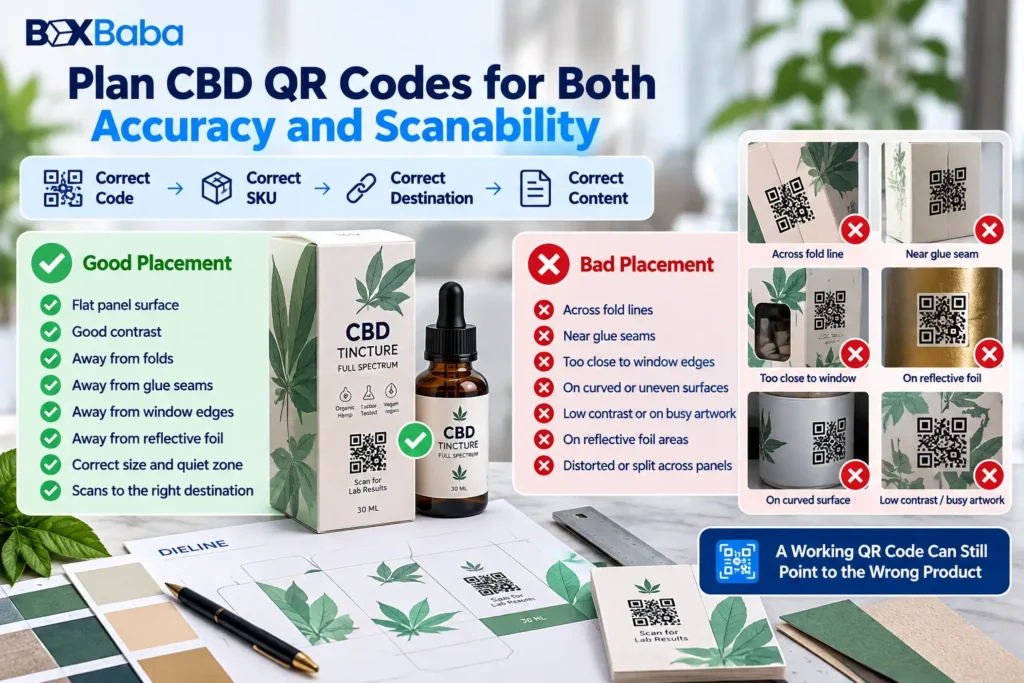
Step 7: Reserve QR-Code Space Before Final Artwork
A QR code may connect physical packaging to:
- product information;
- testing documents;
- certificate-of-analysis information;
- instructions;
- batch-specific resources;
- other approved destinations.
Before printing, verify:
Correct Code → Correct SKU → Correct Destination → Correct Content
Then test the printed package.
Keep the code:
- on a usable panel;
- away from folds where practical;
- away from glue seams;
- away from window edges;
- away from reflective finishing that may impair scanning.
A QR code should not automatically be treated as a substitute for physical information that must remain on the package.
Step 8: Reserve Barcode & Variable-Data Areas
Barcodes, SKUs and lot codes are not the same thing.
Barcode
Typically identifies the commercial product for scanning.
SKU
Identifies the product or variant in the company own system.
Batch / Lot Information
Identifies a production batch where used.
Date Information
May change between production runs where applicable.
Reserve their locations before the decorative layout is finalized.
The packaging manufacturer should not invent:
- UPCs;
- GTINs;
- SKUs;
- lot codes;
- product-specific regulatory data.
Those should come from the brand approved systems.
Step 9: Define the Intended Market Before Approving One Large Artwork Run
CBD and hemp-derived product rules can differ by jurisdiction.
Before approving a national print run, ask:
Where will this exact SKU actually be sold?
Review whether the intended markets require differences in:
- warnings;
- cannabinoid information;
- THC-related information;
- testing references;
- symbols;
- QR strategy;
- physical packaging functionality;
- other product-specific information.
The packaging strategy might use:
- one verified artwork version;
- multiple market-specific versions;
- another legally reviewed variable-information approach.
The packaging supplier should not decide which strategy is legally sufficient.
The brand should define it before bulk printing.
Step 10: Keep Labeling, Tamper Evidence & Child Resistance Separate
These are different packaging questions.
Labeling
→ concerns printed or graphic product information.
Tamper Evidence
→ concerns visible evidence that a package or closure has been opened or interfered with.
Child Resistance
→ concerns the performance of a specific package system where child-resistant packaging is required.
Therefore:
Correct Label ≠ Child-Resistant Package
Tamper-Evident Feature ≠ Child-Resistant Feature
Child-Resistant Package ≠ Correct Labeling
If flexible pouches are being considered for a product that requires restricted access, BoxBaba Child-Resistant Mylar Bags guide explains the CPSC/PPPA distinction and documentation questions in greater detail.
Keep detailed child-resistant analysis outside this article so the pre-print topic remains focused.
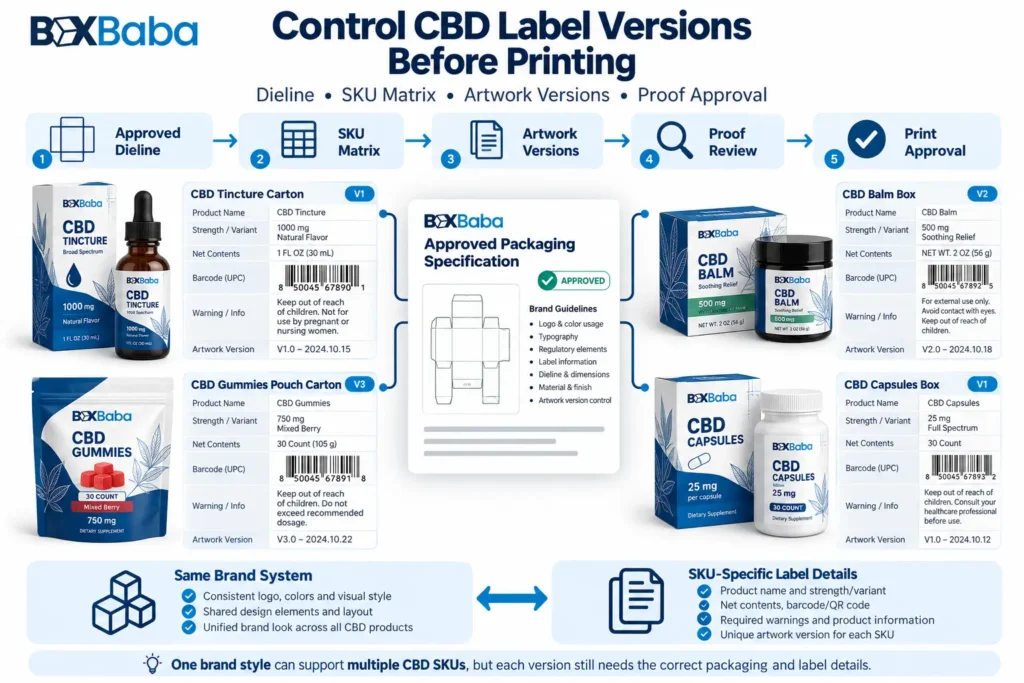
Step 11: Finalize the Structure Before Final Artwork Placement
The final dieline determines:
- cut lines;
- crease lines;
- glue areas;
- closures;
- printable panels;
- window positions;
- opening direction.
Approved information should be mapped onto that real structure.
Use:
Verified Product Information → Final Structure → Dieline → Panel Map → Artwork
not:
Completed Artwork → Guess the Carton Structure
For general structural-file fundamentals, use BoxBaba Dieline in Packaging guide.
Step 12: Review the Folded Package, Not Only the Flat Artwork
A flat PDF can appear correct while the assembled box reveals problems.
Before production approval, check:
- Which panel becomes the front?
- Is every text block oriented correctly?
- Does a flap hide information?
- Does a window cut into an information area?
- Is a barcode still flat?
- Does foil interfere with a QR code?
- Does an ingredient or warning block sit too close to a crease?
- Is the correct variant visible when the product is stocked?
A physical structural sample can be useful where panel orientation, fit or opening behavior requires additional confirmation.
Example: CBD Cosmetic Carton
Consider a CBD cosmetic cream packed in a small jar.
The primary jar may provide very little printable surface.
The secondary carton can provide more room for buyer-approved:
- product identity;
- net quantity;
- ingredients;
- directions;
- warnings where applicable;
- business information;
- barcode;
- QR code.
The packaging workflow becomes:
Finished Jar → Required Information → Carton Structure → Panel Map → Artwork
The carton therefore needs both:
Physical Fit
and:
Information Fit
For CBD beauty packaging built around jars, tubes or bottles, brands can explore Custom CBD Cosmetic Boxes after their information requirements are confirmed.
Example: CBD Dropper Bottle Carton
A CBD dropper project creates two different packaging tasks.
Structural Task
The carton needs to account for the finished:
- bottle;
- shoulder;
- dropper;
- closure;
- bulb.
Information Task
The available panels need to accommodate the brand approved:
- product information;
- quantity;
- directions;
- warnings;
- QR;
- barcode;
- other applicable content.
Solving the bottle geometry does not automatically solve the information layout.
For product-specific carton development, see CBD Dropper Bottle Boxes.
Premium Finishes Come After Functional Panel Planning
Before applying:
- foil;
- holographic foil;
- spot UV;
- embossing;
- debossing;
- matte or gloss lamination;
- soft-touch finishing;
check how the finish interacts with the functional information.
Decorative treatments should not compromise:
- barcodes;
- QR codes;
- warnings;
- ingredient information;
- fine text;
- variable-data zones.
A finish is successful when it supports the design without interfering with the package information function.
CBD Packaging Pre-Print Verification Checklist
Use the following review before releasing artwork:
Check | Pre-Print Question |
Exact SKU | Is this the correct finished product? |
Product classification | Has the product category / intended use been reviewed? |
Federal status | Has current federal treatment been checked? |
November 12, 2026 change | Will this inventory be used after the new hemp definition takes effect? |
Destination market | Which states / channels will receive this SKU? |
Product identity | Is the final approved name correct? |
Quantity | Is the applicable quantity statement final? |
Ingredients | Is the final approved information supplied? |
Directions | Are applicable directions final? |
Warnings | Have applicable warnings been reviewed? |
Claims | Have product and health-related claims been approved? |
Business information | Is responsible-party information correct? |
Cannabinoid / THC information | Has applicable market-specific information been reviewed? |
Barcode | Is it assigned to the correct SKU? |
QR code | Does it scan to the correct final destination? |
Testing reference | Is the correct SKU / batch relationship established? |
Variable data | Is appropriate space reserved? |
Child resistance | Has physical package performance been reviewed separately if applicable? |
Tamper evidence | Has it been reviewed separately from child resistance? |
Dieline | Is this the final structural version? |
Panel orientation | Does the assembled box read correctly? |
Finishes | Do they avoid functional code / information conflicts? |
Version control | Is this clearly the approved production file? |
This checklist supports pre-print planning.
It is not a legal certification.
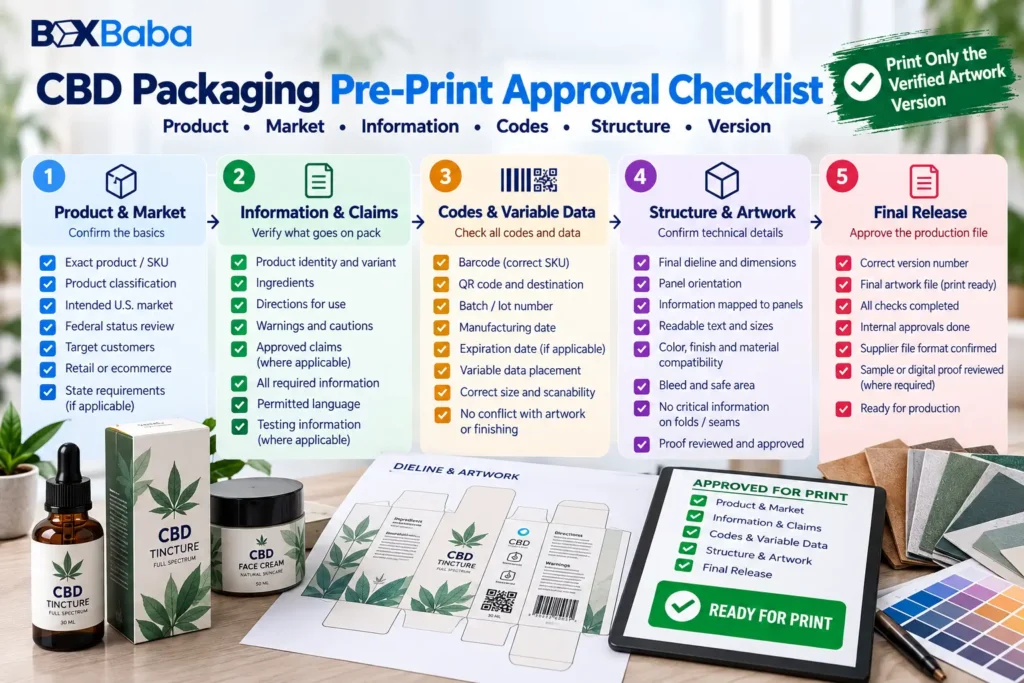
Keep Artwork Version Control Simple
The file released for printing should be unmistakable.
Use a naming system that identifies:
- product;
- SKU;
- carton;
- artwork version;
- approval status.
For example:
CBD-CREAM-01_CARTON_V4_APPROVED
is more useful than:
final-final-cbd-box-new.ai
Before every production release, confirm that the approved artwork still matches:
- the exact SKU;
- current product information;
- current barcode;
- current QR destination;
- intended market.
Detailed repeat-order controls can be handled in the separate CBD packaging reorder guide.
Common CBD Packaging & Labeling Mistakes
Copying a Competitor Label
Another brand may have a different product, formulation, intended use or market.
Better: Verify the actual SKU.
Treating CBD as One Regulatory Category
CBD products can fall into different product contexts.
Better: Determine the product and intended use first.
Designing Before Building the Information Inventory
Important content can end up squeezed into narrow or unsuitable panels.
Better: Freeze information first.
Treating a Familiar Label Format as Product Authorization
A food-style, cosmetic-style or supplement-style panel does not itself determine product legality.
Better: Resolve the product question before design.
Embedding Unreviewed Health Claims Into Branding
Claims can appear inside badges, testimonials or icons.
Better: Approve claim language before artwork.
Treating QR Codes as a Replacement for All Physical Information
Digital access does not automatically replace on-package requirements.
Better: Determine what must remain physical.
Using the Wrong QR Destination
A code may scan correctly but still point to the wrong SKU or outdated document.
Better: Verify the destination before print.
Placing Barcodes Across Folds or Finishes
The code can become harder to scan.
Better: Reserve an appropriate panel before decoration.
Ignoring the November 12, 2026 Federal Change
Long-run packaging may remain in use after the new federal hemp definition takes effect.
Better: Verify the product status before committing to inventory that extends beyond the effective date.
Forgetting Market-Specific Artwork
One design should not be assumed to suit every intended jurisdiction.
Better: Define the market before production.
Treating Child Resistance & Tamper Evidence as the Same Thing
They are different packaging functions.
Better: Evaluate each independently.
Reusing an Old File Without Review
The product, claims, QR, barcode or market requirements may have changed.
Better: Revalidate the artwork before reprinting.
What Should a Brand Give BoxBaba Before Final Artwork Production?
Provide:
- finished product / SKU;
- primary-container dimensions;
- quantity per artwork version;
- approved product copy;
- approved barcode assets;
- QR code and final destination;
- market-specific artwork versions;
- brand assets;
- dieline / structure information where available;
- material and finish direction;
- variable-data requirements;
- artwork status;
- delivery destination.
BoxBaba can then focus on the packaging-production questions, including:
- structure;
- dieline;
- usable panel space;
- artwork placement;
- barcode / QR positioning;
- printing;
- finish compatibility;
- samples;
- production.
BoxBaba does not replace the brand responsibility for reviewing product classification, claims, ingredients, warnings or market-specific legal requirements.
From Verified Information to Custom CBD Packaging
Once the product-information review is complete, the packaging project can follow:
Verified Product
↓
Verified Market
↓
Approved Information
↓
Final Structure
↓
Dieline
↓
Panel Mapping
↓
Artwork
↓
Proof
↓
Production
Brands ready to move into physical packaging can explore Custom CBD Boxes.
BoxBaba orders currently start from 100 units, with artwork support and samples available. Standard production is generally 5–9 business days after artwork approval, with free shipping across the USA.
Final Takeaway
CBD packaging planning should begin before graphic design.
The most useful sequence is:
Product
↓
Market
↓
Applicable Requirements
↓
Approved Information
↓
Claims Review
↓
Panel Planning
↓
Dieline
↓
Proof
↓
Production
A printed carton cannot correct:
- the wrong product classification;
- an unsupported claim;
- the wrong market version;
- an outdated QR destination;
- an incorrect barcode;
- missing approved information.
And in 2026, brands planning long-run hemp-derived cannabinoid packaging should also consider whether the inventory will remain in use after the scheduled November 12, 2026 federal hemp-definition change.
Verify the product and market first.
Then build the packaging around information that has already been approved.
Frequently Asked Questions
Is there one universal CBD label requirement for every product in the USA?
No. Requirements can depend on the product type, intended use, claims and market. CBD cosmetics, food-type products, topicals and other hemp-derived products should not automatically use the same label template.
Can a brand copy another CBD company packaging information?
That is not a reliable method. Another product may have different ingredients, claims, intended use, classification or destination markets.
Are CBD cosmetics treated the same as other CBD products?
No. Cosmetics operate under the laws and regulations applicable to cosmetics, while intended therapeutic or disease-related claims can create additional regulatory issues.
Can a CBD product become a dietary supplement because it uses a Supplement Facts panel?
No. The artwork format does not determine the product regulatory status.
Does a normal food label make a CBD food product federally lawful?
No. Product status and label formatting are separate questions.
Why is November 12, 2026 important for CBD and hemp packaging?
A new federal statutory definition of hemp is scheduled to take effect on that date. Brands planning packaging inventory that will remain in use afterward should verify whether the finished product continues to fit the applicable federal hemp definition before printing large quantities.
Should health claims be reviewed before carton artwork is approved?
Yes. Claims should be reviewed before they become part of headlines, badges, testimonials, icons or other packaging graphics.
Can a QR code replace all information printed on CBD packaging?
Not automatically. The brand needs to determine which information must remain physically present on the finished package.
Can a QR code link to testing or COA information?
Technically yes, but the brand should verify that the destination, SKU/batch relationship and use of the QR code are appropriate for the particular product and market.
Where should a barcode be placed?
Use an appropriate flat panel away from folds, glue seams, window edges and finishes that could impair reliable scanning.
Is child-resistant packaging the same as tamper-evident packaging?
No. They describe different packaging functions and should be evaluated separately.
Does child-resistant packaging automatically make the product label correct?
No. Package performance and printed information are separate compliance questions.
Should CBD packaging be reviewed again before a reorder?
Yes. Confirm that the product, claims, information, barcode, QR destination, market version and approved production file remain current before reprinting.
What should BoxBaba receive before final packaging production?
Provide the exact product/SKU, finished container information, approved copy, barcode and QR assets, quantity by artwork version, market-specific requirements, artwork status, material/finish direction and delivery destination.