
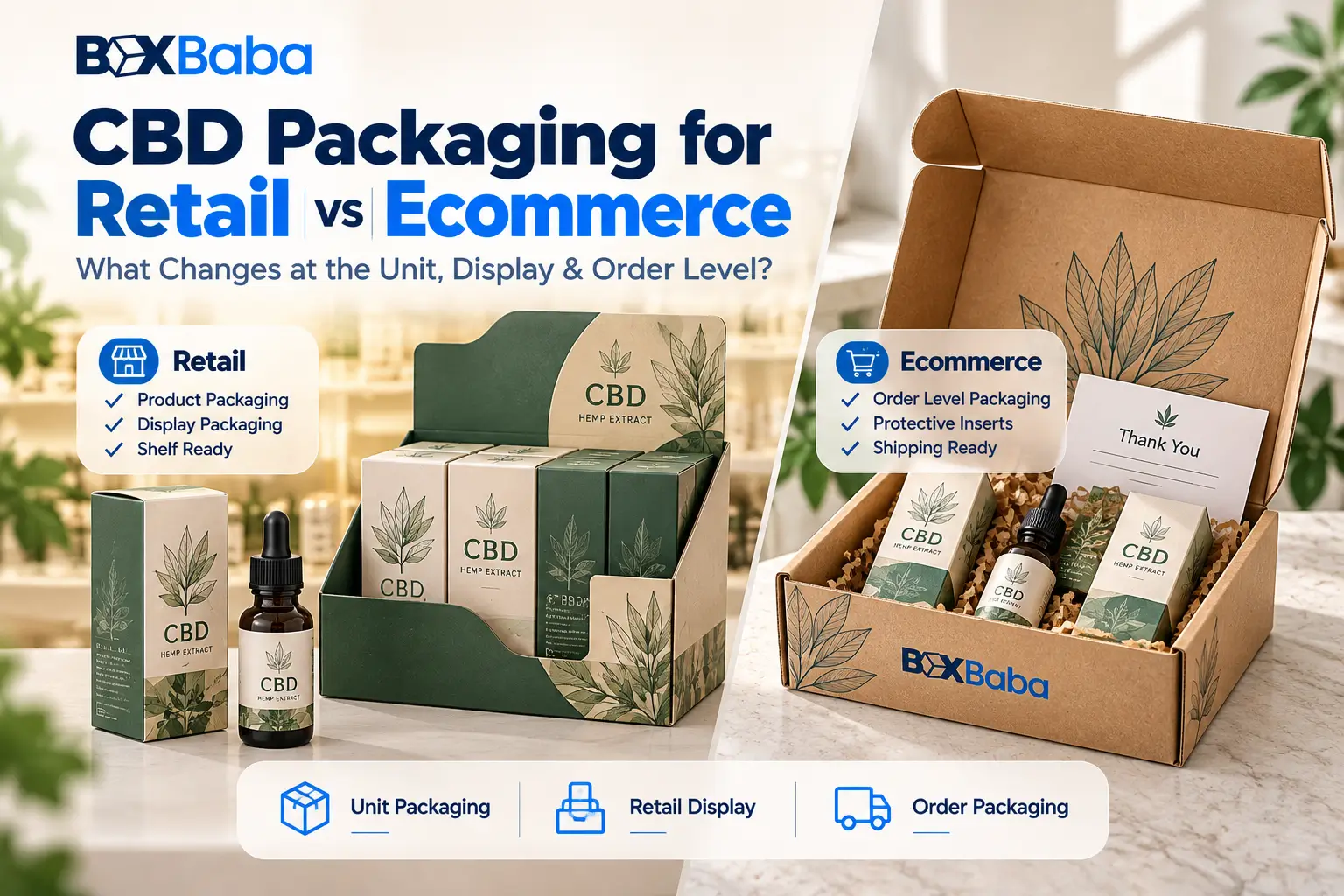
CBD packaging for retail and ecommerce should not automatically start with two different product boxes.
The first question is:
Which packaging layer is actually changing?
A CBD dropper bottle may use the same printed retail carton whether it is purchased from a store shelf or a website.
What changes online may be the package outside that saleable unit.
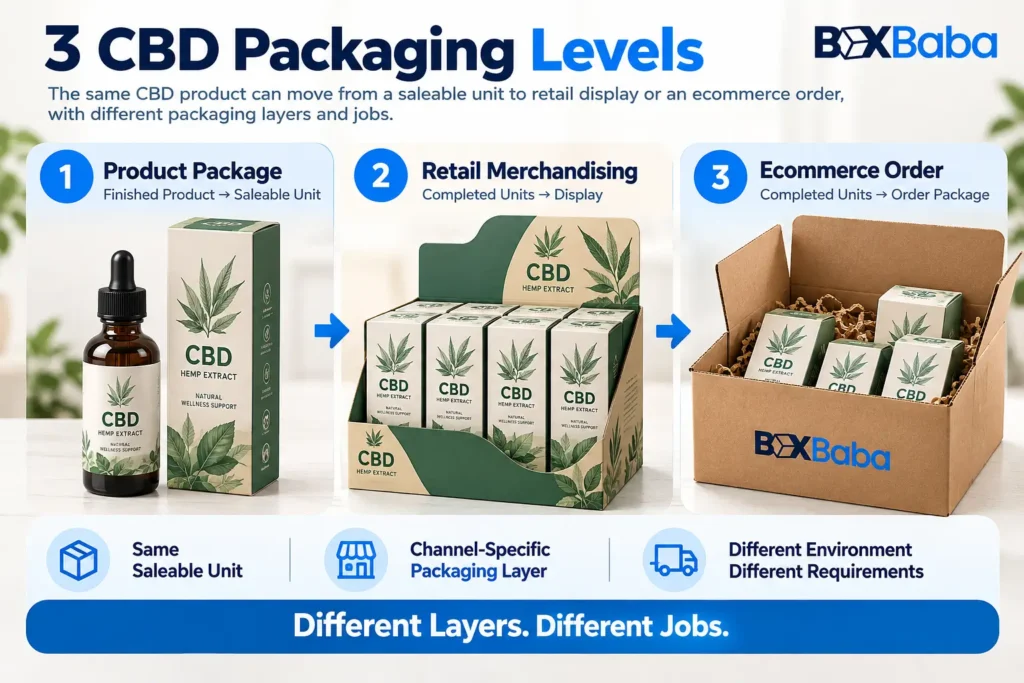
A useful CBD channel model is:
Finished CBD Product → Saleable Unit → Retail Display OR Ecommerce Order
That creates three different packaging levels:
Product Level
→ the individual CBD SKU.
Retail Merchandising Level
→ how completed units are presented in stores.
Ecommerce Order Level
→ how completed saleable units are arranged and shipped to one customer.
For brands still defining the individual product package, start with Custom CBD Boxes.
What Should Change Between Retail & Ecommerce CBD Packaging?
Keep the product-level package consistent where the product and requirements remain the same.
Change the channel-specific layer when the retail or ecommerce environment creates a different packaging job.
Packaging Decision | Retail | Ecommerce |
Main packaging entity | Individual saleable SKU | Completed customer order |
Unit carton | Customer-facing product package | Can often remain unchanged |
Display | May organize several completed units | Normally not required |
Outer package | Depends on store/distribution setup | Mailer or shipping carton often evaluated |
Measurement basis | Finished individual product | Completed saleable units in final order arrangement |
Internal support | Positions one product or retail set | Organizes/separates completed order items |
Loaded weight | Product + unit package | Full order + supports + outer package |
Artwork role | Product identity and approved information | Delivery/brand/fulfillment role |
CR/tamper function | Product-specific requirement | Does not disappear simply because the SKU is sold online |
Quote input | Product-level specification | Product packaging + typical order configuration |
The practical rule is:
Product Requirements Stay With the SKU
while:
Merchandising & Distribution Requirements Follow the Channel
Three Packaging Levels Matter More Than Two Sales Channels
Thinking only in terms of:
Retail Box
vs:
Ecommerce Box
can hide the real structure of the packaging system.
Level 1: Product Package
The saleable CBD unit can include:
Primary Container
and, where used:
Secondary Retail Carton
The primary container might be:
- dropper bottle;
- jar;
- tube;
- pouch;
- pump;
- stick container.
The retail carton may provide:
- printed product identity;
- information panels;
- barcode;
- QR code;
- branding;
- physical organization around the primary package.
Level 2: Retail Merchandising Package
Several saleable units may then enter:
- counter display;
- shelf display;
- dispenser;
- retail case configuration.
The display is developed around the completed saleable units, not the bare CBD containers.
Level 3: Ecommerce Order Package
One customer order may contain:
- one unit;
- several units of one SKU;
- mixed CBD products;
- subscription items;
- gift sets.
The outer package is therefore developed around the finished order configuration.
This distinction prevents one packaging layer from being asked to do every job.
What Should Usually Stay the Same Across Channels?
If the actual product remains unchanged, try to preserve the product-level specification where practical.
Possible shared elements include:
- primary container;
- product orientation;
- retail carton;
- approved product information;
- SKU identity;
- barcode;
- QR code;
- required product-level packaging functionality.
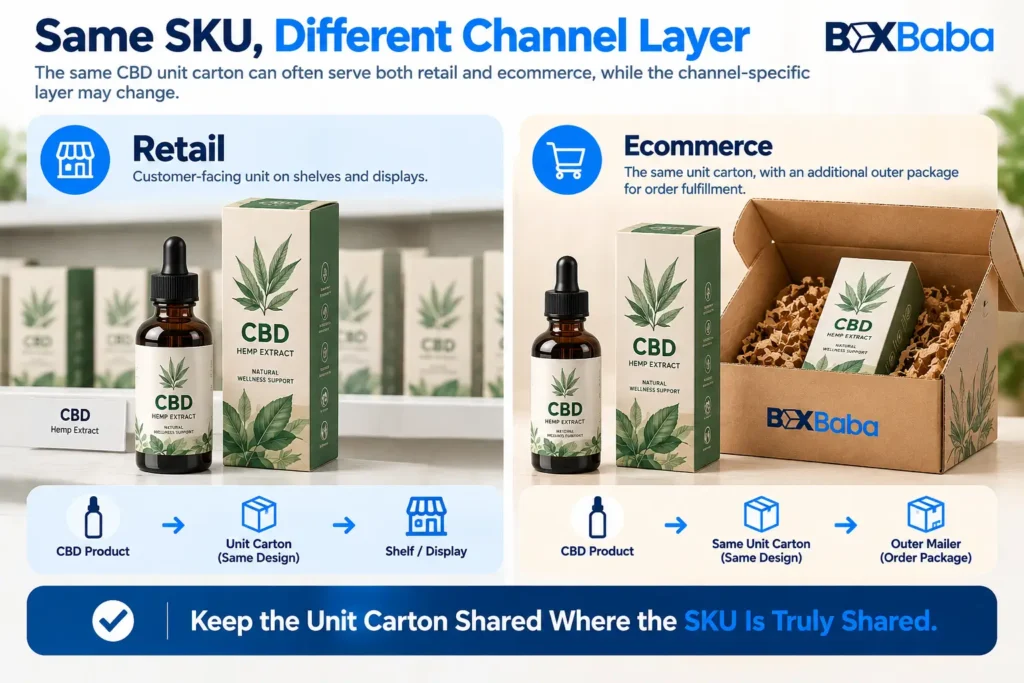
For example:
Retail
CBD Dropper Bottle
↓
Printed Retail Carton
Ecommerce
CBD Dropper Bottle
↓
Same Printed Retail Carton
↓
Order-Level Mailer
The retail carton does not need to be redesigned simply because an ecommerce layer is added outside it.
Sales Channel Does Not Reset CBD Packaging Requirements
This is particularly important for CBD and other regulated cannabinoid products.
If the individual product requires a particular:
- child-resistant function;
- tamper-evident feature;
- warning;
- approved information;
- market-specific artwork;
selling the same SKU through a website does not automatically remove that requirement.
Therefore:
Retail → Ecommerce
does not itself mean:
Child-Resistant → Standard Closure
or:
Tamper-Evident → No Tamper Feature
The applicable requirement follows the product and market.
The ecommerce mailer is an additional order/distribution layer; it should not be used to replace a required product-level packaging function without a valid basis.
For flexible pouch projects where child-resistant packaging is relevant, BoxBaba Child-Resistant Mylar Bags guide provides a deeper explanation of the packaging-function distinction.
When Should the Unit Carton Actually Change?
A channel-specific unit carton may be justified when the channel changes the saleable product configuration itself.
Examples include:
- different product count;
- retailer-specific package dimensions;
- hang-tab requirement;
- different retail display orientation;
- channel-exclusive bundle;
- different primary container;
- different product information;
- separate barcode or SKU;
- different required packaging functionality;
- online product sold without the same secondary carton.
This gives a more useful rule:
Keep the Unit Carton Shared Where the SKU Is Truly Shared
but:
Create a Variant When the Saleable Product Configuration Changes
Retail CBD Packaging Is Designed Around the Saleable Unit
Retail starts with the finished item that the shopper encounters.
That might be:
Dropper Bottle + Carton
or:
Gummy Jar
or:
CBD Pouch
or:
Jar + Carton
depending on the brand product-packaging system.
The retail packaging decision should use the actual completed saleable configuration.
Do not size or classify the retail package from:
- ml;
- oz;
- gummy count;
- capsule count.
The physical package matters.
Retail Fit Has Three Parts
For CBD retail packaging, evaluate:
Product Fit
Does the primary container fit the unit packaging correctly?
Information Fit
Is there enough usable panel space for buyer-approved information?
Retail Fit
Does the completed saleable unit work with the intended shelf, counter or display arrangement?
A box can succeed at the first requirement and fail the other two.
Retail Footprint Is a Real Packaging Variable
Increasing carton dimensions affects more than empty space around the product.
It can change:
- units across a shelf;
- display-box capacity;
- front-facing width;
- case arrangement.
Therefore:
Larger Carton ≠ Automatically Better Presentation
Only increase the package where the product, information or presentation requirement justifies it.
Retail Display Packaging Begins With Completed Units
Suppose a brand wants a counter display containing six CBD dropper cartons.
The structural input is:
6 Completed Dropper Cartons
not:
6 Bare Bottles
The display now needs to account for:
- finished carton dimensions;
- number of units;
- rows/columns;
- product orientation;
- loaded weight;
- desired front-wall height;
- retail footprint.
For a direct commercial display route, explore CBD Display Boxes.
Retail Display Quantity ≠ Ecommerce Order Quantity
This is an important distinction.
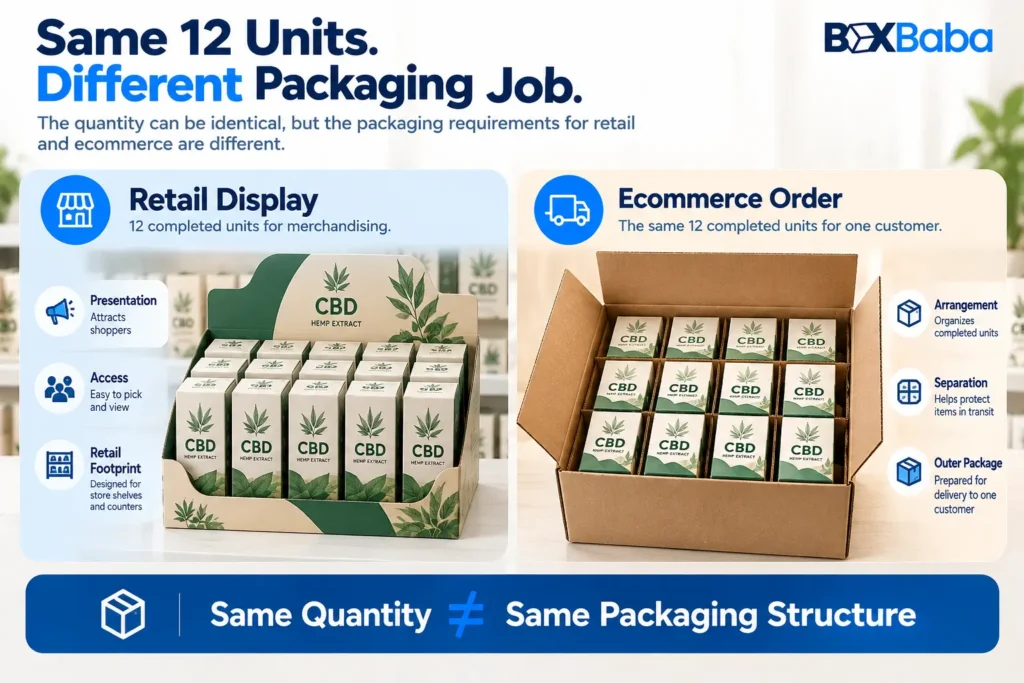
Consider:
12 CBD Cartons in a Counter Display
and:
12 CBD Cartons Purchased by One Ecommerce Customer
The quantity is identical.
The packaging problem is not.
Retail Display
The 12 units may need:
- customer-facing presentation;
- product access;
- replenishment;
- defined display footprint.
Ecommerce Order
The 12 units may need:
- shipping arrangement;
- outer carton;
- internal separation;
- fulfillment label.
Therefore:
Same Quantity ≠ Same Packaging Structure
Quantity must be interpreted in context.
Ecommerce Starts With the Finished Saleable Unit
If the CBD product will actually ship inside its retail carton, the ecommerce package should be developed around that completed carton.
Use:
Primary Product
↓
Completed Unit Carton
↓
Ecommerce Order
↓
Outer Package
Do not jump from:
Bare Bottle → Mailer Dimensions
when the bottle will never enter the mailer bare.
This avoids measuring the wrong packaging entity.
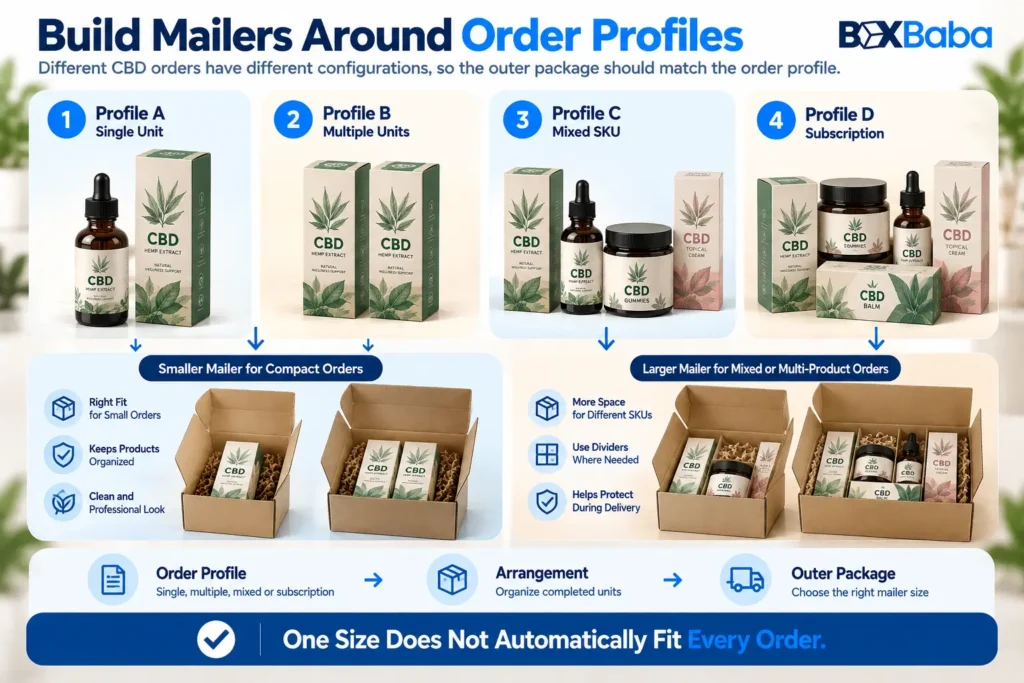
Ecommerce Is an Order-Architecture Problem
An ecommerce website can create several recurring order types.
For example:
Order Profile A
One dropper carton.
Order Profile B
Two dropper cartons.
Order Profile C
Dropper carton + gummy jar/carton + topical carton.
Order Profile D
Four-product subscription bundle.
Each profile may create a different:
- footprint;
- height;
- loaded weight;
- internal arrangement;
- outer-package requirement.
The ecommerce packaging system should therefore be planned from realistic order profiles, not only the dimensions of one SKU.
One Mailer Size May Not Suit Every Order
An ecommerce brand may be tempted to use one large mailer for:
- single-unit orders;
- bundles;
- subscriptions.
That simplifies purchasing but can create other problems.
An oversized outer package may create:
- more unused space;
- greater product movement;
- more internal filler/support;
- larger stored and shipped volume.
That does not mean every order needs a unique box.
It means common order configurations should be grouped logically before final outer sizes are selected.
Mixed CBD Orders Need Product Relationship Planning
A mixed order can contain items with very different geometries.
For example:
Glass Dropper Carton + Gummy Jar Carton + Slim Topical Carton
Now evaluate:
- relative product weight;
- carton dimensions;
- orientation;
- possible movement;
- product-to-product contact;
- internal organization.
The problem is no longer simply:
Which CBD box fits this product?
It is:
How should these completed saleable units share one outer package?
Glass Products Need Order-Level Review
Glass CBD bottles and jars can create different order behavior from lightweight plastic primary containers.
But:
Glass → Foam
is not a universal ecommerce rule.
First evaluate:
- the existing unit carton;
- unit-carton insert where used;
- number of completed units;
- relative weights;
- empty space;
- outer-package geometry.
Possible solutions can include:
- better outer sizing;
- dividers;
- fitted components;
- another suitable structural system.
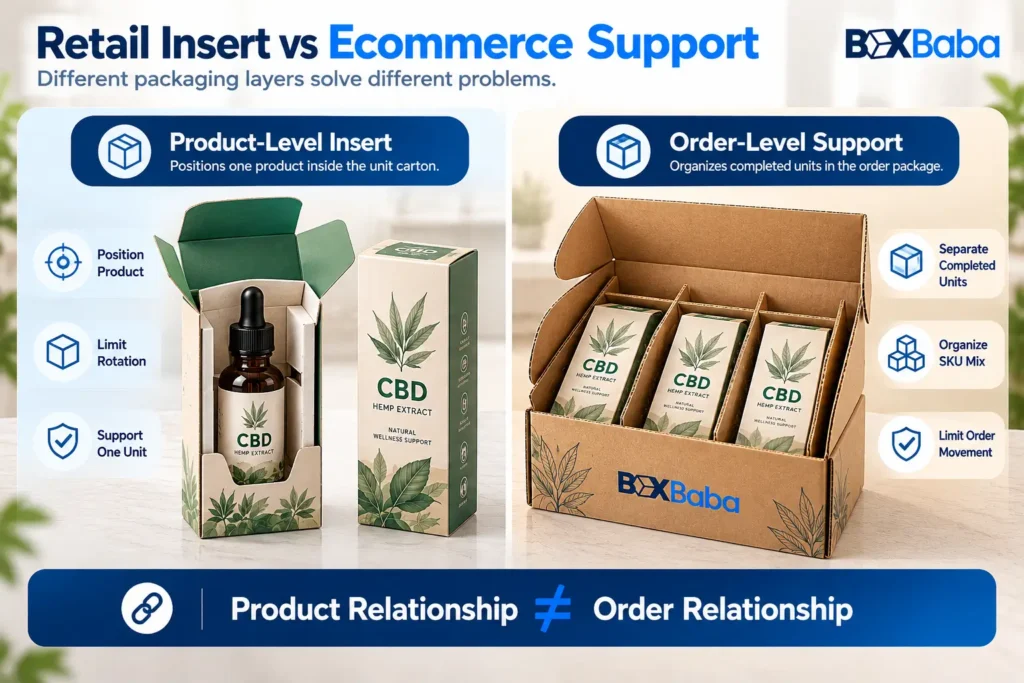
Retail Insert & Ecommerce Support Solve Different Problems
At the product level, an insert may need to:
- center one bottle;
- limit rotation;
- position one jar;
- organize a gift set.
At the ecommerce level, internal support may instead need to:
- separate completed retail cartons;
- organize several SKUs;
- limit order-level movement.
So:
Retail Insert → Product Relationship
while:
Ecommerce Support → Order Relationship
Where fitted internal packaging is required, explore Printed Boxes with Inserts.
Do Not Duplicate the Same Support at Every Layer
Suppose a CBD dropper bottle is already held by a paperboard insert inside its retail carton.
The ecommerce package does not automatically need another cavity shaped directly around the bottle.
At that point the ecommerce entity is:
Completed Dropper Carton
The outer package should solve the behavior of that carton inside the order.
A divider between completed units may be enough.
Or correct outer-package sizing may solve the issue without another insert.
Ecommerce Packaging Is Not a Reinforced Retail Carton
A common conceptual mistake is:
Retail Carton → Make It Much Stronger → Ecommerce Packaging
That is not the only route.
A more flexible architecture is:
Individual Retail Carton
+
Channel-Specific Outer Package
This lets the retail carton remain appropriate for:
- shelf dimensions;
- artwork;
- product presentation;
while the outer package solves the distribution-level requirement.
Custom Mailers Belong at the Order Level
For many ecommerce CBD orders, a mailer can serve as the outer customer-delivery package.
The correct mailer size should reflect:
- completed unit cartons;
- quantity;
- arrangement;
- inserts/dividers where required;
- total loaded weight.
For this layer, explore Custom Mailer Boxes.
Larger or different distribution configurations can be evaluated through Custom Corrugated Boxes.
A Presentation Box Is Not Automatically the Shipping Package
A CBD gift or PR set may use:
- rigid box;
- drawer box;
- magnetic presentation structure;
- fitted insert.
That creates a presentation package.
It does not automatically prove that the structure is appropriate as the final parcel-distribution package.
A layered system might instead use:
CBD Products
↓
Rigid Presentation Package
↓
Corrugated Distribution Package
The correct decision depends on the finished pack-out.
Ecommerce Performance Is a Packaged-Product Question
Do not describe an outer mailer as:
- drop-proof;
- impact-proof;
- guaranteed safe for ecommerce;
without appropriate evidence.
Transit performance depends on the complete package:
- product;
- primary container;
- unit carton;
- inserts/dividers;
- outer package;
- closure;
- loaded weight.
A physical sample can help review fit and arrangement.
It does not automatically establish performance through a distribution system.
Where formal shipping validation is important, the complete packaged product should be assessed under an appropriate project-specific method.
Retail & Ecommerce Can Use Different Materials Without Changing the SKU
One CBD product can use:
Glass Bottle
↓
White Paperboard Retail Carton
↓
Corrugated Ecommerce Mailer
The materials differ because the packaging layers perform different jobs.
Likewise:
CBD Product Set
↓
Rigid Presentation Box
↓
Corrugated Outer Package
This does not mean one material is universally better.
Material follows the role of each layer.
Artwork Also Has Layers
Retail unit artwork and ecommerce mailer artwork do not need to perform the same communication job.
Unit Carton
Can contain buyer-approved:
- product identity;
- variant;
- barcode;
- QR code;
- directions;
- warnings;
- other applicable information.
Retail Display
May focus on:
- brand;
- category;
- SKU family;
- grouped presentation.
Ecommerce Mailer
May focus on:
- brand identity;
- inside-print messaging;
- fulfillment information;
- shipping-label area.
Do not copy every product-information panel onto the mailer merely because there is more printable space.
Reserve Space for Fulfillment Labels
The ecommerce package may carry:
- carrier label;
- fulfillment label;
- warehouse sticker;
- routing identifier.
This is a real artwork constraint.
If an exterior panel will routinely receive a large shipping label, do not place a key branding element or QR code beneath that expected area.
Fulfillment Workflow → Affects → Outer Artwork Layout
Measure Retail & Ecommerce Packaging From Different Entities
For the unit package:
Finished Primary Product → Unit Carton
For retail displays:
Completed Unit Cartons → Display Arrangement
For ecommerce:
Completed Saleable Unit(s) → Order Arrangement → Outer Package
These should remain separate measurement records.
Do not use one dimension set across all three levels.
CBD Dropper Example
Consider a CBD product sold in a glass dropper bottle.
Unit Level
Finished Bottle → Printed Folding Carton
The carton accounts for:
- bottle geometry;
- closure;
- filled weight;
- required information.
For that commercial route, explore CBD Dropper Bottle Boxes.
Retail Level
Six completed cartons may enter:
Counter Display
The display is developed around those six finished cartons.
Ecommerce Level
One customer might receive:
Two Completed Dropper Cartons → Outer Mailer
The ecommerce mailer is not another dropper-bottle box.
It is an order package.
CBD Jar or Gummy Example
A CBD gummy product might use:
Sealed Jar
or:
Sealed Jar + Secondary Carton
or:
Finished Pouch
depending on the brand packaging system.
The ecommerce outer package should begin from whichever of those configurations is actually the finished saleable unit.
Do not assume every CBD gummy SKU has a folding carton.
And do not size the ecommerce package from:
gummy count
rather than the physical package.
Subscription CBD Packaging
A subscription order is usually closer to a repeatable multi-product ecommerce configuration than an individual retail SKU.
The project may need:
- repeatable SKU arrangement;
- divider/insert system;
- inside printing;
- controlled order footprint;
- version control as the assortment changes.
The individual retail cartons can still remain standardized.
The subscription package becomes its own order-level specification.
When Omnichannel Standardization Makes Sense
For brands selling through:
- stores;
- DTC website;
- marketplaces;
- wholesale accounts;
standardization can reduce unnecessary packaging variants.
Good candidates for standardization include:
- primary container;
- unit-carton dimensions;
- unit-carton structure;
- artwork hierarchy;
- barcode/QR placement;
- required product-level functionality.
Channel-specific components may include:
- retail display;
- ecommerce mailer;
- subscription box;
- wholesale case;
- fulfillment label.
That creates:
Shared Saleable Unit + Channel-Specific Secondary Logistics/Merchandising Layer
When Standardization Should Stop
Do not force one unit carton across channels when:
- retailer requirements conflict;
- product count changes;
- primary container changes;
- dimensions change;
- applicable information changes;
- access-control requirements change;
- the online product is a different bundle/SKU;
- marketplace preparation requires a different saleable configuration.
Standardization is useful only when the underlying product specification genuinely remains the same.
Retail vs Ecommerce CBD Packaging Decision Matrix
Decision | Product / Retail Level | Ecommerce Order Level |
Measurement entity | Finished saleable SKU | Completed order |
Unit carton | Core product package where used | Often remains unchanged |
Display | Can organize multiple units | Not normally an order requirement |
Outer mailer | Not usually the unit-carton role | Common order-level option |
Insert/support | Product positioning | Order separation/organization |
Loaded weight | Individual saleable unit | Combined packed order |
Artwork | Product communication | Delivery/brand/fulfillment |
CR/tamper functionality | Follows applicable product requirement | Does not disappear because channel changed |
Material selection | Follows unit structure | Follows order load/outer structure |
Quote basis | Product-level configuration | Typical order profiles |
Common CBD Retail vs Ecommerce Packaging Mistakes
Creating a Different Unit Carton Only Because the Product Is Sold Online
Better: Check whether the product-level package can remain unchanged.
Using Bare Product Dimensions for Ecommerce
Better: Start from the finished saleable unit actually entering the mailer.
Treating Retail Display Quantity as Ecommerce Order Architecture
Better: Define the packaging context, not only the number of units.
Using One Mailer for Every Possible Order
Better: Group common order profiles before finalizing outer sizes.
Adding Fitted Inserts at Every Layer
Better: Identify the unresolved function at each packaging level.
Assuming a Rigid Presentation Box Is Transit-Validated
Better: Evaluate the completed distribution package separately.
Making the Retail Carton Oversized for Online Shipping
Better: Let the ecommerce outer package solve the outer-distribution requirement.
Copying Unit-Carton Artwork Onto the Mailer
Better: Give each packaging surface a defined communication role.
Treating Ecommerce as a Reason to Remove Product-Level CR or Tamper Features
Better: Confirm the applicable requirement independently of channel.
Finalizing Outer Artwork Before Fulfillment Labels Are Planned
Better: Reserve real logistics space.
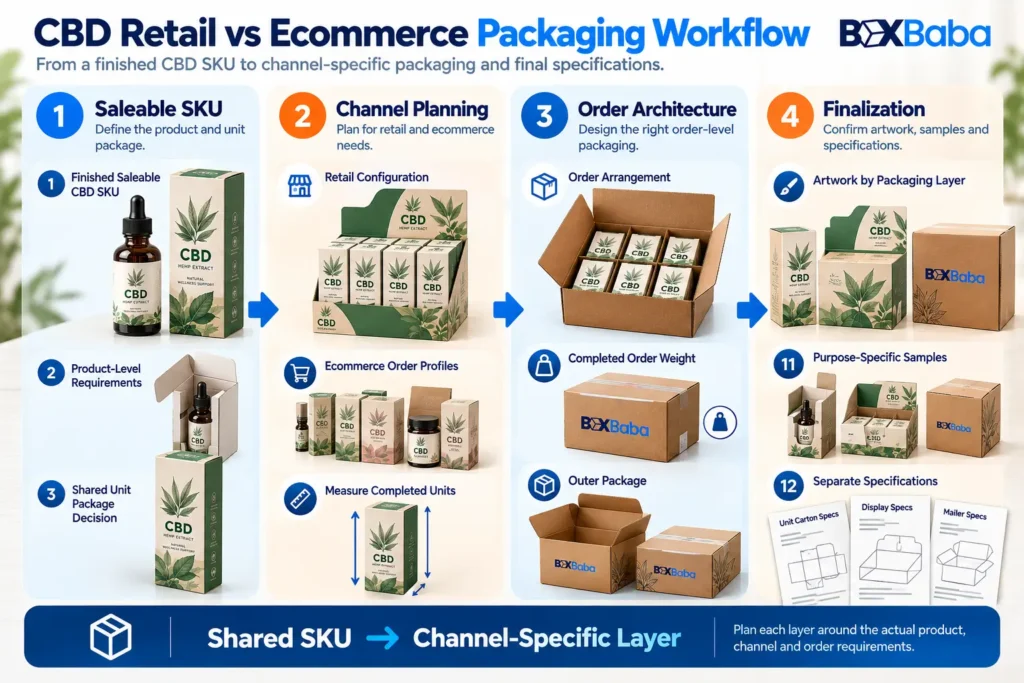
CBD Retail vs Ecommerce Packaging Workflow
Confirm the Finished Saleable CBD SKU
Primary package, unit carton where used, dimensions and filled weight.Confirm Product-Level Requirements
Information, barcode/QR, CR/tamper functionality where applicable.Decide Whether the Same Unit Package Can Serve Both Channels
Standardize where genuinely compatible.Define the Retail Configuration
Shelf, counter, display, hang format or another merchandising setup.Define Common Ecommerce Order Profiles
Single unit, multiples, mixed SKU, subscription or gift set.Measure the Completed Saleable Units
These become ecommerce inputs.Define the Order Arrangement
Orientation, quantity, SKU mix and internal support.Calculate the Completed Order Weight
Not only the individual product weight.Select the Outer Package
Mailer, corrugated shipping carton or another appropriate structure.Plan Artwork by Packaging Layer
Unit information, display communication and fulfillment-facing outer artwork.Review Samples According to Their Purpose
Unit fit, display arrangement and ecommerce pack-out are different reviews.Maintain Separate Specifications
Unit carton, display and ecommerce mailer should remain clearly identified for reorders.
What Should You Send BoxBaba for an Omnichannel CBD Packaging Quote?
Prepare information at both the SKU level and order level.
Saleable CBD Unit
- product type;
- primary-container type;
- finished dimensions;
- filled weight;
- closure;
- unit-carton requirement;
- required product-level packaging functionality;
- artwork status.
Retail
- shelf/counter/display use;
- units per display where relevant;
- preferred arrangement;
- retailer dimension requirements where known.
Ecommerce
- common order sizes;
- typical SKU combinations;
- completed unit-package dimensions;
- total order weight;
- outer-package direction;
- divider/insert requirement;
- fulfillment-label requirements.
Project
- quantity per SKU;
- number of SKUs;
- print and finish direction;
- delivery destination.
A useful brief is:
The same CBD dropper carton will be sold in stores and online. Retail units will be grouped into counter displays. DTC orders usually contain one to three completed cartons, and we need separate corrugated mailer packaging for those order profiles.
That gives the packaging team a channel architecture to solve.
Choosing Retail & Ecommerce CBD Packaging From BoxBaba
A practical omnichannel CBD packaging system can follow:
Product Level
Finished CBD Product
↓
Saleable Unit Carton Where Required
Retail
Saleable Unit
↓
Shelf / Counter / CBD Display Boxes
Ecommerce
Saleable Unit(s)
↓
Order Arrangement
↓
Internal Support Where Needed
↓
Custom Mailer Boxes or Custom Corrugated Boxes
Where a fitted holder or divider is required, explore Printed Boxes with Inserts.
For individual CBD secondary packaging, use Custom CBD Boxes.
BoxBaba CBD packaging currently starts from 100 units, with artwork and dieline support, samples available, standard production generally 5–9 business days after artwork approval, and free shipping across the USA.
When requesting pricing, separate:
the saleable SKU specification
from:
the retail-display or ecommerce-order specification.
That distinction is the foundation of an efficient omnichannel CBD packaging system.
Frequently Asked Questions
Does a CBD product need a different carton for ecommerce?
Not necessarily. The same product-level carton can often remain around the SKU while a separate ecommerce outer package is added.
What is the biggest difference between retail and ecommerce CBD packaging?
Retail usually focuses on the completed saleable SKU and merchandising. Ecommerce also requires packaging the completed customer order.
Should an ecommerce mailer be sized around the CBD bottle?
If the bottle actually ships inside a retail carton, size the order-level packaging around the completed carton rather than the bare bottle.
Can one CBD unit carton work in stores and online?
Yes, where the physical product, artwork, information and applicable packaging requirements remain compatible.
Does ecommerce change child-resistant requirements?
Not simply because the product is sold online. Applicable child-resistant or tamper-related requirements depend on the product, market and governing rules.
Is a retail display the same as an ecommerce multi-pack?
No. A retail display organizes units for merchandising; an ecommerce multi-pack organizes units for one customer order.
Do ecommerce CBD orders always need inserts?
No. Use inserts or dividers where the completed order has a defined positioning, separation or organization problem.
Can a retail insert and ecommerce insert be different?
Yes. One may position the primary product, while the other organizes completed saleable units.
Can a rigid CBD gift box be used as the shipping box?
Do not assume so. Presentation structure and verified distribution performance are different packaging questions.
Should the ecommerce mailer repeat all CBD product information?
Not automatically. Product-level required/approved information usually belongs with the saleable unit; the outer mailer has a different communication role.
Can one ecommerce mailer size work for every order?
Sometimes, but materially different order profiles may justify multiple outer sizes.
What should BoxBaba receive for an omnichannel CBD packaging project?
Provide the finished SKU dimensions and weight, unit-carton requirements, retail display needs, common ecommerce order profiles, combined order weights, outer-package requirements, quantity, artwork status and delivery destination.