
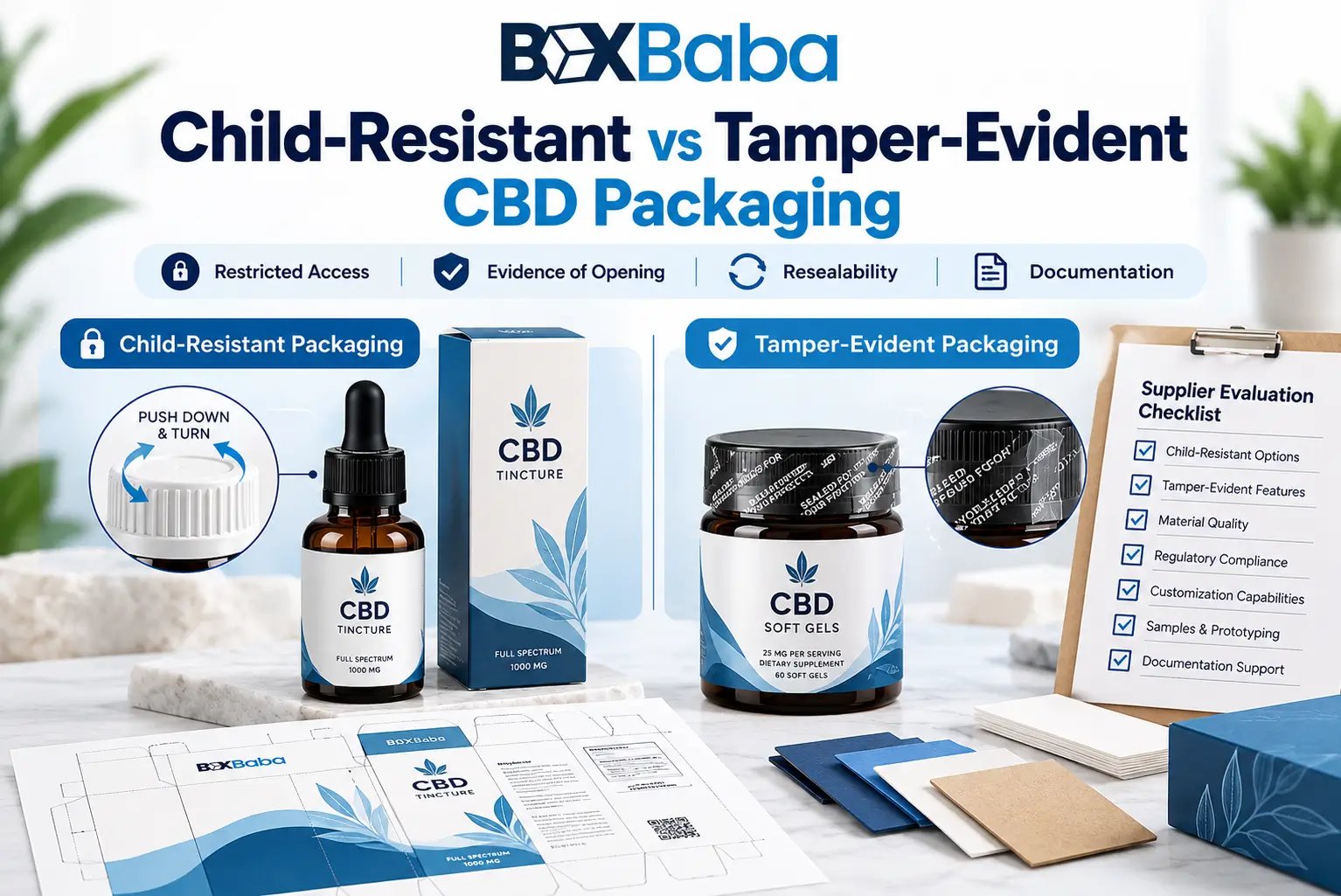
Child-resistant and tamper-evident packaging solve different packaging problems.
Child-resistant packaging is intended to restrict access by young children under an applicable performance standard or another configuration expressly accepted by the governing rule.
Tamper-evident packaging provides evidence that a package has previously been opened or interfered with.
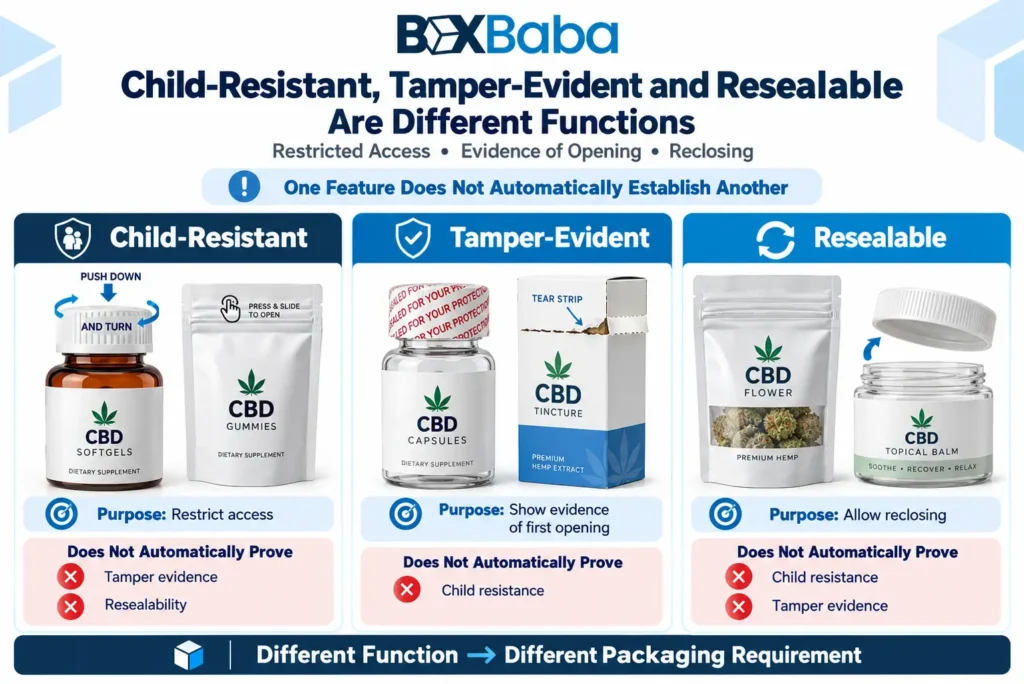
The simplest distinction is:
Child-Resistant → Restricts Access
Tamper-Evident → Shows Evidence of Opening
A third term is also important:
Resealable → Allows the Package to Be Closed Again
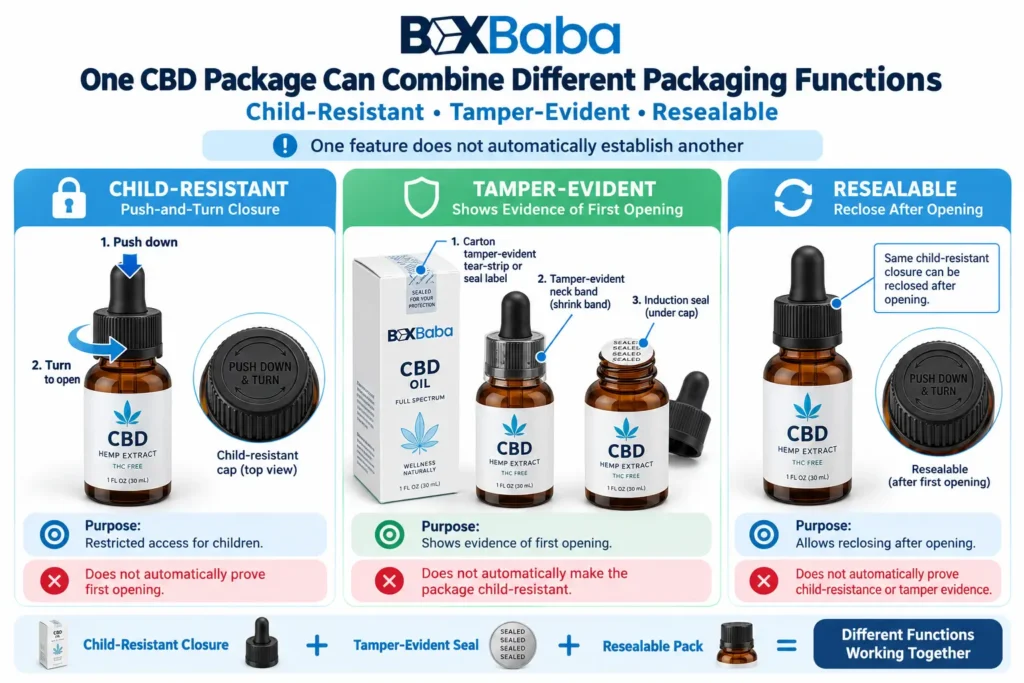
One feature does not automatically establish another.
A bottle can have a child-resistant closure without an obvious first-opening indicator.
A carton can have a breakable seal that shows it has been opened while remaining easy for a child to access.
A standard zipper pouch can be resealable without being child-resistant.
The correct packaging decision therefore begins with:
Finished Product → Jurisdiction / Sales Channel → Required Packaging Function → Packaging Layer → Supporting Documentation → Structure
not:
Contains CBD → Automatically Needs a Child-Resistant Box
For the broader CBD packaging range, brands can explore Custom CBD Boxes after the applicable packaging functions have been established.
Important: This article explains packaging-function and sourcing decisions. It is not legal advice. CBD, hemp and state-regulated cannabis requirements can differ by product, jurisdiction and sales channel.
Child-Resistant vs Tamper-Evident vs Resealable
Function | Main Purpose | What It Does Not Automatically Prove |
Child-resistant | Restricts access by young children under the applicable requirement | Tamper evidence, resealability or compliance with every jurisdiction |
Tamper-evident | Makes prior opening or interference identifiable | Child resistance |
Resealable | Allows the package to be closed again after opening | Child resistance or tamper evidence |
A finished package may provide:
- only one of these functions;
- two of them;
- all three;
- none;
depending on the design and the rules applying to the finished product.
What Does Child-Resistant Packaging Mean?
Under the U.S. Poison Prevention Packaging Act framework, CPSC uses the term special packaging, commonly called child-resistant/senior-friendly packaging.
Under that framework, special packaging is designed to be significantly difficult for children under five to open while remaining reasonably usable by adults.
That is different from making a package:
- thick;
- rigid;
- tightly glued;
- hard to tear;
- unusually shaped;
- inconvenient for adults.
Opening difficulty alone does not establish child resistance.
Where PPPA requirements apply, package performance is evaluated using the child and adult testing procedures specified in the federal regulations.
PPPA Child-Resistant Performance Is Measured, Not Judged by Appearance
Under the general CPSC special-packaging test framework:
- at least 85% of tested children must be unable to open the package during the first five minutes of testing;
- at least 80% must be unable to open it during the full ten-minute child test;
- at least 90% of adults must be able to open the package within the applicable adult test period and, where required, properly resecure it.
These are PPPA performance criteria.
They do not mean that every CBD product automatically falls under PPPA.
The first question remains:
Which requirement applies to this exact product?
CPSC Does Not Approve Individual Child-Resistant Packages
The phrase:
CPSC-approved packaging
should generally be avoided.
CPSC states that it does not approve, certify or endorse specific special packages, packaging manufacturers or testing companies.
A better sourcing question is:
What supports the child-resistant representation for this exact packaging configuration?
Depending on the product and applicable rule, useful evidence may include:
- package identification;
- closure identification;
- testing protocol;
- test report;
- certification records;
- tested dimensions or configuration;
- reclosable / non-reclosable status;
- manufacturer information.
The buyer should confirm that the package being ordered matches the configuration supported by the documentation.
Federal PPPA & State Cannabis Rules Are Not the Same Packaging Framework
This distinction is essential.
Under Federal PPPA
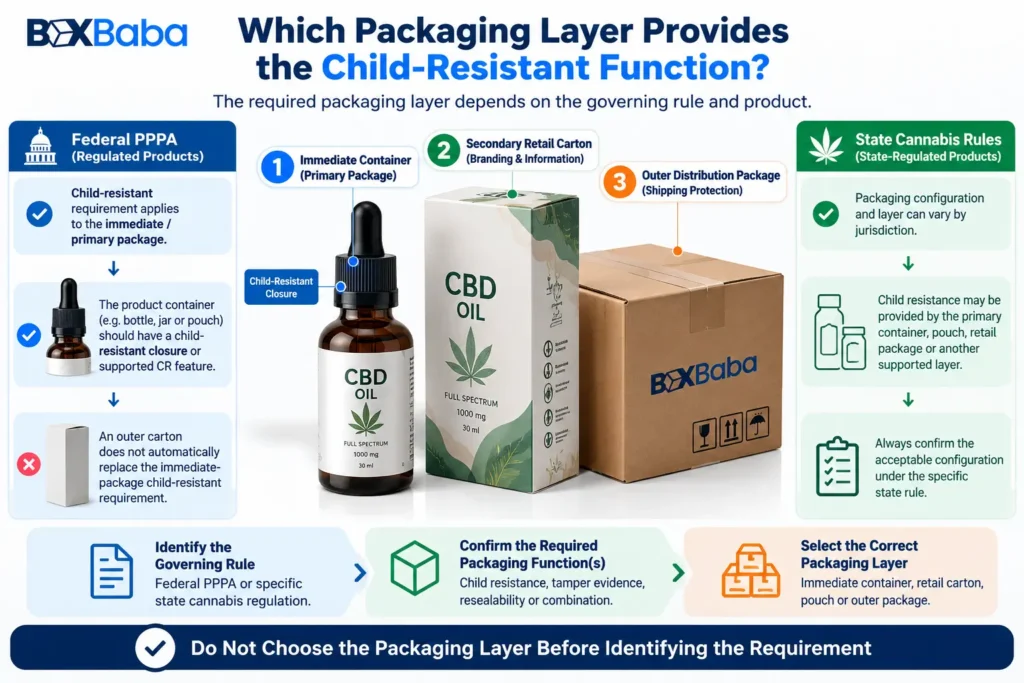
Where PPPA special-packaging requirements apply, CPSC states that the child-resistant requirement applies to the primary or immediate packaging that directly contains the regulated substance.
A child-resistant secondary carton around a non-child-resistant immediate container should therefore not automatically be treated as satisfying a PPPA immediate-package requirement.
Under State Cannabis Rules
A state cannabis program may define its requirements differently.
For example, a state may:
- reference PPPA testing;
- recognize specified alternative package constructions;
- allow a particular packaging layer to provide the required function;
- distinguish single-use and multiple-use child resistance.
The correct question is therefore:
Which regulatory framework governs this product?
Do not transfer a federal PPPA packaging-layer rule blindly into every state cannabis program, and do not transfer a state cannabis exception to every CBD product sold nationally.
Child Resistance Can Be Established Differently Under Specific State Rules
PPPA performance testing is an important child-resistant benchmark, but it is not the only way every state cannabis regulation defines acceptable CR packaging.
Some state rules expressly recognize additional package configurations for particular cannabis products.
That means:
Looks Difficult to Open
→ never enough.
But:
Applicable Rule + Supported Configuration
→ the correct basis for the packaging decision.
The brand should confirm which route applies before the package is described as child-resistant.
What Is Tamper-Evident Packaging?
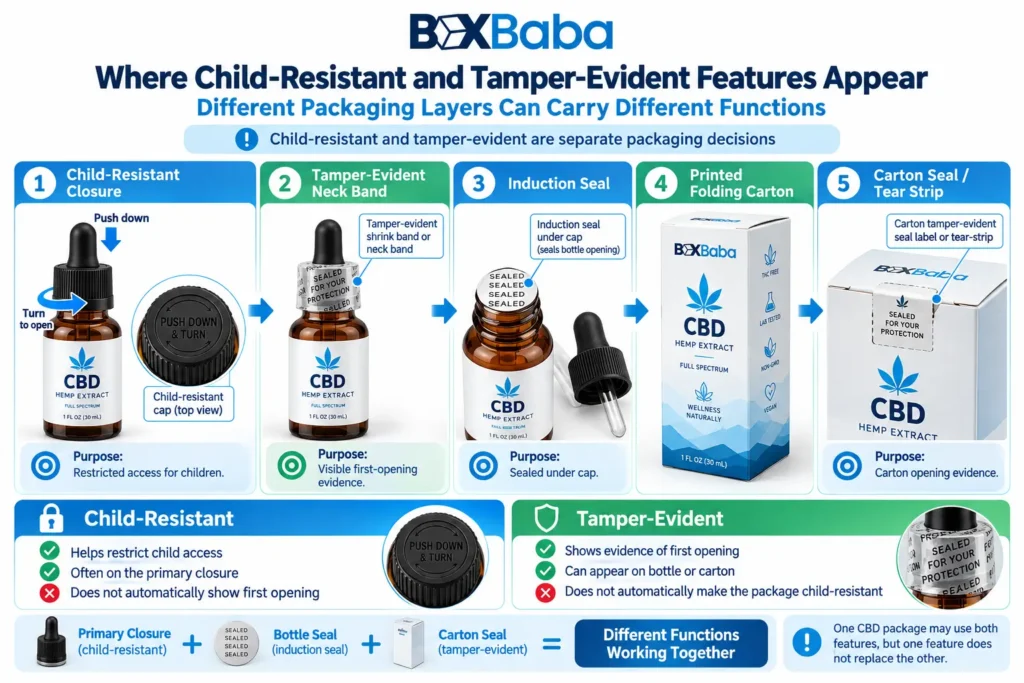
Tamper-evident packaging is designed so a user can identify evidence that the package has previously been opened or interfered with.
Potential features include:
- breakable seals;
- shrink bands;
- tear strips;
- destructible labels;
- induction seals;
- breakaway rings;
- sealed pouch tops;
- other first-opening indicators.
The basic relationship is:
Before Opening → Indicator Intact
then:
After First Opening → Indicator Changes / Breaks / Is Removed
Tamper evidence is therefore about recognizing prior access, not preventing access.
Tamper-Evident Does Not Mean Tamper-Proof
A tamper-evident feature does not guarantee that interference is impossible.
It aims to make previous opening or interference apparent.
Avoid broad claims such as:
- tamper-proof;
- impossible to open;
- impossible to counterfeit;
- completely secure.
Describe the actual feature instead:
- tamper-evident seal;
- breakable band;
- destructible label;
- first-opening indicator;
- heat-sealed pouch top.
Tamper-Evident & Tamper-Resistant Can Appear in Different Regulations
Packaging terminology varies by regulatory context.
State cannabis programs frequently use tamper-evident.
FDA regulations for certain OTC drugs use the term tamper-resistant packaging, with a system intended to provide visible evidence to consumers when tampering has occurred.
This CBD article uses tamper-evident as the general functional term.
Do not assume that the FDA OTC-drug tamper-resistant rules automatically apply to ordinary CBD cosmetics, hemp products or every state-regulated cannabis product.
A Package Can Be Tamper-Evident Without Being Child-Resistant
Consider:
Heat-Sealed Pouch + Standard Zipper
Before sale, breaking the heat seal may provide evidence of first opening.
After the seal is removed, however, the ordinary zipper may be simple to open.
The heat seal should therefore not automatically be described as child-resistant.
This illustrates the difference:
Heat Seal
→ may support tamper evidence.
CR Closure
→ addresses restricted access.
For detailed flexible-pouch sourcing and documentation, use BoxBaba Child-Resistant Mylar Bags guide.
A Child-Resistant Closure Can Exist Without Tamper Evidence
Consider a bottle using a controlled closure such as a push-and-turn system.
The closure may provide the required child-resistant function.
But if there is no:
- breakaway ring;
- intact seal;
- shrink band;
- inner seal;
- other first-opening indicator;
the consumer may have little visible evidence that the container was previously opened.
Therefore:
CR Closure ≠ Automatic Tamper Evidence
Resealable Is a Third, Separate Function
A resealable package can be closed again after opening.
Examples include:
- screw caps;
- zipper pouches;
- lidded jars;
- locking containers.
Resealability alone says nothing about child resistance.
Standard Zipper
→ resealable.
Child-Resistant Zipper Supported for the Applicable Use
→ resealable + child-resistant.
Likewise:
Heat Seal + Standard Zipper
→ potentially tamper-evident before first opening + resealable afterward.
Keep the three functions separate:
Child Resistance
Tamper Evidence
Resealability
When Can a Product Need More Than One Function?
Some product and jurisdiction combinations require several packaging characteristics at the same time.
A regulated cannabis product, for example, may need some combination of:
- child resistance;
- tamper evidence;
- resealability;
- opacity;
- product containment;
- labeling requirements.
This does not mean every CBD product sold through general retail requires that same combination.
A CBD cosmetic sold through conventional retail and a state-regulated cannabis edible can have very different packaging requirements even if both contain cannabidiol.
The sourcing sequence should therefore be:
Product → Jurisdiction → Sales Channel → Required Functions
California Shows Why the Functions Must Be Kept Separate
California regulated cannabis program separately addresses:
- tamper-evident packaging;
- child-resistant packaging;
- resealability for applicable multi-serving products;
- opacity for specified products.
This is useful because it demonstrates that those characteristics are independent requirements.
California also distinguishes between:
- initial/single-use child resistance; and
- multiple-use or lifetime child resistance.
That distinction should not automatically be applied to every CBD product nationwide, but it demonstrates why buyers need to understand what must happen after the first opening.
New York Also Treats the Functions Separately
New York adult-use cannabis framework separately calls for retail packages to be:
- child-resistant;
- tamper-evident;
- fully enclosing;
and resealable where the package contains more than one serving.
Again, this is a state-regulated cannabis example.
It should not be presented as a universal rule for hemp-derived CBD products sold throughout the United States.
Do All CBD Products Need Child-Resistant Packaging?
No universal federal rule says that every product containing CBD automatically requires child-resistant packaging solely because it contains CBD.
Potential requirements depend on factors such as:
- product classification;
- ingredients;
- jurisdiction;
- state cannabis rules;
- federal rules applying to the actual product;
- sales channel.
Use:
Actual Product + Applicable Rule → CR Decision
not:
CBD → CR Packaging
Do All CBD Products Need Tamper-Evident Packaging?
No universal answer can be derived from the letters CBD alone.
Tamper-evident or tamper-resistant requirements depend on the actual product and applicable regulatory system.
Some state cannabis programs require tamper-evident retail packaging.
FDA separately requires tamper-resistant packaging for particular federally regulated product categories.
Those rules should not be transferred automatically to every CBD carton, jar or pouch.
Which Packaging Layer Provides the Child-Resistant Function?
This question needs to be answered after identifying the governing rule.
PPPA-Regulated Product
When PPPA applies, the special-packaging requirement concerns the immediate package directly containing the regulated substance.
Example:
Product → CR Immediate Bottle
A standard secondary folding carton around that bottle does not itself replace the immediate-package requirement.
State Cannabis Product
A state cannabis program may define acceptable packaging layers or structures differently.
Check the specific jurisdiction before deciding whether the:
- primary container;
- retail package;
- pouch;
- carton;
- another packaging layer
provides the required child-resistant function.
The safe rule is:
Do not choose the layer first. Identify the requirement first.
Example: CBD Dropper Bottle
A dropper product could use:
Bottle + Standard Dropper + Printed Carton
or:
Bottle + Supported CR Closure + Printed Carton
depending on the product and applicable market.
If an immediate child-resistant closure is required, do not assume the outer carton can replace it without checking the governing rule.
For bottle sizing, holders and secondary packaging, explore CBD Dropper Bottle Boxes.
Example: CBD Gummies in a Jar
A gummy jar project may involve several separate decisions:
- food/product containment;
- immediate closure;
- child resistance;
- tamper evidence;
- resealability;
- secondary carton;
- labeling.
Do not assume that adding a paperboard carton around the jar satisfies every function.
For secondary retail packaging around gummy jars or pouches, see CBD Gummies Boxes.
Example: Flexible Pouch
A flexible package can contain several structural features.
Feature | What It May Do | What It Does Not Automatically Establish |
Standard zipper | Allows resealing | Child resistance |
CR zipper | Supports restricted access when the applicable configuration is supported | Tamper evidence |
Heat-sealed top | Can show first opening | Continued child resistance |
Tear notch | Helps initiate opening | Child resistance |
Opaque film | Limits product visibility | CR or tamper evidence |
For detailed pouch construction and CR documentation, use the Child-Resistant Mylar Bags guide rather than treating this comparison article as a complete pouch manual.
Example: Controlled-Opening Carton or Rigid Box
A reinforced carton or rigid package may use:
- locking tabs;
- push-and-slide mechanisms;
- release points;
- controlled-opening sequences.
A complex mechanism, however, should not automatically be described as child-resistant.
Ask:
- Which rule requires CR packaging?
- Is this packaging layer allowed to provide that function?
- What exact configuration is supported?
- What documentation is available?
- Is the package single-use or reclosable?
- Has any material, dimension or locking component changed from the supported version?
Brands exploring paperboard or rigid structures can review Custom Child Resistant Boxes as a commercial starting point, then verify the exact configuration and documentation before making compliance claims.
Thicker Material Does Not Create Child Resistance
Material and function are different entities.
For example:
Thicker Board
→ may increase rigidity.
It does not automatically create:
Child Resistance
Likewise:
Rigid Construction ≠ Child Resistance
Magnetic Closure ≠ Child Resistance
Tuck-End Carton ≠ Child Resistance
Hard for an Adult to Open ≠ Child Resistance
A compliance claim needs a basis tied to the actual applicable packaging requirement.
A Tear Strip Does Not Automatically Establish Tamper Evidence
A tear strip can form part of a tamper-evident design.
But the completed package still needs to provide meaningful evidence of prior opening under the applicable requirement.
Ask:
- What changes after first opening?
- Is that change visible?
- Can the package be restored without obvious evidence?
- Does the applicable regulation require a statement identifying the feature?
- Which packaging layer contains the feature?
A decorative perforation should not automatically be marketed as regulatory tamper evidence.
First Opening & Repeated Use Are Different Packaging States
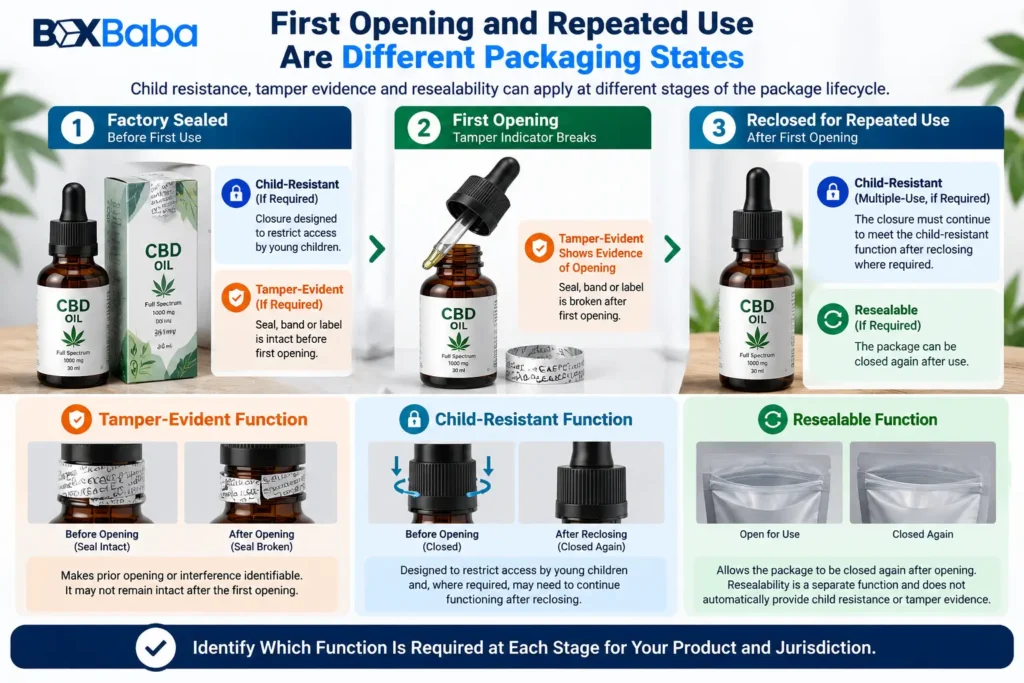
For multi-use products, ask:
What function is required before first opening?
and:
What function must remain after the consumer opens and recloses the package?
A package can be restricted during the original factory-sealed state but become easy to open afterward.
Where the governing rule requires continuing or reclosable child resistance, that distinction becomes critical.
State cannabis programs may use terms such as:
- initial CR;
- single-use CR;
- multiple-use CR;
- lifetime CR.
Use the terminology and requirement of the actual jurisdiction.
Documentation Questions to Ask for Child-Resistant Packaging
Before approving a CR packaging configuration, ask:
- Which regulatory requirement is being addressed?
- What exact packaging configuration is represented as child-resistant?
- What standard, test or expressly accepted regulatory configuration supports that representation?
- Is supporting documentation available?
- Does the documentation match the package being quoted?
- Does it cover the selected size and closure?
- Is the package single-use or reclosable?
- Does the CR function need to remain after repeated opening?
- Would changing the material, dimensions or mechanism affect the supported configuration?
- Which party is responsible for the finished-product compliance or certification obligations?
These questions provide far more useful sourcing information than:
Is this box compliant?
Documentation Questions for Tamper-Evident Packaging
Ask:
- What feature provides evidence of first opening?
- Which packaging layer contains it?
- What changes after opening?
- Can the feature be restored without obvious evidence?
- Is the feature visible to the buyer where required?
- Does the applicable regulation require an identifying or explanatory statement?
- Will printing or finishing interfere with the indicator?
Tamper evidence should be considered as part of the complete finished package, not simply added as decoration.
Child-Resistant Structure Should Be Defined Before Artwork
A controlled-opening mechanism can change the dieline.
It may affect:
- locking tabs;
- slots;
- release points;
- tray geometry;
- opening direction;
- glue areas;
- panel dimensions.
Therefore use:
Required CR Function → Supported Structure → Dieline → Artwork
not:
Finished Standard Carton Artwork → Add CR Mechanism Later
For general structural artwork terminology, BoxBaba Dieline in Packaging guide explains cuts, creases, glue areas and production-file fundamentals.
Tamper-Evident Features Can Affect Artwork Too
A seal, band or tear feature may occupy part of:
- a lid;
- carton opening;
- closure;
- printed panel.
Plan the artwork so that:
- important information is not hidden;
- QR codes remain usable;
- barcodes remain scannable;
- opening instructions remain clear;
- any required description of the tamper feature has appropriate space.
Structural and graphic decisions should therefore be reviewed together.
Child-Resistant Packaging Must Still Account for Adult Usability
Child resistance does not mean making a package as difficult as possible to open.
Under the PPPA framework, adult usability is part of the performance criteria.
The intended relationship is:
Significantly Difficult for Young Children
while remaining:
Reasonably Usable by Adults
That distinction is particularly relevant to multi-use packages and products intended for a broad adult customer base.
What Can a Sample or Proof Actually Validate?
Do not confuse visual approval with child-resistant performance evidence.
Review Type | Useful For | Does Not Automatically Establish |
Digital artwork proof | Text, warning placement, opening instructions, graphics | CR performance |
3D visual mockup | Visual structure and panel relationships | Physical CR performance |
Blank structural sample | Product fit, opening sequence, loading | Regulatory CR compliance |
Printed physical sample | Artwork, finish, visible tamper feature | CR test performance |
Relevant test / compliance documentation | Supported package configuration | Suitability for every different product or jurisdiction |
A structural sample can help the buyer understand how a mechanism works.
It does not replace required performance documentation.
Common Child-Resistant Packaging Mistakes
Calling Any Difficult Package Child-Resistant
Difficulty alone does not establish the claim.
Better: Identify the applicable requirement and supporting basis.
Asking for CPSC-Approved Packaging
CPSC does not approve individual package designs.
Better: Ask what documentation supports the exact configuration.
Assuming an Outer CR Box Always Satisfies PPPA
Under PPPA, the requirement applies to the immediate package.
Better: Separate federal immediate-package rules from state cannabis packaging rules.
Changing a Supported Structure Without Rechecking It
Different dimensions, materials or locking features can alter the package.
Better: Confirm whether the changed configuration remains supported.
Assuming Rigid Means Child-Resistant
Rigid describes construction.
Better: Evaluate the opening system and regulatory basis separately.
Common Tamper-Evident Packaging Mistakes
Calling a Normal Tuck Carton Tamper-Evident
A carton that can open and close normally may provide no evidence of prior access.
Better: Identify a specific evidence-of-opening feature.
Assuming a Heat Seal Is Child-Resistant
A seal can show first opening without restricting access after it is removed.
Better: Treat CR and TE separately.
Using Tamper-Proof
This overstates what ordinary packaging can do.
Better: Describe the actual tamper-evident feature.
Hiding the Indicator Inside Another Packaging Layer
The relevant user may not be able to inspect it.
Better: Review the complete finished retail package.
A Practical Decision Framework
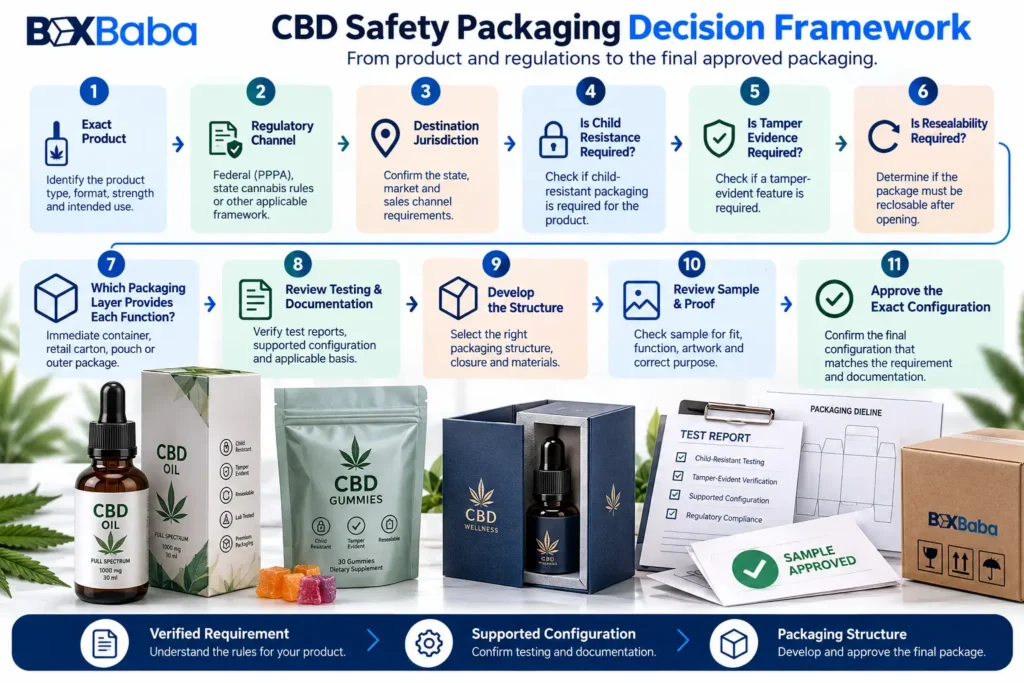
Before sourcing CBD, hemp or cannabis safety packaging:
Identify the Exact Product
What is being sold?Identify the Regulatory Channel
General hemp/CBD market, state-licensed cannabis program or another framework?Identify the Destination Jurisdiction
Which states will receive the product?Determine Whether Child Resistance Is Required
Do not assume based on CBD alone.Determine Whether Tamper Evidence Is Required
Review separately.Determine Whether Resealability Is Required
Especially for multi-use packaging.Identify Which Packaging Layer Must Provide Each Function
Do this according to the governing rule.Review the Supporting Basis
Testing, certification, regulatory specification or other documentation as applicable.Develop the Packaging Structure
Do not add CR functionality as an artwork-stage afterthought.Review Samples & Proofs for Their Actual Purpose
Fit review is not compliance testing.Approve the Exact Configuration
Recheck material, size and mechanism changes before production.
What Should You Send a Packaging Supplier?
For a project involving child-resistant or tamper-evident requirements, prepare:
- exact product type;
- product classification where known;
- primary container;
- intended sales states;
- sales channel;
- whether the item enters a state-licensed cannabis market;
- established CR requirement;
- established tamper-evident requirement;
- resealability requirement;
- immediate-container closure;
- finished dimensions;
- filled weight;
- quantity;
- number of SKUs;
- intended packaging layer providing each function;
- documentation requirements;
- artwork status;
- opening-instruction requirements;
- delivery destination.
If the legal requirement has not yet been established, say so.
The packaging supplier should not guess which regulatory framework governs the finished product.
How BoxBaba Fits Into the Process
BoxBaba can help translate an established packaging requirement into a custom structure.
Depending on the project, this can include:
- custom carton sizing;
- controlled-opening packaging concepts;
- pouch structures;
- dielines;
- inserts;
- opening-instruction space;
- printing;
- finishes;
- structural samples;
- available package documentation.
For flexible formats, use the Child-Resistant Mylar Bags guide to evaluate closure and pouch documentation.
For paperboard and rigid controlled-opening formats, explore Custom Child Resistant Boxes and confirm the exact proposed configuration before describing it as child-resistant.
For the wider CBD product range, use Custom CBD Boxes.
The packaging structure should follow the verified requirement.
It should not be used to invent the requirement.
Final Takeaway
Child-resistant, tamper-evident and resealable packaging perform different functions.
Remember:
Child-Resistant
→ restricts access according to the applicable performance or regulatory requirement.
Tamper-Evident
→ makes previous opening or interference identifiable.
Resealable
→ allows the package to be closed again after opening.
And one additional distinction matters:
PPPA Immediate-Package Requirement ≠ Every State Cannabis Packaging Rule
The correct sequence is:
Product
↓
Jurisdiction / Sales Channel
↓
Required Packaging Functions
↓
Required Packaging Layer
↓
Supporting Basis / Documentation
↓
Structure
↓
Dieline & Artwork
↓
Production
Do not choose a child-resistant CBD box simply because the mechanism looks complicated.
Do not describe a tear strip as child-resistant because it breaks on opening.
Do not assume that a CR closure automatically provides tamper evidence.
And do not assume a secondary CR box satisfies an immediate-package requirement unless the governing rule supports that configuration.
Define the requirement first.
Then specify the packaging system that actually performs the required function.
Frequently Asked Questions
What is the difference between child-resistant and tamper-evident CBD packaging?
Child-resistant packaging restricts access by young children according to the applicable requirement. Tamper-evident packaging provides evidence that the package has previously been opened or interfered with.
Is child-resistant packaging the same as tamper-proof packaging?
No. Child resistance concerns access. Tamper-proof also implies an absolute level of protection that ordinary consumer packaging should not casually claim.
Do all CBD products need child-resistant packaging?
No. The requirement depends on the actual product and the federal, state or market rules that apply to it.
Do all CBD products need tamper-evident packaging?
No. Tamper-evident requirements depend on the particular product and regulatory framework.
Can a product need both child resistance and tamper evidence?
Yes. Some regulated product and jurisdiction combinations independently require both functions.
Is a heat-sealed pouch child-resistant?
Not automatically. A heat seal may provide evidence of first opening. Child resistance depends on the applicable closure/configuration and supporting basis.
Is a resealable zipper child-resistant?
Not automatically. Resealability and child resistance are separate packaging functions.
Does a push-and-turn cap automatically provide tamper evidence?
No. A controlled closure can provide child resistance without giving clear evidence of previous opening.
Is a rigid box automatically child-resistant?
No. Rigid board describes the package construction, not its child-resistant performance.
Can an outer child-resistant box satisfy PPPA?
Not by itself where the federal PPPA immediate-package requirement applies. CPSC states that PPPA special packaging applies to the primary or immediate package directly containing the regulated substance.
Can state cannabis rules allow a different packaging approach?
Yes. State cannabis regulations can define acceptable packaging configurations differently. The specific jurisdiction should be reviewed before choosing the package layer or structure.
Does thicker paperboard make a carton child-resistant?
No. Greater thickness can affect rigidity, but it does not by itself establish a child-resistant claim.
Does CPSC approve child-resistant packaging?
CPSC states that it does not approve, certify or endorse individual special packages or packaging manufacturers.
What should I ask a supplier instead of asking for CPSC-approved packaging?
Ask which requirement applies, what testing or documentation supports the exact configuration, and whether the package being quoted matches that supported configuration.
Can the dimensions of a child-resistant package be changed?
Do not assume a changed configuration remains covered. Confirm whether changes to dimensions, materials, closures or locking features affect the supporting documentation or accepted configuration.
Does child resistance need to remain after opening?
That depends on the product and applicable rule. Some multi-use products require continuing or reclosable child resistance, while some state cannabis systems allow initial/single-use child-resistant packaging for specified products.
What is a tamper-evident feature?
It is a feature intended to make prior opening or interference identifiable, such as a breakable seal, band, destructible label or other first-opening indicator.
Can a standard folding carton be tamper-evident?
Not automatically. A normally reclosable carton may need a defined seal, tear feature or another evidence-of-opening mechanism where tamper evidence is required.
Who is responsible for verifying the finished child-resistant package?
Responsibility depends on the governing rule. Under PPPA, CPSC emphasizes responsibility of the finished-product manufacturer to select suitable packaging and ensure compliance.
Can BoxBaba provide child-resistant packaging structures?
BoxBaba offers controlled-opening and child-resistant packaging options. The exact configuration, documentation and suitability for the product and jurisdiction should be confirmed before making a child-resistant or compliance claim.