
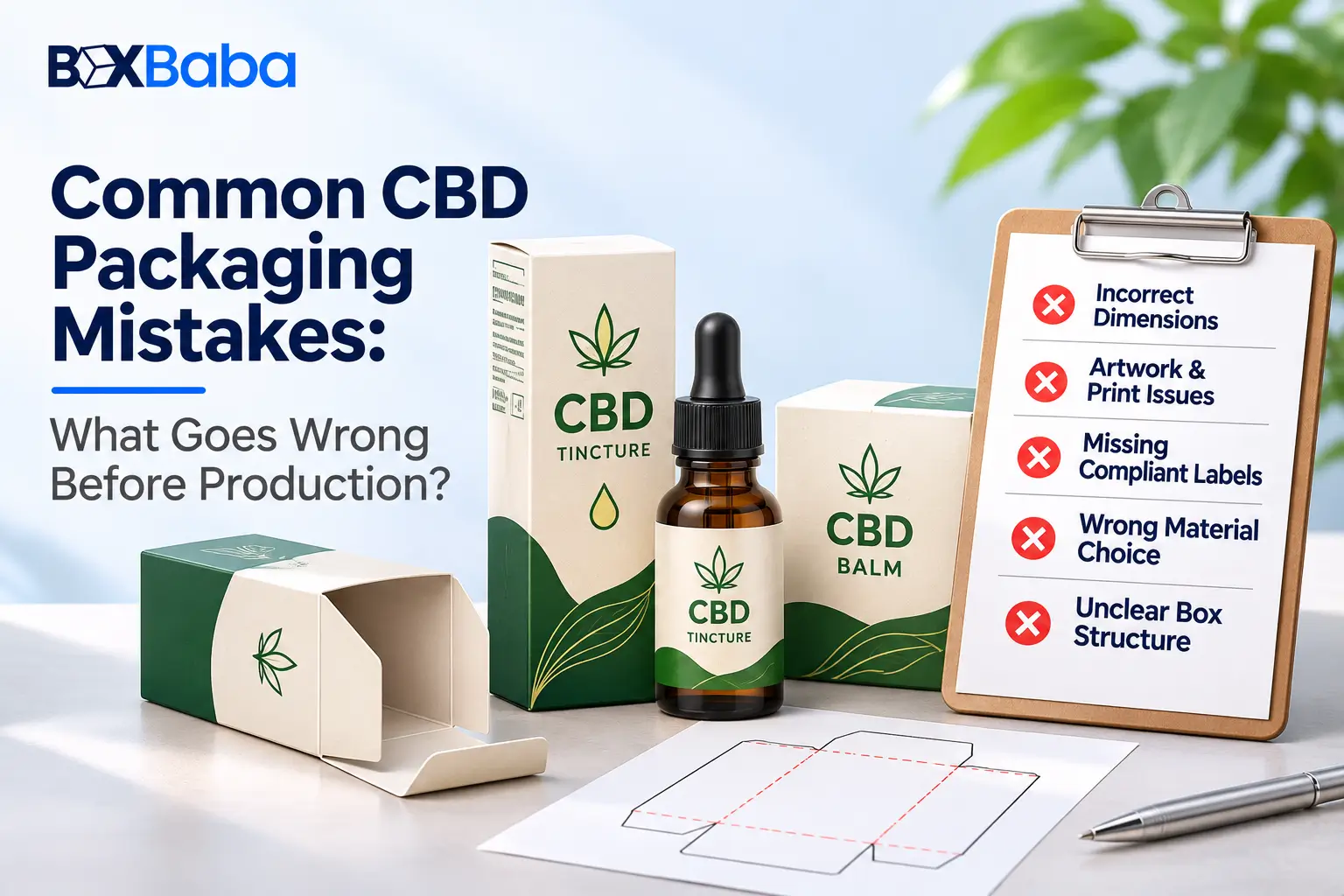
The most expensive CBD packaging mistake is often not the problem you can see.
A bottle that moves inside its carton may look like an insert problem, when the actual cause is an oversized box.
Artwork showing the wrong CBD strength may look like a printing problem, when the root cause is uncontrolled SKU data.
A package described as child-resistant may look structurally secure, but the real problem is that a box-style name was mistaken for evidence of child-resistant performance.
The useful troubleshooting sequence is:
Visible Problem → Upstream Cause → Affected Packaging Stage → Corrective Decision
For CBD packaging, those stages commonly follow:
Finished Product → Product / Market Requirements → Packaging Function → Structure → Dieline → Approved Product Data → Artwork → Proof → Production
The objective is not simply to catch mistakes before printing.
It is to avoid approving a downstream decision before the information it depends on is stable.
Brands still defining the overall packaging system can start with Custom CBD Boxes.
CBD Packaging Mistakes at a Glance
Visible Problem | Likely Root Cause | What to Recheck |
Product does not fit | Box developed from capacity or outdated container | Current finished product |
Carton bulges around closure | Maximum closed profile was missed | Closure, cap, pump or dropper |
Product moves inside box | Carton oversized or internal function unresolved | Outer dimensions before insert |
Insert is hard to load/remove | Retention designed without pack-out review | Loading + retention + removal |
Box feels overbuilt | Structure selected from branding alone | Actual load and presentation role |
CR claim cannot be supported | Structural terminology confused with CR function | Applicable requirement + package basis |
Tamper feature is assumed to provide CR | Two separate functions were merged | CR and tamper evidence separately |
Wrong strength/product printed | SKU/artwork version error | SKU matrix |
QR scans to wrong information | Destination not verified by SKU | Code + destination |
Barcode belongs to another SKU | Product-data assignment failure | Barcode matrix |
Window reveals wrong product area | Product position changed after window design | Product + insert + window |
Retail carton fails online pack-out | Retail unit treated as shipping system | Completed ecommerce order |
Sample approved but package fails another criterion | Wrong proof used for unresolved risk | Approval scope |
Reorder no longer fits | Container changed since previous run | Current product vs prior specification |
Printed inventory becomes stale | Product/rules changed before inventory was consumed | Inventory horizon + current requirements |
The key diagnostic question is:
Which earlier decision produced the visible failure?

Mistake 1: Finalizing the Box Before the CBD Container Is Stable
Packaging concepts can begin early.
Production dimensions should not be frozen while the primary package is still changing.
Changes to the:
- bottle;
- jar;
- dropper;
- pump;
- cap;
- lid;
- pouch closure;
- decorative collar;
can alter the maximum physical profile.
That can then affect:
Dimensions → Structure → Insert → Dieline → Artwork
For example, two products can both contain 30 ml while using completely different primary containers.
If the physical product changes after packaging approval, recheck every downstream relationship affected by that change.
Mistake 2: Treating Fill Capacity as Box Dimensions
A common quote request is:
I need a box for a 30 ml CBD bottle.
That does not provide enough structural information.
Capacity does not define:
- bottle diameter;
- total closed height;
- cap/dropper width;
- shoulder;
- filled weight.
Likewise, a 30-count gummy product does not define:
- jar diameter;
- lid width;
- jar height.
Use:
Finished Container Geometry → Carton Development
not:
ml / oz / Product Count → Standard Box
For bottle-specific commercial packaging, see CBD Dropper Bottle Boxes.
Mistake 3: Measuring the Body but Missing the Closure
The main container body is not always its maximum envelope.
The widest or tallest feature may be:
- dropper bulb;
- cap;
- pump;
- collar;
- lid.
A carton developed only from the body can:
- press on the closure;
- fail to close;
- bulge;
- distort an insert.
Measure the complete closed product as it will be packed.
The physical question is:
What is the maximum finished profile?
not:
What is the diameter of the bottle body?

Mistake 4: Expecting the Secondary Carton to Perform the Primary Container Job
A paperboard, kraft, corrugated or rigid CBD box usually surrounds a finished primary package.
Do not automatically represent that secondary carton as providing:
- liquid containment;
- leak prevention;
- oxygen barrier;
- moisture barrier;
- formulation preservation.
Those functions normally belong to the suitable primary:
- bottle;
- jar;
- tube;
- pouch;
- closure/seal.
Keep the relationship clear:
CBD Formulation → Primary Container
Secondary Box → Structure / Information / Presentation
A stronger-looking outer carton cannot fix an unsuitable primary package.
Mistake 5: Choosing Structure Because the Product Is Premium
Premium positioning is not a structural specification.
A lightweight single bottle may work in a properly developed folding carton.
A multi-product presentation set may justify:
- drawer;
- two-piece;
- rigid;
- another presentation structure.
The decision should follow:
Product Geometry + Loaded Weight + Opening Requirement + Pack-Out + Presentation Need
not:
Premium Product → Rigid Box
Structural complexity should solve a real packaging requirement.
Mistake 6: Assuming Lock Means Child-Resistant
Packaging terminology can be misleading.
A:
- snap-lock bottom;
- auto-lock bottom;
- magnetic closure;
- tab lock;
may sound secure.
Those structural names do not automatically establish child resistance.
Use:
Auto-Lock → Bottom Construction
Child-Resistant → Separate Access-Control Requirement
Likewise:
Magnetic Closure ≠ Child-Resistant Qualification
Where child-resistant functionality may be required, verify the exact product, market and supported package configuration separately.
For additional background on CPSC/PPPA special-packaging concepts, use BoxBaba Child-Resistant Mylar Bags guide.
Mistake 7: Assuming All CBD Products Have the Same CR Requirement
The opposite assumption is also unsafe.
Do not use:
CBD = Child-Resistant Everywhere
or:
CBD = No Child-Resistant Requirement
as universal rules.
The applicable answer can depend on:
- product classification;
- contents;
- jurisdiction;
- market;
- relevant federal/state requirements.
For PPPA-regulated substances, special packaging has a defined performance meaning.
It should not be used as a generic marketing adjective.
Mistake 8: Treating Child Resistance & Tamper Evidence as the Same Function
These functions answer different questions.
Child-Resistant
Restricts child access under an applicable performance framework.
Tamper-Evident
Provides visible evidence that the package has been opened or interfered with.
Resealable
Allows the package to be closed again after opening.
One does not automatically prove another.
A tear strip can provide evidence of first opening without making the package child-resistant.
A child-resistant closure can potentially exist without a particular tamper-evident feature.
Define the required packaging functions separately.

Mistake 9: Adding an Insert Before Asking Why the Product Moves
A loose bottle does not automatically mean:
Add Insert
First ask:
Is the outer carton unnecessarily large?
If the box is oversized without a structural or presentation reason, reducing its dimensions may solve the problem more efficiently.
A separate insert becomes useful when the package still needs a defined function such as:
- retention;
- orientation control;
- separation;
- accessory organization;
- presentation.
Use:
Movement → Review Outer Geometry → Identify Remaining Internal Function → Insert Decision
Where a fitted holder is genuinely required, explore Printed Boxes with Inserts.
Mistake 10: Assuming Every Glass CBD Bottle Needs Foam
Glass describes the primary-container material.
It does not automatically specify the insert.
Compare:
One Glass Dropper Bottle in a Compact Folding Carton
with:
Glass Bottle + Jar + Applicator in a Gift Set
The packaging problems are different.
Internal support should follow:
Geometry + Weight + Arrangement + Required Function
not:
Glass → Foam
Likewise, a very tight insert is not automatically better.
The working relationship should balance:
Retention + Loading + Removal
Mistake 11: Finalizing the Outer Box Before a Required Insert
Where an insert is genuinely required, the structural sequence becomes:
Finished Product
↓
Insert Geometry
↓
Completed Insert Footprint
↓
Outer Box
Freezing the outer dimensions first can create later problems such as:
- insufficient internal room;
- increased package height;
- poor product removal;
- window misalignment.
The internal and external structures should be treated as one connected system.

Mistake 12: Printing CBD Claims Before the Copy Has Been Approved
Packaging artwork should not be used to test speculative product claims.
Be particularly careful with statements involving:
- disease treatment;
- medical outcomes;
- therapeutic effects;
- certifications;
- laboratory/testing claims;
- environmental claims.
The workflow should be:
Product / Regulatory Review → Approved Copy → Packaging Artwork
not:
Designer Creates Claim → Printer Produces It
The packaging supplier can help organize the printed information.
That does not make the supplier the final legal approver of the product claim.
Mistake 13: Treating an Artwork Proof as Regulatory Approval
A proof can confirm:
The approved wording appears on the intended panel.
It cannot itself establish:
The underlying wording satisfies every applicable requirement.
Keep two approval objects separate:
Content Approval
and:
Production Artwork Approval
This distinction is particularly important where CBD products vary by:
- product category;
- formulation;
- market;
- claims.
Mistake 14: Finishing the Visual Design Before Planning Product Information
CBD packaging may need space for approved:
- product identity;
- strength or variant;
- ingredients;
- directions;
- warnings;
- barcode;
- QR;
- variable coding.
If decorative layout, windows and finishes consume all usable panel space first, essential information can end up:
- crowded;
- too close to folds;
- positioned on poor panels.
Use:
Approved Information → Panel Allocation → Visual Design
rather than:
Decorative Composition → Squeeze Product Data Into Remaining Space
Mistake 15: Building Production Artwork Before the Dieline Is Final
A structural change changes the flat artwork map.
Moving from:
Straight Tuck → Auto-Lock
or:
Folding Carton → Drawer
changes panels, flaps or production geometry.
Use:
Approved Structure → Approved Dieline → Production Artwork
For deeper production-file terminology, see the Dieline in Packaging guide.
Do not resize a manufacturing dieline merely because the design needs more room.
Mistake 16: Assuming One Dieline Means One CBD Artwork File
Several CBD products can share a physical carton and still need separate printed files.
For example:
SKU | Structural Dieline | Variant | Barcode | QR Destination | Artwork |
SKU A | DL-01 | Variant A | Code A | Link A | ART-A |
SKU B | DL-01 | Variant B | Code B | Link B | ART-B |
SKU C | DL-01 | Variant C | Code C | Link C | ART-C |
This gives an important distinction:
Structural Version ≠ Printed Artwork Version
A change in:
- strength;
- product name;
- formula;
- barcode;
- QR;
- approved copy;
can create a new printed version without creating a new physical carton.
Mistake 17: Verifying the QR Scan but Not the Destination
A QR code can work perfectly and still be wrong.
Before production:
Scan the Code
and:
Verify the Destination for That Exact SKU
If a CBD brand uses QR links for:
- laboratory/COA information;
- product information;
- instructions;
- support;
make sure the code on SKU A does not lead to information for SKU B.
Scannable QR + Wrong Destination = Production Error
Mistake 18: Treating Barcode Data as Designer-Supplied Information
The packaging supplier should not invent the product barcode.
The brand should provide the correct product identifier/data for each applicable SKU.
Before approval, confirm:
- SKU assignment;
- barcode asset/data;
- placement;
- clear area;
- absence of disruptive folds or finishes.
Artwork can be beautifully executed while the data inside it is wrong.

Mistake 19: Forgetting Future Batch / Lot / Variable Coding
Some product information may be applied after the cartons are printed.
Depending on the product workflow, that can include:
- lot/batch data;
- date coding where applicable;
- other variable production identifiers.
Reserve the area before the surface is finalized with:
- foil;
- heavy coating;
- lamination;
- dense artwork.
Confirm:
What will be added later?
Where?
Using which coding process?
That can influence the final artwork and finish plan.
Mistake 20: Using the Retail Carton as the Ecommerce Shipping System Without Review
Retail packaging and order-level distribution packaging are different entities.
A CBD product might use:
Bottle → Retail Carton
while an online order uses:
Completed Retail Carton(s) → Outer Mailer
The retail carton does not automatically have to become:
- thicker;
- corrugated;
- rigid;
simply because the same SKU is sold online.
For an outer ecommerce layer, explore Custom Mailer Boxes.
Use:
Saleable Unit → Completed Order → Outer Package
rather than:
Bare Product → One Box Does Everything
Mistake 21: Treating a Structural Sample as Shipping Validation
A structural sample can answer:
- Does the product fit?
- Does the insert work?
- Can the package close?
- Can the product be removed?
It does not automatically validate:
- parcel drops;
- vibration;
- compression;
- the complete distribution environment.
Keep:
Fit / Assembly Review
separate from:
Distribution Performance Evaluation
where the latter is required.
Mistake 22: Approving a Prototype Without Defining What It Represents
A printed prototype may differ from bulk production in:
- print process;
- material;
- ink;
- coating;
- lamination;
- foil;
- tooling.
Before approving it, ask:
What exactly am I approving from this sample?
Possible approval scopes include:
- dimensions;
- color direction;
- foil position;
- material feel;
- artwork scale.
A sample should be linked to a defined approval criterion, not treated as proof of everything.
Mistake 23: Approving Only the Front Panel
A correct front does not mean the production file is correct.
Review:
Front
→ product identity and variant.
Sides / Back
→ approved copy, barcode, QR and instructions.
Top / Bottom
→ orientation, coding areas and SKU information.
Structural Areas
→ folds, glue seams, windows, tear/opening features.
Then review how those panels appear after assembly.
Mistake 24: Treating a Fast-Moving Federal Hemp Rule as Static Packaging Copy
A successful first production run proves that a defined previous configuration worked.
It does not prove that today product is identical.
Before repeating the packaging, check whether the:
- primary-container supplier;
- closure;
- dimensions;
- artwork;
- barcode;
- QR;
- material;
- finish;
have changed.
The root failure can be:
Product Changed → Old Packaging File Did Not
A deeper repeat-order workflow belongs in the dedicated CBD reorder guide.
Mistake 26: Keeping Several Files Called Final
Avoid production folders containing:
- final.pdf;
- final-new.pdf;
- final-v2.pdf;
- final-actual.pdf.
Use a controlled identifier that connects:
SKU + Dieline Revision + Artwork Revision + Quantity
The brand and supplier should be able to answer:
Which exact file was approved for this production run?
without relying on memory.
Mistake 27: Trying to Solve Structural Problems With Decoration
Foil cannot correct:
- wrong dimensions;
- poor retention;
- incorrect structure;
- wrong SKU.
Soft-touch cannot correct:
- unsupported claims;
- wrong QR;
- bad ecommerce architecture.
The correct sequence is:
Product → Function → Structure → Artwork → Decoration
A decorative finish should enhance a packaging system that already works.
CBD Packaging Stage-Gate Framework
Prepare enough information to reduce assumptions.
Finished Product
- primary-container type;
- complete closed dimensions;
- closure;
- filled weight where relevant.
Product Versions
- SKU;
- strength/variant;
- quantity;
- barcode;
- QR destination.
Packaging Requirements
- retail/ecommerce/gift role;
- required packaging functions;
- orientation;
- insert/window requirement;
- preferred opening where known.
Artwork
- approved product copy;
- artwork status;
- finishes;
- variable-data area.
Production
- total quantity;
- quantity by artwork version;
- proof/sample requirement;
- delivery destination.

Avoiding CBD Packaging Mistakes With BoxBaba
The most visible problem is not always the root problem.
A loose bottle may start with sizing.
A wrong QR may start with SKU data.
A bad reorder may start with a new bottle supplier.
A questionable CR statement may start with confusing a structural lock with a performance requirement.
Use:
Finished CBD Product
↓
Product / Market Requirements
↓
Packaging Functions
↓
Structure + Internal Support
↓
Dieline
↓
Approved Product Data
↓
Artwork
↓
Proof
↓
Production Version
For the broader packaging route, explore Custom CBD Boxes.
For fitted holders and internal organization, use Printed Boxes with Inserts.
For structural artwork planning, use the Dieline in Packaging guide.
BoxBaba current CBD packaging program starts from 100 units, with artwork and dieline support, samples available, standard production generally 5–9 business days after artwork approval, and free shipping across the USA.
When requesting a quote, share the current finished product, quantity by SKU, intended packaging layer, structure requirements and artwork status.
The best time to correct a CBD packaging mistake is before the upstream decision that causes it becomes locked into production.
Frequently Asked Questions
What is the biggest CBD packaging mistake?
A major root mistake is approving downstream packaging decisions before the product or information they depend on is stable. One container change can affect dimensions, insert geometry, dieline and artwork later.
Can I choose CBD box dimensions from ml or oz?
No. Fill capacity does not establish external package geometry. Measure the complete finished container, including the closure.
Does every CBD product need child-resistant packaging?
No single universal rule applies to every CBD product and market. Verify the exact product, jurisdiction and applicable requirements before selecting or representing packaging as child-resistant.
Is an auto-lock CBD carton child-resistant?
Not automatically. Auto-lock describes the bottom construction. Child-resistant performance is a separate packaging requirement.
Is child resistance the same as tamper evidence?
No. Child resistance concerns access; tamper evidence concerns visible evidence of opening or interference.
Should every glass CBD bottle have an insert?
No. Review the product geometry, weight, carton dimensions and unresolved positioning requirement first.
Can a proof tell me whether CBD claims are legally acceptable?
No. A proof verifies the supplied production artwork. The brand or appropriate reviewer should approve the underlying product-specific claims and regulatory wording.
Can several CBD strengths share a dieline?
Yes, when their physical containers and packaging requirements are genuinely identical. Each printed strength may still require a separate artwork, barcode, QR and approval.
What is a common CBD QR-code mistake?
The QR scans correctly but leads to information for the wrong product or production version. Always verify the destination for the exact SKU.
Can the retail CBD carton also be the ecommerce shipping box?
Possibly in some configurations, but do not assume it. Evaluate the completed online order and distribution package separately.
Does a structural sample prove ecommerce shipping performance?
No. A fit/structural sample and distribution-performance evaluation answer different questions.
What should brands know about the November–December 2026 federal hemp transition?
As of September 7, 2026, recent federal legislation has modified the Section 781 transition. Certain specified provisions remain relevant earlier, while the broader transition extends through December 11, 2026. Verify the exact product status again before printing packaging intended for use through this period.
What should be checked before reordering CBD boxes?
Reconfirm the current container, closure, dimensions, artwork, barcode, QR destination, material, finish and product/market requirements before releasing the previous specification again.