
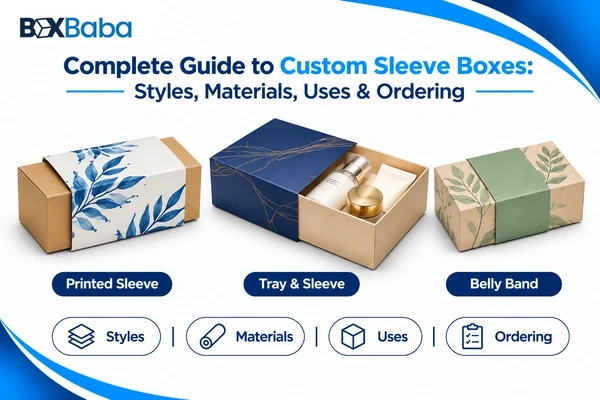
Custom sleeve boxes use a fitted paper or paperboard sleeve around an existing package, product, or inner tray. The sleeve provides an additional surface for printed branding, product information, and presentation. Depending on the construction, it may be a standalone wrap or part of a complete sliding tray-and-sleeve package.
Choosing the right sleeve involves more than selecting an attractive design. Brands must determine what the sleeve surrounds, how it opens, what material is appropriate, and whether the underlying packaging provides sufficient product support.
This guide explains the main sleeve packaging styles, common applications, materials, sizing principles, printing options, and ordering process. It is intended to help U.S. brands and wholesale buyers make informed packaging decisions before requesting a custom quote.
What Are Custom Sleeve Boxes?
Custom sleeve boxes are packaging solutions that use an outer wrap or fitted sleeve around another component. This component may be an existing carton, a compatible product, or a purpose-built inner tray.
Many box sleeves are open at two ends and fit around the sides of an inner package. They can carry printed logos, product names, barcodes, artwork, and promotional messages.
However, a packaging sleeve is not necessarily a complete box.
For example:
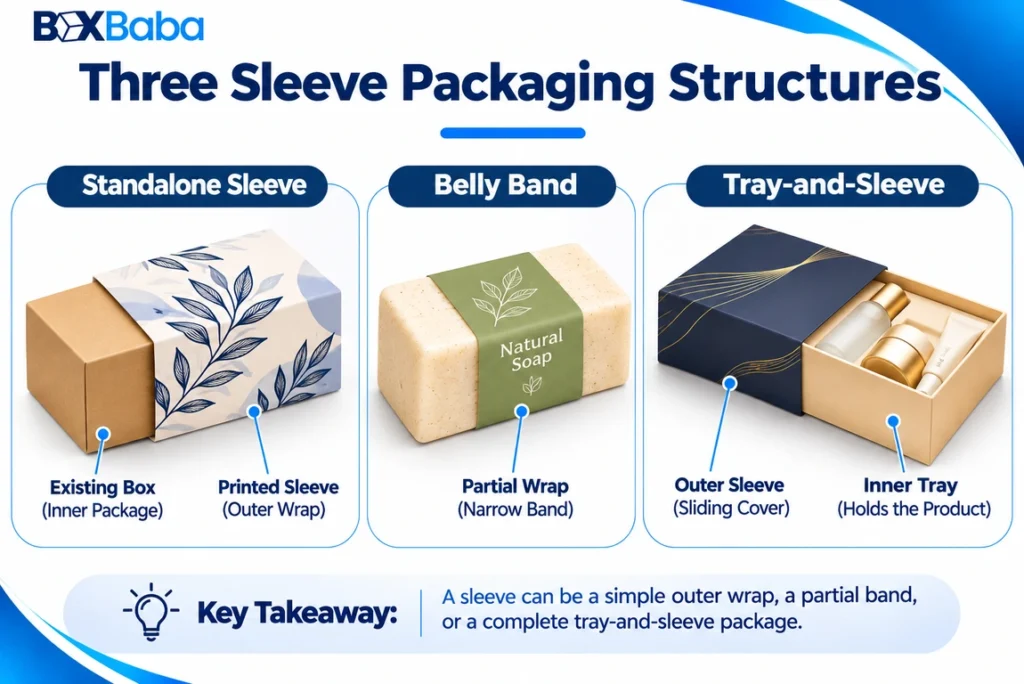
- A standalone box sleeve fits around an existing carton.
- A belly band covers a narrower portion of a product or package.
- A tray-and-sleeve box combines a product-holding inner tray with a sliding outer sleeve.
These formats differ in their construction, measurements, assembly, and intended functions.
For commercial packaging options, explore BoxBabaCustom Sleeve Boxes collection.
These dimensions overlap.
A box can be both rigid and two-piece, Kraft and removable-lid, or heart-shaped and gift-focused.
The terms describe different attributes of the same package.
Types of Custom Sleeve Packaging
The main sleeve styles differ by their coverage, inner components, materials, and opening methods.
Sleeve Packaging Type | Main Construction | Common Use | Key Consideration |
Standalone Box Sleeve | Printed sleeve fitted around an existing carton | Retail branding and promotional packaging | Measure the finished inner box |
Belly Band Sleeve | Narrow paper or paperboard wrap | Soap, gifts, stationery, bundled products | Partial coverage and fastening |
Tray-and-Sleeve Box | Inner product tray with sliding outer sleeve | Cosmetics, gifts, accessories, confectionery | Coordinated tray and sleeve dimensions |
Rigid Tray-and-Sleeve Box | Rigid-board sliding package | Selected premium gifts and jewelry sets | Structure, assembly, weight, and cost |
Window Sleeve | Sleeve with a viewing cutout | Retail products requiring visibility | Cutout placement and optional film |
Kraft Sleeve | Sleeve made using suitable Kraft stock | Natural-looking retail branding | Print contrast and stock selection |
These descriptions represent different kinds of attributes. Standalone sleeves, belly bands, and tray-and-sleeve boxes describe construction, while Kraft identifies a material and a window identifies a design feature.
A tray-and-sleeve box may therefore use Kraft paperboard or incorporate a window when the structure supports it.
Standalone Printed Sleeves
Standalone printed sleeves fit around existing boxes or compatible products.
They are useful when a brand already has a suitable inner package but wants additional exterior branding without redesigning the entire carton.
For example, a company may use one underlying carton across several product variations while changing the sleeve artwork.
BoxBaba Paper Sleeves page provides a relevant commercial starting point.
Belly Band Packaging
Belly bands are narrower wraps that cover only a selected part of the product or package.
They leave more of the underlying surface visible and typically offer less printing area than broader sleeves.
For businesses seeking partial-wrap branding, see Belly Band Sleeves.
Tray-and-Sleeve Packaging
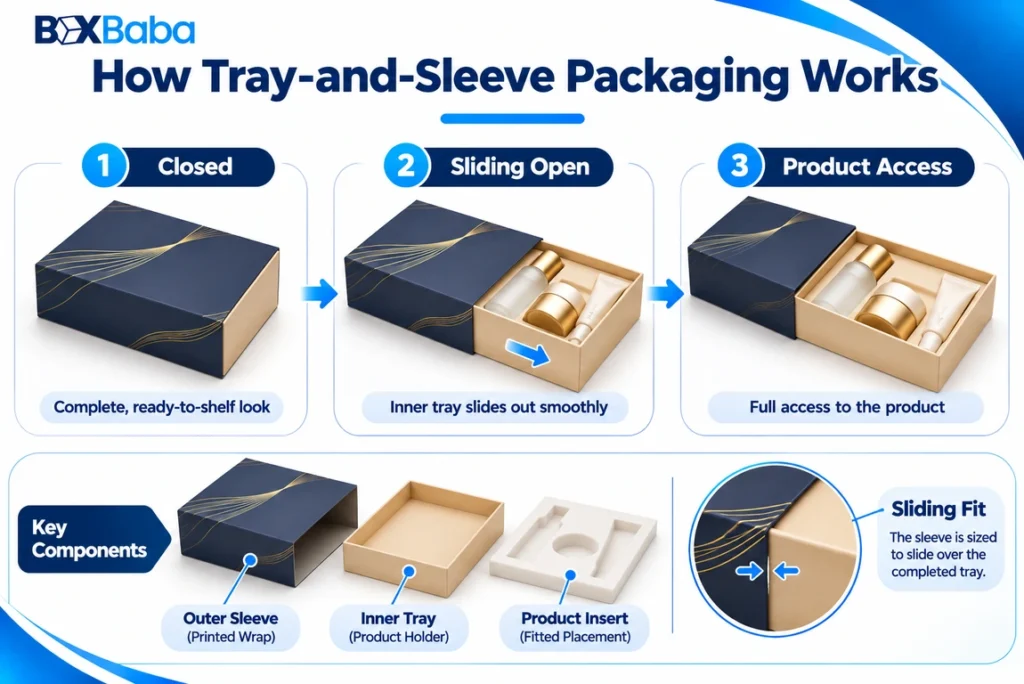
Tray-and-sleeve boxes include a separate inner tray designed to hold the product. The outer sleeve surrounds the completed tray and creates a sliding opening.
This structure can suit arranged products, gift sets, and items requiring a defined presentation area. Because both components must work together, tray sizing and sleeve sizing are separate design tasks.
Rigid and Window Variations
Rigid tray-and-sleeve structures use suitable rigid-board construction rather than ordinary folding-carton paperboard.
Window sleeves include an intentional viewing cutout that reveals part of the underlying product or package.
Neither rigid construction nor a window is automatically included in every sleeve box. The exact components must be specified for the project.
When Should You Use Custom Sleeve Boxes?
Custom sleeve packaging is useful when a brand needs additional printed coverage, coordinated presentation, or a sliding opening around an existing or purpose-built inner component.
The appropriate choice depends on the product and the required packaging function.
Packaging Requirement | Recommended Starting Direction |
Add printed branding to a plain existing box | Standalone printed sleeve |
Keep most of the product or package visible | Belly band |
Create a slide-open presentation | Complete tray-and-sleeve box |
Use a natural-looking paperboard surface | Suitable Kraft sleeve |
Display part of the product through an outer panel | Window sleeve |
Package a selected gift or jewelry set in a substantial structure | Evaluate rigid tray-and-sleeve construction |
Main Benefits of Sleeve Packaging
Branding flexibility: A printed sleeve can introduce new artwork or product information without necessarily changing the underlying box.
Customizable coverage: Brands can choose partial wraps or broader sleeve panels based on the required visual presentation.
Coordinated collections: Compatible underlying packaging may support different sleeve designs across product variations.
Sliding presentation: A complete tray-and-sleeve structure can reveal the product differently from a conventional tuck-end carton.
Material and finishing choices: Suitable paperboard, printing, and surface treatments can be selected to match the intended application.
These are potential design advantages, not universal guarantees. Sleeves are not automatically cheaper, stronger, more protective, or more sustainable than fully printed boxes.
What Materials Are Used for Sleeve Boxes?
Material selection affects printing, stiffness, fold quality, surface appearance, and how the sleeve fits around the underlying component.
The best choice depends on the package dimensions, expected handling, construction, and artwork requirements.
White Paperboard and SBS
White paperboard, including suitable solid bleached sulfate (SBS) grades, provides a smooth surface for detailed printed graphics and brand colors.
It can be appropriate for many folding-carton sleeve constructions when the selected stock provides the necessary stiffness and fold performance.
Kraft Paperboard
Kraft paperboard has a natural-looking surface commonly associated with understated or rustic packaging designs.
Its base color can influence printed graphics, especially lighter inks and subtle gradients.
For Kraft-focused packaging options, explore BoxBaba Kraft Sleeve Boxes.
A brown Kraft appearance does not prove recycled content, recyclability, or environmental certification. Those characteristics require evidence about the actual material and completed package.
Rigid Board and Corrugated Board
Rigid board can be considered for selected tray-and-sleeve presentation structures where a more substantial construction is appropriate.
Corrugated board may be suitable for certain structural applications and separate shipping cartons. It should not be treated as the default material for a thin decorative sleeve.
The material should follow the packaging function, not the other way around.
A lightweight retail sleeve, fitted presentation tray, and corrugated shipping carton may each require different materials.

How to Measure Custom Sleeve Boxes Correctly
The first sizing question is simple: What does the sleeve need to fit around?
An outer sleeve around an existing carton is measured differently from a sleeve designed for a new inner tray.
Measuring a Sleeve for an Existing Box
When an existing box is already supplied, begin with its finished exterior dimensions.
The design sequence is:
Finished Box Exterior → Required Sleeve Coverage → Sleeve Wrap Dimensions → Seam and Fold Allowances → Final Fit → Approved Dieline
Measure the inner box in its assembled condition, including relevant external features.
The sleeve must account for the selected material, folds, seams, and intended method of application or removal.
Measuring a Complete Tray-and-Sleeve Box
For a complete sliding package, develop the inner tray around the product first.
Use this sequence:
Finished Product → Tray Interior → Completed Tray Exterior → Sleeve Interior → Sliding Fit → Final Dieline
The sleeve is designed around the outside of the completed tray, not directly around the product or the tray internal dimensions.
Why Sleeve Fit Matters
A sleeve that is too tight can create assembly problems or make a sliding tray difficult to open.
A sleeve that is too loose may move more than intended or fail to achieve the desired presentation.
Board thickness, folds, glued seams, coatings, and finishing can affect fit.
There is no universal clearance suitable for every sleeve design. Important dimensions and sliding behavior should be checked using the approved construction and, where needed, a physical structural sample.

Custom Sleeve Box Printing and Finishing Options
Printed sleeves allow brands to add visual identity and product information to the outer packaging.
The correct printing and finishing methods depend on the material, artwork, order quantity, and structural design.
Printing Methods
Offset printing may suit larger runs and detailed artwork requiring consistent printed layouts.
Digital printing may be appropriate for selected smaller orders or multiple artwork versions, depending on stock compatibility.
Flexographic printing may suit compatible materials and production conditions where the process is technically appropriate.
CMYK is commonly used for multicolor artwork. Pantone/PMS references can communicate brand-color targets where supported by the selected printing workflow.
Actual color reproduction depends on the substrate, inks, coatings, and print process. Proofing is important for color-sensitive projects.
Finishing Options
Compatible sleeve finishes may include:
- Matte and gloss surface treatments.
- Soft-touch finishes.
- Foil stamping.
- Embossing and debossing.
- Spot UV.
Printing produces artwork and colors; finishing changes selected surface characteristics or adds decorative details.
Coatings and lamination are also different processes. A coating is applied to a surface, while lamination bonds a separate film layer to the substrate.
Finishes should be evaluated around crease lines, glue seams, cutouts, and high-contact sliding surfaces. Raised or textured finishes can influence the movement and appearance of a sliding package.
Why the Sleeve Dieline Is Important
A dieline is the flat structural layout identifying cut lines, folds, panels, and assembly features.
It also helps establish the correct artwork placement.
Important logos, barcodes, and product information should remain clear of unsuitable folds, seams, and cutting areas.
For more detail, read BoxBaba Dieline in Packaging Guide.

Common Applications of Custom Sleeve Packaging
Sleeves can serve different product industries, but the appropriate construction should match the product physical requirements and packaging layer.
Cosmetics and Fragrance
Cosmetic sleeves may fit existing cartons or form part of a complete sliding presentation package.
Bottles, tubes, caps, pumps, and coordinated sets can require different tray and insert arrangements.
For a bottle-oriented example, explore BoxBaba Tray and Sleeve Essential Oil Boxes.
The decorative outer structure should not be treated as a substitute for the product sealed primary container.
Soap, Candles, and Gifts
Sleeves may provide branding for soap bars, candle cartons, and gift packaging.
A standalone sleeve may be sufficient when the existing package performs the required holding function.
However, a paperboard sleeve should not automatically be described as moisture-resistant or suitable for every product-contact requirement.
Bakery and Confectionery
Decorative sleeves can fit around suitable bakery cartons, confectionery trays, and properly wrapped products.
For chocolate, the printed sleeve is distinct from the primary wrapper.
Delicate products such as macarons require suitable product positioning through an inner tray or another approved structure.
BoxBaba Macaron Sleeve Boxes provides an application-specific example.
Direct-food-contact suitability and shipping performance must be evaluated separately when relevant.
Jewelry and Fashion Accessories
Sleeve packaging may also support jewelry, wallets, stationery, and selected apparel accessories.
Product dimensions, material surfaces, display orientation, and inserts influence the required construction.
For a fashion accessory example, visit BoxBaba Wallet Sleeve Boxes.
A decorative sleeve alone does not guarantee protection against scratching, tangling, or transit damage.
What Affects Custom Sleeve Box Pricing?
Custom sleeve packaging costs depend on the complete design and production requirements.
The main variables include sleeve dimensions, stock selection, printing, finishing, order quantity, artwork variations, and whether an inner tray or insert is required.
A standalone sleeve around an existing box differs in scope from a complete tray-and-sleeve package.
For buyers comparing quotations, the important distinction is between the sleeve component price and the total finished packaging cost.
The latter may include inner cartons, inserts, assembly, packing labor, artwork versions, and distribution packaging.
A supplier quotation should identify exactly which components and services are included.
How to Order Custom Sleeve Boxes
Ordering becomes easier when the packaging structure and underlying component are clearly defined before artwork approval.
Step 1: Confirm the Required Structure
Determine whether you need a standalone outer sleeve, belly band, or complete tray-and-sleeve package.
Step 2: Supply the Correct Dimensions
For an existing carton, provide its finished exterior dimensions.
For a complete sliding package, provide the finished product measurements, intended arrangement, and any tray or insert requirements.
Step 3: Choose Materials and Artwork
Discuss preferred stock, printing, brand colors, product information, and finishing.
The final choices must be compatible with the approved construction.
Step 4: Review Proofs and Samples
Each approval method has a different purpose.
Proof or Sample | What It Helps Review |
Digital Artwork Proof | Graphics, text, layout, and panel placement |
3D Mockup | Intended assembled appearance |
Blank Structural Sample | Dimensions, fit, opening, assembly, and product access |
Printed Sample | Print appearance, selected finishes, and completed construction where applicable |
A digital mockup cannot establish actual physical fit.
Step 5: Finalize the Order
Confirm the approved dieline, dimensions, materials, artwork, quantity, sample conditions, and delivery requirements.
For eligible projects, BoxBaba custom packaging MOQ starts from 100 boxes.
The standard production baseline is 5–9 business days after final artwork and specification approval, subject to the confirmed project. Production and delivery times are separate.
Free USA shipping and sample arrangements apply under the relevant offer terms.
Custom Sleeve Box Quote Checklist
Before requesting a quote, prepare:
- Product or finished inner-box measurements.
- Required sleeve structure and coverage.
- Tray or insert specifications, if applicable.
- Product weight and orientation where relevant.
- Material and finishing preferences.
- Artwork files and number of SKU variations.
- Order quantity by size or artwork.
- U.S. delivery destination and required date.
These details help a supplier evaluate the actual packaging configuration instead of quoting an incomplete specification.

Common Mistakes to Avoid with Sleeve Packaging
Many sleeve packaging problems arise when the intended structure is not clearly defined.
Common Mistake | Why It Matters | Recommended Action |
Measuring only the product | The sleeve may actually fit around an inner box or tray | Identify and measure the finished inner component |
Treating a sleeve as a complete box | The quotation may omit a necessary tray or carton | Confirm every supplied component |
Ignoring opening direction | Access and artwork orientation can be affected | Confirm the opening before artwork approval |
Assuming all materials behave alike | Stiffness, folds, and sliding fit can differ | Select stock for the approved structure |
Skipping physical fit review | A digital mockup cannot confirm real assembly | Evaluate a structural sample where needed |
Relying on a retail sleeve for shipping protection | The complete distribution package may need additional support | Review outer shipping requirements separately |
The most useful rule is to design the complete packaging system, including the sleeve, underlying component, intended contents, and handling method.
Choosing the Right Custom Sleeve Box
The best sleeve structure depends on what the packaging needs to do.
Use a standalone sleeve to add branding around a suitable existing box, a belly band when partial coverage is enough, or a tray-and-sleeve package when a fitted inner tray and sliding presentation are required.
Before production, confirm the dimensions, materials, opening method, artwork, and physical fit.
Explore Custom Sleeve Boxes at BoxBaba
BoxBaba provides custom sleeve packaging options for U.S. brands, retailers, and wholesale buyers.
Explore the Custom Sleeve Boxes collection to compare suitable formats, or request a quotation based on your packaging requirements.
Phone: +1 305 574 4357
Email: sales@boxbaba.com
Request a custom sleeve packaging quote with your dimensions, preferred construction, artwork details, and order quantity.
Frequently Asked Questions About Custom Sleeve Boxes
Do Custom Sleeve Boxes Always Require Glue?
No. Some sleeve constructions use glued seams, while others may use compatible mechanical or overlapping closures. The approved dieline should identify the actual assembly method and whether the sleeves will be supplied flat, pre-glued, or assembled.
Can Both the Inner Tray and Outer Sleeve Be Printed?
Both components may be printed when supported by the chosen materials and production process. Artwork should be prepared for each component separately because their printable surfaces and visibility differ.
Can the Same Sleeve Design Be Used Across Multiple Product Variations?
Potentially. Different SKUs may share the same sleeve dimensions when their finished inner components and fit requirements are compatible. Artwork versions, inserts, and order quantities still need to be reviewed individually.