
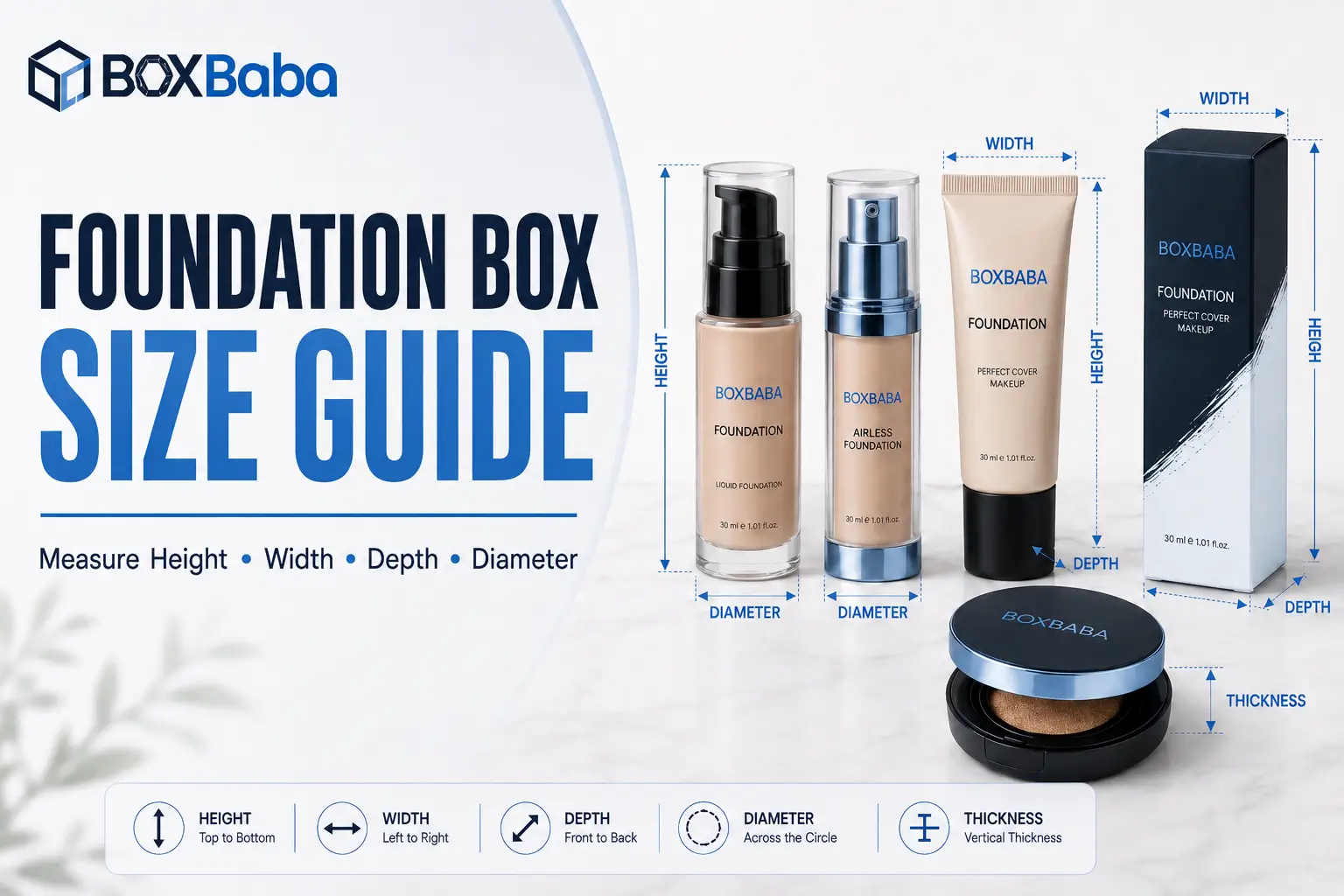
There is no universal foundation box size. A 30 ml or 1 oz fill quantity does not determine carton dimensions because pump bottles, airless containers, tubes, sticks and compacts can have very different exterior profiles.
For custom packaging, measure the complete foundation product in its filled, closed and sale-ready condition, including the final pump, cap, overcap or other exterior components. Then use the maximum product dimensions, orientation, required clearance and any insert to establish the internal carton size.
A useful sizing sequence is:
Finished Foundation Container → Maximum Product Envelope → Clearance / Insert Space → Internal Box Dimensions → Material + Structure → External Box Dimensions
Brands preparing a custom project can explore Custom Foundation Boxes. For broader measurement principles across cosmetic products, review the Cosmetic Box Size Guide.
Is There a Standard Foundation Box Size?
There is no single production-ready box size for every 30 ml, 1 oz or other foundation product.
Net contents tell you how much cosmetic product is inside the package. They do not describe the exterior dimensions of the finished primary container.
A 30 ml foundation could use a:
- tall cylindrical pump bottle;
- short square glass bottle;
- airless dispenser;
- squeeze tube;
- foundation stick;
- compact or cushion case.
Each can require different carton dimensions even when the fill quantity is identical.
The important distinction is:
Foundation Capacity / Net Contents ≠ Finished Container Dimensions ≠ Foundation Box Dimensions
Published size references can help during early planning, but they should not replace measurements from the actual product being packed.
Foundation Measurement-to-Box Size Matrix
| Measurement | What to Measure | Why It Matters |
| Complete closed height | Base to highest pump, cap or overcap | Establishes starting internal carton height |
| Maximum width | Widest exterior point | Establishes starting internal width |
| Maximum depth | Maximum front-to-back dimension | Required for non-round formats |
| Maximum diameter | Widest cylindrical profile | Establishes round-container footprint |
| Base footprint | Actual standing surface | Influences carton footprint and bottom support |
| Shoulder profile | Body-to-neck or closure transition | Can affect clearance and insert contact |
| Pump projection | Actuator width, height and side projection | Pump may extend beyond the bottle body |
| Overcap | Complete installed profile | May become the controlling dimension |
| Filled tube width | Widest part of the filled tube | Establishes tube-carton footprint |
| Tube seam / crimp | Complete sealed-end profile | Can affect total length or width |
| Tube cap | Maximum exterior profile | May be wider than the tube body |
| Compact thickness | Total depth of the closed compact | Determines flat-format carton depth |
| Filled weight | Complete sale-ready product | Can influence structure and internal support |
| Orientation | Upright, horizontal or flat | Changes how product dimensions map to carton axes |
| Insert requirement | Cavity, contact areas and removal direction | Consumes internal space |
These measurements describe the finished product and its packaging inputs, not the completed production dieline.
What Measurements Do You Need From Foundation Packaging?
The correct measurement entity is the complete finished foundation container.
Complete Closed Height
For bottle, pump and stick formats, measure from the lowest point of the base to the highest point of the fully closed product.
Include the installed:
- pump;
- cap;
- overcap;
- collar;
- decorative projection.
For a pump foundation, measure the actuator in its final locked, clipped, capped or other sale-ready position.
Do not use a temporary dispensing or extended position unless that is how the product will actually be packed.
For example:
Bottle Body Height < Pump + Overcap Height
means the closure assembly—not the bottle body—controls the starting carton height.
Maximum Width, Depth or Diameter
Inspect the complete product and identify the largest exterior profile.
For a round bottle, record:
Maximum Diameter
For square or rectangular packaging, record:
Width × Depth
The widest area may occur at the bottle body, shoulder, collar, pump, overcap or another decorative component.
Base Footprint
Measure the actual surface on which the product stands.
A foundation bottle may have a round, square, rectangular, stepped or thick-bottomed base.
The relationship is:
Base Footprint → Influences → Carton Footprint / Standing Orientation / Bottom Support
Closure Profile
A pump bottle should be measured with the complete closure assembly installed.
The actuator may project beyond the main container body.
Therefore:
Bottle Body Width < Pump Projection
can mean the pump controls the required internal carton width.
Filled Weight
Record the complete sale-ready product weight where available.
Filled weight does not determine carton dimensions directly, but it can influence the selected structure, board and internal-support requirements.
How to Measure Foundation Packaging Step by Step
Step 1 — Identify the Container Format
First determine whether the foundation is supplied in a:
- pump bottle;
- airless bottle;
- glass bottle;
- squeeze tube;
- stick;
- compact;
- cushion case;
- another primary package.
The container format determines which measurements matter.
Step 2 — Use the Finished Sale-Ready Product
Whenever possible, measure the filled product or an approved production sample.
Install the final closure, overcap and decorative components.
Do not size the carton from an empty container drawing if the final assembled product has a different exterior profile.
Step 3 — Close the Product Completely
Measure the foundation in the same configuration in which it will be packed and sold.
For pump products, confirm the final locked, clipped or capped position.
For tubes, close the cap.
For compacts and sticks, close the complete outer case.
Step 4 — Confirm Product Orientation
Determine whether the foundation will sit:
- upright;
- horizontally;
- flat;
- inside a fitted tray;
- as part of a multi-product set.
The same container can require different carton proportions when its orientation changes.
Step 5 — Measure the Maximum Product Envelope
For a round bottle:
Maximum Diameter × Complete Closed Height
For a square or rectangular bottle:
Width × Depth × Complete Closed Height
For a compact:
Closed Width × Closed Depth × Total Thickness
For a tube:
Maximum Filled Width × Maximum Filled Depth / Profile × Complete Closed Length
according to the final orientation.
Step 6 — Inspect Closures and Exterior Projections
Check the:
- pump;
- cap;
- overcap;
- tube crimp;
- compact hinge;
- latch;
- decorative logo;
- base.
The controlling dimension may occur outside the central container body.
Step 7 — Record Filled Weight
Use the complete sale-ready product where possible rather than only the empty primary container.
Step 8 — Confirm Insert Requirements
If the package will use a fitted insert, tray or other internal support, include that requirement before final internal dimensions are approved.
Step 9 — Keep Measurement Units Consistent
Record width, depth and height in the same unit, such as inches or millimeters.
When sharing rectangular dimensions, keep the order consistent:
Width × Depth × Height
Clear labeling helps prevent product measurements from being confused with finished carton dimensions.
Step 10 — Label Product Dimensions Correctly
For example:
Foundation Product Dimensions:
1.50 in W × 1.38 in D × 4.35 in H
Do not label these as foundation box dimensions unless the carton itself has already been developed.
Foundation Sizing by Container Format
| Foundation Format | Dimensions to Record | Extra Feature to Check | Main Sizing Risk |
| Pump bottle | Maximum W $\times$ D $\times$ complete H, or diameter $\times$ H | Pump, collar, overcap | Closure may control width or height |
| Airless bottle | Maximum exterior profile + assembled height | Actuator and overcap | Body dimensions alone may be incomplete |
| Glass bottle | Body, base, shoulder, closure, filled weight | Thick or decorative base | Footprint and weight can affect support |
| Squeeze tube | Filled width, filled profile/depth, closed length | Crimp/seam and cap | Empty tube dimensions can understate finished profile |
| Foundation stick | Closed W $\times$ D $\times$ H or diameter $\times$ H | Cap and base mechanism | Exposed product should not be measured |
| Compact | Closed W $\times$ D $\times$ thickness | Hinge, latch, overhang | Bottle measurement logic does not apply |
| Cushion compact | Closed footprint + total thickness | Hinge and decorative overhang | Flat format changes carton proportions |
| Multi-product set | Every item + completed arrangement | Insert and spacing | One-item dimensions do not define the set |
Different foundation formats require different measurement methods.
Pump and Airless Bottles
Measure the complete container with the pump, collar and overcap installed.
If the actuator extends beyond the bottle body, that projection may determine the carton envelope.
Foundation Tubes
Measure the filled, sealed and closed tube, not an empty flattened component.
Record the maximum filled width, filled profile, total closed length, cap profile and seam or crimp.
A useful relationship is:
Filling + Sealing → Changes → Tube Geometry
Therefore:
Finished Filled Tube → Determines → Starting Carton Dimensions
Foundation Sticks
Measure the complete closed outer case, including the cap, base mechanism and decorative projections.
Do not measure the exposed foundation product itself.
Compacts and Cushion Foundation
Measure:
Closed Width × Closed Depth × Total Thickness
Also check the hinge, latch, raised artwork and decorative overhang.
The relationship is:
Foundation Format → Determines → Measurement Method
Worked Example: Measuring a 30 ml Pump Foundation Bottle
Consider a hypothetical rectangular 30 ml foundation bottle with these finished measurements:
Bottle body width: 1.42 in
Bottle depth: 1.38 in
Maximum pump / overcap width: 1.50 in
Complete closed height: 4.35 in
The starting product envelope should not be represented as:
1.42 × 1.38 × 4.35 in
because the pump or overcap extends beyond the main bottle body.
The correct starting product envelope is:
1.50 in W × 1.38 in D × 4.35 in H
These are still product dimensions, not finished carton dimensions.
The next steps are:
1.50 × 1.38 × 4.35 in Product Envelope
→ Required Clearance / Insert Space
→ Internal Carton Dimensions
→ Material + Structure
→ External Carton Dimensions
The example uses a 30 ml foundation, but these measurements should not be treated as a standard for every 30 ml product.
Net contents identify product quantity. Finished container geometry determines packaging size.
Product Dimensions vs Internal vs External Box Dimensions
Foundation product measurements and carton measurements are related, but they should remain separate.
Product Dimensions
These describe the complete sale-ready foundation container.
Examples include:
Maximum Diameter × Complete Closed Height
or:
Width × Depth × Complete Closed Height
or, for a compact:
Closed Width × Closed Depth × Total Thickness
Internal Box Dimensions
These describe the usable space inside the carton.
Use:
Product Dimensions + Approved Clearance / Insert Space → Internal Box Dimensions
External Box Dimensions
These describe the finished outside dimensions of the carton.
They can be influenced by:
- internal dimensions;
- board thickness;
- structural construction;
- folds;
- panels;
- closures.
Therefore:
Internal Box Dimensions + Material / Structure → External Box Dimensions
A foundation container measuring 1.50 × 1.38 × 4.35 inches should not automatically be assigned a carton with those exact external dimensions.
The product envelope, usable internal cavity and finished external carton are three different measurement entities.
What Changes the Final Internal Foundation Box Size?
Once the foundation container has been measured, several packaging decisions can change the required internal space.
Clearance
There is no universal clearance amount that should be added to every foundation carton.
Required space can depend on:
- container geometry;
- pump or cap profile;
- box structure;
- board thickness;
- insert design;
- packing method;
- removal direction.
Use:
Finished Product Dimensions → Required Clearance → Internal Box Dimensions
Final clearance should be confirmed through the selected structure, dieline and applicable proofing or sample route.
Orientation
A pump bottle may be packed upright while a tube, stick or compact may be positioned horizontally or flat.
Therefore:
Same Product + Different Orientation → Different Carton Dimensions
Confirm orientation before developing the final carton.
Inserts
An insert occupies internal space and should be evaluated before the carton dimensions are finalized.
Use:
Foundation Product Dimensions → Insert Layout → Required Internal Space → Box Structure
Not every foundation carton needs an insert.
An insert may be considered where the package requires controlled positioning, product separation, a multi-product arrangement or a particular presentation layout.
Multiple Shades, Shared Dielines and Product Sets
| Lipstick Format | Important Measurements | Main Sizing Consideration |
| Classic cylindrical bullet lipstick | Maximum diameter + closed height | Include cap and base profile |
| Square lipstick case | Width + depth + closed height | Measure both horizontal dimensions |
| Rectangular lipstick case | Width + depth + closed height | Do not substitute one generic diameter |
| Tapered lipstick case | Maximum profile + closed height | Widest point may occur at cap or base |
| Refillable lipstick case | Maximum profile + projections + weight | Refill mechanism can change fit |
| Decorative / metal case | Maximum dimensions + closed height | Consider raised details and contact surfaces |
| Liquid lipstick | Complete closed dimensions | Include cap/applicator assembly |
| Lipstick + lip-liner set | Both products + arrangement | Confirm orientation and insert before sizing |
| Multi-lipstick set | All products + spacing + layout | Size the completed set rather than one unit |
A classic bullet lipstick should still be measured from its actual capped case. A square lipstick requires width, depth and height. A refillable or decorative case may require special attention to the cap, base, refill mechanism and raised details. A liquid lipstick should be measured with the complete cap/applicator assembly closed. The format name does not determine the final carton dimensions.
Multiple Shades, Sets and Shared Dielines
Can Multiple Foundation Shades Use the Same Box Size?
Yes, when the shades use the same physical primary package and structural requirements.
A foundation range may use the same:
- bottle;
- pump;
- external dimensions;
- orientation;
- carton structure;
while changing the:
- shade name;
- shade number;
- barcode;
- artwork.
In that situation:
One Physical Box Configuration + Multiple Artwork Versions
may be possible.
A structural review should be made when another SKU changes the container dimensions, pump, overcap, tube format, compact size, insert, orientation or carton structure.
For example:
30 ml Pump Foundation → Existing Physical Configuration
but:
30 ml Airless Foundation → Different Container Geometry → Dimensions Rechecked
Foundation Sets and Multi-Product Packaging
A set should be sized from the completed arrangement rather than by multiplying one product dimension by the number of items.
A foundation set might contain a:
- foundation bottle;
- concealer;
- primer;
- compact;
- applicator.
Use:
Individual Product Dimensions + Orientation + Spacing + Insert Layout → Set Dimensions
A pair of 1.5-inch-wide products does not automatically require exactly 3 inches of internal width because insert walls, spacing, removal access and surrounding structure can alter the final layout.
Retail Display vs Ecommerce Outer Packaging
The individual foundation carton can become an input for additional packaging layers.
For the retail unit:
Finished Foundation Product → Individual Foundation Carton
For a retail display:
Individual Carton → Display Arrangement → Display Dimensions
For ecommerce:
Completed Boxed Order → Outer Mailer / Shipping Carton
Do not use the bare foundation product dimensions to determine the ecommerce outer package.
Likewise, do not enlarge the individual retail carton simply because the product will later be shipped online.
Brands planning multi-unit retail presentation can evaluate Cosmetic Display Boxes after the individual carton dimensions are confirmed.
Common Foundation Box Sizing Mistakes
| Sizing Mistake | Better Approach |
| Using 30 ml or 1 oz as the carton size | Measure the actual finished container |
| Measuring only the bottle body | Include pump, cap, collar and overcap |
| Measuring the pump in a temporary extended position | Measure its final locked, clipped or sale-ready position |
| Measuring an empty tube | Measure the filled, sealed and closed tube |
| Ignoring tube seam or crimp | Include the complete sealed profile |
| Ignoring pump projection | Record maximum actuator or overcap dimensions |
| Ignoring base footprint | Measure the actual standing area |
| Measuring only front width | Record depth for non-round containers |
| Using diameter for square bottles | Measure width and depth separately |
| Treating a compact like a bottle | Measure closed width, depth and thickness |
| Mixing inches and millimeters | Use one consistent unit system |
| Treating product size as external carton size | Separate product, internal and external dimensions |
| Adding a universal clearance allowance | Confirm clearance through actual structure and proofing |
| Ignoring filled weight | Provide complete sale-ready weight |
| Finalizing the carton before the insert | Include insert space before final internal sizing |
| Assuming every shade requires a new dieline | Check whether the physical container remains identical |
| Assuming the same fill volume means the same box | Compare actual container geometry |
| Measuring only one item in a set | Size the completed arrangement |
| Using retail-carton dimensions for ecommerce shipping | Measure the completed order separately |
Foundation Box Measurement and Quote Checklist
Product Measurements
Foundation Format: Pump Bottle / Airless / Tube / Stick / Compact / Other
Net Contents / Capacity: ____________________
Container Shape: Round / Square / Rectangular / Flat / Irregular
Complete Closed Height: ____________________
Maximum Diameter: ____________________
Maximum Width: ____________________
Maximum Depth: ____________________
Base Footprint: ____________________
Pump / Closure Projection: ____________________
Overcap Dimensions: ____________________
Tube Crimp / Seam: ____________________
Tube Cap Dimensions: ____________________
Compact Thickness: ____________________
Decorative Projections: ____________________
Filled Weight: ____________________
Packaging Configuration
Orientation: Upright / Horizontal / Flat / Unsure
Products Per Box: ____________________
Insert Required: Yes / No / Unsure
Additional Products: ____________________
Preferred Box Structure: ____________________
SKU and Quote Information
Number of Shades / SKUs: ____________________
Same Physical Container Across Shades: Yes / No / Unsure
Quantity Per SKU: ____________________
Intended Use: Retail / Ecommerce / Gift Set / PR / Other
Artwork Status: Ready / In Progress / Not Started
Delivery Destination: ____________________
Instead of sending:
“30 ml foundation bottle, need 500 boxes.”
a more useful request would be:
“The finished 30 ml pump foundation bottle measures 1.50 in W × 1.38 in D × 4.35 in H in its sale-ready configuration. It will be packed upright as one product per carton. No insert has yet been confirmed.”
This gives the packaging supplier confirmed product measurements without assuming the final carton dimensions are already known.
From Foundation Measurements to the Final Dieline
Product dimensions are starting inputs, not the completed production dieline.
Use:
Finished Foundation Measurements
→ Container / Closure Profile Confirmed
→ Orientation Confirmed
→ Insert Requirement Confirmed
→ Internal Carton Dimensions Developed
→ Material and Structure Applied
→ Dieline Prepared
→ Proof / Approval
A dieline can also contain structural panels, folds, flaps, glue areas and closure elements.
Do not create a production dieline by simply adding an arbitrary amount to the product dimensions.
For broader structure, material, insert and presentation decisions, review the Foundation Packaging Boxes Guide after the product dimensions are confirmed.
Request Custom Foundation Box Pricing
A reliable foundation-box specification starts with the actual finished primary package, not a generic 30 ml or 1 oz reference size.
Use:
Finished Foundation Container → Maximum Dimensions → Closure / Container Profile → Orientation → Insert Requirement → Internal Carton → Structure / Material → Dieline / Proof
BoxBaba supplies Custom Foundation Boxes for custom cosmetic packaging projects.
BoxBaba’s MOQ for custom cosmetic boxes starts from 100 boxes.
When requesting pricing, provide the finished product dimensions, filled weight, container format, closure configuration, intended orientation, insert requirements, preferred structure if known, quantity per SKU and artwork status.
If the final carton dimensions are not yet known, provide the finished foundation product measurements rather than estimating an external box size.
Proofing or sample routes are confirmed during quotation. Production timing is project-specific after dimensions, structure, material, inserts, artwork, quantities, finishes and proofing requirements are approved. Shipping methods, charges and estimated transit times are confirmed according to the completed order, packing format, destination and selected service.
Measure the finished foundation container first. Develop the carton around the actual product—not around its fill volume.
FAQs About Foundation Box Sizes and Dimensions
What is the standard foundation box size?
There is no universal production-ready foundation box size. A 30 ml, 1 oz or other net quantity does not define the external dimensions of the bottle, tube, stick or compact. The carton should be developed from the actual finished primary package.
Is a 30 ml foundation box always the same size?
No. Two 30 ml foundation products can use very different pump bottles, airless containers, tubes or other primary packages. The finished container geometry—not the fill quantity—should determine the starting carton dimensions.
How do I measure a foundation bottle for a custom box?
Measure the complete sale-ready product with the final pump, cap or overcap installed. For a round bottle, record maximum diameter and closed height. For a non-round bottle, record width, depth and closed height.
Should a foundation pump be measured locked or extended?
Measure the pump in the final configuration in which the product will be packed and sold, such as its locked, clipped or capped position. Do not use a temporary dispensing position unless that is the actual packed configuration.
How do I measure a foundation tube?
Measure the filled, sealed and closed tube. Record its maximum filled width, filled profile or depth, total closed length, cap profile and seam or crimp.
How do I measure compact foundation packaging?
Measure the complete closed compact using:
Width × Depth × Total Thickness
Also note any hinge, latch or decorative projection extending beyond the main case.
Are foundation product dimensions the same as box dimensions?
No. Product dimensions describe the finished primary package. Internal dimensions describe usable carton space, while external dimensions describe the finished outside package.
How much clearance should a foundation box have?
There is no universal allowance. Clearance depends on the container geometry, closure, structure, material, insert, orientation, packing method and removal requirements. Final clearance should be confirmed through the selected structure and applicable proofing route.
Does every foundation box need an insert?
No. An insert may be evaluated where controlled positioning, separation, multi-product organization or a presentation layout is required, but it should not automatically be added to every foundation carton.
Can multiple foundation shades use the same box size?
Yes, when the shades use the same physical primary package and structural requirements. Different shade names, barcodes or artwork do not automatically require a different physical carton.