
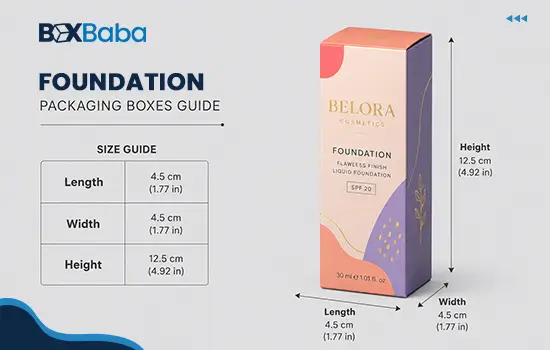
Foundation packaging boxes protect liquid cosmetic containers and present foundation products for retail, ecommerce, wholesale, and beauty-brand launches. The box must support the bottle or tube, reduce product movement, provide space for product information, and match the brand position before production.
Liquid foundation, BB cream, CC cream, tinted moisturizer, serum foundation, and makeup bottle packaging all need different packaging decisions. A glass pump bottle may need a rigid box with an insert. A tube-based BB cream may only need a folding carton. An ecommerce foundation order may need stronger outside packaging or a fitted insert to reduce movement during delivery.
BoxBaba helps beauty brands plan custom cosmetic boxes and custom foundation packaging around container size, filled product weight, material, printing, finish, label space, insert requirement, and sales channel. This guide explains how to choose the right foundation box structure, material, insert, finish, and quote-ready details before ordering.
What Are Foundation Packaging Boxes?
Foundation packaging boxes are custom cosmetic boxes designed to hold, protect, and present liquid foundation, BB cream, CC cream, tinted moisturizer, and makeup bottles. They can include folding cartons, rigid boxes, corrugated structures, inserts, printed branding, finish options, and label space.
Foundation Packaging Boxes Quick Guide
- Liquid foundation boxes need correct bottle fit, label space, and enough structure to reduce movement.
- Rigid boxes work best for premium glass foundation bottles, gift sets, and luxury beauty launches.
- SBS cardstock works well for retail foundation cartons when sharp printing and cost control matter.
- Corrugated packaging is better for ecommerce foundation packaging, wholesale shipping, and fragile bottle protection.
- BB cream and CC cream packaging can often use folding cartons when tubes or lightweight pumps need moderate protection.
- Custom inserts help stabilize glass bottles, airless pump bottles, droppers, and multi-product kits.
- Matte, gloss, soft-touch, foil stamping, spot UV, embossing, and debossing should match brand tier and artwork style.
- Brands should confirm ingredient text, shade names, warnings, barcodes, net weight, and legal claims before printing.
What Are Foundation Packaging Boxes?
Foundation packaging boxes are secondary packaging boxes built around liquid cosmetic containers such as pump bottles, airless bottles, squeeze tubes, glass bottles, and hybrid makeup containers.
A custom foundation box should protect the outer container, provide a clean product presentation, and create enough panel space for product name, shade name, directions, ingredient information, barcode, batch or lot information, and brand details. Brands selling multiple face products can also use related custom cream boxes for BB cream, CC cream, moisturizers, and skincare tubes when the product format is closer to a cream package than a glass bottle.
Foundation boxes do not replace secure caps, seals, pumps, or proper formula testing. They support the packaging system by improving fit, presentation, and handling protection when the bottle, closure, insert, and outer box work together.
Why Foundation Packaging Matters for Liquid Cosmetics
Liquid cosmetic packaging needs more structure than many dry makeup products because filled bottles, pumps, tubes, and glass containers can shift during storage, shipping, and handling.
A foundation box should reduce bottle movement, support shelf presentation, protect printed branding, and keep product information readable. Packaging can influence first impressions and shelf comparison, but it should not make unsupported claims about product performance or customer retention.
The main packaging decision is not only how the box looks. The buyer must match the container type, filled weight, formula risk, sales channel, material, insert, finish, and quote requirements before approving the final box.
Common Risks for Liquid Foundation and Makeup Bottle Packaging
Liquid cosmetics can face different packaging risks depending on container type, closure system, and sales channel.
Risk | Where It Happens | Packaging Response | Important Limitation |
Bottle movement | Shipping, storage, ecommerce fulfillment | Use fitted carton size or insert system | Movement control depends on exact dimensions |
Leakage-related damage | Pump bottles, tubes, poorly sealed containers | Use upright fit, insert, and secure outer packaging | The box alone cannot prevent leakage |
Glass breakage | Glass pump bottles or dropper bottles | Use rigid, corrugated, or insert-supported packaging | Impact risk depends on full shipping method |
Label readability issues | Retail shelves and ecommerce listings | Plan enough front, side, and back panel space | Final text accuracy is the brand responsibility |
Surface scuffing | Handling and fulfillment | Use suitable coating, finish, or outer protection | Finish choice changes handling sensitivity |
Foundation vs BB Cream vs CC Cream vs Makeup Bottle Packaging
Different liquid cosmetic products need different box structures because the container, viscosity, weight, and sales channel change the packaging requirement.
Product Type | Common Container | Best Box Direction | Main Packaging Need |
Liquid foundation | Glass bottle, pump bottle, airless bottle | Rigid or folding carton with insert if needed | Bottle stability and retail presentation |
BB cream | Squeeze tube or lightweight pump | Folding carton or cream-style carton | Cost control and clean shelf layout |
CC cream | Tube, airless pump, small bottle | Folding carton or premium rigid option | Product information and moderate protection |
Serum foundation | Dropper bottle or pump bottle | Insert-supported carton or rigid box | Movement control and glass protection |
Makeup bottle packaging | Glass, pump, dropper, or hybrid container | Corrugated, rigid, or insert-based box | Shipping stability and container protection |
For lighter tube formats, custom cream boxes can support BB cream and CC cream packaging with retail panels and clean branding. For glass or pump formats, foundation boxes should be planned around filled product weight, bottle dimensions, insert need, and shipping channel.
Retail vs Ecommerce Foundation Packaging
Retail foundation packaging prioritizes shelf clarity, while ecommerce foundation packaging prioritizes movement control and delivery protection.
Sales Channel | Best Packaging Direction | Why It Works | Risk to Check |
Retail shelves | SBS cardstock, folding cartons, display-ready layout | Supports color, shade name, barcode, and front-panel branding | Weak structure for heavy glass bottles |
Ecommerce shipping | Corrugated packaging, inserts, mailer boxes | Reduces movement during delivery | Needs fit testing before bulk order |
Wholesale distribution | Stronger cartons, dividers, case packaging | Supports repeated handling and bulk movement | Stacking pressure and pallet handling |
Luxury launch | Rigid boxes, inserts, soft-touch, foil, embossing | Supports premium presentation and gift-ready feel | Higher cost and longer setup |
Subscription beauty kits | Mailer boxes with inserts and inside print | Organizes products and improves unboxing | Products need stable layout inside the box |
If a foundation product ships directly to customers, pair the inner foundation carton with custom mailer boxes or printed boxes with inserts when the bottle needs additional ecommerce support.
Foundation Packaging System Compatibility
The best foundation packaging system depends on bottle type, box type, insert system, and product risk level.
Product Type | Bottle Type | Recommended Box Type | Insert System | Risk Level |
Liquid foundation | Airless pump or glass bottle | Rigid or reinforced folding carton | Foam, paperboard, or molded insert | Medium |
BB cream | Squeeze tube or light pump | Folding carton | Light paperboard insert if needed | Low |
CC cream | Tube or airless pump | Folding carton or rigid box | Die-cut insert for premium format | Medium |
Serum foundation | Glass dropper or pump | Rigid, SBS, or insert carton | Custom die-cut insert | Medium to high |
Makeup bottles | Glass pump, dropper, hybrid container | Corrugated or rigid packaging | Shock-resistant insert | High |
Best Materials for Foundation Packaging Boxes
Foundation packaging materials should be selected by product weight, container type, print quality, shipping requirement, and brand position.
Material | Protection Level | Print Quality | Best For | Buyer Note |
SBS cardstock | Medium | Excellent | Retail foundation cartons, BB cream boxes, CC cream boxes | Good for sharp artwork and cost control |
Rigid board | Very high | Excellent | Luxury foundation boxes, glass bottles, gift sets | Best for premium presentation but higher cost |
Corrugated board | High | Good | Ecommerce foundation packaging and wholesale shipping | Better for shipping strength than slim retail cartons |
Kraft paperboard | Medium | Good | Natural-looking clean beauty packaging | Use eco claims only with documentation |
Brands that need premium structure can review custom rigid boxes for luxury foundation bottles, launch kits, and gift-ready packaging. Brands comparing broader box options can also review the types of cosmetic boxes guide before choosing a final structure.
Best Fit and Bad Fit Material Guide
Each material has a best-fit use case and a bad-fit case that should be considered before production.
Material | Best Fit | Bad Fit | Why |
SBS cardstock | Light to medium retail cartons | Heavy glass bottles without inserts | It prints well but may need support for heavy containers |
Rigid board | Premium foundation bottles and gift sets | Low-budget test launches | It looks premium but costs more than folding cartons |
Corrugated board | Ecommerce and wholesale shipping | Slim retail shelf presentation | It adds protection but may look bulkier |
Kraft paperboard | Natural paper-based brand look | Bright luxury color output | Brown kraft can mute colors |
Insert-supported box | Glass bottles, pumps, kits, PR sets | Very low-cost products without protection needs | Inserts add stability but also add cost |
Popular Foundation Packaging Box Styles
Foundation box styles should match bottle weight, shelf need, shipping channel, and brand tier.
Box Style | Best For | Main Benefit | Caution |
Straight tuck end | Standard retail foundation cartons | Costcontrolled and easy to display | Not ideal for heavy bottles without support |
Reverse tuck end | Lightweight BB cream or CC cream boxes | Practical folding carton structure | Needs correct closure strength |
Auto-lock bottom | Heavier bottles and ecommerce handling | Stronger base support | May cost more than simple tuck cartons |
Sleeve box | Premium skincare and foundation lines | Creates layered presentation | Needs accurate tray fit |
Two-piece rigid box | Luxury foundation sets and gift packs | Premium unboxing and stronger structure | Higher material and production cost |
Insert box | Glass pump bottles and multi-product kits | Reduces movement inside the box | Requires exact product dimensions |
Inserts for Foundation Bottles and Makeup Bottles
Inserts hold foundation bottles in place during shipping, storage, retail handling, and unboxing.
Foundation bottles, glass pumps, airless containers, droppers, and sample kits can move inside the box if the packaging has too much empty space. Printed boxes with inserts help organize the product layout and reduce movement inside the packaging.
Insert Type | Best For | Purpose |
Paperboard insert | Light pump bottles, tubes, retail cartons | Centers the product inside the box |
Corrugated insert | Ecommerce packaging and shipping kits | Adds stronger movement control |
Foam insert | Glass bottles, luxury foundation sets, PR kits | Adds cushioning and premium presentation |
Molded insert | Specific bottle shapes or multi-product kits | Creates a fitted product layout |
Divider insert | Foundation sets and shade kits | Separates multiple containers |
Inserts are most useful when the product is glass, heavy, high value, part of a set, or shipped through ecommerce. For a low-cost tube product, a fitted folding carton may be enough.
Printing and Finishing Options for Foundation Boxes
Printing and finishing should make the foundation box readable, brand-aligned, and suitable for the product tier.
Option | Best For | Packaging Effect |
CMYK printing | Full-color artwork and product visuals | Supports retail graphics and gradients |
PMS color matching | Brand color consistency | Helps maintain color accuracy across product lines |
Matte lamination | Clinical skincare and premium foundation boxes | Creates a smooth low-shine look |
Gloss lamination | Color cosmetics and high-impact retail designs | Makes colors look brighter |
Soft-touch finish | Luxury foundation and gift sets | Adds a smooth tactile feel |
Foil stamping | Logos, borders, luxury accents | Adds metallic brand detail |
Spot UV | Logos, patterns, selected highlights | Creates selective shine |
Embossing/debossing | Logo-focused premium packaging | Adds raised or pressed texture |
Before selecting a finish stack, compare product type, box material, and brand tier. The BoxBaba cosmetic packaging design tips guide explains how to match product, box style, material, finish, sales channel, artwork, and quote inputs in the right order.
Product Formula Packaging Requirements
Formula type does not replace packaging engineering, but it helps buyers understand the container and box support needed for each product.
Formula Type | Common Packaging Challenge | Ideal Packaging System | Key Risk to Review |
Liquid foundation | Pump or bottle stability | Airless pump plus fitted foundation box | Closure leakage and bottle movement |
BB cream | Tube or light pump movement | Tube plus folding carton | Heat, tube shape, and panel readability |
CC cream | Skincare-makeup positioning | Pump or tube plus custom carton | Ingredient and shade information |
Serum foundation | Glass container movement | Dropper/pump bottle plus insert box | Glass impact and air exposure |
Hybrid makeup bottles | Mixed container formats | Insert-supported carton or rigid box | Breakage and movement |
Formula stability, contamination control, and shelf life depend on formulation, container, closure, storage, and shipping conditions. The box supports presentation and movement control, but it should not be described as the only protection system.
Foundation Packaging Cost Drivers
Foundation packaging cost depends on material, box style, quantity, printing, finishing, inserts, proofing, and delivery requirements.
Cost Driver | Why It Affects Cost |
Material choice | Rigid and corrugated materials usually cost more than simple cardstock |
Box size | Larger boxes use more board and may increase shipping/storage cost |
Quantity | Bulk ordering usually reduces per-unit cost, but exact pricing needs a quote |
Printing coverage | Full-color printing, inside printing, and PMS matching add complexity |
Finish options | Foil, embossing, spot UV, soft-touch, matte, and gloss add production steps |
Insert requirement | Custom inserts require extra material, design, and fit testing |
Bottle complexity | Glass, pump, and airless bottles may need stronger packaging support |
Sample or proof | Proofing can add time but reduces artwork and fit mistakes |
Rush timing | Timeline depends on material, quantity, artwork, finish, and production complexity |
Exact foundation packaging pricing should be confirmed with a quote because each project has different bottle dimensions, material needs, print coverage, finish choices, quantity, and insert requirements.
Dieline, Artwork, Sample and Proofing Checklist
A foundation box dieline maps panels, folds, cuts, glue areas, insert position, and artwork placement before printing.
Prepare these details before requesting a foundation packaging quote:
- Product type: liquid foundation, BB cream, CC cream, serum foundation, or makeup bottle
- Bottle or tube dimensions: length, width, height, diameter, and cap/pump details
- Filled product weight and container material
- Box style preference: tuck end, auto-lock bottom, sleeve, rigid, or insert box
- Material preference: SBS cardstock, kraft, corrugated, or rigid board
- Quantity requirement and reorder plan
- Logo file, brand colors, and artwork file
- Shade name, product name, ingredient text, barcode, warning text, and net weight
- Finish preference: matte, gloss, soft-touch, foil, spot UV, embossing, or debossing
- Insert requirement and ecommerce or retail sales channel
- Sample or packaging proof request before bulk production
A packaging proof helps the brand review artwork, color direction, panel placement, finish areas, and fit before production. For glass bottles or premium launches, a physical sample can help confirm product stability and unboxing feel.
Information Every Foundation Box Should Include
Foundation packaging should leave enough panel space for product details that customers, retailers, and fulfillment teams need.
Information Area | Examples |
Brand and product identity | Brand name, product name, shade name, shade number |
Product details | Net weight/volume, usage directions, product benefits |
Labeling and tracking | Barcode, batch/lot number, QR code, distributor details |
Ingredient and caution space | Ingredient panel, warnings, storage notes, claim disclaimers |
Retail and ecommerce support | Front panel, side panels, back panel, scannable label space |
For bottle, jar, and tube branding, cosmetic labels can support product identity and required information areas. Ingredient accuracy, cosmetic claims, shade names, warning text, barcode details, net weight, and legal labeling requirements should be verified by the brand before printing.
Common Foundation Packaging Mistakes
Most foundation packaging mistakes happen when brands focus on appearance before product fit, bottle weight, sales channel, and proofing.
- Choosing a slim retail carton for a heavy glass bottle without insert support.
- Using kraft or eco messaging without material documentation to support the claim.
- Ignoring pump height, cap shape, and bottle diameter when setting box dimensions.
- Using premium finishes that reduce readability or make label panels hard to scan.
- Skipping a proof before printing shade names, ingredients, barcodes, or warning text.
- Using the same packaging structure for retail and ecommerce without shipping support.
- Leaving too much empty space inside the box, which allows product movement.
- Forgetting that formula stability depends on formulation, container, closure, and storage conditions.
BoxBaba Foundation Packaging Selection Framework
The BoxBaba foundation packaging framework helps beauty brands move from product details to a quote-ready packaging plan.
Step | Decision | Why It Matters |
1 | Confirm product format and container type | Bottle, tube, pump, or glass format controls box fit |
2 | Measure dimensions and filled weight | Accurate sizing reduces movement and packaging failure |
3 | Choose sales channel | Retail and ecommerce need different levels of protection |
4 | Select material and box style | Material controls structure, print quality, and presentation |
5 | Decide insert need | Inserts stabilize glass, pumps, and multi-product kits |
6 | Plan artwork and label panels | Panels must support product details and readable text |
7 | Choose finishes carefully | Finishes should match brand tier and budget |
8 | Request proof or sample | Proofing reduces fit, artwork, and print errors |
Need Help Planning Foundation Packaging?
BoxBaba can help you plan custom foundation boxes based on bottle dimensions, material preference, insert need, print coverage, finish choice, quantity, and sales channel. Start with Foundation Boxes if you need packaging for liquid foundation, BB cream, CC cream, tinted moisturizer, and makeup bottle formats.
Why Choose BoxBaba for Custom Foundation Boxes?
BoxBaba supports foundation packaging projects with custom box sizing, material guidance, folding carton styles, rigid options, insert planning, printing, finishing, dieline discussion, artwork setup, and quote preparation. The main product page for this article should be Custom Foundation Boxes, while the broader parent category is Custom Cosmetic Boxes.
For related products, brands can also explore Custom Cream Boxes for BB cream or skincare-cream formats, Cosmetic Labels for bottle and tube branding, Printed Boxes with Inserts for product stability, and Custom Rigid Boxes for premium foundation launches.
BoxBaba can review your product dimensions, artwork direction, material preference, finish plan, quantity, and insert needs before suggesting a packaging structure. Final timeline and price depend on material, quantity, printing, finishes, insert complexity, and proofing requirements.
Final Takeaway
Foundation packaging boxes help beauty brands protect liquid cosmetic containers and present foundation products in a retail-ready or ecommerce-ready format. The right box choice depends on bottle type, filled weight, formula format, material, insert need, print layout, finish choice, sales channel, and quote requirements.
A lightweight BB cream tube may only need a folding carton. A glass liquid foundation bottle may need a rigid box or insert-supported structure. An ecommerce foundation kit may need a mailer box, corrugated protection, or custom inserts. A luxury foundation launch may need rigid board, soft-touch, foil stamping, embossing, or a premium unboxing format.
BoxBaba recommends choosing foundation packaging boxes after confirming product dimensions, sales channel, material, insert need, artwork, label space, and finish direction. To start the project, send your bottle size, quantity, artwork, material preference, and packaging goal through the BoxBaba Contact Us page.
Ready to Order Foundation Packaging Boxes?
BoxBaba can help you plan custom foundation boxes for liquid foundation, BB cream, CC cream, serum foundation, pump bottles, glass bottles, and ecommerce beauty packaging.
FAQs About Foundation Packaging Boxes
What are foundation packaging boxes used for?
Foundation packaging boxes are used to hold, protect, and present liquid foundation, BB cream, CC cream, tinted moisturizer, and makeup bottles. They also provide space for branding, product details, shade information, barcodes, and retail presentation.
What is the best packaging for liquid foundation?
Liquid foundation often works best in a fitted folding carton, rigid box, or insert-supported structure. Glass bottles, airless pumps, and premium products usually need stronger support than lightweight tubes.
Are foundation boxes suitable for BB cream and CC cream?
Yes. Foundation boxes can be customized for BB cream and CC cream, but tube-based products may also fit cream-style folding cartons. The best structure depends on container size, filled weight, and sales channel.
Do foundation packaging boxes need inserts?
Foundation boxes need inserts when the container is glass, heavy, fragile, part of a kit, or shipped through ecommerce. Inserts help hold bottles in place and reduce product movement inside the box.
What materials are best for foundation boxes?
SBS cardstock is common for retail cartons, rigid board fits luxury foundation packaging, corrugated board supports ecommerce shipping, and kraft paperboard creates a natural paper-based look.
Can foundation boxes include logo printing?
Yes. Foundation boxes can include logo printing, brand colors, product names, shade names, ingredient space, barcode area, usage notes, QR codes, and premium finishes.
What finishes work best for foundation packaging?
Matte works well for clinical and premium skincare-inspired foundation. Gloss supports bold color cosmetics. Foil, embossing, spot UV, and soft-touch finishes fit luxury launches and premium retail packaging.
How much do foundation packaging boxes cost?
Foundation packaging cost depends on size, material, quantity, printing coverage, finishes, inserts, proofing, and box style. A custom quote is needed because each project has different bottle and branding requirements.
What should I prepare before ordering foundation boxes?
Prepare bottle dimensions, filled weight, container type, product name, shade names, artwork, logo file, quantity, material preference, finish choice, insert need, and retail or ecommerce sales channel.
Can BoxBaba help with cosmetic labels?
Yes. BoxBaba can support cosmetic labels for bottles, tubes, jars, and foundation containers, along with custom boxes, inserts, printing, and finish planning.
Can BoxBaba handle cosmetic compliance?
BoxBaba can help with packaging layout and label space, but ingredient accuracy, cosmetic claims, warning text, net weight, barcode details, and legal labeling requirements should be verified by the brand before printing.
What is the best CTA for this article?
The best CTA is quote-focused: Request a Custom Foundation Box Quo
Quote. Buyers need size, material, insert, printing, finish, quantity, and artwork guidance before ordering.