
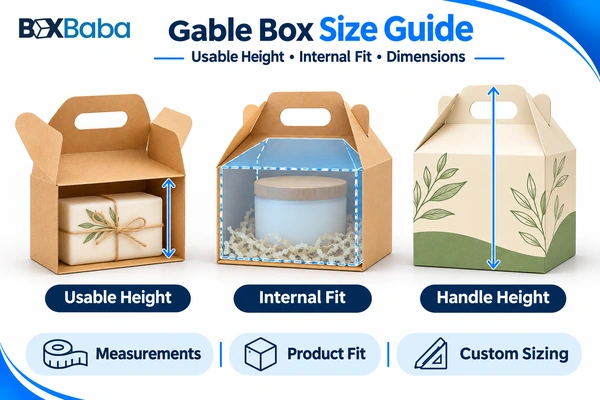
Choosing the right gable box size starts with the finished product, its orientation and the complete packed arrangement—not with a generic small, medium or large label.
Gable boxes require an extra sizing step because their upper panels slope toward the integrated handle. The rectangular lower body provides the most predictable product space, while the area above it narrows toward the handle. As a result, usable rectangular body height, nominal internal dimensions, final usable product space, total assembled height and external dimensions are different measurement concepts.
This guide explains what to measure, how orientation and inserts affect fit, how to interpret gable-box height correctly, and which dimensions should be validated before a custom structure moves into production.
What Does Gable Box Size Actually Mean?
A gable box does not have one single measurement that answers every sizing question.
Several dimensional layers may matter:
Measurement Layer | What It Describes | Why It Matters |
Finished product dimensions | Maximum outside dimensions of the product as it will actually be packed | Starting point for sizing |
Packed arrangement | Combined envelope after all products are positioned | Determines required footprint and height |
Nominal internal dimensions | Inside dimensions of the carton cavity before considering some internal components | Establishes the basic internal structure |
Final usable product envelope | Space actually available after inserts, dividers, liners or platforms are considered | Determines real product fit |
Usable rectangular body height | Full-width/full-depth vertical space below the sloping upper gable | Primary reference for tall rigid products |
Upper gable / handle space | Tapered region above the rectangular body | Cannot be treated as full rectangular volume |
Total assembled dimensions | Full outside dimensions of the erected carton, including upper gable/handle geometry | Relevant to shelving, displays, case packing and assembled storage |
Flat blank dimensions | Unfolded manufacturing geometry before erection | Relevant to manufacturing and some storage planning, not direct product fit |
A buyer asking for a 6-inch-high gable box has not yet established whether six inches means usable rectangular height, external body height or total assembled height.
For custom packaging, define those measurements separately.

Start With the Finished Product, Not the Box
Measure the product in the exact condition in which it will be packed.
That means accounting for the finished, closed product rather than relying only on:
- nominal capacity;
- an unfilled container;
- an old engineering drawing;
- dimensions without the lid, cap, wrapper or retail sleeve;
- only the largest product in a multi-item set.
Record the maximum outside profile.
For a rectangular product, this usually means maximum length, width and height.
For a cylindrical product, record maximum diameter and overall height.
For an irregular item, identify the furthest external points that the package must accommodate.
For universal Length × Width × Height terminology and general internal-versus-external box measurement principles, use BoxBaba box-dimension measurement guide.
Gable-box sizing then adds another question:
How do those product dimensions interact with the rectangular body, tapered upper panels and handle?
Product Orientation Can Change the Required Gable Box Dimensions
The same product can require a different gable box depending on how it is oriented.
Consider a tall rectangular carton.
Placed upright, its height may approach the sloping upper gable area.
Placed horizontally, the required height may decrease while the necessary base length or width increases.
Neither orientation is automatically better.
Evaluate orientation according to:
- product stability;
- desired presentation;
- loading workflow;
- product removal;
- window alignment where relevant;
- insert layout;
- usable body height;
- base footprint.
For multi-item sets, determine the orientation of the complete packed arrangement, not each product independently.
Size Multi-Item Gable Boxes From the Packed Arrangement
Do not calculate a multi-item box simply by adding individual product dimensions together.
Three products, for example, might be arranged:
- side by side;
- front to back;
- stacked;
- around a central item;
- inside separate divider cells;
- at different vertical levels.
Each arrangement creates a different required footprint and tallest packed point.
Use this sequence:
Finished Products → Count → Orientation → Packed Arrangement → Internal Support → Required Usable Space
Only after that arrangement is defined should the final gable-box dimensions be developed.
This is particularly important for gift sets, bakery assortments, takeaway combinations and promotional kits.
Usable Body Height Is Not Total Gable Box Height
The most important gable-specific measurement distinction is between usable rectangular body height and total assembled height.
The lower body of a gable carton provides a rectangular cross-section. Above that body, the upper panels slope inward toward the handle.
The available shape therefore changes as the package gets taller.
Usable Rectangular Body Height
Usable body height is the vertical space available before the upper gable geometry begins narrowing.
For a rigid product that requires its full width and depth all the way to its top, this is the primary rectangular fit reference.
Upper Gable Space
Physical space may remain above the rectangular body, but that space is tapered.
A narrow or differently shaped item may interact with this area differently from a wide rigid carton, bottle, jar or stacked product set.
Do not treat the full upper section as additional rectangular capacity.
Total Assembled Height
Total assembled height extends to the highest point of the formed gable or handle structure.
The product may not occupy this entire height, but the dimension can still affect:
- shelf clearance;
- retail displays;
- assembled-package storage;
- master-carton planning;
- counter or pickup-station clearance.
Where both product fit and overall package footprint matter, specify usable body height and total assembled height separately.
Does the H in L × W × H Include the Handle?
Do not assume that it does.
Packaging suppliers and catalogs may define gable-box height differently. A listed height may refer to the rectangular body, an external body measurement, or another dimensional convention.
A custom specification should therefore define height explicitly.
Where relevant, identify:
- usable internal body height;
- external body height;
- total assembled height to the highest gable/handle point.
A single H value is not enough when its reference points are unclear.
Internal Dimensions and Usable Product Space Are Not Always Identical
Internal dimensions describe the inside cavity created by the carton structure.
But an insert, divider, liner, tray or platform can reduce the space the product can actually occupy.
It helps to distinguish:
Nominal Internal Carton Dimensions
from:
Final Usable Product Envelope After Internal Components
For example, a carton may have enough nominal internal height for a product, but a raised platform can move that product upward toward the sloping gable area.
Likewise, dividers can reduce usable width or length.
When internal components are planned, calculate fit around the complete internal configuration, not the empty carton alone.

Internal Dimensions and External Dimensions Solve Different Problems
Internal and external dimensions should not be used interchangeably.
Internal Dimensions
These are relevant to:
- product fit;
- product arrangement;
- inserts and dividers;
- liners;
- loading;
- product removal.
External Dimensions
These may matter for:
- shelf space;
- assembled storage;
- master cartons;
- case packing;
- warehouse planning;
- displays.
The relationship between internal and external dimensions depends on the actual material and structural design.
Do not convert between them by adding or subtracting one universal board-thickness number.
Use the dimensions from the approved structure.

Do Not Add a Universal Clearance Allowance
There is no single clearance value that should automatically be added around every product.
Required fit allowance can change with:
- product shape;
- desired tightness or looseness;
- sleeves or wrappers;
- inserts and dividers;
- liners;
- loading process;
- product removal;
- material;
- structural design;
- manufacturing requirements.
A rigid gift item may need a different fit relationship from a bakery assortment or multi-container takeaway set.
Start with the actual finished product and packed arrangement. Let the final structural review establish the appropriate fit.
Do not automatically add a fixed fraction of an inch to every side.
Inserts, Dividers and Liners Must Be Included Before Final Sizing
Any component placed between the product and the carton consumes some of the available space.
Examples include:
- inserts;
- dividers;
- platforms;
- wells;
- liners;
- trays;
- sleeves;
- corrugated or paperboard supports.
If a platform raises a product, the tallest packed point may increase.
If dividers separate several items, the required length or width may increase.
The correct sequence is:
Product Arrangement → Internal Support Concept → Final Usable Product Envelope
not:
Final Box Size → Add Internal Components Later
The dedicated insert guide will cover how different supports work. For A-02, the key sizing rule is simple:
Include every internal component before approving the finished dimensions.
Why Volume Alone Does Not Tell You Whether a Product Will Fit
Cubic volume is not enough to determine gable-box fit.
Two arrangements can occupy similar total volume but require different structures.
A wide, low product set may remain entirely inside the rectangular body.
A narrow but tall item with similar volume may extend into the tapered gable region and interfere with the upper structure.
Volume also does not reveal:
- product orientation;
- tallest packed point;
- product shape;
- insert thickness;
- removal path;
- window alignment;
- number of separate items.
Use volume only as a secondary planning concept.
Fit depends on geometry and arrangement, not cubic volume alone.

Mini, Medium and Large Are Relative Size Labels
There is no universal industry dimension that makes every gable box mini, medium or large.
Supplier size labels can differ.
For custom projects, those terms are useful only as broad descriptions.
A mini format may suit:
- favors;
- samples;
- compact promotional products;
- small guest giveaways.
Larger formats may be required because of:
- a wider footprint;
- several products;
- greater usable body height;
- a more substantial packed arrangement.
The label should never replace actual dimensions.
For small event and giveaway applications, review Mini Gable Favor Boxes.

Bakery, Gift and Takeout Sizes Should Follow the Packed Product
Application names do not create universal finished dimensions.
A bakery gable box might contain:
- one taller decorated product;
- several low pastries;
- stacked cookies;
- a mixed assortment.
A gift package could contain one retail product or a multi-item arrangement with an insert.
A takeaway package could contain one primary container or several meal components.
The application tells you which conditions to evaluate. It does not determine the size by itself.
For takeout-specific commercial configurations, explore Gable Takeout Boxes.
Flat Blank Dimensions Are Not Assembled Box Dimensions
A gable carton starts as a flat manufacturing blank or dieline.
That flat structure may contain:
- front and back panels;
- side or gusset panels;
- sloping gable panels;
- handle areas;
- bottom flaps;
- closure tabs;
- glue or lock zones.
The blank overall width and height describe an unfolded structure—not the internal dimensions of the finished carton.
Do not use flat dieline dimensions as product-fit dimensions.
Likewise, do not assume you can create an accurate production blank by simply adding or multiplying the finished box dimensions. Panel geometry, folds, closures, bottom construction and joining areas all affect the flat structure.
Use the approved dieline as the production authority.
Overall Handle Height Matters Even When the Product Does Not Reach the Handle
Product fit is only one sizing question.
The assembled package also needs to fit the environment where it will be stored, displayed, carried or placed into another carton.
Total gable/handle height can matter when:
- boxes sit on retail shelving;
- assembled cartons are stored under a counter;
- finished packages go inside master cartons;
- boxes are placed in displays;
- packing stations have restricted vertical clearance.
Ask two separate questions:
How much usable internal height does the product require?
and
How much total vertical space does the assembled gable box occupy?
They solve different problems.
Windows Can Affect Product-Position Planning
A window does not normally change the product physical dimensions, but its position can change how the product needs to sit inside the carton.
If a specific product feature must appear through the window, sizing and layout may need to coordinate:
- product orientation;
- product height;
- lateral position;
- insert height;
- window location.
Size the structure around the product first, then align the window with the approved packed position.
Do not force an inefficient or unstable orientation merely to satisfy a decorative window concept.
Common Gable Box Sizing Mistakes
Sizing Mistake | Why It Causes Problems | Better Approach |
Choosing medium without dimensions | Size labels vary | Specify actual dimensions |
Measuring only one item in a set | Ignores the combined arrangement | Arrange all products first |
Using total height as usable product height | Upper gable space narrows | Separate body height from overall height |
Using external dimensions for product fit | Outside measurements include the structure | Confirm usable internal space |
Treating nominal internal size as final usable space | Inserts or liners may reduce the envelope | Size around the complete internal configuration |
Ignoring inserts | Internal components consume space | Include them before final sizing |
Adding fixed clearance to every project | Fit requirements vary | Determine clearance through structural review |
Using volume as proof of fit | Volume ignores shape and orientation | Validate actual geometry |
Treating flat blank size as finished size | Flat and erected structures are different | Use assembled dimensions for fit |
Ignoring handle height | Package may not fit shelves or master cartons | Record overall assembled height |
Assuming item count determines size | Products differ in size and layout | Measure and arrange actual products |
How Should You Validate a Custom Gable Box Size?
Different approval methods answer different questions.
Digital Proof or 3D Mockup
Useful for reviewing:
- general structural appearance;
- panel relationships;
- artwork position.
It does not validate actual physical product fit.
Blank Structural Sample
A structural sample is more useful when the main question is fit.
It can help evaluate:
- internal dimensions;
- usable body height;
- upper-gable clearance;
- assembly;
- closure;
- product loading;
- product removal;
- insert or divider relationship;
- total assembled height.
For multi-item packaging, test the intended complete arrangement rather than only the largest individual product.
Printed Physical Sample
A printed sample can help when dimensional validation must also be reviewed alongside material, print or finishing appearance.
Print approval and dimensional fit are still separate questions.

What Should You Send for a Gable Box Sizing Review?
A useful sizing brief should describe the physical product and arrangement clearly.
Prepare:
- finished product dimensions;
- maximum diameter for round products where relevant;
- item count;
- intended orientation;
- planned packed arrangement;
- tallest packed point;
- insert, divider, platform or liner requirements;
- window requirement if product alignment matters;
- packed weight where it will affect later structural review;
- use environment.
Photos or product drawings can also help explain irregular forms.
Treat the supplier approved structural dieline as the production authority rather than trying to derive the final blank from finished dimensions alone.
Gable Box Sizing Checklist
Before approving a custom size, confirm:
Question | Why It Matters |
Have all products been measured in their final packed condition? | Prevents missing caps, wrappers, sleeves or accessories |
Is the final orientation established? | Orientation changes footprint and height |
Is the complete item count arranged? | Multi-item sets require combined-space review |
Is usable rectangular body height sufficient? | Tall rigid items may conflict with the slopes |
Are all inserts, liners and platforms included? | Internal components reduce usable space |
Is the final usable product envelope known? | Nominal internal dimensions may not equal actual usable space |
Is total assembled height known? | Needed for shelf, display and logistics clearance |
Are internal and external dimensions clearly labeled? | Prevents product-fit and logistics confusion |
Is the meaning of H explicitly defined? | Avoids dimensional ambiguity |
Has a structural sample been reviewed where appropriate? | Confirms the real packed geometry |
The Right Gable Box Size Comes From the Packed Arrangement
There is no universal best small, medium or large gable-box size.
A reliable custom sizing process follows:
Finished Product → Count → Orientation → Packed Arrangement → Internal Support → Final Usable Product Envelope → Usable Body Height → Upper Gable / Handle Clearance → External Dimensions → Structural Validation
This sequence separates the measurements that control product fit from the dimensions that describe the complete assembled package.
When you are ready to move from sizing into a custom packaging configuration, explore Custom Gable Boxes.
For compact event or giveaway packaging, compare Mini Gable Favor Boxes. For restaurant and pickup applications, review Gable Takeout Boxes.
To discuss a custom size, prepare the finished product dimensions, count, orientation, packed arrangement and internal-support requirements.
+1 305 574 4357 | sales@boxbaba.com