
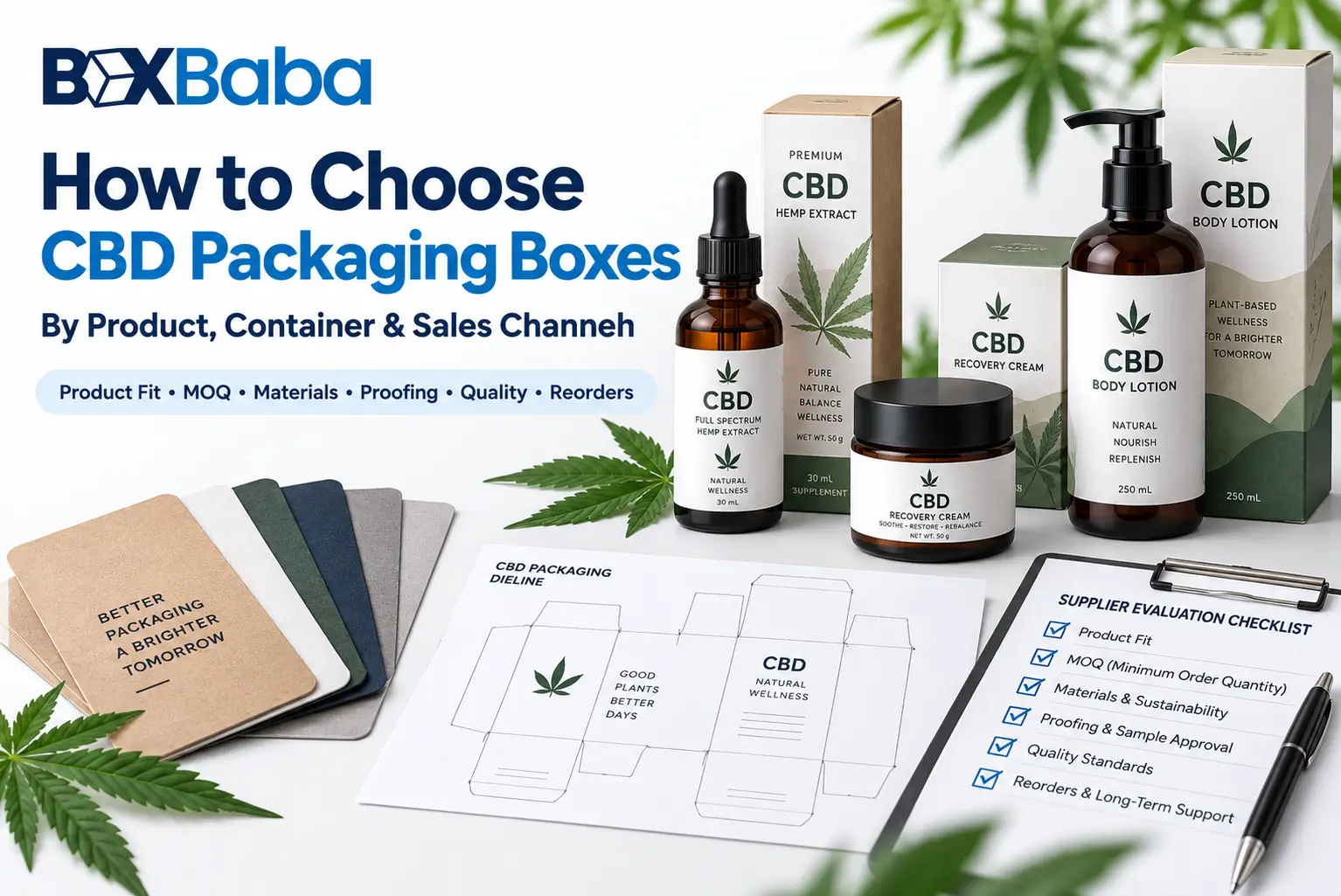
Choosing CBD packaging should begin with the finished product and its primary container, not with a preferred box style, material or finish.
A 30 ml tincture in a glass dropper bottle, a cream in a wide jar and a skincare product in an airless pump may all need different cartons even when their stated capacities appear similar.
A practical selection sequence is:
CBD Product → Primary Container → Maximum External Profile → Filled Weight → Sales Channel → Packaging Structure → Insert Requirement → Dieline → Artwork
This guide explains how to work through those decisions before ordering custom secondary packaging.
Brands ready to move from planning to a commercial packaging format can explore BoxBaba Custom CBD Boxes range after confirming the product information described below.
Important: This is packaging-selection guidance, not legal advice or confirmation that every CBD product format can be marketed in every jurisdiction. Product, labeling and packaging requirements can vary by intended use, claims and market. Verify the rules applying to the finished product before approving packaging.
Quick Answer: How Do You Choose the Right CBD Packaging?
Start with seven questions:
- What CBD product are you packaging?
- What finished primary container holds it?
- What are its maximum external dimensions and filled weight?
- Is one product or more than one product going into the package?
- Will it be sold mainly through retail, ecommerce, display or gifting?
- Does the finished product need additional positioning or separation?
- How much usable panel space is needed for approved product information?
These answers establish the packaging problem before material, finishing and decorative choices are considered.
The key principle is:
The CBD product name identifies the category. The finished container defines the physical packaging job.
Understand the Packaging Layers First
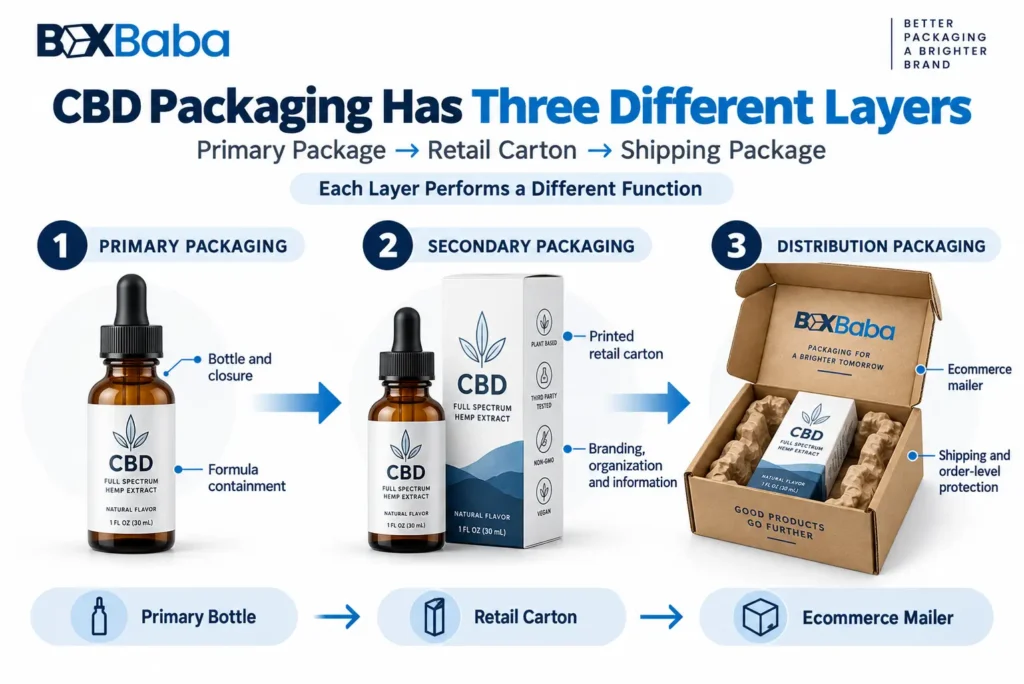
CBD products can use more than one packaging layer, and those layers should not be treated as interchangeable.
Primary Packaging
The primary package directly contains the finished product.
Examples can include:
- a dropper bottle;
- a jar;
- a tube;
- a pump bottle;
- a sealed pouch;
- a lip balm tube;
- another suitable product container.
The primary package normally handles direct containment of the formulation or product.
Secondary Packaging
Secondary packaging surrounds the completed primary package.
Examples include:
- folding cartons;
- sleeves;
- presentation boxes;
- individual retail boxes.
This layer can provide branding, printable information panels, retail presentation, organization and additional structural support where appropriate.
Distribution or Ecommerce Packaging
A further outer layer may be needed when completed products are shipped, bundled or distributed.
For example:
Primary Bottle → Retail Carton → Ecommerce Mailer
Thinking in layers prevents a common mistake: expecting one paperboard carton to perform every containment, retail and distribution function.
Step 1: Identify the CBD Product and Primary Container
Different product forms lead to different primary containers.
That should be the first routing decision.
CBD Oils & Tinctures
Oil and tincture products frequently use dropper-style bottles.
The outer carton may need to account for the:
- bottle body;
- shoulder;
- closure;
- dropper assembly;
- overall packed height;
- filled weight.
Where bottle geometry and fitted holders are central to the project, move into CBD Dropper Bottle Boxes for the product-specific packaging route.
CBD Gummies & Similar Products
A gummy product may use a finished jar, pouch or another primary package.
The number of pieces inside does not tell the box supplier the dimensions of the completed package.
For example:
30 gummies does not define:
- jar diameter;
- jar height;
- lid dimensions;
- pouch width;
- filled depth;
- overall packed weight.
Where a secondary carton or merchandising format is required around the completed unit, see CBD Gummies Boxes.
Remember that the primary food-contact package and the outer printed carton perform different functions, and brands should verify the requirements applying to their particular product and market.
CBD Capsules & Bottled Products
Capsules or similar products may use bottles that need a secondary carton with adequate product-information space.
Here the decision is not just whether the bottle physically fits.
Also consider whether the finished carton provides enough usable surface for buyer-approved:
- product identity;
- directions;
- ingredients;
- warnings;
- barcode;
- QR code;
- other applicable information.
CBD Creams, Topicals & Skincare
Creams and topical products can use very different containers, including:
- jars;
- tubes;
- pump bottles;
- airless containers.
A jar may be short and wide, while a pump bottle may be narrow and tall.
Brands developing broader beauty or skincare ranges can review Custom Skincare Packaging for the relationship between skincare containers and secondary cartons.
CBD Cosmetics & Beauty Products
CBD beauty products can include lip-care tubes, small jars, treatment bottles and other cosmetic-style formats.
The packaging can share one visual system while individual products still use different dimensions and dielines.
For broader CBD beauty packaging, explore Custom CBD Cosmetic Boxes.
CBD Products Packed in Jars
Jar-led packaging needs particular attention to the complete closed container.
The lid can be wider than the body, and a heavy glass jar can create a different structural requirement from a lightweight plastic jar.
For projects where jar geometry is the main packaging variable, see Custom CBD Jars.
Step 2: Record the Finished Product Inputs
Once the product and primary container are known, gather the physical information a packaging supplier actually needs.
At minimum, record:
- maximum width or diameter;
- maximum depth where applicable;
- overall closed height;
- closure profile;
- filled weight;
- intended orientation.
Measure the product in the condition in which it will actually enter the package.
That means including relevant components such as the:
- cap;
- lid;
- pump;
- dropper;
- bulb;
- collar;
- overcap;
- tube closure.
Do not assume that the body of the container is the maximum dimension.
A useful relationship is:
Finished Product Dimensions → Starting Structural Input
Those measurements do not automatically become the final internal or external box dimensions. The finished package may also require clearance, material allowance or internal support.
Fill Capacity Is Not a Box Size
This is one of the most important rules in custom CBD packaging.
30 ml ≠ one standard carton size
50 ml ≠ one standard carton size
1 oz ≠ one standard carton size
Products with equal fill capacity can use containers with different:
- heights;
- diameters;
- widths;
- depths;
- shoulders;
- closures.
For example, the same nominal volume could appear in a dropper bottle, jar, tube or pump bottle.
Each creates a different packaging envelope.
Therefore:
Fill Capacity ≠ External Container Dimensions ≠ Finished Box Dimensions
Step 3: Include the Filled Weight
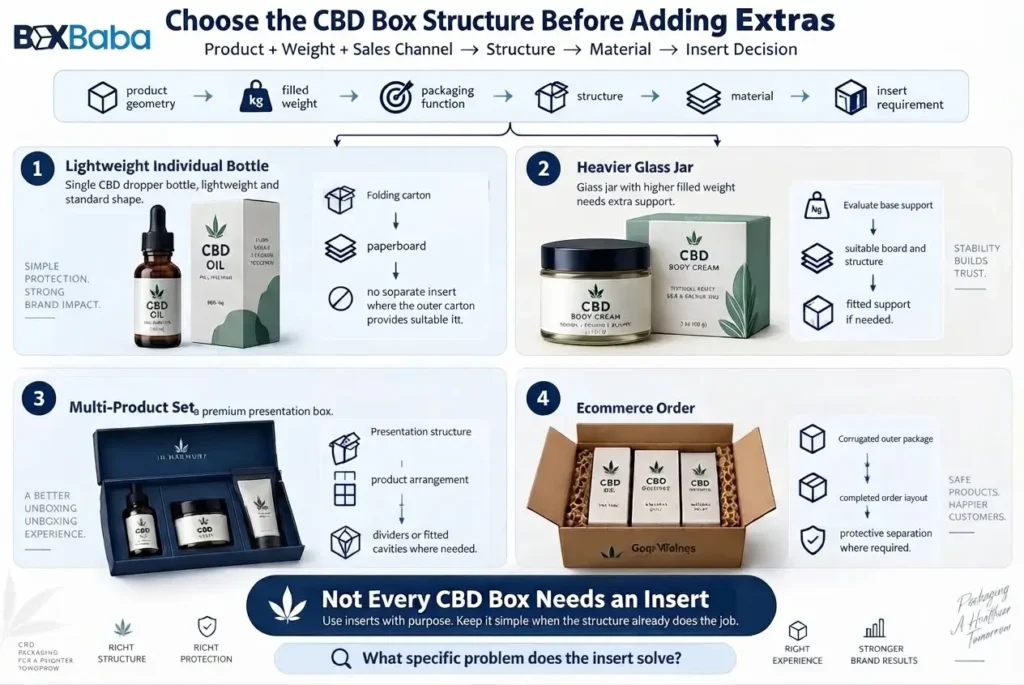
Dimensions explain how much space the finished item occupies.
Filled weight adds another structural input.
Consider:
Lightweight plastic container
→ a straightforward folding carton may be suitable.
Heavier glass container
→ the bottom structure or internal positioning may need additional consideration.
Weight can influence:
- base design;
- product stability;
- insert need;
- packing method;
- multi-product arrangement.
A heavier product does not automatically require rigid packaging. It simply means the completed load should be evaluated rather than choosing a structure from dimensions alone.
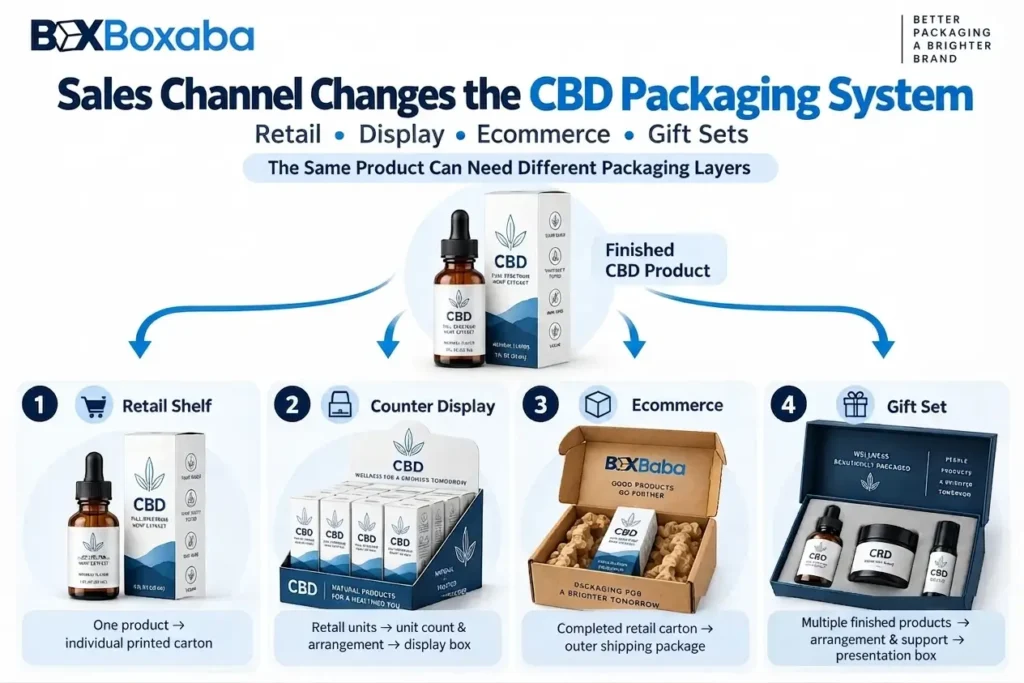
Step 4: Decide How the Product Will Be Sold
The sales channel can change the packaging system even when the individual CBD product stays the same.
Retail Shelf
Retail packaging is generally planned around the finished individual product.
Consider:
- front-facing product identity;
- shelf orientation;
- SKU differentiation;
- readable information panels;
- barcode position;
- consistency across the range.
A well-fitted folding carton may be sufficient for many individual retail products.
Counter or Shelf Display
When several finished retail units need to appear together, the display becomes a separate structure.
The basic relationship changes to:
Finished Retail Unit → Unit Count → Arrangement → Display Structure
For point-of-sale applications, see CBD Display Boxes.
The individual product carton should normally be finalized before the display is engineered around it.
Ecommerce
Online sales may require another packaging layer beyond the retail carton.
For example:
Primary Container → Retail Carton → Outer Ecommerce Package
The outer package may need to account for the complete packed order, including several SKUs, void space and internal organization.
Selling online does not automatically mean the individual retail carton must change.
Gift Sets & Multi-Product Collections
A multi-product CBD set creates a different packaging task.
Instead of measuring one item, consider:
Individual Finished Products → Arrangement → Combined Loaded Weight → Internal Support → Outer Presentation Structure
This is where trays, dividers or fitted inserts may become more relevant.
Step 5: Choose the Packaging Structure From the Product Requirement
Do not start with:
I want a drawer box.
Start with:
What does the finished product need the secondary package to do?
Several structures may be available, but they solve different packaging problems.
Structure | Useful Starting Context |
Straight tuck end | Lightweight individual retail products |
Reverse tuck end | Lightweight bottles, tubes and small cartons |
Auto-lock bottom | Selected products where additional base support or quick setup is useful |
Snap-lock bottom | Selected products needing an interlocking bottom |
Tray-and-sleeve | Presentation-led products or defined product orientation |
Two-piece box | Premium single products or gift-oriented packaging |
Drawer box | Selected premium or presentation applications |
Rigid box | Premium sets and presentation-led projects |
The goal is not to choose the most complex option.
It is to select the simplest structure that correctly handles the finished product and sales environment.
A dedicated CBD box-style guide can later compare these structures in more engineering depth.
Step 6: Match Material to the Structure & Sales Channel
Material should follow the packaging job rather than being selected only from appearance.
White Paperboard / Cardstock
A common direction for retail cartons where the project needs:
- detailed graphics;
- fine text;
- QR codes;
- barcodes;
- decorative finishing.
Natural Kraft
Kraft can support botanical, understated or hemp-inspired visual directions.
Its natural brown base affects color reproduction, so artwork should be considered together with the substrate.
Corrugated Board
Corrugated construction becomes more relevant for:
- outer ecommerce packaging;
- displays;
- larger sets;
- shipping-oriented structures.
It is generally a different structural role from the compact folding carton around one retail unit.
Rigid Greyboard
Rigid construction is primarily a presentation decision for selected premium products and sets.
It should not be assumed to be necessary simply because a product is positioned as premium.
The deeper material comparison belongs in a separate CBD materials article. At this stage, the important decision is to match the material family to the structure, loaded product and sales channel.
Step 7: Decide Whether an Insert Has a Job to Do
Not every CBD box needs an insert.
An insert is worth evaluating when it provides a defined function such as:
- locating a narrow bottle;
- reducing excessive product movement;
- separating several products;
- organizing a gift set;
- maintaining presentation alignment.
A close-fitting lightweight carton may not require a separate insert at all.
A better question than:
Can I add an insert?
is:What problem will the insert solve?
For projects that genuinely require internal product holders, partitions or fitted cavities, explore Printed Boxes with Inserts.
Step 8: Establish the Dieline Before Final Artwork
Once the finished product, structure and dimensions have been confirmed, the dieline becomes the structural map for artwork.
It determines where the package will:
- cut;
- fold;
- close;
- glue;
- position important artwork.
Brands do not need to relearn the full dieline process inside this CBD guide. BoxBaba Dieline in Packaging guide covers cut lines, crease lines, bleed, safe areas, glue tabs and production-file fundamentals in more detail.
The relevant sequence here is:
Finished Product → Structure → Dieline → Artwork
not:
Artwork → Guess the Box Around It
Step 9: Reserve Functional Panel Space Before Premium Finishes
A carton can fit physically and still fail as an artwork surface if important information has nowhere usable to go.
Before approving decorative effects, identify space for buyer-approved:
- product identity;
- ingredients;
- net quantity;
- directions;
- warnings;
- barcode;
- QR code;
- business information;
- other applicable content.
Keep scannable codes away from unsuitable locations such as folds, glue seams or strongly reflective finishing where those treatments could interfere with reliable use.
The detailed artwork, QR and barcode process should be handled in its own artwork-preparation guide.
Child-Resistant & Tamper-Evident Functions Need Separate Evaluation
A standard paperboard carton should not automatically be called child-resistant simply because it contains a CBD product.
Likewise:
Child-Resistant ≠ Tamper-Evident
and:
Tamper-Evident ≠ Child-Resistant
If the finished product or applicable market requires a specific packaging function, the relevant packaging system should be identified and verified separately.
A seal, tear strip or unusual carton opening should not be represented as a tested child-resistant mechanism without the appropriate basis.
This article does not determine which CBD products require a particular safety packaging system. That depends on the finished product and applicable rules.
Product Claims & Regulatory Requirements Come Before Print Approval
A packaging supplier can manufacture an outer box and place buyer-approved content on it.
That does not make every product statement legally acceptable.
CBD brands should review their final:
- product classification;
- intended use;
- ingredients;
- claims;
- warnings;
- labeling;
- market requirements
before approving artwork for production.
Requirements in the United States can differ according to what the product is and how it is marketed, and federal and state considerations may both matter.
Packaging selection and legal product review are therefore related—but separate—tasks.
CBD Packaging Decision Matrix
Packaging Situation | Useful Starting Direction | Main Question |
One lightweight bottle | Folding carton | Does it fit correctly without additional support? |
Dropper bottle | Bottle-specific carton | Are closure and bottle profile accounted for? |
Heavy jar | Stronger carton evaluation | Does weight affect base or insert requirements? |
Tube-based product | Close-fitting carton | Is the filled tube profile measured? |
Multi-product set | Tray/divider/insert structure | How will products be arranged and removed? |
Retail counter assortment | Display box | What are the finished retail-unit dimensions and count? |
Ecommerce order | Retail unit + outer packaging where needed | What does the complete packed order require? |
Premium gift set | Two-piece, sleeve, drawer or rigid structure | Is presentation worth the additional structure? |
The packaging route should follow the job the package needs to perform.
Can Several CBD SKUs Use the Same Box?
Sometimes.
A shared dieline can make sense when several SKUs use the same:
- finished primary container;
- maximum external dimensions;
- closure;
- orientation;
- compatible filled weight;
- insert configuration.
Artwork can then change by formula, flavor, product name or other SKU information while the structure remains consistent.
Do not reuse the same box merely because:
- both products contain CBD;
- both are 30 ml;
- both use the same logo;
- both belong to the same product line.
Structural compatibility comes first.
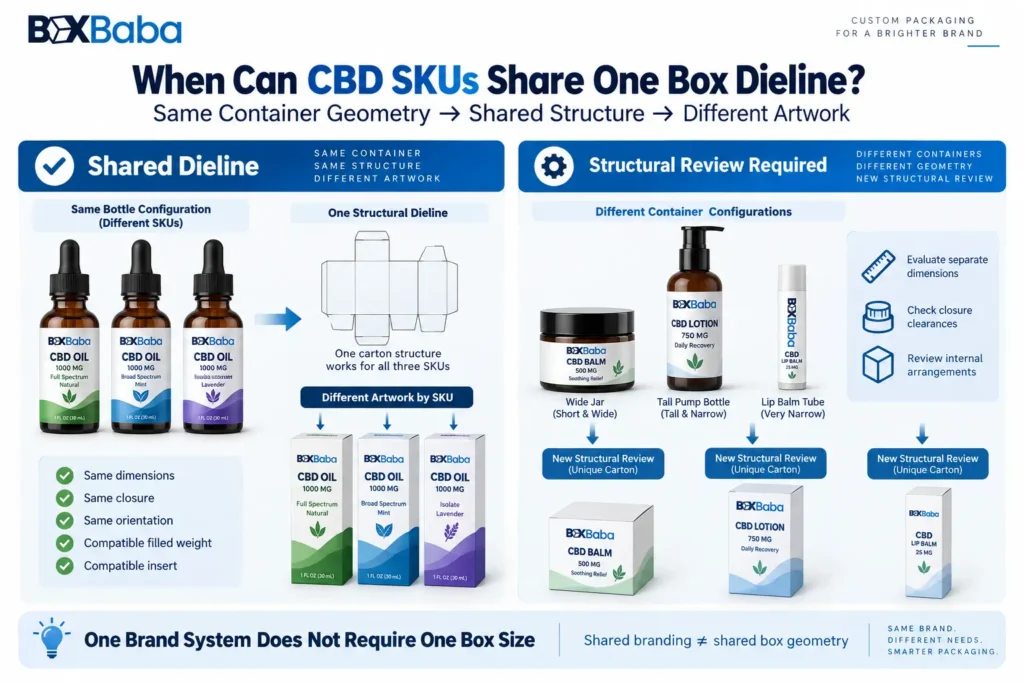
One Brand System Does Not Require One Box Size
A CBD range can look consistent without forcing every SKU into an identical carton.
For example:
Dropper Bottle → Tall Narrow Carton
Jar → Short Wider Carton
Lip-Care Tube → Compact Narrow Carton
The packaging family can still share:
- logo placement;
- typography;
- color architecture;
- front-panel hierarchy;
- graphic language;
- finishing strategy.
Brand consistency and structural standardization are related, but they are not the same decision.
Common Mistakes When Choosing CBD Packaging
Choosing a Box Before Finalizing the Primary Container
A packaging structure based on an estimated bottle or jar can become obsolete when the actual container arrives.
Choosing From ml, oz or Product Count
Fill quantity does not provide external dimensions.
Ignoring the Closure
A cap, dropper, pump or lid can determine the maximum product envelope.
Forgetting Filled Weight
The empty container is not the final structural load.
Treating Every CBD Product as the Same Packaging Type
CBD is a product category, not one physical container geometry.
Using One Dieline Across Incompatible Containers
Shared branding does not make different physical products structurally identical.
Adding Inserts Automatically
Use internal support when it performs a defined function.
Treating the Retail Carton as the Shipping Package
Retail presentation and parcel distribution are different packaging roles.
Choosing Decorative Finishes Before Functional Panels
Product information and scannable codes need appropriate space first.
Treating the Outer Box as the Direct Product Barrier
Direct containment normally belongs to the relevant primary container.
Assuming One Compliant CBD Box Works Everywhere
Packaging and labeling requirements depend on the actual finished product and applicable market.
What Should You Prepare Before Requesting a CBD Packaging Quote?
Once the general packaging direction is clear, prepare:
- CBD product type;
- primary-container type;
- maximum finished dimensions;
- closure profile;
- filled weight;
- intended orientation;
- number of products per box;
- quantity per SKU;
- total order quantity;
- sales channel;
- preferred structure if known;
- insert requirement;
- material direction;
- printing requirements;
- finish preferences;
- artwork status;
- sample requirement;
- delivery destination;
- target project date.
For a product range, provide this information for every distinct physical container format, not merely every product name.
A Practical CBD Packaging Selection Workflow
Use the following sequence before production:
- Identify the Product
Clarify the CBD product type and intended market. - Confirm the Primary Container
Use the final bottle, jar, tube, pouch or other finished unit. - Record the Physical Inputs
Maximum dimensions, closure, filled weight and orientation. - Define the Sales Channel
Retail, ecommerce, display, gifting or multiple channels. - Choose the Packaging Layer
Individual retail carton, display, presentation box or outer shipping package. - Select the Simplest Suitable Structure
Match the structure to the product and channel. - Evaluate the Insert Requirement
Add support only where it performs a useful function. - Select the Material Direction
Match the material family to the structure and application. - Finalize the Dieline
Build the structural template around confirmed inputs. - Plan Functional Artwork Space
Reserve room for approved information, barcodes and QR codes. - Add Decorative Finishes
After functional requirements have been accommodated. - Review Proofing or Sampling Requirements
Choose the appropriate approval route for the project. - Approve Production
Release the project only after the structure and buyer-approved artwork are final.
Choosing Custom CBD Packaging From BoxBaba
The most reliable CBD packaging decision starts with the finished product inside the package.
BoxBaba Custom CBD Boxes category provides commercial routes for product-specific cartons, jars, displays, cosmetics and other CBD packaging formats after the packaging requirements have been defined.
When requesting a quote, share the finished primary-container dimensions, closure, filled weight, quantity, sales channel, insert needs and artwork status.
BoxBaba orders start from 100 units, with artwork and dieline support, samples available, standard production of 5–9 business days after final artwork approval, and free shipping across the USA.
The practical starting question is not:
Which CBD box should I buy?
It is:
What finished product needs to fit inside, and what job does the packaging need to perform?
Answer those two questions first, and the structure, material, insert and artwork decisions become far easier to define.
Frequently Asked Questions
How do I choose the right packaging for a CBD product?
Start with the finished primary container, its maximum dimensions, closure, filled weight and sales channel. Use those inputs to decide the packaging layer, structure, material and whether internal support is needed.
Is there one standard CBD box size?
No. CBD products use bottles, jars, tubes, pouches and other containers with different external dimensions and closures.
Should CBD box size be based on ml or oz?
No. Fill capacity describes the quantity inside the container, not the finished container external dimensions.
Does every CBD product need a secondary box?
Not necessarily. Whether a secondary carton is appropriate depends on the product, primary package, sales channel, presentation requirement and applicable market requirements.
Do CBD boxes need inserts?
Not always. An insert is most useful when it improves product positioning, separation, organization or presentation.
Which material is best for CBD packaging?
There is no universal best material. Paperboard is useful for many retail cartons, kraft can support a natural visual direction, corrugated is often relevant to larger or shipping-oriented structures, and rigid board is mainly used for selected presentation packaging.
What box style works for a CBD bottle?
The answer depends on the finished bottle dimensions and weight. Lightweight bottles may work with tuck cartons, while some heavier products may justify a locking-bottom structure or additional support.
Are standard CBD cartons automatically child-resistant?
No. A normal folding carton should not be represented as child-resistant unless the relevant packaging configuration has a verified basis for that function.
Can several CBD SKUs use the same dieline?
Yes, when the SKUs use physically compatible containers, closures, dimensions, orientations, weight ranges and insert configurations.
Is CBD retail packaging the same as ecommerce packaging?
Not necessarily. The same retail carton may remain around the product while an additional outer mailer or shipping package is used for ecommerce orders.
Should artwork be designed before the dieline?
Generally, the structure and dieline should be established first so important artwork can be positioned around the correct folds, cuts, seams and usable panels.
What information should I send for a CBD packaging quote?
Provide the product type, finished container dimensions, closure, filled weight, quantity, number of SKUs, intended sales channel, preferred structure, insert needs, printing, finishes, artwork status and delivery destination.