
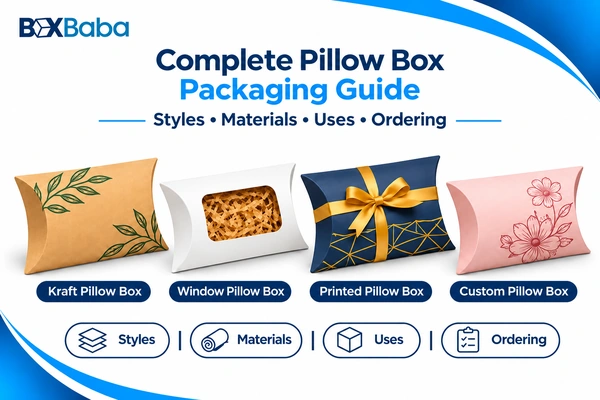
Pillow box packaging is a curved folding-carton format that creates a rounded, cushion-like profile instead of the straight walls and corners of a conventional rectangular carton.
The structure can work well for compatible gifts, favors, apparel accessories, packaged confectionery, jewelry, soap, promotional products, and other compact items. But product category alone does not determine whether a pillow box will work.
The more useful decision is whether the complete packed product can fit the curved usable space, remain in the intended orientation, allow the closures to form correctly, and perform the role required by the sales channel.
This guide explains how pillow packaging works, where it fits, its main trade-offs, and the decisions buyers should make before developing a custom pillow box.
Pillow Box Packaging at a Glance
Decision | What a Buyer Should Understand |
Structure | Pillow boxes use curved folding geometry rather than a conventional rectangular cavity |
Product Fit | Evaluate the complete packed product, not the product category alone |
Sizing | Product dimensions are inputs; they are not automatically the final box dimensions |
Orientation | How the product sits can change required space, presentation, and structural fit |
Material | Carton stock needs to work with the curved structure, artwork, and intended presentation |
Artwork | Curves, folds, and closure areas affect where important graphics should be positioned |
Internal Support | Cards or inserts are useful only when they solve a defined movement or presentation problem |
Fulfillment | A product-facing pillow carton is not automatically a protective outer shipping box |
What Is Pillow Box Packaging?
A pillow box is a folding carton whose main body forms a curved profile when the package is assembled and the end sections are closed.
Many pillow cartons start as a flat, die-cut and scored blank. As the structure is formed, the broad panels bow outward and the curved end sections create the recognizable pillow shape.
That distinction matters because pillow box describes a structural family. It does not mean that every pillow carton has the same dimensions, usable internal space, closure details, material, or application.
For buyers who have already decided that this structural family fits their project, BoxBaba Custom Pillow Boxes category is the main commercial starting point.

How Does a Pillow Box Structure Work?
The curved shape affects the way the package holds a product.
Usable Space Changes Across the Carton
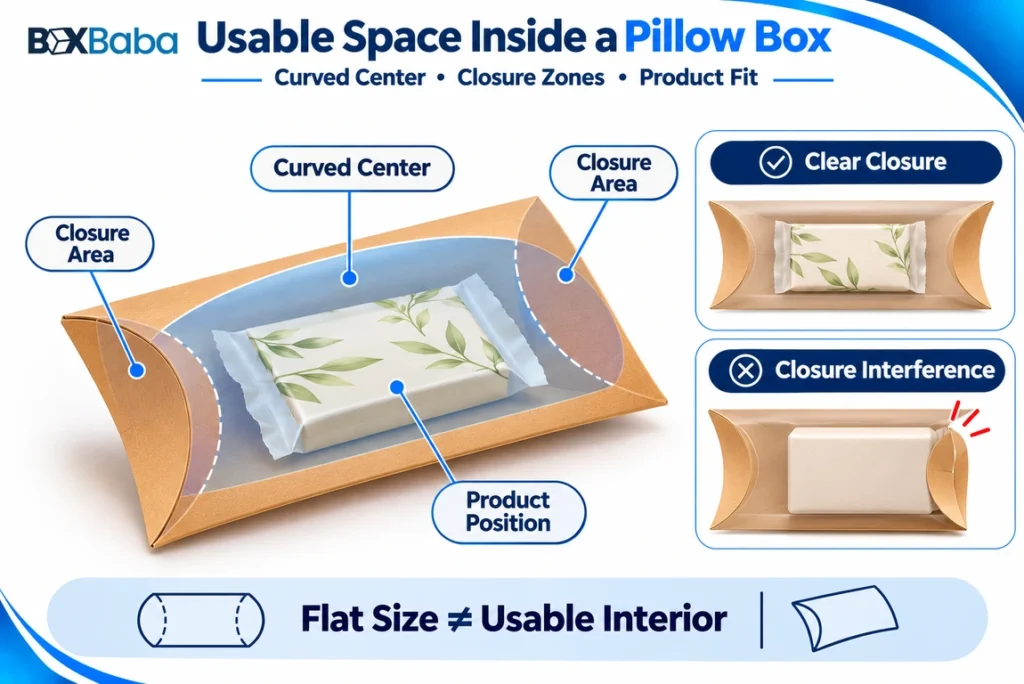
A pillow box does not create the same rectangular internal volume from one end to the other.
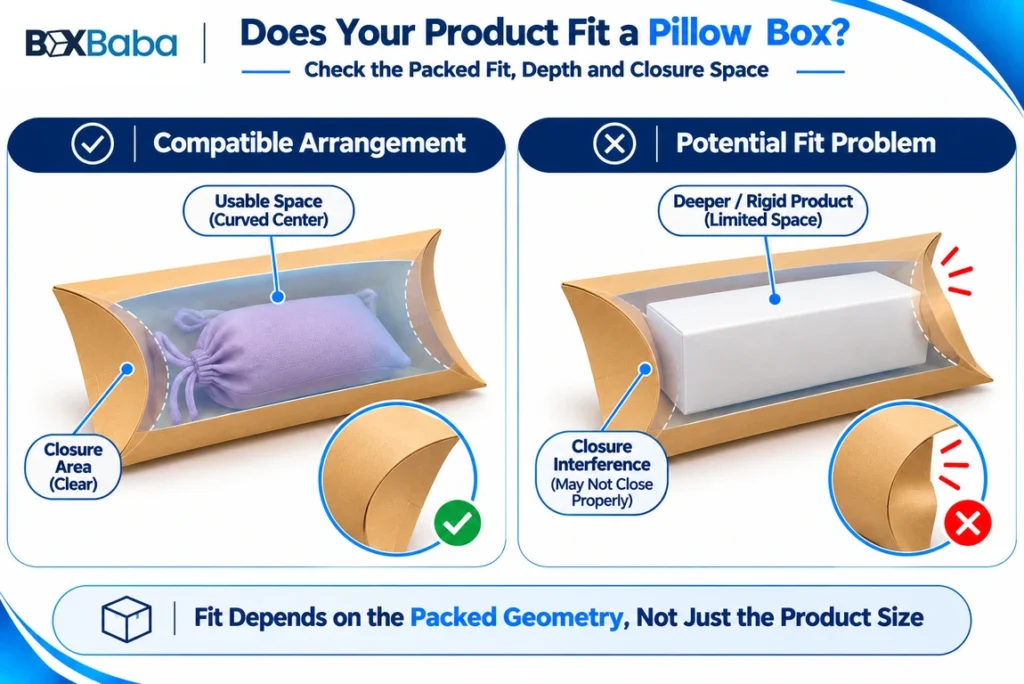
The formed center can provide more usable depth than areas near the curved closures. A rigid product that appears suitable when compared with a flat drawing can therefore interfere with the closing areas after assembly.
The Closures Are Part of the Fit
The product must leave enough usable space for the closing sections to form correctly.
If a packed item pushes into those structural zones, the problem may be product-to-box fit rather than the way the carton is being closed.
The Packed Carton Matters More Than the Empty Carton
A pillow box can look correct while empty but behave differently after a product, pouch, card, tissue, or support is added.
Structural evaluation should therefore use the complete packed configuration rather than the empty package alone.
What Types of Products Can Work in Pillow Boxes?
Pillow boxes generally make the most sense for products whose finished packed geometry is compatible with the curved body and closing areas.
The product name is only the starting point.
Application | What Matters Most |
Gifts and favors | Complete gift arrangement, cards, tissue, quantity per package, and presentation |
Candy and snacks | Primary wrapping/contact condition, piece arrangement, and packed volume |
Apparel and soft accessories | Finished folded dimensions and volume rather than garment size alone |
Hair extensions or arranged products | Bundle arrangement, card, accessories, orientation, and finished depth |
Jewelry or small accessories | Card, pouch, support, orientation, and movement |
Soap and similar compact products | Finished product shape plus any wrapper, sleeve, or primary packaging |
For gift-led projects, the buyer situation helps determine the more appropriate commercial route. Recipient-focused presentation is covered by Pillow Gift Boxes, while repeat event or guest distribution is better aligned with Pillow Favor Boxes.
For confectionery or snack applications, compare Candy Pillow Boxes and Snack Pillow Boxes. Packaging that contains individually wrapped food or another primary package creates a different requirement from direct contact with unpackaged food, which should not be assumed without verification.
Similarly, hair extensions illustrate why arrangement matters. The bundle, fold, presentation card, and included accessories together define the package geometry. The dedicated Hair Extension Pillow Boxes page covers that application commercially.
When Is a Pillow Box Not the Right Structure?
A pillow carton is not automatically the best package just because the product is small.
Another structure may deserve consideration when the packed product:
- needs a rigid rectangular cavity;
- is unusually heavy or deep for the intended folding carton;
- requires substantial structural support;
- needs several fitted compartments;
- has strongly irregular geometry that conflicts with the curved closures;
- depends on large uninterrupted flat information panels;
- requires highly controlled internal positioning;
- must perform as the protective parcel-shipping package.
The practical question is not simply:
Can the product be placed inside?
It is:
Can the carton form, close, present the product, and perform its intended packaging role correctly after the complete product configuration is inside?
What Are the Main Pillow Box Configuration Decisions?
A reliable packaging decision starts with the product and structure before decoration.
Use this sequence:
Packed Product → Orientation → Pillow Fit → Material → Structural Features → Retention → Artwork / Finishing → Fulfillment
Size and Fit
Sizing starts with the actual packed item.
Useful inputs include maximum length or height, width, depth or thickness, widest points, protruding components, intended orientation, quantity inside, and any pouch, card, wrap, tissue, or support.
These are product and packing inputs.
They should not be treated as the finished carton dimensions.
Two distinctions should remain clear:
Product Dimensions ≠ Finished Box Dimensions
and:
Flat Dieline ≠ Assembled Box ≠ Usable Internal Fit
Detailed measurement methodology deserves its own workflow. At the pillar level, the important lesson is to measure what will actually enter the carton and allow the packaging designer to translate those inputs into the finished structure.
Material
Material is part of the structural decision rather than simply a visual preference.
The selected folding-carton stock can influence:
- how the curved panels form;
- fold and closure behavior;
- printing;
- finishing compatibility;
- tactile presentation.
Material terminology should also remain precise. Cardboard, paperboard, kraft paperboard, brown paper, and recycled board are not automatically interchangeable terms.
A brown appearance does not prove a specific kraft composition, recycled content, recyclability, biodegradability, or environmental superiority.
For material-led commercial requirements, compare Kraft Pillow Boxes and Cardboard Pillow Boxes.
Printing, Finishing, and Artwork
Printing places graphic content on the carton. Finishing changes the visual or tactile treatment of the printed package.
BoxBaba available printing methods include:
- Offset printing
- Digital printing
- Flexographic printing
CMYK can be used for full-color artwork, while Pantone/PMS colors can be specified when closer control of important brand or spot colors is required. Final color appearance can still depend on the selected stock and finishing configuration.
Finishing options can include, where compatible:
- matte;
- gloss;
- soft-touch;
- foil;
- embossing;
- debossing;
- Spot UV.
The pillow-box-specific issue is placement.
Curved panels, fold areas, and closure zones can change how logos, small text, barcodes, QR codes, foil, embossing, or other artwork appears after assembly.
For projects where printing itself is the primary buying requirement, Printed Pillow Boxes is the more specific commercial route.
Dieline and Formed-Carton Validation
A dieline represents the flat production geometry. The customer receives and uses the package as a formed three-dimensional object.
Artwork should therefore answer two separate questions:
- Does the artwork follow the correct flat cut-and-fold geometry?
- Does it still appear correctly after the pillow carton is assembled and filled?
BoxBaba existing Dieline in Packaging guide explains the broader role of cut lines, fold lines, glue areas, artwork placement, and production files.
Handles, Windows, and Product Retention
Structural features should be selected because they solve a buyer problem.
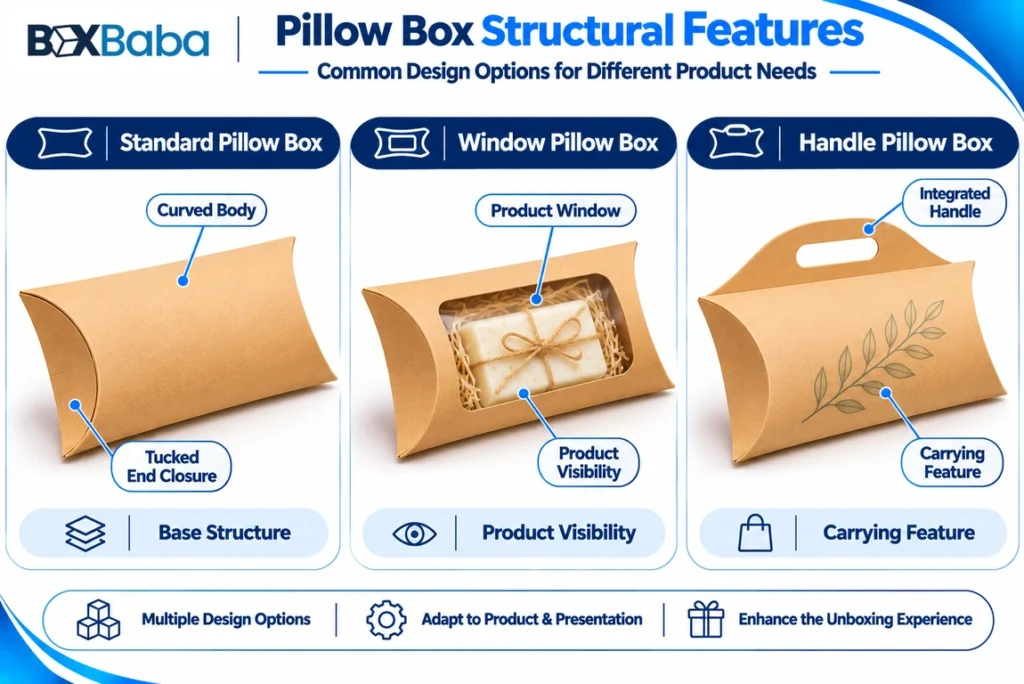
A handle changes the upper structure and carrying interaction. Buyers whose requirement is specifically carrying-oriented can compare Pillow Boxes with Handle.
A window can support product visibility, but it also changes the available artwork area and makes product positioning more important. Window material, placement, and performance should be confirmed for the actual project rather than assumed.
A card, insert, or support can be useful when it needs to control movement, establish orientation, separate components, or position a product for presentation.
If the product already fits and remains in the intended position, adding internal support may introduce unnecessary complexity.
Pillow Boxes for Retail, Gifts, and Ecommerce
A pillow box can perform different roles depending on the sales channel.
Retail and Product Packaging
The curved structure can provide branding and a distinctive product-facing silhouette.
Retail buyers should still consider product orientation, shelf behavior, required information, and whether the carton needs another structural feature.
Gift and Event Packaging
Pillow cartons can work well when package shape contributes to the handoff or gifting presentation.
Cards, tissue, bands, pouches, and multi-item arrangements must still be included when evaluating fit.
Ecommerce Packaging
A pillow box may serve as the product-facing package inside an ecommerce order.
That does not automatically make it the complete shipping-protection system.
A packaging sequence may instead be:
Product → Primary Package if Required → Pillow Box → Additional Protection if Required → Outer Shipping Package
When transportation protection becomes the main requirement, evaluate an appropriate option from Custom Shipping Boxes.

Main Trade-Offs of Pillow Box Packaging
Potential Strength | Corresponding Trade-Off |
Distinctive curved presentation | Less conventional stacking geometry |
Compact folding-carton construction | Less rigid than a rigid presentation structure |
Useful central branding areas | Fold and closure zones require artwork planning |
Can work across several compact-product applications | Does not suit every shape, weight, or depth |
Can use cards or supports where needed | Complex retention systems may work against the curved interior |
Useful as product, retail, or gift packaging | Not automatically protective outer shipping packaging |
The best packaging structure is not the one with the longest list of advantages.
It is the one whose advantages solve the requirements of the actual product and sales channel.

A Practical Pillow Box Decision Framework
Before selecting pillow box packaging, work through these decisions in order.
1. Define the Complete Packed Product
Include the product plus any wrapping, pouch, tissue, card, accessories, or support that will enter the carton.
2. Identify the Maximum Packed Geometry
Record the longest, widest, and deepest relevant points rather than relying only on nominal product dimensions.
3. Decide the Intended Orientation
Determine how the product should sit and which area of the carton should function as the main display face.
4. Evaluate the Curved Usable Space
Confirm that the product can occupy the formed body without interfering with the closing areas.
If the product depends on full rectangular corner-to-corner volume, another structure may be more suitable.
5. Identify Any Retention Problem
Ask whether the product actually needs a card, insert, divider, or support.
Choose internal components to solve movement or presentation problems rather than adding them automatically.
6. Select Structural Features Before Decoration
Determine whether visibility, carrying, or another functional requirement changes the base pillow structure before final artwork is built.
7. Define the Packaging Layer
Decide whether the pillow box is intended as:
- retail packaging;
- gift packaging;
- secondary packaging;
- ecommerce inner packaging.
If it must also handle parcel-distribution risks, evaluate the outer shipping system separately.
Prepare a Starter Brief Before Requesting Custom Pillow Packaging
You do not need to engineer the carton before contacting a packaging supplier.
A useful starting brief should identify:
- the product and complete packed arrangement;
- maximum packed dimensions and orientation;
- quantity per box;
- total quantity and major SKU/artwork variations;
- any card, pouch, insert, window, or handle requirement;
- artwork status;
- material or finish direction if already known;
- delivery destination.
This information gives the packaging supplier a stronger starting point than requesting a generic small, medium, or large pillow box.
Is Pillow Box Packaging Right for Your Product?
A pillow box is a strong option when its curved geometry, usable internal space, presentation, and packaging role all work with the actual packed product.
Start with the product rather than the visual style.
Define the finished arrangement and orientation. Check whether the curved body and closures suit that geometry. Then evaluate material, structural features, retention, artwork, finishing, and the sales channel.
If those requirements align with a pillow-format folding carton, explore BoxBaba Custom Pillow Boxes to compare available commercial directions.
Discuss Your Pillow Box Packaging Requirements
For a project-specific discussion, prepare the packed product dimensions, quantity, SKU or artwork variations, intended orientation, artwork status, material preference if known, structural-feature requirements, and delivery destination.
Phone: +1 305 574 4357
Email: sales@boxbaba.com
Request a Custom Packaging Quote
Frequently Asked Questions
Can one Pillow Box size work across multiple SKUs?
Possibly, but SKU names are not enough to decide. Compare the completed packed dimensions, orientation, and presentation components for each SKU. If the physical configurations vary materially, another dieline may be required even when the branding belongs to one product family.
Does product weight matter if the item fits dimensionally?
Yes. Dimensional fit alone does not establish structural suitability. Product weight can influence material and structure decisions, particularly when the item is dense or when the carton must be handled repeatedly.
When is a physical sample useful for a Pillow Box project?
A physical structural sample can be useful when product fit, closure behavior, orientation, or the interaction between the curved carton and the packed item is difficult to judge from dimensions or a digital mockup alone.
Can Pillow Boxes be used for direct food contact?
Direct-food-contact suitability should not be assumed from the pillow shape or carton material name alone. The exact material, inks, coatings, adhesives, and intended contact condition need appropriate verification for the specific project.
Can important artwork cross the curved areas of a Pillow Box?
Artwork can extend through curved areas, but important text, barcodes, QR codes, logos, and precise decorative effects should be evaluated against the assembled carton. A design that looks correct on the flat file may read differently after the package is formed.
Can a Pillow Box include a window or handle?
Structural variations can be considered where the project and production capability support them. A handle changes the carrying and upper-structure requirements, while a window changes product visibility, positioning, and available artwork area. Each feature should be evaluated as part of the complete package rather than added after the base structure is finalized.