
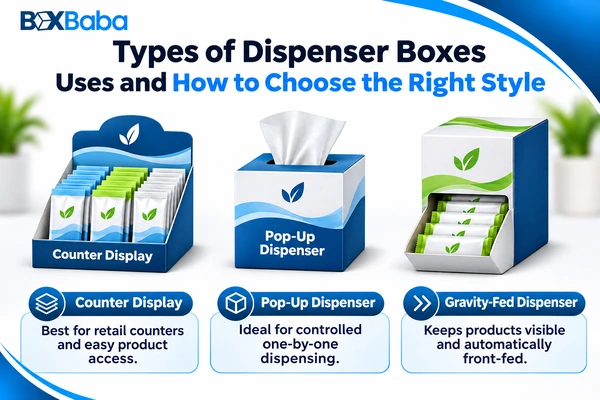
Dispenser boxes are cardboard packaging structures designed to hold multiple products and provide access through a designated opening. Common styles include pull-through, front-access, gravity-feed, flip-out, and perforated dispensers.
They are used for tissues, disposable gloves, sealed sachets, wrapped candies, tea packets, lip balms, and other compatible products. Each style manages access differently, so the right choice depends on the finished product size, shape, quantity, arrangement, and removal method.
This guide explains the main types of dispenser boxes, their applications, structural differences, and practical selection criteria to help businesses choose suitable custom packaging.
What Is a Dispenser Box?
A dispenser box is a packaging carton that holds products and allows users to retrieve them through a planned opening without repeatedly opening the main carton closure.
A typical dispenser combines three elements:
- Product arrangement: How units are positioned, stacked, or separated inside the carton.
- Access opening: The slot, cutout, or panel through which products are removed.
- Structural support: The board, retaining edges, or internal features that help keep the remaining contents in place.
Some dispensers provide direct manual access. Others are designed to encourage products to move toward an opening as contents are removed.
However, not every carton with an opening provides automatic or one-at-a-time dispensing. The actual function depends on the finished product and the approved structure.
Main Types of Cardboard Dispenser Boxes
Dispenser boxes can be described by their access method, product movement, or opening construction. These features may be combined within the same carton.
Dispenser Type | Main Feature | Common Applications | Important Consideration |
Pull-Through Dispenser | Slot for withdrawing flexible products | Tissues, certain packed glove formats | Fold arrangement and withdrawal clearance |
Front-Access Dispenser | Front cutout for direct retrieval | Wrapped products, sachets, small retail items | Finger access and retention |
Gravity-Feed Dispenser | Products are intended to move toward a lower outlet | Compatible packaged units | Product shape, friction, and movement |
Flip-Out Dispenser | Folding panel creates an access or retaining area | Small wrapped products and retail packs | Fold geometry and product support |
Perforated Dispenser | Removable panel creates an opening | Retail-ready packets and packaged merchandise | Tear path and support after opening |
1. Pull-Through Dispenser Boxes
Pull-through dispenser boxes use an opening through which users withdraw flexible products.
Facial tissue cartons are a familiar example. With an appropriate interfolded tissue arrangement, removing one sheet may help present the next.
Some glove dispenser cartons also use access slots, but packed gloves do not necessarily behave like interfolded tissues.
The opening should match the product arrangement and intended withdrawal direction.
For a product-specific example, explore BoxBaba Latex Medical Glove Dispenser Boxes.
2. Front-Access Dispenser Boxes
Front-access dispensers feature a cutout through which users retrieve products directly.
They may suit packaged items that need to remain within reach rather than move automatically toward an outlet.
A suitable retaining edge can help keep the remaining units inside while allowing users to remove the intended product.
Front-access openings can also be positioned on an end panel when the product shape and removal direction make that arrangement more practical.
3. Gravity-Feed Dispenser Boxes
Gravity-feed dispensers are designed so compatible products can move toward a lower opening as units are removed.
They may be considered for products with relatively consistent shapes and suitable stacking behavior.
However, gravity-assisted movement depends on several factors:
- Finished product dimensions and weight.
- Surface friction between products.
- Product orientation and arrangement.
- Opening geometry and retaining edges.
- Behavior as the carton becomes partially empty.
A lower dispensing slot does not automatically guarantee smooth or one-at-a-time feeding.
4. Flip-Out Dispenser Boxes
Flip-out dispenser boxes have a panel that folds outward to create an access area or retaining pocket.
This feature can help expose small packaged products while maintaining a defined opening.
The fold-out panel describes the carton construction. It does not independently determine how the products move.
A compatible design may combine a flip-out front with gravity-assisted movement.
5. Perforated Dispenser Boxes
Perforated dispensers use a removable panel to expose the intended access opening.
The carton may remain more enclosed before use, then be opened by removing the designated section.
The resulting structure determines its function.
If the removed panel reveals a large open tray, the package may function primarily as a retail display. If a smaller outlet remains, the carton may continue to function as a controlled-access dispenser.
Perforation describes how the carton opens; dispensing describes how products are retrieved.

Can One Carton Combine Multiple Dispenser Features?
Yes. A single cardboard dispenser can have more than one structural or functional characteristic.
For example, a hypothetical carton might be:
- Countertop: Because it is positioned on a retail counter.
- Perforated: Because a panel must be removed before use.
- Front-access: Because products are retrieved through the front.
- Divided: Because separate channels organize different variants.
- Kraft: Because its selected substrate is kraft paperboard.
These descriptions are not competing product types. They identify different attributes of the same packaging structure.
Recognizing this distinction helps buyers communicate their requirements more accurately rather than searching for a different box category for every feature.

Dispenser Boxes vs. Regular Boxes and Display Boxes
The difference is the primary function of the packaging.
Packaging Type | Primary Purpose | How Products Are Accessed |
Regular Packaging Box | Contains products | Through its main closure |
Open Display Box | Presents merchandise for selection | Directly from an exposed area |
Dispenser Box | Organizes products for continued retrieval | Through a designated access opening |
Some retail packaging combines display and dispensing functions.
For example, a countertop carton may present branding while allowing customers to retrieve individually packaged items through a lower opening.
A visually attractive display is not automatically a functional dispenser, however. Product access and retention must still be considered.
For more on retail-display classifications, read BoxBaba Types of Display Boxes guide.

Common Applications of Dispenser Boxes
Different products require different access methods, internal arrangements, and support.
Product | Potential Dispenser Approach | Primary Selection Factor |
Facial Tissues | Pull-through slot | Fold type and stack behavior |
Disposable Gloves | Front or perforated access | Packed-glove arrangement and withdrawal |
Individually Packed Bandages | Front-access carton | Packet dimensions and ease of retrieval |
Wrapped Tea Bags | Front-access or compatible divided carton | Envelope dimensions and flavor organization |
Sachets and Stick Packs | Front or compatible lower opening | Finished seals, thickness, and orientation |
Wrapped Candies | Front-access or compatible gravity-feed design | Wrapper shape, friction, and retention |
Lip Balm Tubes | Accessible channel or retaining structure | Tube diameter, cap profile, and removal direction |
These are possible structural directions, not guarantees that every arrangement will work for every product.
For example, a flat sealed sachet and a cylindrical lip balm tube may require different channels even when both products are small.
The finished packaged unit—not merely its product category—should guide the selection.

How to Choose the Right Dispenser Box
Start with the product and intended removal action, then select the structure. Choosing a dispenser by appearance alone can result in unsuitable opening dimensions or product arrangements.
Step 1: Identify the Finished Product
Determine exactly what the carton will hold.
Measure the complete retail-ready unit, including wrappers, seals, caps, folds, or other projecting features.
For tissues or gloves, the packed arrangement also matters.
Step 2: Choose the Required Access Method
Decide how customers or staff should retrieve the product.
A pull-through opening may suit compatible flexible sheets. Direct front access may be more practical for irregularly packaged products. Gravity-assisted movement may be considered for suitable units that can move toward a lower opening.
Choose the withdrawal method before finalizing the cutout.
Step 3: Establish Capacity and Arrangement
Specify the number of products per dispenser and how they will be positioned.
A count alone does not establish box dimensions. The units may be stacked, arranged in rows, or separated into channels.
Their finished dimensions, weight, and arrangement determine the required internal space.
Step 4: Define Placement and Replenishment
Determine whether the carton will sit on a retail counter, shelf, workplace station, or another suitable surface.
Confirm any maximum width, depth, or height.
Also decide whether the carton will be filled once or must allow repeated replenishment.
For related retail-space planning, see BoxBaba Display Box Sizing Guide.
Step 5: Select Suitable Materials and Structural Features
The material should suit the loaded carton and its opening.
White SBS paperboard, kraft paperboard, and suitable corrugated board may be considered depending on the construction.
Retaining edges, dividers, or other internal components should solve a specific access or organization requirement rather than being added unnecessarily.
Step 6: Review a Physical Sample
Where available, evaluate a structural sample using the actual finished products.
Check the carton when it is full, partly depleted, and nearly empty.
This can help identify access difficulties, unwanted product movement, or a need to revise the opening.
A digital artwork proof or 3D mockup is useful for appearance review but does not establish physical dispensing performance.

What Materials and Printing Options Should Buyers Consider?
Material and printing decisions should follow the intended dispenser structure.
SBS paperboard can suit compatible compact cartons requiring detailed printed graphics.
Kraft paperboard offers a natural brown appearance, although printed colors may differ from those on white stock.
Corrugated board may be considered for larger or more demanding structures where a suitable fluted material is needed.
The appropriate choice depends on product weight, panel support, opening geometry, and use.
Custom branding should also be planned around the dispenser physical features. Important text and barcodes should remain on permanent panels rather than removable tear-out sections.
A packaging dieline identifies folds, cut paths, perforations, glue areas, and printable zones. BoxBaba Dieline in Packaging Guide explains these elements in more detail.
Common Mistakes When Choosing Dispenser Packaging
The most avoidable problems usually come from selecting a structure before defining the product and its access requirements.
Measuring the product without its packaging: Sealed margins, wrappers, and caps can change the required opening and internal space.
Assuming gravity-feed performance: Product friction, shape, and orientation affect whether contents move toward an outlet.
Confusing a tear-away display with a dispenser: A removable panel may create an open tray rather than a controlled-access opening.
Ignoring the partly empty condition: Products may become harder to reach or move differently as the contents decrease.
Overlooking loading requirements: A design that is convenient for customers may still be impractical to fill or replenish.
Approving only a digital mockup: Visual approval does not establish physical fit, stability, or dispensing behavior.
These concerns can often be addressed earlier by reviewing representative products and a suitable structural sample.

What Information Should You Prepare Before Ordering?
Before requesting a custom dispenser box quotation, prepare the following information:
- Finished product type and dimensions.
- Weight of each complete unit.
- Required quantity per dispenser.
- Product arrangement and orientation.
- Preferred access or dispensing method.
- Intended counter, shelf, or other placement.
- Loading and refill requirements.
- Any required dividers or retaining features.
- Preferred material and artwork status.
- Wholesale order quantity, number of SKUs, and shipping destination.
A photograph or physical sample can also help explain unusual product shapes.
This information allows a packaging supplier to evaluate relevant structural directions and quote requirements more accurately.
Final Takeaway: Choose the Dispenser Around the Product
The right dispenser box is determined by what it holds, how products are removed, how many units it contains, and where it will be used.
Pull-through, front-access, gravity-feed, flip-out, and perforated constructions each address different packaging requirements. Some can be combined, but the finished product should determine which features are useful.
BoxBaba supports custom cardboard packaging with made-to-size options, artwork assistance, dieline support, and compatible printing choices.
If you are planning a packaging project, explore Custom Dispenser Boxes to discuss a suitable format.
Request a Custom Dispenser Box Quote
Wholesale packaging starts from 100 boxes, with free USA shipping under applicable terms.
Phone: +1 305 574 4357
Email: sales@boxbaba.com
Frequently Asked Questions
Can a dispenser box hold more than one product variety?
Yes, where the structure is suitable. Separate channels or dividers may help organize compatible products, but each compartment must accommodate its assigned unit size, quantity, and access method.
Can cardboard dispenser boxes be supplied flat-packed?
Some folding-carton constructions can be supplied flat or pre-glued for assembly. The appropriate supply format depends on the structure, internal features, and filling process.
Can products be shipped inside a dispenser carton?
A dispenser may be incorporated into a broader retail-ready packing arrangement, but transit protection must be evaluated separately. A retail dispensing carton is not automatically a tested shipping package.
Can a dispenser box hold loose, unwrapped food products?
That requires a separate review of materials, inks, coatings, and applicable product-contact requirements. A carton designed for individually wrapped products should not automatically be used for direct food contact.