
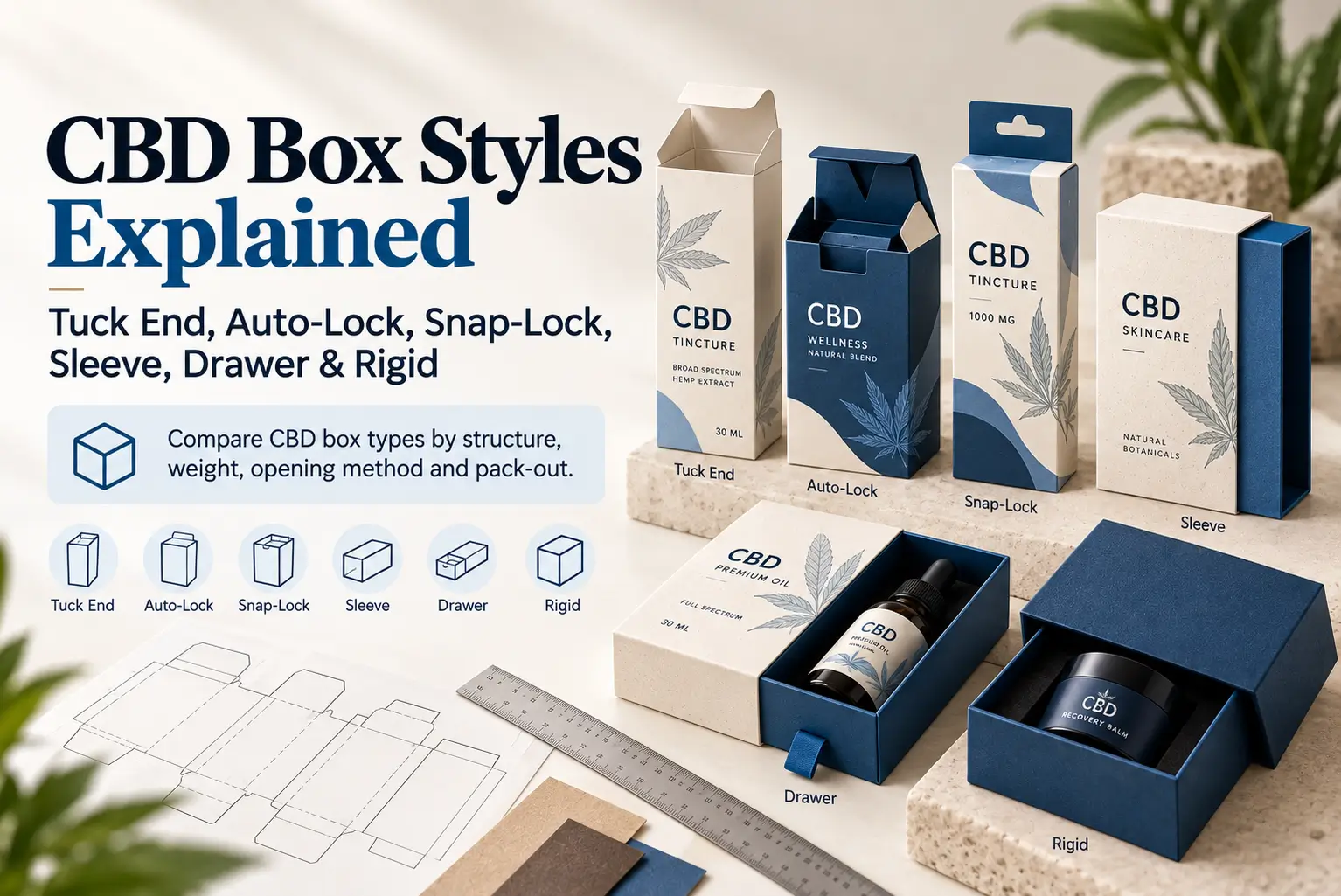
CBD box styles should be selected from the finished product and the structural job the package needs to perform, not from the product name or appearance alone.
A lightweight CBD tube, a glass dropper bottle, a gummy jar and a multi-product gift set can require different structures even when they belong to the same brand.
The practical sequence is:
Finished CBD Product → Dimensions + Filled Weight → Packaging Layer → Opening Method → Bottom Requirement → Internal Support → Pack-Out → Box Structure
One important distinction makes the subject much easier to understand:
Straight tuck and reverse tuck
describe closure arrangements.
Snap-lock and auto-lock
describe bottom constructions.
Sleeve and drawer
describe multi-part packaging/opening formats.
Rigid
describes a broader construction family that can itself use drawer, lid-and-base, magnetic or other opening styles.
They are related packaging terms, but they are not six equivalent versions of the same structural feature.
Brands still defining the overall packaging route can explore Custom CBD Boxes after confirming the finished product and intended use.
Which CBD Box Style Should You Choose?
Use the packaging problem as the starting point.
CBD Packaging Need | Structure to Evaluate | Main Question |
Lightweight individual bottle, tube or small jar | Straight or reverse tuck carton | Does a basic folding carton provide the required fit and loading method? |
Folding carton needs a manually interlocking base | Snap-lock / 1-2-3 bottom | Is the additional bottom construction appropriate for the completed load? |
Folding carton benefits from a pre-glued forming base | Auto-lock / automatic bottom | Does easier base erection justify the construction? |
Inner package needs a wrapping/sliding outer component | Sleeve | What is the sleeve surrounding? |
Product needs a sliding tray reveal | Drawer / tray-and-sleeve | Does the sliding opening improve access or presentation? |
Product needs a formed presentation package | Rigid structure | Which rigid opening style suits the contents? |
Multi-product set | Folding set box, drawer, rigid or another structure | What is the complete arrangement and loaded weight? |
Ecommerce shipment | Separate mailer/distribution structure | Which layer is retail packaging and which is transit packaging? |
The rule is:
Choose the structure because it solves a defined packaging requirement—not because the style name sounds stronger, safer or more premium.
Understand the Structure Hierarchy First
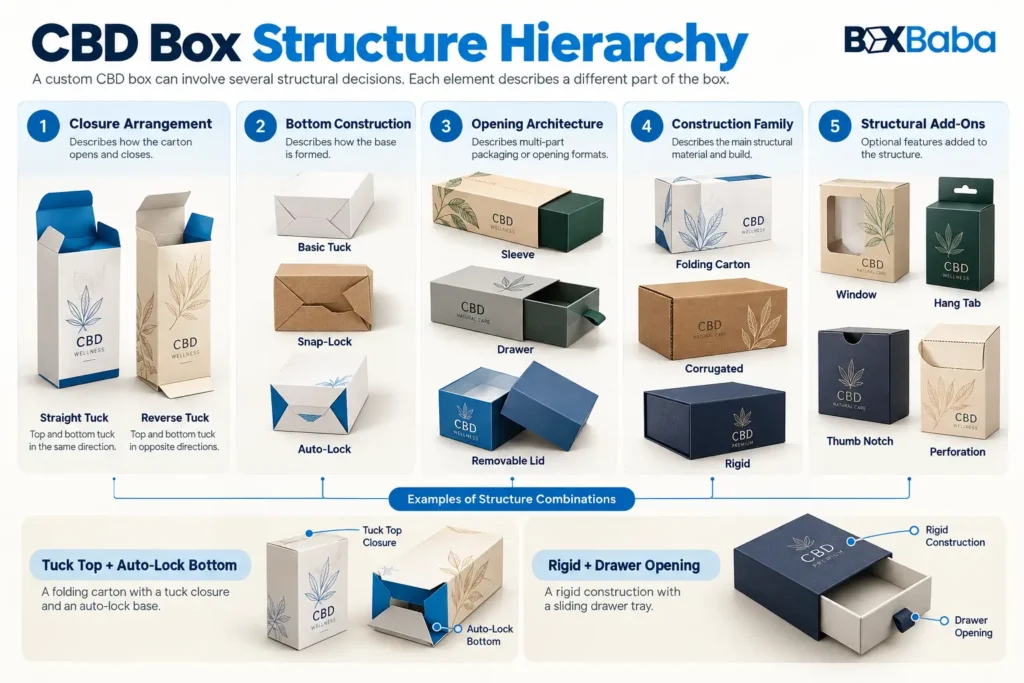
A custom box can involve several structural decisions at once.
Closure Arrangement
Describes how the carton opens and closes.
Examples:
- straight tuck;
- reverse tuck.
Bottom Construction
Describes how the base is formed.
Examples:
- basic tuck bottom;
- snap-lock bottom;
- auto-lock bottom.
Opening Architecture
Describes a broader way in which packaging components interact.
Examples:
- sleeve;
- tray-and-sleeve;
- drawer;
- removable lid.
Construction Family
Describes the broader physical package type.
Examples:
- folding carton;
- corrugated mailer;
- rigid/set-up box.
Structural Add-Ons
Modify another structure.
Examples:
- window;
- hang tab;
- thumb notch;
- perforation.
This creates valid combinations such as:
Tuck Top + Auto-Lock Bottom
or:
Rigid Construction + Drawer Opening
The name of one feature does not necessarily describe the complete box.
Box Style, Material & Size Are Different Specifications
These terms should remain separate in a packaging brief.
Box Style
→ structural geometry.
Material
→ paperboard, kraft, corrugated, rigid board or another approved material direction.
Size
→ finished dimensional specification.
Therefore:
Paperboard ≠ Box Style
Auto-Lock ≠ Material
30 ml ≠ Box Size
The final package combines all three, but one does not replace the others.
Straight Tuck End CBD Boxes
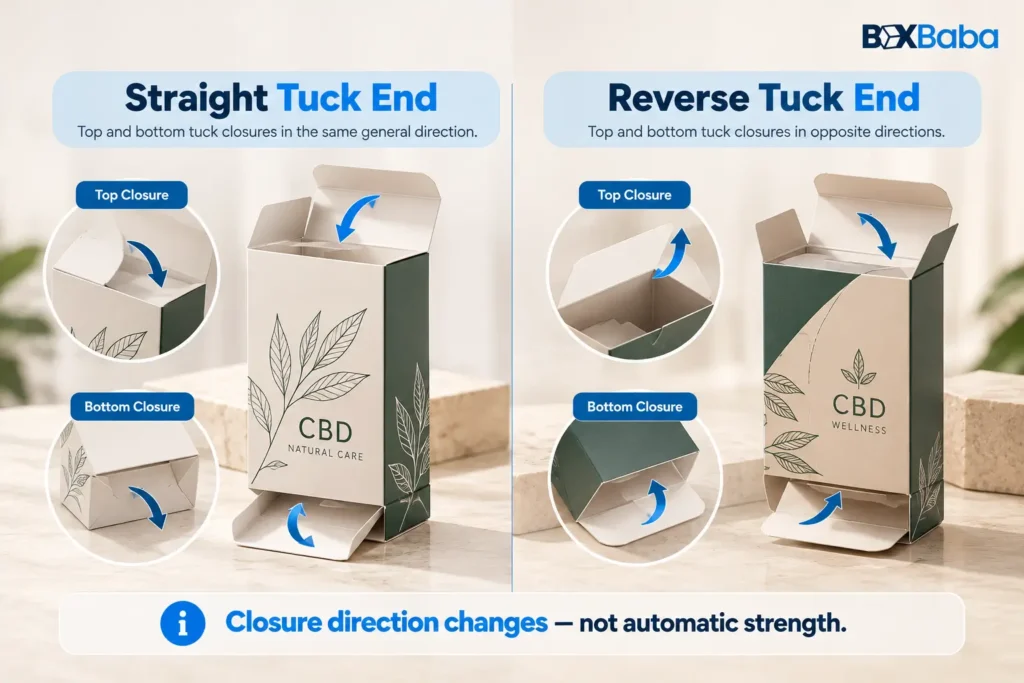
A straight tuck end, or STE, is a folding-carton arrangement in which the main tuck closures at the top and bottom operate in the same general direction.
It can suit compact, individually boxed CBD products such as:
- lightweight bottles;
- tubes;
- lip-care products;
- small cosmetic containers;
- selected small jars.
When STE Can Be a Useful Starting Point
Evaluate straight tuck when:
- one relatively lightweight product is being packed;
- the product has a regular geometry;
- a conventional top-opening carton works;
- no different bottom construction has been identified as necessary;
- the panel arrangement suits the approved artwork.
The final choice still depends on:
- product dimensions;
- filled weight;
- board specification;
- orientation;
- insert requirement;
- packing method.
Brands comparing commercial folding-carton formats can also explore Custom Tuck Boxes.
Reverse Tuck End CBD Boxes
A reverse tuck end, or RTE, positions the main top and bottom tuck closures in opposite directions.
Like STE, it is widely used for compact folding-carton packaging.
Possible CBD applications include:
- bottles;
- tubes;
- lightweight jars;
- lip-care products;
- cosmetic-style CBD products.
STE vs RTE: What Actually Changes?
The key differences are structural rather than prestige-related.
Review:
- closure direction;
- panel arrangement;
- glue-seam relationship;
- product-loading method;
- opening direction;
- artwork orientation.
Do not use simplistic rules such as:
STE = Premium
or:
RTE = Stronger
Closure direction alone does not establish those outcomes.
Straight Tuck vs Reverse Tuck
Decision | Straight Tuck End | Reverse Tuck End |
Top/bottom closure relationship | Same general direction | Opposite directions |
Structural family | Folding carton | Folding carton |
Common starting use | Lightweight individual retail products | Lightweight individual retail products |
Automatically stronger | No | No |
Automatically child-resistant | No | No |
Automatically tamper-evident | No | No |
Commonly supplied flat/collapsed | Yes | Yes |
Requires its own dieline | Yes | Yes |
The correct choice should follow the final structure rather than assumptions attached to the name.
Top Closure & Bottom Closure Can Be Different
A carton does not need to use the same closure concept at both ends.
For example:
Tuck Top + Auto-Lock Bottom
uses a conventional tuck opening while the base uses a pre-glued locking arrangement.
Likewise:
Tuck Top + Snap-Lock Bottom
uses a tuck opening and an interlocking base.
This is why:
I need a tuck box
may not be enough information for a packaging specification.
A more useful question is:
How should the consumer open the package, and how should the base be formed for the completed product load?
When a Basic Tuck Bottom May Not Be Enough
A conventional tuck carton can work for many products, but the bottom should receive additional review when the completed product is:
- relatively heavy;
- made from substantial glass;
- tall with a narrow base;
- part of a multi-product configuration.
That does not automatically mean the carton needs auto-lock.
It means the base requirement needs to be evaluated separately.
Possible directions include:
- snap-lock;
- auto-lock;
- reinforced folding construction;
- another appropriate base.
Snap-Lock Bottom CBD Boxes
A snap-lock bottom is also commonly called a:
- 1-2-3 bottom;
- lock-bottom structure;
depending on supplier terminology.
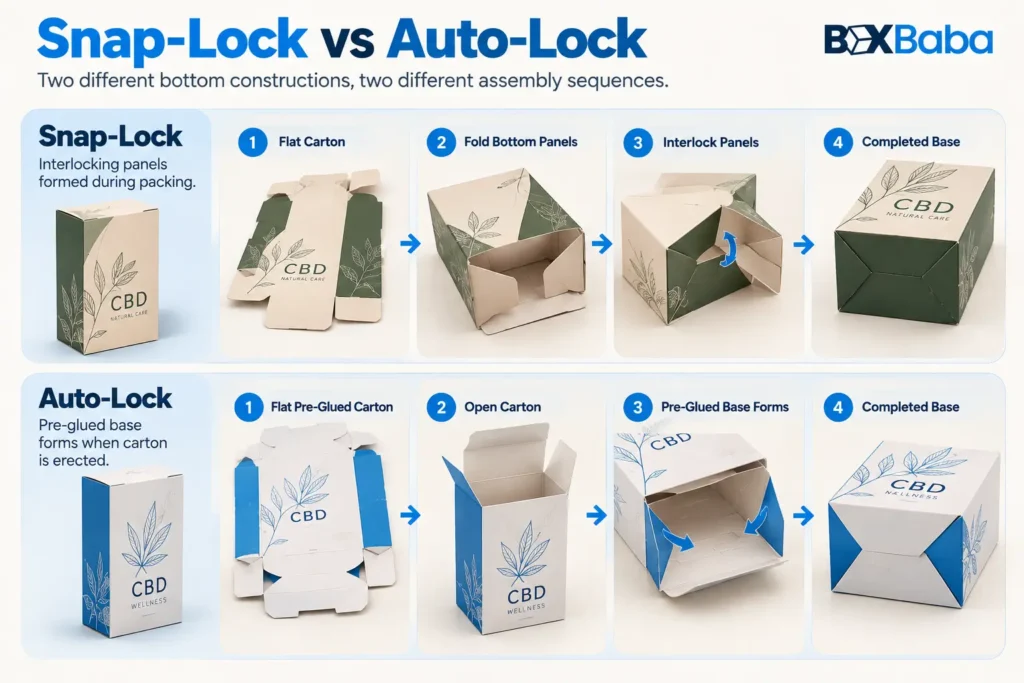
The base uses interlocking panels that are folded into position during carton erection.
When Snap-Lock Is Worth Evaluating
A snap-lock bottom may be useful when a project needs a different base arrangement from a basic tuck bottom.
Possible examples include:
- bottles;
- jars;
- selected glass containers;
- compact multi-product packages.
But avoid:
Glass Product → Snap-Lock
as a universal rule.
Use:
Finished Weight + Footprint + Carton Geometry + Pack-Out → Base Decision
Snap-Lock Affects Pack-Out
The packer forms the interlocking bottom.
For manual packing, consider:
- folding sequence;
- assembly consistency;
- operator time;
- product loading direction.
This operational step matters when comparing snap-lock with auto-lock.
Auto-Lock Bottom CBD Boxes
An auto-lock bottom, also called an automatic bottom, crash-lock or crash-bottom in common packaging terminology, uses a pre-glued base.
When the flat carton is erected, the bottom moves into its assembled position.
When Auto-Lock Is Worth Evaluating
An automatic bottom can be useful where the project benefits from:
- a pre-glued base;
- reduced manual bottom-forming steps;
- repeat pack-out;
- a different base construction from a simple tuck carton.
Possible CBD products can include:
- filled dropper bottles;
- glass jars;
- pump bottles;
- selected product sets.
There is no universal weight at which a CBD carton must become auto-lock.
The entire structure needs to be reviewed.
Snap-Lock vs Auto-Lock
These terms should not be used interchangeably.
Snap-Lock
↓
Interlocking Bottom Panels
↓
Bottom Is Formed During Packing
Whereas:
Auto-Lock
↓
Pre-Glued Bottom Assembly
↓
Base Forms When Carton Is Erected
Both are alternatives to simpler bottom constructions, but they create different:
- dielines;
- converting steps;
- assembly processes;
- pack-out workflows.
If terminology differs between suppliers, rely on the approved structural drawing rather than the informal name alone.
Snap-Lock vs Auto-Lock Decision Table
Decision Factor | Snap-Lock | Auto-Lock |
Bottom construction | Interlocking panels | Pre-glued forming base |
Manual bottom-forming step | Required | Reduced |
Pre-glued base | No | Yes |
Can be considered where base support needs review | Yes | Yes |
Automatically correct for every glass/heavy product | No | No |
Final decision depends on full carton specification | Yes | Yes |
The choice is both structural and operational.
Filled Weight Matters More Than Nominal Capacity
A 30 ml product does not tell you what bottom construction to use.
Consider:
30 ml Lightweight Plastic Bottle
and:
30 ml Glass Dropper Bottle
Their capacity is the same.
Their completed weight and geometry may not be.
Therefore:
Fill Capacity ≠ Structural Load
Use:
Finished Container + Filled Weight + Footprint + Structure
instead of:
30 ml → Auto-Lock
For dropper-specific secondary packaging, see CBD Dropper Bottle Boxes.
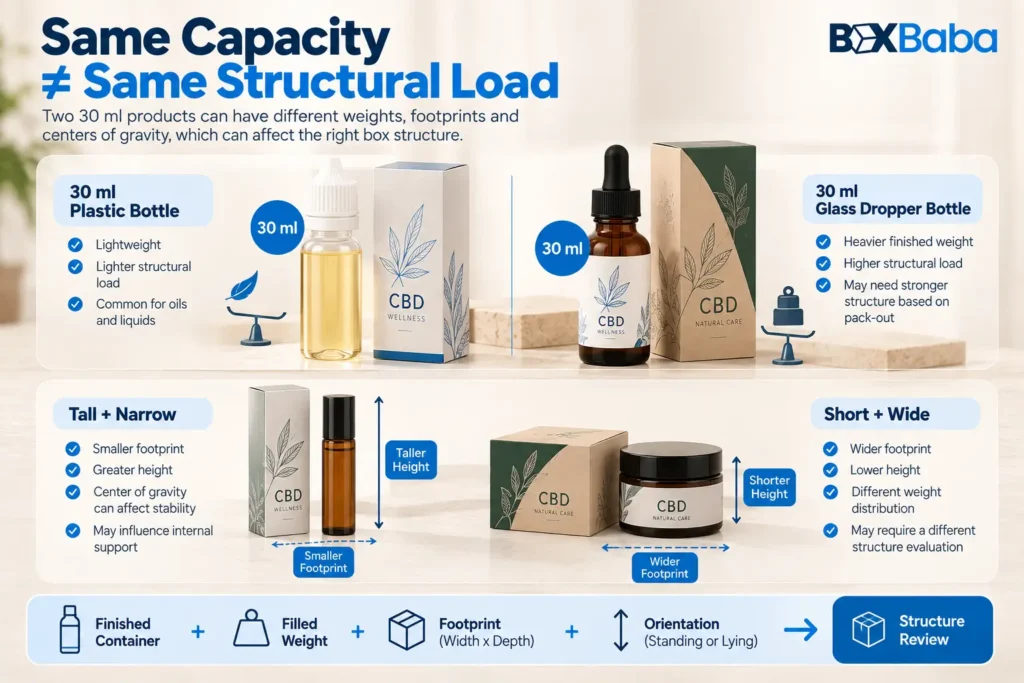
Product Geometry Can Matter as Much as Weight
A tall narrow bottle can behave differently from a short wide jar of equal weight.
Consider:
- base footprint;
- overall height;
- center of gravity;
- intended orientation;
- closure weight.
That can influence:
- bottom construction;
- standing stability;
- insert requirement.
A more complete relationship is:
Weight + Geometry + Orientation → Structure Review
rather than weight alone.
Sleeve CBD Packaging
The word sleeve describes a component that wraps, slips or slides around another product or package.
It can refer to more than one format.
For example:
Simple Product or Carton Sleeve
A printed outer wrap may surround:
- an existing carton;
- a product;
- a grouped pack.
Tray-and-Sleeve
An outer sleeve surrounds a defined inner tray.
Therefore:
Sleeve
is the broader structural concept.
Tray-and-Sleeve
is one specific sleeve configuration.
Brands comparing commercial options can explore Sleeve Boxes.
Sleeve Does Not Automatically Mean Drawer
This distinction is important.
A sleeve can surround:
Inner Carton
without a drawer action.
A drawer package normally uses:
Outer Sleeve / Case + Sliding Inner Tray
The tray moves outward as the primary opening action.
Therefore:
Drawer Uses a Sliding Outer/Inner Relationship
but:
Not Every Sleeve Is a Drawer
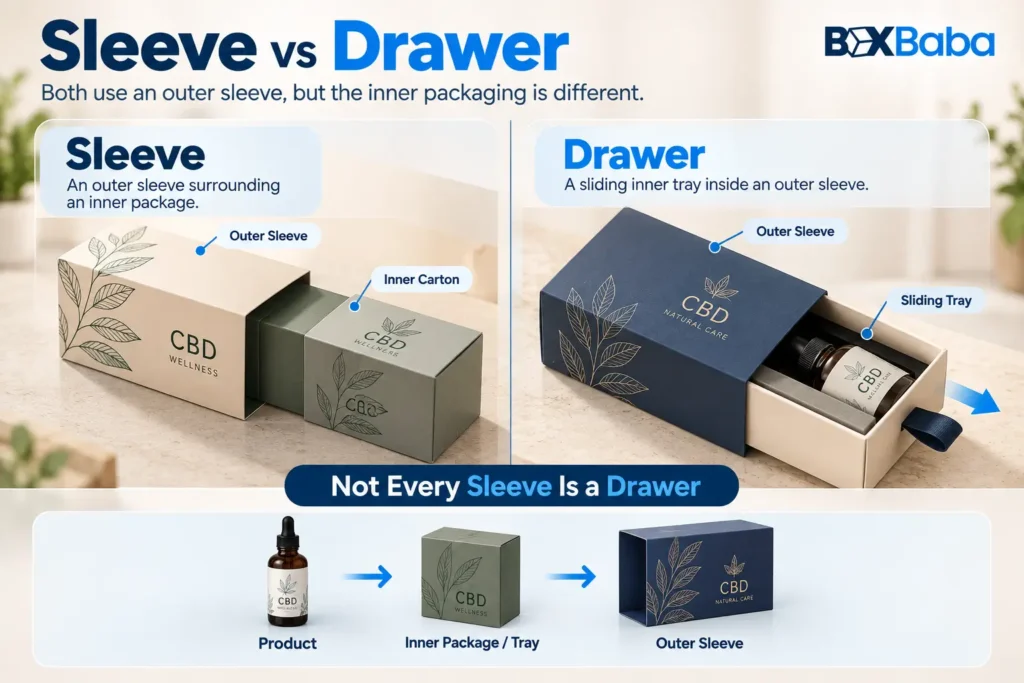
Sleeve Fit Is a Structural Relationship
For a sleeved package:
Finished Product
↓
Inner Package / Tray
↓
Outer Sleeve
The sleeve is normally developed around the completed inner component rather than directly around the raw product measurements.
Therefore:
Product Dimensions ≠ Inner Package Dimensions ≠ Finished Sleeve Dimensions
The fit also needs enough working movement for assembly or opening.
Do not use one universal clearance number for every sleeve.
Drawer CBD Boxes
A drawer box uses a sliding inner component inside an outer sleeve or case.
Typical relationship:
Outer Sleeve
Sliding Tray
A drawer can be made using different construction systems.
It is not automatically rigid.
Possible formats include:
- folding paperboard drawer box;
- wrapped rigid drawer box.
When Drawer Packaging Is Useful
A drawer format can make sense when:
- sliding access is intentional;
- several products need an organized layout;
- an insert is part of the presentation;
- the reveal sequence matters;
- a presentation-led package is justified.
For formed rigid sliding packaging, BoxBaba Custom Rigid Drawer Boxes provides the related commercial route.
Drawer Packaging Needs an Opening System, Not Just a Tray
A drawer should be reviewed for:
- slide direction;
- grip area;
- pull tab/ribbon where applicable;
- tray stop;
- insert position;
- product-removal access;
- loaded tray weight.
A tray that fits extremely tightly may look precise but perform poorly in use.
Use:
Controlled Slide + Practical Access
rather than:
Tightest Possible Fit
Drawer Does Not Establish Load Capacity
The word drawer tells you how the package opens.
It does not automatically tell you how much weight it can handle.
Load performance still depends on:
- material;
- tray construction;
- sleeve construction;
- dimensions;
- product weight;
- insert;
- complete assembly.
Therefore:
Drawer Opening ≠ Heavy-Duty Package
Rigid CBD Boxes
Rigid is a broader package construction family.
A rigid package can use different opening structures, including:
- lid-and-base;
- drawer;
- magnetic/book-style;
- shoulder-neck;
- collapsible rigid.
That leads to a key relationship:
Rigid = Construction Family
while:
Drawer / Magnetic / Lid-and-Base = Opening Structure
BoxBaba Custom Rigid Boxes category covers several of these presentation-led structures.
When Rigid Packaging Makes Sense
Rigid packaging is worth evaluating where the package needs a defined formed presentation structure.
Examples include:
- multi-product gift sets;
- PR packages;
- launch kits;
- selected presentation collections.
A single lightweight CBD bottle does not automatically require a rigid box.
Ask:
What structural or presentation problem does rigid construction solve here?
If a properly designed folding carton already solves the packaging requirement, rigid construction may add unnecessary material, storage volume and complexity.
Two-Piece Rigid Boxes
A two-piece rigid box generally uses:
Separate Lid
Separate Base
This can create broad top access to:
- jars;
- gift sets;
- multi-product collections.
If that opening method suits the product better than a sliding tray or hinged lid, see Two Piece Rigid Boxes.
The two-piece arrangement is an opening structure inside the rigid family, not a completely unrelated material category.
Magnetic Rigid Boxes
Magnetic rigid boxes generally use a hinged presentation structure with concealed magnetic components helping hold the package closed.
They can be useful where:
- top access is preferred;
- repeated opening is expected;
- a presentation-led hinged reveal is useful.
But:
Magnetic Closure ≠ Child Resistance
and:
Magnetic Closure ≠ Tamper Evidence
Those functions require separate evaluation.
Other CBD Structures You May Encounter
The styles in this article are not the only possibilities.
Seal-End Cartons
Use sealed/glued end construction rather than consumer-style tuck closures for applicable projects.
Five-Panel Cartons
Can provide another tall, narrow folding-carton direction for selected bottles and tubes.
Mailer Boxes
Commonly serve ecommerce, subscription, promotional or outer-packaging roles.
Two-Piece Folding Boxes
A lid-and-base relationship can also be developed using folding paperboard rather than rigid construction.
These structures should be evaluated when the finished product or sales channel requires them, rather than added simply to expand the style list.
Window & Hang Tab Are Features, Not Base Box Styles
A package may use:
Reverse Tuck + Window
or:
Straight Tuck + Hang Tab
The window or hang tab modifies the underlying structure.
The same applies to:
- thumb notches;
- tear strips;
- perforations.
This distinction helps maintain an accurate structural specification.
Child-Resistant Is a Function, Not a Basic Box Style
Do not assume a package becomes child-resistant because it uses:
- snap-lock;
- auto-lock;
- sleeve;
- drawer;
- rigid construction;
- magnetic closure.
Those are structural choices.
Child resistance is a separate access-control requirement.
Therefore:
Locking Bottom ≠ Child-Resistant
Drawer ≠ Child-Resistant
Rigid ≠ Child-Resistant
Tamper Evidence Is Also Separate From Structural Style
Auto-lock controls the bottom.
It does not automatically provide evidence that the customer-facing opening has been accessed.
Likewise, an ordinary tuck end can generally be opened and reclosed without creating a specific tamper indicator.
If tamper evidence is required, it should be addressed through an appropriate separate feature or packaging system.
Structure & Inserts Need to Be Developed Together
An insert can change:
- usable internal dimensions;
- orientation;
- removal path;
- required footprint.
For example:
Bottle + Insert + Auto-Lock Carton
should be developed as one connected structure.
Likewise:
Rigid Drawer + Fitted Insert
requires the tray, insert and sleeve to work together.
Where a dedicated internal holder is required, explore Printed Boxes with Inserts.
Structure Can Change the Packing Workflow
A packaging structure should be evaluated from the point of view of the person or line that will actually pack it.
Ask:
- Is packing manual?
- How many units are being packed?
- Must the bottom be assembled first?
- Is the base pre-glued?
- Is the insert loaded before the product?
- Is the product inserted from the top or side?
- Are several components loaded in sequence?
For example:
Snap-Lock
→ requires bottom-panel formation.
Auto-Lock
→ reduces that manual base-forming step.
A structure can be attractive but inefficient for the intended pack-out.
Folding Carton & Rigid Storage Behave Differently
Many folding cartons are supplied flat or collapsed before filling.
Conventional rigid set-up boxes normally retain more of their finished form.
Drawer packaging can also add multiple components:
- sleeve;
- tray;
- insert.
That means structure influences:
- storage cube;
- assembly;
- pack-out;
- finished-package footprint.
These operational consequences should be considered alongside presentation.
Box Style Changes the Dieline
Every structure changes the flat production layout.
STE, RTE, auto-lock, snap-lock, drawer and rigid packaging do not share one universal dieline.
The structure establishes:
- panels;
- flaps;
- cut lines;
- crease lines;
- glue zones;
- opening direction.
Use:
Finished Product → Structure → Dieline → Artwork
For general dieline terminology and artwork zones, see BoxBaba Dieline in Packaging guide.
Structural Fit & Information Fit Must Both Work
A CBD box can physically fit the container and still have poor usable artwork space.
Depending on the product, buyer-approved information may need room for:
- product identity;
- ingredients;
- directions;
- warnings;
- QR code;
- barcode.
A narrow panel or complex multi-part structure can change where that information fits.
This creates two questions:
Does the product fit the structure?
and:
Does the required information fit the panels?
Both should be resolved before production.
Do Not Choose CBD Box Style From ml or oz
A 30 ml container does not automatically need:
- STE;
- RTE;
- auto-lock;
- drawer;
- rigid packaging.
The actual finished container could be:
- lightweight plastic;
- heavy glass;
- tall and narrow;
- short and broad.
Use:
Finished Geometry + Filled Weight + Packaging Role → Structure
not:
Fill Capacity → Box Style
There Is No Universal Weight Threshold for Auto-Lock
Avoid formulas such as:
Use auto-lock over X grams.
The correct choice can also depend on:
- footprint;
- carton height;
- board specification;
- center of gravity;
- insert;
- bottom geometry.
A project-specific structure should be developed from the completed product specification.
Structure Influences Cost, but There Is No Universal Price Ranking
A simple folding carton frequently uses fewer components than a rigid drawer package.
But final pricing can also depend on:
- dimensions;
- material;
- quantity;
- gluing;
- inserts;
- printing;
- finishing;
- assembly;
- number of SKUs.
Therefore:
STE ≠ Always Cheapest
and:
Rigid ≠ Always Most Expensive Under Every Possible Specification
The complete package determines the quotation.
CBD Box Structure Decision Matrix
Product / Packaging Requirement | Structure to Evaluate | Main Decision |
Lightweight individual retail product | STE or RTE | Is a basic folding carton sufficient? |
Different manually formed base required | Snap-lock | Is an interlocking base appropriate for the load and pack-out? |
Pre-glued forming base useful | Auto-lock | Does the erection workflow justify it? |
Existing product/carton needs outer wrap | Sleeve | What exactly does the sleeve surround? |
Sliding access required | Drawer | Does tray movement improve use or presentation? |
Formed presentation set | Rigid | Which rigid opening architecture suits the contents? |
Full top access required | Two-piece lid-and-base | Is removable-lid access preferable? |
Multi-product package | Set carton, drawer, rigid or another supported structure | What is the complete arranged load? |
Retail unit shipped by parcel | Retail structure + outer mailer | Which layer performs each function? |
Child-resistant requirement | Separate CR evaluation | Which supported access-control system applies? |
Common CBD Box-Style Mistakes
Treating Snap-Lock & Auto-Lock as the Same Structure
They use different base-forming methods.
Better: Confirm whether the bottom is manually interlocked or pre-glued.
Assuming RTE Is Stronger Than STE
Closure direction alone does not establish load performance.
Better: Evaluate the complete carton.
Selecting Auto-Lock Only Because the Container Is Glass
Glass is only one variable.
Better: Evaluate weight, dimensions, footprint and pack-out.
Calling Every Sleeve a Drawer
A sleeve can surround another carton without using a sliding tray.
Better: Define the inner component and opening method.
Assuming Every Drawer Is Rigid
Drawer architecture can be used with different material systems.
Better: Specify construction and opening separately.
Using Rigid for Every Premium Product
Price positioning does not automatically create a structural requirement.
Better: Define the presentation or structural reason.
Treating a Window as a Box Style
A window modifies another structure.
Better: Define the base structure first.
Assuming Lock Means Child-Resistant
Lock-bottom terminology describes the base.
Better: Evaluate access-control requirements independently.
Designing Artwork Before the Structure
A different structure means different panels and folds.
Better: Finalize the dieline first.
Choosing Structure From Capacity
ml and oz do not define product geometry or load.
Better: Use the finished product.
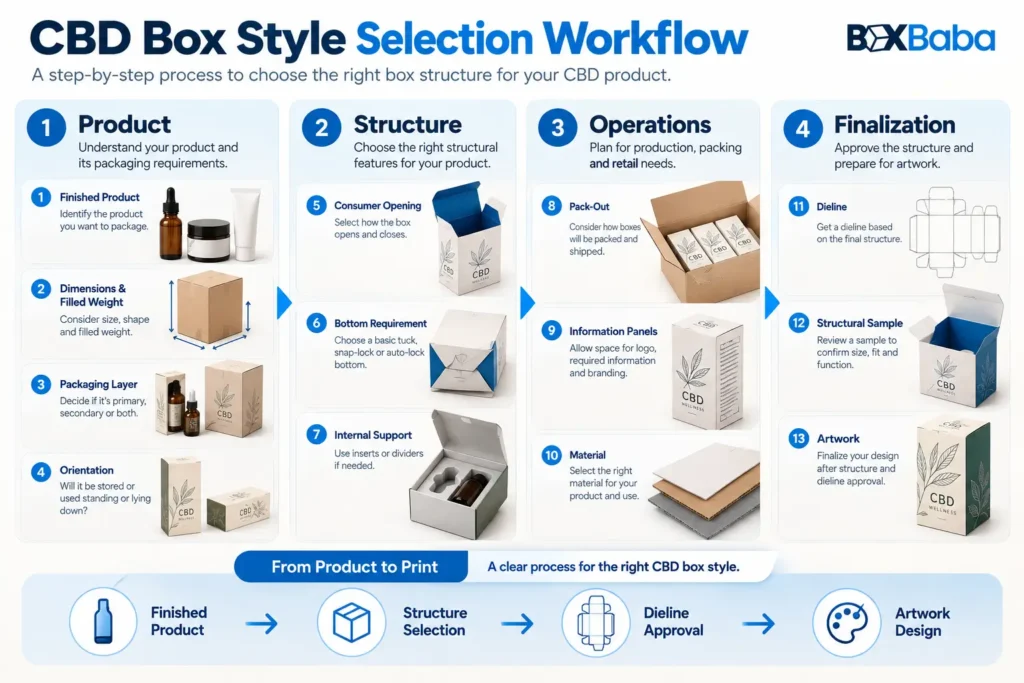
CBD Box Style Selection Workflow
Confirm the Finished Product
Bottle, jar, tube, pouch or product set.Record Dimensions & Filled Weight
Use the complete finished primary package.Identify the Packaging Layer
Retail carton, gift package, display or ecommerce outer layer.Set Product Orientation
Upright, horizontal or another approved arrangement.Define the Consumer Opening
Tuck, sliding tray, removable lid, hinged opening or another method.Define the Bottom Requirement
Basic tuck, snap-lock, auto-lock or another supported base.Review Internal Support
Determine whether the insert changes the structure.Review Pack-Out
How will the package be erected and loaded?Review Information Panels
Does the selected structure provide usable artwork space?Confirm the Material
Material should support the approved structure and loaded product.Develop the Dieline
Do not manufacture from a style name alone.Review a Structural Sample Where Appropriate
Check fit, opening, assembly, sliding action and removal.Finalize Artwork
After the structure is approved.
What Should You Send BoxBaba for a Structure Recommendation?
Provide:
- CBD product type;
- primary-container type;
- finished dimensions;
- filled weight;
- units per box;
- intended orientation;
- retail, gift, display or ecommerce use;
- preferred opening method, if known;
- insert requirement;
- manual or automated packing information where relevant;
- quantity;
- number of SKUs;
- artwork status;
- delivery destination.
Instead of:
Which CBD box style is best?
a more useful brief is:
We have one filled glass dropper bottle per retail carton. The finished bottle dimensions and weight are confirmed. It will stand upright and be packed manually. We need a compact folding carton but have not decided whether the bottom should use a basic tuck, snap-lock or auto-lock structure.
That gives the packaging team an actual structural problem to solve.
Choosing CBD Box Styles From BoxBaba
The best CBD structure is the one that matches the finished product, opening requirement, base requirement and packing method.
A useful starting framework is:
Straight / Reverse Tuck
→ compact folding-carton retail packaging.
Snap-Lock
→ manually interlocking bottom construction.
Auto-Lock
→ pre-glued forming bottom.
Sleeve
→ wrapping/sliding component around another package or tray.
Drawer
→ sliding tray opening architecture.
Rigid
→ formed construction family that can use drawer, magnetic, two-piece and other openings.
Explore Custom CBD Boxes for the wider CBD packaging range.
For tuck structures, see Custom Tuck Boxes.
For sleeve formats, explore Sleeve Boxes.
For presentation structures, see Custom Rigid Boxes.
When requesting a quote, share the actual finished product dimensions, filled weight, orientation, opening method, quantity, insert requirements and artwork status.
BoxBaba CBD packaging currently starts from 100 units, with artwork and dieline support, samples available, standard production generally 5–9 business days after artwork approval, and free shipping across the USA.
Choose the structure because it performs the required packaging job—not because a box-style name sounds more premium, stronger or safer.
Frequently Asked Questions
What is the difference between a box style and a box material?
Box style describes structural geometry or opening method, while material describes what the package is made from. For example, auto-lock is a structural feature, while paperboard is a material.
What is the difference between straight tuck and reverse tuck?
Straight tuck cartons place the main top and bottom tuck closures in the same general direction. Reverse tuck cartons position them in opposite directions.
Is reverse tuck stronger than straight tuck?
Not automatically. Closure direction alone does not establish load performance.
What is a snap-lock bottom?
A snap-lock or 1-2-3 bottom uses interlocking lower panels that are formed during carton assembly.
What is an auto-lock bottom?
An auto-lock or automatic bottom uses a pre-glued base that forms when the carton is erected.
Are snap-lock and auto-lock the same?
No. Snap-lock uses manually interlocking panels. Auto-lock uses a pre-glued forming base.
What is a tuck-top auto-bottom carton?
It combines a tuck-style consumer opening at the top with an auto-lock construction at the bottom.
Is a sleeve the same as a drawer box?
No. A sleeve can simply surround another package. A drawer uses a sliding tray as the opening mechanism.
Are all drawer boxes rigid?
No. Drawer architecture can be made using folding paperboard or rigid construction.
Is rigid a box style?
Rigid is better understood as a broad construction family. Rigid packages can use drawer, magnetic, lid-and-base and other opening structures.
What is a two-piece CBD box?
A two-piece package uses separate lid and base components. It can be made using different material/construction systems, including rigid presentation packaging.
Is auto-lock automatically better for glass bottles?
No. Bottle weight, footprint, carton dimensions, center of gravity, insert and packing process all influence the base decision.
Does a locking bottom make the box child-resistant?
No. Snap-lock and auto-lock describe bottom construction. Child resistance is a separate access-control function.
Is a magnetic rigid box child-resistant?
Not automatically. Magnetic closure and child-resistant performance are separate requirements.
Can a window be added to a tuck box?
Yes. A die-cut window can modify structures such as STE or RTE. The window does not replace the underlying box style.
Does a heavy CBD product always need auto-lock?
No. There is no universal product-weight threshold. The complete carton specification should be evaluated.
Should box structure be selected before the dieline?
Yes. The structure determines the cut, fold, glue and panel layout used to create the dieline.
Should artwork be finalized before choosing the structure?
No. The approved dieline should normally come first because the structure determines the usable artwork panels.
Can the same CBD product use different structures for retail and ecommerce?
Yes. An individual retail carton can remain around the product while a separate outer mailer or shipping structure handles parcel distribution.
What should I send BoxBaba for a CBD box-style recommendation?
Provide the finished product dimensions, filled weight, orientation, quantity per box, intended packaging layer, desired opening method, pack-out information, insert requirement and artwork status.