
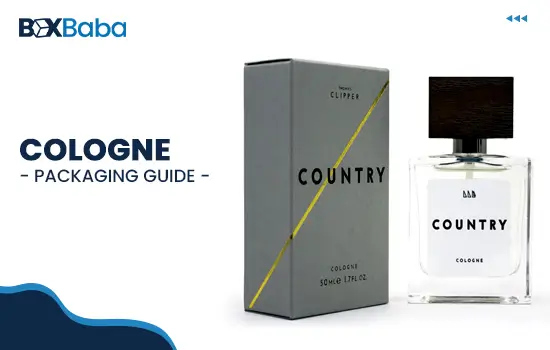
A cologne box must do more than display a logo. It must fit the closed bottle, support its filled weight, control movement, protect vulnerable glass and provide enough usable space for branding and product information. That becomes difficult when fragrance containers vary in height, depth, base shape, cap size and weight. A full-size glass cologne bottle, slim travel spray and promotional tester may belong to the same fragrance line, but they rarely need the same packaging structure or insert.
This BoxBaba cologne packaging guide helps beauty brand founders, product managers, packaging buyers and ecommerce teams choose the right box dimensions, structure, material, insert and finish. It prioritizes bottle fit, protection and practical packaging performance before decorative design.
Buyers planning a wider fragrance line can also use the perfume packaging boxes guide to compare packaging for perfume, cologne, fragrance oils and gift sets.
What is Cologne Packaging?
Cologne packaging is the secondary box, insert, printed surface and protective system used to contain, present and distribute a fragrance bottle. It may include a folding carton, auto-bottom box, rigid box, sleeve, drawer box, fitted insert or ecommerce mailer.
Cologne Packaging Quick Guide
- Measure the fully closed, filled bottle, including its cap and widest points.
- Record its height, width, depth and weight.
- Choose the box structure before selecting finishes.
- Use folding cartons for lighter retail bottles, auto-bottom cartons for added base strength and rigid boxes for heavy or premium products.
- Add an insert when the bottle can move, rotate, or collide.
- Support the bottle at the base, not the cap or atomizer.
- Use separate retail and ecommerce shipping layers when needed.
- Approve a physical sample before bulk production.
- Share dimensions, quantity, material, insert, artwork, destination and deadline when requesting a quote.
Use the BoxBaba Cologne Packaging Fit Framework
Step | Packaging Decision | What to Check |
1. Measure | Confirm the complete bottle size | Closed height, maximum width, depth, filled weight, cap and projections |
2. Assess Risk | Identify what could go wrong | Movement, glass impact, cap pressure, scratching and leakage |
3. Select Structure | Choose the appropriate box format | Folding carton, auto-bottom carton, sleeve, drawer or rigid box |
4. Control Movement | Design the insert and removal method | Base support, side retention, neck clearance, finger notches or ribbon lift |
5. Finish and Validate | Add branding after fit is approved | Material, printing, finishes, artwork panels, physical sample and quote details |
What Custom Cologne Packaging Must Protect and Present
Custom cologne packaging must protect the bottle, control movement, communicate the brand and support the product’s retail or ecommerce channel. A strong packaging system solves several connected problems rather than focusing only on appearance.
Accurate product fit
Measure the fully closed and filled bottle, including its base, shoulders, atomizer, collar, cap, labels and decorative features. Measuring only the glass body can create poor cap clearance or an incorrect insert fit.
Movement and glass protection
The bottle should not slide, rotate, rattle, or lift inside the box. The box and insert should reduce:
- Bottom and side impact
- Cap or atomizer pressure
- Product-to-product contact
- Scratching and vibration
The bottle should normally be supported at its base rather than by the cap.
Retail presentation
Retail cologne boxes need clear branding, stable shelf placement, readable product details, barcode space and durable finishes. Brands with wider beauty ranges can also explore custom cosmetic boxes.
Ecommerce protection
A printed retail carton may not be strong enough for parcel delivery by itself. Ecommerce orders may also require a corrugated mailer, cushioning, void control and product separation.
Choose Cologne Packaging by Container Format
Full-size cologne bottles need weight support, travel sprays need orientation control and testers need efficient identification and handling. The container format is the first structural decision because it determines internal dimensions, bottle orientation and retention requirements.
Full-size glass cologne bottles
Full-size bottles often have:
- Greater filled weight
- Broad or irregular bases
- Sculpted shoulders
- Decorative caps
- Metallic surfaces
Travel sprays
Travel sprays are usually lighter and narrower than full-size bottles, but their slim proportions can make them prone to tilting or vertical movement.
Suitable starting directions include:
- Slim tuck-end cartons
- Sleeve boxes
- Small drawer boxes
- Paperboard retention tabs
- Separate cavities for travel sets
Cologne testers
Tester packaging often prioritizes identification, storage efficiency and ease of removal.
A tester may use:
- The same bottle as the retail unit
- A simplified cap
- A plain carton
- A smaller fill size
- A counter-display arrangement
Miniatures and discovery sets
Miniature bottles and sample sprays need separate cavities so that each item remains organized and readable.
A discovery-set insert should:
- Separate each fragrance
- Keep labels facing the correct direction
- Prevent caps from touching
- Allow easy product removal
Container-Format Comparison
Match the packaging structure to the container format instead of forcing every fragrance SKU into one box style.
Container Format | Main Packaging Need | Recommended Starting Direction | Insert Priority | Main Risk |
Full-size glass bottle | Weight support and presentation | Folding carton, auto-bottom carton or rigid box | Base, shoulder or neck control | Movement and bottom failure |
Travel spray | Control in a narrow cavity | Slim carton, sleeve or fitted tray | Side and vertical retention | Tilting or sprayer pressure |
Tester bottle | Efficient identification and handling | Simple carton, partition or tray | Position and SKU separation | Loose storage or scuffing |
Miniature bottle | Visibility and organization | Drawer, sleeve or gift-set tray | Separate fitted cavity | Difficult removal |
Multi-bottle set | Separation and loaded-weight control | Rigid box, drawer or reinforced carton | Individual cavities or dividers | Bottle collision |
Cologne Boxes Size Guide: How to Measure the Bottle
Measure the complete, filled and fully closed bottle before creating a dieline or selecting a stock box size. Box dimensions should be developed from the physical product, its orientation and any insert—not by adding a random allowance around the bottle. For a more detailed measurement process, use BoxBaba’s Cosmetic Box Size Guide. BoxBaba’s live guidance also emphasizes measuring the product before dieline, insert and bulk-order approval.
Measure the Bottle Correctly
- Height: Measure from the bottle base to the top of the installed cap, including the atomizer, collar, overcap and decorative features.
- Width: Record the widest left-to-right point, which may be the body, shoulders, base, or cap.
- Depth: Measure front to back. Do not assume width and depth are the same.
- Filled weight: Use the finished product weight because it affects board strength, insert support and shipping protection.
- Bottle shape: Photograph the front, back, sides, top and bottom to show irregular bases, shoulders, caps and fragile details.
- Orientation: Confirm whether the bottle will sit upright, flat, angled, label-forward, or inside a multi-product set.
A physical sample is helpful when the bottle has an unusual or complex shape.
Cologne Bottle Measurement Worksheet
This example illustrates a quote brief; it is not a final production specification.
Measurement Field | Example Reading | Packaging Implication |
Closed height | 5.25 inches | Establishes minimum internal height before clearance |
Maximum width | 2.25 inches | Defines cavity width |
Maximum depth | 1.50 inches | Controls front-to-back orientation |
Filled weight | 10.5 ounces | Affects board, base and insert strength |
Base shape | Flat rectangular base | Supports upright placement |
Shoulder shape | Rounded | May require upper side retention |
Cap shape | Wide metallic cap | Requires clearance and scuff review |
Orientation | Upright, label forward | Determines dieline and cavity direction |
Removal method | Side finger notches | Requires accessible insert openings |
Sales channel | Retail and ecommerce | May require a retail box plus outer shipper |
Final internal dimensions depend on bottle geometry, board thickness, insert material, manufacturing tolerance, packing method and removal experience.
Best Cologne Box Structures by Bottle and Sales Channel
Folding cartons suit many retail bottles, auto-bottom cartons add base strength and rigid boxes suit heavy or presentation-led fragrance products. The best cologne boxes packaging structure is the simplest format that safely supports the bottle and the intended customer experience.
Structure-Selection Matrix
Choose the structure by loaded weight, sales channel, storage limits and presentation goal.
Product Situation | Folding Carton | Auto-Bottom Carton | Sleeve or Drawer | Rigid Box |
Lightweight retail bottle | Strong fit | Optional | Optional | Usually unnecessary |
Moderately heavy bottle | Possible with support | Strong fit | Possible | Strong fit |
Heavy luxury bottle | Weak to moderate | Possible after testing | Strong fit | Strongest starting direction |
Travel spray | Strong fit | Usually unnecessary | Strong fit | Usually unnecessary |
Discovery set | Possible with tray | Possible | Strong fit | Strong fit |
Tester packaging | Strong fit | Usually unnecessary | Possible | Usually excessive |
Limited warehouse space | Strong fit | Strong fit | Moderate | Weak fit |
Premium unboxing | Moderate | Moderate | Strong fit | Strongest fit |
Ecommerce presentation | Needs outer-shipper review | Needs outer-shipper review | Needs outer-shipper review | Needs outer-shipper review |
BoxBaba’s custom rigid boxes include two-piece, drawer, magnetic, book-style and other presentation formats. Rigid boxes provide stronger presence, but they generally occupy more warehouse and freight space than folding cartons.
Best Materials and Board Strength for Cologne Boxes
Choose cologne box materials according to filled bottle weight, packaging structure, print requirements and distribution channel. “Cardboard” is too broad for an accurate packaging specification. The quote should identify a material direction, construction and suitable thickness.
Material-Selection Table
Material | Common Format | Best Fit | Main Strength | Main Limitation |
SBS paperboard | Folding carton | Retail cologne packaging | Smooth print surface | Caliper must match loaded weight |
Kraft-style board | Folding carton or sleeve | Natural visual direction | Distinct paper appearance | Colors may reproduce differently |
Corrugated board | Mailer or outer shipper | Ecommerce and wholesale | Distribution protection | Less compact than paperboard |
Rigid board | Setup, drawer or magnetic box | Luxury and gifting | Substantial structure | More storage and freight volume |
Specialty wrapped paper | Rigid box exterior | Premium tactile branding | Distinct texture | Scuffing and availability need review |
Cologne Box Inserts, Windows and Movement Control
A fitted insert should control bottle movement without pressing against the atomizer, cap, label or decorated glass. The insert and outer box should be designed together. Adding an insert after the carton is finalized can create poor clearance or unnecessary box size.
When does a cologne box need an insert?
An insert should be considered when:
- The bottle slides or rotates.
- The box is intentionally larger than the product.
- The bottle is heavy or fragile.
- The product needs a centered presentation.
- Several products share one box.
- The cap should not touch the top panel.
- The bottle has an irregular base.
- Ecommerce handling increases movement risk.
A lightweight, closely fitted bottle may only need a simple folded support. Not every product requires a complex foam cavity.
Paperboard inserts
Folded or die-cut paperboard inserts can provide:
- Base support
- Side retention
- Neck support
- Product separation
- Printed presentation surfaces
- A relatively compact structure
Paperboard works well for many retail cartons, but thin stock can deform under a heavy bottle.
Corrugated inserts
Corrugated inserts provide deeper structural support and can suit:
- Ecommerce packaging
- Heavy bottles
- Wholesale handling
- Gift sets
- Multi-item arrangements
Exposed edges may appear more functional than premium, so the visual requirement should be reviewed.
EVA foam and fitted foam inserts
Foam can be cut around the bottle geometry and provide cushioning and a precise presentation.
It may fit:
- Heavy glass
- Sculpted bottles
- Rigid gift boxes
- PR kits
- Limited editions
- High-value sets
An overly tight foam cavity can scratch surfaces, compress labels or make removal difficult. Physical testing is important.
Brands comparing protective arrangements can review printed boxes with inserts for insert-supported packaging formats. BoxBaba’s fragrance content currently discusses paperboard, foam, corrugated and molded-pulp insert directions for different bottle and channel needs.
Molded-pulp inserts
Molded pulp can provide shaped support with a formed-fiber appearance.
Its suitability depends on:
- Bottle shape
- Filled weight
- Required surface quality
- Cavity depth
- Tooling
- Quantity
- Presentation standard
Environmental claims still require material-specific verification.
Support the base and stabilize the top
The bottle base should normally carry the product’s weight. A neck or shoulder feature may control side movement, but it should not transfer excessive pressure to the atomizer or cap.
Make the bottle easy to remove
A secure insert must also allow the customer to access the product.
Possible removal features include:
- Side finger notches
- Ribbon lifts
- Pull tabs
- Recessed grips
- Flexible retention tabs
- Clearance around the shoulders
The customer should not need to pull on the cap or sprayer to remove the bottle.
Window cutouts
A die-cut window can reveal the bottle and increase shelf visibility.
However, a window can also:
- Reduce printable panel space
- Weaken wall continuity
- Expose glass to scratching or dust
- Require a film patch
- Add production complexity
- Interfere with product information
Use a window when bottle visibility directly contributes to the buying decision.
Printing and Finish Compatibility for Cologne Boxes
Choose printing and finishes after the structure, material, dieline and information panels have been approved.
A premium finish cannot correct poor bottle fit, weak support or unreadable artwork.
CMYK printing
CMYK suits:
- Full-color artwork
- Gradients
- Product imagery
- Illustrations
- Broad print coverage
Color appearance can change across white paperboard, kraft stock and specialty wraps. Review the artwork on the intended material.
PMS and Pantone color matching
Pantone matching can help brands maintain a recognizable signature color.
Confirm:
- Pantone reference
- Substrate
- Coating or lamination
- Inside and outside printing
- Metallic surfaces
- Acceptable production tolerance
A color viewed on a monitor is not a reliable production reference.
Matte and gloss finishes
Matte creates a lower-shine appearance that can support minimal or premium branding. Dark matte surfaces may show rubbing or fingerprints.
Gloss creates a reflective appearance and can strengthen bright colors. It may also create glare under store lighting.
Soft-touch coating
Soft-touch adds a smoother tactile surface that can support luxury positioning.
It may require testing for:
- Fingerprints
- Scratching
- Rubbing
- Color shift
- Compatibility with foil
- Compatibility with spot treatments
Foil stamping
Foil can emphasize:
- Logos
- Fragrance names
- Borders
- Monograms
- Limited-edition details
Foil improves emphasis but adds tooling and production stages. Use it as a focal detail rather than covering every panel.
Embossing and debossing
Embossing raises an artwork area, while debossing presses it inward.
Both can strengthen logos and simple graphics, but small text, narrow strokes and artwork close to folds may not reproduce clearly.
Spot UV
Spot UV creates selective gloss over a chosen area.
It can work well over matte surfaces, but it may add little value when the underlying artwork is already busy or reflective.
For a more detailed comparison, see BoxBaba’s cosmetic packaging finishes guide. The guide compares matte, gloss, soft-touch, foil, embossing, debossing and spot UV according to product, artwork, material and budget.
Retail vs Ecommerce Cologne Packaging Requirements
Retail cologne packaging prioritizes shelf presentation, while ecommerce packaging must also manage parcel movement, compression and breakage risk.
The same printed box may be part of both systems, but it should not be expected to perform every shipping function.
Retail and ecommerce comparison
Requirement | Retail Shelf | Ecommerce Delivery |
Primary objective | Presentation and information | Protection through distribution |
Common inner box | Folding carton or rigid box | Folding carton or rigid box |
Outer packaging | Master case | Individual mailer or shipping carton |
Insert role | Alignment and presentation | Movement and impact control |
Surface priority | Print and finish quality | Scuff resistance and protection |
Main risk | Poor display or deformation | Breakage, leakage or compression |
Validation | Shelf and master-case review | Complete packed-shipment review |
Alcohol-based fragrance products may be subject to carrier and hazardous-material requirements. Confirm product classification, packaging, marking, destination and service eligibility with the selected carrier before shipping. Brands shipping fragrance products directly to consumers can compare outer packaging through BoxBaba’s custom mailer boxes.
Common Cologne Packaging Risks and How to Fix Them
The main cologne packaging risks are uncontrolled movement, glass breakage, cap pressure, weak bottom panels and difficult product removal.
Correct the cause of each risk instead of simply making every packaging component thicker.
Risk-response table
Risk | Possible Cause | Warning Sign | Packaging Response |
Bottle movement | Excess clearance or weak insert | Rattling or rotation | Reduce space and add fitted retention |
Glass breakage | Direct impact or weak outer package | Chipping, cracking or leakage | Add cushioning, separation and outer protection |
Cap pressure | Short box or high insert | Marked cap or difficult closing | Increase clearance and support the base |
Bottom failure | Loaded weight exceeds structure | Bulging or opening base | Use stronger board, auto-bottom or rigid structure |
Insert deformation | Insert is too thin | Bottle leans after packing | Increase strength or change geometry |
Surface scratching | Tight or abrasive contact | Marked glass, label or cap | Review contact material and tolerance |
Difficult removal | Tight cavity or no grip | Customer pulls on sprayer | Add notches, ribbon or side clearance |
Product collision | Shared cavity without separation | Bottles touch | Add individual cavities or dividers |
Artwork cracking | Finish crosses folds | Cracked ink or lamination | Adjust finish and artwork zones |
Barcode failure | Foil, texture or fold interference | Code does not scan | Use a flat, non-reflective panel |
What to Check on a Cologne Box Sample
Test the box with the real filled bottle before bulk production.
- The bottle stays secure without rattling or rotating.
- The base supports the weight, not the cap or atomizer.
- The insert does not scratch the bottle or label.
- The product is easy to remove.
- Flaps, lids and drawers close without pressure.
- The bottom panel does not bend.
- Barcodes and small text remain readable.
- Foil, embossing and other finishes align correctly.
- Multi-bottle products stay separated.
- Packing is practical for production staff.
A digital proof confirms artwork placement, but only a physical sample can verify fit, pressure, removal and structural performance.
Artwork and Proofing Checklist
Start artwork after the dieline and required information panels are approved.
- Keep the brand name, fragrance name, product type and net contents easy to read.
- Reserve space for ingredients, business details, warnings, barcode and batch information where applicable.
- Keep important text and barcodes away from folds, cut lines and glue areas.
- Review the artwork proof, 3D mockup and physical sample before production.
Confirm final labeling requirements with a qualified reviewer before printing.
Which Cologne Packaging Should You Choose?
Choose the simplest structure that supports the filled bottle, controls movement and suits the sales channel.
- Folding carton: Best for lightweight retail bottles, flat storage, multiple SKUs and cost-efficient printing.
- Auto-bottom carton: Suitable when the bottle needs stronger base support or faster packing.
- Sleeve or drawer box: Works well for discovery sets, travel sprays, gifts and premium presentation.
- Rigid box: Best for heavy or fragile bottles, luxury launches, fitted inserts and high-value gifting.
- Outer corrugated shipper: Recommended for ecommerce orders that need impact protection, cushioning, or product separation.
Consider another option when the board is too weak, the insert presses on the cap, the bottle can move, glass products may collide, or the retail box is being used as the only shipping layer.
What Affects Custom Cologne Box Cost?
Custom cologne box pricing depends on the complete packaging specification. There is no universal price because dimensions, structure, materials, printing, inserts, finishes, quantity and delivery requirements vary by project.
Key cost factors include:
- Box size: Larger dimensions use more material and increase storage and shipping volume.
- Structure: Folding cartons generally cost less than rigid, drawer, sleeve, or magnetic boxes.
- Material: SBS paperboard, kraft stock, corrugated board, rigid board and specialty wraps have different production costs.
- Printing: CMYK coverage, Pantone colors, inside printing and multiple artwork versions can affect pricing.
- Finishes: Foil stamping, embossing, spot UV, soft-touch coating and window patches add production stages.
- Inserts: Cost changes with the material, thickness, number of cavities and bottle-specific shape.
- Quantity and SKUs: Larger runs may reduce unit cost, while multiple sizes or designs require additional setup.
- Proofing and delivery: Samples, assembly, destination and deadlines also affect the final quote.
BoxBaba states that MOQ starts at 100 boxes on most product lines. Confirm the exact minimum, pricing and production terms for your specifications.
Commercial tradeoffs
Stronger structure versus lower cost: A reinforced or rigid structure can better support heavy glass but uses more material and production work.
Premium finish versus production simplicity: Foil, embossing and soft-touch treatments can elevate presentation but add setup and approval requirements.
Tight fit versus easy packing: A precise cavity controls movement, but insufficient tolerance can slow packing and frustrate removal.
Compact retail size versus shipping protection: A small carton saves shelf space, but ecommerce delivery may require a larger outer package.
Custom insert versus future flexibility: A bottle-specific cavity improves presentation but may become unusable if the bottle or cap changes.
Quote-Readiness Checklist for Custom Cologne Boxes
A complete quote request should include enough detail to confirm the box structure, insert, printing, quantity and delivery requirements.
Product details
- Bottle type and product name
- Closed height, width and depth
- Filled bottle weight
- Bottle photos or drawing
- Base, shoulder and cap shape
- Product orientation
- Number of items per box
- Fragility or scratch concerns
Packaging details
- Preferred box structure and material
- Insert, window, or closure requirements
- Inside or outside printing
- CMYK or Pantone colors
- Finish preferences
- Retail or ecommerce use
- Required proofing level
Commercial details
- Order quantity and number of SKUs
- Artwork status
- Shipping ZIP code
- Required delivery date
- Expected reorder quantity
- Budget range, if available
- Required documents or certifications
Why Choose BoxBaba for Custom Cologne Boxes?
BoxBaba connects bottle measurements, box structure, inserts, printing, finishes and quote preparation within one fragrance-packaging workflow.
The current Cologne Boxes page presents options for full-size bottles, testers, travel sprays, gift sets, retail products and ecommerce orders. Available project directions include custom dimensions, folding cartons, rigid boxes, inserts, CMYK or Pantone printing, matte or gloss treatments, foil stamping, embossing and spot UV.
BoxBaba can review:
- Closed bottle dimensions
- Filled product weight
- Preferred structure
- Insert requirements
- Artwork status
- Printing and finish direction
- Quantity
- Sales channel
- Destination
- Required delivery date
Final MOQ, material availability, sampling, production schedule, freight and delivery terms should be confirmed in the written quotation.
FAQs About Cologne Packaging
What box style is best for cologne boxes?
Folding cartons suit many lightweight retail bottles, while auto-bottom cartons provide stronger base support. Rigid, sleeve and drawer boxes may better suit heavy bottles, discovery sets, luxury products and presentation-led launches.
How do I measure a cologne bottle for a custom box?
Measure the fully closed bottle’s height, maximum width, maximum depth and filled weight. Record the base, shoulders, cap, orientation and removal method. Final box dimensions must also account for board thickness, clearance and insert space.
Do cologne boxes need inserts?
Cologne boxes need inserts when the bottle can move, rotate, lift, collide or place pressure on the box. Paperboard supports suit many retail cartons, while corrugated, foam or molded inserts may suit heavier or irregular bottles.
Which material is best for cologne boxes?
SBS paperboard suits detailed retail printing, kraft-style stock supports a natural appearance, corrugated board works for stronger outer packaging and rigid board suits heavy or luxury products. The final material should match the bottle weight and structure.
How much do custom cologne boxes cost?
Cost depends on dimensions, material, thickness, structure, quantity, printing, inserts, finishes, sampling, assembly, SKU count, destination and deadline. A complete project specification is required for accurate pricing.
Are rigid boxes better than folding cartons for cologne?
Rigid boxes provide stronger presentation and may better support heavy premium bottles. Folding cartons are more compact, scalable and storage-efficient. The better option depends on bottle weight, brand tier, sales channel, quantity and budget.
Can a retail cologne box be used for ecommerce shipping?
A retail carton may not provide enough parcel protection by itself. Ecommerce orders may also need an outer corrugated box, cushioning, movement control and carrier-specific packaging review.
Should I request a physical cologne box sample?
Request a physical sample when the bottle is heavy, fragile, irregular, tightly fitted or placed in premium packaging. A sample can reveal movement, pressure, removal and finish issues that a digital proof cannot show.
Final Takeaway
Effective cologne packaging begins with the physical bottle, not the decorative finish.
Measure the complete, filled product. Identify movement, breakage and cap-pressure risks. Choose the simplest structure that safely supports the bottle and sales channel. Design the insert around stable points. Then select the board, artwork, printing and finishes.
The strongest decision sequence is:
Measure the bottle → identify the risk → choose the structure → engineer the insert → approve the artwork → select the finish → test the sample → request the quote.
This process helps avoid oversized boxes, weak bottoms, bottle movement, difficult removal, unnecessary finishing costs and ecommerce damage.
Request a Custom Cologne Box Quote
Share the closed bottle dimensions, filled weight, photographs, quantity, preferred box style, material, insert needs, printing, finishes, artwork status, shipping ZIP code and required delivery date.
BoxBaba can review the specifications and help identify a quote-ready packaging direction for retail, ecommerce, gifting, wholesale or fragrance launch use.
Request a quote for custom cologne boxes designed around your bottle dimensions, weight, insert and sales channel.