
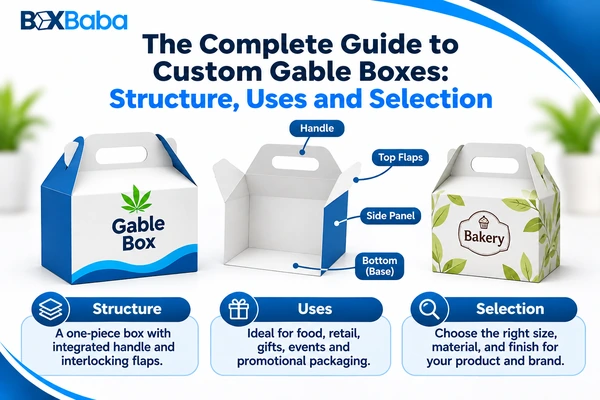
A custom gable box is a handled carton with a rectangular lower body and upper panels that slope toward an integrated carrying area. For a buyer, the important question is not simply whether this shape looks right. Gable geometry changes how product height, packed weight, material, bottom construction, windows, inserts, artwork and carrying conditions need to be evaluated.
The best specification starts with the packed product and its use environment, then moves through fit, loaded conditions, structure, material, features and validation. This guide explains that decision system at a high level so you can determine whether a gable box suits the project and recognize which technical decisions require deeper review before production.
What Is a Custom Gable Box?
A custom gable box is a paper-based carton built around a rectangular product body and a distinctive upper structure that slopes toward a built-in handle area.
Its basic structure can combine:
- a product-holding body;
- side panels or gusset areas;
- sloping upper gable panels;
- an integrated handle;
- a top closure;
- a bottom structure;
- printable exterior panels.
Depending on the project, a gable carton may also include a window, insert, divider, platform or other internal component.
The handle is an important feature, but it cannot be evaluated separately from the rest of the loaded package. When the box is carried, the packed contents, bottom, side and upper panels, material and handle all work together.
That is why choosing a gable box requires more than selecting a shape.
Anatomy of a Gable Box
Understanding the main structural areas helps explain why product fit, artwork and carrying decisions interact.
Component | Primary Role | Buyer Implication |
Rectangular body | Holds most of the packed product | Defines the main usable product space |
Sloping upper panels | Form the gable profile | Reduce rectangular clearance for tall products |
Handle area | Provides the built-in carrying point | Needs to work with the complete loaded structure |
Upper closure | Forms and closes the top | Exact design affects loading and opening |
Side panels / gusset areas | Connect the body and upper structure | Affect folding, depth and artwork |
Bottom | Supports the packed contents | Construction affects assembly and loaded behavior |
Glue / lock zones | Join or secure structural areas | Need to remain functional during artwork planning |
Optional window | Provides product visibility | Removes panel material and printable area |
Optional insert / divider | Positions or separates products | Consumes internal space and changes pack-out |
The flat blank or dieline used to manufacture the carton is also different from the final assembled box. Cut, crease, glue and lock areas become functional parts of the three-dimensional structure after folding.
A gable box should therefore be evaluated as a complete packaging system—not as a rectangular carton with a handle added afterward.

How to Choose a Custom Gable Box
A practical selection process begins with the product and works outward.
Stage | Question | Why It Matters |
1. Product | What exactly will be packed? | The finished product controls every later decision |
2. Arrangement | How many items and in what orientation? | Arrangement determines footprint and required space |
3. Loaded conditions | What is the complete packed weight and how is it distributed? | Bottom and carrying requirements depend on the loaded package |
4. Use environment | Retail, gifting, takeaway, event, pickup or another use? | Use conditions change structural priorities |
5. Structure and material | Which bottom and material direction suit the project? | Structure and material need to work together |
6. Features | Is a window, insert or divider actually useful? | Features change internal space and panel structure |
7. Artwork and validation | How will graphics fit the structure, and what needs to be proved before production? | Approval should address the project’s actual risks |
This order prevents a common packaging mistake: selecting an attractive configuration first and then trying to make the packed product fit it.
How Much Space Is Actually Usable Inside a Gable Box?
The total assembled height of a gable box is not the same as its usable rectangular product height.
The lower body provides the main rectangular storage area. Above that point, the panels slope inward toward the handle. A tall item can therefore fit within the overall exterior height while still interfering with the upper slopes or closure.
This distinction can matter for:
- bottles and jars;
- tall retail cartons;
- decorated bakery items;
- stacked gift products;
- products raised on an insert or platform.
For general Length × Width × Height terminology and internal-versus-external measurement principles, use BoxBaba guide to measuring box dimensions correctly.
For a gable box, the additional question is where the usable rectangular body ends and the sloping upper geometry begins.
Do not assume a universal clearance allowance. Final dimensions need to follow the actual product and packed arrangement.

How Do Gable Box Sizes Differ?
Terms such as mini, standard, large or extra-large describe relative packaging needs; they do not establish one universal set of gable-box dimensions.
A smaller format may suit favors, samples or one compact product. A larger format may need to accommodate several products, a larger footprint or a more demanding loaded configuration.
The important sizing inputs remain:
- product dimensions;
- item count;
- orientation;
- packed arrangement;
- usable rectangular height;
- internal support;
- complete packed weight where relevant.
Choose the finished size from those inputs rather than from a size label alone.
Why the Handle, Bottom and Packed Load Work Together
An integrated handle provides a built-in carrying point, but it does not establish a universal weight capacity.
Loaded behavior can be influenced by:
- total packed weight;
- base footprint;
- product position;
- center of gravity;
- weight distribution;
- material;
- handle geometry;
- bottom construction;
- window openings;
- carrying distance and conditions.
Two packages with the same total weight can behave differently if one distributes the load evenly and the other concentrates it near one side.
Broad Bottom Types
At a high level, gable cartons may use different base-forming approaches.
Manual or interlocking bottoms require the packer to form or lock the base during assembly.
Pre-glued or automatic-bottom structures are designed so that the base forms as the carton is erected, reducing some repeated manual base-locking steps.
Neither approach is universally stronger, cheaper or better. The appropriate bottom depends on the exact carton design, packed load, material, quantity and packing workflow.

What Materials Are Commonly Used for Gable Boxes?
Gable-box material should follow the loaded product and presentation requirement rather than appearance alone.
Material Direction | High-Level Characteristic | Main Buyer Question |
White paperboard / cardstock | Light printable surface suited to many folding-carton presentations | Does the selected board and structure suit the packed configuration? |
Natural Kraft paperboard | Brown substrate becomes part of the visual design | How will the natural surface affect artwork and presentation? |
Corrugated board | Different layered construction that may be evaluated for more demanding size, rigidity or handling requirements | Does the project need a different structural direction than a folding paperboard carton? |
These materials should not be treated as interchangeable, and corrugated construction is not automatically the better choice.
When natural brown Kraft is the main commercial requirement, explore Kraft Gable Boxes.

Can a Gable Box Include a Window?
A window can be useful when showing the packed product helps the retail, bakery, gift or promotional presentation.
But a window is also a structural decision.
An opening:
- removes material from a panel;
- reduces available printable area;
- changes where branding can be positioned;
- needs to work around folds, handles, closures, bottom features and glue/lock zones;
- should align with the product’s actual packed position.
Window placement should therefore follow the product arrangement rather than being chosen independently.
When visibility becomes the dominant commercial requirement, compare Window Gable Boxes.
When Does a Gable Box Need an Insert or Divider?
Not every gable box needs internal support.
An insert, divider or platform becomes useful when it solves a defined problem such as:
- separating multiple products;
- maintaining orientation;
- reducing unwanted movement;
- positioning a product at a particular height;
- creating a repeatable multi-item layout.
Internal support also occupies space and can change the packing process. It should therefore be considered before the final dimensions are approved.
Decorative tissue or filler has a different role. It may support presentation or light spacing but should not automatically be treated as structural restraint.

What Are Gable Boxes Commonly Used For?
Gable boxes can serve several applications because the format combines product containment, branding surfaces and a built-in carrying area.
Application | Why the Format May Fit | Main Decision |
Retail products | Printable carton with integrated carrying area | Does the loaded product suit the structure? |
Takeout / pickup | Hand-carry configuration | Do the food conditions, load and carry requirements fit? |
Bakery products | Presentation plus carrying | Is usable height and product movement addressed? |
Gift sets | Groups products in a handled presentation format | How will the items be arranged and positioned? |
Favors / giveaways | Compact presentation for small items | Would a mini format be more proportionate? |
Promotional kits | Combines multiple branded items | Will the complete kit remain balanced and practical to load? |
Larger multi-item packs | Can group several products in one carry package | Do size and loaded conditions still suit a gable structure? |
For food and takeout, the gable shape itself does not establish food-contact suitability, grease performance, moisture resistance or temperature suitability. Those decisions depend on the actual food, contact layer and use conditions.
For a current takeout-specific commercial configuration, see Gable Takeout Boxes.
When the project is primarily a small event favor, sample or guest giveaway, compare Mini Gable Favor Boxes.
How Should Artwork Be Planned for a Gable Box?
Gable-box artwork needs to follow the physical carton structure.
Important functional areas can include:
- front and back body panels;
- side and sloping gable panels;
- handle openings;
- folds and scores;
- closure tabs;
- bottom flaps;
- glue or lock areas;
- windows;
- barcodes and QR codes.
Artwork that looks correct on a flat screen can become folded, interrupted or hidden when the carton is assembled.
Final graphics should therefore be prepared on the approved structural dieline.
For deeper guidance on cut lines, crease lines, bleed, safe areas and glue tabs, use BoxBaba packaging dieline guide.
Printing and finishing should also remain separate decisions: printing applies ink and graphics, while finishing changes surface appearance or emphasizes selected areas. The exact production approach should follow the material, artwork, quantity and structure.

What Are the Main Advantages of Gable Boxes?
A gable box can be useful when a project benefits from combining a carton body with an integrated carrying area.
Potential advantages include:
- built-in hand-carry functionality;
- distinctive structural profile;
- printable exterior panels;
- several possible material directions;
- optional windows and internal supports;
- use across retail, gift, food-service and promotional settings;
- sizing around a defined packed arrangement.
Those advantages are conditional.
A handle does not solve an unsuitable load. A window does not help if it conflicts with important structural areas. A distinctive silhouette does not compensate for inadequate usable height.
What Are the Limitations of Gable Boxes?
A gable format is not appropriate for every packaging project.
Requirement | Why Another Format May Deserve Evaluation |
Very tall product | The sloping upper area may remove too much usable clearance |
Demanding loaded configuration | Another structure may manage the load more appropriately |
Broad top access | Another opening style may make loading or removal easier |
Highly rigid presentation | A different presentation structure may better fit the required experience |
Parcel shipping as the primary job | A separate transport package may still be necessary |
Maximum uninterrupted artwork area | Handle geometry, folds and windows can constrain panel space |
Product cannot tolerate movement | Internal support or another packaging structure may be required |
Choose a gable box because its geometry and workflow fit the packed product—not simply because the shape is recognizable.
Is a Gable Box a Shipping Box?
Not automatically.
A gable box can function as retail, gift, event, food-service outer or hand-carry packaging. Those functions are different from parcel-shipping protection.
If the finished package will enter a courier, ecommerce or fulfillment network, determine whether a separate outer shipping carton or transport layer is required.
Presentation package ≠ retail carry package ≠ parcel shipping package.
How Should a Gable Box Be Validated Before Production?
Different approval methods answer different questions.
Digital Proof or 3D Mockup
Useful for reviewing artwork position, panel relationships, branding and general appearance.
It does not prove the physical fit of the loaded product.
Structural Sample
Useful for reviewing:
- product fit;
- usable height;
- assembly;
- bottom and handle relationship;
- window position;
- insert layout;
- product loading and removal.
Printed Physical Sample
Useful when the project needs physical review of print appearance, material color or compatible finishing.
A printed sample alone does not establish universal carrying capacity or parcel-shipping performance.
Choose the proofing method according to the risk that needs to be reduced.
What Should You Prepare Before Discussing a Custom Gable Box?
You do not need to engineer the carton before speaking with a packaging supplier, but a useful starting brief should describe the packed product.
Prepare the core inputs:
- finished product dimensions;
- item count and intended arrangement;
- complete packed weight where relevant;
- use environment;
- total quantity and any size/artwork versions;
- window or internal-support requirement if already known;
- artwork status;
- delivery destination and required in-hand date if relevant.
Those inputs provide a better starting point than asking for a small, medium or large gable box without describing the product.
A Simple Rule for Choosing the Right Gable Box
Start with the packed product rather than the catalog name.
Then move through the decisions in this order:
Product → Arrangement → Dimensions → Packed Weight → Use Conditions → Structure → Material → Feature → Artwork → Proof
If those requirements remain compatible with the gable structure, the format can be a useful option.
If the product is too tall for the usable body, too demanding for the loaded structure, difficult to pack or remove, incompatible with the use environment, or primarily needs parcel protection, another packaging format may be more appropriate.
When you are ready to move from general evaluation into a custom configuration, explore Custom Gable Boxes and prepare the product, arrangement, packed weight, quantity and artwork information above.
+1 305 574 4357 | sales@boxbaba.com