
Choosing cosmetic packaging boxes should begin with the finished product—not with a preferred color, finish or box style. Measure the fully assembled bottle, jar, tube, compact or palette, confirm its filled weight and closure profile, and then consider how the product will be displayed, packed, sold and shipped.
The box structure, material, insert, window, artwork and finishing direction should follow those product requirements. Brands planning made-to-size packaging can review BoxBaba’s custom cosmetic boxes after preparing the product information explained in this guide.
This article focuses on secondary paper-based packaging placed around a completed cosmetic container. Formula compatibility and primary-container selection require a separate evaluation.
Choose a cosmetic packaging box by confirming the finished product’s maximum dimensions, filled weight, closure, orientation and sales channel. Use that information to select a box structure, material and internal support. Finalize the dieline before completing artwork, then provide the quantity, SKU variations, proofing requirements and delivery destination for quotation.
Use the Cosmetic Box Selection Brief Builder
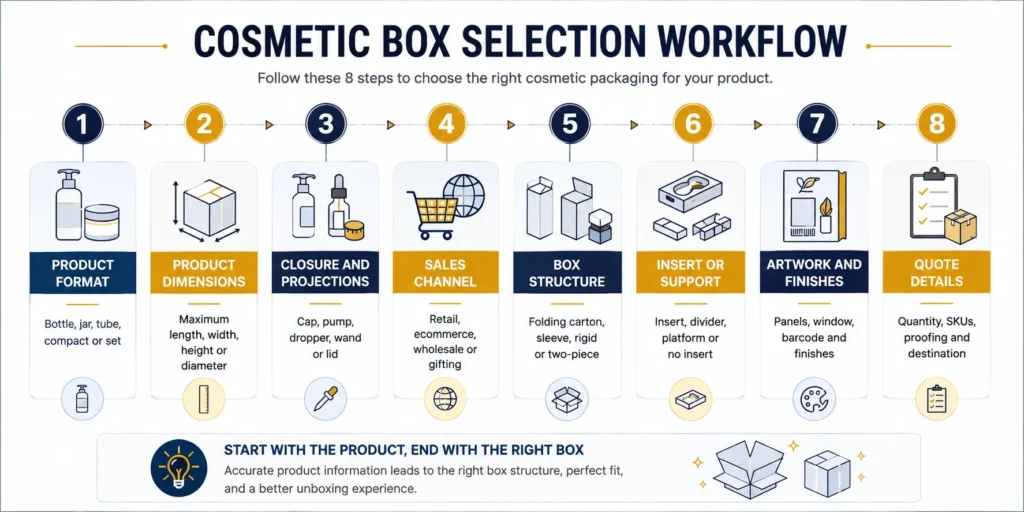
The following sequence turns a cosmetic product into a practical packaging specification.
| Step | Information to confirm | Packaging decision produced |
|---|---|---|
| 1 | Product and container format | Basic product profile |
| 2 | Maximum packed dimensions and filled weight | Internal sizing basis |
| 3 | Cap, lid, pump, dropper, wand or other projections | Clearance requirements |
| 4 | Retail, ecommerce, wholesale, gifting or display use | Packaging-layer requirements |
| 5 | Preferred opening and product presentation | Box-structure direction |
| 6 | Product movement, weight, geometry and contact areas | Insert or support decision |
| 7 | Artwork, information panels, window and finishes | Dieline requirements |
| 8 | Quantity, SKUs, proofing and destination | Quote-ready project brief |
Before moving to structure selection, confirm that you have the complete product, maximum dimensions, filled weight, closure profile, sales channel and quantity. Missing any of these details can change the recommended box direction.
A hypothetical quote brief may read:
We need a folding carton for a 30 mL serum bottle measuring 1.5 × 1.5 × 4.8 inches with the dropper attached. The filled bottle weighs 3.2 ounces and will be sold through retail and ecommerce. We need a paperboard insert, outside printing, barcode space and three artwork variations.
These measurements are illustrative only. Final dimensions and weight must be taken from the buyer’s complete retail-ready product.
This description gives a packaging supplier more useful information than requesting a small premium cosmetic box.
Choose the Product Before You Choose the Box
The finished cosmetic product establishes the starting point for the packaging design. Two products with the same advertised fill volume may need different boxes because their containers, closures and decorated profiles differ.
Before selecting a structure, identify:
- The cosmetic product type
- The finished primary container
- The maximum length, width, height or diameter
- The cap, lid, pump, dropper, wand or overcap
- Decorative collars, labels, sleeves or projecting components
- The filled product weight
- The intended product orientation
- Any leaflet, applicator or accessory packed with it
- The preferred removal direction
Measure the complete retail-ready product rather than the empty container or advertised fill volume.
For example, custom serum boxes should be planned around the assembled serum bottle, including its dropper, pump or airless closure. The widest shoulder or closure may determine the required box width even when the bottle body is narrower.
Similarly, custom lipstick boxes should account for the complete lipstick case, decorative cap, square or rounded profile and any projecting base. Measuring only the inner cosmetic mechanism may produce an unsuitable carton.
Why Fill Volume Is Not Enough
Fill volume describes the quantity of product inside the container. It does not establish the container’s external dimensions.
A 30 mL product may be supplied in:
- A short glass dropper bottle
- A tall airless pump bottle
- A wide cream jar
- A flexible squeeze tube
- A decorative fragrance bottle
Each format creates different width, height, weight, clearance and insert requirements. Use the physical product—not only its advertised volume—as the sizing basis.
Match the Cosmetic Product Format to a Box Direction
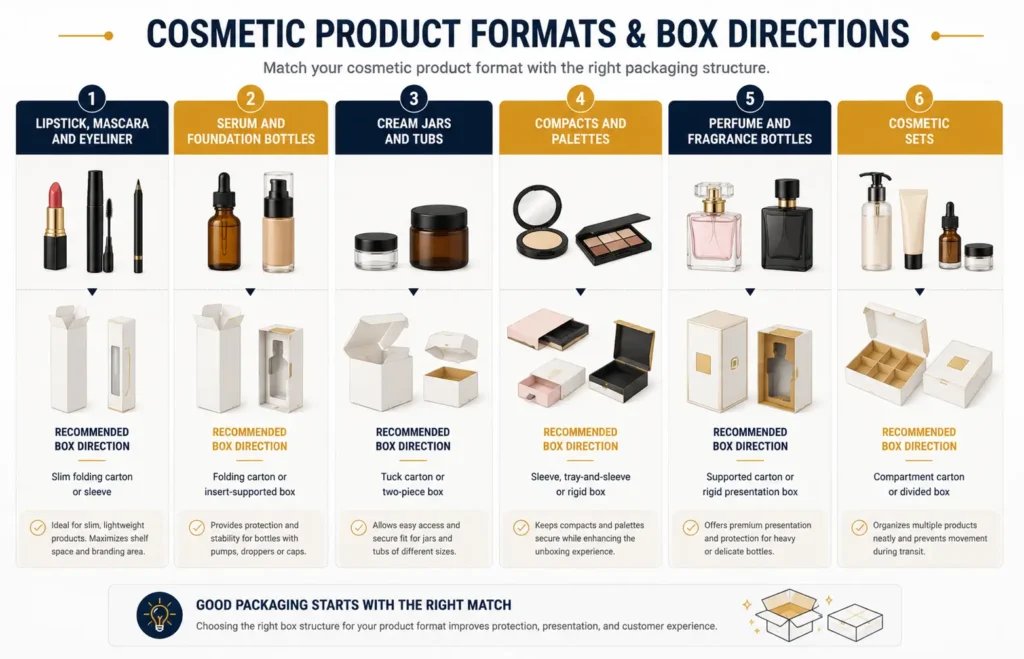
The appropriate structure depends on the product profile, weight, presentation, opening experience and distribution requirements.
| Cosmetic product format | Details to review | Possible box directions |
|---|---|---|
| Lipstick, mascara and eyeliner tubes | Maximum length, cap profile, clips and orientation | Straight tuck, reverse tuck, sleeve or slim folding carton |
| Serum and foundation bottles | Shoulder, base, pump, dropper, overcap and filled weight | Folding carton, auto-lock carton or insert-supported box |
| Cream jars and cosmetic tubs | Lid diameter, jar height, filled weight and removal clearance | Tuck carton, two-piece box or supported folding carton |
| Compacts and eye shadow palettes | Closed dimensions, hinge, clasp and product thickness | Folding carton, sleeve, tray-and-sleeve or rigid presentation box |
| Glass fragrance bottles | Bottle profile, cap, decorative collar, weight and insert | Supported folding carton, two-piece box or rigid structure |
| Cosmetic sets | Number of items, product order, accessories and combined weight | Compartment carton, divided box, tray-and-sleeve or rigid set box |
These are starting directions rather than universal recommendations. A lightweight glass bottle may work in a properly planned paperboard carton, while a heavy multi-product set may require a more substantial structure and coordinated outer shipping package.
Projects involving filled glass bottles, decorative caps and fitted supports can also review the requirements for custom perfume boxes.
Folding Cartons
Folding cartons may suit many lightweight or moderately weighted cosmetic products. They can support printed branding, product information, windows and selected inserts while being supplied flat for assembly.
Their suitability depends on the completed dimensions, weight, closure profile, board selection and distribution conditions.
Tray-and-Sleeve Boxes
A tray-and-sleeve box creates a defined sliding removal direction. It may suit compact products, palettes, sets and projects where the inner tray forms part of the presentation.
The product should be checked for removal clearance so the tray does not fit too tightly around inserts or accessories.
Two-Piece Boxes
A separate lid and base can provide broad access to jars, compacts, fragrance products and cosmetic sets. Lid depth, fit, internal height and filled weight should be confirmed before production.
Rigid Presentation Boxes
Rigid boxes may support selected gift sets, launches and premium presentation projects. They should not be selected solely because the product has a high retail price.
Rigid construction can increase material use, storage volume, assembly requirements and shipping weight. Compare these tradeoffs against the required presentation and sales channel.
Brands comparing structure, storage, assembly and presentation tradeoffs can review the detailed guide to rigid versus folding carton cosmetic packaging.
Decide Whether the Packaging Is for Retail, Ecommerce or Both
The sales channel changes how the packaging system should be planned.
Retail Packaging
Retail cosmetic packaging may need:
- A defined shelf footprint
- A clear front-facing panel
- Product identification
- Barcode space
- Shade, fragrance or SKU information
- Tamper-evident features where specified
- A window or product-visibility area
- Hanging or display requirements
- Retailer-specified dimension limits
The individual cosmetic box should provide enough printable space for required artwork and product information without relying on crowded panels or impractically small text.
The buyer or retailer remains responsible for confirming the final shelf, display, labeling and dimension requirements.
Ecommerce Packaging
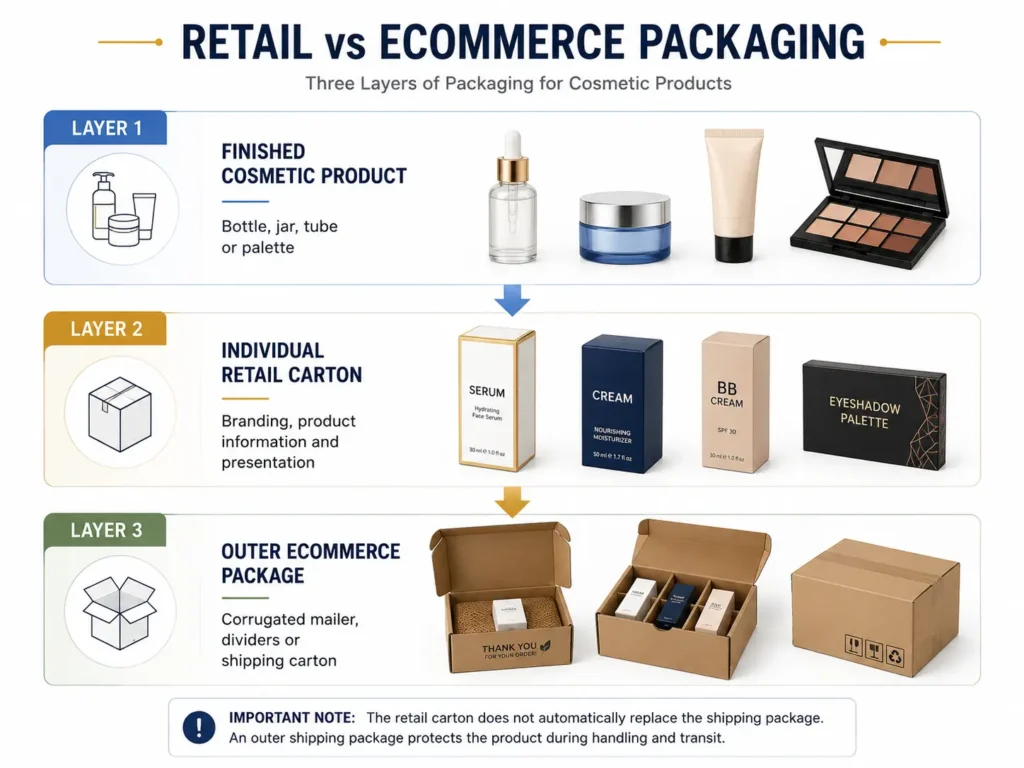
A retail carton does not automatically replace an ecommerce shipping package.
An ecommerce configuration may include:
Finished cosmetic product
→ individual retail carton
→ internal packing or divider
→ corrugated mailer or shipping carton
The outer package should be reviewed according to the completed retail-box dimensions, total order weight, number of products, void space and selected shipping method.
Do not assume that a visually premium folding carton or rigid box is automatically parcel-ready.
Wholesale and Distribution
Wholesale projects may also require:
- Retail boxes per master case
- Product orientation
- Dividers
- Master-carton dimensions
- Completed case weight
- Barcode or case-label requirements
- Units by SKU
- Pallet or warehouse considerations
- Gift, Launch and PR Packaging
Gift and promotional sets may prioritize opening order, product arrangement, printed cards, accessories and interior branding.
The presentation package should still be coordinated with a separate shipping package where required.
Choose Material After the Structure and Weight Are Known
Material should follow the approved product and structure—not the other way around.
White Paperboard or Cardstock
White paperboard may support detailed printed artwork, product information and bright brand colors. It is commonly considered for folding cartons, sleeves and lightweight cosmetic packaging.
Its final suitability depends on the product weight, carton dimensions, structure and required surface treatment.
Kraft-Style Paperboard
Kraft-style board can support a natural or understated visual direction. Printed colors may appear differently on a brown or unbleached surface than on white paperboard.
Do not describe a package as sustainable or fully recyclable solely because it has a kraft appearance. Coatings, laminates, windows, adhesives and local recovery facilities can affect the completed package.
Corrugated Board
Corrugated material may be considered for ecommerce mailers, PR kits, wholesale cases and heavier multi-product arrangements.
Flute and wall construction should be selected according to the completed dimensions, weight and distribution requirements.
Wrapped Rigid Board
Wrapped rigid board may support presentation-led boxes, gift sets and selected fragrance or skincare collections.
The project may require additional review of wrap material, hinge construction, magnets, trays, assembly and shipping weight.
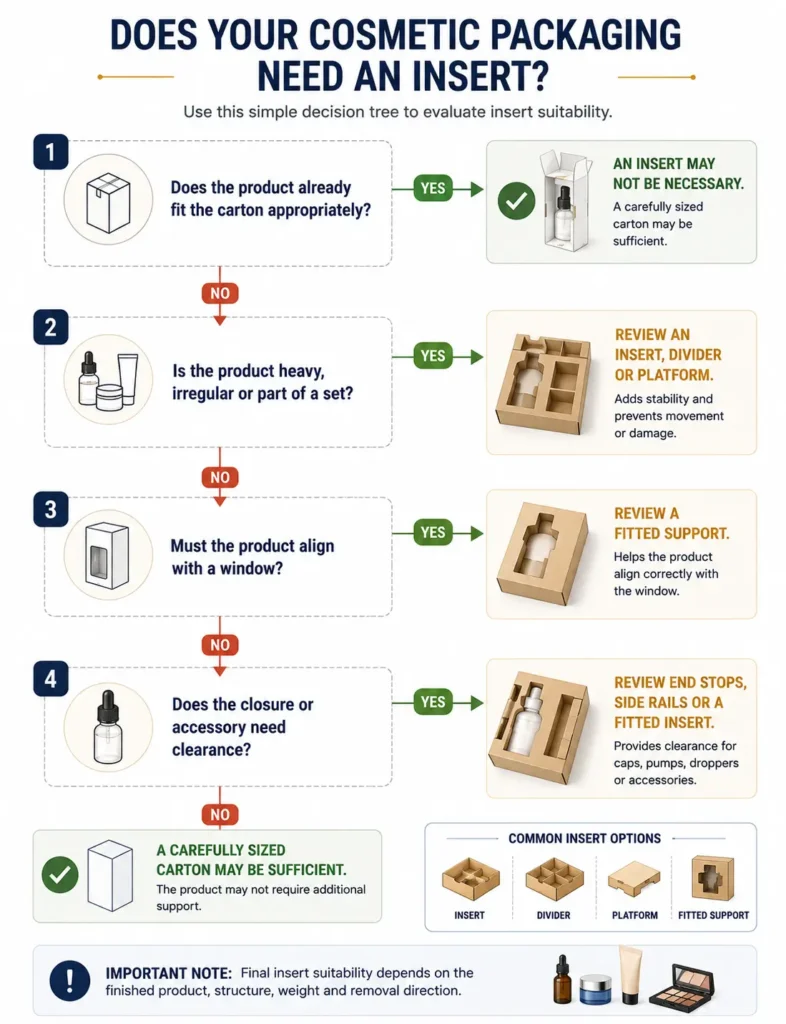
Decide Whether You Need an Insert, Divider or Window
Not every cosmetic box needs an insert. A properly fitted carton may already provide an appropriate product arrangement for a lightweight, regularly shaped container.
Consider an internal support when:
- The product has excessive space around it
- The container is heavy or irregular
- Several products share one package
- A closure or accessory needs clearance
- The product must remain aligned with a window
- The customer needs a defined removal direction
- A jar, bottle or tube should be separated from printed materials
- Different items need individual compartments
Possible support directions include folded paperboard trays, end stops, side rails, dividers, platforms and selected molded or foam components.
An insert can help organize an approved arrangement or limit unnecessary movement. It should not automatically be described as preventing breakage, leakage or product damage.
Insert Decision Check
Ask these questions:
- Does the product already fit the proposed carton appropriately?
- Is the container’s weight concentrated in one area?
- Are the cap, pump, dropper or decorative components exposed?
- Does the package contain more than one item?
- Is product alignment important for a window?
- Can the customer remove the product easily?
- Will the insert interfere with labels or decorated surfaces?
- Does the insert increase the box size unnecessarily?
Window Packaging
A window may reveal the cosmetic product, color, bottle profile or support card.
Confirm:
- The visible product area
- Product orientation
- Window position
- Remaining structural border
- Film requirement
- Product-to-window clearance
- Artwork safe zones
- Barcode and information-panel space
A window should not be treated as providing moisture, hygiene or shipping performance unless project-specific evidence supports that claim.
Check Artwork, Dieline and Finish Compatibility
Detailed artwork should be completed after the basic structure and dieline direction are established.
The dieline identifies:
- Cut lines
- Fold and score lines
- Glue areas
- Printable panels
- Bleed
- Safe zones
- Closure panels
- Window position
- Insert position
- Opening direction
Important logos, text, barcodes and product information should not be placed directly across folds, glue seams or cut edges.
For broader artwork planning, color systems and finishing decisions, review BoxBaba’s cosmetic packaging design tips.
Plan Artwork by SKU
Prepare an artwork schedule when the product range includes multiple:
- Shades
- Fragrances
- Sizes
- Formula types
- Product names
- Languages
- Barcodes
- Market versions
Several SKUs may share one box structure when their completed dimensions, weight range, orientation, closure clearance, insert, window and removal method remain compatible. Artwork-only changes do not always require a new structural dieline.
Separate dielines may be required when the physical containers or internal arrangements differ materially.
Evaluate Finishes After the Artwork Is Approved
Possible visual directions may include matte or gloss lamination, soft-touch surfaces, foil stamping, embossing, debossing and Spot UV.
Suitability depends on the material, structure, artwork size, score lines, glue areas, window position and production method.
Decorative finishes should not automatically be described as adding structural strength, shipping performance or moisture resistance.
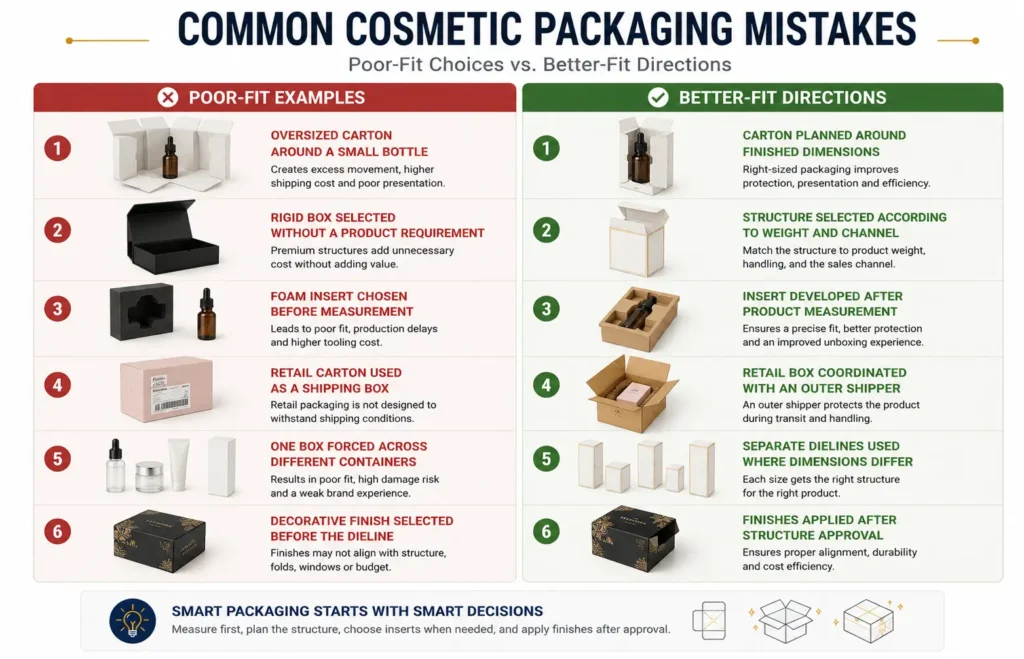
Avoid Overbuilding and Under-Specifying the Box
A suitable cosmetic package should match the product, channel and brand requirements without adding unnecessary complexity.
| Packaging decision | Why it may be a poor fit | Better planning direction |
|---|---|---|
| Rigid box for a lightweight, low-margin unit | May add cost, storage volume and shipping weight without solving a product requirement | Compare it with a printed folding carton |
| Thin basic carton for a heavy product set | May not suit the combined weight or internal arrangement | Review structure, material, dividers and outer shipping |
| Foam insert selected before product measurement | May create concentrated contact or unnecessary box size | Measure the finished product and define contact areas first |
| Large carton used to avoid exact sizing | Can create excessive internal space | Use the completed product dimensions |
| Decorative finishes selected first | May conflict with folds, windows or material | Confirm the structure and dieline before finishes |
| One box forced across different bottles | May create inconsistent fit and clearance | Compare dimensions and use separate dielines where needed |
| Retail carton used as the shipping carton | May expose presentation packaging to distribution handling | Coordinate it with an outer mailer or shipping case |
| Insert added to every package | Can increase complexity without improving the arrangement | Use an insert only where the product or set requires it |
Prepare a Quote-Ready Cosmetic Packaging Brief
A complete project brief helps the packaging supplier evaluate the structure, materials, printing, inserts, proofing and distribution requirements without relying on assumptions.
Product Information
Provide:
- Product type
- Finished product dimensions
- Maximum diameter where relevant
- Filled product weight
- Container and closure type
- Product photographs
- Physical sample availability
- Label or decorated-surface details
For a multi-product set, also provide the total completed set weight, including products, supports, accessories and printed components.
A physical product sample may be useful when the container has an irregular profile, decorative projections, a complex closure or contact areas that are difficult to communicate through dimensions alone.
Packaging Information
Provide:
- Preferred structure or opening direction
- Insert, divider or platform requirements
- Window requirement
- Product orientation
- Retail, ecommerce, wholesale or gifting use
- Flat-packed or assembled delivery preference
- Outer shipping requirements
Artwork Information
Provide:
- Logo and artwork status
- Number of SKUs
- Quantity by artwork
- Printing direction
- Inside-printing requirements
- Barcode and QR-code positions
- Finish preferences
- Language or market versions
Ordering Information
Provide:
- Total quantity
- Quantity by size
- Quantity by structure
- Quantity by artwork or SKU
- Delivery destination
- Required project date
- Proofing or sample requirements
When comparing quotations, provide each supplier with the same dimensions, structure, material direction, insert requirements, artwork count, quantity and delivery destination. Prices based on different specifications are not directly comparable.
Proofing or sample routes are confirmed during quotation. Standard production takes 5–9 business days after final artwork and project specifications are approved. BoxBaba provides free shipping across the USA. Production and transit time are separate.
Final Takeaway
The most effective cosmetic packaging decisions begin with the finished product. Confirm its maximum dimensions, closure profile, filled weight and sales channel before selecting the structure, material, insert or decorative finish.
A clear product-to-quote sequence helps avoid oversized cartons, unnecessary inserts, unsuitable structures and artwork that conflicts with the dieline.
Brands ready to discuss their product specifications can request a custom cosmetic box quote.
FAQs
What should I consider when choosing cosmetic packaging boxes?
Start with the fully assembled product, including its closure, decoration and filled weight. Then evaluate the sales channel, box structure, material, insert need, artwork space, quantity, proofing and shipping requirements.
Should I choose the material or box structure first?
Choose the basic structure first using the product dimensions, weight and opening requirements. The material direction can then be reviewed according to the selected structure, print requirements and distribution conditions.
Can I choose a cosmetic box size from the product’s fill volume?
No. Fill volume does not show the external container dimensions, cap, pump, dropper, lid or decorative profile. Measure the complete retail-ready product.
Does every cosmetic box need an insert?
No. An insert may be unnecessary when a lightweight, regularly shaped product already fits appropriately inside the carton. Inserts are more relevant when movement, weight, alignment, separation or removal requires additional planning.
Which cosmetic packaging works for ecommerce?
The individual cosmetic carton should normally be coordinated with a corrugated mailer or shipping carton. The final configuration depends on the retail-box dimensions, completed order weight, product count, void space and shipping method.
Are rigid boxes always better for cosmetic products?
No. Rigid boxes may suit selected gift, fragrance and launch projects, but they can add cost, storage volume, assembly requirements and shipping weight. Folding cartons may be more appropriate for many individual retail products.
Can several cosmetic SKUs use the same box?
Several SKUs may share one dieline when their finished dimensions, weight range, orientation, insert, window and structure remain the same. Different physical containers may require separate dielines.
When should cosmetic box artwork be prepared?
Detailed artwork should be finalized after the structure and dieline direction are approved. This helps position logos, text, barcodes and finishes around cuts, folds, glue areas, windows and closures.
What information is needed for a cosmetic box quote?
Provide the product dimensions, filled weight, container type, quantity, SKU breakdown, sales channel, structure direction, insert or window needs, artwork status, finish preferences and delivery destination.
What is the minimum order quantity for custom cosmetic boxes?
The verified minimum order quantity for custom cosmetic boxes is 100 boxes. Provide separate quantities for each size, structure, artwork and SKU variation.