
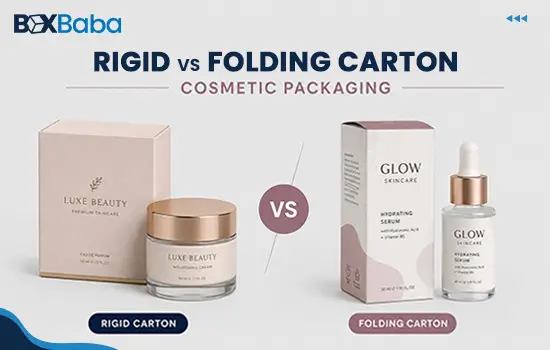
Choosing between folding cartons and rigid boxes for cosmetics is not simply a choice between inexpensive packaging and luxury packaging.
The right structure depends on the finished cosmetic product, its dimensions and loaded weight, the required presentation, internal arrangement, sales channel, storage conditions and packing process.
A lightweight mascara tube may work well in a folding carton. A fragrance gift set may justify a rigid presentation box. The same serum bottle could use either structure depending on how the product is positioned, presented and sold.
Finished Cosmetic Product → Geometry + Loaded Weight + Internal Arrangement + Presentation + Sales Channel + Logistics → Packaging Structure
Folding Carton / Premium Folding Carton / Rigid Box
Brands planning packaging across a wider beauty range can start with Custom Cosmetic Boxes, while projects already requiring a formed presentation structure can explore Custom Rigid Boxes.
Folding Cartons vs Rigid Boxes: Quick Comparison
Neither structure is automatically better for cosmetics.
A folding carton is generally a strong starting point when a brand needs a lightweight printed secondary package that stores efficiently and works across retail SKUs.
A rigid box becomes more relevant when the package needs a formed structure, a defined opening experience or a presentation format that justifies the additional material and operational requirements.
Decision Factor | Folding Carton | Rigid Box |
Basic construction | Foldable paperboard | Formed rigid board with an outer wrap |
Storage before use | Commonly supplied flat or collapsed | Conventional versions remain formed |
Collapsible option | Inherent to carton structure | Available with selected rigid designs |
Printed branding | Applied to carton panels | Commonly applied to the outer wrap |
Premium presentation | Possible | Strong presentation potential |
Inserts | Optional | Optional |
Multi-product sets | Possible | Often considered for presentation-led sets |
Dieline system | Folding-carton dieline | Structure/wrap-specific templates |
Main decision | Product + project requirements | Product + project requirements |
Packaging Requirement → Structure
Cosmetic Category ≠ Predetermined Box Type
What Is a Cosmetic Folding Carton?
A folding carton is usually made from paperboard that is printed, cut, creased and converted into a structure that can be supplied flat or collapsed before packing.
Depending on the project, structures may include straight tuck end, reverse tuck end, auto-lock bottom, seal-end, sleeve, window and other custom paperboard formats.
Folding cartons are widely used for cosmetics because they can combine branding, product information, barcode and SKU areas, windows, decorative finishes and compatible internal supports.
They can be used for everyday, prestige and premium beauty products.
Folding Carton ≠ Low-End Packaging
A folding carton can look highly refined when the board, structure, artwork, printing and finishes are developed appropriately.
What Is a Rigid Cosmetic Box?
A conventional rigid box uses a thicker board core that retains its formed shape rather than being erected like a standard folding carton.
The structural board is commonly covered with printed, colored, textured or specialty wrapping material.
Rigid cosmetic packaging may use formats such as:
- Two-piece lid-and-base boxes
- Drawer boxes
- Magnetic closure boxes
- Shoulder-neck boxes
- Book-style structures
- Collapsible rigid boxes
BoxBaba offers these types across its rigid packaging range.
Folding Carton → Foldable Paperboard
Rigid Box → Formed Rigid Board + Wrap
That is the fundamental difference. Premium is a positioning decision, not the technical definition of a rigid box.
Conventional and Collapsible Rigid Boxes Are Different
Rigid packaging should not be treated as one single logistical format.
A conventional setup rigid box normally stays assembled during storage and transport. A collapsible rigid box is designed to reduce its volume before final setup.
Conventional Rigid Box ≠ Collapsible Rigid Box
This can materially change the storage comparison. A conventional rigid box may use more warehouse space before packing. A collapsible version can reduce storage volume but may introduce an additional assembly step.
Lower Storage Volume ↔ Additional Assembly
The finished appearance alone should not decide which option is better.
Start With the Finished Cosmetic Product
Before choosing either structure, measure what will actually go inside it.
Do not select a box from product capacity alone. A 30 ml serum bottle, 30 ml foundation bottle and 30 ml airless container can have completely different exterior geometry.
Measure the complete closed and sale-ready product, including the final cap, pump, dropper, lid, collar, applicator or other permanent exterior feature.
Product Input | Why It Matters |
Maximum width or diameter | Establishes the widest product point |
Maximum depth | Important for non-round products |
Complete closed height | Establishes the full packed height |
Base footprint | Helps evaluate orientation and support |
Loaded weight | Provides structural context |
Closure profile | May extend beyond the product body |
Orientation | Determines how dimensions map to the box |
Number of products | Changes the internal arrangement |
For a detailed measurement workflow across bottles, jars, tubes and compacts, use the Cosmetic Box Size Guide.
Finished Product → Product Envelope → Internal Requirements → Packaging Structure
Choose the Box First → Force the Product Into It
The Same Cosmetic Product Can Need Different Box Dimensions
Product dimensions and finished package dimensions are different entities.
Consider a hypothetical serum bottle measuring 1.45 in maximum diameter × 4.20 in complete closed height.
If the bottle uses a folding carton, development may follow:
Bottle Envelope → Required Internal Space → Paperboard + Folds → External Carton Dimensions
Now place the exact same bottle inside a rigid presentation box with a fitted holder:
Bottle Envelope → Insert Arrangement → Internal Rigid-Box Cavity → Rigid Board + Wrap + Lid/Base → External Dimensions
The serum bottle has not changed. The surrounding packaging structure has.
Product Dimensions ≠ Box Dimensions
Same Product + Different Structure → Different Packaging Specification
Do not reuse the finished external dimensions of an existing folding carton as the assumed external dimensions of a rigid box.
How the Dimensional Architecture Changes
Folding Carton
The simplified relationship is:
Finished Product → Clearance / Support → Internal Carton Dimensions → Paperboard + Folds → External Dimensions
The structural panels then become part of the flat dieline.
Rigid Box
A rigid presentation structure may follow:
Finished Product → Arrangement / Insert → Internal Cavity → Rigid Board Walls + Wrap → Lid / Base / Tray / Sleeve → External Dimensions
A drawer-style rigid box introduces another relationship:
Product → Inner Tray → Sliding Clearance → Outer Sleeve
Finished Product → Structure-Specific Dimension Development
This is more reliable than trying to assign one standard cosmetic box size to both formats.
Does a Heavy Cosmetic Product Automatically Need a Rigid Box?
No.
Loaded weight matters, but weight by itself does not determine the structure.
Loaded Weight + Product Footprint + Orientation + Board Specification + Bottom Construction + Internal Support + Shipping System
A heavy cosmetic jar may justify a rigid structure in one project. Another product with similar weight may work in a suitably engineered folding carton.
Loaded Weight ≠ Automatic Rigid Box Requirement
This prevents brands from overbuilding packages simply because the product contains glass or feels heavy.
Does Glass Automatically Mean Rigid Packaging?
No. Glass construction is another input, not a complete packaging specification.
A fragrance bottle, serum bottle or cosmetic jar should be assessed from its finished dimensions, loaded weight, base footprint, closure, orientation, internal movement, retail or presentation requirement and ecommerce distribution configuration.
A glass fragrance bottle may use a folding carton for one retail program and a rigid presentation package for a gift or launch configuration.
Brands developing fragrance-specific packaging can review Custom Perfume Boxes after the finished bottle specifications are established.
Glass Container ≠ Automatic Rigid Box Requirement
Does a Rigid Box Automatically Provide Better Protection?
Rigid board creates a different structural shell from folding paperboard, but the term rigid should not be treated as a universal performance guarantee.
The completed packaging system may also depend on product fit, internal movement, insert geometry, orientation, closures, outer shipping packaging, handling and distribution conditions.
Rigid Structure ≠ Guaranteed Distribution Protection
Folding Carton ≠ Automatically Insufficient Protection
Product + Fit + Structure + Internal Support + Distribution Packaging → Completed Package Performance
This distinction becomes especially important for ecommerce orders.
When Folding Cartons Are the Better Starting Point
Folding cartons are often worth considering first when the product needs an efficient secondary retail package without the formed presentation architecture of a rigid box.
They can work particularly well when:
- One cosmetic product is packed per carton.
- The product geometry is relatively straightforward.
- Flat storage is valuable.
- Several SKUs share one physical structure.
- Clear retail information panels are needed.
- Production quantities make storage and pack-out efficiency important.
- Premium decoration is required without rigid construction.
Products frequently packaged this way include individual lipstick, mascara, eyeliner, serum, cream, foundation and other skincare formats.
Common Use ≠ Mandatory Structure
When a Rigid Box Is Worth Evaluating
Rigid packaging becomes more relevant when the brand needs a formed presentation structure or opening experience that is central to the package.
Examples may include:
- Fragrance gift sets
- Skincare collections
- Limited-edition launches
- PR kits
- Influencer packages
- Multi-product makeup sets
- Drawer-style reveals
- Magnetic opening experiences
- Shoulder-neck presentations
For larger assortments containing several beauty products, Custom Makeup Boxes provides the related commercial path for multi-product configurations.
Premium Product ≠ Automatic Rigid Box
The rigid structure should solve a real presentation, arrangement or structural requirement.
A Premium Folding Carton May Be Enough
This is one of the most important decisions beauty brands often miss.
The choice is not limited to a basic carton or a rigid luxury box. A premium folding carton sits between those extremes.
Depending on the specification, a folding carton may use:
- Upgraded compatible paperboard
- Sleeve-and-tray construction
- Premium printing
- Foil stamping
- Embossing or debossing
- Spot effects
- Matte or gloss lamination
- Soft-touch treatments
- Specialty papers
- Windows
- Paperboard internal components
Premium Appearance ≠ Rigid Construction Requirement
If the buyer wants stronger shelf presentation but does not need a formed rigid structure, a premium folding carton can sometimes provide the better balance.
Folding Carton or Rigid Box by Cosmetic Format
Product categories are useful starting points, but they should not become universal rules.
Cosmetic Product | Folding Carton | Rigid Box | What Should Control the Decision |
Lipstick | Commonly suitable | Possible for launches/sets | Case dimensions, quantity, presentation |
Mascara | Commonly suitable | Possible for sets | Tube dimensions and arrangement |
Eyeliner | Commonly suitable | Possible for presentation sets | Product format and accessories |
Serum | Often suitable | Useful for selected premium presentations | Bottle geometry, dropper/pump, weight |
Cream jar | Often suitable | Possible | Lid width, weight, footprint |
Foundation | Often suitable | Possible | Bottle geometry and loaded weight |
Perfume | Suitable in many retail projects | Often evaluated for presentation | Bottle shape, weight, cap and brand objective |
Palette | Carton or sleeve possible | Possible | Closed dimensions, hinge, weight |
Multi-product set | Possible | Frequently evaluated | Product arrangement and presentation |
PR kit | Possible | Frequently presentation-led | Product count, layout and opening sequence |
Use the table to identify what needs further evaluation—not as a rigid prescription.
Inserts Are a Separate Decision
Do not assume that every rigid box needs an insert or that every folding carton works without one.
Insert requirements depend on the actual product and internal packaging problem.
Product Dimensions + Internal Space + Orientation + Arrangement + Removal Requirement → Insert Decision
A self-contained cosmetic compact may sit inside a rigid box without another structural holder. A folding carton holding several products may need a divider or fitted support.
Where the project does require a fitted product holder or divider, review Printed Boxes with Inserts.
Box Structure ≠ Automatic Insert Requirement
Retail Packaging and Ecommerce Shipping Have Different Jobs
A folding cosmetic carton and a rigid presentation box are usually not the complete ecommerce shipping system.
Finished Cosmetic Product → Retail / Presentation Package
Completed Retail Package → Outer Mailer / Shipping Carton
Rigid Cosmetic Box ≠ Parcel Shipping Carton
Folding Cosmetic Carton ≠ Parcel Shipping Carton
A rigid fragrance box may provide excellent presentation and still require an appropriate outer shipping package. A folding skincare carton should not simply be enlarged because it will later enter an ecommerce order.
The channel-specific differences are covered in more detail in Retail vs Ecommerce Cosmetic Packaging.
Storage and Pack-Out Can Change the Better Choice
Folding Cartons
They are commonly supplied flat or collapsed, helping reduce storage volume before erection. Depending on the structure, pack-out may involve:
Carton Erection → Product Loading → Closure
Conventional Rigid Boxes
They generally arrive formed. This may simplify some loading operations but increases storage volume.
Collapsible Rigid Boxes
They reduce pre-use cube but require setup before loading.
This produces two separate efficiency questions: How much space does the empty packaging occupy? How much work is required to pack the product?
Flat-Pack Efficiency ≠ Packing-Line Efficiency
Pre-Assembled Convenience ≠ Storage Efficiency
A buyer ordering thousands of units should evaluate both.
Artwork Is Developed Differently
A folding-carton artwork file and rigid-box artwork template are not interchangeable.
Folding Carton Artwork
The structural dieline may contain front and back panels, side panels, tuck flaps, bottom panels, glue areas, closures, windows and hang-tab areas. Artwork must coordinate with folds, panel orientation and structural boundaries.
Rigid Box Artwork
A rigid package can contain separate structural elements such as a lid, base, tray, outer sleeve, inner shoulder, cover or wrap. The printed wrap is developed around these formed components.
Folding Carton Dieline ≠ Rigid Box Wrap Template
Do not resize an existing folding-carton file and assume it is ready for a rigid structure.
Product → Structure → Dimensions → Dieline / Wrap Template → Artwork
Structure Also Affects Available Information Panels
Cosmetic artwork may need space for buyer-approved information such as product identity, ingredients, net contents, directions, warnings, shade or SKU, barcode, product claims and company information.
A folding carton often offers clearly defined exterior panels. A rigid package may provide larger visual surfaces, but its wrap geometry and opening structure can change where information is best positioned.
Packaging Structure → Influences → Available Artwork Space
The brand remains responsible for its final ingredients, claims, net contents, warnings, barcode and applicable market-specific labeling.
Both Structures Can Support Premium Finishes
Premium finishing does not belong exclusively to rigid packaging.
Folding cartons can support compatible options such as foil, embossing, debossing, spot effects, laminations and other decorative treatments. Rigid packages can use printed or specialty wraps with compatible finishing techniques.
Desired Visual / Tactile Effect → Compatible Material + Printing + Finish
Premium Finish ≠ Rigid Box
This distinction helps brands avoid paying for a heavier structure when the actual requirement is primarily visual.
Compare the Complete Project Cost, Not Just the Box Type
There is no reliable universal per-unit price difference that applies to every rigid box and every folding carton.
Dimensions + Material + Structure + Print + Wrap + Finish + Insert + Quantity + Assembly + Packing + Shipping
A highly finished folding carton with complex internal components can have a very different cost profile from a straightforward folding carton. Rigid-box cost also changes with the board, wrap, opening style, construction, insert and quantity.
Box Category ≠ Final Packaging Cost
Compare two complete specifications around the same finished product and quantity. That produces a meaningful commercial comparison.
Sampling Should Match the Selected Structure
Structural approval should happen before production artwork is treated as final.
Folding-Carton Review
- Product fit
- Insertion
- Closure
- Bottom construction
- Insert position
- Removal access
- Window alignment
Rigid-Box Review
- Lid/base fit
- Drawer movement
- Tray-to-sleeve clearance
- Opening sequence
- Wrapped edges
- Closure behavior
- Insert positioning
Structure Approval ≠ Artwork Approval
Appearance Approval ≠ Distribution-Performance Validation
A package that looks correct still needs to function correctly with the actual finished product.
Can One Beauty Brand Use Both Structures?
Yes.
For many brands, a mixed packaging system makes more sense than choosing one format for the entire range.
Core Retail SKUs → Folding Cartons
Prestige SKUs → Premium Folding Cartons
Gift / PR / Limited Collections → Rigid Presentation Boxes
This can preserve operational efficiency while reserving more complex structures for products where they provide meaningful value.
Brand consistency can still be maintained through typography, colors, artwork hierarchy, material direction, finishing and logo placement. The physical structure does not need to be identical for every product.
For brands still evaluating the wider range of beauty packaging structures, the broader guide to How to Choose Cosmetic Packaging Boxes can help establish the starting format.
Common Folding Carton vs Rigid Box Selection Mistakes
Common Mistake | Better Approach |
Choosing rigid only because the product is premium | Identify the required presentation or structural function |
Assuming folding cartons look inexpensive | Evaluate material, printing and finish separately |
Assuming every heavy product requires rigid | Review loaded weight with the complete structure |
Assuming glass automatically requires rigid | Evaluate the finished product and distribution system |
Treating rigid construction as shipping protection | Evaluate outer shipping separately |
Choosing from fill capacity | Measure the complete product |
Using the same external size for both structures | Develop each structure independently |
Assuming every rigid box needs an insert | Evaluate the actual internal requirement |
Assuming cartons cannot use inserts | Treat the insert as a separate decision |
Ignoring collapsible rigid options | Compare storage and assembly |
Comparing generic unit prices | Compare equivalent specifications |
Creating artwork before final structure | Approve the structural template first |
Ignoring warehouse space | Compare empty-packaging cube |
Ignoring pack-out time | Review the loading sequence |
Folding Carton vs Rigid Box Quote Checklist
A packaging supplier can compare the structures more accurately when both options start from the same product information.
Finished Product
Cosmetic Product: ____________________
Maximum Width / Diameter: ____________________
Maximum Depth: ____________________
Complete Closed Height: ____________________
Loaded Weight: ____________________
Cap / Pump / Lid Profile: ____________________
Packaging Configuration
Products Per Box: ____________________
Packing Orientation: ____________________
Insert Required (Yes / No / Unsure): ____________________
Accessories: ____________________
Presentation Level (Retail / Premium / Gift / PR / Other): ____________________
Preferred Opening Experience: ____________________
Operational Requirements
Sales Channel (Retail / Ecommerce / Both / Other): ____________________
Flat Storage Important (Yes / No / Unsure): ____________________
Pre-Assembled Packaging Preferred (Yes / No / Unsure): ____________________
Packing Constraints: ____________________
Project Details
Preferred Structure (Folding / Rigid / Unsure): ____________________
Quantity Per SKU: ____________________
Number of SKUs: ____________________
Artwork Status: ____________________
Delivery Destination: ____________________
Instead of sending only: We need luxury rigid packaging for our 30 ml serum.
Provide: The finished 30 ml serum bottle measures 1.45 inches at its maximum diameter and 4.20 inches in complete closed height including the dropper. One bottle will be packed upright per box. We are comparing a premium folding carton with a rigid presentation box.
That allows both structures to be evaluated from the same physical starting point.
Request Cosmetic Packaging Pricing
The choice between a folding carton and rigid cosmetic box should begin with the finished product and the packaging requirement, not with an assumption that one structure is always more premium or more protective.
Finished Product → Dimensions + Loaded Weight → Internal Arrangement → Presentation → Sales Channel → Logistics → Folding Carton / Premium Folding Carton / Rigid Box
Brands planning a full cosmetic packaging program can review Custom Cosmetic Boxes. If the project already requires a formed presentation structure, continue to Custom Rigid Boxes.
BoxBaba’s minimum order quantity for custom packaging projects in this category starts from 100 boxes.
When requesting pricing, provide the finished product dimensions, loaded weight where relevant, quantity per SKU, intended orientation, insert requirement, preferred structure if known, artwork status and delivery destination.
If you are still comparing rigid and folding structures, provide the finished cosmetic product specification rather than estimating the final box dimensions. Both options can then be evaluated from the same starting point.
Choose the structure that solves the product, presentation and operational requirements—not simply the structure that looks more expensive.
FAQs About Folding Cartons vs Rigid Boxes for Cosmetics
What is the main difference between a folding carton and a rigid box?
A folding carton uses foldable paperboard that is cut and creased into an erectable package. A conventional rigid box uses thicker formed board that retains its shape and is commonly covered with a printed or specialty wrap.
Are rigid boxes better than folding cartons for cosmetics?
Not universally. Rigid boxes can suit presentation-led gift sets, launches and premium collections. Folding cartons can suit individual retail products, large SKU ranges and projects where flat storage and operational efficiency matter.
Can folding cartons look premium?
Yes. Board choice, structure, artwork, specialty paper, foil, embossing, surface treatments and other compatible finishes can produce premium folding-carton packaging.
Do luxury cosmetics need rigid boxes?
No. Luxury positioning alone does not determine the structure. The choice should also consider the finished product, required opening experience, internal arrangement, sales channel, storage and project economics.
Do glass cosmetic bottles require rigid packaging?
No. Glass is only one product attribute. Finished dimensions, loaded weight, orientation, internal support and the complete distribution system should also be considered.
Is a rigid box automatically more protective?
Rigid board provides a different structural shell, but the completed packaging performance also depends on product fit, inserts, orientation and outer distribution packaging.
Are folding cartons cheaper than rigid boxes?
Folding cartons often use a more space- and material-efficient construction, but there is no universal price difference. Final cost depends on the complete specification, including size, material, structure, printing, finishes, inserts, quantity, assembly and shipping.
Do rigid cosmetic boxes always need inserts?
No. Insert need should be evaluated independently from the outer box type.
Can folding cartons use inserts?
Yes. Folding cartons can use compatible fitted holders, dividers and other internal components when the product configuration requires them.
Which is better for perfume: rigid or folding?
Either can be appropriate. The decision should be based on the finished fragrance bottle, loaded weight, presentation objective, internal arrangement and sales channel.
Which structure is better for skincare products?
Many individual skincare products can use folding cartons, while premium collections or presentation sets may justify rigid structures. The finished container and project requirements should determine the choice.
Are collapsible rigid boxes the same as normal rigid boxes?
No. Conventional rigid boxes retain their assembled shape. Collapsible rigid boxes are designed to reduce volume before setup.
Can the same artwork be used on both structures?
The brand design can remain consistent, but the production artwork must be adapted to the approved structure. Folding-carton dielines and rigid-box wrap templates are different.
Which structure is better for ecommerce cosmetics?
Neither structure automatically replaces an outer shipping package. The completed retail package should be evaluated separately from the ecommerce mailer or shipping carton.
Can a cosmetic brand use both folding cartons and rigid boxes?
Yes. A brand can use folding cartons for core products, premium cartons for selected lines and rigid structures for gift sets, PR packages and presentation-focused launches.