
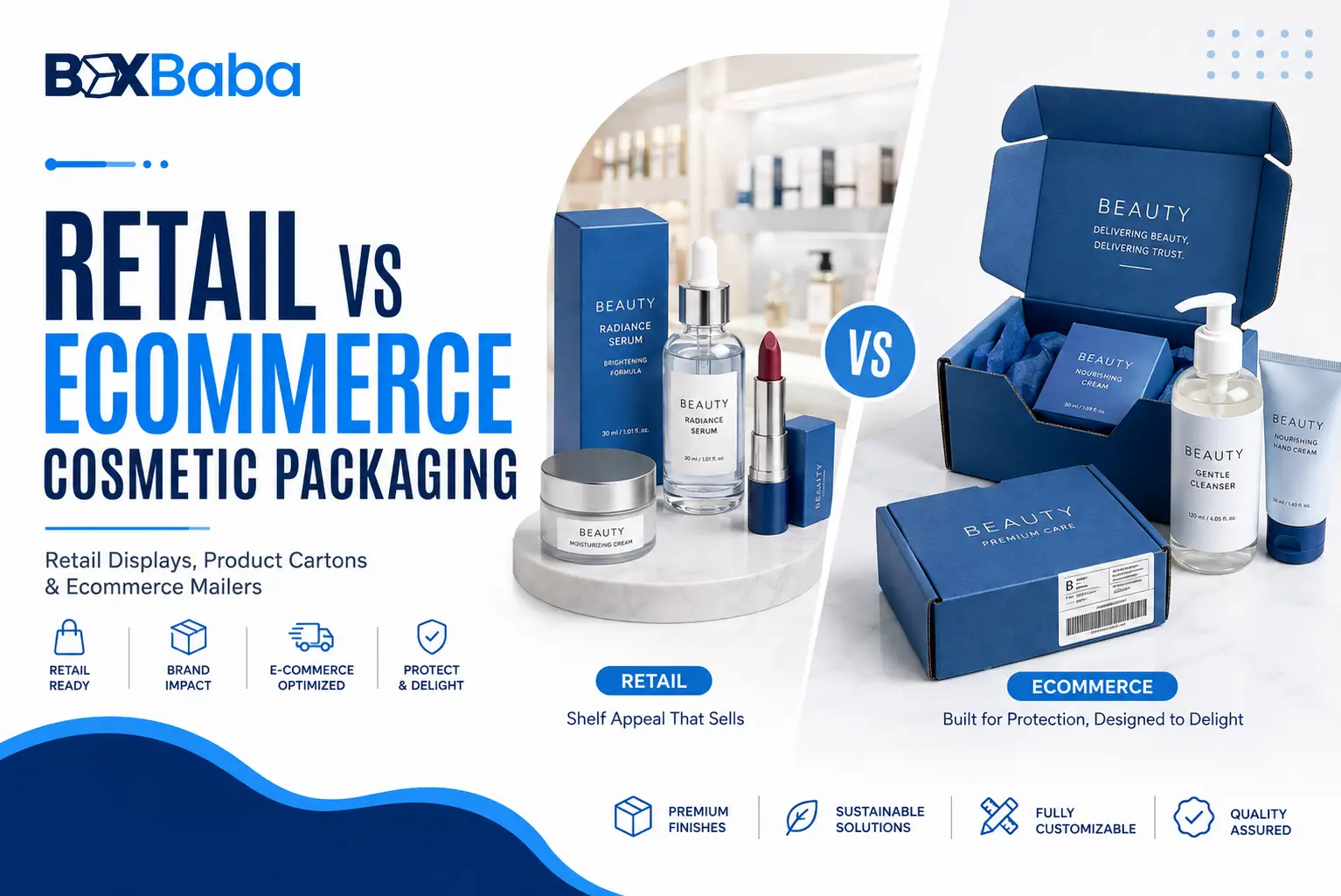
Retail and ecommerce cosmetic packaging serve different parts of the sales journey. Retail packaging is usually planned around the individual cosmetic product and its customer-facing presentation, while ecommerce packaging must also account for the completed packed order and the outer package used for distribution.
A beauty brand does not necessarily need two completely different product cartons. The same retail-ready cosmetic carton may sometimes serve both channels, with an additional mailer or shipping carton used for ecommerce orders where required.
A practical packaging model is:
Finished Cosmetic Product → Retail Product Carton → Internal Support Where Needed → Ecommerce or Distribution Outer Package
The right combination depends on the finished product dimensions, filled weight, box structure, number of products packed together, presentation requirements and sales channel.
Brands still deciding the overall packaging direction can review How to Choose Cosmetic Packaging Boxes. For a project-specific packaging quote, explore Custom Cosmetic Boxes.
What Is the Difference Between Retail and Ecommerce Cosmetic Packaging?
The main difference is the packaging environment and measurement basis.
Retail cosmetic packaging is usually planned around an individual finished product that may be displayed on a shelf, counter or other customer-facing retail area.
Ecommerce packaging must also consider how one or more completed products will be arranged inside an outer package for distribution.
A useful distinction is:
Retail Packaging → Finished Individual Product
Ecommerce Packaging → Completed Packed Order
This means a retail product carton and an ecommerce outer package may perform different jobs even when they are used for the same cosmetic SKU.
Retail vs Ecommerce Cosmetic Packaging Decision Matrix
| Decision Area | Retail Packaging | Ecommerce Packaging | Omnichannel Brand |
|---|---|---|---|
| Main Packaging Task | Contain and present the individual cosmetic product | Package the completed order for distribution | Support both environments |
| Product Carton | Folding carton, rigid box, or another suitable product box | Retail carton may remain around the product | One retail-ready carton may serve both channels |
| Outer Package | Depends on retail/distribution setup | Mailer or shipping carton may be required | Add channel-specific outer packaging for online orders |
| Measurement Basis | Fully assembled individual product | Completed packed order | Maintain product and order measurements separately |
| Loaded Weight | Individual product and carton | Combined packed-order weight | Evaluate both levels |
| Artwork Priority | Customer-facing retail hierarchy | Unit carton plus optional outer-mailer branding | Coordinate unit-carton and shipper artwork |
| Insert Role | Positioning or presentation where required | Order organization or internal support where required | Use inserts according to the actual packaging layer |
| Display Requirement | Shelf, counter, or display compatibility may matter | Usually not a primary parcel requirement | Keep the retail display layer separate |
| Quote Input | Product dimensions, retail structure, and quantity | Product packaging plus complete order requirements | Specify packaging components and quantities by channel |
It is:
Which packaging layers does this sales channel actually require?
Think in Packaging Layers, Not One Box
Treating the complete packaging system as one box can lead to poor structural decisions.
For many cosmetic products, it is more useful to separate the package into functional layers.
Primary Cosmetic Container
This is the container that directly holds the cosmetic product.
Examples include serum bottles, cream jars, mascara tubes, lipstick tubes, foundation bottles and perfume bottles.
Its finished dimensions, closure and filled weight influence the secondary package around it.
Retail Product Carton
The retail carton is the branded secondary box around the individual product where one is required.
It may provide space for branding, product identification, artwork, barcodes, QR areas and other approved product information.
Examples include a printed serum carton, lipstick box or perfume carton.
Insert or Internal Presentation Support
Some packages may use fitted paperboard inserts, dividers, compartments or product-holding trays.
These components should be added where they serve a defined positioning, organization or presentation requirement rather than being included automatically.
Ecommerce or Distribution Outer Package
When completed products are sent directly to a customer, an additional outer layer may be appropriate.
For example:
Serum Bottle → Printed Serum Carton → Ecommerce Mailer
A multi-product order might instead use:
Serum Carton + Cream Carton + Cleanser Carton → Internal Arrangement → Corrugated Mailer
The outer package should be planned around the completed order configuration, not one bare cosmetic product.
What Retail Cosmetic Packaging Needs to Do
Retail cosmetic packaging begins with the fully assembled finished product.
The individual carton should then be planned around product fit, artwork, customer-facing presentation and the way the item will occupy retail space.
Start With Product Fit
Retail artwork cannot compensate for an incorrectly sized carton.
Measurements may need to account for the product body and relevant features such as:
- cap;
- pump;
- dropper;
- wand;
- lid;
- decorative collar;
- other projections.
Fill volume alone does not determine the required box dimensions.
Brands still confirming product measurements can use the Cosmetic Box Size Guide.
Plan the Customer-Facing Panels
Retail packaging may need a clear visual hierarchy for the brand, product name, variant and other approved customer-facing information.
Which panels matter most depends on the carton orientation and retail environment.
The buyer remains responsible for final product claims, ingredient information, warnings, legal labeling and artwork approval.
Account for SKU Identification
A skincare range may include serum, moisturizer, eye cream, cleanser and facial oil while maintaining one visual packaging system.
Different SKUs do not automatically require completely different box structures.
Where finished dimensions and structural requirements genuinely match, several variants may sometimes share one physical carton format while using different artwork.
Check Shelf, Counter or Display Footprint
Where individual cosmetic cartons will sit inside a multi-unit display, confirm the finished unit dimensions before developing the display.
Relevant information can include product orientation, number of units, SKU arrangement, customer access, loaded weight and available retail footprint.
Brands planning multi-unit presentation can review Custom Cosmetic Display Boxes.
What Ecommerce Cosmetic Packaging Needs to Do
Ecommerce adds another packaging decision because the brand must plan beyond the individual product carton.
The outer package should reflect the completed pack-out.
An online customer might order one serum, a serum and cream together, several units of one SKU or a complete skincare set.
Those order configurations can require different outer-package dimensions or internal arrangements.
Measure the Completed Packed Order
The size of one cosmetic product does not determine the size of a multi-product ecommerce package.
Relevant inputs may include:
- dimensions of each retail carton;
- number of units;
- orientation;
- dividers or internal supports;
- combined dimensions;
- total loaded weight.
Therefore:
Finished Product → Determines Retail Carton
while:
Completed Pack-Out → Determines Ecommerce Outer Package
These are separate measurement tasks.
The Retail Carton May Stay Inside the Ecommerce Package
Selling a product online does not automatically require replacing its retail carton.
A brand may use:
Cosmetic Product → Retail Carton → Ecommerce Outer Package
This allows the same individual product carton to remain consistent across store and online sales while the distribution layer changes.
Multi-Product Orders Need Separate Planning
One lipstick and a multi-product skincare kit are different ecommerce pack-outs.
The outer package should therefore be evaluated around the actual products, quantities, arrangement and loaded weight.
For outer ecommerce packaging, brands can evaluate Custom Mailer Boxes or Custom Corrugated Boxes according to the completed project requirements.
Does Ecommerce Packaging Replace the Retail Cosmetic Box?
Not necessarily.
The retail carton and ecommerce outer package can perform different functions.
For example:
Retail Sale
Serum Bottle → Serum Carton
Ecommerce Sale
Serum Bottle → Same Serum Carton → Ecommerce Mailer
The unit carton can remain the individual branded product package while the mailer or shipping carton handles the additional ecommerce distribution role.
Whether both layers are needed depends on the actual product, structure, loaded weight, order configuration and distribution requirements.
Cosmetic Packaging for Brands Selling Both Retail and Online
Many beauty brands operate across several channels rather than choosing only retail or ecommerce.
They may sell through stores, their own website, marketplaces, wholesale accounts or subscription programs.
For these brands, the useful question is:
Which packaging component can remain consistent across channels, and which component needs to change?
A practical omnichannel direction may be:
One Retail-Ready Unit Carton + Channel-Specific Outer Packaging Where Required
For example, a cream jar can use the same printed product carton in a store and in a website order. The ecommerce order can then add an outer package designed around the completed pack-out.
When One Retail Carton May Work Across Channels
A shared unit carton may be practical when the finished product, dimensions, structure and artwork requirements remain compatible.
Channel differences can then be managed through the outer packaging layer.
When Different Packaging Configurations May Be Needed
Separate configurations may need to be evaluated where:
- channel-specific unit counts differ;
- ecommerce sales use kits or bundles;
- retail uses a specialized presentation structure;
- online orders need different internal organization;
- product or pack-out dimensions differ.
The goal is not to force one structure across every channel. It is to identify which layers can be shared and which should remain channel-specific.
Folding Cartons, Rigid Boxes and Mailers by Sales Channel
Box structure should follow the role the package performs.
Folding Cartons
Folding cartons can serve as individual secondary packages for products such as lipstick, mascara, serum, foundation, cream and lotion.
For an omnichannel product, the system may be:
Finished Product → Folding Carton → Retail Shelf or Ecommerce Outer Package
Rigid Cosmetic Boxes
Rigid structures may be evaluated for presentation-focused packaging such as fragrance boxes, skincare collections, gift sets or PR kits.
A rigid presentation box should not automatically be treated as the complete parcel-shipping package.
For detailed structural comparison, use Rigid vs Folding Carton Cosmetic Packaging.
Mailers and Shipping Cartons
Mailers and shipping cartons generally perform an outer packaging role for completed orders.
They may contain one retail carton, several cosmetic cartons or a multi-product kit.
Brands still comparing cosmetic box structures can review Types of Cosmetic Boxes.
Retail Display Packaging vs Ecommerce Mailers
Retail displays and ecommerce mailers organize products for different environments.
A retail display may be planned around:
- unit-carton dimensions;
- product count;
- SKU arrangement;
- orientation;
- customer access;
- retail footprint.
An ecommerce mailer is planned around:
- complete order quantity;
- product-carton dimensions;
- packed arrangement;
- loaded weight;
- outer-package requirements.
Therefore:
Retail Display → Organizes Units for Customer-Facing Presentation
Ecommerce Mailer → Organizes a Completed Order for Distribution
The two structures should not be sized from the same measurement entity.
How Inserts Change Between Retail and Ecommerce Use
An insert can serve different purposes at different packaging layers.
In a retail presentation box, an insert may position a bottle, organize several products or establish a specific presentation layout.
In an ecommerce package, internal support may instead be evaluated around the completed order arrangement.
Possible options can include dividers, fitted supports or compartment layouts where required.
Not every ecommerce order needs an insert.
The decision should follow the number of products, geometry, available internal space, loaded weight and outer-box structure.
A useful rule is:
Evaluate Each Packaging Layer Separately → Add Internal Support Only Where It Serves a Defined Function
This also helps avoid duplicating support components unnecessarily.
Materials for Retail vs Ecommerce Cosmetic Packaging
Material choice should follow the function and structure of each packaging layer rather than the channel name alone.
Retail product cartons may use paperboard, kraft board, specialty stocks or rigid constructions according to the product, structure, artwork and presentation requirements.
Corrugated board is commonly evaluated for outer mailers and shipping cartons where a different structural construction is needed.
One order may therefore use several material families.
For example:
White Paperboard Retail Carton + Corrugated Ecommerce Mailer
or:
Rigid Presentation Box + Corrugated Outer Shipping Package
Do not assume that all ecommerce packages need the same flute, wall construction or board specification. The exact material system should follow the completed pack-out.
Artwork and Branding for Retail vs Ecommerce
Artwork priorities can differ between packaging layers.
Retail Carton Artwork
Retail cartons may emphasize customer-facing hierarchy, product identification, SKU differentiation and the panels visible in the intended store environment.
Ecommerce Outer-Package Artwork
The individual carton can retain its normal product-facing artwork, while the outer ecommerce package can use a separate branding direction where required.
The mailer does not automatically need to repeat all information or decorative elements used on the retail carton.
Each packaging surface should have a defined role.
How to Size Retail and Ecommerce Cosmetic Packaging
Retail and ecommerce packaging often require two different sets of measurements.
For the Retail Carton
Measure the fully assembled cosmetic product, including relevant closures and projections.
Then account for the chosen box structure and any required internal support.
For the Ecommerce Outer Package
Measure the completed products and cartons as they will actually be arranged inside the order.
For example:
Serum Carton + Cream Carton + Lip Balm Carton + Divider
The dimensions and arrangement of those components become inputs for the outer package.
Use:
Finished Product → Retail Carton
Completed Pack-Out → Ecommerce Outer Package
Do not use one dimension set for both packaging layers.
Retail vs Ecommerce Cosmetic Packaging Cost Considerations
Retail and ecommerce packaging can create different purchasing requirements because the number of packaging components may change.
A retail product could use:
Product → Retail Carton
while an ecommerce order could use:
Product → Retail Carton → Outer Mailer
and a multi-product kit could use:
Several Product Cartons → Internal Arrangement → Outer Mailer
The complete packaging budget may therefore need to account for the unit carton, insert where required, outer shipping package, quantities, SKU configuration, packing format and delivery scope.
Do not compare the price of one retail carton with the price of a complete ecommerce packaging system as though they represent the same packaging task.
Common Retail vs Ecommerce Cosmetic Packaging Mistakes
| Packaging Mistake | Better Approach |
|---|---|
| Using a retail carton as the parcel package without evaluation | Assess the outer distribution requirement separately |
| Designing ecommerce packaging around the bare product | Size the outer package around the completed packed order |
| Assuming ecommerce requires a different retail carton | Check whether the same unit carton can serve both channels |
| Overbuilding the retail carton because the product will be shipped | Separate product-carton and distribution roles |
| Treating a rigid presentation box as the shipper by default | Evaluate the outer package separately |
| Adding inserts to every ecommerce order | Use internal support where the actual pack-out requires it |
| Ignoring store/display footprint | Confirm unit dimensions and retail arrangement |
| Using one dimension set for both channels | Measure the finished product and completed order separately |
| Ignoring multi-product ecommerce orders | Plan around the actual SKU mix and order configuration |
| Repeating every retail artwork element on the mailer | Define the role of each packaging surface |
What Information Is Needed for a Retail or Ecommerce Packaging Quote?
A useful quote request should describe both the product and the sales channel.
Provide the finished product dimensions, filled weight, primary-container type, required unit-carton structure if known, printing and finishing direction, insert requirements, typical ecommerce order configuration, outer-package requirements, quantity per SKU, total quantity, delivery destination and artwork status.
For retail projects, also describe any shelf, counter or multi-unit display requirement.
For ecommerce projects, provide the number and type of products commonly packed together and the completed order configuration where known.
For omnichannel projects, identify which packaging component should remain common across retail and online sales.
For example:
The same serum carton will be sold through stores and our website. We need the retail carton plus a separate outer mailer for online orders.
That gives a clearer project basis than requesting only retail and ecommerce cosmetic packaging.
Request Custom Cosmetic Packaging for Retail or Ecommerce
Retail and ecommerce packaging should be planned around how the cosmetic product will be presented, packed and distributed, not around one universal box style.
A useful framework is:
Retail
Finished Product → Retail Product Carton → Shelf / Counter / Display
Ecommerce
Finished Product → Retail Carton Where Required → Internal Support Where Needed → Outer Mailer or Shipping Carton
Omnichannel
One Retail-Ready Unit Carton + Channel-Specific Outer Packaging Where Required
BoxBaba’s MOQ for Custom Cosmetic Boxes starts from 100 boxes.
When requesting pricing, provide the finished product dimensions, filled weight, primary-container type, retail-carton requirements, typical ecommerce order configuration, number of products packed together, insert requirements, outer-package requirements, quantity per SKU, total quantity, printing and finishing direction, intended sales channel, delivery destination and artwork status.
If you are unsure whether one retail carton can serve both store and ecommerce sales, provide the product and order details so the packaging layers can be evaluated separately.
Proofing or sample routes are confirmed during quotation. Standard production takes 5–9 business days after final artwork and project specifications are approved. BoxBaba provides free shipping across the USA. Production and transit time are separate.
FAQs About Retail vs Ecommerce Cosmetic Packaging
What is the difference between retail and ecommerce cosmetic packaging?
Retail cosmetic packaging is generally planned around the individual product and its store-facing presentation. Ecommerce packaging must also account for the completed packed order and any outer package required for distribution. The same retail carton may sometimes be used in both channels.
Can I use the same cosmetic box for retail and ecommerce?
Yes, where the finished product, carton dimensions, structure and artwork remain suitable. The ecommerce order may then use an additional mailer or shipping carton around the retail-ready product box.
Does an ecommerce cosmetic order always need a mailer box?
Not always. The outer packaging requirement depends on the completed pack-out, including product count, dimensions, loaded weight, arrangement and distribution conditions. The appropriate structure should be evaluated for the actual order.
Can a folding cosmetic carton be shipped by itself?
A folding carton should not automatically be assumed to be the complete parcel-shipping package. If the product will move through ecommerce distribution, evaluate whether another outer package is required based on the completed order and distribution requirements.
Do ecommerce cosmetic packages need inserts?
Not every ecommerce package needs an insert. Internal support may be useful where product arrangement, positioning or separation requires it. If the completed order already fits appropriately, an additional insert may be unnecessary.
What packaging should be considered for glass serum or perfume bottles sold online?
Start with the finished bottle dimensions, filled weight, individual product-box requirements and completed ecommerce pack-out. The glass container may use a retail carton or presentation box, while the overall order may also require a separate outer package. Glass construction alone does not determine the box style.
How should cosmetic packaging be measured for ecommerce?
Measure the individual finished product for its retail carton, then measure the completed product arrangement for the outer ecommerce package. The retail carton and shipping package use different measurement entities.
What information is needed for a retail vs ecommerce cosmetic packaging quote?
Provide the product dimensions, filled weight, unit-carton requirements, typical ecommerce order configuration, insert requirements, outer-package requirements, quantity per SKU, total quantity, intended sales channel, artwork status and delivery destination.