
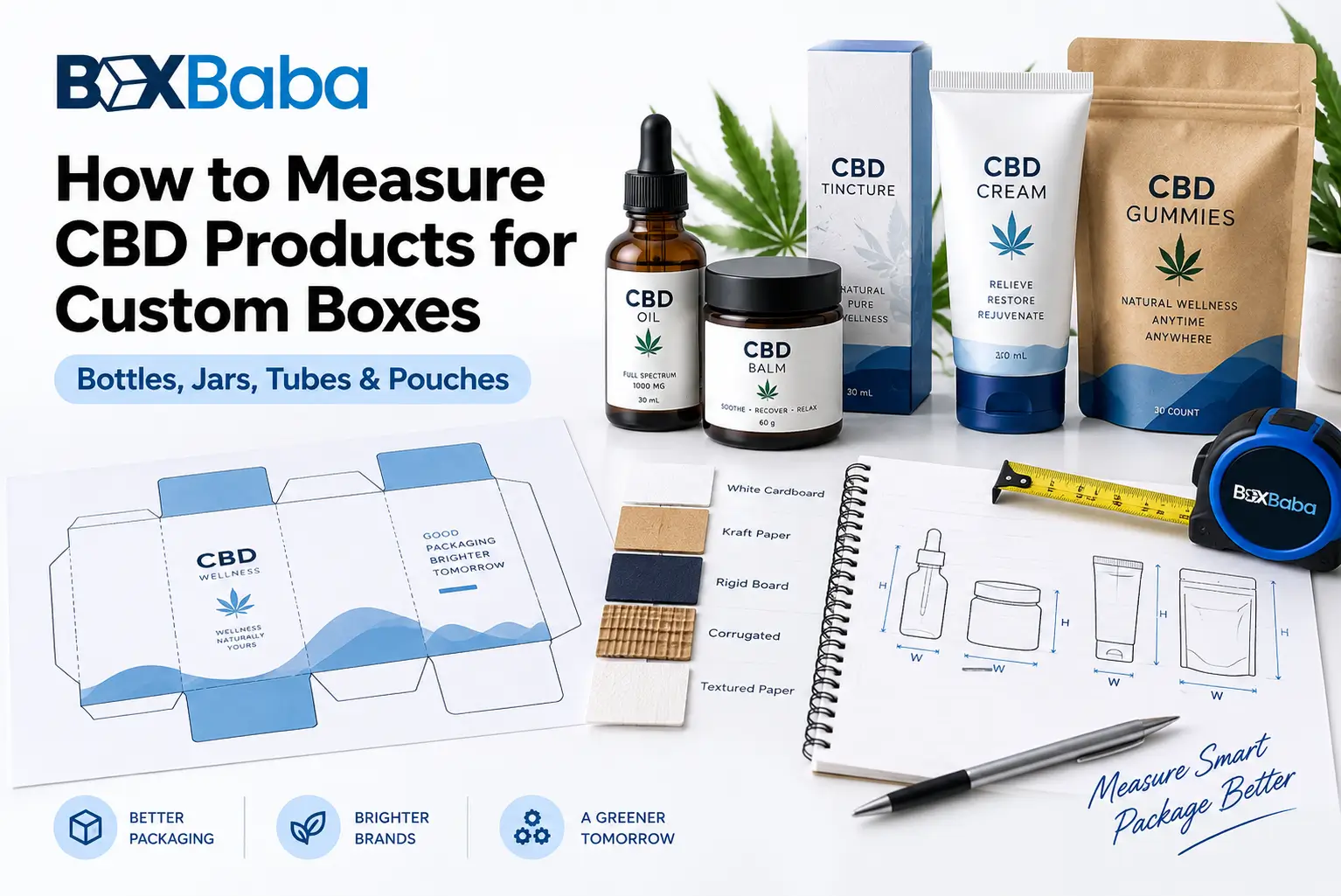
To measure a CBD product for a custom box, measure the complete finished primary package exactly as it will enter the secondary packaging.
For a non-round product, record:
Maximum Height × Maximum Width × Maximum Depth
For a truly round container, record:
Overall Height + Maximum Finished Diameter
Then record three additional inputs:
Closure / Packed State + Filled Weight + Packing Orientation
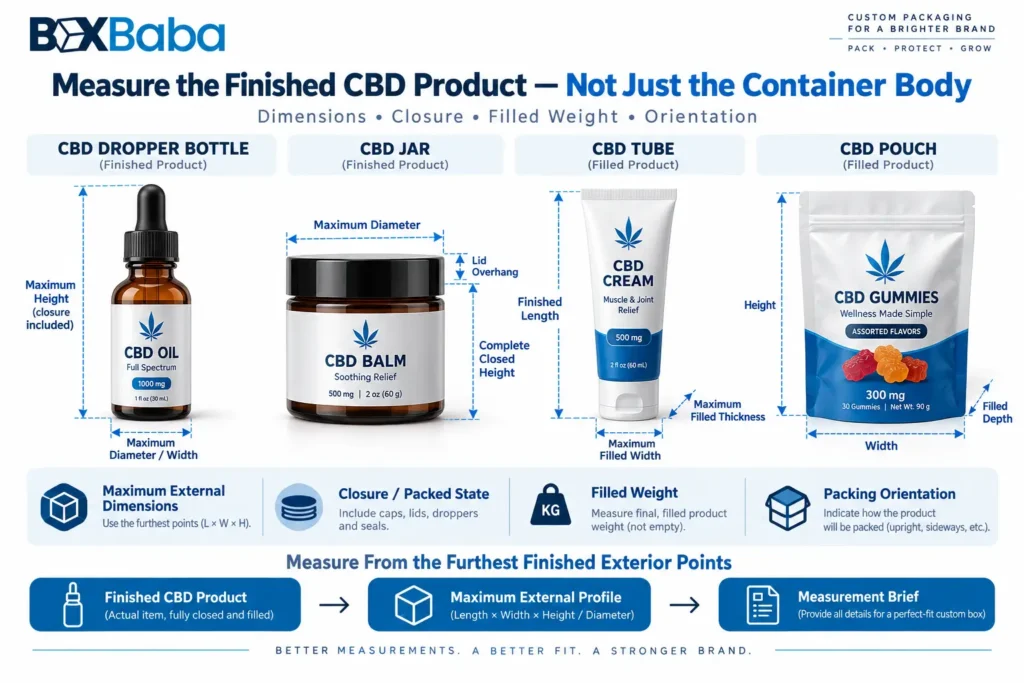
This means measuring a dropper bottle with its final dropper installed, a jar with its lid completely closed, a pump bottle in the position used during packing, a tube after filling and sealing, and a flexible pouch in a realistic filled condition.
The practical measurement sequence is:
Finished CBD Product → Maximum External Profile → Closure / Packed State → Filled Weight → Orientation → Measurement Brief
Do not choose a carton from product capacity alone.
30 ml does not equal one standard CBD box size.
A 30 ml product could be supplied in a narrow dropper bottle, wide cosmetic jar, airless pump or squeeze tube. Each can require different secondary packaging.
Brands preparing a commercial project can use these measurements when exploring Custom CBD Boxes, but the numbers collected in this guide are product measurements—not final carton dimensions.
Quick Measurement Checklist
Before sending a CBD packaging enquiry, record the following information for each distinct primary-container format:
Input | What to Record |
Product | CBD product type / SKU |
Primary container | Bottle, jar, tube, stick, pouch or other format |
Height | Maximum finished height |
Width | Maximum side-to-side dimension |
Depth | Maximum front-to-back dimension |
Diameter | Maximum diameter where genuinely round |
Closure | Cap, lid, pump, dropper, bulb, overcap, zipper or fitment |
Packed state | Locked, closed, capped, sealed or another defined state |
Filled weight | Complete finished primary unit |
Orientation | Upright, horizontal, flat or defined presentation position |
Units per box | One or multiple |
Accessories | Any item packed with the product |
Reference | Product photographs, sample or supplier drawing where available |
The important word is maximum.
Measure from the furthest finished exterior point on one side to the furthest finished exterior point on the opposite side.
Measure the Saleable Primary Package, Not the CBD Formulation
The outer carton is normally developed around the package that directly contains the product.
For example:
CBD Oil → Dropper Bottle → Secondary Carton
CBD Gummies → Sealed Jar → Secondary Carton
CBD Lip Balm → Twist-Up Tube → Secondary Carton
The amount of formulation inside can identify the SKU, but it does not describe the physical packaging envelope.
For example:
30 ml CBD oil
does not tell the box supplier the:
- bottle diameter;
- bottle height;
- shoulder profile;
- dropper size;
- cap width;
- filled weight.
Likewise:
30 gummies
does not identify the external dimensions of the finished gummy jar or pouch.
For sizing purposes, measure what physically goes inside the custom box.
How to Measure CBD Bottles
CBD bottle packaging includes several closure types, and the closure often creates the most commonly missed measurement.
CBD Dropper Bottles
Measure the complete bottle with the final dropper fitted.
Record:
- maximum bottle diameter or width;
- depth where applicable;
- overall closed height;
- shoulder profile;
- maximum closure width;
- rubber bulb where used;
- collar or other permanent exterior component;
- base footprint;
- filled weight.
For a round bottle, the body may appear to require only:
Diameter + Height
but check whether the dropper cap or bulb is wider than the glass.
If it is, use the maximum finished width, not the body diameter alone.
Use the Final Dropper, Not a Placeholder Closure
If the product will ship with:
Bottle + Dropper
do not provide measurements taken from:
Bottle Only
Different dropper assemblies can change both height and width.
If the final production closure changes after the first packaging measurement, recheck the product before approving the carton structure.
Brands whose project is primarily defined by this container format can explore CBD Dropper Bottle Boxes.
How to Measure CBD Pump Bottles
Measure a pump bottle in the exact state in which it will be packed.
Record:
- maximum bottle width;
- maximum depth;
- complete packed height;
- shoulder profile;
- pump collar;
- actuator;
- horizontal spout projection;
- overcap where applicable;
- base footprint;
- filled weight.
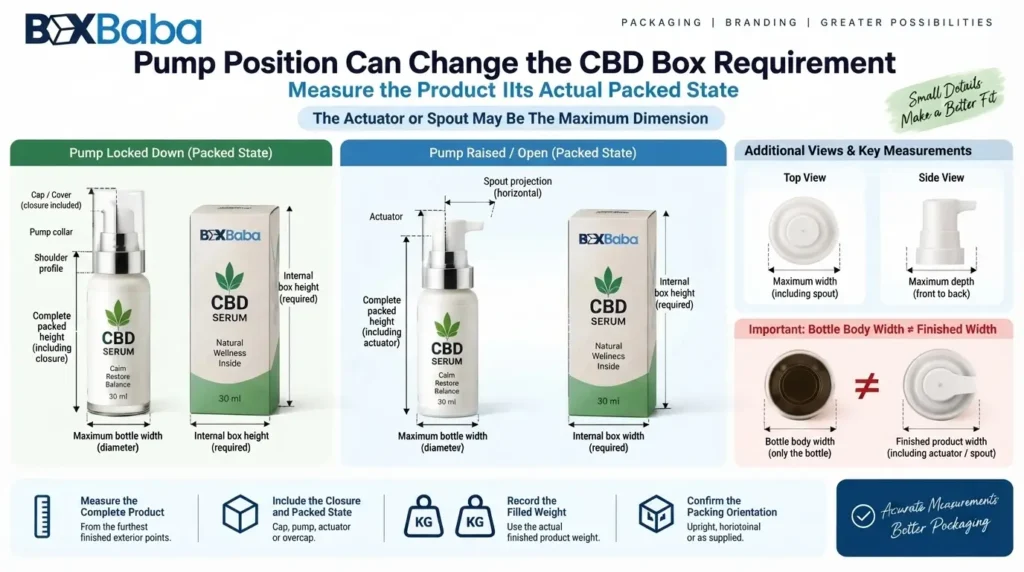
The Pump Position Matters
A pump might be packed:
- locked down;
- rotated closed;
- under an overcap;
- raised;
- in another supplier-defined configuration.
The measurement brief should state which version applies.
If the pump is packed locked, measure it locked.
If production units enter the carton with the actuator raised, measure that condition instead.
Measure Projection as Well as Height
A pump can extend horizontally beyond the bottle wall.
That means:
Bottle Body Width ≠ Finished Pump Product Width
where the actuator or spout becomes the furthest external point.
How to Measure Foaming Dispensers
Foaming pumps can have a relatively broad dispenser assembly.
Record:
- maximum bottle width;
- maximum bottle depth;
- overall packed height;
- maximum pump-head width;
- collar dimensions;
- nozzle or spout projection;
- overcap where fitted;
- filled weight.
A narrow bottle does not automatically mean a narrow box if the pump head is substantially wider.
How to Measure Capped CBD Bottles
For capsule bottles, topical bottles or other capped formats, measure:
- maximum body diameter or width;
- maximum depth;
- overall closed height;
- cap diameter or width;
- cap overhang;
- shoulder profile;
- filled weight.
Do not use the capsule count or product capacity as a physical box dimension.
For example:
30 capsules
does not establish the bottle height or cap width.
Two manufacturers can use very different containers for the same count.
How to Measure CBD Jars
For a jar, compare the body and lid before recording the maximum width.
Round Jars
Measure:
- maximum body diameter;
- maximum lid diameter;
- overall closed height;
- lid height;
- lid overhang;
- base footprint;
- filled weight.
If:
Jar Body = narrower
and
Lid = wider
the lid controls the maximum diameter.
Use:
Maximum Finished Diameter
not automatically:
Jar Body Diameter
Square & Rectangular Jars
Record:
Maximum Height × Maximum Width × Maximum Depth
Also check whether the lid projects beyond the side walls.
Do not treat width and depth as interchangeable unless the container is genuinely square.
Double-Wall & Decorative Jars
A small amount of CBD cream or balm can be supplied in a much larger double-wall cosmetic container.
Measure the complete exterior assembly, including permanent:
- decorative shells;
- lids;
- raised bases;
- collars;
- outer walls.
The internal fill capacity does not matter to the carton geometry if the exterior package is different.
For jar-led commercial packaging, see Custom CBD Jars.
CBD Gummies: Measure the Jar or Pouch, Not the Gummies
When gummies are sold in a jar, the jar becomes the product being measured for the secondary carton.
Record:
- maximum jar diameter or width;
- depth where applicable;
- overall closed height;
- lid dimensions;
- filled weight.
Do not calculate the carton from gummy count.
For example:
30 gummies ≠ one standard jar size
A brand may use a tall narrow jar while another uses a short wide jar for a similar quantity.
For product-specific commercial packaging, explore CBD Gummies Boxes.
How to Measure CBD Tubes
Flexible tubes should be measured after filling, sealing and fitting the final cap whenever possible.
Record:
- overall closed length;
- maximum filled width;
- maximum filled thickness;
- cap diameter or width;
- cap depth;
- crimped or sealed-end profile;
- filled weight.
Do Not Use the Flat Empty Tube as the Final Measurement
An unfilled tube can lie nearly flat.
After filling, its side profile expands.
Therefore:
Empty Tube Dimensions ≠ Finished Filled Tube Dimensions
Use the realistic saleable form when developing secondary packaging.
Check Whether the Cap Is Wider Than the Tube
Flip-top and screw caps can project beyond the filled tube body.
If the cap becomes the maximum width or depth, record that dimension accordingly.
How to Measure CBD Lip Balm Tubes, Sticks & Tins
CBD lip-care products can use several primary-container geometries.
Round Twist-Up Tube
Record:
- maximum diameter;
- overall closed height;
- cap diameter;
- twist-base diameter;
- filled unit weight.
Oval or Rectangular Stick
Record:
- maximum width;
- maximum depth;
- overall closed height;
- cap dimensions;
- base dimensions.
Do not convert an oval or rectangular package into an assumed diameter.
Tin
For a round tin:
Maximum Diameter + Overall Closed Height
For a rectangular tin:
Maximum Width × Maximum Depth × Overall Closed Height
Brands coordinating CBD lip care with other beauty formats can explore Custom CBD Cosmetic Boxes.
How to Measure a CBD Pouch for a Secondary Carton
Flexible pouches require particular care because their physical depth changes after filling.
Use a realistic filled and closed pouch where possible.
Record:
- maximum width;
- overall height;
- maximum filled depth;
- bottom gusset where relevant;
- side gusset where relevant;
- zipper or closure profile;
- spout or fitment where applicable;
- filled weight.
Flat Dimensions Are Not Always the Packed Dimensions
A pouch stored flat may appear to have almost no depth.
After filling, the product can expand the:
- front-to-back profile;
- bottom gusset;
- side gussets.
Therefore:
Flat Empty Pouch ≠ Finished Filled Pouch Envelope
Do not invent one fixed depth if the package changes noticeably according to fill.
Provide a representative filled sample or the supplier finished-package specification where available.
Include Spouts & Fitments
If a pouch has a spout or fitted closure, measure the complete component.
It can affect:
- maximum height;
- maximum width;
- orientation inside a secondary carton.
Include Permanent Exterior Components That Affect Fit
Measure the final product configuration, including permanent components when they materially change its exterior profile.
Examples can include:
- overcaps;
- neck bands;
- collars;
- decorative shells;
- substantial sleeves;
- raised labels;
- tamper components;
- other attached exterior features.
A thin label may make no meaningful dimensional difference, while a decorative collar or large overcap may change the package geometry substantially.
Use a practical rule:
If the component goes into the box with the product and changes its maximum external profile, include it.
Confirm Packing Orientation
Dimensions describe the product geometry.
Orientation describes how those dimensions are assigned inside the package.
For example:
Bottle Upright
→ bottle height usually maps to carton height.
Bottle Horizontal
→ the same physical bottle can create a wider presentation footprint.
Record whether the product will be packed:
- upright;
- horizontal;
- flat;
- in another defined position.
Orientation becomes particularly important when:
- a window must align with the product;
- a closure should face a particular direction;
- several items share one package;
- an insert controls presentation.
Record Filled Weight
Measure the weight of the complete finished primary unit where practical:
Container + Product + Closure = Filled Unit Weight
This is more useful than the empty-container weight because the finished product becomes the structural load.
Filled weight is particularly useful for:
- glass dropper bottles;
- heavy jars;
- pump bottles;
- multi-product sets;
- large filled pouches.
Weight does not automatically determine the final board or box style.
It is an input the structural packaging team can evaluate alongside geometry and the intended configuration.
Measurement Data Is Not the Final Box Size
This distinction prevents one of the most common sizing mistakes.
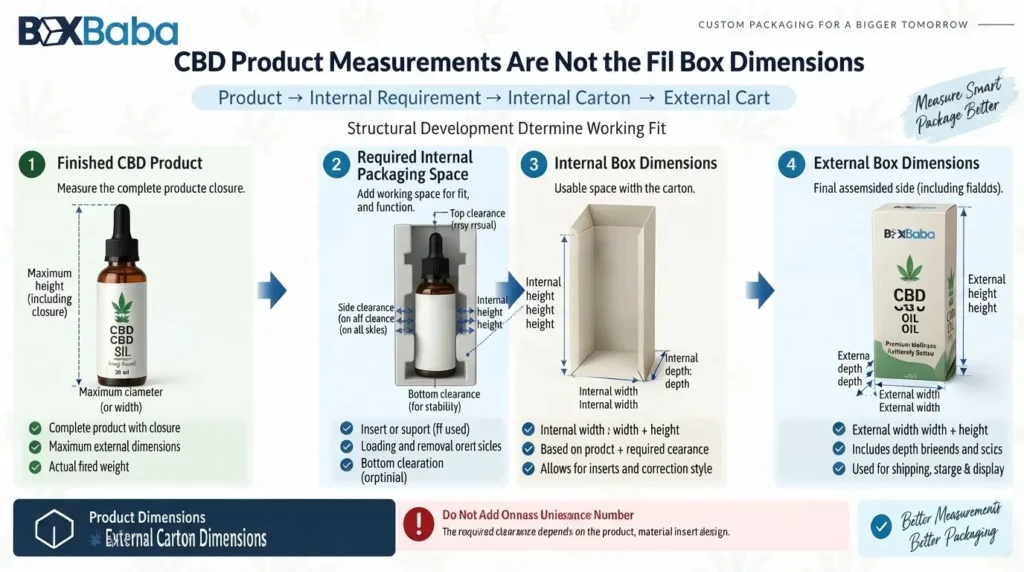
These are separate things:
Finished Product Dimensions
↓
Required Internal Packaging Space
↓
Internal Box Dimensions
↓
External Finished Box Dimensions
The buyer supplies accurate product measurements.
The structural packaging process then evaluates requirements such as:
- loading direction;
- product removal;
- material construction;
- inserts;
- structure;
- product variation;
- production tolerances.
Therefore:
Product Dimensions ≠ Internal Carton Dimensions ≠ External Carton Dimensions
Do Not Add a Universal Clearance Number
There is no reliable fixed amount that should be added around every CBD bottle, jar, tube or pouch.
Working clearance can vary with:
- product geometry;
- closure shape;
- container variation;
- loading direction;
- removal direction;
- box structure;
- material;
- insert design.
Some current packaging guides recommend fixed allowances, but a universal formula can create either excessive movement or an unnecessarily tight fit.
The buyer job is simpler:
Provide accurate finished-product measurements.
The final working clearance should be resolved during structural development.
If the Final Product Is Not Available Yet
Sometimes packaging planning begins before the production product exists.
In that situation, clearly label the dimensions as preliminary.
Useful references may include:
- approved container drawing;
- manufacturer specification;
- production-equivalent sample;
- confirmed closure drawing.
Use:
Preliminary Dimensions → Final Product Confirmation → Structural Approval
Do not silently treat a supplier drawing or prototype measurement as guaranteed finished-production geometry.
Before final approval, confirm that the production container and closure still match the packaging specification.
Account for Primary-Container Variation
Where the primary-container supplier provides dimensional tolerances, include them with the packaging brief.
Variation becomes more important when:
- carton fit is intentionally close;
- an insert contacts the container closely;
- glass components show normal dimensional variation;
- flexible filled packages vary by fill;
- different suppliers provide nominally similar containers.
When appropriate, check more than one production-representative sample.
Do not invent a generic percentage tolerance for all CBD containers.
Use the information supplied for the actual component.
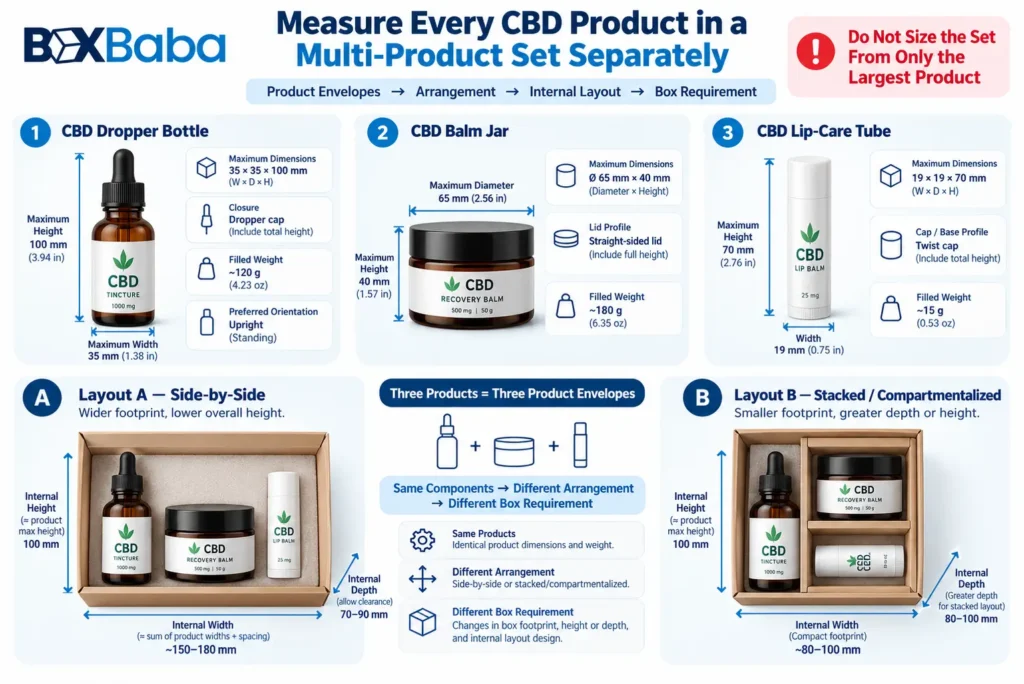
Measure Multi-Product CBD Sets One Item at a Time
A set containing three products cannot be sized from only the largest product.
Measure each item separately.
For every component, record:
- product name;
- primary-container type;
- maximum dimensions;
- closure;
- filled weight;
- preferred orientation.
For example:
Dropper Bottle + Balm Jar + Lip-Care Tube
creates three separate product envelopes.
The structural stage can then determine how those envelopes should be arranged.
Do not calculate the final gift-box size by simply adding all product widths.
Different layouts can produce different footprints.
Where internal holders or compartments will be required, Printed Boxes with Inserts provides the relevant commercial packaging route.
Measure Accessories as Separate Components
If an accessory will be inside the same finished package, measure it separately.
Examples may include:
- applicator;
- spatula;
- brush;
- booklet;
- measuring component;
- other included item.
Record its:
- length;
- width;
- thickness or depth;
- weight where relevant;
- preferred orientation.
Do not assume the accessory can be placed into unused space after the box has already been engineered.
Can Several CBD SKUs Share the Same Measurement Set?
Yes—when their physical packaging is genuinely the same.
Several formulas or variants may share one carton structure when they use the same:
- primary container;
- maximum external dimensions;
- closure;
- packed state;
- orientation;
- compatible filled weight.
Artwork may still change by:
- product name;
- formula;
- flavor;
- strength;
- barcode;
- other SKU information.
Equal capacity alone is not enough.
Two 30 ml products can still use different bottles.
When Is a Physical Sample Particularly Useful?
Dimensions and photographs can begin many packaging discussions, but a physical sample becomes especially useful when the finished product has:
- irregular geometry;
- decorative projections;
- complex pumps or droppers;
- heavy glass construction;
- flexible filled shapes;
- close-fitting insert requirements;
- surfaces that should avoid concentrated contact.
A sample can communicate three-dimensional characteristics that are difficult to describe through numbers alone.
Confirm the sample route for the particular project before production.
Product Photographs That Improve the Measurement Brief
Useful reference photographs can include:
- front view;
- side view;
- top view;
- bottom view;
- closure close-up;
- finished product in its actual packed state.
For a pouch, include a side view showing the realistic filled depth.
CBD Product Measurement Matrix
CBD Package Format | Measure | Include | Commonly Missed |
Dropper bottle | Maximum H + diameter or W × D | Dropper, bulb, cap | Closure width |
Pump bottle | Maximum H × W × D | Pump, collar, overcap | Spout projection / packed pump state |
Capped bottle | H × W × D or diameter | Complete cap | Cap overhang |
Round jar | H + maximum diameter | Closed lid | Wider lid |
Square jar | H × W × D | Closed lid | Lid projection |
Flexible tube | Filled H × W × D | Cap and sealed end | Filled thickness |
Lip balm tube | Closed H + max diameter or W × D | Cap and twist base | Wider cap/base |
Flexible pouch | W × H × maximum filled depth | Gusset, zipper, fitment | Filled profile |
Multi-product set | Each item separately | Accessories | Orientation and component count |
These are measurement rules, not standard BoxBaba carton dimensions.
Common CBD Measurement Errors
Mistake | Why It Creates a Weak Specification | Better Method |
Measuring an empty bottle/tube/pouch | Finished profile can differ | Measure the saleable unit |
Using ml, oz, grams or unit count as size | Capacity does not define geometry | Provide physical dimensions |
Ignoring the closure | It may be widest or tallest | Measure the complete package |
Measuring only the jar body | Lid may overhang | Use maximum finished diameter |
Measuring an unlocked pump incorrectly | Packed height may differ | Record actual packed state |
Forgetting filled weight | Empty container is not final load | Weigh the completed unit |
Mixing units | Increases specification errors | Use inches or mm consistently |
Adding generic clearance | Fit requirements vary | Provide actual product dimensions |
Treating measurements as dieline dimensions | Dieline contains structural components | Let the structural stage develop the box |
Assuming all SKUs share geometry | Containers can differ | Measure every distinct physical format |
CBD Product Measurement Brief Template
Use this template before requesting secondary packaging.
Information | Project Detail |
Product Name | __________________ |
SKU / Variant | __________________ |
Primary Container | __________________ |
Closure Type | __________________ |
Packed Closure State | __________________ |
Measurement Unit | Inches / mm |
Maximum Height | __________________ |
Maximum Width | __________________ |
Maximum Depth | __________________ |
Maximum Diameter, if relevant | __________________ |
Filled Weight | __________________ |
Packing Orientation | __________________ |
Units per Box | __________________ |
Accessories | __________________ |
Supplier Drawing Available | Yes / No |
Production Sample Available | Yes / No |
Product Photos Available | Yes / No |
Container Variation / Tolerance Provided | __________________ |
For multiple products, complete the physical information for each distinct container.
What Happens After the Product Is Measured?
Product measurement is the buyer-input stage.
The structural packaging stage comes next:
Finished Product
↓
Verified Maximum Measurements
↓
Closure + Filled Weight + Orientation
↓
Internal Packaging Requirement
↓
Structure / Insert Development
↓
Dieline
↓
Fit Review
↓
Artwork
↓
Production
The product dimensions themselves are not the dieline.
A dieline also defines panels, folds, flaps, glue areas and structural features.
For the production-file fundamentals, use BoxBaba Dieline in Packaging guide.
What Should You Send BoxBaba After Measuring the Product?
Once the measurement brief is complete, provide:
- product type;
- finished primary-container dimensions;
- closure and packed state;
- filled weight;
- packing orientation;
- photographs or sample information;
- quantity per SKU;
- number of distinct container formats;
- accessories;
- insert requirement if already known;
- delivery destination.
These inputs give the packaging team a better starting point than a request such as:
I need a box for a 30 ml CBD product.
Brands can then explore the appropriate commercial packaging route through Custom CBD Boxes.
BoxBaba current CBD packaging program starts from 100 units, includes artwork support and sample options, typically uses 5–9 business days of production after artwork approval, and includes free shipping across the USA.
Final Takeaway
The most useful CBD packaging measurement is the finished primary package in the state in which it will actually enter the box.
For bottles, include the cap, dropper or pump.
For jars, measure the widest finished point—which may be the lid.
For tubes, use the filled and sealed profile.
For pouches, measure realistic filled depth rather than only the flat dimensions.
Then record:
Maximum Dimensions + Closure / Packed State + Filled Weight + Orientation
Do not convert those numbers into a final box by adding an arbitrary allowance.
The correct handoff is:
Finished CBD Product → Accurate Measurement Brief → Structural Specification → Dieline → Custom Packaging
Useful reference photographs can include:
- front view;
- side view;
- top view;
- bottom view;
- closure close-up;
- finished product in its actual packed state.
For a pouch, include a side view showing the realistic filled depth.
Frequently Asked Questions
Should I measure a CBD bottle with the cap, pump or dropper attached?
Yes. Measure the complete product exactly as it will be packed. The closure can become the maximum height, width or depth.
Does a 30 ml CBD bottle have a standard box size?
No. Capacity does not define the external bottle geometry. Different 30 ml containers can have different heights, diameters, shoulders and closures.
Should I use inches or millimeters?
Either is suitable. Use one system consistently throughout the specification. Millimeters can be convenient for smaller containers and closures.
How many product samples should I measure?
There is no universal number. If the supplier identifies meaningful dimensional variation, or the packaging fit will be close, checking several representative units can provide useful context.
Should I add extra clearance to my measurements?
Do not assume one fixed allowance works for every project. Provide accurate finished-product dimensions and let the structural packaging process determine the required working fit.
Can a container drawing replace the physical product?
It can be useful during preliminary planning. Final production packaging should still be checked against the actual production container or a suitable representative sample where fit is important.
How should I measure a pump that locks down?
Measure the pump in the state in which it will enter the carton. Clearly state that the measurement represents the locked packing position.
How do I measure a pouch that changes shape when filled?
Use a representative filled and closed pouch where possible and record its maximum realistic width, height and filled depth. Include gussets, spouts or other fitments that affect the final profile.
Can several CBD SKUs use the same box dimensions?
They can when their finished containers, closures, packed states, orientations and fit requirements are physically compatible. Equal capacity or similar branding alone does not establish compatibility.
When should I send a physical product sample?
A sample becomes particularly useful for irregular shapes, flexible packages, complex closures, heavy glass containers or projects where the finished fit will be closely controlled.