
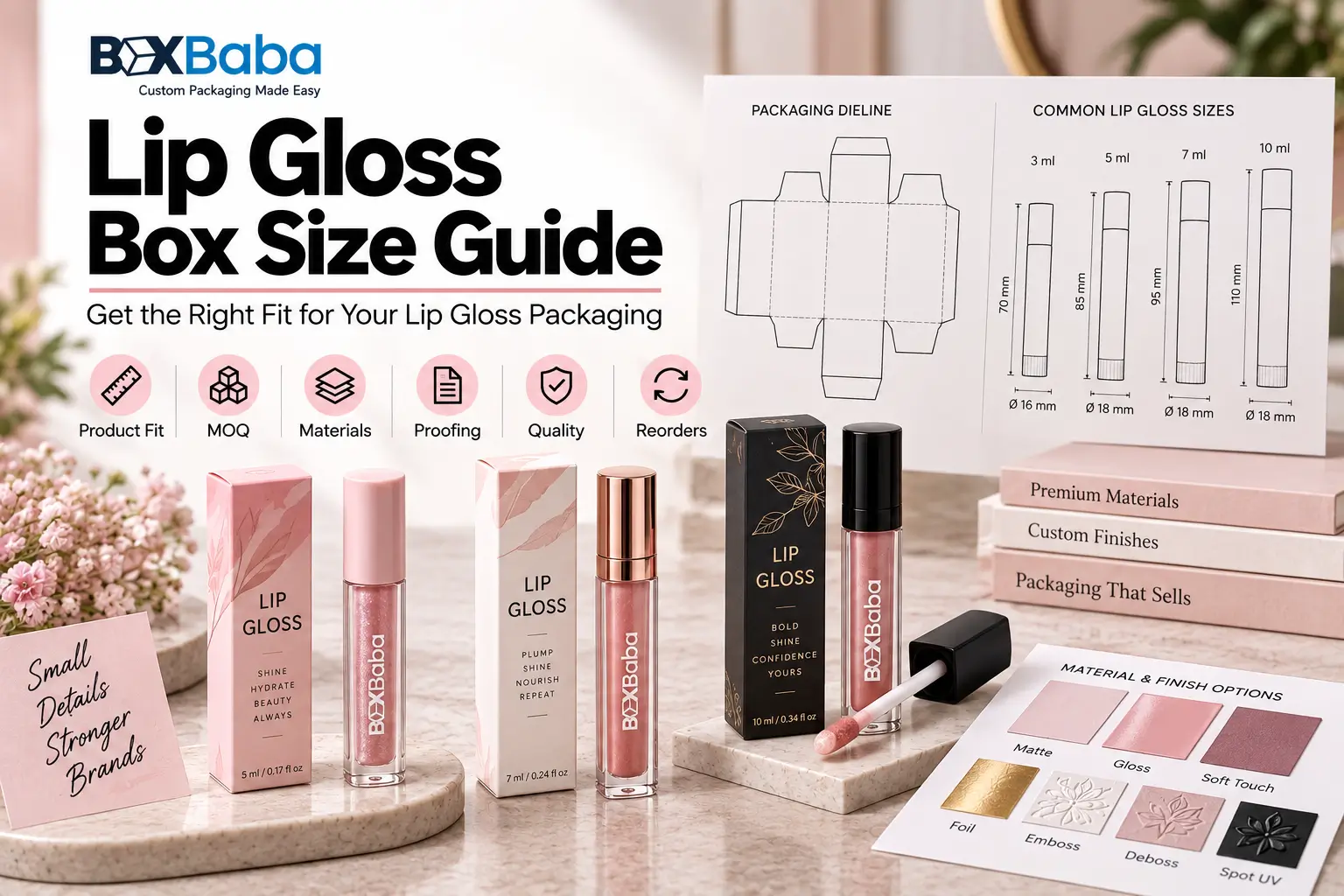
There is no single production-ready lip gloss box size.
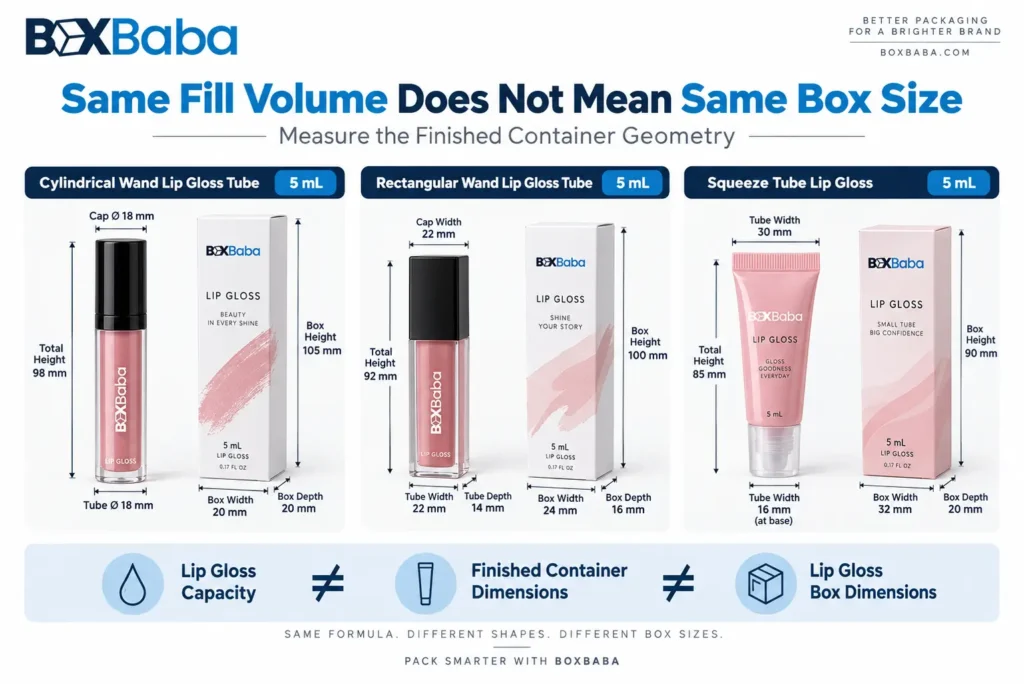
Two lip gloss products can contain the same amount of formula but use completely different primary containers. One may use a tall cylindrical wand tube, another a rectangular applicator tube, and another a short squeeze tube or pot.
The box therefore needs to be developed around the complete finished lip gloss container, not only the product volume or a generic tube-size reference.
Finished Lip Gloss Product -> Maximum External Geometry -> Orientation -> Internal Support if Needed -> Internal Carton Dimensions -> Material + Structure -> External Box Dimensions -> Dieline
Brands preparing a custom project can review Lip Gloss Boxes for commercial packaging options. For measurement principles that apply across bottles, jars, tubes and other cosmetics, see the Cosmetic Box Size Guide.
Is There a Standard Lip Gloss Box Size?
There is no universal lip gloss carton size that can reliably be selected from product capacity alone.
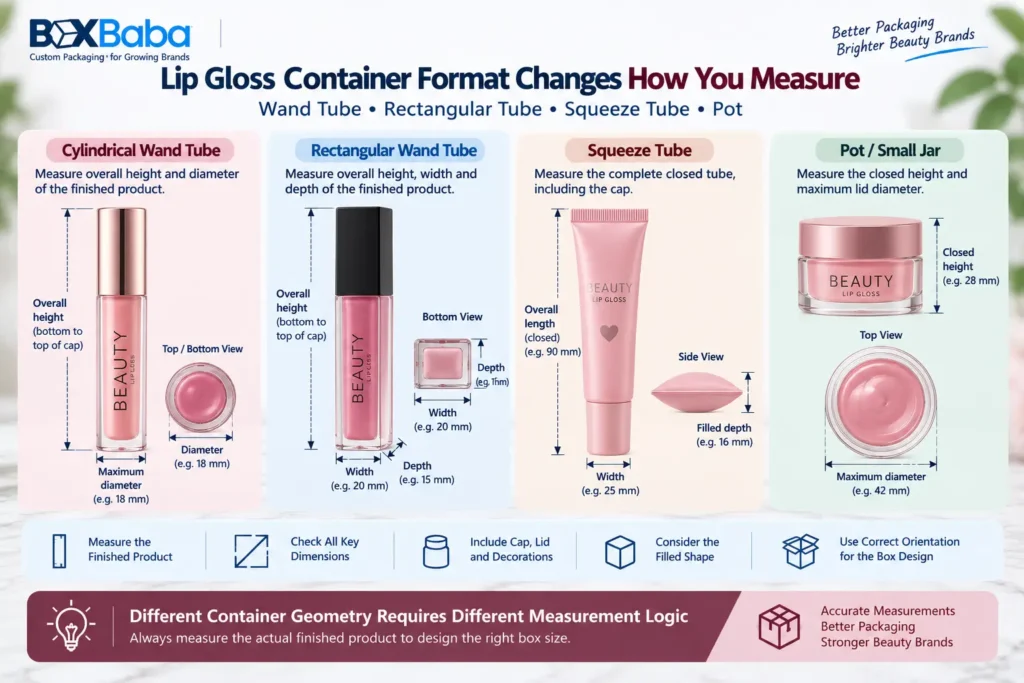
Lip gloss may be sold in cylindrical wand tubes, square or rectangular wand tubes, squeeze tubes, mini or travel-size tubes, pots or small jars, decorative containers, dual-ended products and multi-shade sets.
Even two wand tubes with similar fill capacity can have different cap diameters, barrel widths, shoulder profiles and overall closed heights.
Lip Gloss Capacity != Finished Container Dimensions != Lip Gloss Box Dimensions
Published size ranges can be useful for early planning, photography or rough shelf-layout discussions. They should not replace dimensions taken from the actual product that will enter the carton.
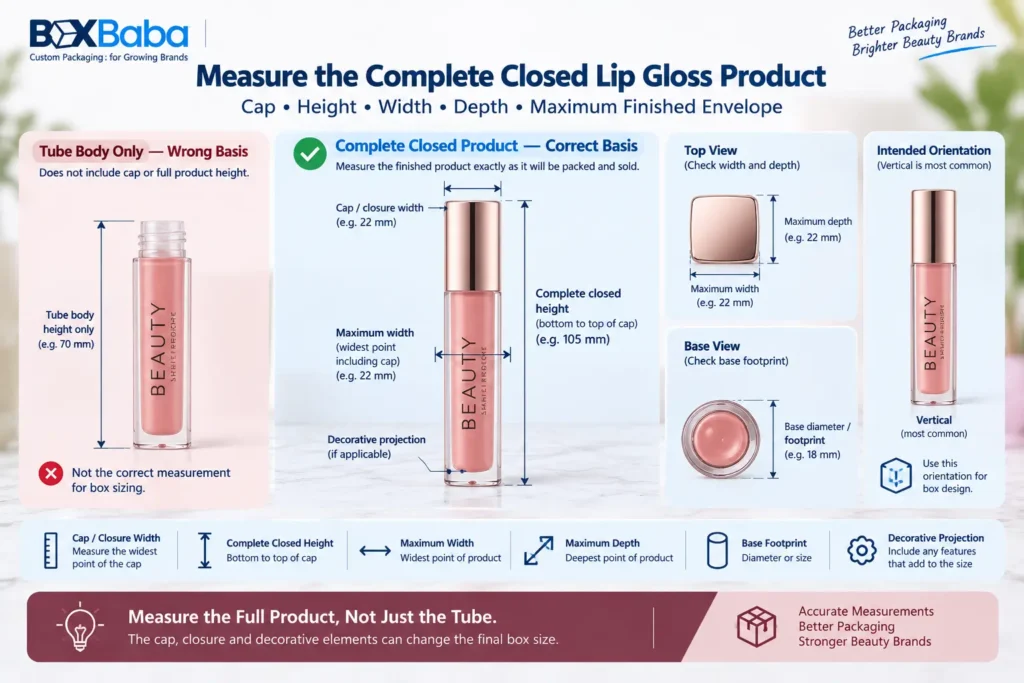
Measure the Complete Closed Lip Gloss Product
Measure the lip gloss exactly as it will be packed and sold. For a conventional wand product, this normally means the tube body, applicator closure, cap and permanent decoration as one finished product.
Do not measure only the clear product chamber. The cap may be wider than the main barrel. A decorative collar may project beyond the tube body. A square closure may create a different maximum depth from a cylindrical tube. Measure the furthest finished points.
Lip Gloss Measurement Checklist
Measurement | What to Record |
|---|---|
Overall closed height | Bottom of the finished tube to the highest point of the fitted cap |
Maximum width | Widest point across the tube, cap or decoration |
Maximum depth | Deepest point for rectangular, oval or irregular products |
Maximum diameter | Use for a genuinely circular finished profile |
Cap / closure width | Record separately where it exceeds the tube body |
Base footprint | Useful for upright orientation and structural planning |
Decorative projection | Any permanent component extending beyond the main geometry |
Filled weight | Weight of the complete filled retail-ready product |
Intended orientation | Upright, horizontal or another planned position |
Units per carton | Single product or multi-product set |
These dimensions describe the product envelope. They are not automatically the final carton dimensions.
How to Measure a Wand Lip Gloss Tube
A wand lip gloss should be measured with the applicator completely closed and the cap seated in its normal retail position.
For a cylindrical product, record the complete closed height and maximum diameter. For a square or rectangular wand tube, record maximum width, maximum depth and complete closed height.
Check the cap separately even if the tube body appears uniform. A cylindrical barrel may be narrower than a decorative square cap. In that case, the cap – not the barrel – may determine the carton width and depth.
Use the Maximum Finished Envelope, not the Tube Body Only
The internal applicator wand does not normally need to be measured separately because it is contained inside the closed finished product. What matters for carton sizing is the outside profile of the complete packaged item.
How to Measure a Square or Rectangular Lip Gloss Tube
Do not convert a square product into a single diameter measurement. Measure width, depth and complete closed height independently because the finished cross-section may not be perfectly square.
Also check whether the cap is wider than the product chamber, deeper than the main body, offset, tapered, faceted or decorated with a projecting feature. A small difference in closure geometry can affect the structural dieline of a narrow cosmetic carton.
How to Measure an Oval Lip Gloss Container
An oval product should generally be treated as a width-and-depth measurement problem rather than a diameter-only problem.
Record maximum width, maximum depth and complete height. The widest point may occur through the main body, while the deepest point may occur through the cap or decorative profile. Do not assume oval width and depth are identical.
How to Measure a Lip Gloss Squeeze Tube
Flexible squeeze tubes behave differently from rigid wand tubes. Measure the product in its normal filled and closed condition.
Record the overall closed length, maximum filled width and maximum filled depth. Also check the cap width or diameter, shoulder, sealed end and filled body profile.
An empty flexible tube can appear flatter than the finished filled product, so an unfilled sample may not represent the final packaging geometry accurately. If the sealed or crimped end is wider than the main tube body, include that maximum width in the specification. If the cap projects beyond the tube body, include the closure in the maximum external envelope.
How to Measure Lip Gloss Pots and Small Jars
Some lip gloss products use short pots or jars rather than elongated tubes. For a round pot, measure the complete closed height and maximum diameter. Check the lid as well as the container body.
If the pot body diameter is 1.45 in but the closed lid diameter is 1.55 in, the packaging measurement should begin with the 1.55-inch maximum finished diameter, not the smaller body dimension.
For square or rectangular pots, record maximum width, maximum depth and complete closed height. Do not assume that product capacity determines the carton footprint.
Product Dimensions Are Not Box Dimensions
A finished lip gloss container has its own physical dimensions. The usable space inside the carton has another set of dimensions. The outside of the assembled carton has another.
Product Dimensions != Internal Box Dimensions != External Box Dimensions
Finished Product Dimensions
These describe the lip gloss product itself.
Internal Box Dimensions
These describe the usable carton space available around the product. They may need to account for the product envelope, structural clearance, an insert or divider, and removal access.
External Box Dimensions
These describe the outside dimensions of the finished package. Material thickness and structural construction influence the relationship between internal and external size.
A supplier therefore should not simply copy the tube dimensions and call those the final carton dimensions.
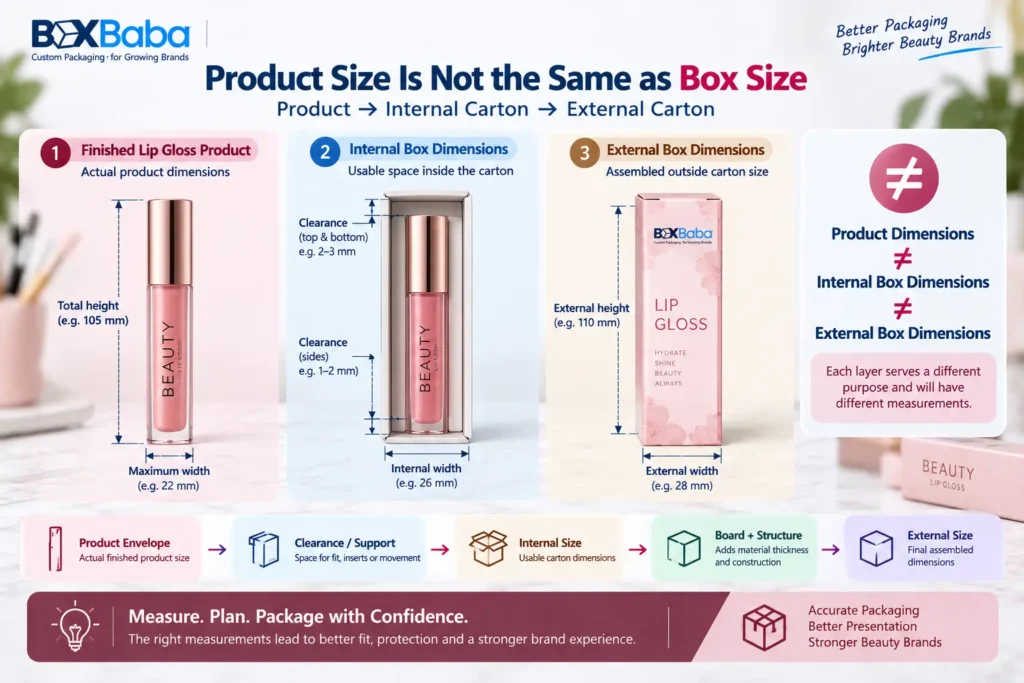
Do Not Add One Universal Clearance Value
A common sizing shortcut is to measure the product and automatically add the same fixed amount to every dimension. That is not a reliable universal method.
Product Geometry -> Material -> Carton Structure -> Packing Method -> Insert -> Product Variation -> Removal Access
A slim cylindrical wand tube and a flexible squeeze tube should not automatically receive identical clearance logic. The better approach is to provide the actual finished-product dimensions clearly labeled as product dimensions, then develop the required internal specification around the selected construction.
When Does a Lip Gloss Box Need an Insert?
A single lightweight gloss tube that already fits appropriately inside a folding carton may not require a separate insert.
An insert becomes more relevant when the package has an unresolved internal function, such as maintaining orientation, separating multiple tubes, creating a presentation arrangement, positioning an accessory or controlling substantial unused internal space.
Lip Gloss Product != Automatic Insert Requirement
Required Internal Function -> Direct Fit / Integrated Support / Separate Insert
A separate insert also occupies physical space, so it should be considered before final carton dimensions are locked.
For the full decision process, see When Do Cosmetic Boxes Need Inserts?.
Single Lip Gloss Carton vs Multi-Shade Set
Measuring a single tube is only the first step for a multi-product collection.
Individual Product Measurements -> Product Count -> Arrangement -> Spacing / Support -> Removal Access -> Completed Internal Layout
Suppose two collections both contain four gloss tubes. They still may require different boxes because one collection could use slim cylindrical tubes while the other uses wide rectangular tubes. Product count alone does not determine box size.
Multi-Shade Lip Gloss Set Planning
Variable | What to Confirm |
|---|---|
Number of products | Exact units per package |
Individual dimensions | Measure every physical container format |
Orientation | Vertical, horizontal or another arrangement |
SKU order | Whether a specific visual sequence matters |
Spacing | Required separation between products |
Insert / divider | Whether one is needed and its completed footprint |
Removal access | Space needed to lift or remove each tube |
Accessories | Applicator, card or other separately packed item |
Loaded weight | Combined weight of complete set |
Outer structure | Folding carton, sleeve, drawer, two-piece or other format |
A set box should therefore be developed around the complete arrangement, not by multiplying one tube width by the number of products and treating that as the finished box dimension.
Can Several Lip Gloss Shades Use the Same Box Size?
Yes, when the physical packaging geometry remains the same.
Same Tube -> Same Cap -> Same Dimensions -> Same Orientation -> Same Structure
The structural packaging may be able to use one shared dieline while each shade receives a different artwork version.
Same Physical Geometry -> Shared Structural Dieline -> Multiple Artwork SKUs
Shade name, color graphics and barcode changes do not necessarily require a new structural carton. However, the structure should be reviewed if a variant changes the container dimensions, closure, orientation, insert, window position or number of products per box.
This distinction can simplify multi-SKU packaging management without incorrectly treating every artwork change as a structural change.
Mini Lip Gloss Products Need Their Own Measurements
Do not create a mini lip gloss carton by proportionally shrinking a full-size box. The mini product should be measured independently.
Check complete height, maximum width and depth or diameter, cap profile, base, decoration and filled weight. The relationship between the cap and body may be different from the full-size version. For example, a mini product may have a relatively large cap compared with its shortened product chamber, changing the physical proportions of the carton.
Dual-Ended Lip Gloss Products
Dual-ended lip products can create a different sizing problem because both ends may contain closures or applicators. Measure the product from the furthest closed end to the opposite furthest closed end. Also record the maximum width and depth across both ends.
For a dual-ended cylindrical product, record complete end-to-end length and maximum diameter. For a shaped product, record complete length, maximum width and maximum depth. If the two ends have different closure dimensions, include the larger finished cross-section.
Window Position Depends on Product Geometry
A window is not simply an artwork feature. If the box needs to reveal the gloss shade, product chamber, logo or cap, first confirm the product orientation and visible product area before setting the window position and artwork.
Product Orientation -> Visible Product Area -> Window Position -> Structural Review -> Artwork
The visible portion of a wand tube may not remain centered if the product can rotate freely inside an oversized carton. Likewise, a window positioned from estimated tube dimensions may not align correctly with the physical product. This is another reason measurement and structural planning should occur before artwork is finalized.
Lip Gloss Retail Carton vs Ecommerce Package
An individual lip gloss carton and the outer package used to ship an online order perform different packaging roles.
Retail: Finished Lip Gloss -> Individual Retail Carton
Ecommerce: Finished Lip Gloss -> Retail Carton -> Completed Order Arrangement -> Outer Mailer / Shipping Carton
The retail box should therefore not automatically be sized or described as the complete ecommerce shipping package. If several glosses are sold together online, the ecommerce sizing task may need to begin from the dimensions and arrangement of the completed retail boxes, not the bare lip gloss tubes.
For more detail, see Retail vs Ecommerce Cosmetic Packaging.
Worked Lip Gloss Measurement Example
Consider a hypothetical rectangular wand lip gloss product. The finished measurements are:
Product Attribute | Example Measurement |
|---|---|
Tube body width | 0.72 in |
Tube body depth | 0.70 in |
Cap width | 0.78 in |
Cap depth | 0.76 in |
Complete closed height | 4.18 in |
The correct starting product envelope would therefore be 0.78 in maximum width x 0.76 in maximum depth x 4.18 in complete height.
The carton should not automatically be specified as exactly 0.78 x 0.76 x 4.18 in because those are the finished product dimensions.
Product Envelope -> Required Clearance / Internal Support -> Internal Carton Dimensions -> Board + Structure -> External Carton Dimensions
The example illustrates the method; it is not a universal lip gloss box size.
What If the Final Lip Gloss Tube Is Not Available Yet?
If the final product has not yet been manufactured, use the most reliable available reference and mark the measurements as preliminary. Possible references include approved container drawings, manufacturer specifications or a production-equivalent sample.
Preliminary Dimensions -> Final Finished Product -> Measurement Confirmation -> Structural Approval
Do not treat estimated dimensions as confirmed production dimensions. If the selected container supplier later changes the cap, wall profile or bottle proportions, the packaging specification should be checked again.
Finished Box Dimensions vs Flat Dieline Dimensions
A finished box dimension describes the assembled package. A dieline describes the flat production layout before cutting, creasing, folding and gluing. These are different dimensional systems.
A carton dieline can contain front and rear panels, side panels, glue flap, tuck flaps, locking features, dust flaps, cut lines, crease lines, window areas and other structural components.
Lip Gloss Product Measurements -> Structural Specification -> Finished Carton Dimensions -> Dieline
The tube dimensions themselves are not a dielin.
Common Lip Gloss Box Sizing Mistakes
Mistake | Why It Creates a Weak Specification | Better Direction |
|---|---|---|
Choosing box size from fill volume | Capacity does not define exterior geometry | Measure the finished product |
Measuring only the tube body | Cap may be wider or taller | Include the complete closed closure |
Treating width and depth as identical | Square, rectangular and oval products may differ | Record both separately |
Measuring an empty squeeze tube | Filled profile may differ | Measure the finished filled tube where possible |
Using a competitors standard box size | Their container may have different geometry | Use your own product dimensions |
Adding universal clearance | Fit requirements vary | Develop clearance with the structure |
Ignoring insert thickness | Insert consumes internal space | Develop insert before locking box size |
Multiplying tube width for sets | Arrangement involves spacing and access | Plan the completed set |
Treating product size as external box size | Board and construction affect dimensions | Distinguish product, internal and external dimensions |
Finalizing artwork before structure | Window and panel position may change | Confirm dieline first |
Lip Gloss Box Measurement and Quote Checklist
Before requesting packaging pricing, prepare the complete finished lip gloss product and record its maximum physical dimensions.
Provide the product format, complete height, maximum width, maximum depth or diameter, cap/applicator profile, filled weight, orientation, units per package, insert requirement if known, window requirement, preferred structure if known, quantity by SKU, artwork status and intended retail/ecommerce use.
This gives the packaging supplier a more useful specification than simply stating, I need a box for a 5 ml lip gloss. The formula volume can still be provided as product information, but it should not replace the finished container measurements.
How Lip Gloss Measurements Become a Custom Box
Finished Lip Gloss Product -> Maximum External Envelope -> Filled Weight + Orientation -> Direct Fit / Insert Requirement -> Internal Carton Specification -> Material + Box Structure -> External Dimensions -> Structural Dieline -> Artwork -> Proof / Fit Confirmation
Brands ready to develop packaging around their actual tubes, squeeze products, pots or multi-shade sets can review BoxBabas Custom Lip Gloss Boxes.
FAQs About Lip Gloss Box Sizes
What is the standard lip gloss box size?
There is no universal production-ready lip gloss box size. The correct dimensions depend on the complete finished container, including the tube body, cap or applicator closure, decorative components, orientation and any required internal support.
Does lip gloss volume determine the box size?
No. Fill volume describes the amount of cosmetic formula inside the container. It does not define the outside dimensions of the finished lip gloss tube or the carton developed around it.
How do I measure a lip gloss tube for a box?
Measure the product completely closed. Record the overall height and the maximum width and depth. If the entire product is truly circular, record the overall height and maximum diameter. Include the cap and any permanent decorative projections.
Should I include the wand cap when measuring lip gloss?
Yes. The applicator cap is part of the finished retail product and may determine the maximum height, width or diameter.
How do I measure a square lip gloss tube?
Measure its maximum width, maximum depth and complete closed height separately. Do not assume width and depth are identical.
How do I measure a squeeze-tube lip gloss?
Measure the finished, closed tube at its maximum overall length, filled width and filled depth. Include the cap, shoulder and sealed end where they create the maximum dimensions.
Is the lip gloss tube size the same as the internal box size?
No. The product dimensions establish the starting physical envelope. Internal carton dimensions may also account for structural clearance, inserts, packing method and product-removal access.
Are internal and external lip gloss box dimensions the same?
No. Internal dimensions describe usable space inside the carton. External dimensions describe the assembled outside package and are influenced by the material and construction.
Do lip gloss boxes need inserts?
Not automatically. A separate insert should be considered when a defined internal positioning, separation, organization or presentation requirement cannot be handled adequately by the outer structure alone.
Can several lip gloss shades use one box dieline?
They can when the finished container dimensions, closure, orientation, structure and relevant internal configuration remain the same. Different shade artwork alone does not necessarily require a new structural dieline.
How do I size a box for several lip gloss tubes?
Measure every finished tube first, then establish the product count, arrangement, spacing, support or divider requirements, removal access and complete loaded layout before determining the internal box requirement.
Should I use online standard lip gloss box dimensions?
They can provide rough planning context, but production packaging should be developed around the actual finished lip gloss product rather than assuming another brands dimensions will fit your tube.