
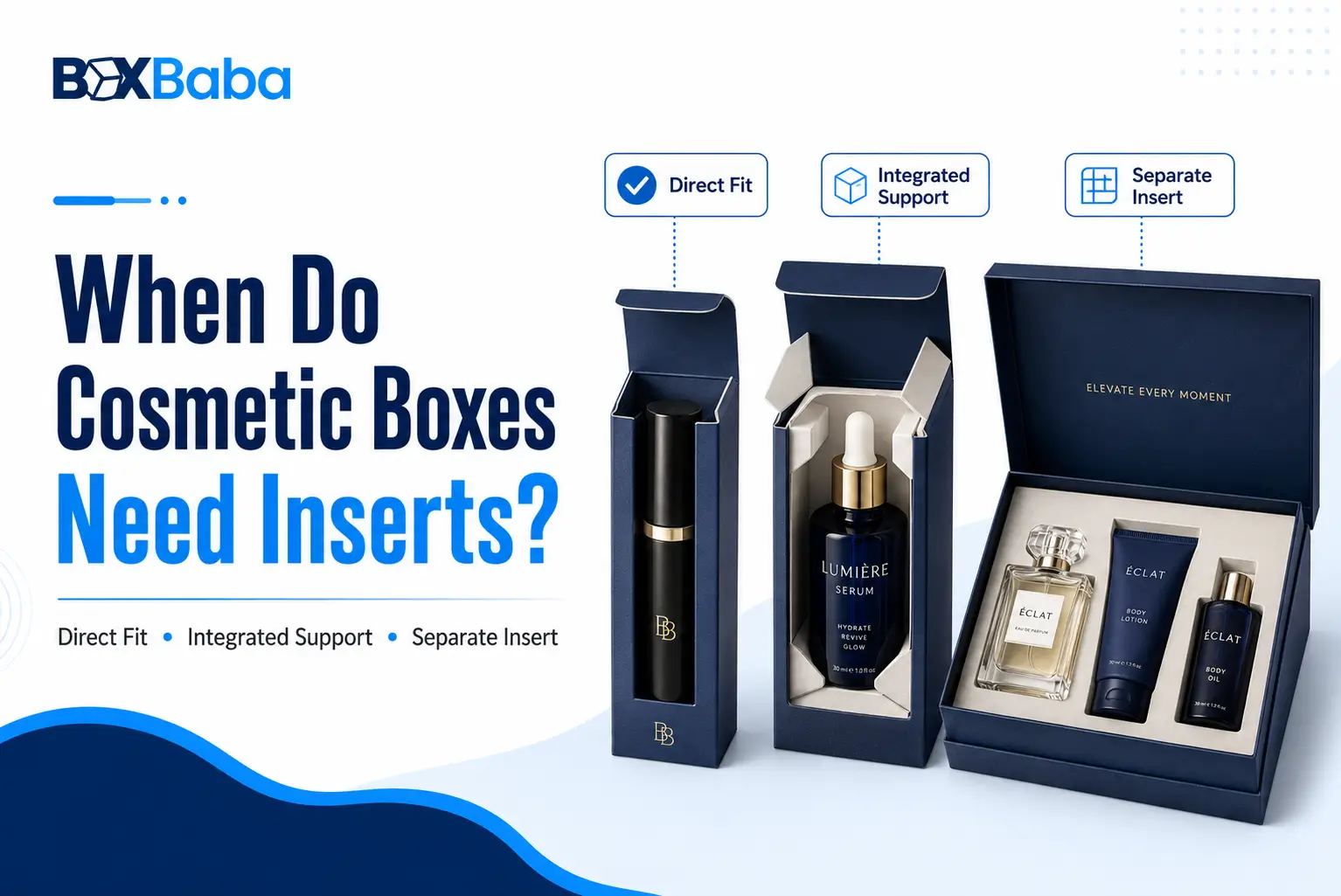
A Practical Guide for Beauty Brands
Not every cosmetic box needs an insert.
A structural insert becomes worth evaluating when the outer box alone does not provide the positioning, separation, organization, support or presentation arrangement required for the finished cosmetic product.
A lightweight lipstick, mascara tube or cosmetic tube that already fits appropriately inside a folding carton may not need another internal component. A heavier bottle, irregular container, multi-product beauty set or presentation box may create a different requirement.
Finished Cosmetic Product → Maximum Product Envelope → Loaded Weight + Orientation → Required Internal Function → Direct Fit / Integrated Support / Separate Insert
The cosmetic category alone should not decide the answer.
Cosmetic Product Type ≠ Automatic Insert Requirement
Brands developing the complete secondary package can review Custom Cosmetic Boxes. When a fitted internal component has already been identified as part of the project, Printed Boxes with Inserts provides the related commercial packaging route.
What Is a Cosmetic Box Insert?
In this guide, a cosmetic box insert means a structural internal packaging component developed to position, separate, organize or support a finished cosmetic product inside an outer package.
Depending on the project, that component may be a folded paperboard holder, divider, platform, tray, molded component, foam cavity or another fitted structure.
This definition is important because the word insert can also describe non-structural items such as instruction cards, promotional cards, leaflets or thank-you cards.
Those are different packaging entities.
Structural Cosmetic Insert ≠ Promotional Insert Card
This article is concerned with structural internal packaging, not promotional literature placed inside a box.
When Does a Cosmetic Box Need an Insert?
An insert should be considered when the finished packaging configuration has a defined internal task that the outer carton cannot perform sufficiently by itself.
That task may involve maintaining a planned orientation, separating several products, organizing accessories, creating a presentation layout, controlling excessive open space or establishing suitable product-removal access.
The better question is therefore not:
Does a serum bottle need an insert?
It is:
What must the completed package do that the outer box alone does not currently achieve?
Consider two serum products.
The first is a lightweight bottle that fits closely inside a suitably developed folding carton. It may not require another structural component.
The second is a heavier bottle positioned upright in a presentation package beside an applicator. The project now has to consider bottle position, applicator position, loaded weight, arrangement and removal.
Both products are serum. Their packaging configurations, however, are different.
BoxBaba’s Custom Serum Boxes page follows the same principle by planning serum packaging around the complete assembled bottle, closure, weight, orientation and insert requirement rather than treating all serum bottles as one standard format.
When a Cosmetic Box May Not Need an Insert
An insert should not be added automatically.
A single lightweight cosmetic product may work without a separate holder when the selected carton already provides appropriate internal fit and the product can be packed and removed as intended.
This may apply to some lipsticks, mascara tubes, eyeliner pens, lip balms, cosmetic tubes and small skincare containers.
For example, a mascara tube that fits appropriately inside its folding carton may gain little from an additional structural component when no special positioning or display arrangement is required.
That does not mean mascara boxes never use inserts. It means:
Suitable Direct Fit + No Unresolved Internal Function → Separate Insert May Be Unnecessary
The same reasoning applies to lipstick packaging. Some individual Custom Lipstick Boxes can be developed as accurately fitted cartons without automatically adding another internal component.
An insert becomes more relevant when the configuration changes.
One Lipstick → Individual Fitted Carton
is different from:
Lipstick + Liner + Applicator → Presentation Arrangement
The second package must solve an organizational problem that the first does not have.
Direct Fit, Integrated Carton Support or Separate Insert?
A common packaging mistake is treating the decision as having only two choices: No Insert or Separate Insert. There is a third possibility.
Some box structures can incorporate product-retaining features into the carton itself.
Required Internal Function → Direct Fit / Integrated Carton Feature / Separate Insert
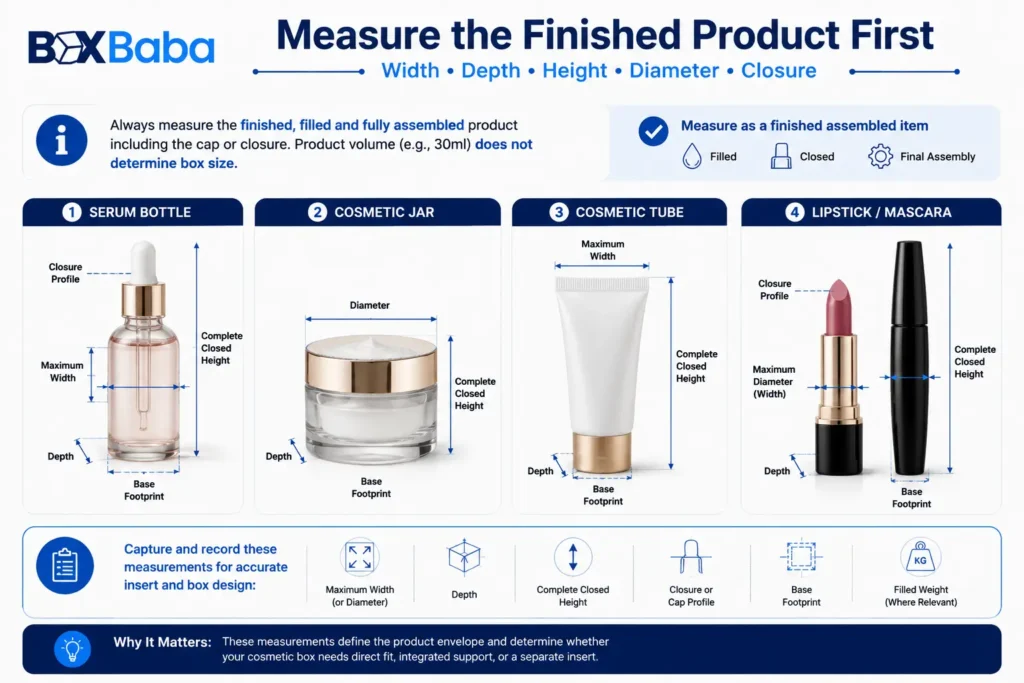
Direct Fit
The finished product sits directly inside the carton without another product-holding component. This may suit a lightweight item with a straightforward shape and appropriately developed internal dimensions.
Integrated Structural Support
The box itself may incorporate folded panels, platforms, internal stops, locking features or other structural elements that help define the product position.
Positioning Requirement ≠ Automatic Separate Insert
Separate Insert
A separate internal component becomes more relevant where the project needs defined cavities, multiple compartments, more complex positioning, accessory organization or a presentation arrangement that is impractical to create through the outer carton alone.
This three-route framework prevents unnecessary material complexity.
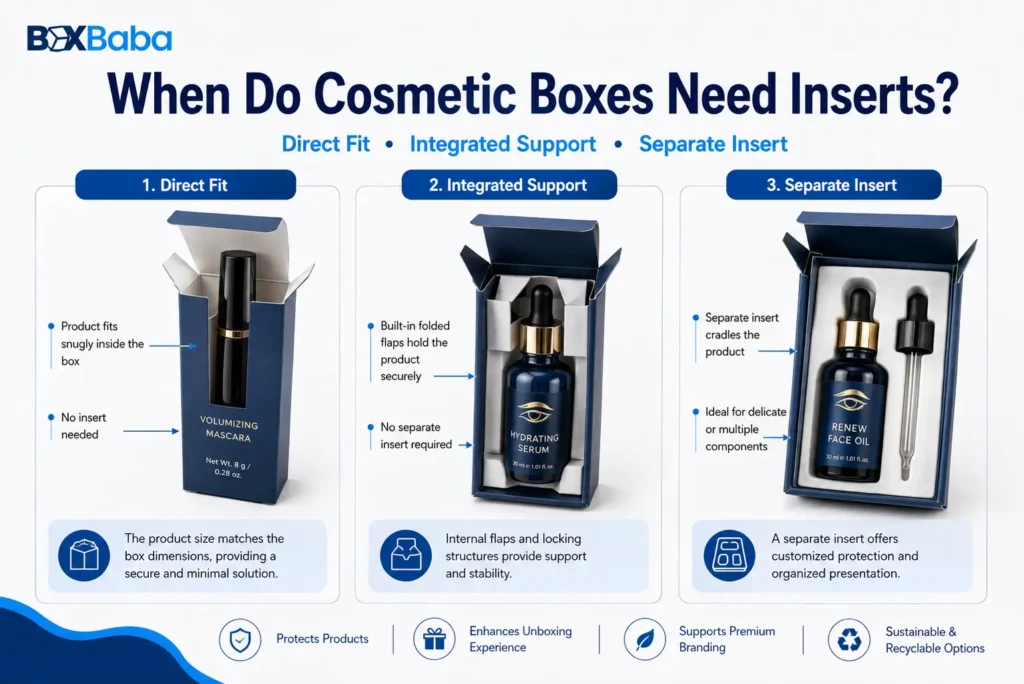
Cosmetic Box Insert Decision Matrix
Packaging Condition | What to Evaluate |
Lightweight product already fits appropriately | Separate insert may be unnecessary |
Considerable unused internal space | Review whether positioning is required |
Product must remain in a specific orientation | Evaluate integrated support or an insert |
Two or more products share one box | Evaluate separation and completed arrangement |
Brush, spatula or applicator is packed separately | Include accessory position in the layout |
Tall container with a small base | Review orientation, loaded weight and support |
Heavy glass bottle or jar | Review geometry, weight and completed structure |
Irregular container | Determine whether the carton alone can retain it |
Gift, PR or launch set | Evaluate planned presentation and removal sequence |
Product already has substantial primary housing | A secondary insert may be unnecessary |
Ecommerce order | Evaluate the completed shipped package separately |
Tight cavity makes removal difficult | Redesign clearance or access rather than simply reducing cavity size |
The purpose is to identify the unresolved packaging requirement first. The insert comes afterward.
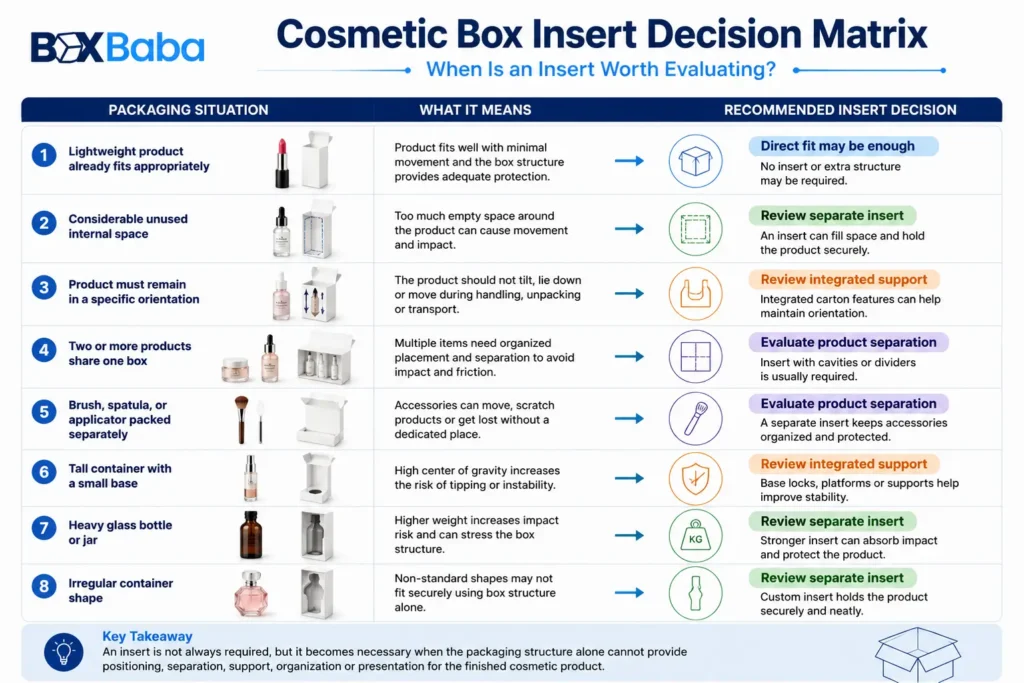
Measure the Finished Cosmetic Product Before Designing the Insert
The insert should be developed around the finished product rather than a generic bottle capacity, jar volume or cosmetic category.
Rectangular Container: Maximum Width × Maximum Depth × Complete Closed Height
Round Container: Maximum Diameter × Complete Closed Height
Compact / Palette: Closed Length × Closed Width × Maximum Closed Thickness
Measure the product in the condition in which it will actually enter the box. That may include the final cap, lid, pump, dropper bulb, overcap, collar, hinge, latch or other permanent exterior feature.
For the wider measurement sequence across bottles, jars, tubes, compacts and other beauty products, use the Cosmetic Box Size Guide.
Finished Product Measurements → Insert Development
not:
Nominal Fill Capacity → Insert Size
A 30 ml glass serum bottle and a 30 ml airless bottle can have substantially different external geometry even though both hold the same nominal volume.
Product Variation and Insert Tolerance
A measurement taken from one product sample should not automatically be treated as proof that every production unit will be dimensionally identical.
Containers, closures and assembled components can have manufacturing variation. Where representative production or production-equivalent units are available, compare them for meaningful differences such as:
Product Feature | Variation to Review |
Bottle body | Maximum diameter, width or depth |
Pump | Actuator position and projection |
Dropper | Bulb and collar dimensions |
Jar | Lid diameter and overhang |
Tube | Filled depth, cap and crimp |
Palette | Hinge, latch and closed thickness |
Decorative closure | Maximum exterior projection |
Nominal Product Dimension ≠ Guaranteed Maximum Production Dimension
The insert also has its own material and manufacturing tolerances.
Product Variation + Insert Construction + Manufacturing Tolerance → Approved Cavity Requirement
There is no single universal clearance value that should be added to every cosmetic insert. The appropriate allowance should be evaluated from the actual product, insert construction, material, packing method and proof/sample route.
How Cosmetic Product Format Changes the Insert Decision
Serum and Skincare Bottles
Serum bottles can differ in base footprint, shoulder profile, dropper-bulb width, pump geometry, overcap dimensions and loaded weight.
A bottle that fits closely inside an individual carton may not require a separate insert. A heavier bottle in a large presentation package may require more deliberate internal positioning.
Skincare Packaging provides the related commercial category for broader bottle, jar, pump and skincare configurations.
Perfume Bottles
Fragrance bottles deserve particular attention because two bottles with the same fill volume can differ considerably in glass weight, cap geometry, shoulder width and base shape.
A glass bottle does not automatically require foam.
Glass Bottle → Geometry + Loaded Weight + Orientation + Structure + Presentation / Distribution Requirement → Insert Decision
Custom Perfume Boxes similarly plans the package around the completely assembled fragrance bottle and project configuration.
Cosmetic Jars
Jars are usually shorter and wider than slim bottle formats. Measure the complete closed jar rather than the jar body alone because the lid may establish the maximum diameter.
Jar Body + Lid Profile + Base Footprint + Loaded Weight + Orientation → Insert Decision
Tubes
A filled cosmetic tube may have a different external profile from an empty tube. The cap, shoulder, filled thickness and sealed/crimped end can all influence the finished envelope.
A simple single-tube folding carton may work without an insert, while a multi-tube skincare set creates a separate arrangement problem.
Lipstick, Mascara and Eyeliner
These long or narrow products often work effectively inside accurately developed individual folding cartons.
Again: Product Category ≠ Insert Requirement.
For example, an individual Custom Mascara Boxes project may use a direct-fit carton, while a mascara-and-primer set may require more deliberate internal organization.
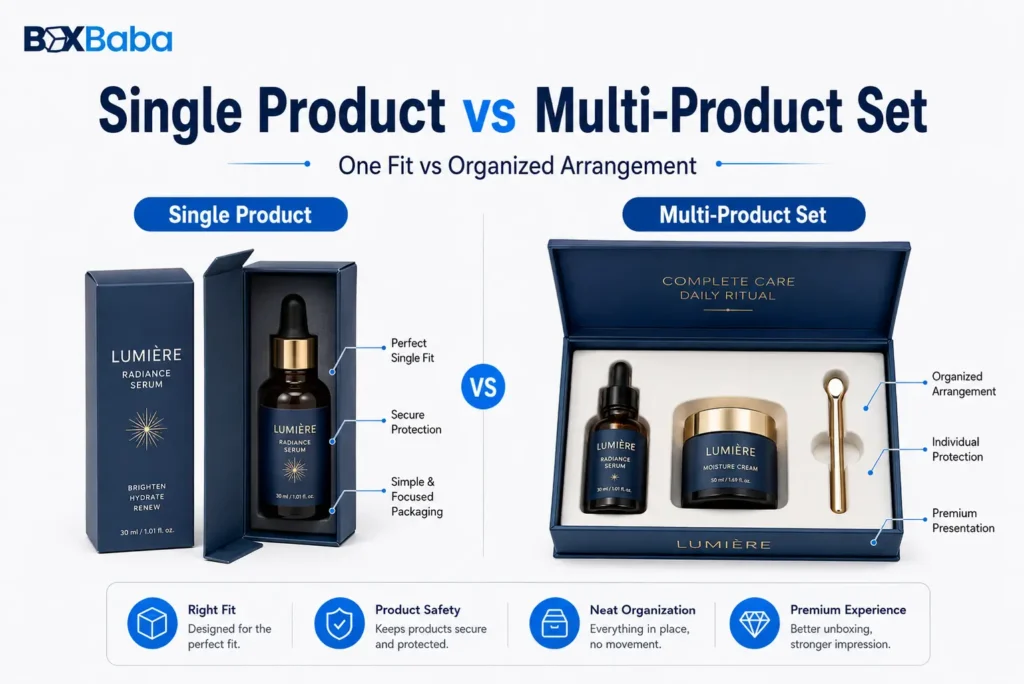
Single Products and Multi-Product Cosmetic Sets
Multi-product packaging is one of the clearest situations in which inserts, dividers or trays become worth evaluating.
A set may contain serum and cream, lipstick and liner, perfume and travel spray, mascara and primer, foundation and applicator, or a larger combination of cosmetic products.
Do not size a set by multiplying one product dimension.
Individual Products → Planned Arrangement → Required Spacing / Separation → Insert Geometry → Internal Box Dimensions
Suppose three products each measure 1.5 inches wide. That does not automatically establish an internal width of 4.5 inches.
The final layout may also include divider walls, insert folds, finger-access areas, different closure profiles and spacing between cavities.
Beauty collections and coordinated assortments should therefore be planned around the full set. Custom Makeup Boxes provides the related commercial route for multi-product makeup packaging.
How Inserts Change Cosmetic Box Dimensions
The dimensions of the finished cosmetic product, insert cavity, usable internal box and completed external package are different measurements.
Product Dimensions ≠ Insert Cavity Dimensions ≠ Internal Box Dimensions ≠ External Box Dimensions
The product establishes the starting physical envelope. The insert then establishes a cavity and its own completed footprint. That insert occupies internal space. The box is developed around the combined configuration.
Finished Product → Insert Cavity → Completed Insert Footprint → Internal Box Specification → Material + Structure → External Box Dimensions
This is why an outer box should not be fully finalized before a required insert is developed.
Two inserts built around the same product can also create different outer dimensions.
Same Product + Different Insert Construction → Potentially Different Internal / External Dimensions
Product Contact Areas and Removal Access
The maximum exterior dimension is not always the best area for an insert to contact.
A bottle may be widest at its pump. A palette may be widest at its latch. A serum bottle may have a large dropper bulb. A cosmetic container may also have decorated or easily marked surfaces.
Maximum Product Envelope ≠ Preferred Insert Contact Area
Area | Purpose |
Support area | Suitable surface for carrying or locating the product |
Retention area | Area used to help maintain the planned position |
Sensitive / no-pressure area | Surface where concentrated contact may be undesirable |
Removal area | Space required for fingers or another removal method |
This matters because a mathematically tight cavity can still produce a poor user experience. A jar may fit perfectly but be difficult to lift. A bottle may fit but catch at the neck. A palette may sit securely but provide no practical finger access.
Tight Fit ≠ Good Insert Design
Product Position + Appropriate Contact Areas + Removal Access → Practical Insert Geometry
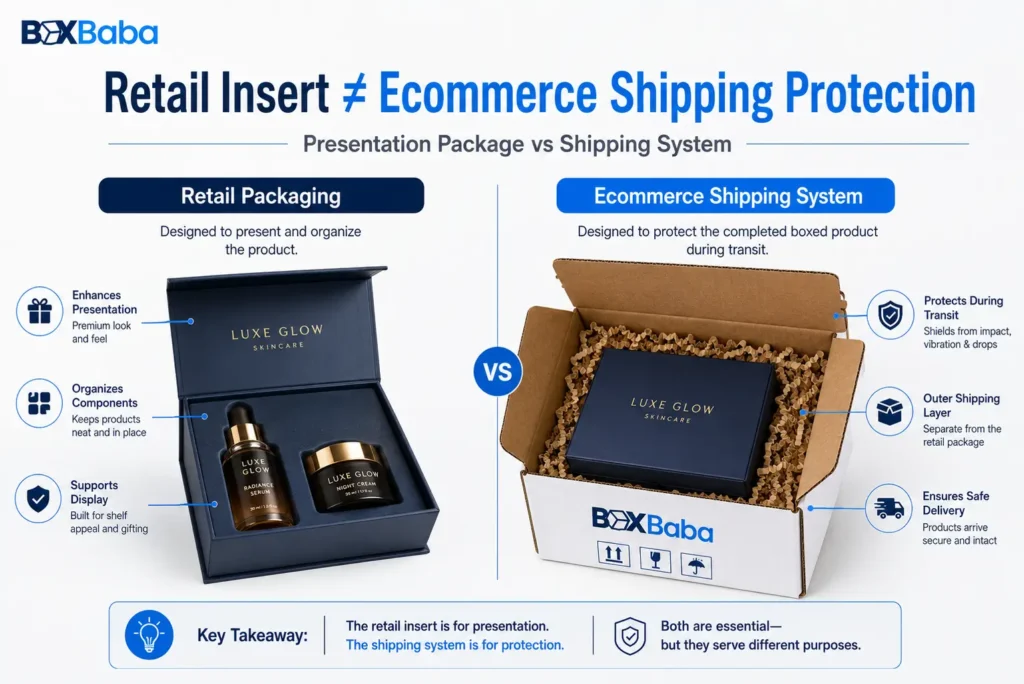
Retail Inserts and Ecommerce Shipping Packaging Are Different
A cosmetic insert inside a retail or presentation box should not automatically be treated as the complete ecommerce shipping solution.
Retail: Finished Cosmetic Product → Retail / Presentation Package
Ecommerce: Completed Boxed Order → Outer Mailer / Shipping Carton
The ecommerce package may contain one retail carton, several SKUs, an entire beauty set or other products. The completed boxed order—not the bare cosmetic container—becomes the starting measurement entity for the outer shipping package.
An insert developed for visual presentation or product positioning inside a retail carton does not automatically validate the full shipping system.
Retail Insert ≠ Ecommerce Shipping Package
Good Retail Fit ≠ Verified Distribution Performance
Select the Insert Material After the Requirement Is Confirmed
Material selection should follow the functional decision. Do not begin with Which foam should I use? Begin with What internal packaging function must be solved? Then evaluate the construction.
Die-Cut and Folded Paperboard
Paperboard can create platforms, slots, supports or cavities for compatible cosmetic products and presentation arrangements.
Paperboard Dividers
Partitions can separate several bottles, tubes or other products within one box where individual cavities are unnecessary.
Corrugated Components
Corrugated insert structures may be considered for appropriate larger, heavier or outer-packaging applications where their thickness and construction suit the package.
Molded Fiber or Pulp
Molded fiber can be evaluated where the forming method, product geometry and presentation requirements make it suitable.
Foam
Foam can create closely fitted cavities for selected presentation configurations, but it should not automatically be specified solely because the container is glass, premium or high value.
Insert Requirement → Required Function → Product Geometry → Suitable Insert Construction
Insert Design Affects Packing and Assembly
A structurally accurate insert can still create an inefficient production pack-out.
The person assembling the box must be able to form the insert, identify the correct orientation, position the product and close the package repeatedly.
A complicated component can add unnecessary packing steps even if the finished presentation looks attractive.
Insert Assembly → Product Loading → Accessory Placement → Box Closure → Repeatability
Watch for designs that require repeated adjustment, cause a product to catch on a folded tab, create an unclear loading direction or make individual accessories difficult to place consistently.
Good Fit ≠ Efficient Pack-Out
Packing workflow is particularly important for larger quantities and repeat orders because a small unnecessary assembly step can become significant when repeated across an entire production run.
Plan the Insert Before Final Dieline and Artwork
Insert development can influence the internal dimensions of the carton. Internal dimensions can influence the final external structure. That structure determines the dieline. The dieline then determines the artwork panels.
Finished Product → Insert / Internal Support → Box Structure → Finished Dimensions → Dieline → Artwork
If the internal arrangement changes after artwork has already been developed, panel sizes, folds, opening areas or artwork placement may also require revision.
This does not mean artwork development cannot begin conceptually earlier. It means production artwork should follow the approved structural dieline.
Fit Review and Distribution Testing Are Different
A sample or prototype can help evaluate how the cosmetic product interacts with the insert and box.
A fit review may examine product insertion, removal, cavity fit, insert position, closure, accessory arrangement and visible presentation.
That does not automatically establish transportation performance. Where distribution performance matters, the completed packaging system may require a separate evaluation appropriate to the project and distribution conditions.
Dimensional Fit ≠ Verified Distribution Performance
Avoid describing an insert as universally drop-proof, impact-proof or shipping-tested unless the exact completed package has been tested under a defined method and the result supports that statement.
How an Insert Can Affect Cost and Packaging Volume
An insert can solve a useful packaging problem, but it also adds another structural component.
Factor | Possible Effect |
Material | Additional substrate is required |
Tooling / converting | Insert may require cutting, folding or forming |
Assembly | Pack-out can gain another step |
Internal space | Insert walls or folds consume volume |
Box dimensions | Outer package may become larger |
Storage | Larger assembled volume can affect storage needs |
Shipping | Completed package dimensions and weight can change |
Defined Insert Function > Unnecessary Packaging Complexity
Premium appearance by itself is not a technical reason to add a structural insert. Presentation can be a valid project objective, but that objective should be explicitly identified.
Direct Product Contact Requires Separate Review
Most cosmetic box inserts discussed in this guide interact with the finished primary container—the bottle, jar, tube, compact, palette or other retail-ready package. They do not normally contact the cosmetic formulation itself.
Cosmetic Product Formulation → Primary Packaging
Structural Box Insert → Finished Primary Container
If a packaging component will directly contact the cosmetic formulation, material compatibility and any applicable direct-contact requirements require separate evaluation.
A standard secondary paperboard, foam or molded insert should not automatically be assumed suitable for direct cosmetic-product contact.
Common Cosmetic Insert Planning Mistakes
Sizing or Planning Mistake | Better Approach |
Assuming every cosmetic box needs an insert | Evaluate the finished package configuration |
Assuming every glass bottle needs foam | Review geometry, weight and packaging function |
Choosing insert material first | Define the required internal function first |
Measuring only the product body | Include closures and permanent projections |
Using fill capacity as insert size | Measure the complete finished product |
Measuring one sample and ignoring variation | Review representative units where possible |
Using one universal clearance | Develop clearance from the actual specification |
Making the cavity excessively tight | Include packing and removal requirements |
Treating the widest point as the support point | Map appropriate contact areas separately |
Designing the carton before a required insert | Establish insert geometry first |
Finalizing artwork before structural approval | Complete dieline development first |
Ignoring packing efficiency | Review assembly and product-loading sequence |
Forgetting separate accessories | Size the completed arrangement |
Multiplying one product width for a set | Develop the actual arranged footprint |
Treating a retail insert as shipping validation | Review the ecommerce pack separately |
Assuming successful fit proves shipping performance | Separate fit review from distribution evaluation |
Adding an insert only to appear premium | Define the functional or presentation purpose |
Cosmetic Insert Measurement and Quote Checklist
Before requesting a cosmetic box with a fitted insert, prepare the following information:
- Finished product: product type; complete closed height; maximum width, depth or diameter; base footprint; closure profile; loaded weight where relevant; product photographs or technical drawings.
- Arrangement: product orientation; number of products per box; accessory dimensions; desired product positions; removal direction; presentation requirement; sensitive/decorated surfaces.
- Insert requirement: positioning, separation, organization, support or presentation function; preferred insert direction if known; integrated carton support vs separate insert if already considered.
- Project: preferred box structure if known; total quantity; quantity by SKU; artwork status; intended retail, ecommerce, gift, PR or other use; delivery destination.
Instead of sending:
I need inserts for 500 serum boxes.
provide something such as:
The finished serum bottle measures 1.42 inches at its maximum diameter and 4.25 inches in complete closed height including the fitted dropper. The product will be packed upright as one bottle per box. We want a centered presentation with finger access for removal, and the insert construction has not yet been selected.
That gives the packaging supplier a physical requirement that can be evaluated rather than a predetermined solution.
Request Custom Cosmetic Boxes With Inserts
A reliable cosmetic insert specification starts with the finished product and the packaging function that needs to be solved, not with a predetermined material.
Finished Product → Maximum Product Envelope → Product Variation + Loaded Weight → Orientation → Required Internal Function → Direct Fit / Integrated Support / Separate Insert → Insert Geometry → Internal Box Dimensions → External Box Dimensions → Dieline → Artwork → Proof / Approval
If your project requires fitted product holders, cavities, partitions or other structural internal packaging, review Printed Boxes with Inserts. Brands planning a wider beauty packaging program can start from Custom Cosmetic Boxes.
BoxBaba’s verified minimum order quantity for custom cosmetic boxes starts from 100 boxes.
When requesting pricing, provide the complete finished product dimensions, loaded weight where relevant, closure or lid profile, orientation, products per box, accessories, intended insert function, preferred structure if known, quantity by SKU and artwork status.
Proofing or sample routes are confirmed during quotation. Standard production takes 5–9 business days after final artwork and project specifications are approved. BoxBaba provides free shipping across the USA. Production and transit time are separate.
FAQs About Cosmetic Box Inserts
Do all cosmetic boxes need inserts?
No. A cosmetic box may not require a separate insert when the finished product already fits appropriately inside the selected structure and no additional positioning, separation, organization or presentation function remains unresolved.
When should a cosmetic box use an insert?
An insert should be evaluated when the outer box alone does not provide the required product position, separation, organization, support or planned presentation arrangement.
Do glass cosmetic bottles always need inserts?
No. Glass construction alone does not determine whether an insert is required. The completed bottle dimensions, loaded weight, shape, orientation, box structure, presentation and distribution requirements should be considered together.
Do glass bottles always need foam inserts?
No. Glass does not automatically require foam. Foam is one possible insert construction. The appropriate solution should be selected after the required internal function, product geometry and package structure have been established.
Do serum boxes need inserts?
Not every serum box requires one. An individual bottle may work inside an appropriately developed carton, while a heavier bottle, presentation package or multi-product serum set may require more defined internal positioning.
Do perfume boxes need inserts?
Not automatically. The decision depends on the complete bottle geometry, filled weight, selected outer structure, product orientation, presentation and completed packaging configuration.
Do cosmetic jars need inserts?
Some jar packages may benefit from a fitted holder, particularly in presentation arrangements or multi-product sets. A jar that already fits appropriately inside its carton may not need another structural component.
Do lipstick or mascara boxes need inserts?
Many individual lipsticks and mascara tubes can use accurately fitted folding cartons without separate inserts. Sets, irregular containers or presentation packaging may create additional positioning requirements.
Does every cosmetic gift set need an insert?
No universal rule applies, but multi-product sets usually require more deliberate arrangement than individual cartons. Evaluate whether the products require cavities, dividers, integrated support or another method of organization.
How do inserts affect cosmetic box dimensions?
An insert occupies internal space. Its cavity, walls, folds, product arrangement and removal areas should therefore be established before final internal and external carton dimensions are approved.
How much clearance should a cosmetic insert have?
There is no universal clearance value for every cosmetic package. Clearance depends on product geometry, dimensional variation, insert construction, material, loading method, removal access and the approved project specification.
What measurements are required for a cosmetic insert?
Provide the finished product’s maximum exterior dimensions, closure profile, base footprint, loaded weight where relevant, intended orientation, product quantity, separately packed accessories and intended removal method.
Is paperboard better than foam for cosmetic inserts?
Neither is universally better. The suitable option depends on the required function, product dimensions, loaded weight, box structure, presentation requirements and complete project specification.
Should the insert be designed before the box?
Where a separate insert affects the required internal space, its geometry should be developed before the final box dimensions and production dieline are approved.
Should the insert be planned before artwork?
The final structural insert and box specification should be established before production artwork is finalized because insert requirements can affect internal dimensions, external dimensions, panel sizes and the final dieline.
Is an insert inside a retail cosmetic box enough for ecommerce shipping?
Not automatically. The finished retail package and the completed ecommerce shipment are separate packaging systems. The outer shipping configuration should be evaluated from the completed boxed order.
Does a successful insert fit mean the package is shipping-tested?
No. A fit review confirms dimensional and functional aspects of the arrangement. Verified distribution performance requires separate evaluation of the completed packaging system where applicable.