
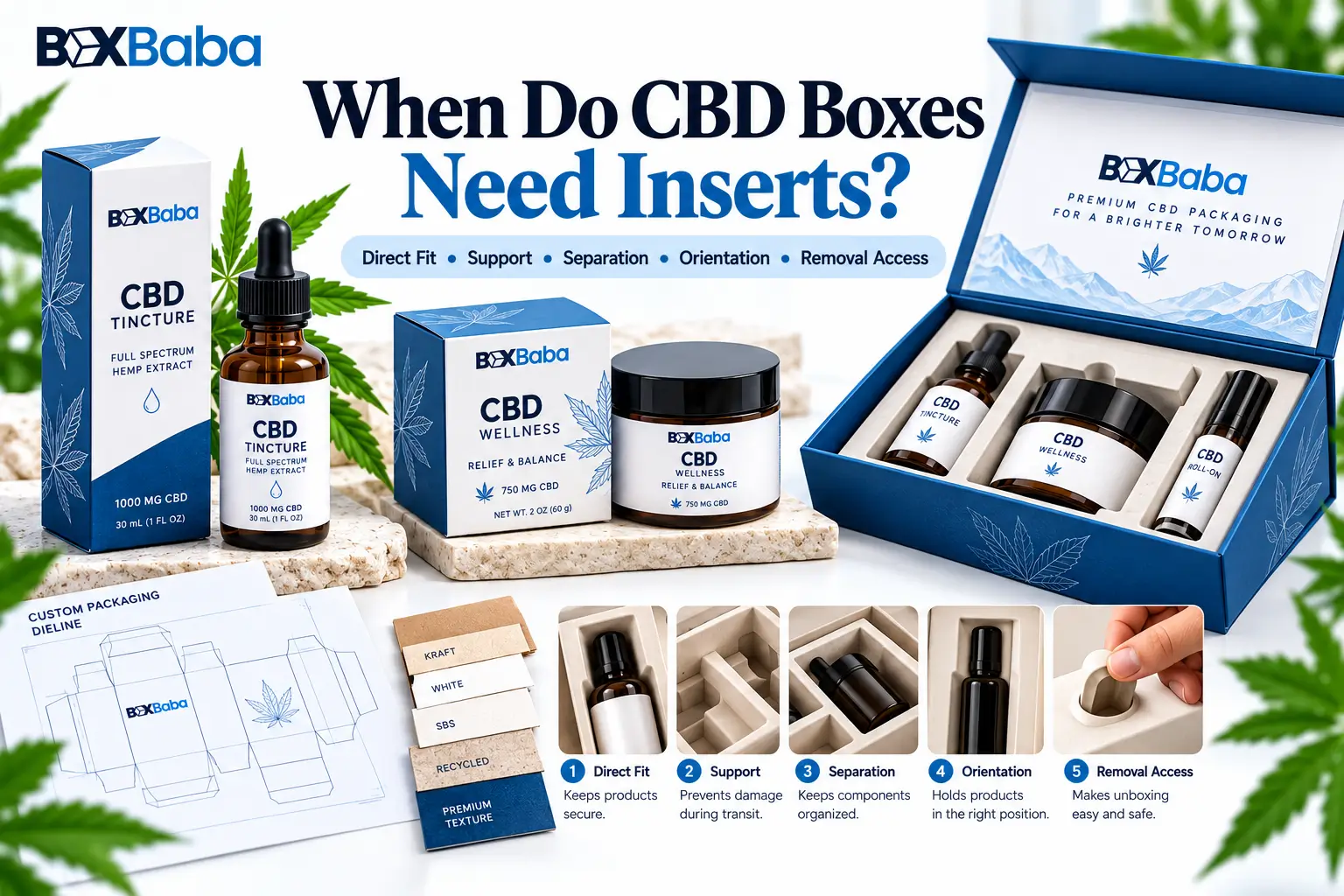
Not every CBD box needs an insert.
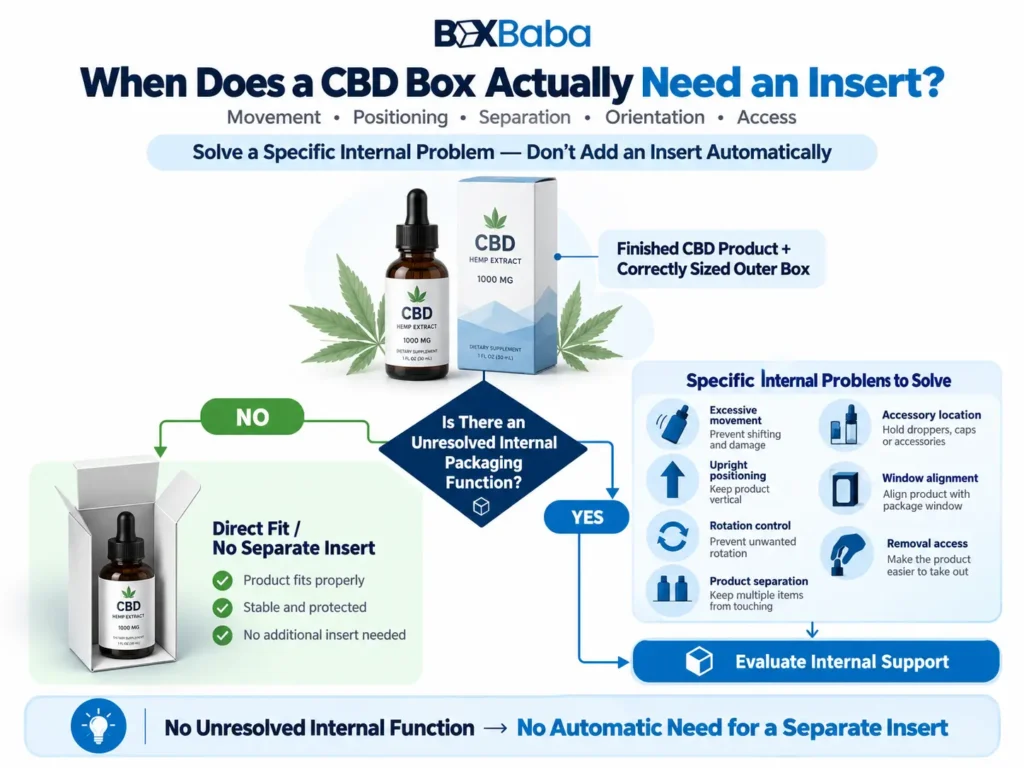
A separate insert becomes worth considering when the finished primary package still has an unresolved internal packaging requirement after the outer box has been correctly sized and structured.
That requirement might be:
- positioning;
- separation;
- support;
- rotation control;
- presentation;
- accessory organization;
- removal access.
A lightweight bottle that already sits correctly inside a folding carton may not need another component.
A larger box containing a glass dropper bottle, jar and accessory creates a different internal packaging problem.
The useful decision sequence is:
Finished CBD Product → Outer Box Requirement → Unresolved Internal Function → Direct Fit / Integrated Support / Separate Insert
So the real question is not simply:
Should CBD packaging have an insert?
It is:
What must happen inside this package that the outer structure cannot already do?
Brands still choosing their overall CBD packaging route can start with Custom CBD Boxes. If a separate structural holder, tray or divider has already been identified, explore Printed Boxes with Inserts.
Quick Answer: When Does a CBD Box Need an Insert?
An insert is worth evaluating when:
- a bottle or jar moves excessively;
- a product needs to remain upright;
- a round container needs rotation control;
- two rigid containers need separation;
- several different products share one package;
- an accessory needs a defined position;
- a presentation box is intentionally larger than the product;
- a product must remain aligned with a window;
- the outer carton cannot provide the required internal retention;
- product removal needs deliberately designed finger access.
A separate insert may be unnecessary when:
- one lightweight product already fits correctly;
- the carton follows the product geometry closely;
- no product separation is required;
- orientation does not need to be controlled;
- no accessories share the package;
- the outer structure already includes suitable holding features.
A useful rule is:
No Unresolved Internal Function → No Automatic Need for a Separate Insert
Structural Insert vs Printed Insert Card
The word insert can describe two very different things.
Structural Insert
An internal packaging component used to:
- locate;
- support;
- retain;
- separate;
- orient;
the finished product.
Examples include:
- die-cut paperboard holders;
- platforms;
- dividers;
- trays;
- fitted cavities;
- molded components.
Printed Insert
A non-structural item such as:
- instruction card;
- thank-you card;
- leaflet;
- promotional card.
These should not be confused.
Structural Insert ≠ Printed Insert Card
This guide deals with structural internal packaging.
The Insert Decision Starts With the Finished Primary Package
CBD itself does not determine the insert.
The insert interacts with the container.
For example:
CBD Oil → Dropper Bottle
CBD Gummies → Jar
CBD Cream → Cosmetic Jar
CBD Lip Balm → Twist-Up Tube
That primary package determines the physical variables that matter, including:
- external geometry;
- base footprint;
- closure profile;
- filled weight;
- orientation.
Therefore:
CBD Product Name ≠ Insert Requirement
Two CBD oils can use completely different bottle geometries.
Two cream products can use a jar and an airless pump.
The structural decision must follow what physically enters the box.
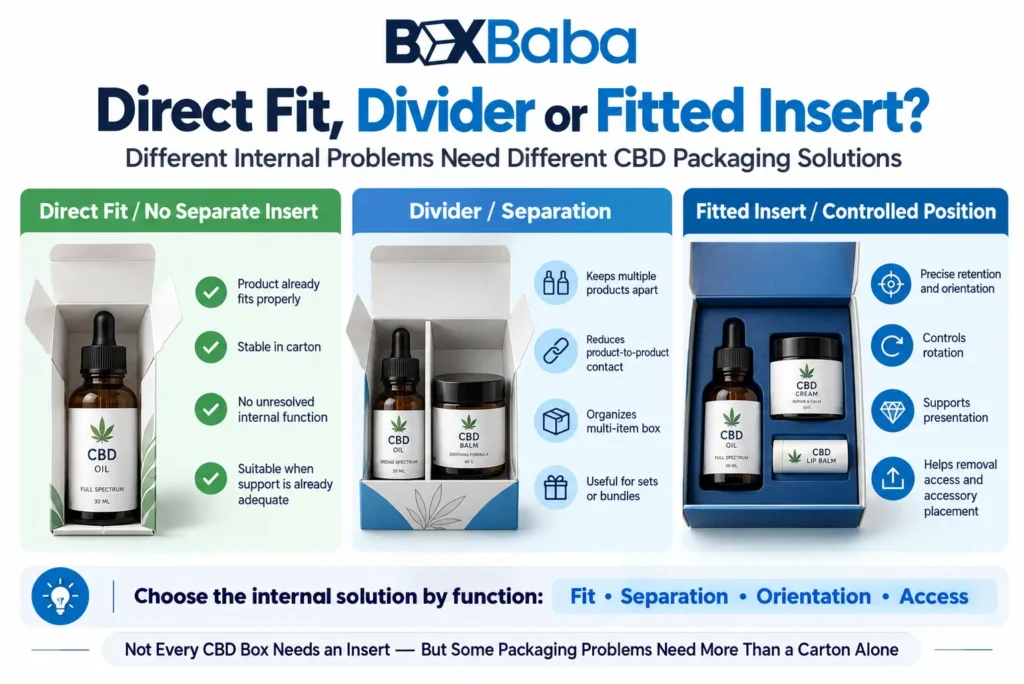
Three Packaging Routes: Direct Fit, Integrated Support or Separate Insert
The most useful decision is not simply:
Insert vs No Insert
There are three possible routes.
1. Direct Fit
The finished product sits directly inside an appropriately developed carton.
This can work when:
- one product is being packed;
- the container is relatively stable;
- movement is already acceptable;
- orientation does not need additional control;
- there is no accessory to organize.
A small jar, lip-care tube or lightweight bottle may fall into this category.
2. Integrated Carton Support
Sometimes the outer carton can create its own internal support through features such as:
- folded panels;
- stops;
- retaining flaps;
- platforms;
- internal locks;
- shaped panel geometry.
This leads to an important rule:
Need for Internal Support ≠ Automatic Need for a Separate Insert
The carton itself may solve the requirement.
3. Separate Insert
A separate component becomes more useful when the packaging requires:
- multiple cavities;
- more precise bottle location;
- separation between products;
- defined accessory locations;
- presentation geometry that the outer box alone cannot create.
The objective should be to use the simplest structural solution that solves the real internal requirement.
CBD Insert Decision Matrix
Packaging Situation | Starting Direction |
Single lightweight bottle in close-fit carton | Direct fit may be enough |
Broad, stable jar in close-fit carton | Separate insert may be unnecessary |
Tall bottle inside larger presentation box | Evaluate positioning support |
Heavy glass bottle inside oversized box | Evaluate support and retention |
Two glass containers in one package | Evaluate separation |
Bottle + jar + tube gift set | Defined compartments are worth evaluating |
Round bottle must remain front-facing | Evaluate rotation control |
Accessory shares the package | Give it a defined position |
Large unused internal space | First recheck box sizing |
Product is difficult to remove | Add access rather than making the cavity tighter |
Outer carton already has holding features | Separate insert may be unnecessary |
Do Not Use an Insert to Fix an Unnecessarily Oversized Box
Suppose a small dropper bottle moves excessively inside its carton.
The immediate reaction might be:
Add an Insert
But first ask:
Why is the box larger than the bottle?
There are two different routes:
Reduce the Outer Box
or:
Keep the Larger Box + Add Internal Positioning
The second route makes more sense when the larger structure serves another genuine purpose, such as:
- gift presentation;
- additional products;
- accessories;
- defined visual arrangement.
If the oversized carton serves no purpose, reducing unnecessary internal volume may be the better starting point.
Use:
Movement → Review Outer Box → Identify Required Internal Function → Decide on Insert
When Does a CBD Dropper Bottle Need an Insert?
Dropper bottles often deserve closer review because they combine a relatively narrow footprint with a taller finished profile.
Important physical variables include:
- bottle diameter;
- overall closed height;
- shoulder;
- dropper closure;
- bulb;
- filled weight;
- base footprint.
When Direct Fit May Be Enough
A single lightweight bottle may not require a separate holder if:
Bottle → Properly Sized Carton → Acceptable Position
already solves the internal packaging requirement.
When Additional Positioning Becomes More Useful
Evaluate support when:
- the presentation box is wider than the bottle;
- the bottle needs to remain centered;
- the container has a narrow base;
- another product shares the package;
- the bottle needs to remain aligned with a window;
- product rotation needs to be limited.
For the commercial carton route, see CBD Dropper Bottle Boxes.
Maximum Bottle Size & Support Area Are Not the Same Thing
The widest point on a dropper bottle may be:
- the bulb;
- closure;
- collar.
But the widest point is not automatically the best structural contact area.
An insert may instead locate the product around:
- the bottle body;
- base;
- another stable exterior area.
This produces two different concepts:
Maximum Product Envelope
→ defines the space the product occupies.
Support / Retention Area
→ defines where the internal structure interacts with the product.
Do not place unnecessary concentrated contact against an operational closure simply because it is the widest point.
A CBD Jar Often Creates a Different Insert Decision
Jars are commonly shorter and broader than dropper bottles.
That geometry can make a single jar inherently more stable inside a close-fitting carton.
Direct Fit May Be Appropriate When
- the jar has a broad footprint;
- the outer carton is correctly sized;
- movement is limited;
- the package contains only one jar;
- no particular orientation is required.
Evaluate an Insert When
- the jar sits inside a larger presentation box;
- several products share the package;
- the jar is relatively heavy;
- an accessory needs its own position;
- presentation requires the jar to remain precisely centered.
Measure the complete closed jar rather than the body alone because the lid may create the maximum width.
For jar-specific packaging, explore Custom CBD Jars.
Glass Does Not Automatically Mean Foam
The relationship:
Glass Container → Foam Insert
is too simplistic.
Glass tells you something about the primary container material.
It does not tell you:
- the product geometry;
- filled weight;
- outer-box size;
- required orientation;
- required internal function.
The better decision is:
Glass Container → Physical Configuration → Required Internal Function → Suitable Structure
Foam may suit a particular presentation project.
A folded paperboard holder, divider or direct-fit carton may suit another.
Select the construction after identifying the job.
CBD Gummies & Capsule Bottles
A gummy jar or capsule bottle can be structurally stable enough to use direct fit in a correctly developed carton.
An insert becomes more relevant when:
- two or more jars share the box;
- a jar sits beside another product;
- the container must remain in a specific presentation position;
- accessories or literature need separate compartments;
- the outer package intentionally creates substantial extra space.
The number of gummies or capsules does not determine the insert requirement.
The completed primary package does.
For commercial gummy packaging, see CBD Gummies Boxes.
Tubes, Lip Balm & Small CBD Containers
Small tubes, sticks and lip-care containers frequently have less reason to use a separate insert when sold individually.
A close-fitting carton may already:
- locate the product;
- restrict excessive movement;
- establish the orientation.
A separate holder becomes more relevant when:
- several units are packed together;
- different container types share a set;
- the product sits inside a larger presentation structure;
- exact visual alignment matters.
Do not add another component solely because the product is positioned as premium.
Flexible CBD Pouches Need a Different Kind of Review
A filled pouch behaves differently from a rigid bottle or jar.
Its shape may vary according to:
- fill level;
- gusset;
- zipper;
- product distribution inside the pouch.
If a flexible pouch goes into a secondary carton, first evaluate whether an appropriately sized outer structure can already control the package adequately.
A rigid fitted cavity is not automatically necessary simply because the pouch itself is flexible.
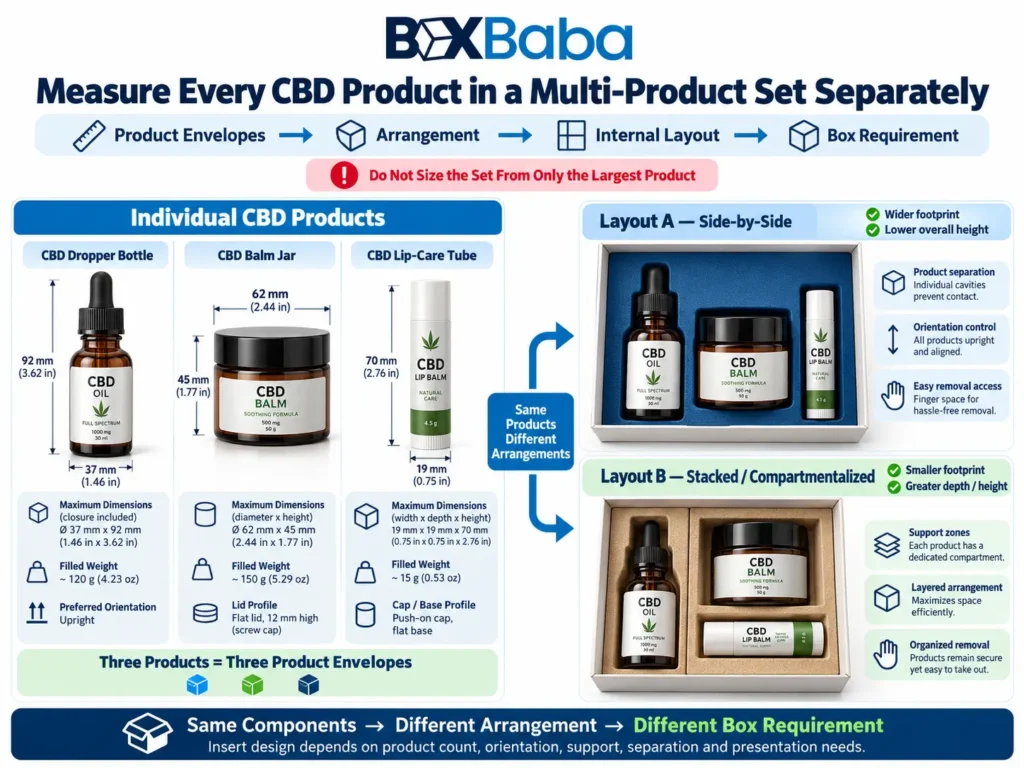
Multi-Product CBD Sets Create the Strongest Case for Inserts
A multi-product set creates several internal relationships at once.
Consider:
Dropper Bottle + Balm Jar + Lip-Care Tube
The packaging now has to account for:
- three product envelopes;
- different weights;
- different orientations;
- product-to-product contact;
- removal sequence;
- overall presentation.
The correct sequence is:
Measure Each Finished Product
↓
Choose the Arrangement
↓
Identify Separation / Retention Requirements
↓
Develop the Internal Structure
↓
Develop the Outer Box Around the Completed Arrangement
Do not choose a large gift-box size first and then force the products into the remaining space.
For this type of presentation packaging, explore CBD Gift Boxes.
Divider vs Fitted Insert
Not every multi-product package needs an individually contoured cavity.
Divider / Partition
Best considered when the main problem is:
Product A must remain separate from Product B
Fitted Insert
More relevant when the package also needs:
- defined location;
- controlled rotation;
- exact presentation alignment;
- specialized removal access.
Use the least complex structure that performs the required function.
Product-to-Product Contact Matters
When several rigid containers share one box, uncontrolled movement can allow:
- bottle-to-bottle contact;
- jar-to-bottle contact;
- accessories to migrate;
- decorated primary packages to rub against one another.
Separation may be useful even when every individual item is structurally stable.
That does not automatically mean every product needs a tightly contoured cavity.
Sometimes one partition solves the problem.
Location Control & Orientation Control Are Different
A cylindrical bottle can remain in roughly the correct location while still rotating.
That matters when:
- a logo needs to face forward;
- a label needs to align with a window;
- several products should present consistently when the box opens.
Distinguish:
Location Control
→ Where does the product sit?
Orientation Control
→ Which direction does it face?
A package may need one without the other.
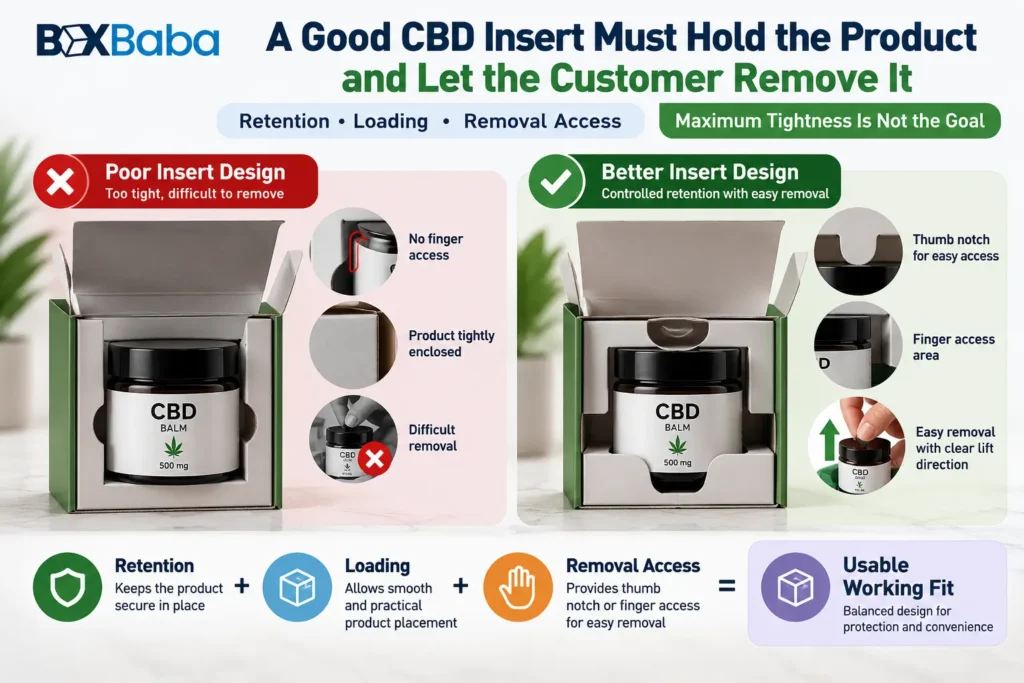
A Useful Insert Must Also Allow Product Removal
A cavity can hold a product extremely tightly and still be poorly designed.
Consider:
Secure Jar + No Finger Access
The user now struggles to remove the product.
Insert development should balance:
Retention + Loading + Removal
Possible access features include:
- thumb notches;
- finger cutouts;
- exposed product areas;
- defined lift paths.
The objective is not maximum tightness.
It is a usable working fit.
Define the Insert Function Before the Geometry
The word support is often used too broadly.
An insert may need to perform one or more distinct jobs:
Function | What It Means |
Support | Helps carry or stabilize the product |
Retention | Limits unwanted movement |
Separation | Keeps products apart |
Location control | Keeps the product in a defined area |
Orientation control | Keeps it facing the required direction |
Accessory organization | Provides separate space for another item |
Removal access | Allows practical product extraction |
Presentation | Establishes the intended opening arrangement |
Before choosing a material or cavity shape, identify which functions actually matter.
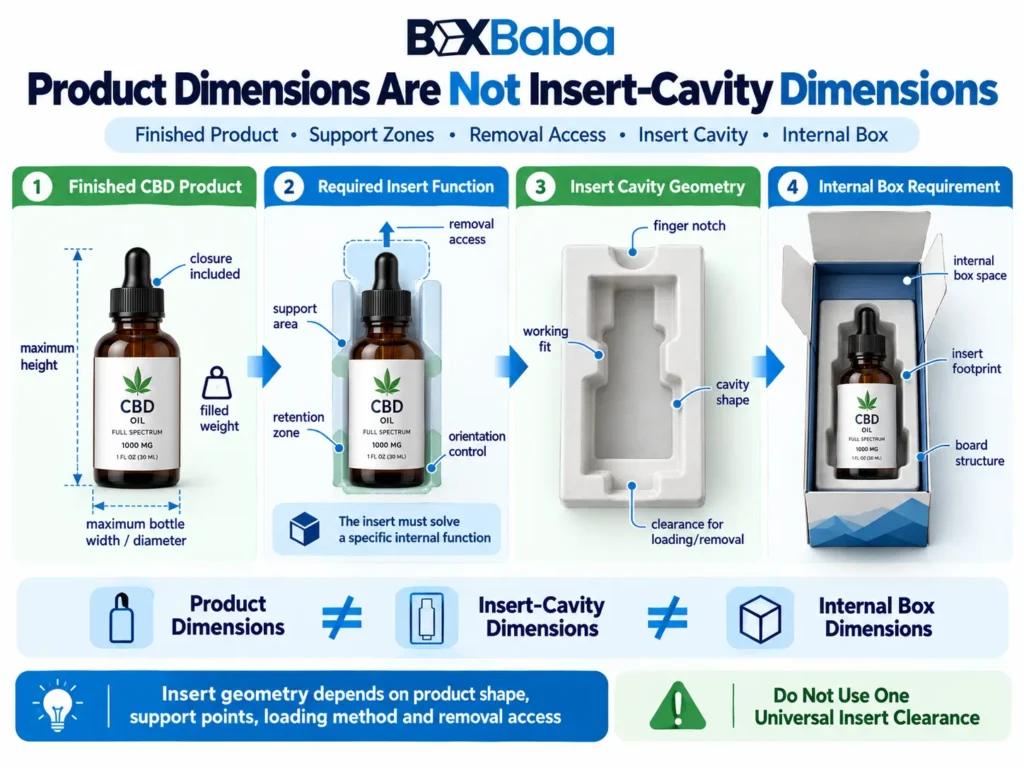
Product Dimensions, Insert Geometry & Outer Box Dimensions Are Different
An inserted package contains several dimensional relationships:
Finished Product
↓
Insert / Retention Geometry
↓
Completed Insert Footprint
↓
Internal Outer-Box Requirement
↓
Finished External Box
Therefore:
Product Dimensions ≠ Insert Dimensions ≠ Box Dimensions
A required insert should normally be developed before the final outer-box dimensions are frozen because the insert itself occupies internal space.
Do not calculate the insert by simply adding one universal allowance around the product.
Actual working fit depends on the product, construction, loading direction and removal requirement.
Material Comes After the Insert Function
Once an insert is actually required, possible constructions can include:
- die-cut / folded paperboard;
- paperboard dividers;
- corrugated internal components;
- molded fiber;
- foam.
No one option is universally best for CBD packaging.
Use:
Required Function → Suitable Structure → Suitable Material
rather than:
Premium CBD Product → Foam
The deeper material tradeoffs should be evaluated separately after the insert requirement has been established.
Inserts Normally Interact With the Primary Package, Not the CBD Formulation
Most structural inserts discussed in this article are intended to contact the outside of:
- bottles;
- jars;
- tubes;
- pouches.
They should not automatically be represented as providing:
- moisture barrier;
- oxygen barrier;
- leak prevention;
- formulation preservation.
Those functions generally belong to the relevant primary container and closure.
Likewise, if an insert is intended to directly contact an exposed food or ingestible product rather than its sealed primary container, the material suitability for that intended direct-contact use requires separate review.
Child-Resistant Closure & Insert Function Should Remain Separate
A CBD bottle may use a child-resistant primary closure.
The ordinary structural insert surrounding that bottle should not be described as child-resistant simply because it holds the container.
Likewise, the insert should not interfere with:
- the closure mechanism;
- required operating areas;
- relevant opening instructions.
Use:
CR Closure → Access-Control Function
and:
Insert → Positioning / Support Function
as separate packaging relationships.
Packing Efficiency Matters
An insert can fit the product well but create a poor packing workflow.
Review the pack-out process:
Form Insert → Place Insert → Load Product → Load Accessories → Confirm Position → Close Box
Ask:
- Is the loading direction obvious?
- Does the product catch on tabs?
- Does the insert remain assembled?
- Can operators load the product consistently?
- Is an accessory difficult to place?
- Does closing the box require repeated adjustment?
This produces another important distinction:
Good Product Fit ≠ Efficient Pack-Out
Both should be evaluated before approval.
What Can a Structural Sample Tell You?
A physical sample can be particularly useful when:
- product geometry is irregular;
- several products share one insert;
- the bottle or jar is relatively heavy;
- closures project beyond the main body;
- removal access is difficult to judge;
- the insert has several folds or cavities.
A structural sample can help review:
- fit;
- loading;
- orientation;
- product removal;
- arrangement.
It does not automatically prove:
- ecommerce shipping performance;
- drop resistance;
- regulatory compliance.
Only claim what the relevant review or test actually establishes.
Common CBD Insert Mistakes
Mistake | Better Decision |
Assuming every CBD bottle needs an insert | Check direct fit first |
Using an insert to fill an oversized carton | Recheck box size first |
Assuming glass always means foam | Identify the function first |
Designing the outer box before a required insert | Develop the internal system first |
Holding the bottle by its fragile closure | Define stable contact areas |
Eliminating all clearance | Preserve loading and removal |
Assuming a divider and fitted cavity are the same | Match structure to required function |
Assuming the insert is child-resistant | Keep CR and retention functions separate |
Treating a retail insert as proof of shipping performance | Review distribution separately |
Ignoring pack-out labor | Test assembly and loading |
Reusing an insert after the primary container changes | Recheck the physical fit |
CBD Insert Decision Workflow
Use this process before specifying a separate component:
- Confirm the Finished Primary Package
Bottle, jar, tube, pouch or other container. - Confirm the Product Quantity
One item or several? - Set the Intended Orientation
Upright, horizontal, front-facing or another position. - Review the Outer Carton
Can correct carton geometry already solve the problem? - Identify the Remaining Internal Function
Support, retention, separation, orientation, accessory organization or removal. - Choose Direct Fit, Integrated Support or Separate Insert
Do not assume the insert first. - Define Product Contact & Access Areas
Decide where the package should hold the product and where it should remain accessible. - Develop the Internal Geometry
Avoid universal cavity-clearance formulas. - Develop the Outer Box Around the Required Internal Structure
Account for the completed insert footprint. - Review the Pack-Out Sequence
Make sure assembly and loading are practical. - Review a Structural Sample Where Appropriate
Evaluate fit, position and removal. - Finalize the Dieline
Once the physical structure is established.
For general production-file terminology, see BoxBaba Dieline in Packaging guide.
What Should You Send for a CBD Box With Inserts?
Provide:
Finished Product Information
- primary-container type;
- maximum external dimensions;
- closure profile;
- filled weight;
- product photos or sample information.
Internal Arrangement
- number of products;
- intended orientation;
- desired positions;
- accessories;
- required separation;
- removal direction;
- window-alignment requirement where applicable.
Required Function
State whether the package needs:
- support;
- retention;
- separation;
- orientation control;
- accessory organization;
- presentation;
- removal access.
Project Information
- quantity;
- number of SKUs;
- preferred outer structure if known;
- artwork status;
- intended retail / gift use;
- delivery destination.
A useful brief is:
The finished dropper bottle will be packed upright as one bottle per presentation box. The bottle needs to remain centered, and the customer needs finger access for removal. The final bottle dimensions, closure and filled weight are available, but we have not selected the insert material yet.
That gives the structural team a problem to solve instead of prematurely specifying one material.
Choosing CBD Packaging With Inserts From BoxBaba
A separate insert should follow a defined internal packaging requirement.
The decision path is:
Finished CBD Product
↓
Product Quantity + Orientation
↓
Internal Function
↓
Direct Fit / Integrated Support / Separate Insert
↓
Internal Geometry
↓
Outer Box
↓
Dieline
When a separate fitted holder, divider or tray is required, explore Printed Boxes with Inserts.
For multi-product presentation projects, see CBD Gift Boxes.
For the wider CBD packaging range, use Custom CBD Boxes.
When requesting a quote, provide the actual finished container dimensions, filled weight, quantity, orientation, products per box, required internal function and artwork status.
Use an insert because the completed package has a specific internal job that needs solving—not simply because the product contains CBD, comes in glass or is positioned as premium.
Frequently Asked Questions
Do all CBD boxes need inserts?
No. A separate insert may be unnecessary when the finished product already fits appropriately and there is no unresolved requirement for additional positioning, separation, orientation or organization.
When should a CBD box use a separate insert?
Consider one when direct fit or integrated carton support cannot adequately provide the required retention, separation, orientation, accessory organization or presentation.
Do CBD dropper bottles always need inserts?
No. A single bottle can sometimes use a properly developed folding carton without a separate holder.
Do glass CBD bottles always need foam?
No. Glass alone does not determine insert material. Evaluate geometry, weight, orientation and the actual internal function first.
Do CBD jars need inserts?
Not necessarily. Broad, stable jars may work well with direct-fit cartons. Inserts become more relevant in larger presentation boxes or multi-product sets.
Is a divider the same as a fitted insert?
No. A divider primarily separates products, while a fitted insert can also locate, retain or orient an individual product.
Can an insert keep a round bottle facing forward?
Yes. Appropriate insert geometry can limit rotation when the product needs to remain aligned with a window or presentation direction.
Do product dimensions equal insert-cavity dimensions?
No. Product dimensions are inputs. Insert geometry must also account for construction, loading and removal requirements.
Is there one standard insert clearance?
No. Working fit depends on product geometry, variation, insert construction, loading and removal needs.
Does an insert make CBD packaging child-resistant?
No. A standard structural insert should not be treated as a child-resistant access-control system.
Can an insert directly touch CBD gummies?
That requires separate material-suitability review for the intended direct food-contact use. Do not assume an insert designed to hold a sealed gummy jar is suitable for exposed product contact.
Does a fitted retail insert prove the package is suitable for parcel shipping?
No. Retail presentation and distribution performance are separate packaging questions.
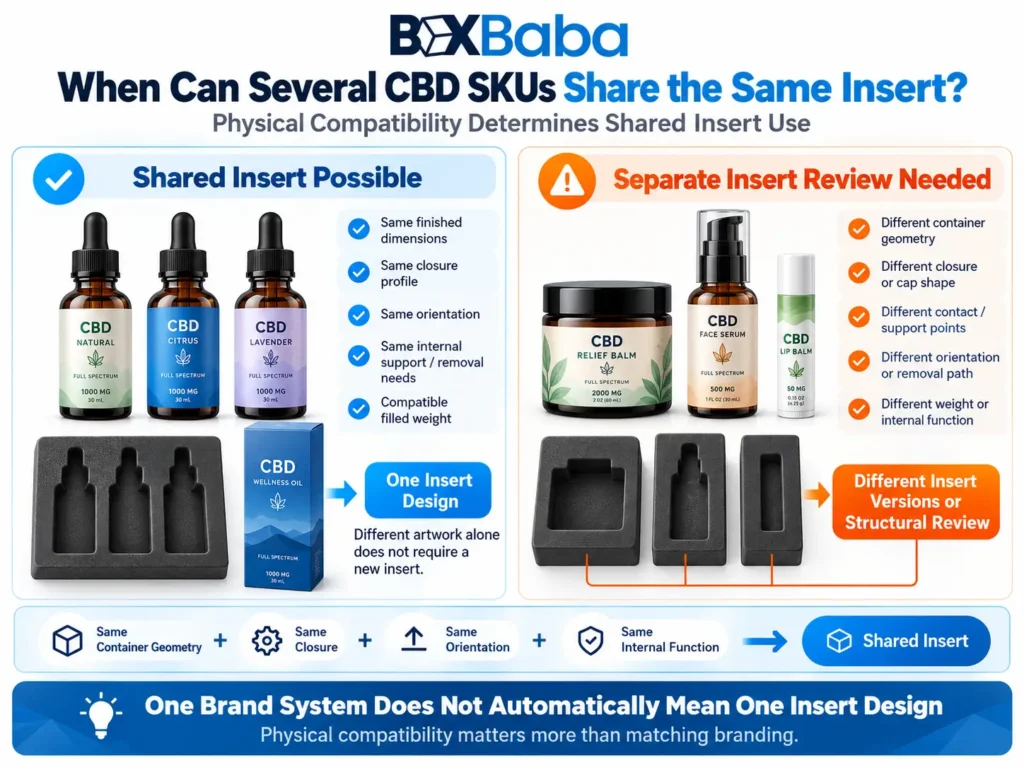
Can several CBD SKUs share the same insert?
Yes, when their physical containers, closures, dimensions, orientations and fit requirements are compatible.
Should the insert be rechecked if the bottle or jar changes?
Yes. Even a similar-capacity replacement container can have different external dimensions, closure geometry or weight.
What should I provide BoxBaba for a CBD insert project?
Provide the finished container dimensions, closure, filled weight, quantity, number of products, orientation, accessories, required internal function, artwork status and delivery destination.