
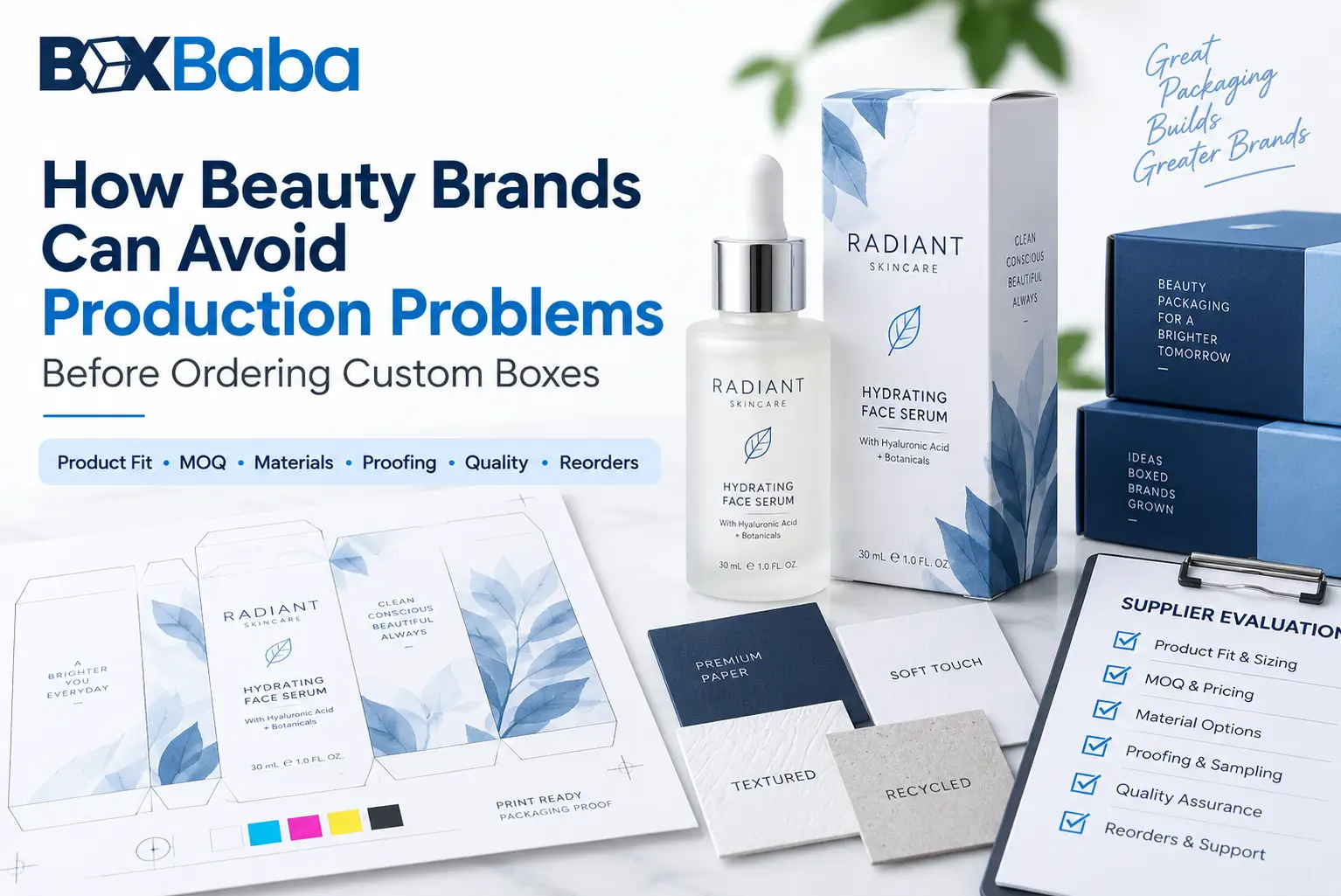
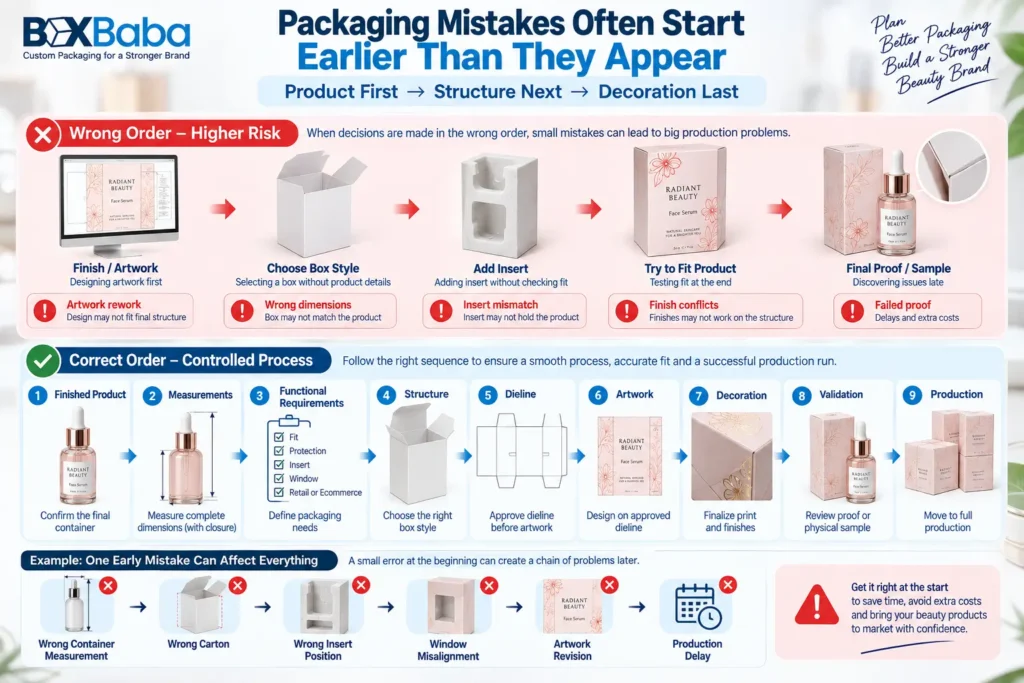
The most common cosmetic packaging mistakes happen when brands make decisions in the wrong order – for example, choosing a box before the finished container is measured, designing artwork before the dieline is approved, adding an insert or window without checking product position, or approving production with a proof that cannot validate the unresolved risk. Prevent them by confirming each packaging stage before the next one begins.
Finished Product -> Measurements -> Structure -> Material -> Insert / Window -> Dieline -> Artwork -> Proofing -> Production -> Reorder Verification
This guide focuses on printed secondary cosmetic packaging such as folding cartons, sleeves, rigid boxes and insert-supported boxes placed around a finished cosmetic container. Primary bottles, jars, tubes, pumps, droppers and airless systems may require separate formula-compatibility, leakage, dispensing or component-performance testing that is outside this articles main scope.
Cosmetic Packaging Mistakes at a Glance
Packaging Stage | Common Mistake | What It Can Affect | Better Planning Direction |
Product | Packaging before the finished container is confirmed | Dimensions, structure, insert, artwork | Finalize or obtain a representative product first |
Sizing | Using fill volume as box size | Internal fit and clearance | Measure the complete closed container |
Structure | Choosing style by appearance alone | Support, loading, closure | Match structure to product and channel |
Insert | Adding one automatically | Box size, cost, removal | Define the inserts function first |
Window | Adding it after structure or artwork | Product visibility and panel space | Coordinate product, insert, window and artwork |
Artwork | Designing before final dieline | Rework and panel misalignment | Approve structure before production artwork |
Labeling | Leaving required copy until the end | Readability and panel layout | Reserve copy space before final artwork |
Finishes | Selecting decoration too early | Fold conflicts and unnecessary complexity | Apply finishes after structure and dieline planning |
Proofing | Assuming one proof validates everything | Fit, color or artwork errors | Match proof type to the unresolved risk |
SKUs | Forcing one structure across different containers | Inconsistent fit | Separate geometry from artwork variation |
Channel | Using retail packaging as shipping packaging | Distribution risk | Evaluate each packaging layer separately |
Reorder | Reusing old dieline or artwork without verification | Fit and version errors | Confirm current product and specification |
Quoting | Comparing different specifications | Misleading price comparison | Quote equivalent structures and requirements |
The mistakes are connected. A wrong container measurement can affect the carton, insert, window, artwork, proof and reorder – not just the box dimensions.
Why Packaging Mistakes Usually Start Earlier Than They Appear
A cosmetic box should not begin with a favorite box style, decorative finish or finished artwork and then try to make the product fit afterward.
A safer sequence is Finished Product -> Functional Requirements -> Structure -> Dieline -> Artwork -> Decoration -> Validation.
BoxBabas How to Choose Cosmetic Packaging Boxes guide follows the same product-first principle: the completed bottle, jar, tube, compact or palette should establish the dimensional and structural starting point before decorative decisions are finalized.
The biggest mistake is therefore not one particular wrong measurement. It is making a downstream decision before the upstream specification is stable enough to support it.
Product and Measurement Mistakes
Designing Packaging Before the Cosmetic Product Is Final
Packaging concepts can begin early, but production dimensions should not be locked while the primary container is still changing. A different bottle diameter, jar lid, pump, dropper, overcap, shoulder, decorative collar, base or total height can affect the carton. Filled weight can also matter when the structure or insert must support the product.
If a primary-container supplier changes after the dieline is approved, ask whether anything changed in the products external geometry, packed orientation or weight. If it did, review the packaging specification before continuing.
Treating Fill Volume as a Box Dimension
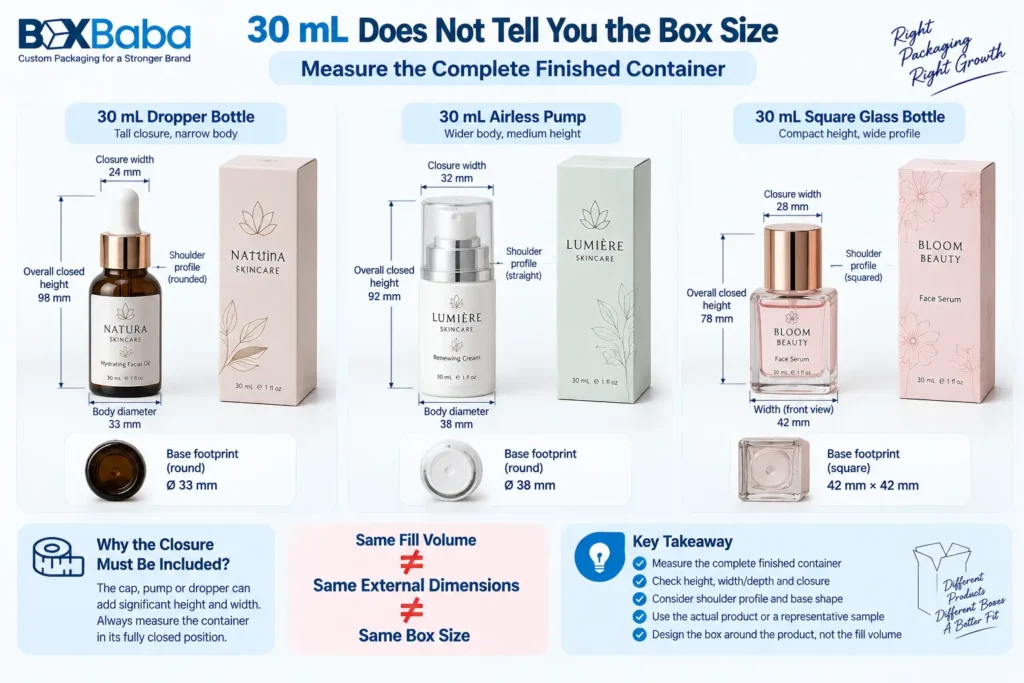
A 30 mL serum, 50 mL moisturizer or 1 oz foundation does not have one universal carton size. Capacity describes how much formula the primary container holds; it does not describe the containers exterior dimensions.
A 30 mL dropper bottle, 30 mL airless pump and 30 mL square glass bottle can all require different cartons. Measure the finished container rather than choosing a box from fill volume alone.
Measuring the Body but Ignoring the Closure
The widest or tallest point may be the pump head, dropper bulb, overcap, jar lid, applicator closure, decorative collar or shoulder. Measure the product in the state in which it will actually be packed – including the complete fitted closure.
Product-Fit and Structure Mistakes
Assuming a Box Fits Because the Product Goes Inside
Physical entry is only one part of fit. A product can enter a carton and still be poorly packaged.
A more useful definition is Good Fit = Loading + Clearance + Retention + Closure + Removal + Presentation.
- Can the product be loaded without forcing the carton?
- Does the carton close without pressing on a pump or dropper?
- Is there excessive internal movement?
- Can the customer remove the product comfortably?
- Does the product remain in the intended orientation?
- If there is a window, does the intended product area remain visible?
Choosing Box Structure From Appearance Alone
A rigid box may create a premium presentation, but it is not automatically the right structure for every lipstick or serum. Likewise, a simple folding carton may suit many products but be inadequate for a heavy multi-product glass set without appropriate internal support.
Structure should follow product dimensions, filled weight, orientation, number of items, opening direction, insert requirement, sales channel and intended presentation. Structural complexity should solve a packaging requirement rather than exist for its own sake.
Forcing One Structure Across Containers That Are Not Physically Compatible
Brands often try to simplify purchasing by sharing one carton across several products. This can work when the physical geometry remains compatible.
One lipstick case geometry + 12 shades -> one structural dieline + multiple artwork versions.
But 30 mL dropper bottle + 30 mL airless pump does not automatically equal one box simply because both containers hold the same volume.
Keep structural variation separate from artwork variation.
Insert and Window Mistakes
Adding an Insert Because It Looks Premium
An insert should solve a defined problem such as holding a bottle, limiting movement, separating products, supporting a fragile container, maintaining orientation or aligning a product with a window. If it has no clear function, it can add material, package size, assembly and cost without solving a real packaging problem.
Ask: What problem will this insert solve?
Making the Insert So Tight That the Product Is Hard to Remove
More retention is not always better. Review both Container -> Insert Cavity and Insert -> Outer Box. Then check finger access and removal direction. The product should remain appropriately positioned without requiring unnecessary force to remove it.
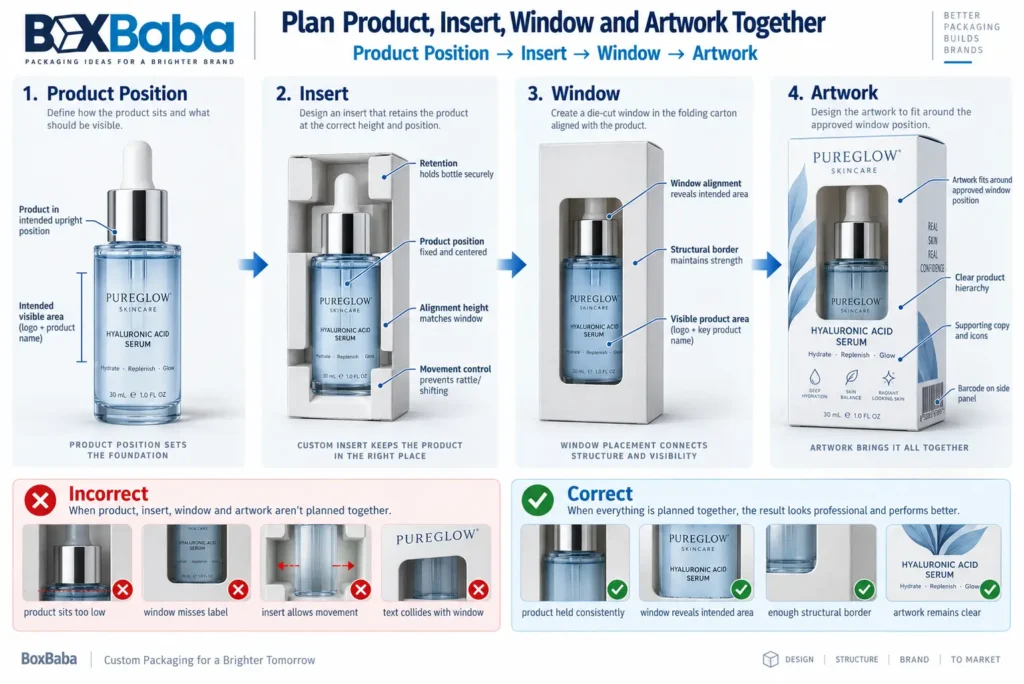
Adding a Window After the Package Is Already Designed
A window interacts with product position, insert geometry, structural borders, artwork, text, folds and available barcode space. Plan the relationship in this order:
Product Position -> Insert -> Window -> Artwork
Do not assume a window improves hygiene, protection or tamper evidence unless the complete structure is specifically designed and validated for that function.
Material Selection Mistakes
Choosing Material From Appearance Alone
White paperboard, kraft board, corrugated board and rigid-board constructions do not perform identical jobs. Material choice should consider structure, product load, folds and scores, print requirements, finishing requirements, insert relationship and sales channel.
For deeper material planning, use BoxBabas Best Materials for Custom Cosmetic Boxes guide rather than treating color or thickness alone as the specification.
Assuming Kraft Appearance Proves an Environmental Claim
A brown kraft appearance may communicate a natural visual direction, but appearance alone does not prove claims such as recycled, recyclable, biodegradable, compostable, FSC-certified, plastic-free or a specific recycled-content percentage. Environmental language should match the actual material, coatings, films, inks and available documentation.
Artwork and Dieline Mistakes
Designing Detailed Artwork Before the Dieline Is Approved
A visual concept can be developed early, but production artwork should be built on the final approved dieline. The dieline establishes panel sizes, cuts, folds, glue areas, flaps, windows and the usable artwork surfaces. If the structure changes after artwork is complete, the design may require substantial rework.
Use Structure -> Approved Dieline -> Final Artwork rather than Artwork -> Force the Structure Around the Design.
Resizing the Structural Dieline to Make the Design Fit
Artwork should adapt to the approved structure. If required copy or branding does not fit, review the information hierarchy or packaging structure rather than casually stretching or redrawing structural lines. A structural change should be treated as a structural revision.
Forgetting the Assembled Orientation
A flat dieline can make top flaps, bottom panels, inside printing, drawer boxes and sleeves difficult to visualize. Review how the package reads after assembly, not only how it looks on the flat artwork file.
Labeling, Barcode and QR Code Mistakes
Leaving Required Product Copy Until the End
Cosmetic packaging may need room for product identity, net quantity, ingredients, business information, warnings, directions, shade or formula identifiers, barcodes and other approved or market-required content. Do not finish the visual composition first and then squeeze important copy into whatever space remains.
For U.S. cosmetics, review the current FDA cosmetics labeling requirements as part of the brands compliance process. The packaging supplier can organize printable space, but it should not be treated as the final legal approver of product claims or labeling.
Assuming the Packaging Supplier Approves Cosmetic Claims
The supplier can print the approved artwork; that does not automatically validate whether every claim, certification mark or labeling statement is legally appropriate. The beauty brand, manufacturer, distributor or responsible compliance reviewer should verify the final product copy before production approval.
Treating Barcodes and QR Codes as Decorative Graphics
Barcodes and QR codes are functional production elements. Avoid distorting them, placing them across folds or seams, pushing them against cut edges, covering them with unsuitable decoration, or reusing another SKUs code.
For QR codes, verify Correct SKU -> Correct QR -> Correct Destination before production release.
Finish Mistakes
Choosing Finishes Before the Structure and Artwork Are Stable
Foil, Spot UV, embossing, debossing, matte lamination and gloss lamination are finishing decisions. They should not determine basic product fit or structure. Finish placement may need revision near folds, cut edges, windows or other structural areas.
Use the Cosmetic Packaging Finishes Guide for the detailed finish-selection process; this article only needs the decision rule: structure first, decoration second.
Using Decoration to Solve a Structural Problem
A glossy surface cannot stabilize a heavy jar, and foil cannot control bottle movement. Keep structural performance separate from surface presentation. Each finish should answer a visual or tactile objective rather than compensate for an unresolved fit or support problem.
Proofing and Approval Mistakes
Assuming a Digital Proof Validates Physical Fit
A digital proof can help review artwork, panel layout, wording, SKU information, finish locations and dieline relationships. It cannot physically establish bottle fit, insert retention, drawer movement, product removal or assembled structural behavior.
Assuming a Physical Sample Validates Everything
A blank structural sample may be useful for fit, folds, closure, loading and insert geometry, but it does not prove final print color. A digitally printed prototype may show physical artwork without reproducing the exact appearance of a production run made with a different print or finishing process.
The rule is: approve a proof only for the attributes it was designed to validate.
Approving Only the Front Panel
Errors often hide on side panels, bottom panels, top flaps, ingredient areas, barcode panels or SKU identifiers. Review the complete package and its assembled orientation, not only the hero panel.
Assuming Someone Else Owns the Final Approval
Packaging approval can involve different responsibilities. The brand or product team may verify the correct product and SKU; creative may verify the design; a compliance reviewer may verify applicable claims and labeling; packaging/prepress may check structural and file relationships; and operations may check quantities, codes and pack-out requirements. One person may perform several roles, but approval ownership should still be explicit before production release.
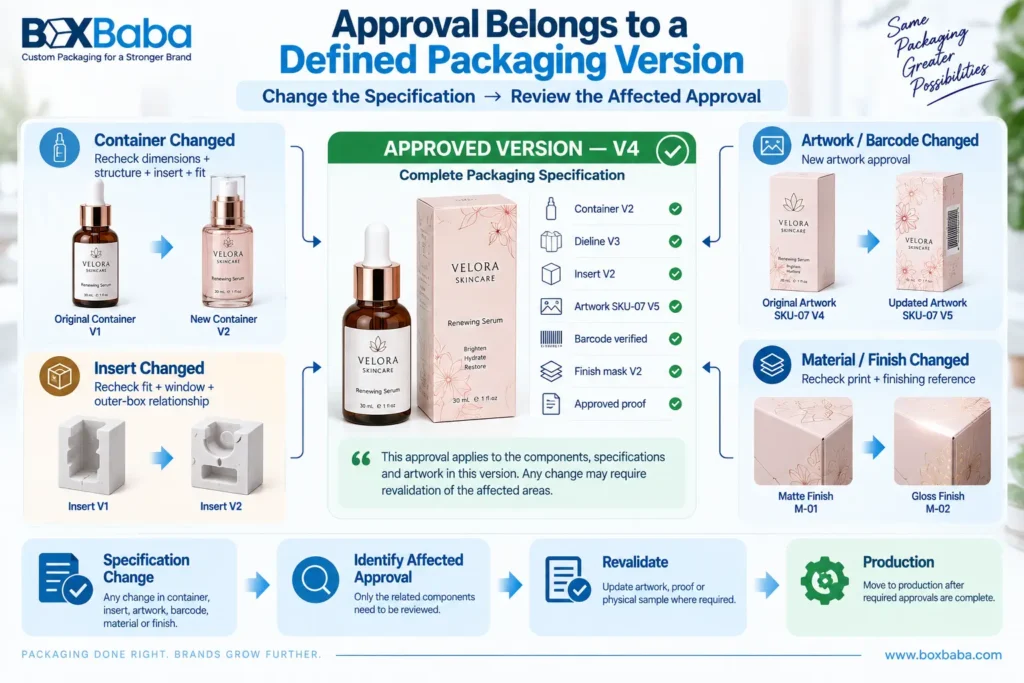
Changing the Specification After Approval Without Revalidation
If the container, material, insert, window, artwork, barcode, foil area or SKU information changes after approval, determine which previous approval is no longer valid. Approval belongs to a defined version – not permanently to the project.
Retail and Ecommerce Mistakes
Treating the Retail Carton as the Ecommerce Shipping Package
A retail carton and an ecommerce outer package can perform different jobs. A serum sold online may use Serum Bottle -> Retail Carton -> Ecommerce Outer Package. Evaluate the customer-facing carton and the distribution layer separately rather than expecting one decorative carton to solve every shipping requirement.
BoxBabas Retail vs Ecommerce Cosmetic Packaging guide covers this channel distinction in more depth.
Designing Ecommerce Packaging Around One Bare Product
An ecommerce order may contain one unit, several products, multiple SKUs, a gift set or a complete skincare routine. Plan the outer package around the completed order configuration rather than only one bare bottle.
Multi-SKU and Version-Control Mistakes
Assuming Every SKU Needs a New Dieline
A new shade or formula does not automatically require a new structural carton. If the finished product geometry remains the same, several artwork SKUs may share one structure.
Example: One lipstick tube geometry -> one carton dieline -> 20 shade artwork versions.
Assuming Every SKU Can Use the Same Dieline
The reverse mistake also occurs. Do not force different containers into one carton merely because they have the same nominal volume, belong to one collection or seem visually similar. Share a structure only when the physical geometry and support requirements remain compatible.
Failing to Control Artwork Versions
Files named final.pdf, final2.pdf and final-actual.pdf create avoidable ambiguity. Use a controlled SKU schedule that identifies product, SKU, shade or formula, barcode, QR destination, artwork version, structural version, quantity and approval status.
Keep the distinction explicit: Structural Version != Artwork Version.
Reorder Mistakes
Assuming the Previous Packaging Specification Is Still Correct
Repeat orders feel safer because the packaging has already been produced, but that can create complacency. Before reordering, confirm whether the primary-container supplier, dimensions, closure, filled weight, label, ingredients, claims, barcode, QR destination, artwork, finish, material or quantity has changed.
Reusing a Dieline After Changing Container Suppliers
Two suppliers can sell apparently similar 30 mL bottles that are not dimensionally identical. Verify the finished replacement container instead of assuming the old carton remains suitable because the nominal capacity is unchanged.
Reordering From an Old Artwork File
The physical box may be unchanged while the approved artwork has moved forward. A repeat order should reproduce the intended version – not simply the last file someone finds.
Quote and Supplier-Comparison Mistakes
Requesting a Quote Without Complete Product Information
An incomplete specification forces assumptions. Prepare the product type, finished dimensions, filled weight, closure profile, product orientation, box style where known, material direction, insert/window requirements, number of SKUs, quantity per SKU, artwork status, printing, finish preferences, sales channel and delivery destination.
Comparing Supplier Prices for Different Specifications
A basic folding carton and a thicker carton with an insert, matte lamination and foil are different products. For a meaningful comparison, request pricing against the same dimensions, structure, material, printing, finish, insert, quantity and delivery scope.
When the Visible Problem Is Not the Root Cause
Packaging problems often compound. The issue that becomes visible may have started several decisions earlier. Diagnose backward through the specification rather than correcting only the final symptom.
Visible Problem | Likely Earlier Cause | What to Recheck |
Product moves inside box | Wrong internal dimensions or support decision | Product measurements + insert requirement |
Carton bulges or will not close | Insufficient clearance or wrong structure | Finished product envelope + structure |
Window misses the product | Product position or insert changed | Product orientation + insert + window |
Artwork no longer fits | Structure changed after design | Approved dieline + artwork version |
Foil crosses a fold | Finish planned before final structure | Dieline + finish mask |
Barcode or QR fails | Placement, size or artwork issue | Production artwork + code verification |
Ecommerce pack-out performs poorly | Retail carton expected to do distribution work | Complete packed order + outer packaging |
Reorder no longer fits | Primary container changed | Current container dimensions + closure |
Wrong shade or formula printed | Version-control failure | SKU schedule + approved artwork |
A useful diagnostic question is: What changed, and which earlier decision created this result?
Cosmetic Packaging Mistake Prevention Framework
Before moving from one stage to the next, verify the inputs needed by that stage. This stage-gate approach is more reliable than waiting for one final visual review before production.
Product Gate
- Finished container and closure are confirmed
- External dimensions are current
- Representative packed state and filled weight are known where relevant
Structure Gate
- Carton style is appropriate
- Loading and removal work
- Insert and window relationships are defined
Artwork Gate
- Approved dieline is being used
- Copy, SKU, barcode and QR information are current
- Panel orientation is correct
Finish Gate
- Finish has a defined visual/tactile purpose
- Placement is compatible with folds and structural areas
Proofing Gate
- The unresolved risk is identified
- The selected proof can actually validate that risk
- The correct version is being reviewed
Production Gate
- Final specification and quantities are confirmed
- Approval ownership is complete
- The exact production artwork version is identified
Reorder Gate
- Product/container has not changed
- Artwork and codes are current
- Structural specification remains compatible
Common Assumptions That Cause Cosmetic Packaging Mistakes
Assumption | Better Rule |
30 mL tells me the box size. | Measure the actual finished container. |
If it goes inside, it fits. | Check loading, clearance, retention, closure and removal. |
Premium boxes need inserts. | Use an insert only for a defined function. |
We can add the window later. | Plan product, insert, window and artwork together. |
Kraft means sustainable. | Verify the material and the environmental claim. |
The designer can adjust the dieline. | Structural changes require structural review. |
Our supplier checked the claims. | The responsible brand/compliance reviewer must verify product copy. |
A digital proof confirms fit. | Physical relationships require appropriate physical review. |
A sample proves everything. | Approve only the attributes the sample represents. |
Retail packaging is enough for ecommerce. | Evaluate the distribution layer separately. |
Every shade needs a new structure. | Separate artwork variation from geometry. |
Same capacity means same container. | Compare actual dimensions and closure profiles. |
Repeat order means nothing needs checking. | Reconfirm product, structure and artwork versions. |
The cheapest quote is the best comparison. | Compare equivalent specifications. |
Before You Approve Cosmetic Packaging for Production
☐ The actual finished product has been measured.
☐ Fill capacity has not been used as a substitute for external dimensions.
☐ Closure projections and relevant filled weight are included.
☐ Product loading, clearance, closure and removal have been considered.
☐ The structure suits the product and sales channel.
☐ Every insert has a defined function.
☐ Window placement matches the intended product position.
☐ Material suits the structure, print and finish requirements.
☐ Environmental claims are supported where used.
☐ Final artwork uses the approved dieline.
☐ Product copy, claims and certification marks have been reviewed by the responsible party.
☐ Barcode belongs to the correct SKU and QR destination has been checked.
☐ Finish locations have been reviewed against structural areas.
☐ The selected proof or sample matches the unresolved risk.
☐ Every artwork SKU has been approved.
☐ Retail and ecommerce packaging roles have been separated where necessary.
☐ Final quantities match the approved SKU schedule.
☐ The exact approved production version has been identified.
Final Takeaway
The most visible cosmetic packaging problem is not always the root problem. A misplaced finish is easy to see; an incorrect assumption made before the dieline was created can affect the entire packaging system.
The safest sequence is Finished Cosmetic Product -> Accurate Measurements -> Structure -> Material -> Insert / Window -> Dieline -> Artwork -> Finishes -> Proofing -> Production.
At every stage, ask what information must be confirmed before the project moves forward. That question prevents more packaging problems than adding another finish, another insert or another layer of complexity.
Planning Custom Cosmetic Packaging?
Share the finished container dimensions, filled weight, closure profile, quantity by SKU, artwork status, box or structure direction, insert/window requirements, finish preferences, sales channel and delivery destination. Starting with the actual product specification helps reduce assumptions before quotation and production. Explore Custom Cosmetic Boxes for the commercial packaging route.
Frequently Asked Questions
What is the most common cosmetic packaging mistake?
One of the most common mistakes is making packaging decisions before the finished cosmetic product is confirmed. A wrong product assumption can affect carton size, structure, inserts, windows, artwork and proofing later in the project.
Why is fill volume not enough to size a cosmetic box?
Fill volume describes the amount of formula inside the primary container, not the containers external dimensions. Two 30 mL bottles can have different heights, diameters, shoulders and closures and therefore require different cartons.
How do I know if a cosmetic product fits a box correctly?
Check more than whether it goes inside. Review loading, clearance, retention, closure, removal and presentation. If an insert or window is involved, also verify the products final position.
Does every cosmetic box need an insert?
No. An insert should solve a defined fit, movement-control, organization, support or presentation requirement. Adding one automatically can increase package size, material and assembly without useful benefit.
Should cosmetic packaging artwork be prepared before the dieline?
A visual concept can be developed early, but production artwork should be completed on the approved dieline so panel sizes, cuts, folds, glue areas, windows and structural relationships are known.
Can multiple cosmetic SKUs share one box structure?
Yes, when the physical containers have compatible dimensions, closure profiles, orientation and support requirements. Different shades or formulas may share one structural dieline while using separate artwork versions.
Can a digital proof confirm product fit?
No. A digital proof can review artwork and dieline relationships, but it cannot physically validate bottle clearance, insert behavior, loading, removal or assembled structural performance.
Is a retail cosmetic carton enough for ecommerce?
Not necessarily. The retail carton and ecommerce outer package can perform different jobs. Evaluate the completed order configuration and decide whether an outer mailer, corrugated carton or additional support is required.
What changes require packaging to be reviewed again?
Review the affected packaging stage when the primary container, dimensions, closure, material, insert, window, artwork, barcode, finish or SKU information changes. Approval applies to a defined version.
How can beauty brands reduce packaging mistakes before production?
Use a controlled sequence: finalize the product, measure it, select the structure, plan inserts/windows, approve the dieline, prepare artwork, verify copy and SKUs, use the appropriate proofing route, and identify the exact production version before ordering.