
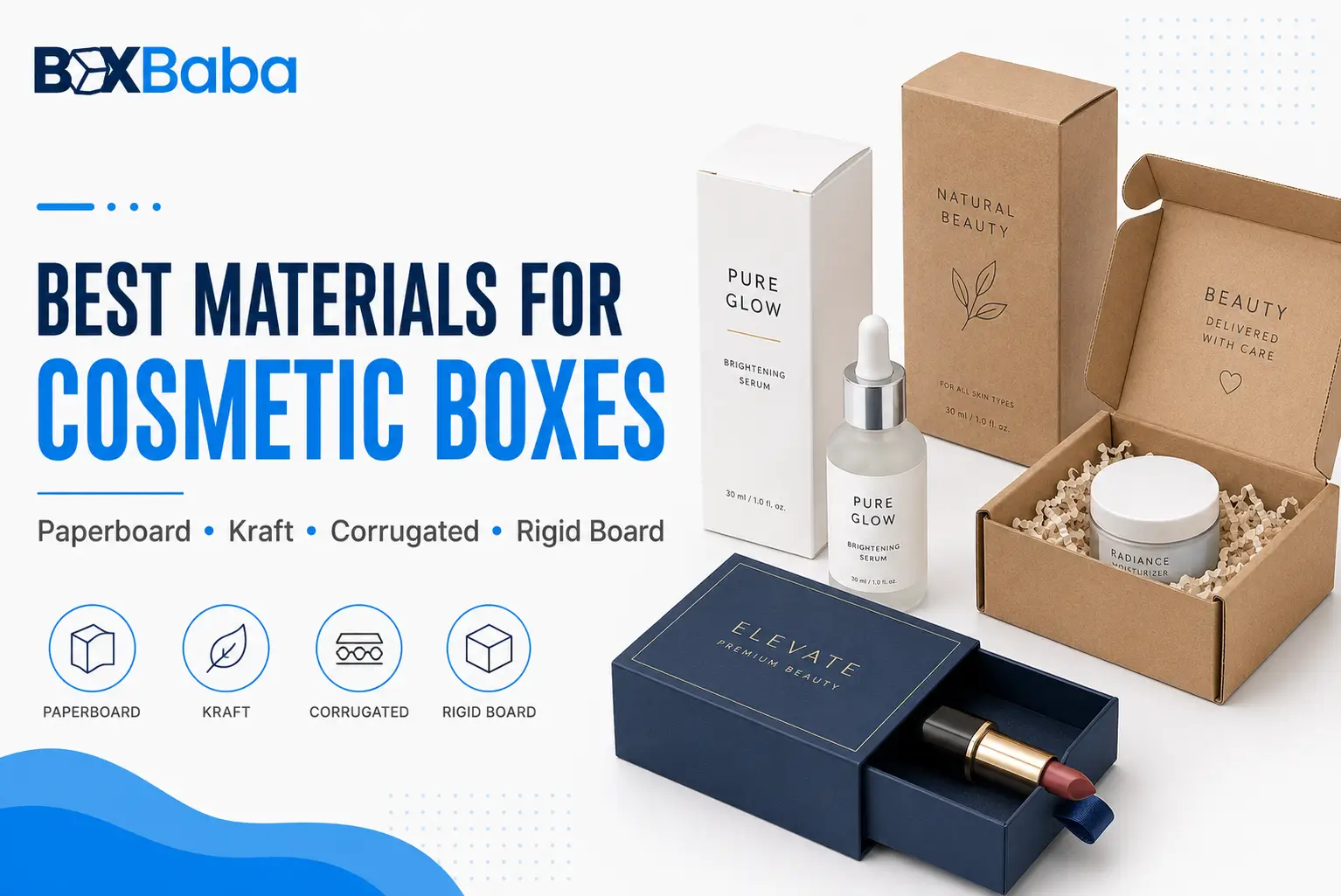
There is no single best material for every custom cosmetic box. White paperboard is often a practical starting point for printed retail folding cartons, kraft paperboard can suit packaging where the natural brown substrate is part of the design, corrugated board is commonly evaluated for ecommerce and distribution packaging, and greyboard or chipboard is used as the structural core of many rigid presentation boxes.
The right choice depends on the finished cosmetic product, filled weight, box structure, artwork, finishes and sales channel.
A useful decision sequence is:
Finished Product → Structure → Material → Printing / Finish → Packaging Channel
This guide focuses on paper-based materials used for secondary cosmetic packaging and outer boxes. It does not compare the glass, plastic, metal or other primary containers that directly hold cosmetic formulas.
If you are planning a complete packaging project, you can also review Custom Cosmetic Boxes or the guide on How to Choose Cosmetic Packaging Boxes.
Cosmetic Box Material Selection Matrix
Use the following matrix as a starting point rather than a fixed specification.
Material Direction | Common Starting Use | Structural Role | Surface / Print Character | Buyer Should Consider |
|---|---|---|---|---|
White Paperboard / Cardstock | Printed cosmetic retail cartons | Foldable carton material | Light-colored printing base | Filled weight, board grade, structure, artwork and finish |
Kraft Paperboard / Cardstock | Natural brown retail cartons | Foldable carton material | Brown substrate becomes part of the design | Artwork contrast, stock shade, coating and finish |
Corrugated Board | Ecommerce mailers, PR kits and shipping cartons | Fluted distribution board | Depends on liner and printing process | Packed weight, mailer structure and distribution requirements |
Greyboard / Chipboard Core | Rigid presentation boxes and gift sets | Thick structural core | Normally covered by a printed or specialty wrap | Box construction, insert, product load and presentation |
Specialty Cardstocks / Wraps | Premium visual or tactile applications | Surface or specialty stock direction | Metallic, textured, colored or holographic | Underlying structure, printing, readability and finish |
The same cosmetic product can require a different material when its container, filled weight, insert, presentation or distribution method changes.
Material and Box Structure Are Not the Same Thing
Material and box style are closely related, but they are not interchangeable terms.
White paperboard and kraft paperboard are material directions. Corrugated board is a layered board construction using liner material and a fluted medium. Greyboard or chipboard is commonly used as a structural core in rigid packaging. A folding carton, mailer box and rigid box are box structures.
This distinction matters because structure constrains which material constructions are practical.
A folding carton must be cut, creased and folded. A rigid presentation box usually uses a thick board core that is assembled and then covered with a printed or specialty wrap. Corrugated packaging uses a different layered construction and is commonly evaluated for mailers, larger kits and distribution packaging.
If your main question is still which box structure to use, review Types of Cosmetic Boxes before finalizing the substrate.
What Determines the Right Cosmetic Box Material?
Choosing a material only because it looks premium, thick, natural or inexpensive can lead to the wrong specification. The finished cosmetic product and the job of the package should come first.
Product Dimensions and Filled Weight
Start with the complete product that will actually enter the box.
A lightweight lipstick tube and a filled glass perfume bottle create different packaging loads even if both are sold as individual cosmetics.
Useful inputs include the finished dimensions, filled weight, primary-container type, closure profile, orientation, number of products and whether an insert is required.
Filled weight is particularly important for bottles, jars and multi-product sets.
A heavier product does not automatically require a rigid box. Structure, board grade, insert design and intended use should be evaluated together.
If dimensions have not yet been confirmed, use the Cosmetic Box Size Guide before locking the material specification.
Box Structure
The intended structure narrows the appropriate material direction.
A conventional folding carton normally uses foldable paperboard or cardstock. A presentation-led rigid box normally uses a greyboard or chipboard structural core with a separate wrap. An ecommerce mailer often leads toward a corrugated construction.
The same serum bottle may therefore use white paperboard for the retail carton and corrugated board for the outer ecommerce package.
Retail vs Ecommerce Use
Retail and distribution packaging perform different jobs.
A retail carton may prioritize product fit, graphics, shelf presentation, information panels and decorative finishes. An ecommerce package is evaluated around the completed order, packed dimensions, total load, internal movement and distribution conditions.
A printed folding carton should therefore not automatically be treated as the complete shipping package.
Artwork and Finish Requirements
Board shade and surface affect the visual starting point for printed artwork.
A bright white paperboard provides a different base from natural kraft, colored stock, metallic stock or a textured paper.
The final printed appearance can also depend on the coating, ink system, print process, artwork and approved proof.
For packaging that depends heavily on light colors, pastels, small typography or detailed graphics, a white paperboard direction may be easier to evaluate. For packaging designed around a natural brown substrate, kraft may be more appropriate.
Neither is universally better.
Main Materials Used for Cosmetic Boxes
White Paperboard and Cardstock
White paperboard is commonly considered for printed cosmetic folding cartons because it provides a clean, light-colored base for branding and product information.
It can be a practical direction for packaging such as lipstick cartons, mascara boxes, serum cartons, foundation boxes, cream cartons and general skincare packaging.
White board can work particularly well when the design depends on bright or pastel brand colors, small typography, product photography, clean white areas or detailed cosmetic graphics.
The final board should still be selected according to the product load, structure, surface coating, printing process and finishing requirements.
White Cardstock Is Not One Fixed Grade
White cardstock is a broad commercial description rather than one universal technical specification.
The final project may need to define the exact board grade, caliper, coating and surface.
SBS may be one possible white paperboard grade, but every white cosmetic carton should not automatically be described as SBS unless that exact grade has been confirmed.
Kraft Paperboard and Cardstock
Kraft-style paperboard can suit brands that intentionally want the natural brown substrate to remain part of the visual design.
It may be appropriate for selected skincare, personal-care, lip-care and minimalist cosmetic packaging.
The main difference from white paperboard is that the substrate itself contributes more visibly to the final artwork.
Colors printed on natural brown stock can appear different from the same artwork printed on a white board. Exact results depend on stock shade, ink coverage, print process, coatings and artwork.
Kraft can therefore be a useful direction when the brown base is intentional, but the artwork should be developed for the material rather than transferred from a white-board design without review.
For broader commercial options, see Custom Kraft Boxes.
Corrugated Board
Corrugated board uses a layered construction that includes liner material and a fluted medium.
For cosmetic packaging, it is commonly more relevant to ecommerce mailers, subscription boxes, PR kits, larger cosmetic sets and outer shipping cartons.
The exact construction should be selected according to the completed package rather than simply the cosmetic product name.
Important variables can include packed dimensions, loaded weight, number of products, internal support and distribution method.
Do not assume one flute or wall construction is suitable for every cosmetic order.
For distribution-oriented packaging options, see Custom Corrugated Boxes.
Greyboard or Chipboard Core for Rigid Cosmetic Boxes
Rigid presentation boxes commonly use a thick greyboard or chipboard structural core with a separate printed or specialty wrap.
The core provides the main shape and stiffness of the package, while the wrap creates much of the visible printed or tactile surface.
This construction can be considered for selected perfume boxes, skincare gift sets, makeup collections and presentation-led cosmetic kits.
A glass product does not automatically require rigid packaging. Filled weight, box size, insert, presentation goals and distribution still matter.
The visible wrap is also a separate material decision. It may use printed paper, textured stock, colored paper or another specialty surface.
For a deeper structure comparison, review Rigid vs Folding Carton Cosmetic Packaging or explore Custom Rigid Boxes.
Specialty Cardstocks and Wraps
Specialty materials can create a stronger visual or tactile effect, but they should normally be chosen after the structural requirement is understood.
Possible directions include foil metallic cardstock, textured or linen-style paper, colored stock and holographic stock.
Metallic and holographic surfaces can change contrast and reflectivity. Colored stock makes the base color part of the artwork. Textured paper can influence fine printed details, large solid areas and selected finishes.
The underlying structural material and the visible surface should therefore be treated as two related decisions.
Paperboard Grade Names Buyers May Encounter
Packaging suppliers and technical documents may use several grade names. These terms should not be treated as interchangeable.
Term | Buyer Takeaway |
|---|---|
SBS | A specific white paperboard grade; not a synonym for every white cardstock |
FBB | A paperboard grade/family used in packaging markets |
CCNB / Coated Recycled Board | A different board construction and surface direction |
Kraft Board | A kraft-oriented board family, often with a natural brown appearance |
These are industry material terms rather than a statement that every grade is available for every BoxBaba project. Confirm the exact substrate during quotation.
Which Material Fits Which Cosmetic Packaging Task?
Product names can help narrow the decision, but they should not become fixed material rules.
Cosmetic Packaging Task | Practical Starting Direction | What Can Change the Decision |
|---|---|---|
Lightweight lipstick or mascara carton | White or kraft paperboard | Artwork, structure and presentation |
Serum bottle carton | White paperboard | Glass weight, dropper/pump and insert |
Cream or skincare jar carton | Paperboard | Jar weight, lid, insert and structure |
Perfume retail carton | Paperboard or rigid presentation structure | Filled bottle weight, cap, insert and positioning |
Makeup palette | Paperboard, specialty stock or rigid structure | Palette size, weight and presentation |
Multi-product skincare set | Paperboard, rigid or corrugated depending role | Combined load, arrangement and channel |
Cosmetic PR kit | Rigid or corrugated depending presentation and shipment | Insert, product count and distribution |
Ecommerce cosmetic order | Corrugated outer package | Packed dimensions, total weight and fulfillment method |
For example, an individual serum bottle may use a white paperboard retail carton, but a heavier glass serum bottle with a fitted insert may require a different board specification.
Similarly, a perfume bottle can use a conventional folding carton in one project and a rigid presentation box in another. The product name does not determine the box by itself.
Relevant product-specific pages include Custom Serum Boxes, Custom Cream Boxes, Perfume Boxes and Custom Lipstick Boxes.
How Material Affects Printing and Finishes
Material influences more than structural performance. The substrate surface also affects the starting point for printing and decorative finishing.
White paperboard provides a light base for color reproduction. Kraft introduces a natural brown background. Metallic, colored and holographic materials contribute their own visual effect. Textured stocks can change how fine print and detailed finishes appear.
Cosmetic packaging may use finishes such as foil stamping, embossing, debossing, Spot UV, matte or gloss treatments and soft-touch treatments.
The suitability and final appearance of a finish can depend on the exact board, coating, print process, artwork and finishing system.
It is therefore better to establish the material direction before final artwork and finishes are locked.
Moving artwork designed for white paperboard to kraft, colored stock or metallic stock at the final stage can change contrast and apparent color.
For a deeper comparison of decorative treatments, review the Cosmetic Packaging Finishes Guide.
GSM, Caliper and Board Thickness
Buyers often ask for the best GSM for cosmetic boxes, but there is no single GSM that works for every product.
The material specification should consider product load, structure and board characteristics together.
What Does GSM Mean?
GSM means grams per square meter. It describes the mass of paper or board per unit area.
GSM does not by itself tell you the exact thickness, stiffness, folding behavior or structural performance of the material.
Two boards can have similar GSM values and still behave differently.
What Is Caliper?
Caliper describes the physical thickness of the paperboard.
It can influence carton stiffness, creasing, fold geometry, tuck fit and the relationship between internal and external dimensions.
GSM and caliper are related material attributes, but they are not interchangeable measurements.
Thicker Does Not Automatically Mean Better
A thicker board may create a more substantial feel, but additional thickness can also affect creasing, folding and dieline geometry.
A heavier cosmetic product may justify a stronger structural evaluation, but that does not automatically mean increasing GSM.
Bottom construction, insert design, product orientation and outer shipping packaging may also affect the final solution.
A meaningful change in material thickness should also trigger a dieline review because board caliper can affect fold positions, panel relationships and insert fit.
Retail Box Material vs Ecommerce Shipping Material
One of the most important distinctions for cosmetic brands is the difference between product packaging and distribution packaging.
A cosmetic product might follow this system:
Serum Bottle → Paperboard Retail Carton → Corrugated Ecommerce Mailer
The retail carton handles product presentation and information. The outer corrugated package handles the completed order and distribution role.
This does not mean every cosmetic retail carton needs an additional corrugated box.
It means the shipping requirement should be assessed separately.
A stronger retail carton should not automatically be assumed to replace an outer parcel package when the completed order and distribution conditions call for one.
Choosing Materials for Cosmetic Boxes With Inserts
An insert can serve different purposes at different packaging layers.
In a retail presentation box, an insert may position a bottle, organize several products or establish a specific presentation layout.
In an ecommerce package, internal support may instead be evaluated around the completed order arrangement.
Possible options can include dividers, fitted supports or compartment layouts where required.
Not every ecommerce order needs an insert.
The decision should follow the number of products, geometry, available internal space, loaded weight and outer-box structure.
A useful rule is:
Evaluate Each Packaging Layer Separately → Add Internal Support Only Where It Serves a Defined Function
This also helps avoid duplicating support components unnecessarily.
Materials for Retail vs Ecommerce Cosmetic Packaging
An insert changes the packaging system because the product load is no longer interacting only with the outer carton.
An insert can hold a bottle in position, separate products, organize a gift set, control orientation or improve presentation.
Not every cosmetic box requires one.
For products that do need an insert, evaluate the finished product geometry, filled weight, insert contact area, removal direction, outer structure and number of products.
The widest part of a cosmetic product is not always where the insert should hold it.
For example, a perfume bottle may be widest around the shoulder while the actual support area is around the body or base.
The maximum product envelope defines the space required inside the box, while the insert contact area defines the geometry used to support the item.
Removal access matters too. A very tight insert is not automatically better if the customer cannot easily grip and remove the product.
Environmental Material Claims to Verify
Environmental terminology should describe specific, supportable packaging attributes rather than broad assumptions based on color or material name.
Claim | What Should Be Verified |
|---|---|
Recycled content | Actual board specification and documented recycled content |
Recyclable | Completed package construction and relevant local collection/processing infrastructure |
FSC-certified | Project-specific certified material sourcing and documentation |
Plastic-free | All coatings, films, windows, laminations and other components |
Biodegradable / Compostable | Exact material construction and supporting evidence |
A natural brown kraft appearance does not prove that a package contains recycled fiber.
Similarly, a paper-based package should not automatically be described as plastic-free if it contains lamination, window film or other plastic components.
For a broader brand-positioning discussion, review Luxury vs Eco-Friendly Cosmetic Packaging.
Common Cosmetic Box Material Selection Mistakes
Mistake | Why It Matters | Better Approach |
|---|---|---|
Choosing by appearance alone | Structural requirements may be ignored | Start with the finished product and structure |
Calling every paper box cardboard | The actual material specification remains unclear | Identify the specific board family or construction |
Assuming thicker board is always better | Extra thickness can affect folding and dieline geometry | Match board specification to product and structure |
Choosing rigid packaging automatically for glass | Glass alone does not determine the box | Evaluate filled weight, insert and presentation |
Choosing kraft solely because it looks sustainable | Brown appearance does not prove environmental attributes | Verify the actual material construction |
Treating the retail carton as the shipping package | Retail and distribution packaging serve different roles | Evaluate the completed ecommerce order separately |
Choosing corrugated for every cosmetic box | It may be unnecessary for individual retail cartons | Use corrugated where the distribution or format requires it |
Ignoring filled weight | Size alone does not describe the load | Provide both dimensions and filled weight |
Selecting finishes before substrate | Surface characteristics affect the final result | Establish material direction before final artwork/finish |
Choosing GSM from a generic chart | GSM alone does not define performance | Evaluate grade, caliper, structure and load together |
Ignoring insert requirements | Inserts change internal geometry and load distribution | Develop the insert and outer structure as a system |
Changing board without reviewing the dieline | Different caliper can change fit and folds | Recheck the structure after a material change |
What Material Information Should You Send for a Quote?
You do not need to know the exact board grade or GSM before requesting custom cosmetic box pricing.
If you are unsure, provide enough product information for the material direction to be evaluated.
Useful details include:
- cosmetic product type;
- finished product dimensions;
- filled weight;
- primary-container type;
- number of products per box;
- preferred box structure, if known;
- retail, ecommerce, gift or PR use;
- insert requirement;
- preferred material appearance;
- printing requirements;
- planned finishes;
- order quantity;
- artwork status.
A practical specification workflow is:
Product Specification → Structure → Material Direction → Exact Board Specification → Proof / Approval
If you are unsure about the substrate, state:
Please evaluate a suitable material direction based on the finished product weight, intended box structure, artwork and sales channel.
That is more useful than selecting a technical board grade from a generic online chart without enough product information.
Request Custom Cosmetic Box Pricing
The best cosmetic box material is selected around the actual product and packaging role, not from a universal material rule.
When requesting pricing, share the finished dimensions, filled weight, primary-container type, intended structure, product count, insert requirements, retail or ecommerce use, preferred material direction, printing requirements, finishes, quantity and artwork status.
If you are unsure whether paperboard, kraft, corrugated, rigid-board construction or a specialty stock is the better direction, BoxBaba can evaluate the material as part of the complete packaging specification.
The MOQ for Custom Cosmetic Boxes starts from 100 boxes.
Proofing or sample routes are confirmed during quotation. Standard production takes 5–9 business days after final artwork and project specifications are approved. BoxBaba provides free shipping across the USA. Production and transit time are separate.
FAQs About Cosmetic Box Materials
What is the best material for custom cosmetic boxes?
There is no universal best material. White paperboard is commonly considered for printed retail folding cartons, kraft can suit packaging where the brown substrate is part of the design, corrugated is commonly evaluated for ecommerce and distribution packaging, and greyboard or chipboard is used as the structural core of many rigid presentation boxes.
Is white paperboard good for cosmetic packaging?
White paperboard can be suitable for many cosmetic folding cartons because it provides a light printing base. The exact grade and thickness should still follow the product weight, structure, artwork and finishing requirements.
Is SBS the same as white cardstock?
No. SBS is a specific paperboard grade, while white cardstock is a broader commercial description. Do not assume every white cosmetic carton is SBS unless the exact material has been confirmed.
Kraft or white paperboard: which should I choose?
White paperboard provides a lighter base for printed graphics, while kraft uses the natural brown substrate as part of the visual design. Choose according to the structure, artwork and intended appearance rather than treating either as universally better.
Is corrugated board suitable for cosmetic packaging?
Yes, particularly for ecommerce mailers, subscription packaging, PR kits and outer distribution cartons. It is not automatically the right choice for every individual retail cosmetic box.
Does a glass cosmetic bottle need a rigid box?
No. Glass is only one factor. Filled weight, product dimensions, insert requirements, presentation and distribution should also be considered.
What GSM is best for cosmetic boxes?
There is no one correct GSM for all cosmetic boxes. GSM should be evaluated together with board grade, caliper, product weight, structure and insert requirements.
Is kraft cosmetic packaging automatically eco-friendly?
No. A natural brown appearance does not establish recycled content, recyclability or another environmental attribute. Claims should be based on the actual completed material specification.