
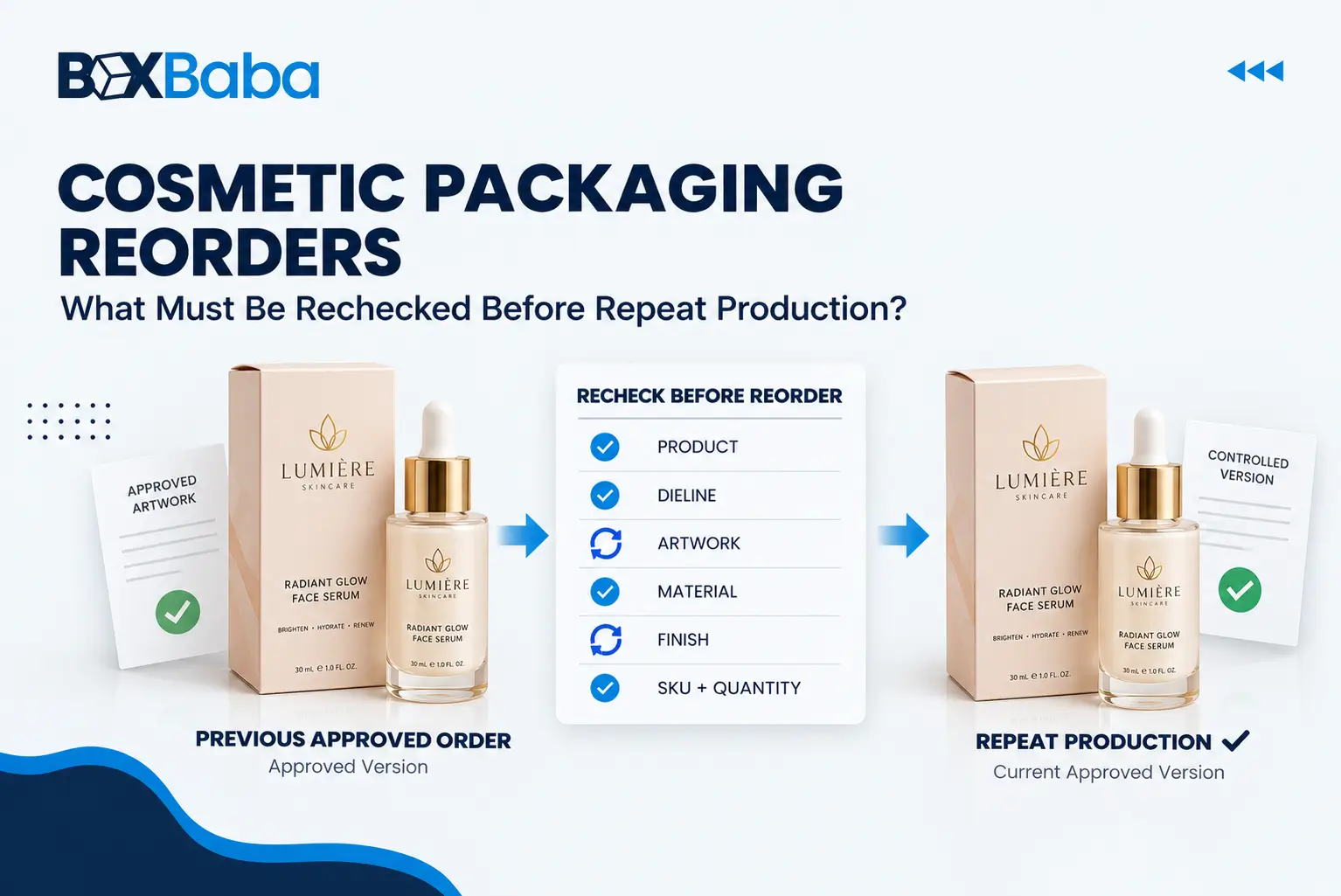
A cosmetic packaging reorder should not begin with print the old file again. It should begin by confirming whether the product, box, artwork, material, finish, quantity, SKU mix, sales channel or delivery requirements have changed since the previous approved production run.
Some repeat orders are genuinely identical. Others look identical at first but contain a new barcode, revised ingredient panel, changed bottle cap, different insert, new market language, updated finish or a new material direction. Each change can affect a different part of the packaging specification.
Use this reorder sequence: Previous Approved Production Reference -> Current Product / Order Review -> Change Detection -> Risk Classification -> Updated Proof or Sample Where Needed -> Version-Controlled Approval -> Repeat Production
For proof and sample types, review Cosmetic Packaging Samples and Proofing. Brands starting a new package rather than repeating an approved one should begin with How to Choose Cosmetic Packaging Boxes.
What Is a Cosmetic Packaging Reorder?
A cosmetic packaging reorder is a repeat production request for a packaging item that has already been developed or produced. The repeat may use the same structure and artwork, or it may include controlled revisions.
The useful distinction is: Repeat Customer != Identical Packaging Specification.
A reorder is only same as before after the previous approved specification has been compared with the current requirement.
Why Reorders Still Need a Pre-Production Check
The previous run is valuable because it provides a known production reference, but packaging conditions can change between runs. The cosmetic product itself may change, the container supplier may revise a component, artwork may be updated, or the brand may enter a new market.
- Product container or closure changed.
- Box dimensions, insert, window or opening direction changed.
- Material, board thickness or finish changed.
- Artwork copy, shade name, ingredients, barcode or QR code changed.
- A new market, language or retailer version is being introduced.
- The quantity or SKU mix changed materially.
- Retail, ecommerce, wholesale or master-case requirements changed.
The purpose of the reorder review is not to redesign a stable package. It is to identify exactly what remained stable and exactly what changed.
Start With the Previous Approved Production Reference
A reliable reorder needs a controlled reference to the previously approved package. Do not rely only on a product name, an old email attachment or a file called FINAL-final-v2.
The previous production reference should identify, where applicable:
- Product / SKU name and internal code.
- Approved box structure and finished dimensions.
- Dieline revision or structural file reference.
- Artwork revision and approval date.
- Material and board specification.
- Printing / color reference.
- Finish layers and locations.
- Insert or divider specification.
- Window, hang tab or other structural feature.
- Approved proof, physical sample or retained reference where applicable.
- Packing / assembly notes and quantity by SKU.
These references work together. Artwork alone does not define the complete packaging specification.
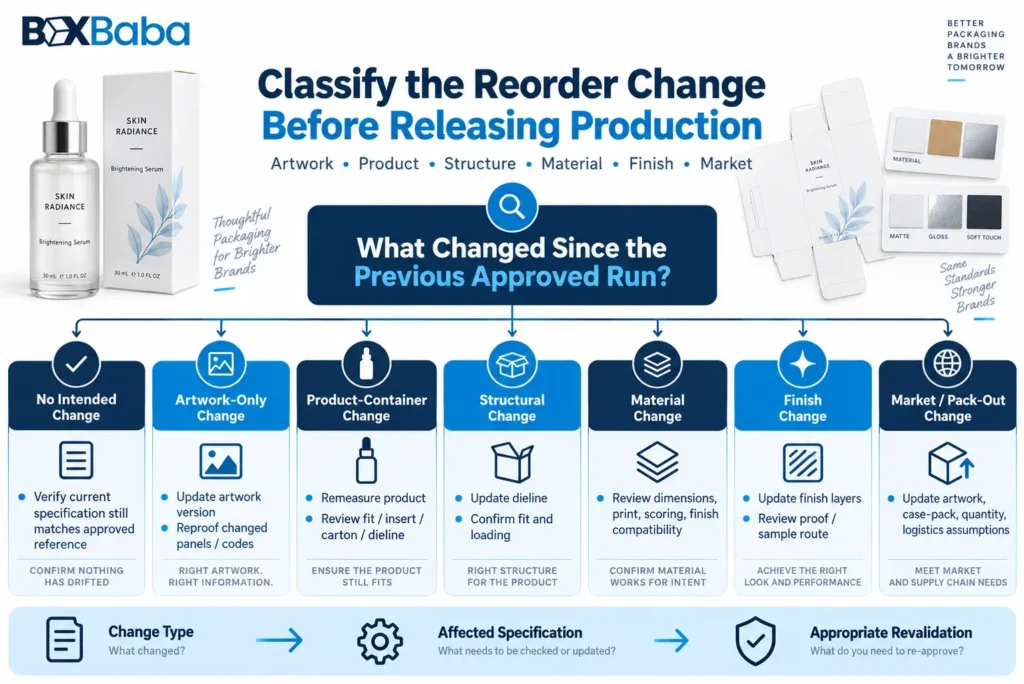
Reorder Change Classification
Change Type | Typical Example | Reorder Action |
|---|---|---|
No intended change | Same product, structure, material, print, finish, artwork and packing specification | Verify the current specification still matches the approved reference; confirm quantity and destination |
Artwork-only change | Text, barcode, shade name, language or graphics change while physical package remains compatible | Update artwork version; reproof affected panels / codes |
Product-container change | Bottle, jar, tube, closure, cap, pump, dropper, lid or filled weight changes | Remeasure product; review fit, insert, box and possibly dieline |
Structural change | Dimensions, opening, insert, divider, window, hang tab or product orientation changes | New structural review; updated dieline; fit confirmation |
Material change | Board grade, thickness, surface or substrate changes | Review dimensions, print appearance, scoring / folding and finish compatibility |
Finish change | Matte / gloss, foil, Spot UV, emboss / deboss or other treatment changes | Update finish layers; review compatible artwork and proof route |
Market / retailer change | Language, required panel copy, barcode, symbols, case marks or channel requirements change | Update controlled artwork / packing version and approvals |
Scale / pack-out change | Quantity, units per master case, SKU allocation, distribution or shipping configuration changes | Reconfirm quantity by version, packing and logistics assumptions |
Recheck the Finished Cosmetic Product
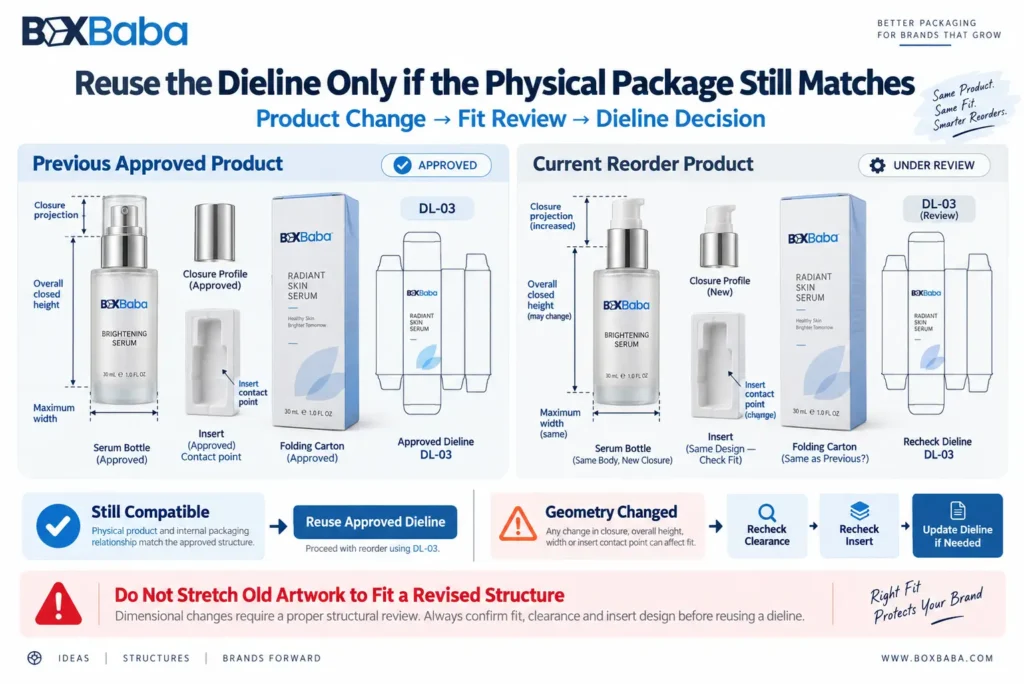
The first physical question is whether the cosmetic product entering the package is still the same product geometry as the previous run. Recheck the finished, assembled, retail-ready container when the bottle, jar, tube, compact, palette, cap, pump, dropper, wand, lid or decorative component has changed.
Even a small closure change can alter the maximum width, depth or height. A new bottle supplier may use a slightly different base, shoulder or cap profile. A heavier filled product may also affect the packaging review.
If the primary container changed, use the measurement method in the Cosmetic Box Size Guide before assuming the old carton still fits.
Recheck the Finished Cosmetic Product
The first physical question is whether the cosmetic product entering the package is still the same product geometry as the previous run. Recheck the finished, assembled, retail-ready container when the bottle, jar, tube, compact, palette, cap, pump, dropper, wand, lid or decorative component has changed.
Even a small closure change can alter the maximum width, depth or height. A new bottle supplier may use a slightly different base, shoulder or cap profile. A heavier filled product may also affect the packaging review.
If the primary container changed, use the measurement method in the Cosmetic Box Size Guide before assuming the old carton still fits.
Recheck the Box Dimensions and Structural Dieline
Confirm whether the previous finished box dimensions and dieline remain valid. The old structure can often be reused when the physical product, orientation, insert, opening and required internal space remain compatible.
A structural review becomes more important when the reorder changes:
- Product dimensions or closure profile.
- Product orientation.
- Insert, divider or cavity arrangement.
- Window size or position.
- Hang tab, locking feature or opening direction.
- Number of products inside the box.
- Accessory or instruction-card arrangement.
- Material thickness where it affects the completed structure.
Do not stretch or shrink old artwork to fit a revised box without an approved structural file. If the physical structure changed, update the dieline first and then update the artwork to the approved dieline.
Recheck Inserts, Dividers and Product Position
An outer box can remain the same while the internal product position changes. This can happen when a bottle cap, pump, jar lid, accessory or product arrangement is revised.
Confirm the insert cavity, insert outside dimensions, contact areas, removal method, window alignment and product orientation. If a previous insert is being reused with a modified product, fit should be rechecked rather than assumed.
A new insert can also change usable internal space even when the external carton dimensions stay similar.
Recheck Material and Board Specification
Same artwork does not mean same physical package if the material changes. Reconfirm the approved paperboard, kraft, corrugated or rigid-board direction and any project-specific thickness / construction reference used in the previous run.
A material change can affect:
- Color appearance
- Surface texture
- Scoring and folding behavior
- External dimensions relative to internal dimensions
- Glue / assembly behavior
- Foil, Spot UV, embossing or lamination compatibility
- Perceived stiffness and presentation
If the substrate or surface changes, review the visual and structural consequences before approving the reorder as same as last time.
Recheck Print Process and Color Reference
Repeat production should use an identified color expectation rather than an assumption that every run will look absolutely identical. Printed appearance can be influenced by the substrate, ink system, print process, coating, lamination, lighting and production conditions.
For critical brand colors, confirm the intended reference for the repeat run. Depending on the project, that reference may be a numerical color specification, approved proof, prior physical sample or another agreed benchmark.
If the material, print process or finish has changed, a prior printed sample may no longer represent the current production conditions exactly.
Recheck Finishes and Special-Effect Layers
Finishing instructions should be part of the controlled production file, not only remembered from a previous order. Confirm whether matte, gloss, soft-touch, foil, Spot UV, embossing, debossing, coating or other effects are unchanged.
A finish change can require updated artwork layers, revised production setup and a different proof or sample decision.
For finish selection and compatibility, review the Cosmetic Packaging Finishes Guide.
Recheck Every Artwork Element That Can Change by SKU
Artwork is one of the most common areas where a repeat order becomes a new production version. Compare the previous approved file against the current buyer-approved content instead of editing from memory.
- Product name and product type.
- Shade, fragrance, strength or formula name.
- Net quantity / product size.
- Ingredients or other buyer-supplied copy.
- Directions and warnings.
- Business / distributor information.
- Barcode and SKU number.
- QR code and destination.
- Batch / lot / date-coding area.
- Language or market-specific panels.
- Claims and promotional wording.
- Finishing masks / foil / Spot UV / emboss layers.
The packaging supplier can help place buyer-approved information on the approved dieline, but the brand remains responsible for confirming that the current product copy, codes, claims, warnings and market information are correct before printing.
Recheck Barcodes and QR Codes
A reorder can look visually unchanged while the functional codes have changed. Confirm the actual barcode / SKU file for every artwork version and check whether any QR destination, campaign link or digital landing page has changed.
Do not assume that an old code remains correct because the graphic looks similar. Barcode and QR code changes should be treated as controlled artwork revisions and included in the proof review.
Recheck SKU List, Quantity and Version Allocation
Repeat orders frequently change in quantity even when the packaging structure stays stable. Confirm the total order quantity and the exact quantity for every artwork, size, market or structural version.
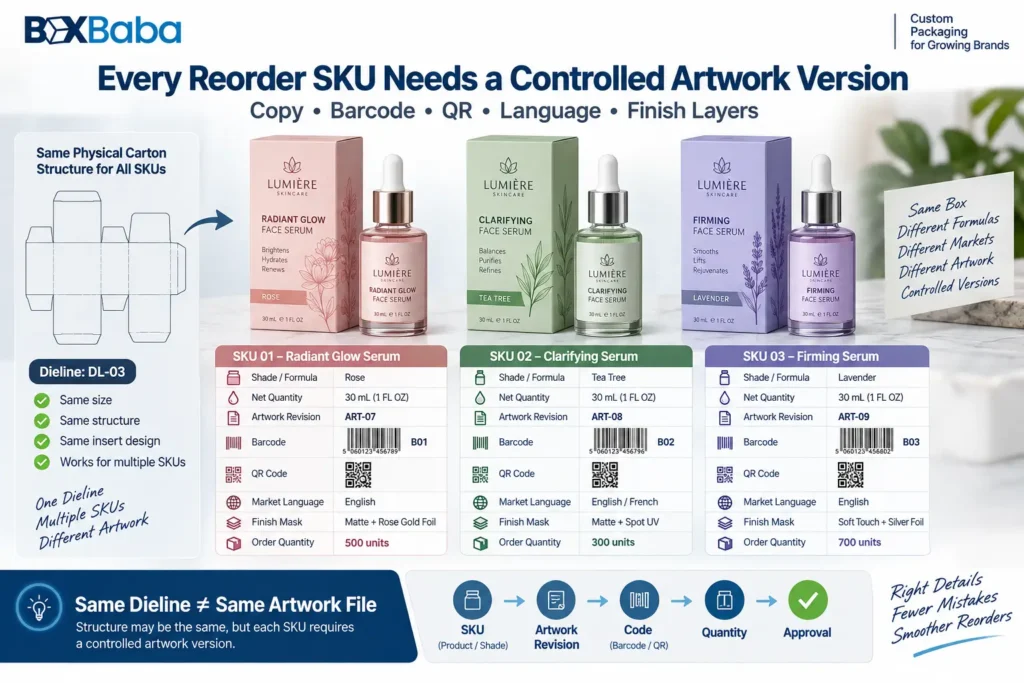
Use a version schedule such as: SKU / product -> structure revision -> artwork revision -> quantity -> market / language -> approval status.
This is especially important for shade-heavy makeup ranges, fragrance families and skincare lines where several SKUs may share one dieline but use different printed content.
Can Multiple Cosmetic SKUs Still Share One Dieline on a Reorder?
Yes, when the physical container and package relationship remains compatible. Several shades, fragrances or formula variants can continue using one structural dieline if the finished product dimensions, closure, orientation, insert, window and required internal fit remain unchanged.
Same Physical Geometry -> Shared Structural Dieline -> Separate Controlled Artwork Versions.
A new dieline should be reviewed when one SKU changes physical size, product count, closure, insert, orientation, window or another structural attribute.
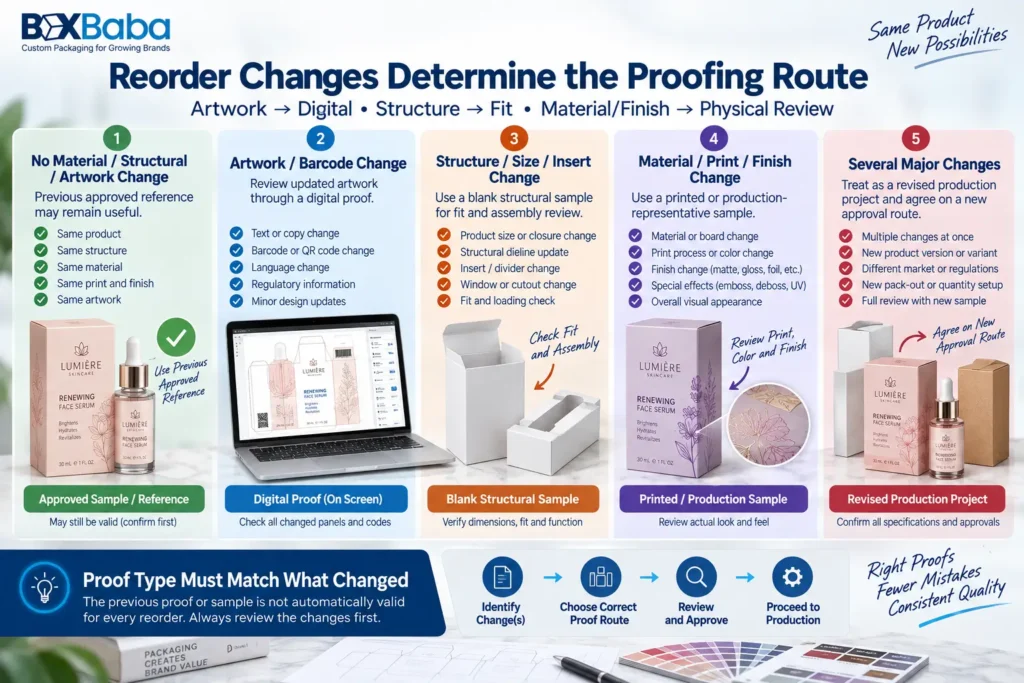
Recheck Whether the Previous Proof or Sample Is Still Applicable
Not every reorder requires the same proofing route. The right level of revalidation depends on what changed and what the previous sample was originally intended to prove.
Reorder Condition | Likely Review Direction | Key Point |
|---|---|---|
No material / structural / artwork change | Prior approved reference may remain useful, but current order details still need confirmation | Confirm supplier reorder process and current approval record |
Text / barcode / artwork-only change | Digital proof is often relevant to panel placement and file content | Review every changed panel and functional code |
Structural / size / insert change | Blank structural or fit review may be relevant | Confirm physical fit, loading, closure and removal |
Material / print / finish change | Printed or production-representative review may become more relevant | Confirm what the new sample is intended to validate |
Several major changes | Treat as a revised production project rather than an automatic reorder | Agree the new proof / sample route before production |
A proof or sample should only be approved for the criteria it is designed to validate. For the full framework, use the Samples and Proofing Guide.
Recheck Pack-Out, Assembly and Master-Case Requirements
The individual cosmetic carton can remain unchanged while the operational packing requirement changes. Confirm whether boxes are supplied flat or assembled, how products are inserted, how SKU versions are separated and how finished units are packed into inner or master cartons.
Recheck:
- Units per inner / master case
- SKU mixing or case separation
- Case labels / markings
- Finished case weight
- Pallet or warehouse requirements where applicable
- Whether retail displays or inserts are preloaded
- Delivery destination and selected shipping service
Recheck the Sales Channel or Distribution Layer
A repeat retail carton may be unchanged, but the distribution environment can change. A brand that previously sold only in retail may add ecommerce. A wholesale account may require different case packing. A retailer may introduce shelf, barcode or display requirements.
If the channel changes, review the relationship between the retail unit and the outer distribution package using Retail vs Ecommerce Cosmetic Packaging.
Create a Controlled Reorder Record
The most useful reorder record is not a single artwork file. It is a controlled set of references that identifies the exact package being repeated.
Reorder Record | Example of What to Store |
|---|---|
SKU / project ID | Serum-30ml-01 |
Product reference | Approved 30 ml bottle + pump version |
Dieline revision | DL-03 |
Artwork revision | ART-07 |
Material | Approved paperboard / construction reference |
Print / color reference | Approved process and color benchmark |
Finish reference | Matte + foil mask revision |
Insert revision | INS-02 or N/A |
Approval date / owner | Current internal approval record |
Quantity | Quantity by artwork / SKU |
Production reference | Previous order / approved sample reference where applicable |
Version Naming: Avoid Final-Final-2
Use file names that make the production version identifiable without opening several folders. A useful naming convention can include product, SKU, structure, market, artwork revision and approval status.
Example: Serum30ml_US_DL03_ART07_Approved.pdf
The exact naming system can vary, but one principle should remain: archived drafts should not be easy to confuse with the current approved production version.
When Is a Reorder No Longer an Identical Repeat?
Treat the project as a revised production specification when a change can affect physical fit, printed content, finish placement, production method or packing instructions.
- New bottle, jar, tube, cap, pump, dropper or lid.
- New box size or dieline.
- New insert / divider / window configuration.
- New substrate or meaningful material construction change.
- New or removed finish.
- New market / language / retailer version.
- New barcode, QR code or product copy.
- New product count or internal arrangement.
Not every change requires a completely new package, but every relevant change should be visible in the controlled specification before repeat production is approved.
Worked Example 1: Same Foundation Carton, New Shade Barcode
A foundation range uses the same bottle, pump, carton dimensions and structure for all shades. The brand adds one new shade with a new shade name and barcode, but the physical bottle remains identical.
Reorder direction: keep the approved structural dieline; create a new controlled artwork version for the shade; verify the barcode, shade copy and quantity; review the updated proof before production according to the project proofing route.
Information gain: artwork variation does not automatically require a new dieline when physical geometry remains the same.
Worked Example 2: Same Cream SKU, New Jar Lid
A cream brand reorders the same 50 ml SKU but the jar supplier changes the lid. The new lid projects farther beyond the jar body and adds a small amount to the complete closed height.
Reorder direction: remeasure the finished jar, review internal clearance and insert / carton fit, and confirm whether the old structure still works before reusing the dieline. If the physical fit changes, update the structure before artwork is released.
Worked Example 3: Same Serum Structure, New Material and Finish
A serum carton keeps the same bottle and dimensions, but the brand changes the board surface and replaces gloss with matte plus selective foil.
Reorder direction: the product fit may remain compatible, but the material, color appearance, finishing layers and proof / sample reference need review. The old printed sample should not automatically be treated as the visual benchmark for the new construction.
Common Cosmetic Packaging Reorder Mistakes
Mistake | Why It Creates Risk | Better Direction |
|---|---|---|
Sending only an old artwork PDF | Artwork does not define material, structure, insert or previous approval | Reference the complete approved specification |
Assuming same product means same container | Suppliers can change caps, pumps, jars or bottle geometry | Recheck the finished product when components change |
Using the old dieline after a size change | Artwork may no longer align with physical structure | Approve the revised structural file first |
Editing an archived file without version control | Old and new files can be confused | Use revision IDs and approval status |
Changing a barcode without reproofing | Functional code can be wrong even when design looks similar | Treat codes as controlled artwork elements |
Assuming repeat color will be absolutely identical | Material, print and finishing conditions influence appearance | Use an agreed reference and review changed conditions |
Changing finish instructions only by email | Production layer may not match the official file | Update controlled finish layers / notes |
Ignoring quantity by SKU | Total quantity can hide incorrect artwork allocation | Confirm quantity for every version |
Skipping fit review after a new bottle / lid | Small geometry changes can affect clearance | Remeasure and recheck fit |
Assuming the retail carton is the full shipping solution | Distribution layer may change | Reconfirm ecommerce / wholesale outer packaging |
Cosmetic Packaging Reorder Checklist
- Previous order / production reference.
- Current product and SKU list.
- Current finished product dimensions and closure profile where anything physical changed.
- Approved box dimensions and dieline revision.
- Insert, divider, window and orientation status.
- Approved material / board construction.
- Print method and color reference.
- Finish list and finish-layer files.
- Current artwork revision for every SKU.
- Current product name, shade / fragrance / formula details and buyer-approved copy.
- Barcode and QR files for every version.
- Market / language / retailer version.
- Quantity by SKU / artwork / size.
- Proof or sample route required for the changes.
- Assembly / packing / master-case requirements.
- Delivery destination and schedule.
- Named approver and recorded production approval.
From Previous Order to Repeat Production
- Retrieve Previous Approved Production Reference
- Compare Current Product and Order Requirement
- Identify No-Change vs Changed Attributes
- Classify Artwork / Structural / Material / Finish / Market Changes
- Update Dieline or Artwork Where Required
- Choose the Appropriate Proof / Sample Review
- Confirm SKU Quantities and Pack-Out
- Record Version-Controlled Approval
- Release Repeat Production
Brands ready to repeat or revise a cosmetic packaging program can use BoxBabas Custom Cosmetic Boxes category to identify the relevant commercial packaging route for the current SKU or product family.
Frequently Asked Questions About Cosmetic Packaging Reorders
Can I reorder cosmetic boxes using the exact same artwork file?
You can reuse an approved file only after confirming that the product, structure, material, finishes, content, codes and market requirements have not changed. The previous artwork alone does not define the complete packaging specification.
Do I need a new dieline for every cosmetic packaging reorder?
No. The same dieline can often be reused when the finished product geometry, orientation, insert, window and structural requirements remain compatible. Physical changes should trigger a structural review.
Does changing a shade name require a new dieline?
Usually not when the box structure and finished product geometry remain the same. A shade-name change is typically an artwork-version change, but the revised artwork should still be controlled and approved.
Does changing a barcode require a new proof?
A barcode change should be treated as a controlled artwork revision. The updated code and its placement should be checked through the applicable proofing process before production.
What if my bottle supplier changes the cap or pump?
Remeasure the complete finished product and review clearance, insert fit and carton dimensions before assuming the old structure remains suitable.
Can I expect the repeat print color to be exactly identical?
Not automatically. Printed appearance can vary with material, process, ink, coating, lamination and production conditions. Use an agreed reference and recheck conditions that have changed.
Do I need a physical sample for every repeat order?
Not necessarily. The required proof or sample route depends on what changed and what needs to be validated. Artwork-only, structural, material and finish changes can require different review methods.
Can several cosmetic SKUs share one dieline on repeat orders?
Yes, when their physical dimensions, closures, orientation, insert, window and internal fit remain compatible. Each printed SKU should still use its own controlled artwork version and quantity.
Should I recheck ingredients and warnings on a repeat order?
Yes. Compare the previous packaging against the current buyer-approved product information. The brand should confirm that all current copy, claims, warnings and market-specific information are correct before printing.
What should I send a packaging supplier for a reorder?
Provide the previous order or approved production reference, current SKU list, quantity by version, current artwork, any physical product changes, material / finish changes, delivery destination and a clear list of what should remain unchanged.
When does a repeat order become a revised packaging project?
When changes affect physical fit, structure, material, print, finish, artwork content, market version or packing instructions, the order should be treated as a controlled revision rather than an automatic repeat.
Should ecommerce packaging be rechecked on a retail-carton reorder?
If the sales channel, order configuration or outer shipping package changed, yes. The retail carton and ecommerce outer package are separate packaging layers and should be reviewed according to the current packed order.
Why is version control important for cosmetic packaging?
It connects the correct SKU to the correct dieline, artwork, material, finish and approval record, reducing the chance that an outdated file or previous market version is released for production.