
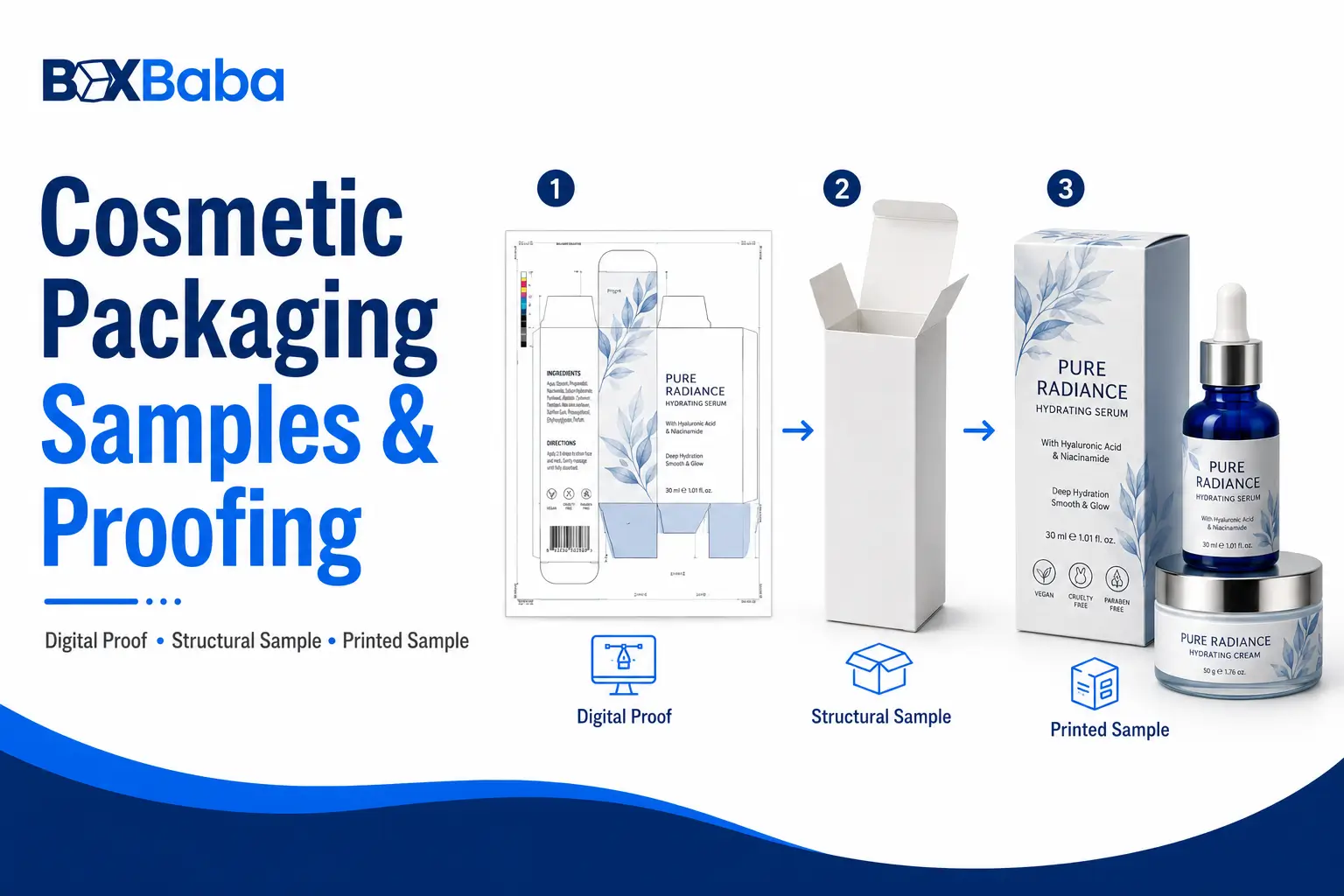
Cosmetic packaging proofs and samples validate different parts of a packaging project before production. Use a digital proof to review artwork and dieline relationships, a blank structural sample to check dimensions, closure and product fit, and a printed sample to review physical artwork and finish appearance. A sample should only be approved for the criteria it was designed to test; it does not automatically validate every aspect of the final production run.
Core workflow: Unresolved Packaging Risk → Appropriate Proof or Sample → Defined Acceptance Criteria → Review → Corrections → Version-Controlled Approval → Production
Scope note: This guide focuses on proofing and sampling for printed secondary cosmetic packaging such as folding cartons, sleeves, rigid boxes and insert-supported boxes. Primary bottles, jars, pumps, tubes and airless systems may require separate formula-compatibility, dispensing, leakage or component testing that is outside the scope of this guide.
Cosmetic Packaging Proofs and Samples at a Glance
Review Route | Best Used For | Does Not Automatically Confirm |
3D digital mockup | General assembled appearance and visual presentation | Physical dimensions, material feel or actual printed color |
Digital artwork proof | Panels, text, artwork, orientation, dieline relationships and finish locations | Product fit, material feel or physical structural behavior |
Stock / reference sample | General structure, board or finish reference | Your exact dimensions, artwork, product fit or custom result |
Blank structural sample | Dimensions, folds, closure, loading, removal, insert fit and product clearance | Final printing, exact color or decorative finish appearance |
Printed sample / prototype | Artwork scale, physical presentation, color direction and selected finishes | Exact bulk result unless production conditions are equivalent |
Product-fit review | Product, insert and outer-box interaction | Conditions or products not actually tested |
Pre-production / production-representative sample | Higher-fidelity review when production-like materials and processes are used | An absolute guarantee that every production unit will be identical |
Terminology varies between suppliers. A prototype, white sample, printed sample, press sample or pre-production sample can mean different things. Before approval, ask what the sample is made from, how it is produced and what it is intended to validate.
Why Cosmetic Packaging Needs Proofing
Cosmetic packaging combines visual, structural and operational requirements in one relatively small object. A serum carton, for example, may need to coordinate a glass bottle, dropper or pump, insert, carton dimensions, ingredient copy, barcode, QR code, brand colors, lamination and selective finishes.
A digital file can make those elements look complete before their physical relationships have been tested. Proofing creates checkpoints between design and production so the brand can validate the right question at the right stage.
- Is the artwork on the correct panel and in the correct orientation?
- Does the box close correctly?
- Does the actual jar or bottle fit without excessive movement or pressure?
- Does the insert retain the product while still allowing practical removal?
- Does a window reveal the intended part of the product?
- Do the barcode and QR code remain functional?
- Do foil, Spot UV or other selective effects sit where intended?
- Does the package remain practical to assemble, load and handle?
If the packaging structure itself is still being selected, review How to Choose Cosmetic Packaging Boxes before deciding which sample route is appropriate.
Define What the Sample Must Prove Before You Request It
The strongest proofing workflow begins with an unresolved risk, not with the name of a sample. Before requesting anything physical, define the decision the sample must help you make and the condition that determines whether it passes.
Review Area | Example Approval Question |
Product fit | Can the finished or representative packed product be loaded and removed without forcing the carton? |
Insert retention | Does the product remain in the intended position during normal handling without excessive movement? |
Window alignment | Is the intended product area consistently visible through the opening? |
Closure | Does the package close without bulging, distortion or excessive resistance? |
Artwork | Are the correct panels, SKU details, orientation and finishing areas present? |
Barcode / QR | Does the printed code remain readable or scannable in the intended location? |
Finish | Is the selected treatment positioned correctly and visually acceptable? |
Color | Is the sample being approved only for direction, or as an agreed production reference under defined conditions? |
Approval rule: A sample should be approved against defined criteria, not simply because it looks good.
An insert should not be added automatically.
A single lightweight cosmetic product may work without a separate holder when the selected carton already provides appropriate internal fit and the product can be packed and removed as intended.
This may apply to some lipsticks, mascara tubes, eyeliner pens, lip balms, cosmetic tubes and small skincare containers.
For example, a mascara tube that fits appropriately inside its folding carton may gain little from an additional structural component when no special positioning or display arrangement is required.
That does not mean mascara boxes never use inserts. It means:
Suitable Direct Fit + No Unresolved Internal Function → Separate Insert May Be Unnecessary
The same reasoning applies to lipstick packaging. Some individual Custom Lipstick Boxes can be developed as accurately fitted cartons without automatically adding another internal component.
An insert becomes more relevant when the configuration changes.
One Lipstick → Individual Fitted Carton
is different from:
Lipstick + Liner + Applicator → Presentation Arrangement
The second package must solve an organizational problem that the first does not have.
3D Mockup vs Digital Artwork Proof
3D Digital Mockup
A 3D mockup represents how the packaging may look after assembly. It is useful for internal presentation, visual hierarchy and understanding how visible panels relate to each other.
It is not a physical test. A realistic render does not prove that the package closes correctly, that an insert holds the bottle correctly or that the material and finish will look the same in production.
Digital Artwork Proof
A digital artwork proof is a production-review document. It helps check artwork placement on the approved dieline, panel orientation, text, barcode and QR placement, window relationships and the location of foil, Spot UV or other specified treatments.
- front, back and side panels
- top and bottom orientation
- product name, shade, formula or SKU
- ingredient and instruction copy
- barcode and QR content
- artwork scale and panel relationships
- window location
- foil, Spot UV, emboss/deboss or other finish areas
Digital proof → validates artwork relationships. Physical sample → validates physical relationships.
Blank Structural Samples: Fit, Closure and Assembly
A blank structural sample is an unprinted physical version of the proposed packaging. Its job is structural validation rather than final visual approval.
Depending on the project, it can help review finished dimensions, folds, tuck flaps, locking tabs, drawer movement, lid fit, insert geometry, window position, product loading and basic assembly.
Ask what material the sample uses. Some structural samples use the intended production stock, while others use a representative prototyping substrate. That distinction affects how confidently you can judge stiffness, folding behavior and surface characteristics.
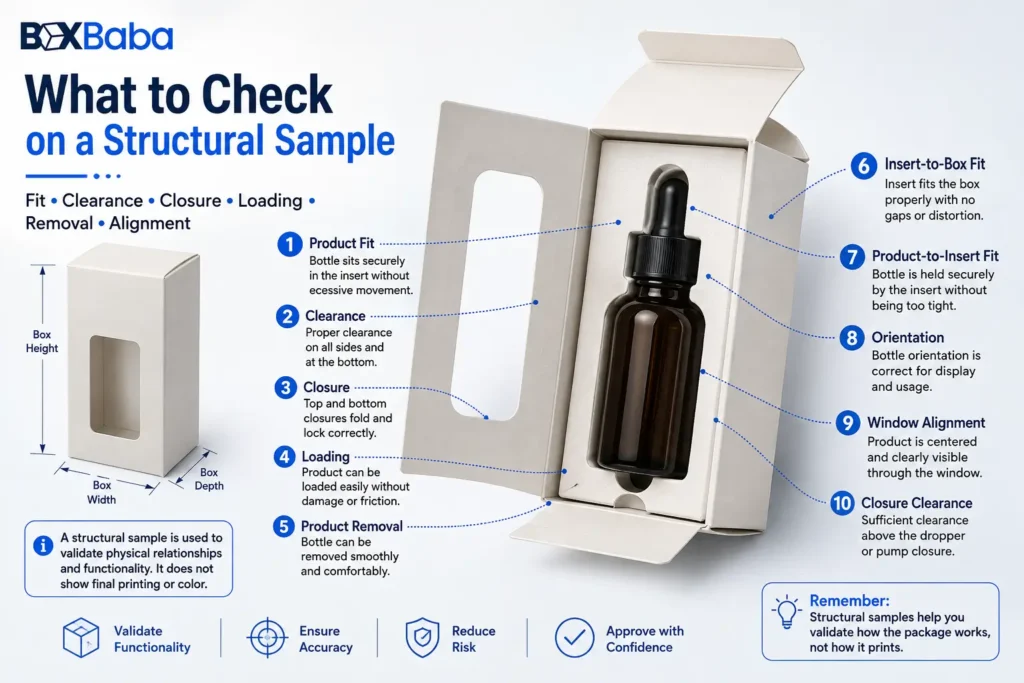
What to Check on a Structural Sample
- Product fit: the product should fit without being forced into the package.
- Clearance: excessive space can allow unwanted movement; insufficient space can complicate packing or apply pressure.
- Closure: close every flap, lid, sleeve or drawer and check for bulging or distortion.
- Loading: confirm the product can be packed efficiently without damaging the carton or insert.
- Removal: make sure the customer can remove the product without unnecessary force.
- Insert fit: check both insert-to-box movement and product-to-insert movement.
- Orientation: confirm the product faces the intended direction after normal packing.
- Window alignment: verify the product sits where the opening expects it to sit.
- Closure clearance: pumps, lids, sprayers and droppers should not receive unintended structural pressure.
Where weight or closure geometry matters, evaluate the finished or representative packed state when practical rather than relying only on an empty undecorated container.
Printed Samples: Artwork, Color and Finish Review
A printed sample adds artwork to a physical package and helps answer a different question: does the assembled packaging look the way the brand expects?
- artwork scale and hierarchy
- typography and small-copy readability
- panel transitions and alignment
- logo size and placement
- image quality
- color direction
- barcode and QR placement
- inside printing
- window-to-artwork relationship
- matte or gloss appearance
- foil, Spot UV and emboss/deboss positioning
Will a Printed Sample Match Production Color Exactly?
Not automatically. A prototype may be produced using a different printing process, substrate, ink system or finishing route from the bulk order. Even identical artwork can appear different because board whiteness, surface texture, lamination, coating, lighting and production calibration affect perception.
Ask this before approving color: Is this sample intended to show approximate color direction, or is it intended to serve as an agreed production-level reference?
If brand-color consistency is critical, confirm the available color-proofing route and the reference standard that will be used during production.
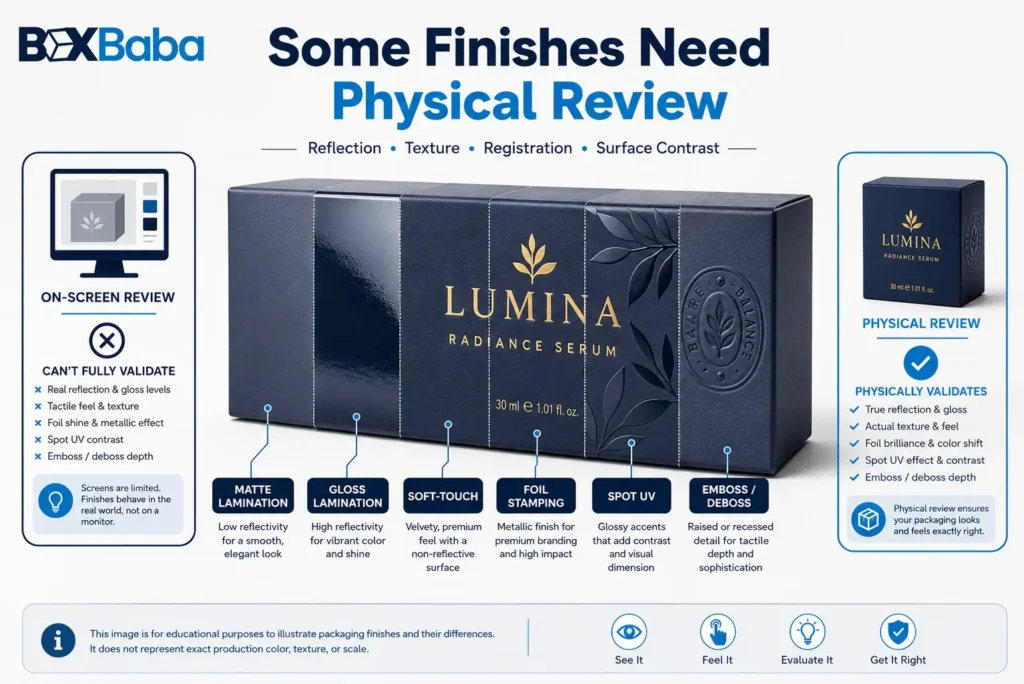
Samples for Matte, Gloss, Foil and Other Finishes
A screen can simulate a finish but cannot reproduce actual reflection, texture or tactile behavior. Physical review becomes more useful when the finish itself is part of the buying decision.
Finish | What a Physical Sample Can Help Review |
Matte lamination | Color softness, scuff visibility, dark-area marking and contrast with selective finishes |
Gloss lamination | Reflectivity, color intensity, glare, fingerprints and readability under lighting |
Soft-touch | Tactile feel and surface character that a digital mockup cannot demonstrate |
Foil | Color, reflection, registration, fine detail and relationship with folds |
Spot UV | Position, registration and contrast against the surrounding surface |
Emboss / deboss | Placement, depth, readability and interaction with the carton structure |
For finish-selection decisions before sampling, review the Cosmetic Packaging Finishes Guide.
Product-Fit Review for Cosmetic Containers and Inserts
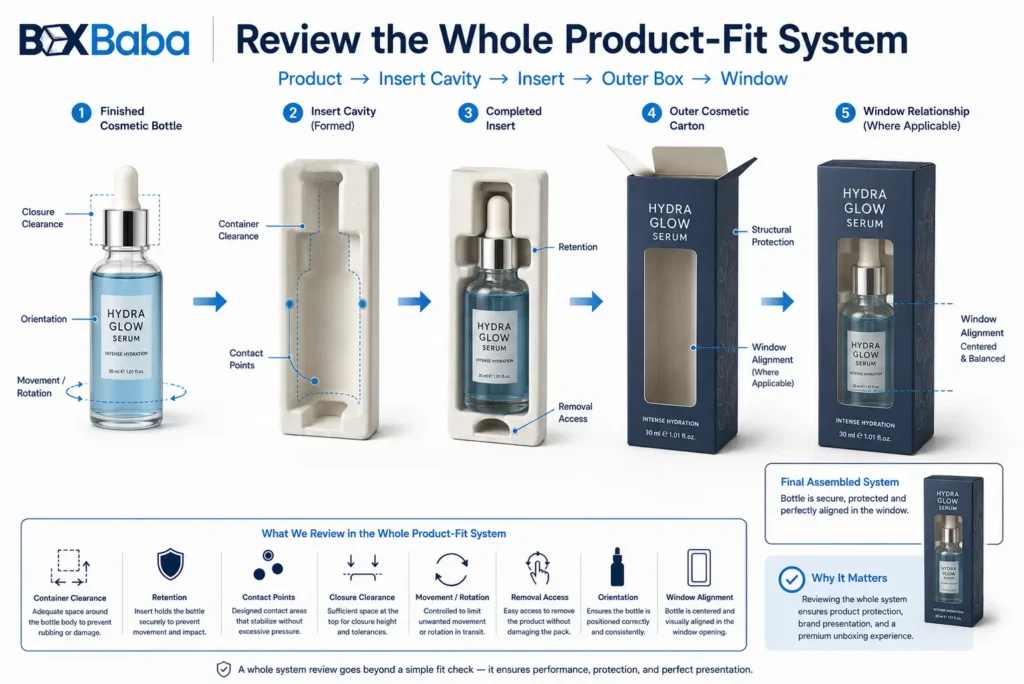
Product-fit review asks whether the actual cosmetic container and the secondary packaging work together. This is different from checking dimensions on a screen.
- container clearance
- insert cavity and retention
- bottle or jar movement
- rotation
- closure clearance
- packed weight where relevant
- product removal
- orientation
- window alignment
- contact points
Use the actual finished product or an accurate representative unit whenever practical. Two containers with the same fill capacity can have very different external dimensions, shoulders, lids, pumps or dropper closures.
For insert-supported packaging, review the whole system: Product → Insert Cavity → Insert → Outer Box → Window (where used).
When fitted internal support is part of the project, see Printed Boxes with Inserts for commercial insert options and project-specific sampling routes.
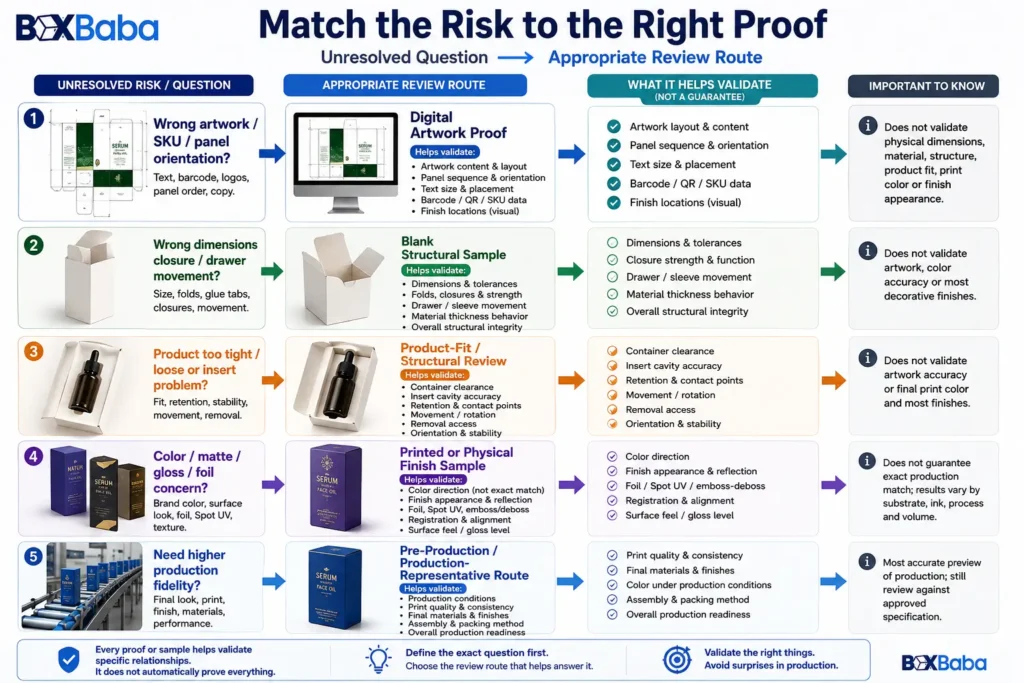
Which Proof Should You Choose? Risk-to-Proof Matrix
Choose the lowest-complexity proof that reliably answers the unresolved question. Do not request a more elaborate sample simply because it sounds more complete.
Main Risk | Best Review Route |
Wrong text, SKU or artwork | Digital artwork proof |
Wrong panel orientation | Digital proof and/or 3D mockup |
Wrong box dimensions | Blank structural sample |
Product too tight or loose | Product-fit / structural sample |
Insert cavity problem | Blank structural / product-fit review |
Window misses the product | Physical structural sample |
Color direction concern | Printed sample or appropriate color proof |
Matte vs gloss uncertainty | Physical finish sample |
Foil or selective finish placement | Finish-capable printed sample / proof |
Soft-touch feel | Physical sample |
Drawer movement or closure | Structural sample |
Multi-SKU artwork error | Controlled digital proof for each artwork version |
Higher production fidelity | Pre-production / production-representative route where available |
Structural Approval vs Artwork/SKU Approval
Cosmetic ranges frequently reuse one physical structure across multiple shades, fragrances or formulas. A lipstick range may share one carton geometry while each shade has a different shade name, color identifier, barcode, QR destination and artwork file.
Structural approval does not replace artwork/SKU approval.
If the geometry is genuinely identical, one structural review may support the shared structure. Every artwork variant should still be checked against its correct product information and quantity.
For a commercial example where shade and artwork variations matter, see Makeup Boxes.
Samples for Retail vs Ecommerce Cosmetic Packaging
Retail Review
- front-panel hierarchy and shelf orientation
- shade identification
- barcode panel
- window visibility
- lighting and glare
- small-copy readability
- closure and repeated handling
Hold the carton naturally, turn it, view it under normal overhead lighting and judge it as a three-dimensional object rather than only as a flat proof.
Ecommerce Review
For ecommerce, the retail carton may sit inside a separate mailer or shipping carton. A sample of the cosmetic box alone does not automatically prove parcel-shipping performance.
- product movement inside the retail box
- bottle or jar fragility
- void space in the shipping system
- rubbing between components
- unboxing presentation
- closure security during fulfillment
Sample review ≠ formal transit testing. Compression, vibration, drop or distribution testing should be treated as separate validation work where required.
Pre-Production and Approved Reference Samples
Some projects offer a higher-fidelity sample made with materials, printing and finishing processes closer to the planned production run. It may be described as a pre-production sample, production sample, press sample or approval sample. Terminology is not standardized, so ask exactly how it is manufactured.
The more closely the sample matches the intended board, ink, press, tooling, lamination, foil, finishing and assembly, the more useful it may be as a production reference. It should still not be described as an absolute guarantee that every production unit will be identical.
If a representative final sample is formally approved, document the specification it represents:
- artwork version
- dieline / structural revision
- substrate
- printing specification
- Pantone or other spot colors where applicable
- lamination / coating
- foil or other selective finishes
- insert
- approval date
- any accepted differences or tolerances recorded by the project team
Approved Sample + Written Specification + Version ID = Useful Production Reference
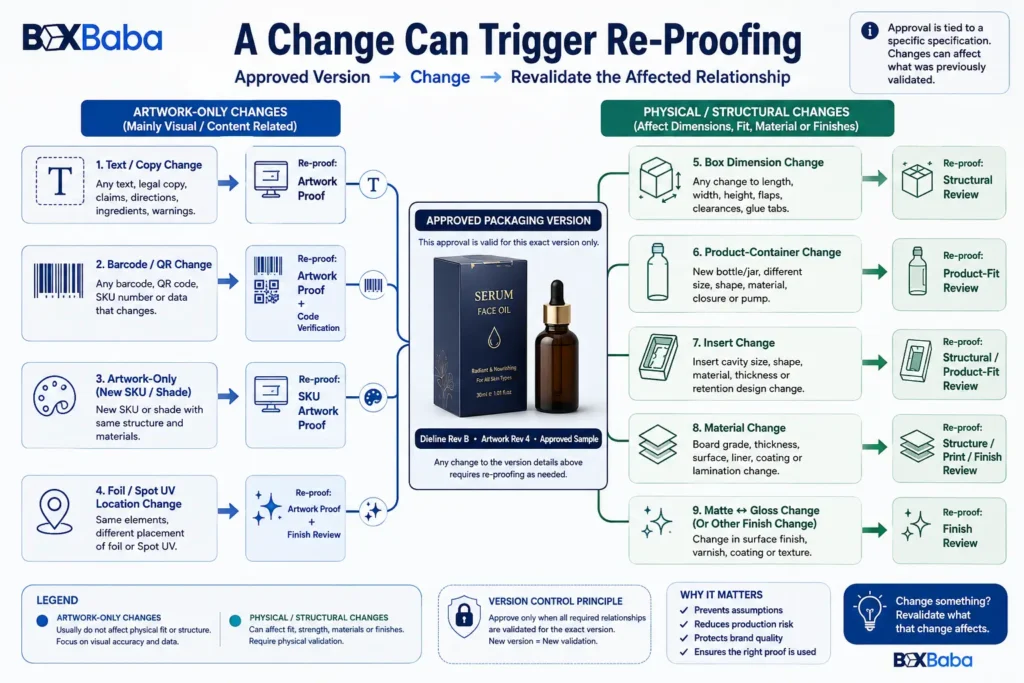
What Changes Require Re-Proofing?
Approval belongs to a specific version, not permanently to the project. When something changes, determine which relationship has been affected and revalidate that part of the packaging.
Change | Review Again |
Text only | Artwork proof |
Barcode / QR | Artwork proof + code verification |
Artwork scale or panel placement | Artwork proof |
Box dimensions | Structural review and revised dieline |
Product container | Product-fit review |
Insert geometry | Structural / product-fit review |
Window position | Structural + artwork relationship |
Material | Structure, print and finish review where relevant |
Matte to gloss / other surface change | Finish review |
Foil / Spot UV location | Artwork + finish proof |
Major brand-color change | Color review |
New artwork SKU only | SKU artwork proof unless structure also changes |
Common Cosmetic Packaging Proofing Mistakes
Mistake | Why It Causes Problems | Better Approach |
Approving only a 3D mockup | It does not physically test the packaging | Use the appropriate structural review where needed |
Assuming digital proof confirms fit | Fit is a physical relationship | Test the actual product where fit matters |
Rejecting a blank sample for lacking print | The sample has a different purpose | Use it for structural review |
Assuming a printed prototype exactly predicts bulk color | Printing conditions may differ | Confirm what color fidelity the sample represents |
Approving only the front panel | Errors can remain elsewhere | Review the complete dieline |
Testing only an empty container | Packed weight or closure can matter | Use representative packed condition when relevant |
Ignoring insert removal | The product may become difficult to access | Test loading and customer removal |
Treating a stock sample as custom proof | It was not made to your specification | Use it only as a reference |
Changing the file after approval | The approved version no longer matches production | Re-proof the affected elements |
Failing to identify versions | Teams may approve different files | Use controlled naming and signoff |
Assuming a finish render equals a physical finish | Screens cannot reproduce tactile/reflection behavior | Review a physical finish when critical |
Skipping SKU checks | Wrong shade or barcode can reach production | Approve every artwork version |
Cosmetic Packaging Sample Approval Checklist
☐ Correct product / SKU and artwork version identified
☐ Correct approved dieline / structural revision used
☐ Dimensions and structure checked where relevant
☐ Product fit reviewed where required
☐ Insert fit, retention, loading and removal checked where required
☐ Window-to-product relationship reviewed where applicable
☐ Product name, shade, formula and net contents confirmed
☐ Ingredients, directions, warnings and other product copy reviewed by the responsible party
☐ Barcode verified and QR destination tested
☐ Batch / lot coding area reserved where required
☐ Panel and inside-print orientation checked
☐ Brand-color direction reviewed at the intended proof level
☐ Small copy checked at physical size on printed samples
☐ Matte, gloss, soft-touch or other surface direction reviewed where relevant
☐ Foil, Spot UV and emboss/deboss positioning checked
☐ Packing method and assembly practicality considered
☐ Proof / sample limitations understood
☐ Approval criteria documented
☐ Final production version clearly identified
What to Send When Requesting a Cosmetic Packaging Sample
A useful sample request begins with the packaging specification and the decision you need the sample to resolve.
- cosmetic product type
- finished container dimensions
- packed / representative weight where relevant
- container material and closure type
- product orientation
- box style
- material direction
- insert requirement
- window requirement
- artwork status and version
- brand-color requirements
- finish requirements
- number of SKUs
- quantity
- sales channel
- delivery destination
- the exact question the proof or sample must answer
Instead of only writing I need a sample, define the purpose. For example: We need to confirm whether our filled 30 mL glass serum bottle fits securely in the paperboard insert and remains centered behind the window.
For a product-specific example where artwork proofing and structural sampling are both relevant, see Custom Serum Boxes.
Cosmetic Packaging Samples and Proofing With BoxBaba
The appropriate review route depends on what still needs to be validated. A digital proof may be suitable for artwork and panel relationships, while a blank structural sample can be more useful when dimensions, closure or product fit need physical review. Printed samples can add physical artwork and finish evaluation where the project requires it.
When requesting a quote or sample route, share the product, packaging specification, artwork status, SKU count and the exact unresolved question so the review can be matched to the project rather than chosen only by sample name.
For skincare-specific packaging options and proofing context, review Skincare Packaging.
Final Takeaway
Cosmetic packaging proofing is not about collecting as many samples as possible. It is about answering the right question before that question becomes a production problem.
Packaging Specification → Unresolved Risk → Appropriate Proof/Sample → Acceptance Criteria → Review → Revalidation Where Needed → Version-Controlled Approval → Production
Use digital proofs for artwork relationships, structural samples for physical geometry, product-fit reviews for the container/insert/box relationship, and printed or production-representative samples when physical artwork, color or finishes require additional validation. Most importantly, understand what each approval does not prove.
Request a Cosmetic Packaging Sample or Quote
Need to confirm your cosmetic packaging before production? Share the finished product dimensions, packed weight where relevant, box style, material direction, insert or window requirements, artwork status, SKU count, finish requirements, quantity and delivery destination. Also explain what you need the proof or sample to validate—such as product fit, structure, artwork, color direction or finish appearance—so the appropriate review route can be discussed with the packaging specification.
Frequently Asked Questions
What is a cosmetic packaging proof?
A cosmetic packaging proof is a pre-production review used to check selected aspects of a packaging project before bulk printing. Depending on the proof type, it may help review artwork, dieline relationships, color direction, structure, product fit or finishing.
What is the difference between a digital proof and a physical sample?
A digital proof is screen-based and is mainly used to review artwork, panels, orientation and dieline relationships. A physical sample lets the brand handle the package and can be used to review dimensions, closure, product fit, material behavior or physical presentation depending on how it is produced.
Can a digital proof confirm that my cosmetic bottle fits?
No. A digital proof can show the intended relationship between artwork and a dieline, but it does not physically confirm bottle clearance, insert fit, loading, removal or loaded structural behavior.
What is a blank structural packaging sample?
A blank or structural sample is an unprinted physical version of the proposed packaging. It is mainly used to evaluate dimensions, folds, closures, insert fit, loading, product clearance and other structural relationships.
What is a printed packaging sample?
A printed sample is a physical prototype carrying the artwork. It can help review artwork scale, panel relationships, color direction and selected finishes. How closely it represents the bulk order depends on the materials and processes used to make the sample.
Will a printed sample exactly match final production color?
Not automatically. Color can vary when the sample and mass production use different substrates, inks, printing methods, laminations, coatings or color-control conditions. Confirm what level of color fidelity the sample is intended to provide.
Do cosmetic boxes with inserts need a physical sample?
A physical sample is particularly useful when product fit, insert cavity, bottle movement, product removal, product orientation or window alignment needs validation. Test the actual product with the insert and outer box whenever practical.
Does every shade or SKU need a separate physical sample?
Not necessarily when all SKUs use the same approved structure and only artwork changes. Each artwork version should still be controlled and checked for the correct shade, barcode, SKU, QR code and product information.
What should I check before approving cosmetic packaging?
Confirm the appropriate structure, product fit where required, artwork version, SKU details, barcode and QR data, copy, finish placement, sample limitations and the exact production version being authorized.