
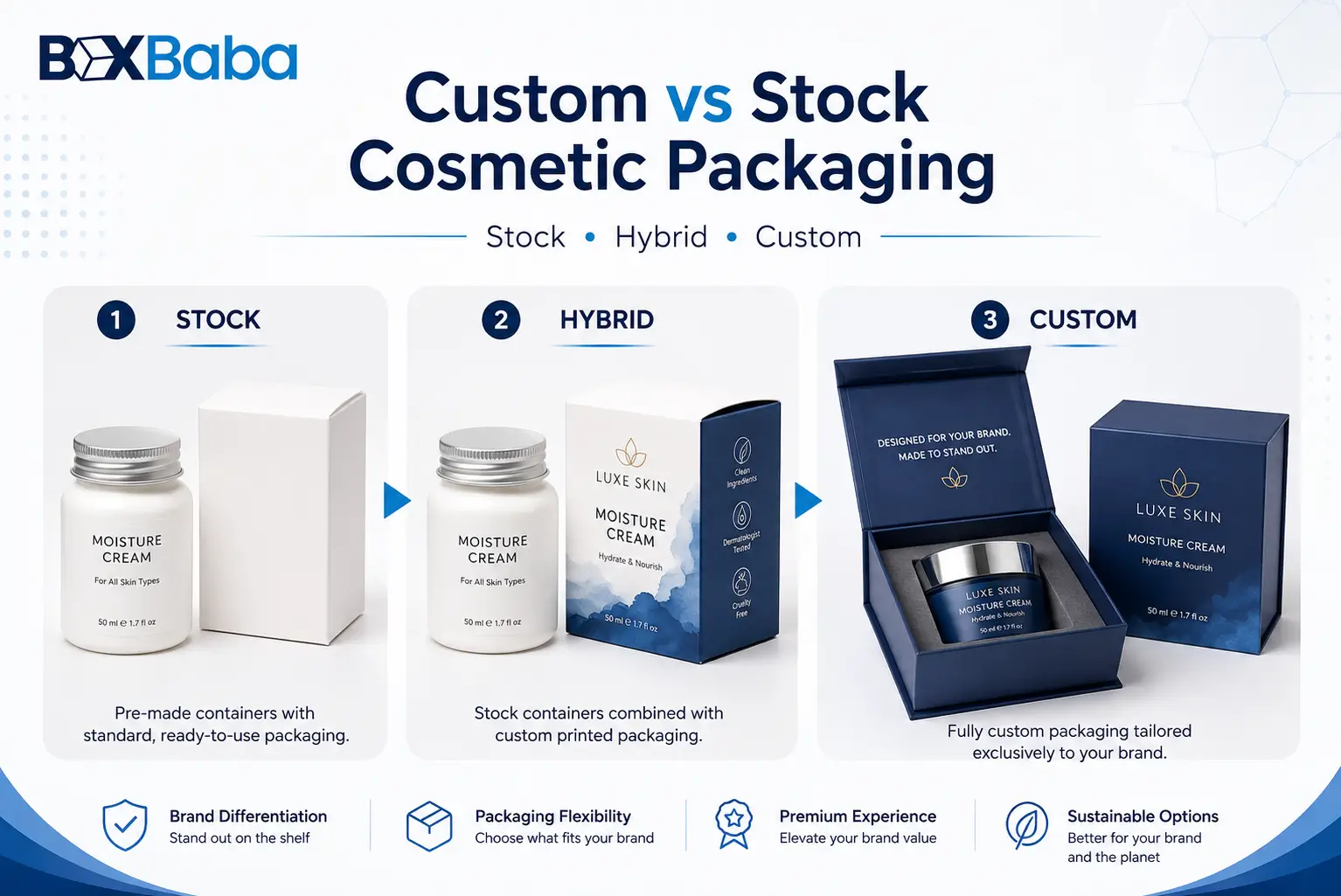
Choose stock cosmetic packaging when an existing size or component already meets the product, branding, quantity and timeline requirements. Choose custom packaging when the product needs a specific fit, structure, artwork system, insert, window or presentation that available stock options cannot provide. Beauty brands do not have to choose one system for every layer: a stock bottle or jar can be paired with a made-to-size custom secondary carton.
Custom vs Stock Cosmetic Packaging at a Glance
Decision Factor | Stock Packaging | Custom Secondary Packaging |
|---|---|---|
Dimensions | Existing standard sizes or formats | Developed around specified product dimensions |
Structure | Existing format | More flexibility in structure and panel proportions |
Product fit | Product must work within an available size | Carton can be planned around the finished product |
Branding | Depends on available decoration, labels or existing printable areas | Artwork can be planned around the approved dieline |
Inserts / windows | Limited by the available format | Can be coordinated with product position and presentation |
Setup | Usually fewer development steps when a suitable item is available | Requires specification, dieline, artwork and approval |
Timeline | Can be shorter when the correct item is genuinely in stock | Includes development and proofing before production |
MOQ | Depends on supplier and component | Depends on box type, material, print and production method |
SKU system | Works for simple ranges when the same stock format suits all products | Can support a coordinated structure with controlled artwork variants |
Best starting use | Testing, temporary needs or a product that already fits well | Product-specific fit, branded retail packaging, inserts, windows and coordinated SKUs |
Neither route is automatically better. The better option is the least complicated packaging system that meets the actual product, brand, channel and operational requirements.
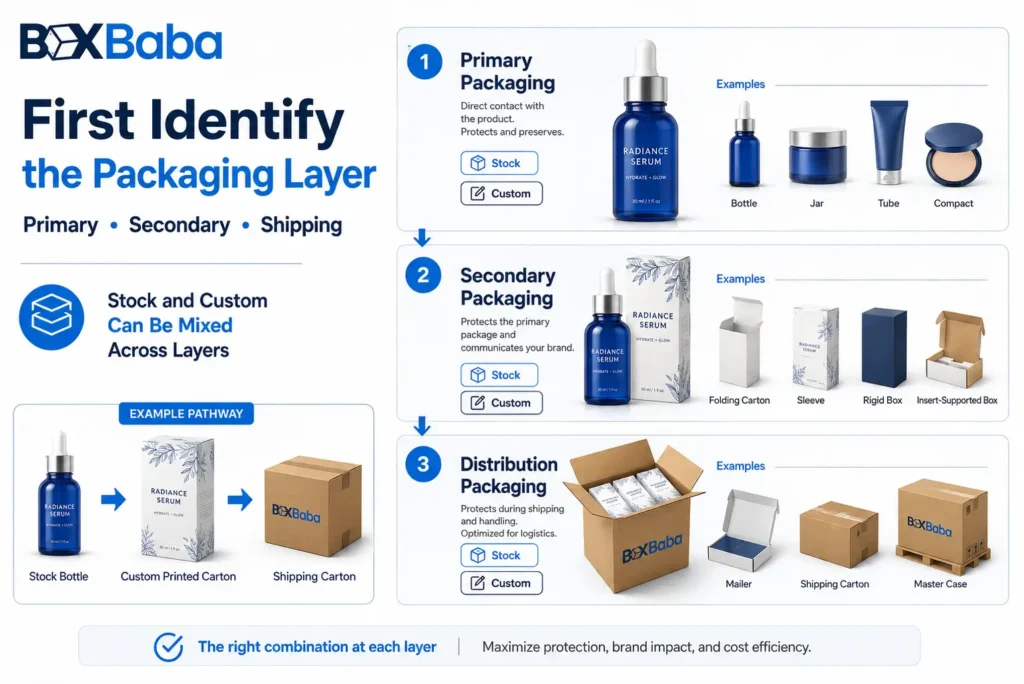
First Identify the Packaging Layer
The phrase cosmetic packaging can describe several different layers. Comparing custom and stock options without identifying the layer creates confusion because each layer has different manufacturing requirements.
Packaging Layer | Examples | Main Job |
|---|---|---|
Primary packaging | Bottle, jar, tube, compact, lipstick case, pump or dropper | Directly contains or dispenses the cosmetic product |
Secondary packaging | Folding carton, sleeve, rigid box, box with insert | Surrounds the primary container and carries branding, information and presentation |
Distribution / shipping packaging | Mailer, shipping carton, master case | Protects the packed order through fulfillment, storage or transport |
In this guide, custom secondary packaging means a carton, sleeve, rigid box or related paper-based package developed around defined product dimensions, structure and artwork. It does not automatically mean developing a proprietary bottle, jar, pump or other molded primary component.
If the overall box-selection decision is still open, review How to Choose Cosmetic Packaging Boxes before finalizing the stock-versus-custom direction.
What Is Stock Cosmetic Packaging?
Stock cosmetic packaging uses existing sizes, structures or components that have already been manufactured or tooled rather than being developed specifically around one brand’s dimensions or structural requirements.
Stock Primary Packaging
Examples include ready-made bottles, jars, tubes, pumps, droppers, lipstick cases, compacts and closures. A beauty brand can choose an available format and add branding through labels, printing, color or other decoration where the supplier supports it.
Stock Secondary Packaging
Stock secondary packaging can include ready-made folding cartons, gift boxes, mailers or sleeves offered in predetermined dimensions. The finished cosmetic product has to work within those existing dimensions and panel proportions.
What Does Custom Cosmetic Packaging Actually Mean?
The word custom can describe very different levels of development. For primary packaging, fully custom may involve proprietary molds, glass or plastic tooling, custom closures or new component engineering. For secondary paper-based packaging, custom usually means developing the box around the finished container, product load, artwork and presentation requirements.
A custom cosmetic box can be planned around the finished container dimensions, closure profile, filled weight, orientation, box style, material, insert, window, artwork, barcode/QR space, print, finishes and SKU variations.
Custom carton ≠ custom bottle mold. A beauty brand can keep an existing primary container and customize only the customer-facing secondary box. |
Stock, Semi-Custom and Fully Custom: Why Terminology Can Be Confusing
The term semi-custom is used differently across the cosmetic-packaging industry. For primary packaging, it often means starting with an existing bottle, jar or tube and changing elements such as color, decoration, labels, printing or closures. A supplier of secondary packaging may use the same term differently.
Do not make a sourcing decision from the label alone. Ask which dimensions, tooling, structure and components are stock, which elements can be changed, and whether the customization affects the primary container or the secondary carton.
Stock and Custom Can Be Mixed Across Packaging Layers
Primary Container | Secondary Packaging | Typical Use |
|---|---|---|
Stock | Stock | Testing, temporary packing or products that already fit an existing combination well |
Stock | Custom | A strong option when an established bottle, jar or tube works but the brand needs a made-to-size printed carton |
Custom | Stock | Possible where an available carton genuinely fits the proprietary container and brand requirements |
Custom | Custom | A coordinated system where both the primary component and secondary package justify dedicated development |
For many beauty brands, the second combination is the most commercially practical:
Stock Primary Container → Custom Secondary Carton |
A stock 30 mL serum bottle can use a custom printed serum carton. A ready-made 50 mL cream jar can use a made-to-size folding box. A standard lipstick case can use a coordinated secondary carton with shade-specific artwork. Customizing the outer package does not require redesigning every component in the packaging system.
When Does Stock Cosmetic Packaging Make Sense?
Stock packaging can be the better decision when an existing option already satisfies the important requirements without creating a new problem elsewhere in the packaging system.
You Are Testing a New Product
If the container, brand direction or expected demand may still change, an existing format can reduce the number of decisions that must be locked too early.
The Launch Timeline Is Short
A suitable in-stock component can remove some development steps, although actual inventory, quantity and decoration requirements still need confirmation.
The Product Already Fits Well
There is no reason to customize dimensions merely for the sake of customization if the available package provides appropriate clearance, closure and presentation.
Branding Needs Are Simple
Labels, sleeves or limited decoration may be sufficient for some early-stage products or temporary applications.
The Packaging Is Temporary
Stock packaging can suit prototypes, internal samples, short promotions, transitional packaging or test-market launches.
When Does Custom Cosmetic Packaging Make More Sense?
Custom secondary packaging becomes more useful when available stock formats force compromises in product fit, structure, information layout, branding or channel performance.
The Product Does Not Fit Available Boxes Properly
A substantially oversized box may allow unwanted movement or require additional filler. A box that is too tight can interfere with loading, removal or closure. Custom dimensions allow the carton to be planned around the complete retail-ready product.
The Product Needs a Defined Insert
Glass bottles, jars, palettes and multi-product sets may need an insert developed around the product geometry and outer box rather than adapted to an arbitrary stock cavity.
A Window Must Align With the Product
Custom packaging can coordinate product position, insert geometry, window position and artwork so the intended part of the cosmetic product is visible.
The Artwork Needs Better Panel Architecture
Cosmetic cartons can carry product identity, net contents, ingredients, directions, warnings, barcode, QR code and SKU information. A stock box may physically hold the product while still providing poor panel proportions for the required artwork.
Several SKUs Need a Coordinated System
A consistent custom structure can support multiple artwork versions where product geometry remains compatible, helping a range feel connected without requiring a different box structure for every shade or formula.
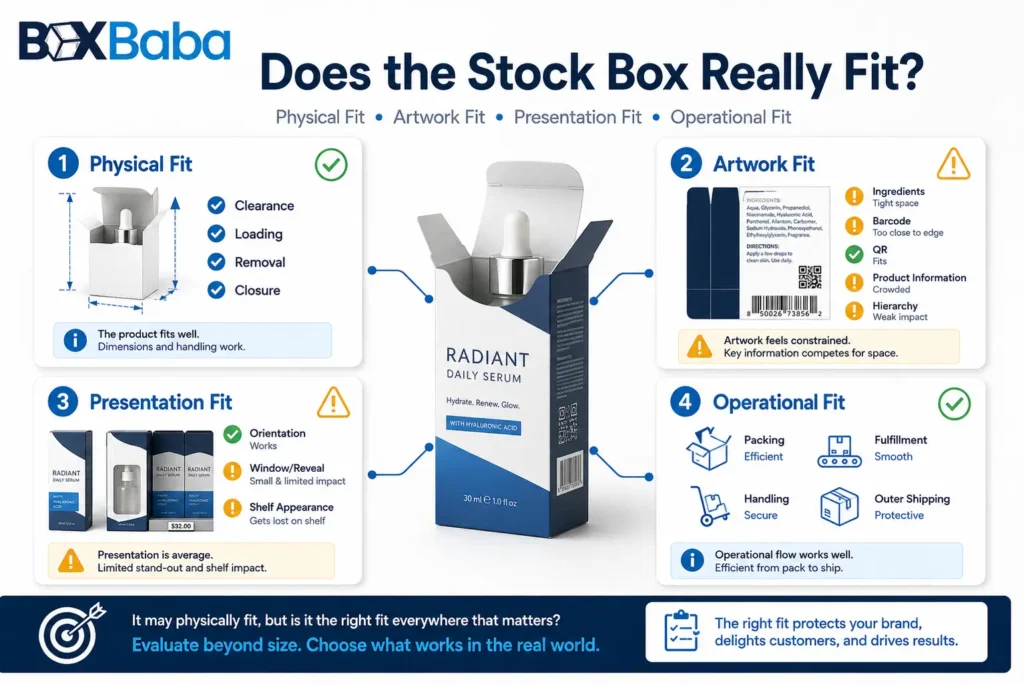
Does the Stock Option Really Fit?
A stock package should not be judged only by whether the product can physically enter the box. Fit has several dimensions.
Fit Test | Questions to Ask |
|---|---|
Physical fit | Can the product be loaded and removed without forcing it? Is there acceptable internal movement and closure clearance? |
Artwork fit | Do the available panels provide enough space for the approved product information, barcode, QR code and brand hierarchy? |
Presentation fit | Does the product sit in the intended orientation? Does a window or reveal show the right area? |
Operational fit | Is packing practical? Does the carton work with the intended retail, fulfillment and outer-shipping workflow? |
A box can physically fit a cosmetic product and still be a poor packaging fit. |
Five Triggers That Make Customization Useful
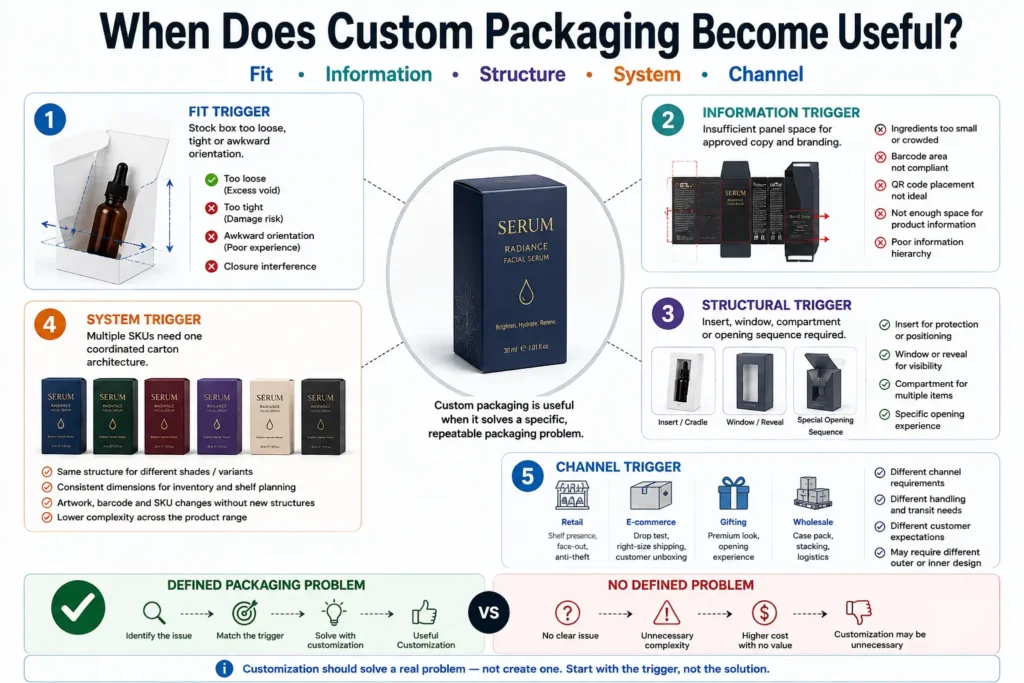
A custom package should solve a defined requirement. These five triggers provide a practical test.
1. Fit Trigger
Available stock dimensions create excessive movement, insufficient clearance or an awkward packed orientation.
2. Information Trigger
The existing panels cannot accommodate approved product information and artwork without crowding or poor hierarchy.
3. Structural Trigger
The product needs a fitted insert, coordinated window, dedicated compartment, opening sequence or other structural relationship unavailable in the stock format.
4. System Trigger
Multiple shades, formulas or products need a repeatable carton architecture with controlled artwork variations.
5. Channel Trigger
Retail, ecommerce, wholesale or gifting requirements cannot be handled adequately by the available stock configuration.
Customization requirement = defined packaging problem + a packaging change that solves it. If the brand cannot explain what customization will improve, the additional complexity may be unnecessary. |
Stock vs Custom Packaging by Cosmetic Product Type
Cosmetic Product | Stock May Work When | Custom Secondary Packaging Becomes Useful When |
|---|---|---|
Serum | The bottle and available carton have suitable clearance and panel space | Bottle profile, dropper/pump, insert, window or branded carton needs a defined fit |
Face cream | The jar works with an existing carton | Lid profile, jar weight, insert or presentation needs a made-to-size structure |
Moisturizer | A standard bottle or tube already fits the chosen outer package | A coordinated skincare range needs consistent branded cartons |
Foundation | The existing container and carton work for an early launch | Shade system, pump profile, panel information or retail presentation needs a defined carton |
Lipstick | A standard tube and stock carton meet the immediate need | Shade identification and coordinated retail branding justify a custom carton |
Mascara | The tube length and available carton fit correctly | Closure profile, artwork system or range consistency needs a product-specific carton |
Eyeshadow / palette | The compact fits an available package | Palette dimensions, window or reveal structure is product-specific |
Perfume | An existing carton safely accommodates the bottle | Filled weight, insert, bottle position and presentation require a defined structure |
Cosmetic set | A stock gift box fits the complete arrangement | Multiple products need dedicated compartments and a controlled presentation order |
For a product-specific example, review Custom Serum Boxes, which should be planned around the complete bottle, closure and intended support rather than nominal fill volume alone.
Custom vs Stock Packaging for New Beauty and Private-Label Brands
A new beauty brand does not automatically need the least customized packaging, and it does not automatically need a fully bespoke system. The decision should follow product stability and the job the packaging has to perform.
- Confirm whether the finished bottle, jar, tube or compact is stable. If the primary container may still change, locking the final secondary dieline too early can create rework.
- Decide whether the brand is testing demand or preparing for a confirmed retail launch. An early test may justify a simpler system; a finalized multi-SKU launch may justify more secondary customization.
- Check whether a suitable stock option genuinely passes the fit tests. Do not reject stock simply because it is stock.
- Identify exactly what customization would solve: product fit, insert support, window alignment, artwork space, SKU consistency, retail presentation or another defined requirement.
Private-label brands are particularly well suited to a hybrid strategy because the manufacturer may already supply a standard bottle, jar, tube, pump or dropper while the brand develops its own secondary presentation.
Private-Label Formula → Stock Manufacturer Container → Brand Decoration → Custom Printed Outer Carton |
For a wider private-label workflow, see the Private Label Cosmetic Packaging Guide.
Custom vs Stock Cost: Compare the Whole Packaging System
Do not compare only the unit price of a stock box with the unit price of a custom box. The two options may create different downstream requirements.
Stock System May Include | Custom System May Include |
|---|---|
Available stock package | Project-specific carton development |
Extra filler or void management where needed | Dieline and structural setup |
Labels, sleeves or added branding components | Custom printing and controlled artwork |
Packing adjustments | Insert or window development where required |
Larger or different outer shipping format if the stock box is oversized | Proofing / sampling requirements |
Storage implications of standard sizes | Finishes or other selected production options |
A custom box can sometimes reduce wasted space or extra components, but it should not be assumed to lower total cost automatically. A complex custom structure with inserts and specialty finishes can cost considerably more than a simple suitable stock package. Compare equivalent systems and use the actual specification.
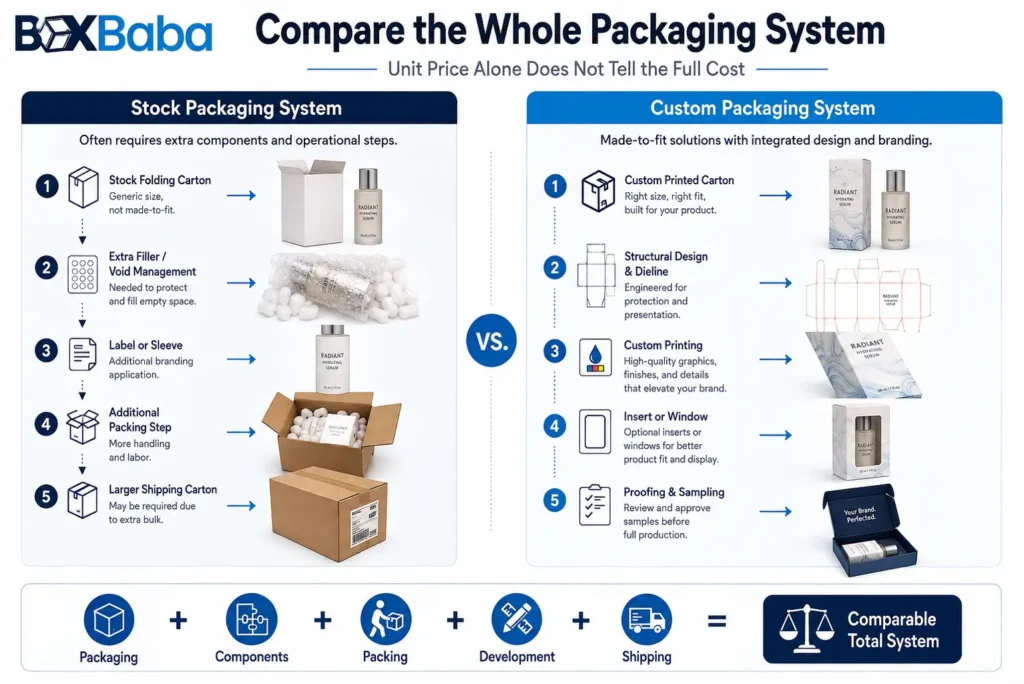
Compare Quotes Using the Same Specification
A plain stock carton and a custom printed carton with an insert, foil and inside printing are not equivalent products. When comparing options, confirm the same decision variables:
- internal and external dimensions
- material and structure
- printing
- finish
- insert or internal support
- assembly requirements
- SKU count and quantity
- packing format
- outer-shipping requirements
- delivery destination
MOQ, Timeline and Tooling: Do Not Mix Primary and Secondary Packaging Assumptions
A custom molded bottle and a custom printed folding carton are fundamentally different manufacturing projects. MOQ, tooling investment and development time from one category should not be applied automatically to the other.
Stock packaging can be faster when the correct item is already manufactured, in inventory and needs little additional decoration. Custom secondary packaging requires the dimensions, structure, dieline, artwork and proofing requirements to be finalized before production.
MOQ also depends on what is being customized. BoxBaba’s current Custom Cosmetic Boxes category starts from 100 boxes, while the final project requirements still depend on structure, size, material, printing, finishing and other specifications.
Structural Standardization Across Multiple Cosmetic SKUs
Customization does not mean every shade or formula needs a different structural box. When several products share compatible finished geometry, one approved structure may support multiple controlled artwork versions.
One Structural Dieline → Multiple Artwork SKUs |
For example, a lipstick line using the same tube dimensions may use one structural carton with twelve shade-specific artwork files, barcodes and color identifiers. A serum range using different bottle heights or closure profiles may require more than one structural version.
Separate structural standardization from artwork variation. This can simplify the packaging system without forcing physically incompatible products into one carton.
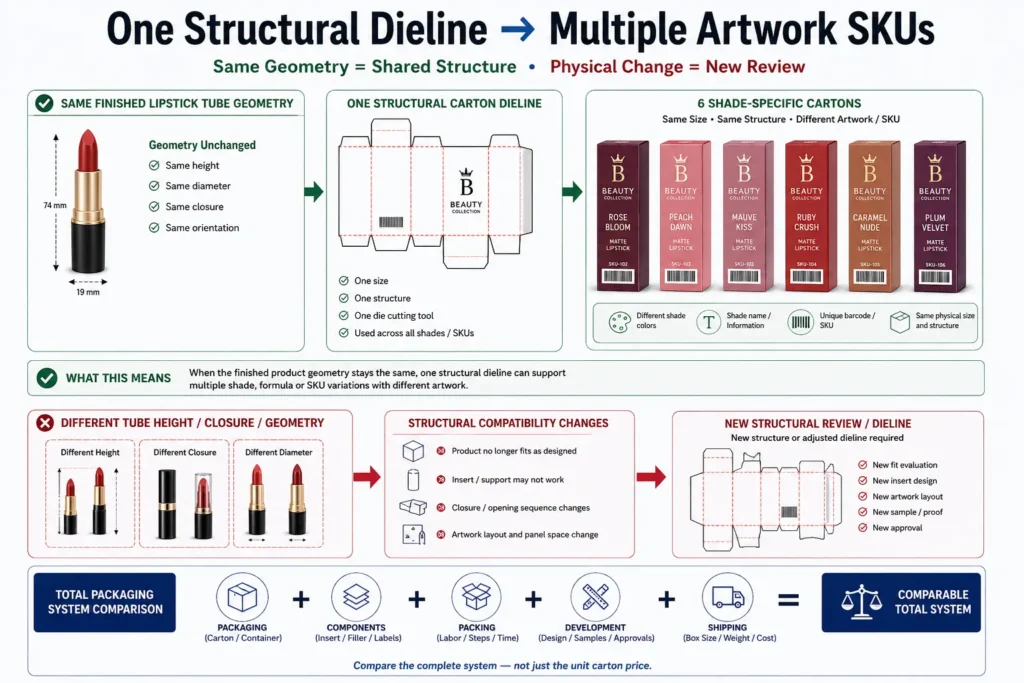
Custom Packaging Gives More Control Over Materials and Finishes
Stock formats limit the project to the materials and surface options already available. Custom secondary packaging can provide more flexibility to select the material, print method and finish around the structure, product load, artwork and presentation goal.
For material planning, see Best Materials for Custom Cosmetic Boxes. Material should still follow the finished product and structural role rather than being selected only because it appears premium, natural or inexpensive.
Custom vs Stock Decision Matrix
Situation | Better Starting Direction | Why |
|---|---|---|
Early market test | Stock / hybrid | Reduces unnecessary structural commitment while product demand or format is still being tested |
Product dimensions still changing | Stock / delay final custom carton | A final custom dieline may become obsolete |
Existing box passes all fit tests | Stock may be sufficient | Custom dimensions may add little practical value |
Poor fit in available sizes | Custom | Allows product-specific carton dimensions |
Private-label bottle already selected | Stock primary + custom secondary | Preserves the existing container while building branded presentation |
Several shades or formulas share the same container | Custom secondary | Supports a coordinated structural system with multiple artwork versions |
Insert-supported glass bottle | Custom | Allows product, insert and outer carton to be developed together |
Exact window alignment | Custom | Window position can follow the actual product arrangement |
Temporary promotional pack | Stock may be sufficient | Lower need for a permanent structural system |
Premium multi-product set | Custom | Arrangement and presentation are product-specific |
Ecommerce outer shipper | Stock or custom | Evaluate packed dimensions, total order and distribution requirements separately |
A Better Decision Framework: Start With Constraints, Not Preference
1. Confirm the finished product
Measure the complete retail-ready bottle, jar, tube, compact, palette or other product, including the closure and filled weight where relevant.
2. Check existing packaging options
Determine whether a suitable stock primary or secondary package already exists.
3. Test the full fit
Check physical fit, artwork fit, presentation fit and operational fit rather than dimensions alone.
4. Identify the sales channel
Confirm whether the package is intended for retail, ecommerce, wholesale, gifting or multiple channels.
5. Identify the customization trigger
State the specific problem that custom packaging would solve.
6. Compare the complete systems
Compare material, structure, packing requirements, quantity, development needs and shipping implications rather than box price alone.
7. Choose the simpler option that meets the requirement
Do not choose custom because it sounds more professional, and do not choose stock merely because it appears easier.
What Should You Provide for a Custom Cosmetic Box Quote?
If stock packaging no longer meets the project requirements, prepare a quote brief around the finished product rather than a generic box size.
- cosmetic product type and primary-container format
- maximum finished length, width, height or diameter
- filled product weight
- cap, lid, pump, dropper or other closure profile
- intended product orientation
- units per box
- preferred box style
- insert or internal-support requirements
- window requirements
- artwork status and number of SKUs
- quantity per SKU
- printing and finish requirements
- retail, ecommerce or other sales channel
- delivery destination
For multi-product sets, also provide the finished dimensions and weight of each component plus the intended arrangement.
Need to know whether your cosmetic product requires a custom box? Share the finished container type, maximum dimensions, filled weight, closure profile, quantity, SKU count, artwork status, insert or window requirements and sales channel. Those details allow the carton requirement to be evaluated around the actual product rather than a generic cosmetic-box size. |
Custom vs Stock Cosmetic Packaging: Final Decision
Neither custom nor stock packaging is universally better. Choose stock when an existing format meets the product, branding, quantity, timeline and channel requirements without creating meaningful compromises. Choose custom secondary packaging when the finished product needs a specific fit, structure, insert, window, artwork system, material, finish or presentation that the available stock options cannot provide appropriately.
Most importantly, cosmetic packaging does not have to be completely stock or completely custom. For many beauty brands, the practical solution is a stock primary container paired with a custom printed secondary carton.
Best decision = the simplest packaging system that correctly supports the product, brand, sales channel and operational requirements. |
Frequently Asked Questions
What is the difference between custom and stock cosmetic packaging?
Stock cosmetic packaging uses existing sizes, structures or components. Custom packaging is developed around specific dimensions, artwork, structural or brand requirements. The terms can apply differently to primary containers and secondary boxes, so identify the packaging layer before comparing them.
Can I use a stock cosmetic bottle with a custom box?
Yes. A stock bottle, jar, tube or compact can be paired with a custom secondary carton developed around the finished container dimensions, closure profile, artwork and presentation requirements.
Does custom cosmetic packaging require a custom mold?
Not necessarily. A custom molded bottle or jar may require specialized primary-packaging tooling, but a made-to-size printed paperboard carton is a different manufacturing project and does not require a proprietary cosmetic-container mold.
Is custom cosmetic packaging always more expensive than stock packaging?
No universal rule applies. Custom packaging can involve more development and production setup, but the correct comparison is the complete packaging system. Stock packaging can also introduce extra filler, labels, packing steps or oversized shipping requirements.
Is stock packaging better for a new beauty brand?
Stock or hybrid packaging can be practical for an early-stage launch when the product or demand is still being tested. Custom secondary packaging may still make sense when the primary container is finalized and the brand needs a defined retail presentation.
When should a beauty brand switch from stock to custom packaging?
Consider custom packaging when stock options create persistent problems with fit, artwork space, inserts, windows, SKU organization, retail presentation or another defined packaging requirement.
Can multiple cosmetic SKUs share the same custom box?
Yes, when the finished products share compatible dimensions, closure profiles, orientation and internal-support requirements. Different shades, formulas, barcodes or artwork still require controlled artwork versions even when the structural dieline is shared.
Is stock packaging always faster than custom packaging?
It can be faster when the correct item is already manufactured and available in the required quantity. Actual timing still depends on inventory, decoration, quantity, shipping and supplier conditions, while custom cartons require specification and approval before production.
Does custom packaging always require a higher MOQ?
No. MOQ depends on the packaging type, material, print method, structure and production process. Custom molded primary packaging and custom printed secondary cartons should not be assigned the same MOQ assumptions.
Should retail and ecommerce cosmetics use the same packaging?
The same retail carton may sometimes serve both channels, but ecommerce orders may still require a separate outer mailer or shipping carton. Evaluate the customer-facing carton and the distribution layer separately.