
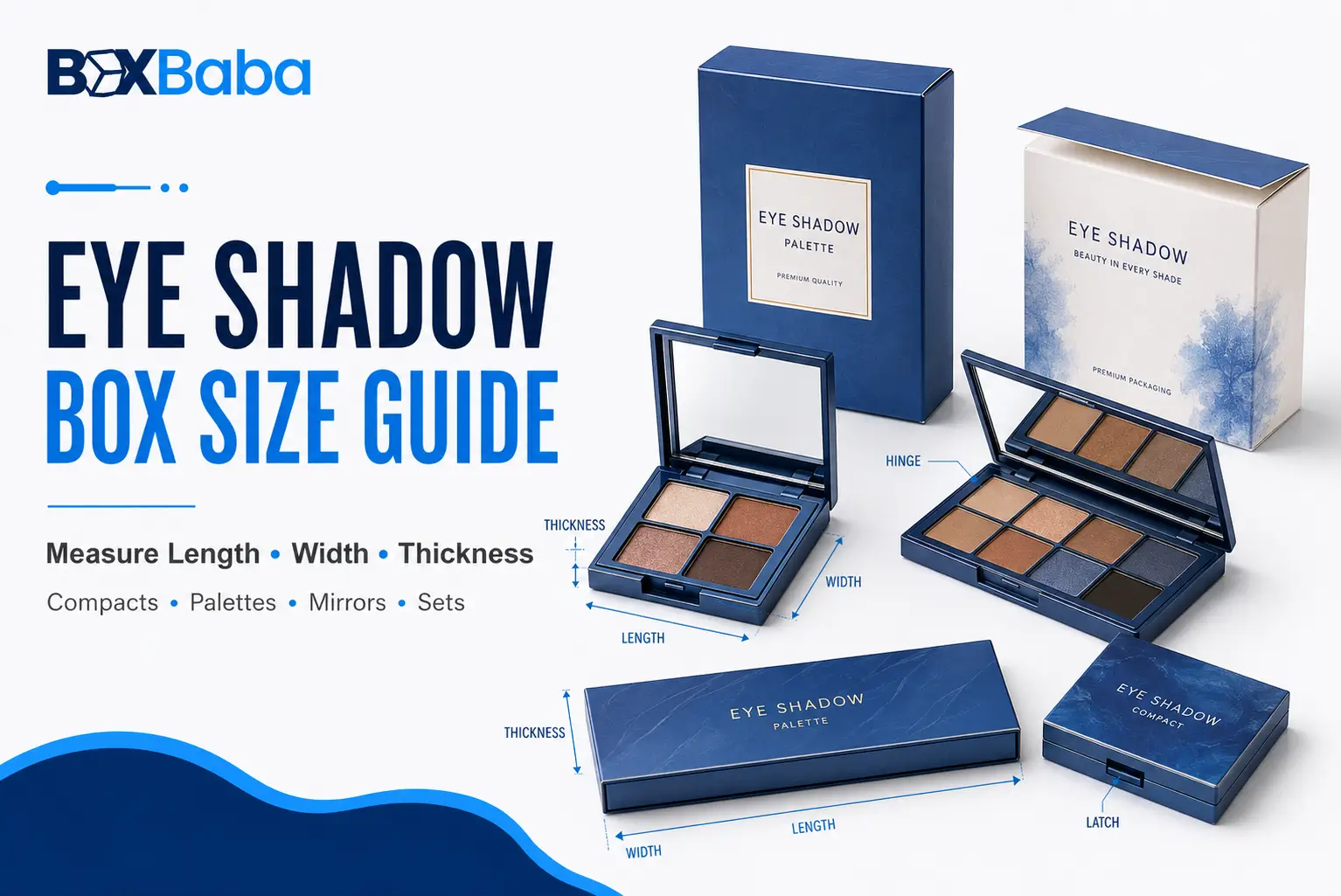
There is no universal eyeshadow box size. Single compacts, duo, quad, 9-pan and larger multi-pan palettes can have very different external dimensions even when they contain the same number of shades.
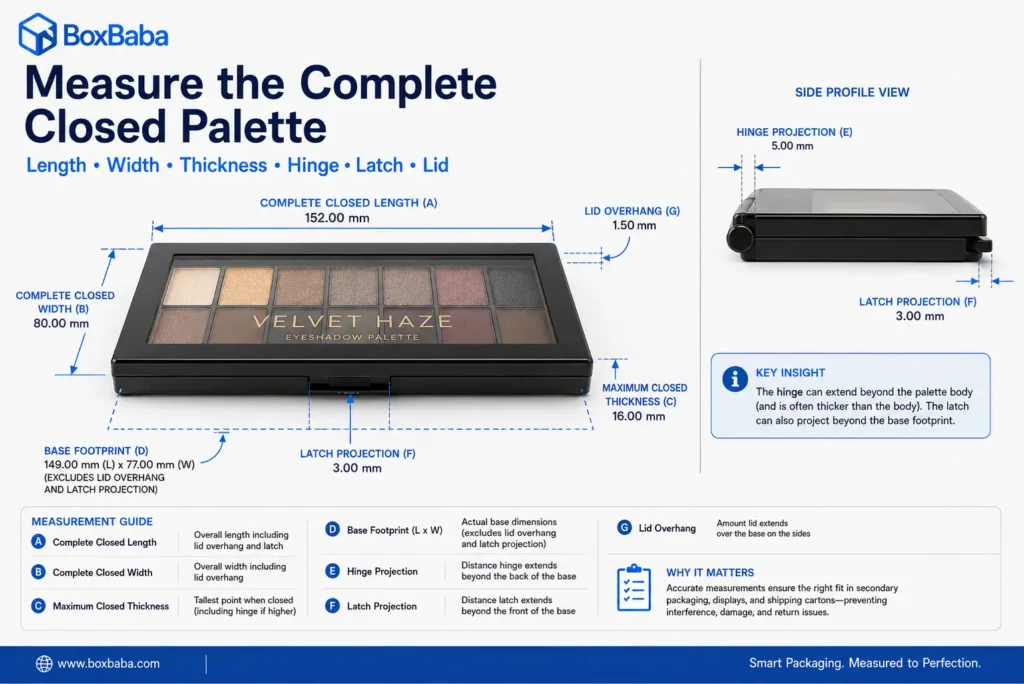
To determine the correct starting size, measure the complete closed and sale-ready palette at its maximum length, width and thickness. Include any projecting hinge, latch, lid overhang or permanent decorative feature.
The practical sizing relationship is:
Complete Closed Palette → Maximum External Envelope → Clearance / Internal Support → Internal Box Dimensions → Material + Structure → External Box Dimensions
Pan count describes the product layout. It does not determine the carton dimensions or automatically determine the box structure.
Brands already preparing a commercial packaging project can review Custom Eye Shadow Boxes. For the broader measurement principles used across bottles, jars, tubes and other cosmetic formats, refer to the Cosmetic Box Size Guide.
Understanding Published Eyeshadow Box Size References
Packaging suppliers publish various dimensions for single and multi-pan eye shadow packaging. These figures can help with preliminary planning, but they should not be treated as universal production standards.
| Eye Shadow Format | Published Market Example | How to Use It |
| Single compact | Around 2 × 2 × 0.5 in | Early reference only |
| Single palette / sleeve | Around 3 × 3 × 1 in in another published example | Shows that one universal standard does not exist |
| 2-pan palette | Around 3 × 2 × 0.6 in | Measure the actual closed palette |
| 3-pan palette | Around 3.5 × 2.5 × 0.7 in | Pan count alone is insufficient |
| 4–6 pan palette | Around 4.5 × 3.5 × 1 in | Check complete palette geometry |
| 8–12 pan palette | Around 6–6.5 × 4–4.5 × about 1–1.2 in across published examples | Use only for early comparison |
| Broad palette range | Around 90–150 × 60–120 × 15–25 mm | General planning reference |
These figures are not BoxBaba production specifications.
Why Published Standard Sizes Conflict
Published suppliers may describe both a roughly 2 × 2 × 0.5-inch carton and a 3 × 3 × 1-inch carton as a common single-palette size.
Both cannot define every single eye shadow compact.
The reason is that the finished geometry can change with:
Pan Size + Pan Spacing + Housing + Hinge + Latch + Lid + Mirror + Applicator Compartment
A published dimension may describe one common product or packaging format without establishing a universal standard.
Use the distinction:
Published Reference Size → Early Planning Input
but:
Complete Closed Palette → Production Measurement Input
Why Pan Count Does Not Determine Eye Shadow Box Size
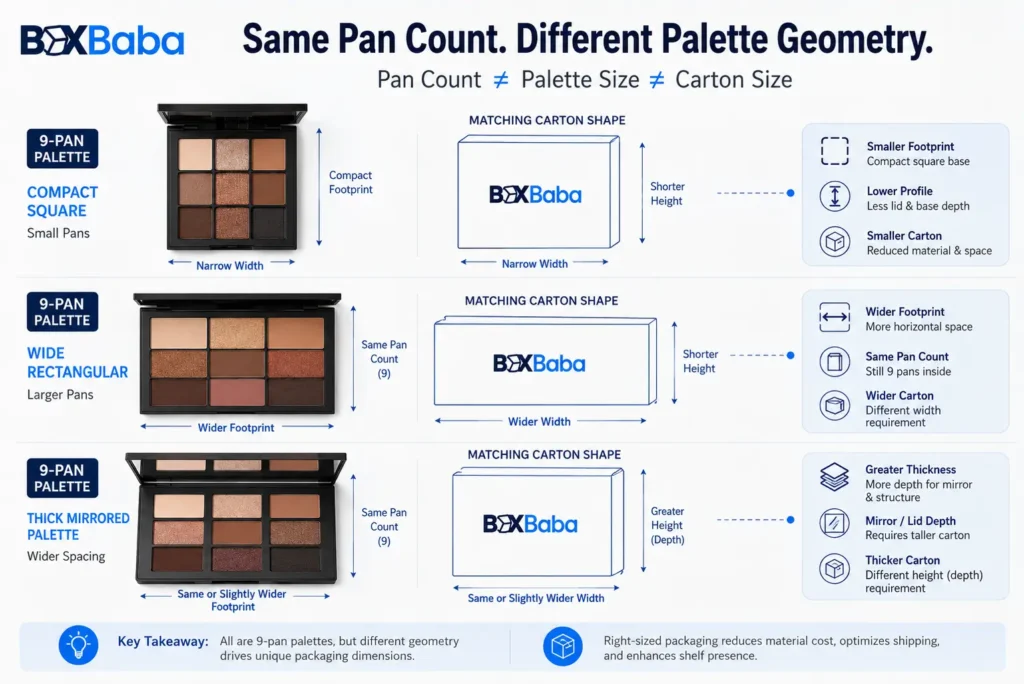
Pan count describes the internal shade arrangement rather than the external palette dimensions.
A 9-pan palette can be larger than a 12-pan palette if it uses larger pans, wider spacing, thicker walls, a mirror or a different closure system.
Likewise, two quad palettes may have completely different footprints. One could arrange four round pans in a 2 × 2 grid while another uses four rectangular pans in one row.
Both contain four shades, but they are different physical packaging entities.
Therefore:
Pan Count ≠ Palette Dimensions ≠ Eye Shadow Carton Dimensions
The finished palette—not the shade count—should define the starting product envelope.
Does Pan Count Determine the Box Structure?
A 12-pan palette does not automatically require a magnetic box, and a 20-pan palette does not automatically require a book-style or rigid box.
Structure should be selected from the completed specification, including:
- finished palette dimensions;
- loaded weight;
- presentation requirement;
- internal support;
- opening experience;
- intended use.
The useful relationship is:
Pan Count ≠ Box Structure Requirement
Does Every Eye Shadow Palette Need a Secondary Carton?
No.
Some completed palettes may already serve as the approved retail package without a separate paperboard carton.
In those cases, the next packaging task may instead involve a gift set, retail display, promotional package or ecommerce shipping package.
This guide specifically applies when a secondary carton is being developed around a finished eye shadow compact or palette.
When a secondary carton is used:
Primary Palette → Finished Cosmetic Product Package
Secondary Carton → Outer Retail Package
A request such as:
I need packaging for a 9-pan palette.
does not yet provide the dimensions needed for the secondary carton.
The physical palette must be measured first.
Eye Shadow Palette Measurement-to-Box Size Matrix
| Measurement | What to Measure | Why It Matters |
| Complete closed length | Furthest end-to-end point of the closed palette | Establishes one main product axis |
| Complete closed width | Widest side-to-side point | Establishes the second product axis |
| Maximum closed thickness | Thickest point of the complete closed palette | Establishes starting product thickness |
| Hinge projection | Widest or most projecting closed-hinge point | May control thickness or length |
| Latch projection | Furthest point of the closure | May extend beyond the body |
| Lid overhang | Lid edge extending beyond the base | May control length or width |
| Base footprint | Closed base length and width | Provides orientation/support input |
| Mirror position | Mirror location within the lid | May influence lid thickness and support planning |
| Separate applicator | Brush or sponge packed outside the primary palette | Adds to secondary-carton layout |
| Applicator compartment | Built-in cavity inside the palette | Already forms part of the primary package |
| Loaded weight | Complete sale-ready palette | Provides structural/support context |
| Weight distribution | Balanced, lid-heavy or uneven | May influence support decisions |
| Packing orientation | Flat, vertical, on edge or tray-packed | Determines how palette axes map to carton axes |
| Window-visible area | Approved visible part of the packed palette | Helps coordinate window placement |
| Sensitive surfaces | Mirror, decorated lid or metallic areas | Helps identify suitable contact areas |
| Product drawing/photo | Complete closed palette geometry | Helps communicate unusual projections |
These are palette measurements and packaging inputs, not finished external box dimensions.
How to Measure the Complete Closed Palette
Measure the palette in the exact condition in which it will enter the secondary carton.
For a typical rectangular palette, record:
Closed Length × Closed Width × Maximum Closed Thickness
Do not determine the carton from the pan diameter, shade count, powder weight, open-palette dimensions, internal pan tray or mirror dimensions alone.
The objective is to identify the outermost physical point along each axis.
Closed Length and Width
Measure the complete closed exterior.
If the latch, lid or decorative frame extends beyond the central palette body, include that projection.
For example:
Palette Body Length: 3.65 in
Maximum Length Including Latch: 3.72 in
Use:
3.72 in
because the latch establishes the furthest finished point.
Maximum Closed Thickness
Do not assume the central palette body is the thickest part.
A hinge, raised lid, decorative frame or closure may extend farther.
For example:
Palette Body Thickness: 0.62 in
Maximum Thickness at Closed Hinge: 0.70 in
Use:
0.70 in
as the product’s maximum closed thickness.
Therefore:
Hinge Projection > Body Thickness → Hinge Controls Maximum Thickness
Hinge, Latch and Lid Overhang
Measure the hinge with the palette closed.
Then inspect the latch separately. If it projects beyond the main body, include its furthest point.
Finally compare the lid footprint with the base.
If the lid extends farther:
Base Footprint ≠ Maximum Closed Palette Footprint
Use the larger exterior dimensions.
Useful Measuring Tools
A ruler may be sufficient for larger length and width measurements.
Digital calipers can be useful for smaller features such as:
- closed palette thickness;
- hinge projection;
- latch projection;
- small lid overhangs.
Measure on a stable surface and keep one measurement system throughout the specification.
What If the Final Eye Shadow Palette Is Not Available Yet?
Packaging development can begin before final production units are available.
If the completed sale-ready palette does not yet exist, start with an approved technical drawing, manufacturer specification, prototype or production-equivalent sample representing the intended finished geometry.
Label these measurements as preliminary.
Then confirm the carton against the final or production-equivalent palette before production approval.
A safer workflow is:
Preliminary Palette Specification → Production-Equivalent Palette → Final Measurement Confirmation → Carton Approval
If several representative units are available, compare them for meaningful dimensional variation rather than assuming one nominal number perfectly represents every unit.
Pay particular attention to variation in:
- hinge projection;
- latch position;
- lid closure;
- maximum closed thickness.
How to Report Eye Shadow Palette Dimensions
Avoid sending three unlabeled measurements.
Record each axis and state the intended packing orientation.
For example:
Palette: 3.72 in L × 2.85 in W × 0.70 in T — packed flat
where:
L = complete closed length
W = complete closed width
T = maximum closed thickness
If the same palette is packed vertically or on one edge, its physical dimensions remain unchanged, but those axes map differently to the carton.
Therefore:
Palette Dimensions + Packing Orientation → Carton Axis Assignment
This is why a packaging supplier should receive clearly labeled product dimensions, not simply three numbers.
Sizing by Eye Shadow Palette Format
| Eye Shadow Format | Measurements to Record | Check Closely | Main Sizing Risk |
| Single compact | Closed L × W × T | Hinge / latch | Pan diameter mistaken for box size |
| Duo palette | Closed L × W × T | Mirror / closure | Shade count used instead of physical dimensions |
| Quad palette | Closed L × W × T | Hinge / applicator area | Internal layout changes footprint |
| 6–12 pan palette | Complete closed dimensions | Mirror / hinge / latch | Pan count alone is misleading |
| Large multi-pan palette | Closed L × W × T + loaded weight | Lid / weight distribution | Size and weight both matter |
| Mirrored palette | Complete closed dimensions | Lid thickness / mirror position | Lid may control thickness |
| Palette + separate applicator | Palette + accessory dimensions | Accessory position | Accessory changes carton arrangement |
| Refill-pan set | Finished holder/tray + complete arrangement | Cavity layout | Loose pan diameter is insufficient |
| Multi-palette set | Every palette + complete arrangement | Divider / insert | One palette does not define the set |
Different formats use the same maximum-envelope principle, but each configuration presents unique physical traits that require careful measurement of the finished, closed product rather than relying solely on shade counts or pan diameters.
What About 14-, 20-, 35- or Larger Palettes?
Large and professional palettes still do not have universal carton dimensions.
Published suppliers provide progressively larger reference sizes for 14-, 20-, 35-, 50- and even larger pan counts, but the same limitation applies: pan count does not define the finished palette geometry.
For large formats, record the complete closed dimensions and also consider the:
- lid;
- hinge;
- latch;
- integrated mirror;
- loaded weight;
- intended orientation.
This gives BoxBaba coverage for large professional palettes without turning pan count into a false sizing rule.
How Mirrors, Applicators and Refill Holders Affect the Specification
Some palette components are already included in the closed product envelope. Others introduce separate carton requirements.
Built-In Mirrors
A mirror installed inside the palette lid should not be added again to the exterior dimensions.
The closed palette already contains it.
However, the mirror may influence lid thickness, loaded weight, weight distribution and appropriate internal-support contact areas.
Where support is required, it should be planned around suitable palette surfaces rather than assuming concentrated pressure should be applied to the mirror, hinge, latch or decorated lid.
Built-In vs Separate Applicators
A built-in brush or sponge compartment is already part of the finished palette.
A separately packed applicator is different.
Built-In Applicator → Included in Palette Envelope
Separate Applicator → Additional Secondary-Carton Input
Measure a separate applicator independently and establish where it will sit before finalizing the carton.
Refill Pans and Primary Holders
Loose pan diameter alone is not sufficient for secondary-carton sizing.
If the pans are installed inside an approved magnetic holder, tray or other primary package, measure the completed holder instead.
For refill sets:
Refill Pans + Approved Holder / Tray → Completed Primary Set
If cosmetic product will directly contact a paperboard component, direct-contact materials, coatings, inks, adhesives and applicable requirements require separate review.
A standard secondary paperboard carton should not automatically be treated as direct-contact cosmetic packaging.
Worked Example: Measuring a Quad Eye Shadow Palette
Consider a hypothetical quad palette:
Palette Body Length: 3.65 in
Maximum Length Including Latch: 3.72 in
Closed Width: 2.85 in
Palette Body Thickness: 0.62 in
Maximum Closed Thickness at Hinge: 0.70 in
The latch controls maximum length:
3.72 in
The hinge controls maximum thickness:
0.70 in
Therefore:
Maximum Finished Palette Envelope: 3.72 L × 2.85 W × 0.70 T
The presence of four pans does not determine any of these measurements.
These are hypothetical finished-palette dimensions. They are not a universal quad-palette box size and they are not final external carton dimensions.
A discovery set should be sized from the completed arrangement, not by multiplying one bottle dimension by the number of products.
A set may include:
- sample vials;
- miniature bottles;
- travel sprays;
- several full-size fragrances;
- bottles with different cap profiles.
Measure every product independently.
Consider:
- each product’s width or diameter;
- depth;
- complete closed height;
- cap profile;
- orientation;
- spacing;
- insert cavity layout;
- removal access;
- completed loaded weight.
Five 0.60-inch-wide fragrance vials do not automatically require exactly 3.00 inches of internal width because insert walls, spacing and removal access can increase the completed arrangement.
Weak vs Useful Eye Shadow Packaging Specifications
A packaging supplier can work with physical product measurements more effectively than with pan count alone.
| Weak Specification | More Useful Specification |
| 9-pan palette | Closed palette measures 5.2 L × 3.8 W × 0.75 T |
| 4-pan compact | Closed quad measures 3.72 L × 2.85 W × 0.70 T including latch and hinge |
| Palette with mirror | Closed dimensions, hinge/latch profile and loaded weight provided |
| 12 shades | Actual closed palette dimensions and packing orientation provided |
| Need a small box | Finished palette measurements plus insert/window requirements provided |
A packaging supplier can work with physical product measurements more effectively than with pan count alone. Providing detailed specifications keeps the carton design tied directly to the physical package rather than relying on general product descriptions.
How Palette Measurements Become Carton Dimensions
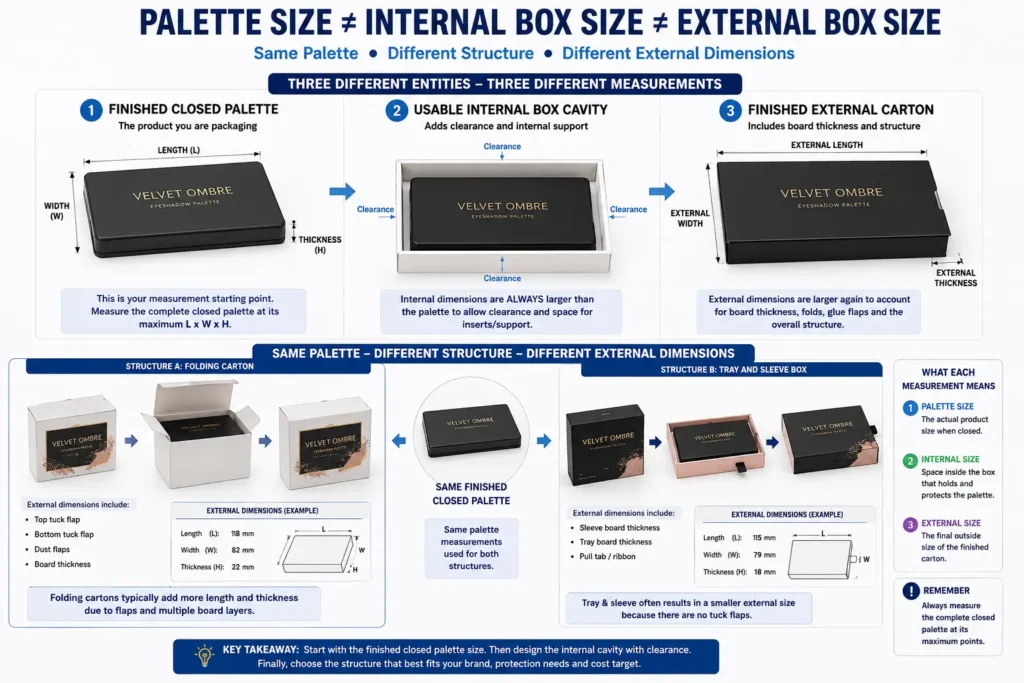
The finished palette, usable internal carton space and completed external box are three different dimensional entities.
Palette dimensions describe the complete primary product.
Internal box dimensions describe usable space inside the secondary carton.
External box dimensions describe the completed outside package.
Internal space can depend on the palette envelope as well as clearance, folded board construction, insert geometry, separate accessories and removal direction.
Therefore:
Finished Palette → Required Internal Space → Finished External Carton
A palette measuring 3.72 × 2.85 × 0.70 inches should not automatically be assigned a carton with those exact external dimensions.
Why the Same Palette Can Produce Different External Box Sizes
Two packages developed around the same palette do not necessarily have identical external dimensions.
Consider a hypothetical palette measuring:
5.00 L × 3.50 W × 0.75 T
That same product might be packed inside a folding carton or a tray-and-sleeve package.
Both structures begin with the same palette envelope, but their final outside measurements can differ because their:
- material thicknesses;
- folds;
- panels;
- tray walls;
- structural components;
are different.
Therefore:
Same Palette Envelope + Different Box Structure → Potentially Different External Dimensions
This is why the palette measurements should be presented as product dimensions, not as predetermined external carton dimensions.
Clearance, Orientation and Internal Support
There is no universal clearance allowance that should automatically be added around every eye shadow palette.
Required space depends on the completed specification, including the hinge, latch, lid overhang, material, box structure, orientation, insert and removal method.
A straightforward compact may fit directly inside a suitably developed folding carton without an insert.
A heavier, irregular, mirrored or presentation-focused palette may require a more defined support arrangement.
Where fitted internal support is appropriate, Printed Boxes with Inserts provides a related packaging route.
The insert itself occupies internal space, so its geometry should be established before final carton dimensions are approved.
How Much Clearance Should You Add?
There is no single production-ready clearance value for every palette.
Avoid automatically adding the same fraction of an inch around every product.
A simple folding carton, fitted paperboard insert and rigid tray can require different allowances around the same primary palette.
The final relationship is:
Structure + Material + Hinge/Latch Geometry + Insert + Orientation + Removal Method → Clearance Requirement
Final fit should then be reviewed through the proofing or sample route confirmed for the project.
Weight, SKUs and Shared Dielines
Two palettes can have nearly identical external dimensions but different loaded weights because of differences in the case material, pan arrangement, mirror, lid or internal components.
Weight does not automatically require a larger box.
Instead:
Similar External Dimensions + Different Loaded Weight → Support / Structure Review
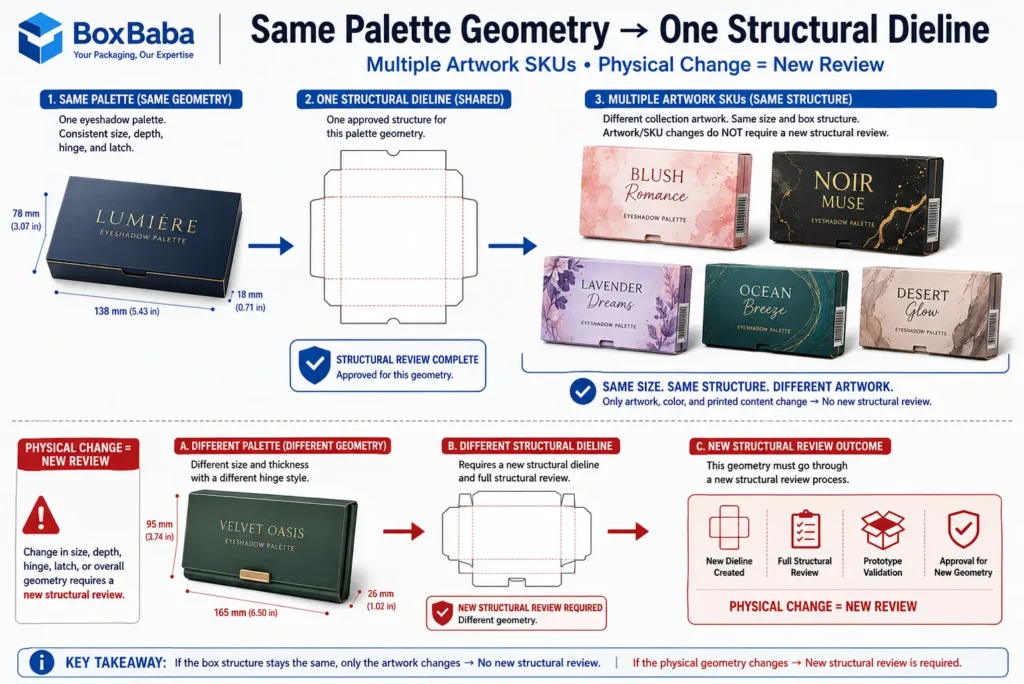
The same physical palette may also support several shade collections.
If the palette dimensions, hinge, latch, lid, orientation, internal support, window position and carton structure remain unchanged, the same structural dieline may support multiple artwork versions.
Changing the shades or graphics alone does not automatically require another structural carton.
The important question is:
Did the artwork change, or did the physical palette change?
Sizing Sets, Displays and Ecommerce Packaging
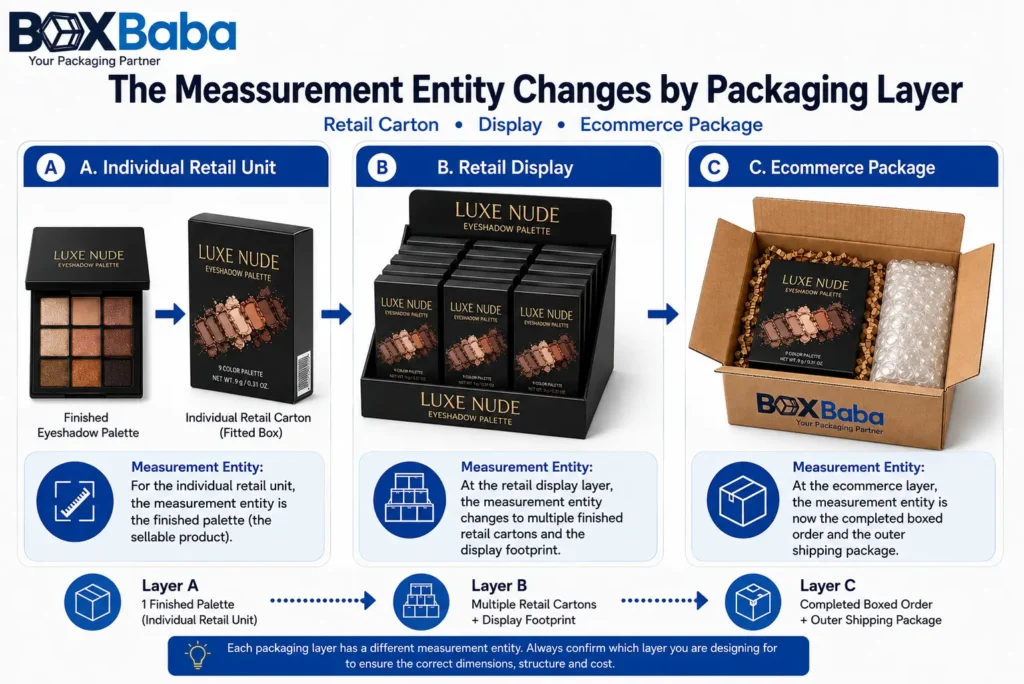
Once the project contains more than one retail unit, the measurement entity changes.
Multi-Palette and Makeup Sets
Do not size a set by multiplying one palette dimension.
Measure every completed product and establish:
Individual Products → Arrangement → Spacing / Support → Completed Set Dimensions
When the set combines eye shadow with mascara, eyeliner, brushes or other beauty products, Custom Makeup Boxes may be a more appropriate commercial route.
Retail Displays
An individual eye shadow carton and a retail display are separate packaging entities.
For one retail unit:
Finished Palette → Individual Carton
For merchandising:
Multiple Retail Units → Rows / Facings / Tiers → Display Dimensions
Brands developing shelf or countertop presentation can review Custom Cosmetic Display Boxes rather than treating a display as one oversized palette carton.
Ecommerce Packaging
The shipping package should be developed around the completed boxed order.
For retail:
Finished Palette → Individual Carton
For ecommerce:
Completed Boxed Order → Outer Mailer / Shipping Carton
Do not use the bare palette dimensions as final parcel dimensions
Windows Depend on Palette Orientation
A window may reveal an approved portion of the closed palette or decorated lid.
Its position should be established after the packed palette orientation is known.
Window alignment can depend on:
- palette position;
- lid graphics;
- visible product area;
- hinge direction;
- latch position;
- internal support.
If the primary palette remains closed, the outer-carton window does not automatically reveal the eye-shadow pans.
Confirm what should actually be visible before the structural opening and surrounding artwork are finalized.
Common Eye Shadow Packaging Sizing Mistakes
| Sizing Mistake | Better Approach |
| Choosing the carton from pan count | Measure the finished closed palette |
| Treating published dimensions as universal standards | Use them only for early planning |
| Assuming every quad uses the same box | Measure the actual finished product |
| Measuring the palette open | Use the packed closed state |
| Measuring only the pan tray | Measure the complete primary package |
| Ignoring hinge projection | Check maximum closed thickness |
| Ignoring latch projection | Include its furthest point |
| Measuring only the base footprint | Check lid overhang |
| Assuming body thickness is maximum thickness | Compare body, lid and hinge |
| Adding a built-in mirror twice | Measure the complete closed palette once |
| Ignoring a separate applicator | Include it in the secondary arrangement |
| Counting a built-in applicator twice | Treat it as part of the primary palette |
| Using loose pan diameter as carton size | Measure the completed holder or tray |
| Applying one universal clearance value | Confirm fit from the completed specification |
| Finalizing the carton before the insert | Include support geometry first |
| Assuming every mirrored palette requires an insert | Evaluate the actual configuration |
| Assuming every shade collection needs a new dieline | Compare the physical palette first |
| Multiplying one palette dimension for a set | Develop the completed arrangement |
| Treating a display as one enlarged carton | Size it from retail units and facings |
| Using retail-carton dimensions for ecommerce shipping | Measure the completed boxed order |
Avoiding these common sizing mistakes ensures that your secondary packaging matches the exact physical realities of your finished cosmetic palettes, preventing costly adjustments during production.
Eye Shadow Palette Measurement and Quote Checklist
Finished Palette
| Field | Value / Options |
| Palette Format | Single / Duo / Quad / Multi-Pan / Refill Set / Other |
| Pan Count | ____________________ |
| Complete Closed Length | ____________________ |
| Complete Closed Width | ____________________ |
| Maximum Closed Thickness | ____________________ |
| Hinge Projection | ____________________ |
| Latch Projection | ____________________ |
| Lid Overhang / Decorative Projection | ____________________ |
| Base Length | ____________________ |
| Base Width | ____________________ |
| Loaded Weight | ____________________ |
Palette Features
| Field | Value / Options |
| Mirror Included | Yes / No |
| Mirror Position | ____________________ |
| Built-In Applicator Compartment | Yes / No |
| Separate Applicator Included | Yes / No |
| Separate Applicator Dimensions | ____________________ |
Packaging Configuration
| Field | Value / Options |
| Orientation | Flat / Vertical / On Edge / Tray / Other / Unsure |
| Opening Direction | ____________________ |
| Internal Support Required | Yes / No / Unsure |
| Removal Direction | ____________________ |
| Window Required | Yes / No / Unsure |
| Products Per Box | ____________________ |
| Product Photograph / Technical Drawing Available | Yes / No |
SKU and Quote Details
| Field | Value / Options |
| Number of Collections / SKUs | ____________________ |
| Same Physical Palette Across SKUs | Yes / No / Unsure |
| Quantity Per SKU | ____________________ |
| Preferred Box Structure | ____________________ |
| Intended Use | Retail / Ecommerce / Set / Display / PR / Other |
| Artwork Status | Ready / In Progress / Not Started |
| Delivery Destination | ____________________ |
Specification Best Practice:
Basic Inquiry: Need 500 boxes for a quad eyeshadow palette.
Complete Specification Example: The finished closed quad palette measures 3.72 in long including the latch, 2.85 in wide and 0.70 in at its maximum hinge thickness. It will be packed flat as one palette per carton, includes an internal mirror, and no separate insert has yet been confirmed.
Providing detailed physical specifications gives the packaging supplier actionable information required to evaluate and develop a precise production carton.
What specific cosmetic packaging format or product specifications would you like to review or prepare next?
Confirm the Final Palette Fit Before Production
Measurements establish the starting specification, but final fit should still be reviewed through the proofing or sample route confirmed for the project.
Where a structural or physical sample is used, review the palette insertion, side and top clearance, hinge and latch clearance, removal access, insert position, orientation, separately packed accessories and window alignment.
For multi-product packaging, also evaluate spacing and access between individual items.
This final review is particularly relevant when the palette has an irregular hinge, projecting latch, oversized lid, mirror or fitted support system.
Finished Eye Shadow Box Dimensions vs Flat Dieline Size
Finished carton dimensions and flat dieline dimensions are not the same.
The assembled carton describes the completed three-dimensional package.
The flat dieline contains the panels and structural components required to create that package, which may include:
- front and back panels;
- side panels;
- top and bottom flaps;
- glue areas;
- sleeve or tray components;
- closure features;
- window geometry;
- insert-related elements.
Therefore:
Finished Eye Shadow Box Dimensions ≠ Flat Dieline Dimensions
Do not use the assembled carton dimensions as the artwork-canvas dimensions.
The development sequence is:
Finished Palette → Internal Carton Specification → Material + Structure → Finished Box Dimensions → Flat Dieline → Proof / Approval
The finished carton should also provide usable panel space for approved artwork.
Final ingredients, net contents, warnings, shade information, product claims, barcode and market-specific labeling remain the buyer’s responsibility.
Request Custom Eye Shadow Box Pricing
A reliable eye-shadow packaging specification starts with the complete closed and sale-ready palette, not a generic single, quad, 9-pan, 12-pan or larger reference size.
BoxBaba supplies Custom Eye Shadow Boxes for palette-specific packaging projects.
The verified minimum order quantity for custom cosmetic boxes starts from 100 boxes.
When requesting pricing, provide the palette format, complete closed dimensions, hinge and latch profiles, lid overhang, mirror and applicator details, loaded weight where relevant, packing orientation, internal-support requirements, products per box, quantity per SKU and artwork status.
If the final carton dimensions are not yet known, provide the finished palette dimensions rather than estimating an external box size.
Proofing or sample routes are confirmed during quotation. Production timing is project-specific after dimensions, structure, material, inserts, artwork, quantities, finishes and proofing requirements are approved. Shipping methods, charges and estimated transit times are confirmed according to the completed order, packing format, destination and selected service.
Brands developing a wider cosmetic packaging range can also review Custom Cosmetic Boxes for the parent commercial category.
Measure the complete closed eye-shadow palette—including its hinge, latch, lid overhang and permanent exterior profile—before developing the carton around it.
FAQs About Eyeshadow Box Sizes
What is the standard eyeshadow box size?
There is no universal production-ready eyeshadow box size. Published suppliers use different reference dimensions, and single, duo, quad and multi-pan palettes can have different hinges, latches, lids and exterior dimensions.
Does pan count determine eyeshadow box size?
No. Pan count describes the shade arrangement. Two palettes with the same number of pans can have different external dimensions because pan size, spacing, housing, mirror, applicator compartment and closure design can vary.
Do 4-pan, 6-pan, 9-pan and 12-pan palettes have standard box sizes?
No. Published reference dimensions may group palettes by pan count, but the final carton should be developed around the actual closed palette.
What about 20-pan or larger professional eyeshadow palettes?
Large professional palettes should also be measured from the complete closed product. High pan counts do not determine a universal size because pan dimensions, spacing, lid construction, mirror, hinge, latch and housing vary.
How do I measure an eyeshadow palette for a custom box?
Measure the complete palette in its closed sale-ready condition. Record maximum length, width and thickness, including any projecting hinge, latch, lid overhang or permanent decorative feature.
Should an eyeshadow palette be measured open or closed?
Measure it in the condition in which it will actually be packed—normally closed. Open dimensions do not represent the product envelope that the secondary carton must accommodate.
What determines eyeshadow box thickness?
The thickest point of the complete closed palette establishes the starting product thickness. Depending on the design, this may be the body, hinge, raised lid, decorative frame, latch or another permanent projection.
Is palette thickness the same as box height?
Not necessarily. Report the product as length × width × maximum closed thickness. Once the packing orientation and box structure are selected, those product axes are mapped to the carton’s length, width and height or depth.
Does the hinge count when measuring an eyeshadow palette?
Yes. If the hinge projects beyond the body or creates the thickest point, include it in the maximum closed dimensions.
Should the palette latch be included?
Yes. If the latch projects beyond the main body, include its furthest point in the finished product envelope.
Does a built-in mirror change the dimensions?
A built-in mirror does not need to be added separately when it is already contained inside the closed palette. It may still influence lid thickness, loaded weight and support decisions.
How much clearance should I add around an eyeshadow palette?
There is no universal clearance value. Required space depends on the hinge, latch, lid, structure, material thickness, insert, orientation and removal method.
When a supplier asks for dimensions, should I send palette dimensions or box dimensions?
If the carton has not yet been structurally developed, send the finished closed palette dimensions and clearly identify them as product dimensions. Do not guess the internal or external carton size. The required internal space and final outside dimensions can then be developed from the palette, structure, material, insert and clearance requirements.
How do I measure a palette with an applicator?
If the applicator is built into the primary palette, measure the closed palette normally. If it is packed separately inside the secondary carton, measure the applicator separately and include its planned position in the arrangement.
Can several eyeshadow collections use the same box?
Yes, when the physical palette dimensions, hinge, latch, orientation, support and carton structure remain unchanged. Shade or artwork changes alone do not automatically require another structural dieline.
Are palette dimensions the same as box dimensions?
No. Palette dimensions describe the finished primary product, internal box dimensions describe usable space inside the secondary carton, and external dimensions describe the completed outside package.