
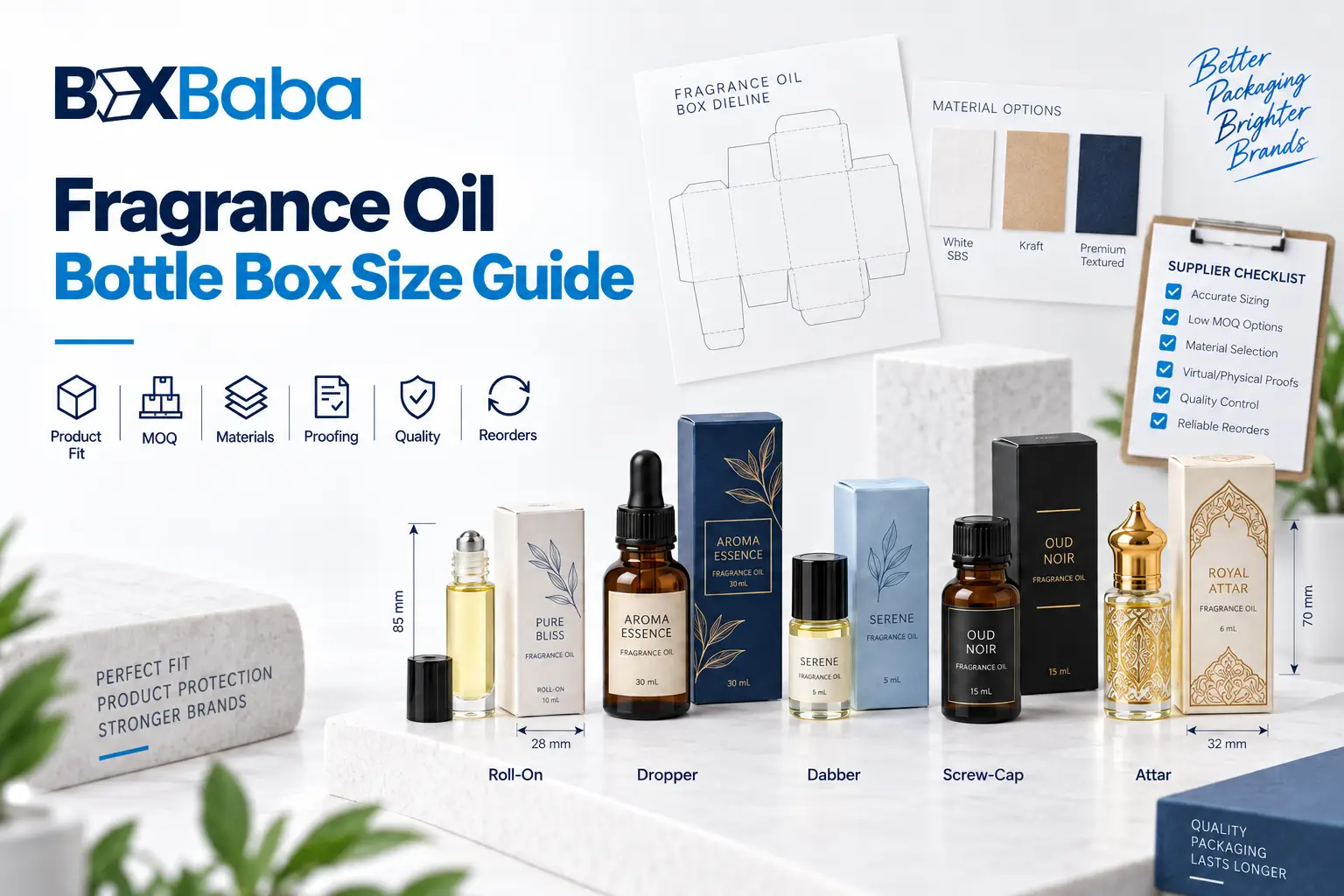
There is no universal fragrance oil box size. A 5 ml, 10 ml, 15 ml or 30 ml fragrance oil can be sold in a narrow roll-on bottle, a dropper bottle, a screw-cap glass container, a dabber bottle or a decorative attar bottle. Those containers can have very different heights, diameters, closures, base footprints and finished weights even when the stated volume is similar.
The reliable sizing method therefore starts with the completely assembled, filled, closed, labeled and decorated bottle – not the fragrance volume alone.
Use this sequence: Finished Fragrance Oil Bottle -> Maximum External Envelope -> Closure / Applicator Profile -> Orientation -> Insert or Support if Needed -> Internal Box Dimensions -> Material + Structure -> External Box Dimensions -> Dieline
Brands preparing a custom project can review Custom Fragrance Oil Packaging. For the measurement principles used across cosmetic bottles, jars and tubes, see the Cosmetic Box Size Guide.
Is There a Standard Fragrance Oil Box Size?
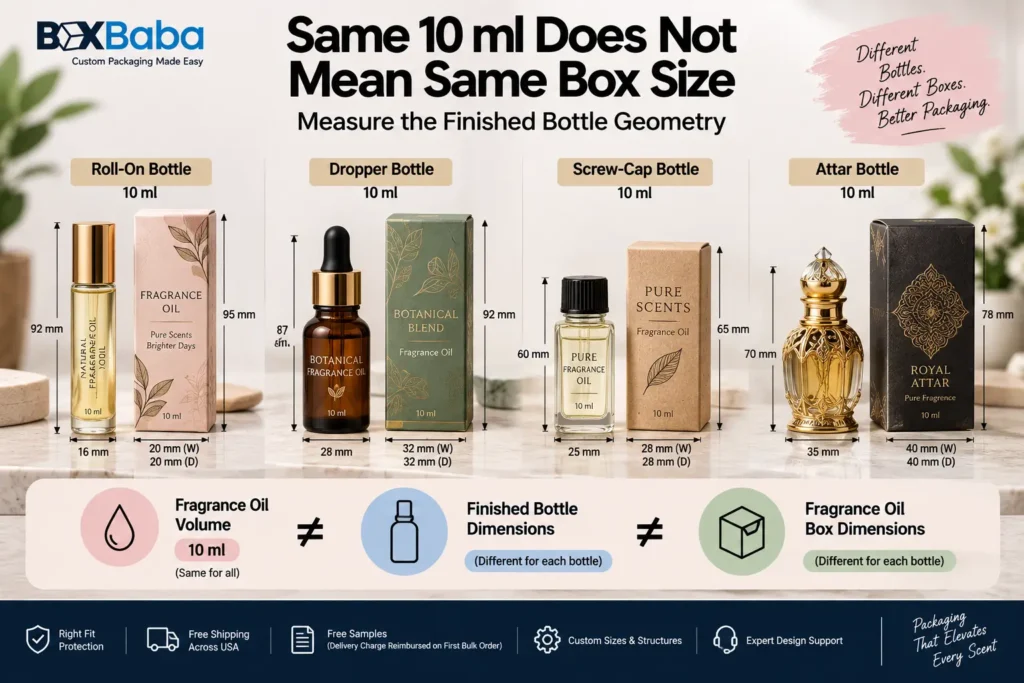
No single production-ready carton size fits every fragrance-oil bottle. Nominal capacities such as 5 ml, 10 ml, 15 ml and 30 ml describe how much liquid the container holds; they do not define its exterior geometry.
For example, two 10 ml fragrance oils could use a slim cylindrical roller bottle and a short decorative attar bottle. Their width, depth, cap profile, center of gravity and box footprint may be completely different.
The important distinction is: Fragrance Oil Volume != Finished Bottle Dimensions != Fragrance Oil Box Dimensions.
Capacity-based reference sizes can help with early planning, but production packaging should be developed from the actual finished bottle or an approved dimensional reference from the bottle supplier.
Fragrance Oil Packaging Is Different From Spray Perfume Packaging
Fragrance oil and spray perfume belong to the same broader fragrance context, but their bottle systems are not identical. Spray perfume commonly uses an atomizer, collar and overcap. Fragrance oils may use a roller housing, dropper bulb, screw cap, dabber applicator or decorative attar closure.
That difference changes what must be measured. This guide therefore focuses on roller, dropper, dabber, screw-cap, attar, sample and mini fragrance-oil bottles.
For full-size spray perfume bottles, caps, shoulders, atomizers and perfume inserts, use the Perfume Box Size Guide.
Measure the Complete Retail-Ready Bottle
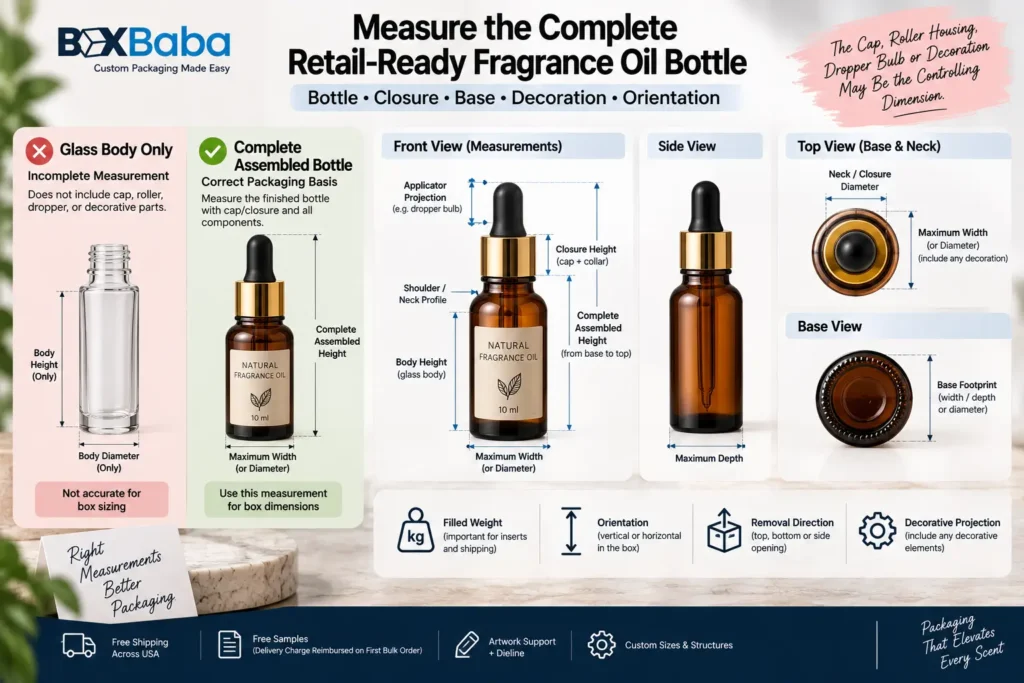
Measure the bottle exactly as it will enter the secondary carton. Install the final roller, dropper, applicator, screw cap or decorative closure. Include the label, sleeve, band or permanent decorative component when it changes the outside profile.
Do not measure only the central glass body. The cap, roller housing, dropper bulb, collar, decorative overhang or base can become the controlling dimension.
Fragrance Oil Bottle Measurement Checklist
Measurement | What to Record |
Complete assembled height | Base to the highest point of the installed closure or decoration |
Maximum width | Widest finished point on rectangular, oval or irregular bottles |
Maximum depth | Deepest finished point from front to back |
Maximum diameter | Widest outside diameter for a truly round bottle |
Base footprint | Actual standing width x depth or diameter |
Shoulder / neck profile | Record where it projects beyond the body |
Closure dimensions | Cap, roller housing, dropper bulb, screw cap or dabber assembly |
Applicator projection | Any component extending beyond the bottle or closure |
Decorative projection | Raised band, ornament, sleeve, emblem or unusual cap feature |
Filled product weight | Formula + bottle + closure + label + permanent decoration |
Orientation | Upright, horizontal or another approved position |
Removal direction | Lift, slide or another planned method |
Units per box | Single bottle, multipack, sample set or discovery arrangement |
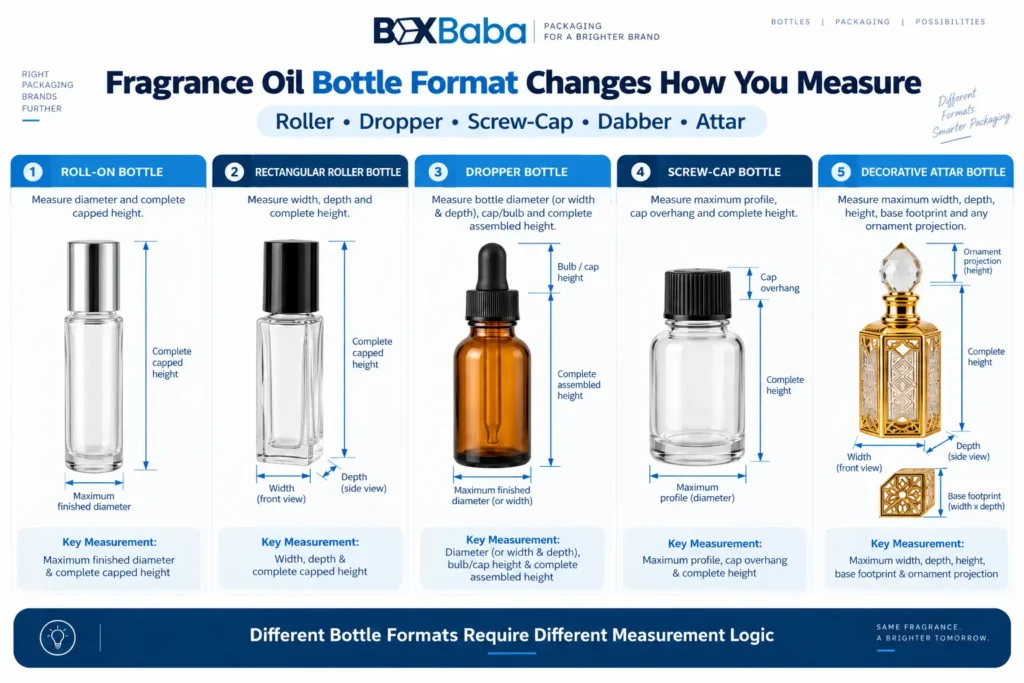
Fragrance Oil Bottle Format-to-Measurement Matrix
Bottle Format | Measurement Basis | Critical Check |
Roll-on bottle | Maximum diameter + complete capped height | Roller housing and cap may exceed bottle body |
Rectangular roller bottle | Maximum W x D x complete H | Closure may not align with body |
Dropper bottle | Maximum W x D or diameter + complete assembled H | Bulb or cap may control width/height |
Screw-cap bottle | Maximum W x D or diameter + complete capped H | Cap overhang and shoulder profile |
Dabber / applicator bottle | Maximum W x D x H | Applicator or cap projection |
Decorative attar bottle | Maximum finished W x D x H | Ornamental cap, neck, base and balance |
Sample vial / mini | Actual finished dimensions for each vial | Closure-to-body proportion |
Multi-bottle set | Every bottle + arrangement + spacing/support | One bottle does not define the set |
How to Measure a Roll-On Fragrance Oil Bottle
Measure a roll-on bottle with the roller assembly installed and the cap fully closed. For a cylindrical product, record the complete capped height and the maximum finished diameter.
Check three separate horizontal measurements: the bottle-body diameter, the roller-housing diameter and the cap diameter. Use the largest of the three as the starting cross-section.
Use: Maximum Finished Diameter + Complete Capped Height.
A narrow bottle body does not guarantee a narrow carton if the roller housing or cap projects farther outward.
How to Measure a Rectangular or Shaped Roller Bottle
A square, rectangular or oval roller bottle should not be reduced to one diameter measurement. Record maximum width, maximum depth and complete capped height separately.
Use: Maximum Width x Maximum Depth x Complete Capped Height.
Inspect the cap and roller assembly as well as the glass body. The largest width and largest depth can occur at different points.
How to Measure a Dropper Fragrance Oil Bottle
Measure the complete bottle with the dropper fully installed. Include the bulb, cap, collar and any exterior part of the closure that remains on the retail-ready product.
For a round bottle, record maximum finished diameter and complete assembled height. For square, rectangular or irregular bottles, record maximum width, depth and height.
The dropper bulb or cap can be wider than the bottle body. It can also increase the complete height substantially, so bottle-only measurements are not enough.
The pipette itself is normally contained inside the bottle when the product is closed, so carton sizing is based on the outside profile of the complete assembled product rather than the internal stem length.
How to Measure a Screw-Cap Fragrance Oil Bottle
Screw-cap bottles are often geometrically simple, but the closure still needs separate review. Measure the bottle completely closed and record maximum width and depth or maximum diameter, complete height, cap dimensions and any shoulder or neck overhang.
If the cap is wider than the glass body, use the cap as the controlling horizontal dimension.
How to Measure Dabber and Applicator Bottles
Dabber and specialty applicator bottles can have closures that are difficult to describe with only height and diameter. Record the maximum exterior dimensions and document any applicator, cap or decorative feature that projects beyond the main body.
When the geometry is irregular, provide front, side and top photographs or a supplier drawing in addition to the dimensions. This helps communicate profile changes that a simple W x D x H measurement may not fully describe.
How to Measure Decorative Attar Bottles
A press-on nail kit may also contain adhesive tabs, a mini file, buffer, prep pad, cuticle stick, instruction card o
Decorative attar bottles can use sculpted glass, metal collars, heavy bases, ornate caps, long applicators or irregular footprints. Measure the finished product at the furthest points rather than selecting the apparent body width.
Record: Maximum Finished Width x Maximum Finished Depth x Complete Height.
Also record the base footprint, cap weight, filled product weight and whether the bottle is top-heavy, bottom-heavy or otherwise unbalanced. Those are structural inputs, not reasons to assume a specific box or insert material.
r liquid glue. These components can change both the tray arrangement and the finished package.
Measure each accessory independently before the final layout is established.
If liquid glue is included, measure the complete closed glue container as its own primary-packaging entity. Do not size an accessory cavity from the fill volume alone.
Mini Bottles and Sample Vials Need Their Own Measurements
Do not scale a full-size fragrance-oil carton down by a fixed percentage for a miniature bottle. A mini product can have a proportionally wider cap, thicker base or different closure-to-body ratio.
Measure every sample vial or mini bottle independently, including the installed cap or closure.
Same 10 ml Does Not Mean Same Box Size
Consider four hypothetical 10 ml products: a narrow roller bottle, a round dropper bottle, a square screw-cap bottle and a decorative attar bottle. They hold the same nominal volume but can have different diameters, widths, depths, closures and complete heights.
Therefore: Same Volume -> Different Bottle Geometry -> Potentially Different Carton Geometry.
This is why published 10 ml box sizes should be treated as references rather than production specifications.
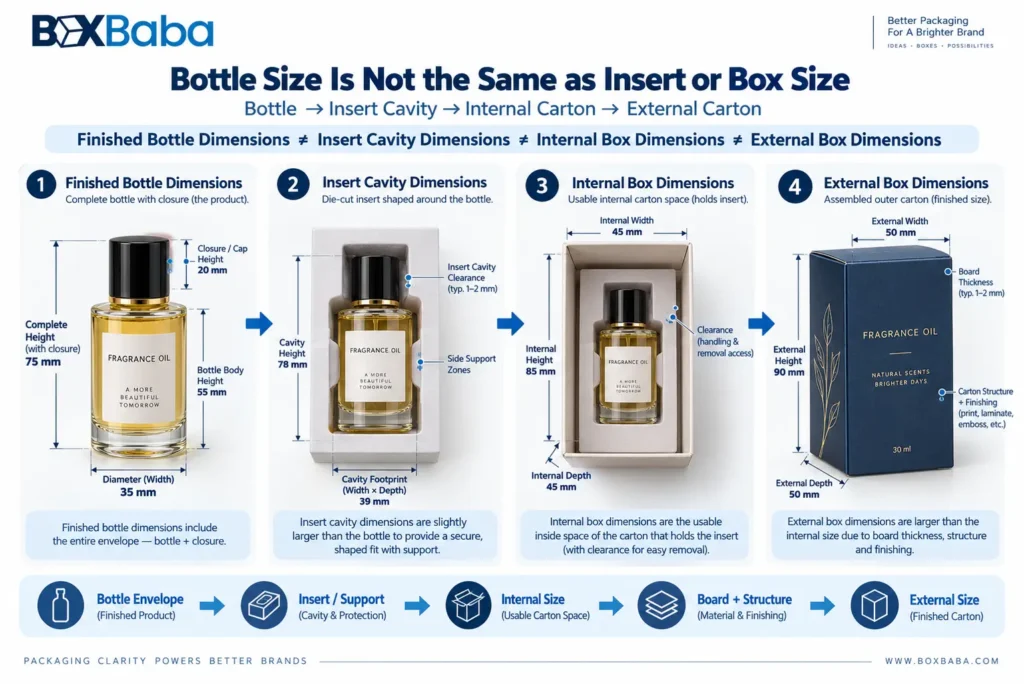
Product Dimensions, Insert Cavity, Internal Box and External Box Are Different
Fragrance-oil packaging can contain several separate dimensional entities. The finished bottle is measured first. If an insert is used, the insert cavity has its own dimensions. The completed insert has an outside footprint. The box then has internal and external dimensions.
Finished Bottle Dimensions != Insert Cavity Dimensions != Internal Box Dimensions != External Box Dimensions.
The bottle establishes the physical starting envelope. The insert, if required, occupies internal space. Board thickness and folded construction then affect the relationship between usable internal space and the outside size of the finished box.
Do Not Add One Universal Clearance
A fixed clearance added to every fragrance-oil bottle is not a reliable universal rule. A slim roller bottle, heavy decorative attar bottle and dropper bottle with a large bulb do not necessarily need identical internal space.
Clearance can depend on bottle geometry, dimensional variation, material, loading direction, closure profile, insert construction, label-sensitive surfaces and removal access.
Provide the actual finished-bottle dimensions first. Develop the internal carton requirement around the approved package construction.
When Does a Fragrance Oil Box Need an Insert?
A fragrance-oil bottle does not automatically need a separate insert because it is glass, premium or small. A closely fitted lightweight roller bottle may work inside a suitably developed folding carton without another component.
An insert becomes more relevant when the package needs a defined position, several bottles separated, a decorative bottle presented in a planned orientation, an accessory organized or a product-removal method created.
Use: Required Internal Function -> Direct Fit / Integrated Structural Support / Separate Insert.
For the broader decision framework, see When Do Cosmetic Boxes Need Inserts?.
Label-Sensitive and Decorated Surfaces
Fragrance-oil bottles may use paper labels, metallic decoration, frosted glass, coated surfaces or printed glass. Identify areas where avoidable rubbing or concentrated insert contact should be limited.
The maximum exterior dimension is not automatically the preferred support point. Product-envelope measurement and insert-contact planning are related but different tasks.
Bottle Orientation Can Change the Box Dimensions
The same bottle can create a different carton footprint depending on whether it is packed upright, horizontally or within a presentation arrangement.
Upright Bottle -> Height-driven carton. Horizontal Bottle -> wider presentation footprint.
Orientation can also change insert geometry, window position, opening direction and removal access. Confirm it before final structural dimensions and artwork.
How to Size a Multi-Bottle Fragrance Oil Set
Do not size a set by multiplying one bottle diameter by the number of fragrances. Measure every bottle and accessory, then develop the actual arrangement.
Use: Individual Bottle Dimensions -> Bottle Count -> Fragrance Order -> Orientation -> Spacing / Separation -> Insert / Divider -> Removal Access -> Total Loaded Layout.
Set Variable | What to Confirm |
Bottle count | Exact units per package |
Bottle format | Confirm whether every SKU uses the same physical container |
Closure types | Roller, dropper, screw cap, dabber or mixed |
Fragrance order | Sequence if visual presentation matters |
Spacing / separation | Cavity, divider or open-space requirement |
Removal access | Finger notch, lift direction, ribbon or other method |
Printed cards / accessories | Measure separately |
Combined weight | Complete packed set |
Can Several Fragrances Use One Structural Dieline?
Yes, when the physical bottle configuration remains the same. A fragrance range can use different names, colors, barcodes and artwork while sharing one structural dieline if the bottle dimensions, closure, orientation, insert, window and relevant weight range remain compatible.
Same Physical Bottle Configuration -> Shared Structural Dieline -> Multiple Fragrance Artworks.
A new structural review is appropriate when one SKU changes from roller to dropper, uses a different cap, changes bottle diameter, moves to a decorative attar bottle or changes the internal set arrangement.
Fragrance Oil vs Essential Oil: Keep the Search Intent Separate
This guide is written for fragrance oils, perfume oils, attars and scent oils sold as fragrance products. Aromatherapy or wellness-positioned essential oils can use similar bottle geometries, but they belong to a different commercial and informational context.
If the project is specifically an aromatherapy or wellness essential-oil product, review Essential Oil Boxes rather than forcing the fragrance-oil article to cover that separate intent.
Retail Fragrance Oil Carton vs Ecommerce Shipping Package
The individual fragrance-oil carton and the ecommerce outer package are separate packaging layers. The retail carton is developed around the finished bottle. The outer mailer or shipping carton is developed around the completed order.
Retail: Finished Bottle -> Individual Fragrance Oil Carton. Ecommerce: Completed Retail Carton(s) -> Outer Mailer / Shipping Carton.
Do not use the bare bottle dimensions as the dimensions for the shipping package, and do not automatically enlarge the retail carton simply because the product will also be sold online.
For the full channel distinction, see Retail vs Ecommerce Cosmetic Packaging.
Mixed Fragrance Collections Need a Broader Packaging Plan
A collection that combines fragrance oils with travel sprays, full-size perfume bottles, sample vials or accessories is no longer only a single bottle-size problem. Measure every product independently, then develop the complete arrangement.
For mixed-format discovery collections, seasonal sets, gift sets and PR kits, use Custom Fragrance Packaging as the broader commercial hub.
Worked Example: 10 ml Roll-On Bottle
Consider a hypothetical 10 ml roll-on fragrance oil with a 0.64 in bottle-body diameter, 0.69 in roller-housing diameter, 0.72 in cap diameter and 3.35 in complete capped height.
The correct starting product envelope is 0.72 in maximum diameter x 3.35 in complete height because the cap is the widest finished component.
The final carton should not automatically be specified as exactly 0.72 x 0.72 x 3.35 in. Those are product dimensions. The package still needs its approved internal clearance or support, board and structure before the external carton dimensions are established.
Worked Example: Decorative Attar Bottle
Consider a hypothetical attar bottle with a 1.25 in glass-body width, 1.10 in depth, a decorative cap that reaches 1.42 in at its widest point and a complete height of 3.10 in.
The starting maximum envelope is 1.42 in width x 1.10 in depth x 3.10 in height, assuming no other permanent feature projects farther.
Because the bottle is decorative, also record its base footprint, filled weight and removal direction before any fitted internal support is developed.
What If the Final Bottle Is Not Available Yet?
Use the most reliable approved reference available and label the dimensions as preliminary. Suitable references can include the bottle supplier technical drawing, an approved specification sheet or a production-equivalent sample.
Then follow: Preliminary Bottle Dimensions -> Final Finished Bottle -> Measurement Confirmation -> Structural Approval.
If the bottle supplier changes the cap, roller housing, dropper bulb, glass profile, base or decorative closure, recheck the carton before production.
Finished Box Dimensions vs Flat Dieline Dimensions
Finished carton dimensions describe the assembled package. A dieline is the flat production layout before cutting, creasing, folding and gluing. Bottle dimensions are therefore not the same thing as dieline dimensions.
The production sequence is: Bottle Measurements -> Internal Requirement -> Finished Carton Dimensions -> Structural Dieline -> Artwork.
Common Fragrance Oil Box Sizing Mistakes
Mistake | Why It Fails | Better Direction |
Choosing a box from 5 ml, 10 ml or 15 ml volume | Capacity does not define exterior geometry | Measure the finished bottle |
Measuring only the glass body | Closure may be wider or taller | Include roller, dropper, cap or applicator |
Ignoring roller-housing diameter | Housing can exceed body diameter | Measure all closure components |
Ignoring dropper-bulb width | Bulb may control carton width | Measure complete assembled dropper |
Using one diameter for a rectangular bottle | Width and depth differ | Record both separately |
Copying a standard roller-box size | Bottle and closure profiles vary | Use the actual product |
Adding one universal clearance | Internal fit is construction-specific | Develop project-specific internal space |
Assuming every glass bottle needs an insert | Glass alone does not define the function | Identify the unresolved internal requirement |
Multiplying one bottle width for a set | Spacing, removal and dividers also matter | Plan the completed arrangement |
Treating retail carton as the shipping package | Different packaging layer | Measure the completed order separately |
Finalizing artwork before structural approval | Panels and windows can change | Approve dieline first |
Fragrance Oil Bottle Measurement and Quote Checklist
- Fragrance / product name and bottle format.
- Nominal volume as product information, not as a substitute for bottle dimensions.
- Complete assembled height.
- Maximum width and depth or maximum diameter.
- Base footprint.
- Roller-housing, dropper-bulb, cap, screw-cap or dabber dimensions.
- Shoulder, neck, collar and decorative projections.
- Filled product weight and bottle balance if relevant.
- Label, printed glass or decorated surfaces that may influence contact areas.
- Preferred product orientation and removal direction.
- Units per package and fragrance order for sets.
- Insert, divider, platform or window requirement if known.
- Number of bottle formats, fragrances and artwork SKUs.
- Quantity per artwork / fragrance.
- Artwork status, sales channel and delivery destination.
This gives a packaging supplier a far stronger physical specification than a request such as, I need 500 boxes for a 10 ml fragrance oil.
From Fragrance Oil Bottle Measurements to the Final Box
- Finished Fragrance Oil Bottle
- Maximum External Envelope
- Closure / Applicator Profile
- Filled Weight + Orientation
- Direct Fit / Insert Requirement
- Internal Carton Specification
- Material + Box Structure
- External Dimensions
- Structural Dieline
- Artwork
- Proof / Fit Confirmation
Brands ready to develop packaging around their actual roller, dropper, dabber, screw-cap or attar bottles can review BoxBaba Custom Fragrance Oil Packaging.
Frequently Asked Questions About Fragrance Oil Box Sizes
What is the standard fragrance oil box size?
There is no universal production-ready size. The correct carton depends on the complete finished bottle, closure or applicator, orientation, internal support and selected box construction.
Does 10 ml determine the fragrance oil box size?
No. Ten milliliters describes product capacity, not the bottle outside diameter, width, depth, closure profile or complete height.
How do I measure a roll-on fragrance oil bottle?
Measure the bottle with the roller assembly installed and the cap fully closed. Record the complete capped height and the maximum finished diameter, checking the bottle body, roller housing and cap separately.
Should I include the roller housing when measuring the bottle?
Yes. The roller housing is part of the finished product and may be wider than the bottle body.
How do I measure a dropper fragrance oil bottle?
Measure the complete assembled bottle with the dropper, bulb, cap and collar installed. Record maximum width and depth or maximum diameter, plus complete assembled height.
Does the pipette length determine the carton height?
Normally no. The pipette sits inside the closed bottle. Carton sizing begins with the outside profile of the complete assembled retail-ready product.
How do I measure a decorative attar bottle?
Measure the maximum finished width, maximum depth and complete height, including the decorative cap and permanent projections. Also record the base footprint and filled weight.
Are bottle dimensions the same as internal box dimensions?
No. Bottle dimensions establish the physical starting envelope. Internal box dimensions may also account for clearance, structure, inserts and removal access.
Are internal and external fragrance oil box dimensions the same?
No. Internal dimensions describe usable space inside the carton. External dimensions describe the finished outside package and are influenced by board thickness and structure.
Do fragrance oil bottles always need inserts?
No. The need for an insert depends on the complete bottle geometry, weight, orientation, package structure, product count and the internal function that must be solved.
Can several fragrance oils use the same box dieline?
Yes, when the bottle dimensions, closure profile, orientation, insert, window and structural configuration remain compatible. Artwork changes alone do not necessarily require a new structural dieline.
How do I size a multi-bottle fragrance oil set?
Measure every bottle and accessory independently, then confirm bottle count, fragrance order, orientation, spacing, support, removal access and the completed loaded arrangement.
Is fragrance oil packaging the same as perfume packaging?
They overlap within the fragrance category, but the bottle systems can differ. Spray perfume commonly uses atomizers and overcaps, while fragrance oils may use rollers, droppers, dabbers, screw caps or attar closures. Each should be measured according to its finished bottle format.
Can I use an online standard roller-bottle box size for production?
Use online sizes only for rough planning. Production packaging should be based on the actual finished bottle or an approved dimensional reference from the bottle supplier.